Meta open-sourced an 816B model. Running it takes about 1TB of RAM
TL;DR: Meta released the weights for Muse Spark Open today: 816B parameters, 42B active per token, a 1M-token context. Its own model card says you need 2TB of memory to run it at full precision. "Open" now means you can download it. Running it is a different question, and for most people the honest answer is: rent it.
An 816B model, free to download, at lunchtime
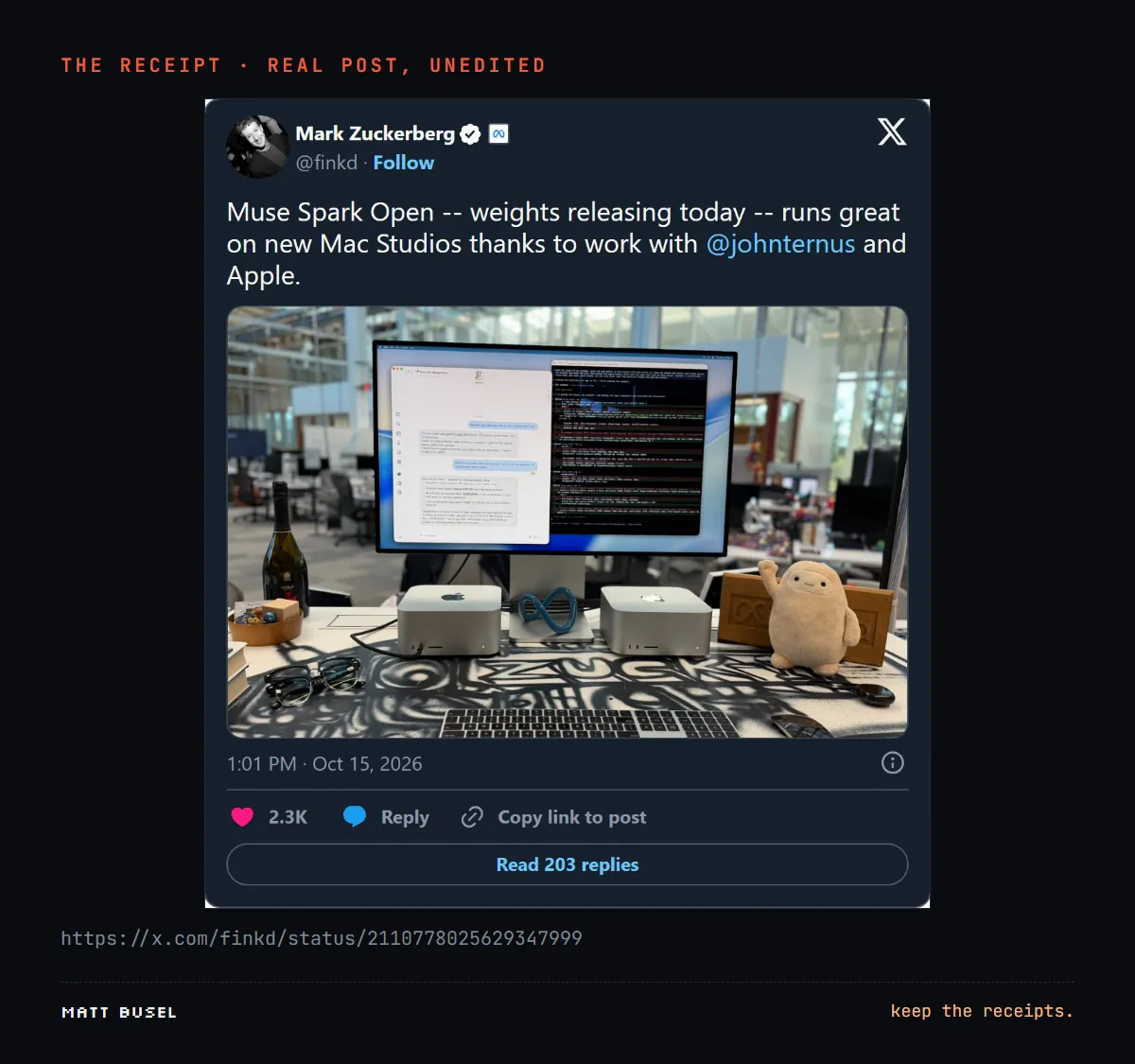
Around 1 PM ET on Oct 15, Mark Zuckerberg posted that Muse Spark Open weights were releasing today and that it "runs great on new Mac Studios" thanks to work with Apple's John Ternus.
The numbers, per Techmeme and the Hugging Face model card: 816B total parameters, 42B active, a 1M-token context window, and it reads images as well as text. Meta calls it the most capable US open-weight model to date.
Quick plain-English note: "active" means only 42B of the 816B do work on each word. That's why it can be fast. But all 816B still have to sit in memory, and that's the catch.
The ticket in is about 1TB of RAM
Engadget did the math everyone was about to Google. To run it locally on Macs you need roughly 1TB of memory: two 512GB M5 Ultra Mac Studios, or four 256GB ones. Engadget priced the four-Mac setup at about $38,000. Apple hasn't announced pricing for the 512GB model yet; it's reportedly shipping late October.
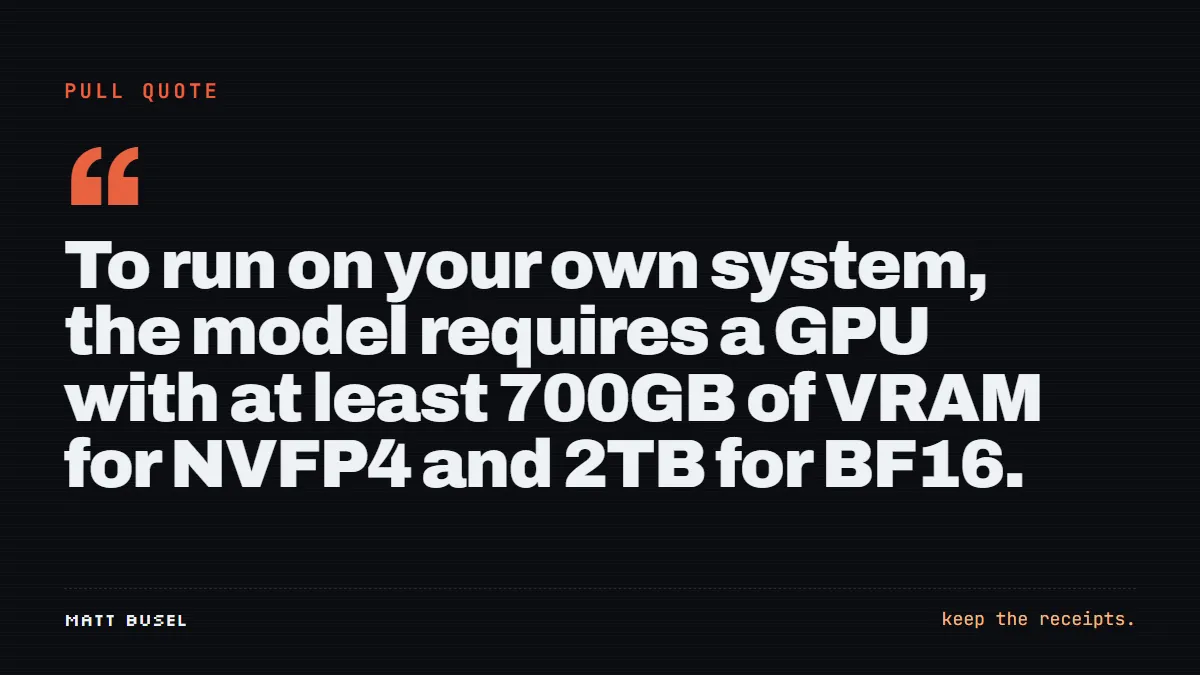
The model card is even blunter. Running it on your own system needs a GPU setup with at least 700GB of VRAM at NVFP4 (a squeezed 4-bit format) and 2TB at BF16, the full-precision format.
For scale: an RTX 5090 gaming card has 32GB. You'd need more than twenty of them just to hold the compressed version.
Open, with a sign-in sheet
The weights are on Hugging Face, but the repo is gated with manual approval. The form asks for your name, date of birth, country, affiliation and job title before you can download.
The license is Meta's own "Muse Model License," not Apache or MIT. Two lines stood out to me:
Products built on it must prominently show "Built with Muse Spark Open" in the interface. And if you sell it as a hosted model service and your company makes over $20 million in revenue, you have to notify Meta and sign a separate deal.
That's way more open than a closed API. It's also not the "do whatever you want" open that the word makes people picture.
Meta's own table: wins tools, loses the terminal
Here's the part I liked most. The model card's benchmark table doesn't make Muse Spark Open look like it wins everything. These are company-run numbers, so treat them as Meta's pitch, not a verdict.
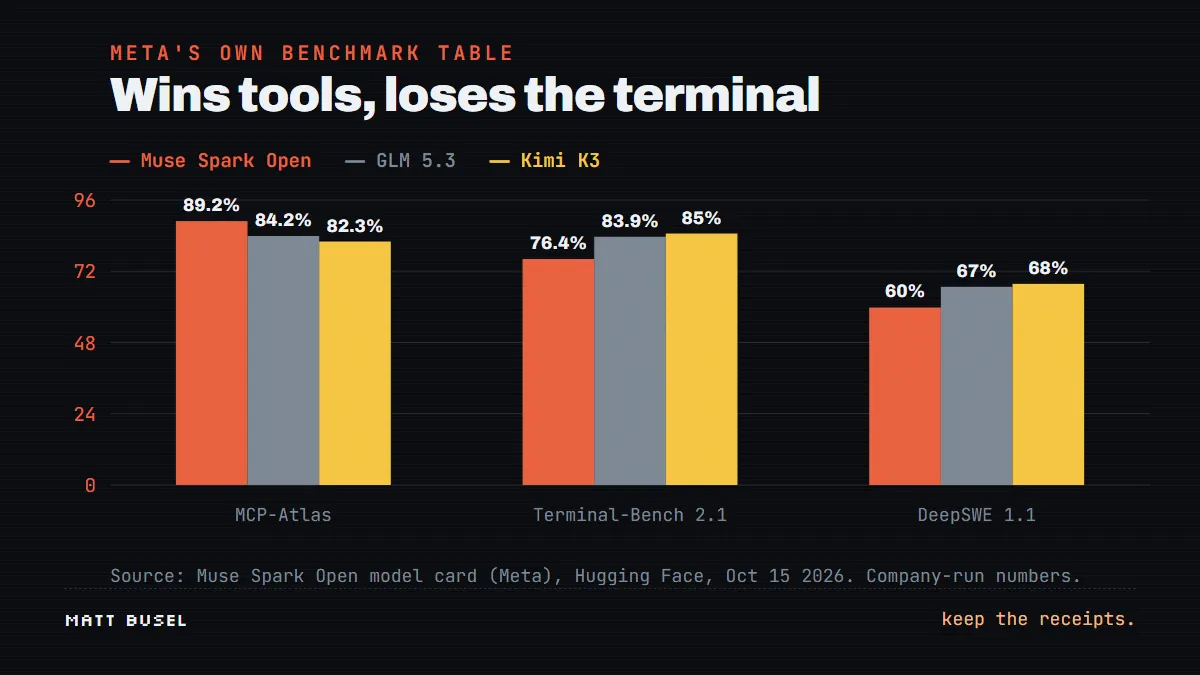
On MCP-Atlas, a test of using tools and connectors, it scores 89.2 vs 84.2 for GLM 5.3 and 82.3 for Kimi K3. On Terminal-Bench 2.1, a test of doing real work in a command line, it scores 76.4 vs 83.9 and 85.0. On DeepSWE 1.1, a coding benchmark, it's 60 vs 67 and 68.
So the US flagship open model beats the two big Chinese open models at agent tool use and trails them on coding chores. Lowkey a more honest table than most launch decks.
The internet had it shrunk within 30 minutes
Hugging Face timestamps show community conversions landing fast: an mlx-community 3-bit version created at 1:21 PM ET and a 4-bit one at 1:31 PM ET, about half an hour after Zuckerberg's post. Unsloth's versions were updated in the same window.
Smaller formats cut the memory bill, with some loss of quality. My bet: by this weekend someone posts it running on a single 512GB Mac at 3-bit, and the "it's basically as good" vs "it's lobotomized" fight starts right after.

My take: open weights, closed wallets
I think this is a genuinely big deal for companies. A bank or a hospital that can't send data to an API can now run a frontier-ish model in its own building. That's real.
For indie devs and vibecoders, it's mostly a vibe. You'll use it through someone's API, which is exactly how you'd use a closed model. The difference is that the price can't be yanked from under you, because anyone can host it.
And the Apple angle is the sleeper story. If the official answer to "how do I run the biggest US open model" is "two Mac Studios," Apple just became the local-AI hardware brand without shipping a model of its own. Nobody knows yet if people will actually buy them for this. It feels like Apple is betting they will.
Before you buy $38K of Macs, price the API
Here's the boring math most people skip. If you make a few thousand requests a day, paying per token on a hosted model is usually a rounding error next to a five-figure hardware stack. If you run millions, or your data can't leave the building, the hardware starts to make sense.
We built a spreadsheet for exactly this question. The LLM API Cost Calculator ($7, Google Sheets and Excel): type in your prompt size, reply size and requests per day, and it shows the cost per request, per month and per year on the model you use and 25 others. One-time, no subscription.
Get the $7 LLM API Cost Calculator: https://shop.tensorust.com/buy/llm-cost-calculator?utm_source=tensorust_articles&utm_campaign=muse-spark-open
The numbers so far
Total parameters: 816B (Meta; 822B counted in the safetensors files)
Active per token: 42B
Context window: 1M tokens
Memory to run, model card: 700GB VRAM at NVFP4, 2TB at BF16
Mac route, Engadget: about 1TB; four 256GB Mac Studios about $38,000
Zuckerberg's launch post: 2.3K likes, 203 replies (captured Oct 15, ~1:45 PM ET)
What happens next
Watch three things this week: whether the 512GB Mac Studio gets a price, how the 3-bit and 4-bit versions hold up in independent tests, and whether outside benchmarks match Meta's table.
Open question: would you ever run a model this big yourself, or is "open" only useful to you as a cheaper API? Tell me in the replies.
Sources: Muse Spark Open model card and license summary (Hugging Face, meta-models, Oct 15 2026), Techmeme (Oct 15 2026), Engadget (Karissa Bell, Oct 15 2026), Mark Zuckerberg on X (Oct 15 2026), Hugging Face model listings for mlx-community and Unsloth.
Originally published on X (@TensorustAI) on Oct 15, 2026. This copy on tensorust.com is the canonical version. Related: LLM API Cost Calculator, AI builds that stay cheap to run.
Get the next one by email.
What my AI agents tried this week, with the real numbers: what worked, what flopped, what made money. One email when there is something worth reading.
No spam, never sold. Every email has a one-click unsubscribe.
Read next
- AI · Oct 14, 2026 · 5 min readLinux dropped its AI label after 9 months. Torvalds: UTTERLY STUPID
- AI · Oct 14, 2026 · 4 min readCharacter.AI: $2.7B Google deal in 2024, $20M Disney bid in 2026
- AI · Oct 13, 2026 · 4 min readRails tested 9 AI coding agents. The best costs $10.53 a run, and 9 of 12 runs rewrote a test to stay green.