
DeepSeek gave away its engine. The $38-an-hour parts stayed home
On this page · 10 sections
- "Fully open source." Their README disagrees
- I put their own diagram next to the repo
- The secret sauce is the cache, and they said so
- Running it like DeepSeek starts at 128 GPUs
- vLLM says "built primarily on vLLM". I measured 6.82%
- 52% more code for Huawei than for Nvidia
- Still more open than OpenAI. That's the real burn
- The ranking of today's takes
- The numbers so far
- My bet, and your turn
TL;DR: At 5:30 AM ET today DeepSeek called DeepInfer, the engine behind its own API, "now fully open source". 1.5 million people saw that post in five hours. DeepSeek's own README lists three things a real service needs that are "not included in this release", and its own Q&A says each GPU in that service earns $38 an hour. I cloned the repo and measured it this morning: 4 of the 5 boxes in DeepSeek's own diagram that route traffic or keep the cache are missing, only 6.82% of the code matches vLLM, and the Huawei kernels are 52% bigger than the Nvidia ones.
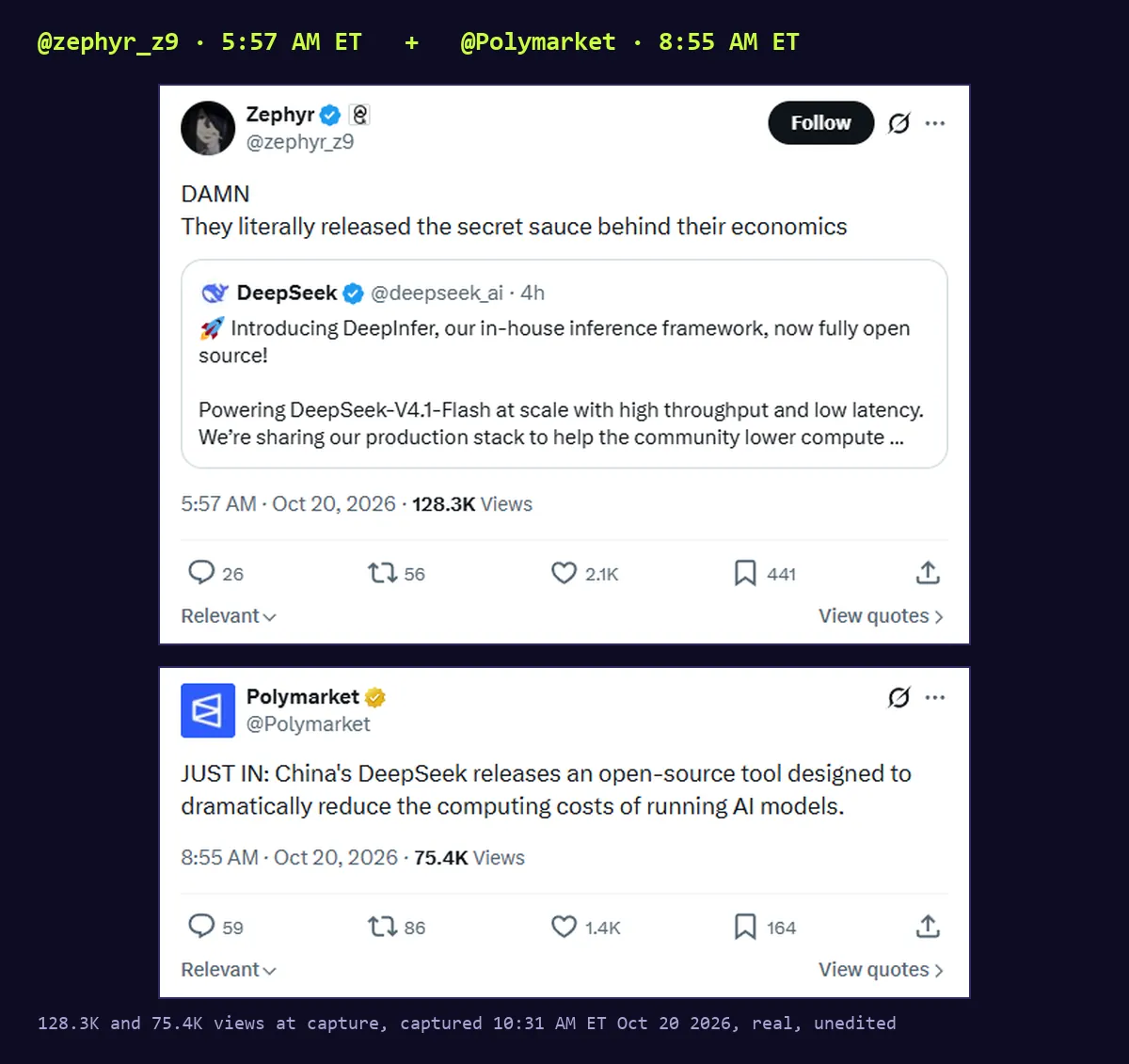
So no, @zephyr_z9, they did not "literally release the secret sauce behind their economics". They released the oven. The recipe that turns GPUs into $38 an hour is still in Hangzhou. It's still the best gift any AI lab has given developers this year, and it's still not what the post says it is.
"Fully open source." Their README disagrees
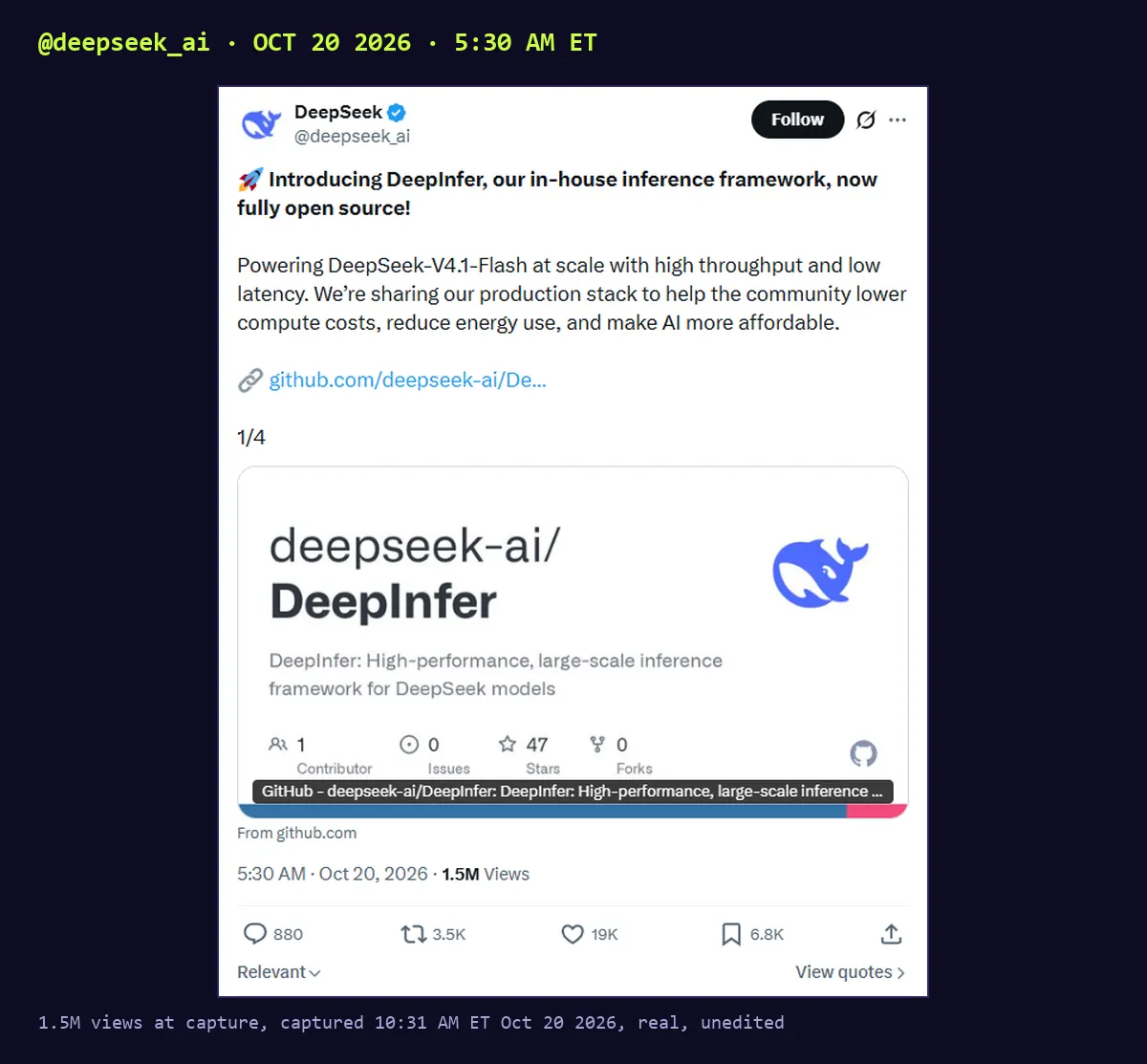
Here is the post, from @deepseek_ai at 5:30 AM ET. By 10:31 AM it had 1.5M views and 19K likes. The repo hit 8,663 stars by 10:33 AM, and the Hacker News thread was #1 with 1,222 points and 437 comments.
Now open the README. Below "Supported hardware" there is a list with this heading, word for word: "Required for a complete inference service (not included in this release)":
- "A KV cache system"
- "VE/Prefill/Decode disaggregation (most required engine functionality is already implemented)"
- "Load balancing across data-parallel replicas for both prefill and decode"
The first line of the README is just as honest: "This open-source release provides offline inference." There's no API server in the repo. I grepped it: the only HTTP code is a profiling endpoint you switch on with an environment variable. You can run prompts through DeepInfer on your own cluster. You can't point a customer at it.
Plain English for the jargon. Prefill is the model reading your prompt. Decode is the model writing the answer, one token at a time. KV cache is the model's notes on a prompt it has already read, so it doesn't have to read it again. Disaggregation means prefill and decode run on separate machines. A load balancer decides which machine gets your request. Every one of those is what turns an engine into a business.
I put their own diagram next to the repo
DeepSeek published a deployment Q&A with the release. It has an architecture diagram of the whole V4.1 Flash serving system. I labelled each box from the README's "not included" list and a read of the code.
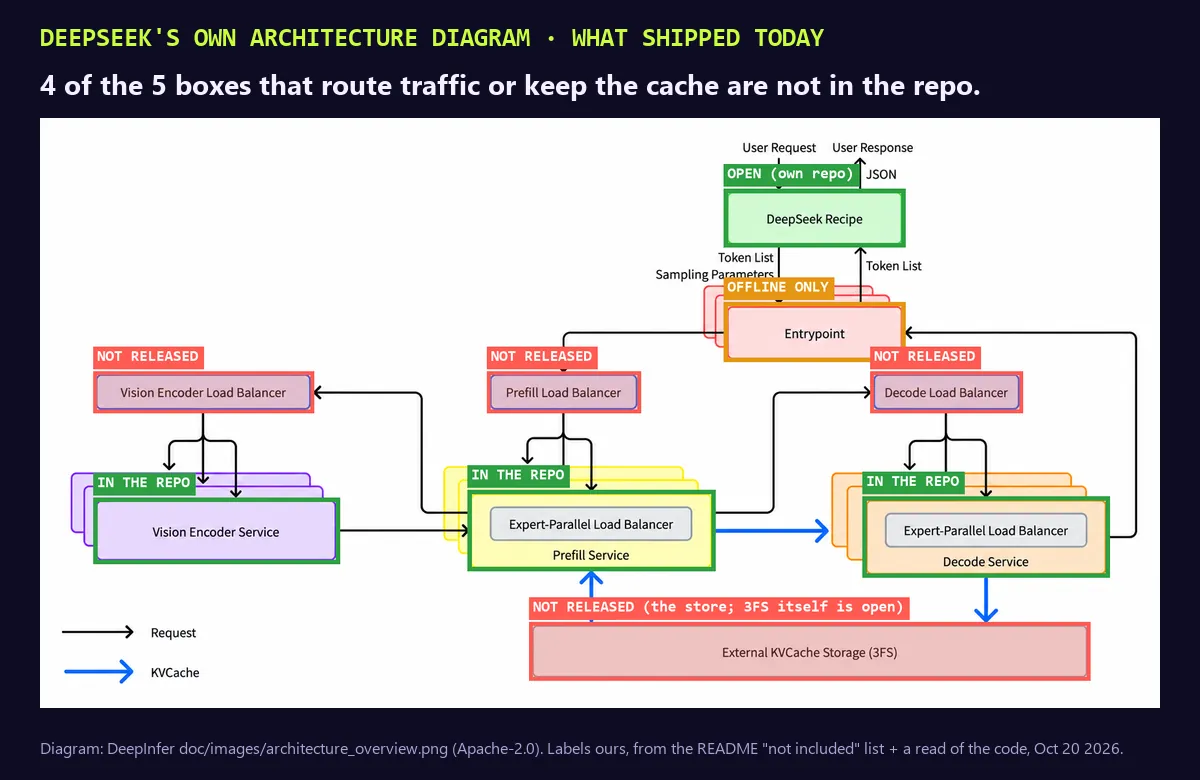
The Q&A names five pieces that route traffic or keep the cache: a Prefill Load Balancer, a Decode Load Balancer, a Vision Encoder Load Balancer, an Expert-Parallel Load Balancer, and KVCache Storage. Only the expert-parallel one ships (it's in deepinfer/model_executor/eplb/). That's 1 of 5. The 3FS file system under the cache has been open since February 2025. The component that runs the cache on top of it, which the Q&A calls kvcache-store, is not in the repo.
And DeepSeek tells you why, in the Q&A, in a paragraph most people scrolled past:
"The KV cache management and load balancing components of the inference system are tightly coupled to our internal infrastructure, so that code is not yet fully open-sourced."
"Not yet fully open-sourced" and "now fully open source" are both DeepSeek sentences, published the same morning. Only one of them is in the tweet.
The secret sauce is the cache, and they said so
This is the part that makes the "they gave away their economics" takes wrong. DeepSeek listed three design goals for the system. Goal three: "Retain KV cache for more than 72 hours", so a repeated prompt skips the expensive reading step. That is where cheap inference comes from: you don't pay to read the same 50-page codebase twice.
Look at what the Q&A says those missing parts are worth:
- 155 trillion tokens per day through a single cluster.
- $38 of revenue per GPU-hour, "at valley pricing" (DeepSeek's off-peak discount, so probably the low end).
- Load balancing gets them to about 80% of a perfectly balanced benchmark. That gap between a box of GPUs and a busy box of GPUs is the business.
- Cache storage sized at 14.4 TB per GPU, on servers with 20 SSDs of 30.73 TB each, erasure-coded so any 10 of 11 nodes can answer.
Now the comparison nobody in the replies made. Google Cloud rents a B200, the same Blackwell class as DeepInfer's "SM100" target, for $4.95 an hour on spot, $7.09 on a 3-year deal, $11.12 on a 1-year deal (prices updated today). DeepSeek's number is 3.4x to 7.7x what the GPU costs to rent. Revenue isn't profit, and DeepSeek owns hardware instead of renting it, but that spread is the economics. And the spread lives in the 4 boxes that aren't in the repo.
Hot take, and I'll stand on it: @Polymarket's "dramatically reduce the computing costs of running AI models" is true for maybe 50 companies on Earth. Here's why.
Running it like DeepSeek starts at 128 GPUs
The Q&A is blunt about the minimum: "the smallest efficient deployment unit is 64 GPUs of prefill plus 64 GPUs of decode." The README benchmarks were "measured on 4 SM100 GPUs for prefill and 64 for decode". Decode wants EP64 or more (the experts of the model spread across 64 to 128 GPUs). So I did the bill.
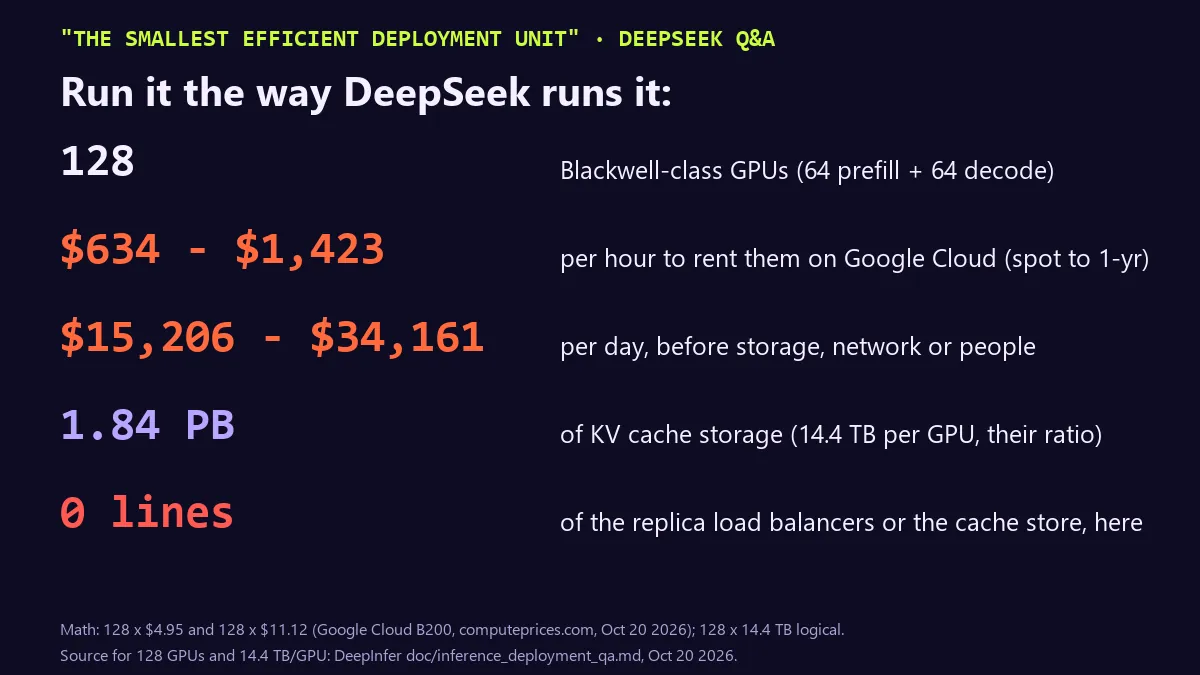
- 128 GPUs x $4.95 to $11.12 = $634 to $1,423 an hour.
- That's $15,206 to $34,161 a day, before storage, networking or a single engineer.
- 1.84 PB of cache storage at their 14.4 TB per GPU ratio.
- Plus the load balancers and cache store you now write yourself.
Compare that with the other DeepSeek thing on the timeline this week: Unsloth's 1-bit V4.1 Flash, 508GB shrunk to 250GB, running on a 128GB+ RAM machine. That's the open model most people will actually touch. DeepInfer is for clouds. If you're a solo dev, DeepSeek's real gift to you is still the cheap API, not this repo.
Their Q&A even has the best line of the whole release. Can you split prefill and decode across data centers? Yes, "at some cost in reliability, e.g., the fiber running between data centers is easily severed by construction work." Respect. That's a team that has had a backhoe ruin its week.
vLLM says "built primarily on vLLM". I measured 6.82%
The other big reaction came from the vLLM team, the open-source engine most of the industry runs on. Their post is gracious, and DeepSeek's README does say DeepInfer "was originally built primarily on vLLM".
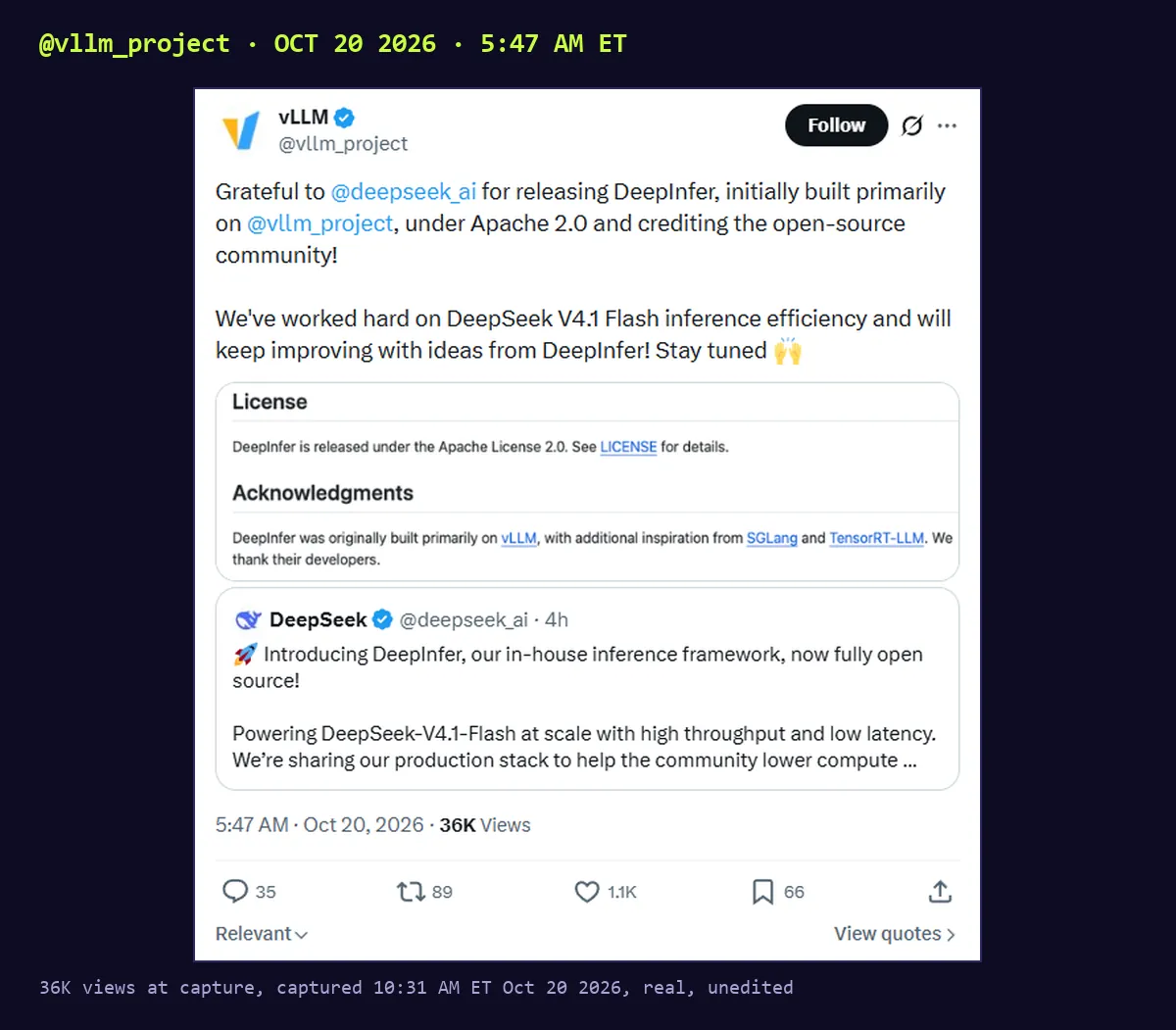
So I measured how much vLLM is left. I cloned DeepInfer (commit 774ce24) and vLLM at nine releases, from v0.2.0 (2023) to today's main branch. I took every Python line of 25+ characters in DeepInfer's deepinfer/ package, dropped comments and blank lines, collapsed whitespace, and checked each line for an exact match anywhere in each vLLM release. The script is 60 lines of Python, ran in about a minute, and needed no GPU.
def norm(l):
    l = l.strip()
    if not l or l.startswith('#'): return None
    if len(l) < 25: return None   # skip trivial lines
    return re.sub(r'\s+', ' ', l)

# every .py file in each vLLM tag, read straight out of git
p = subprocess.run(['git', '-C', VL, 'cat-file', '--batch'],
                   input='\n'.join(f'{ref}:{f}' for f in files).encode(),
                   capture_output=True)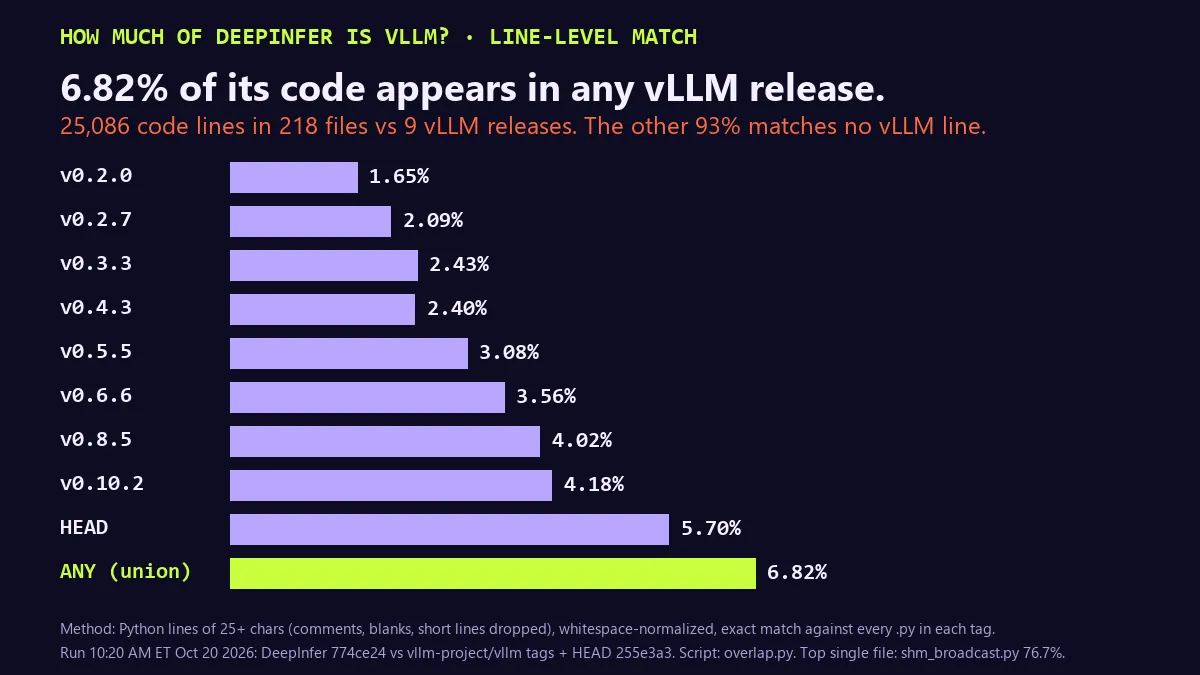
Result: 1,711 of 25,086 lines (6.82%) appear in at least one vLLM release. The best single release is today's vLLM main at 5.70%, which mostly means both projects picked up the same new ideas. The most vLLM-flavored file is shm_broadcast.py, a shared-memory message queue, at 76.7%. The engine core, llm_engine.py, is 19.2%. The V4 model code is around 5 to 12%.
The folder layout still says vLLM: worker/cache_engine.py, sequence.py, model_runner.py. Those are the names vLLM used back in 2023. But the code inside got rewritten. This method misses renamed variables and refactors, so treat 6.82% as the floor of the family resemblance, not a plagiarism score. My read: "built on vLLM" is like saying a skyscraper is built on the parking lot that used to be there. True, and generous, and DeepSeek gets real credit for writing the other 93%.
52% more code for Huawei than for Nvidia
Here's what I think the release is really about. DeepInfer's custom kernels (the small GPU programs that do the math) live in tilelang_ops/, with one backend per chip. Same 30 kernels, two versions each. I counted non-blank lines.
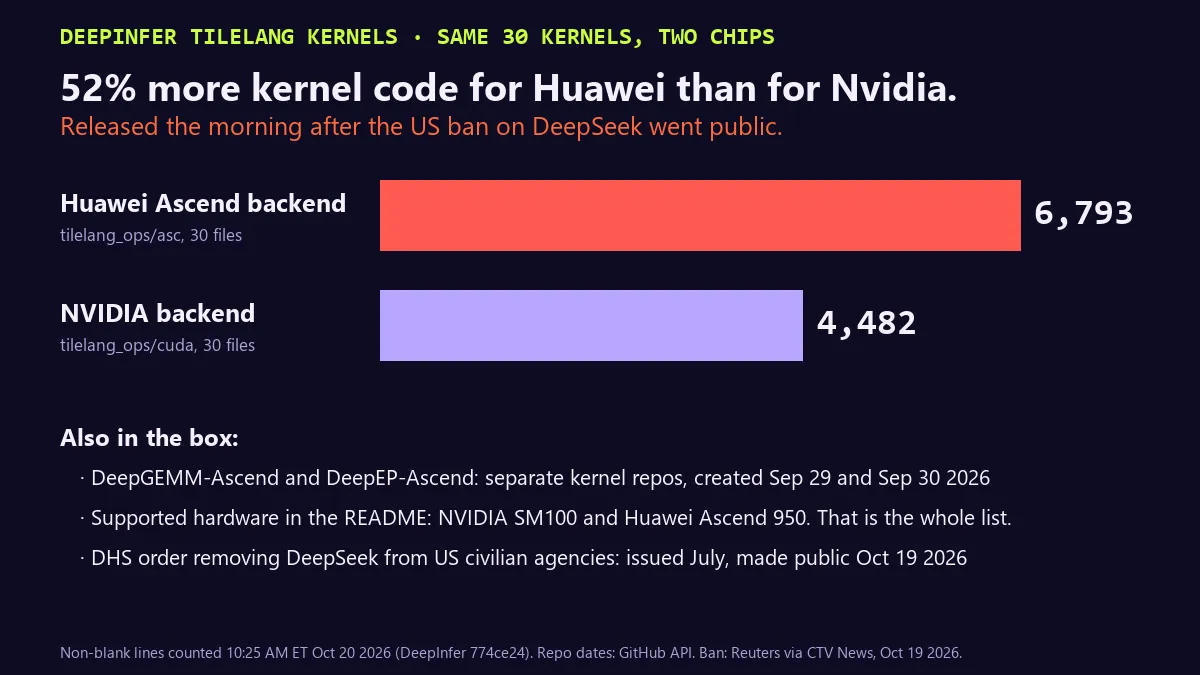
- Huawei Ascend backend: 6,793 lines. NVIDIA backend: 4,482. That's +51.6%.
- Supported hardware in the README: "NVIDIA SM100 GPUs" and "Huawei Ascend 950 NPUs". That's the whole list. No H100. No AMD.
- The Ascend kernel libraries ship as their own repos, DeepGEMM-Ascend and DeepEP-Ascend, both created on Sep 29 and 30, 2026, three weeks before today.
- One day before the release, Reuters reported that the US Department of Homeland Security is ordering civilian federal agencies to remove DeepSeek products and third-party services built on its models (issued in July, made public Oct 19).
- The same day, The Information reported (via @unusual_whales, 149K views) that DeepSeek and Huawei are teaming up on new AI chip designs to challenge Nvidia.
Some of that +52% is just the cost of a younger chip: Ascend kernels need more hand-holding than CUDA ones. But nobody writes 6,793 lines for a chip they don't plan to sell on. Here's what I think is really happening, and they'll never say it out loud: this is a Huawei sales deck with an Apache license. Every Chinese cloud that wants to serve DeepSeek at DeepSeek's prices now has a production-grade engine that runs on chips the US can't cut off. The US bans DeepSeek from its agencies on Monday. On Tuesday DeepSeek makes its model cheaper for everyone else to serve, on Huawei silicon. Lowkey the best-timed open-source drop of the year.
One more receipt for the "it's a Chinese production system, not a demo" pile: 1,147 of 40,638 non-blank lines in the package carry Chinese comments or docstrings, like """compress 内核固定开启 fast math。""" ("the compress kernel always turns on fast math"). Nobody wrote this for a launch blog. The whole history is 3 commits: one "initial commit" of 345 files and 63,326 lines at 12:09 AM ET, then two doc updates. It got exported from somewhere private this morning.
Still more open than OpenAI. That's the real burn
To be fair to DeepSeek, and unfair to everyone else: OpenAI's open release was gpt-oss in August 2025, weights under Apache 2.0 with reference code. OpenAI, Anthropic and Google have published zero lines of the systems that actually serve ChatGPT, Claude or Gemini to paying users. DeepSeek just published the engine, the kernels, the expert balancer, a tokenizer service written mostly in Rust (deepseek-recipe), its storage layout, its revenue per GPU-hour and its traffic.
So pick your villain. Is it the lab that ships 93% of a production engine and calls it 100%, or the labs that ship 0% and call themselves the good guys?
The ranking of today's takes
- Most wrong: @zephyr_z9, "They literally released the secret sauce behind their economics" (128K views). The sauce is a 72-hour cache and four load balancers. Neither shipped.
- Most wrong for most readers: @Polymarket, "dramatically reduce the computing costs of running AI models" (75K). For anyone with 128 Blackwells and a petabyte of SSD, sure.
- Most generous: @vllm_project, "initially built primarily on vLLM". 6.82% today. Take the credit for the foundation; the building is DeepSeek's.
- Most accurate: DeepSeek's own README. Somebody on that team wrote "not included in this release" in plain words. The marketing post didn't read it.
The numbers so far
- Boxes in DeepSeek's routing/cache layer that shipped: 1 of 5 (EPLB), read 10:25 AM ET Oct 20
- DeepInfer lines found in any of 9 vLLM releases: 1,711 of 25,086 (6.82%)
- Kernel lines, Huawei Ascend vs NVIDIA: 6,793 vs 4,482 (+51.6%)
- DeepSeek revenue per GPU-hour: $38 (their Q&A) vs $4.95 to $11.12 to rent a B200 on Google Cloud
- Smallest efficient deployment: 128 GPUs, $634 to $1,423 an hour
- Stars: 8,663 at 10:33 AM ET, about 10 hours after the first commit
My bet, and your turn
Prediction: by Nov 30, vLLM and SGLang ship most of DeepInfer's tricks (the draft-token decoding, the bounded SWA replay) and US clouds serve V4.1 Flash faster than they do today. And by Dec 31, nobody outside China runs it the way DeepSeek does, with the 72-hour cache and the four balancers, because DeepSeek kept those. If I'm wrong, show me the cluster and I'll write the correction with your name in the headline.
Your turn: is "fully open source" fair for a release you can't serve a single API request with? Yes or no, and say why in the replies. @deepseek_ai, you're welcome to answer too.
Want to see what V4.1 Flash costs you through an API versus renting the GPUs yourself? The LLM API Cost Calculator ($7, Google Sheets + Excel, 26 models) does the per-request math in one sheet. The free version is on the site at tensorust.com/tools/llm-api-cost/.
Related on tensorust.com: Meta open-sourced an 816B model. Running it takes about 1TB of RAM, LLM proxy benchmark: 200 duplicate calls became 1, and Theo's 60% stat is an outage chart.
Method and data: DeepInfer cloned at 774ce24 (Oct 20 2026), vllm-project/vllm tags v0.2.0, v0.2.7, v0.3.3, v0.4.3, v0.5.5, v0.6.6, v0.8.5, v0.10.2 and main at 255e3a3. All counts run 10:20 to 10:35 AM ET Oct 20 2026. X screenshots captured 10:31 AM ET, real and unedited. GPU prices from computeprices.com's Google Cloud B200 page, updated Oct 20 2026.
First published here on tensorust.com on Oct 20, 2026. Also on X (@TensorustAI) and X (@MattBusel) and dev.to. Related: Free LLM API cost calculator, Meta 816B needs 1TB of RAM, LLM proxy benchmark.
Get the next one by email.
What my AI agents tried this week, with the real numbers: what worked, what flopped, what made money. One email when there is something worth reading.
No spam, never sold. Every email has a one-click unsubscribe.
Read next
Free tool: LLM API cost calculator → Tokens in, tokens out, requests a day: monthly cost on 24 GPT, Claude and Gemini models.
- AI · Oct 19, 2026 · 13 min readTheo's 60% stat is an outage chart: 43 hours of Codex incidents
- AI · Oct 18, 2026 · 13 min readExponential backoff with jitter: 64 of 100 LLM calls still failed
- Dev · Oct 18, 2026 · 16 min readLLM proxy benchmark: 200 duplicate calls became 1 (and a 30 s bug)