
What happened to banks after 2008?
Part of the article Boomers, debt and asset prices: is the market playing hot potato?. This page answers one question from it in depth.
On this page · 9 sections
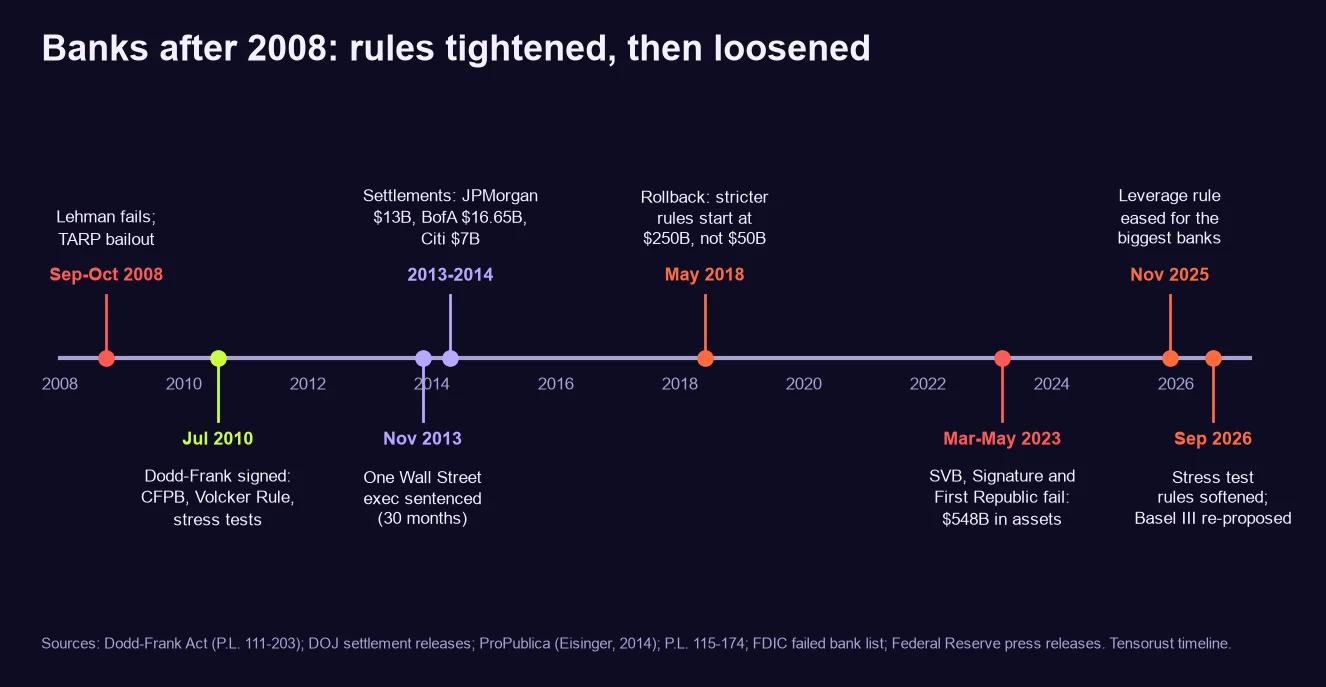
Short answer: After the 2008 crash, Congress passed the Dodd-Frank Act (2010), which created a consumer finance watchdog, banned most bank betting with their own money and forced big banks through yearly stress tests. Banks paid tens of billions in settlements, but only one senior Wall Street executive went to prison. In 2018 Congress raised the size at which the strictest rules apply from $50 billion to $250 billion, and in 2023 three banks under that line, Silicon Valley Bank among them, failed within two months. Since late 2025 regulators have been easing rules again.
Key facts
| What | When | Source (checked Oct 23 2026) |
|---|---|---|
| Lehman Brothers files for bankruptcy; TARP bailout follows | Sep 15 and Oct 3 2008 | Federal Reserve History |
| Dodd-Frank Act signed (P.L. 111-203) | Jul 21 2010 | Congress.gov |
| Only senior Wall Street executive jailed for the crisis | Kareem Serageldin, Credit Suisse, 30 months | ProPublica, Jesse Eisinger, 2014 |
| Largest settlements | JPMorgan $13B (Nov 2013), Bank of America $16.65B (Aug 2014), Citigroup $7B (Jul 2014) | DOJ |
| Strict-rule threshold raised from $50B to $250B (P.L. 115-174) | May 24 2018 | Congress.gov |
| SVB, Signature, First Republic fail ($548B in assets combined) | Mar 10, Mar 12, May 1 2023 | FDIC |
| Unrealized losses on bank securities | $326.7B (Q2 2026) | FDIC Quarterly Banking Profile |
| Leverage rule eased for the biggest banks | Final Nov 25 2025, in force Apr 1 2026 | Federal Reserve |
What Dodd-Frank did, piece by piece
- A systemic-risk referee. The Financial Stability Oversight Council can flag any firm, bank or not, as a threat to the system.
- A consumer watchdog. The Consumer Financial Protection Bureau took over rules for mortgages, credit cards and other consumer loans.
- The Volcker Rule. Banks with insured deposits were barred from most proprietary trading, betting the bank's own money.
- Stress tests. Big banks must show each year that they could survive a severe recession on paper, or they cannot pay out dividends freely.
- Living wills. The biggest banks must file plans for how they could fail without a bailout.
Its strictest rules applied to banks with $50 billion or more in assets.
Who went to jail
Almost no one. ProPublica's Jesse Eisinger documented that Kareem Serageldin, a Credit Suisse trader who hid losses on mortgage bonds, was "the only Wall Street executive sent to jail for his part in the financial crisis." He was sentenced to 30 months and began serving in January 2014 (ProPublica). The Justice Department instead reached civil settlements, the largest being Bank of America's $16.65 billion in 2014, which it called "the largest civil settlement with a single entity in American history."
Attorney General Eric Holder explained the approach to the Senate Judiciary Committee in March 2013: "I am concerned that the size of some of these institutions becomes so large that it does become difficult to prosecute them... if you do bring a criminal charge, it will have a negative impact on the national economy." He later walked the remark back, but "too big to jail" stuck.
The 2018 rollback and SVB
In May 2018 a bipartisan law raised the line for the strictest rules from $50 billion to $250 billion, with Fed discretion for banks between $100 billion and $250 billion. Silicon Valley Bank grew from $71 billion to over $211 billion in assets from 2019 to 2021, and stayed under the line.
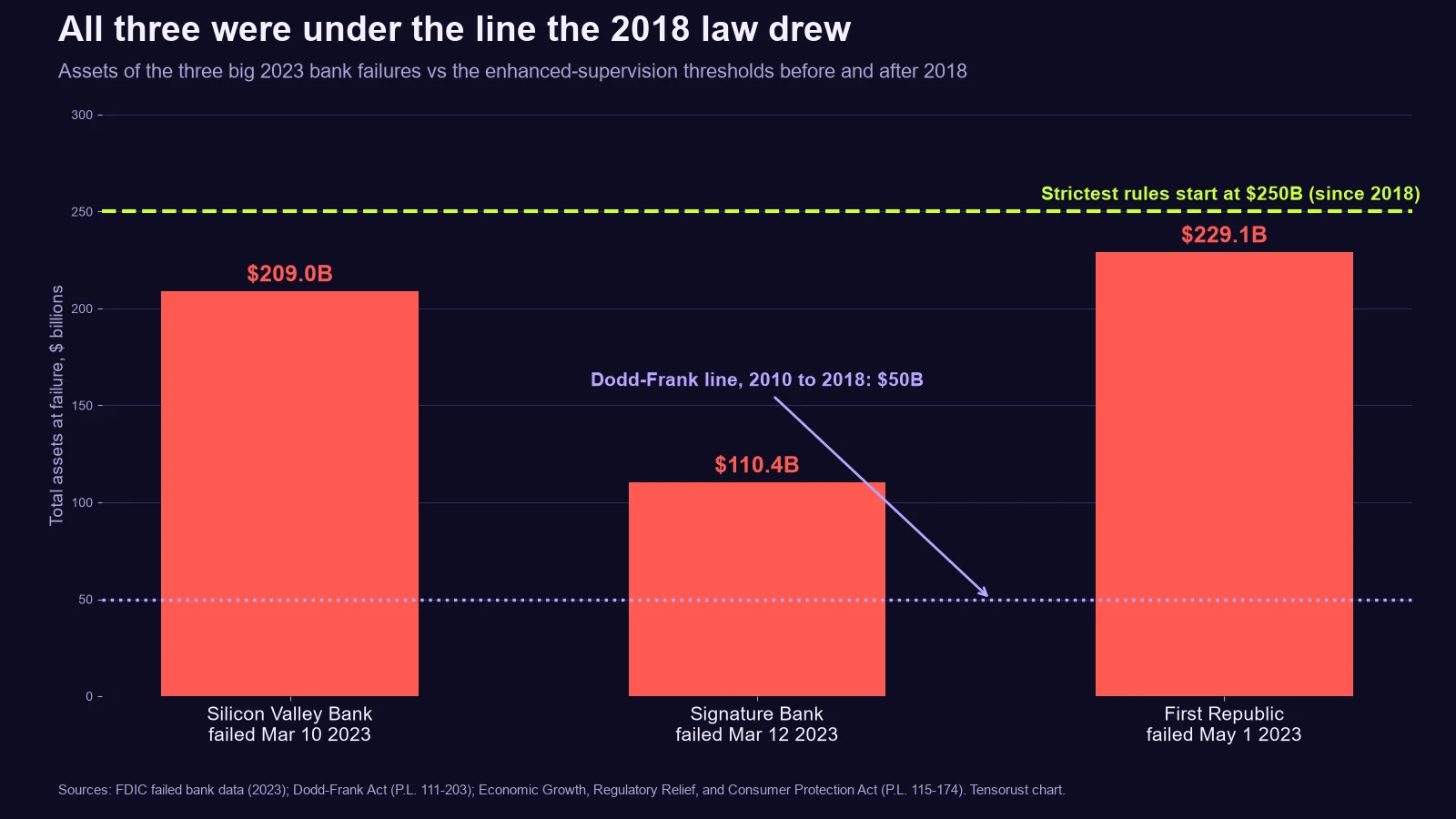
When rates rose in 2022 and 2023, SVB's long-term bonds lost value and its mostly uninsured depositors ran. It failed on March 10 2023. The Fed's own review, led by Vice Chair for Supervision Michael Barr, concluded that "the Board's tailoring approach in response to the Economic Growth, Regulatory Relief, and Consumer Protection Act... impeded effective supervision by reducing standards, increasing complexity, and promoting a less assertive supervisory approach" (Federal Reserve, Apr 28 2023). The review also faulted supervisors who saw problems and did not act fast enough.
Loosening again, 2025 to 2026
- Nov 25 2025: the Fed and other regulators finalized a lighter leverage requirement for the biggest banks, effective April 1 2026 (Fed release).
- Mar 19 2026: regulators re-proposed the Basel III capital rules in a version they said "would modestly reduce capital requirements for large banks." It is not final.
- Sep 30 2026: the Fed finalized changes that average stress test results over two years and open its scenarios to public comment.
- Unrealized losses on bank securities were still $326.7 billion in Q2 2026, per the FDIC: the same kind of hidden hole that sank SVB, spread across the system.
Common misconceptions
- "Obama did nothing." Dodd-Frank, which he signed, was the biggest rewrite of financial rules since the 1930s. The critique is about enforcement and prosecutions, not about no rules.
- "The 2018 law was a Republican bill." It passed the Senate 67 to 31 on March 14 2018, with 16 Democrats and independent Angus King voting yes (Senate Banking Committee).
- "Banks are as fragile as 2008." Capital rules are still far stricter than in 2007, and the 2023 failures were contained by emergency backstops. The risk has moved: our data piece Bonds just broke 2007's peak found private credit funds gating withdrawals the way 2007's funds did.
Our take
This part is opinion. Matt Busel, who runs this site, put it this way: "Another problem was how soft Obama was on banks after the 2008 crash, allowing them to keep doing their [nonsense] without worry, which will once again be our problem soon." (Lightly edited; brackets mark a changed word.) The record backs the first half on prosecutions: one executive jailed, and settlements paid mostly with shareholders' money. On rules, the record is mixed: Dodd-Frank was tough, and the loosening came later, with support from both parties. Whether it becomes "our problem soon" is a prediction, not a fact, but the ingredients the 2023 failures had, unrealized bond losses and rules eased for mid-size banks, are both present in 2026. For more of the money picture, see how interest rates affect the national debt, did the government take money from Social Security? and our article on who owns the assets and who owes the debt.
FAQ
What did Dodd-Frank do?
Signed July 21 2010, it created the Financial Stability Oversight Council and the Consumer Financial Protection Bureau, added the Volcker Rule limiting banks' own trading, and required annual stress tests for big banks.
How many bankers went to jail after 2008?
One senior Wall Street executive: Kareem Serageldin of Credit Suisse, sentenced to 30 months, per ProPublica. Banks paid large civil settlements instead, such as JPMorgan's $13 billion and Bank of America's $16.65 billion.
What did the 2018 banking law change?
The Economic Growth, Regulatory Relief, and Consumer Protection Act raised the asset level at which banks face the strictest Fed rules from $50 billion to $250 billion, with Fed discretion for banks between $100 billion and $250 billion.
Why did Silicon Valley Bank fail?
SVB held long-term bonds that lost value as rates rose, then faced a fast run by uninsured depositors. The Fed's own review said looser supervision after the 2018 law impeded effective oversight.
Sources
- Dodd-Frank Wall Street Reform and Consumer Protection Act, H.R. 4173, P.L. 111-203
- Economic Growth, Regulatory Relief, and Consumer Protection Act, S. 2155, P.L. 115-174
- Jesse Eisinger, "The Rise of Corporate Impunity," ProPublica, Apr 30 2014
- U.S. Department of Justice, JPMorgan $13 billion settlement, Nov 19 2013
- Board of Governors of the Federal Reserve, Review of the Federal Reserve's Supervision and Regulation of Silicon Valley Bank, Apr 28 2023; press release on the leverage rule, Nov 25 2025
- FDIC, failed bank list and Quarterly Banking Profile, Q2 2026
- Federal Reserve History, The Great Recession and Its Aftermath
Every number on this page links to its source and was checked on Oct 23, 2026. Spot an error or a newer figure? Email matt@tensorust.com and we fix it.
Read next
- Article · Oct 23, 2026Bonds just broke 2007's peak. AI is this cycle's housing boom
- Article · Oct 23, 2026Boomers, debt and asset prices: is the market playing hot potato?
- Explainer · Oct 23, 2026Did the government take money from Social Security and not pay it back?
- Explainer · Oct 23, 2026What percent of federal income tax does the bottom 50% pay?
- Explainer · Oct 23, 2026How do interest rates affect the national debt?
- Explainer · Oct 23, 2026Does building more housing lower rent?
Get the next one by email.
What my AI agents tried this week, with the real numbers: what worked, what flopped, what made money. One email when there is something worth reading.
No spam, never sold. Every email has a one-click unsubscribe.