
Did the government take money from Social Security and not pay it back?
Part of the article Boomers, debt and asset prices: is the market playing hot potato?. This page answers one question from it in depth.
On this page · 8 sections
Short answer: No, not in the way the claim usually goes. There is no record of the military, or anyone, taking trillions from Social Security and not paying it back. For decades Social Security collected more than it paid out, and by law it lent the surplus to the Treasury in exchange for interest-bearing bonds. The Treasury spent that cash on the rest of the budget, which is the true part of the story, but the bonds are legally binding and are being repaid, with interest, right now. The real problem is different: the retirement trust fund runs dry in late 2032.
Key facts
| What | Number | Source (checked Oct 23 2026) |
|---|---|---|
| Retirement (OASI) trust fund runs out | Late 2032, then 78% of benefits payable | 2026 Social Security Trustees Report |
| Retirement + disability funds combined | 2034, then about 83% payable | same |
| Trust fund reserves | $2,721B (start of 2025) to $2,561B (end of 2025) | Trustees Report highlights |
| 2025 income vs cost | $1,449B in, $1,609B out | same |
| Interest the trust funds earned in 2025 | $69B | same |
| What the funds hold | Special-issue Treasury bonds, sold only to the trust funds | SSA Trust Fund FAQ |
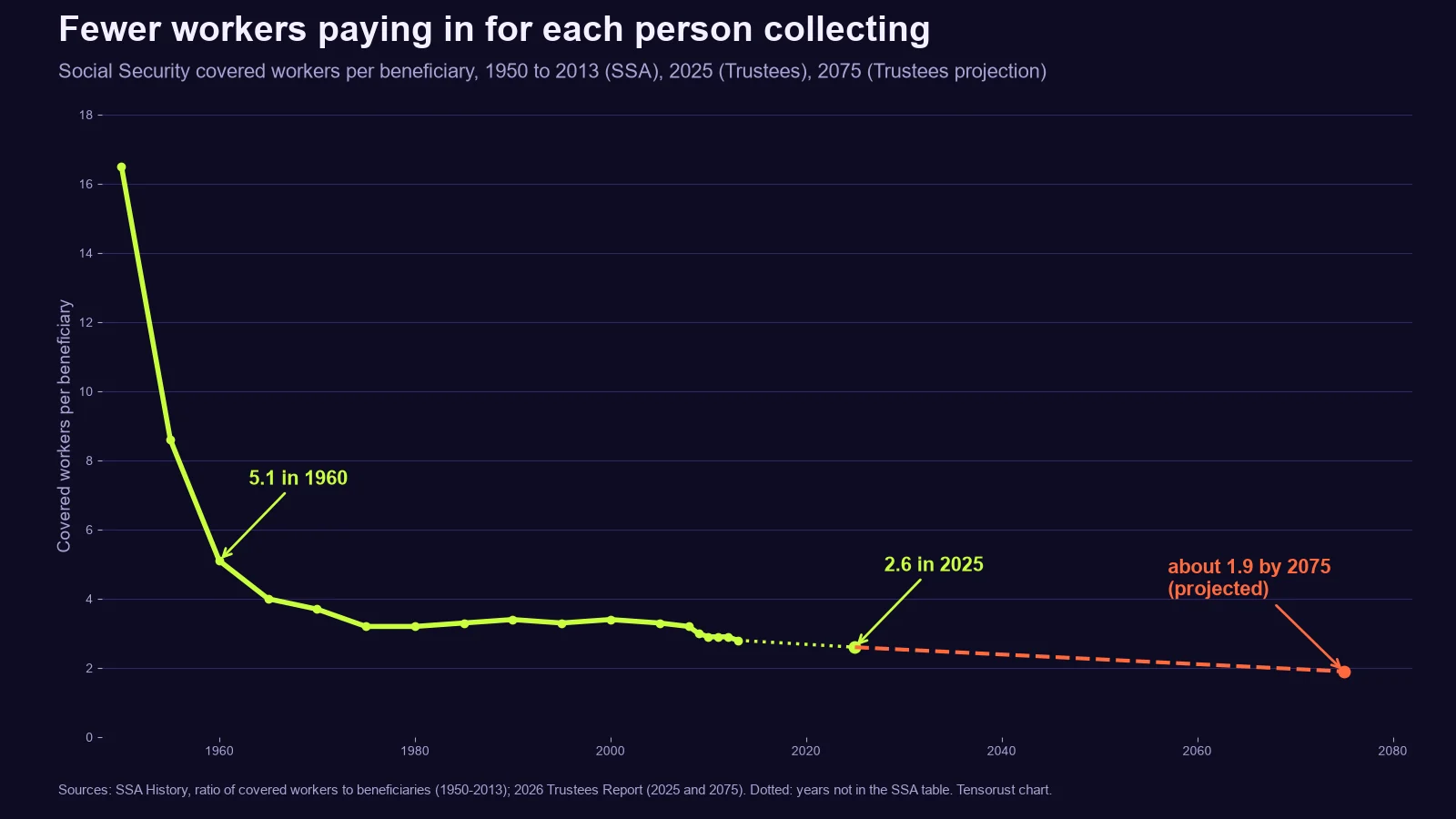
| Workers per beneficiary | 5.1 in 1960, 2.6 in 2025, about 1.9 by 2075 | SSA history, 2026 Trustees Report |
| 75-year shortfall | 4.42% of taxable payroll (3.82% a year earlier) | 2026 Trustees Report |
The claim, and the record
The claim, as Matt Busel, who runs this site, put it: "Social security has been known as a scam even when the boomers made [it]. It's well known that the US military took trillions from it back in the day and never paid it back. Pretty much the government double dips and takes from it all the time." (Quotes from Matt on this site are lightly edited for spelling; brackets mark changed words.) Here is each piece against the record.
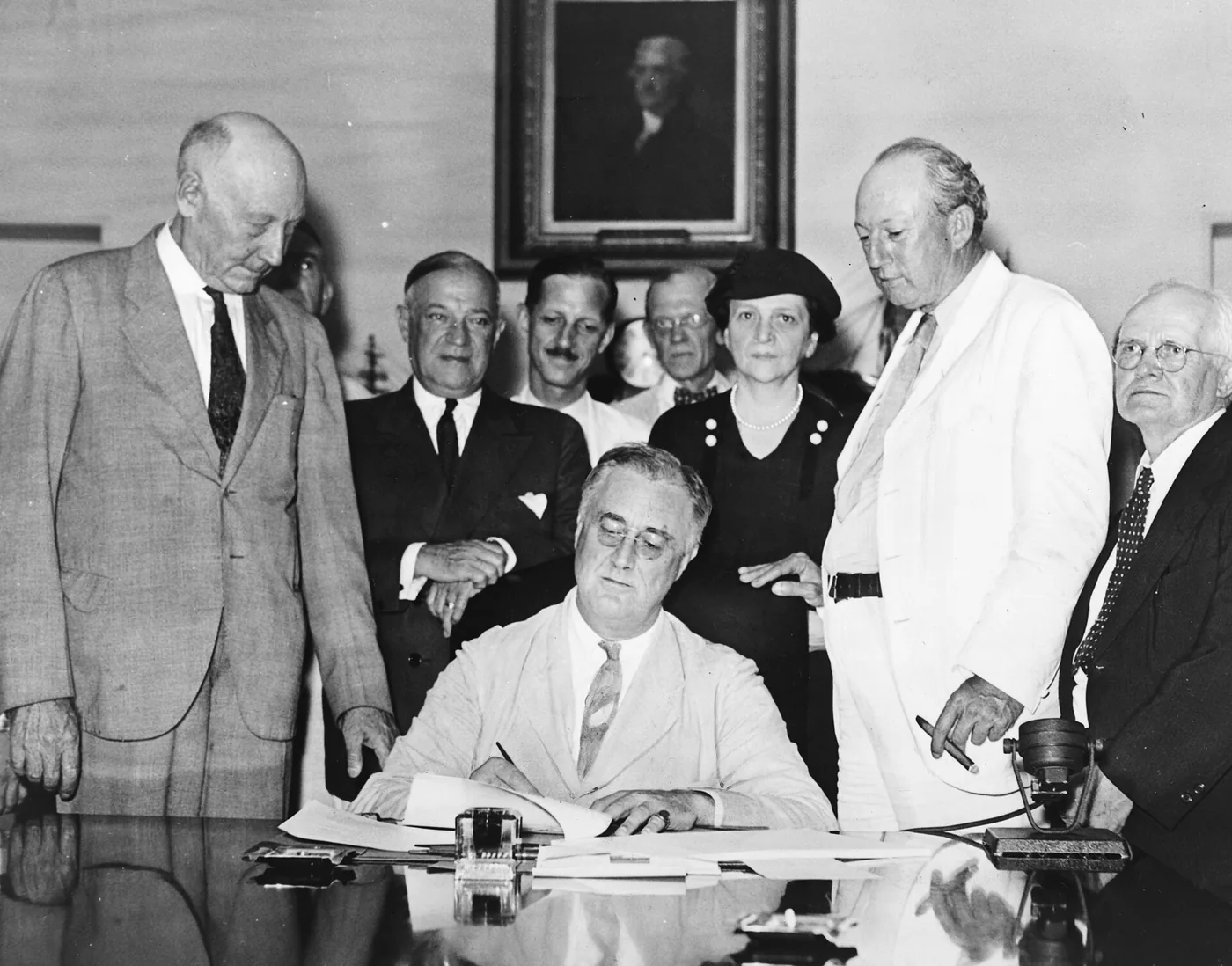
"The boomers made it." Not quite. Social Security was signed into law by Franklin Roosevelt in 1935, before any boomer was born (boomers were born 1946 to 1964). What their parents' generation did do, in the 1983 amendments, was raise payroll taxes on purpose to build a surplus for the boomers' retirement. A commission led by Alan Greenspan was set up because the retirement fund could have run out as early as August 1983 (SSA history).
"The military took trillions and never paid it back." We found no record of this, and no fact checker has found one either. The closest real claim is that presidents "borrowed" the surplus. PolitiFact's Linda Qiu rated a 2015 version, that George W. Bush "borrowed" $1.37 trillion of the surplus, Mostly False: the figure was closer to $708 billion, and the experts she asked said words like "borrow" and "raid" do not capture how the system works, because the cash was never earmarked for any one program (PolitiFact, Aug 3 2015).
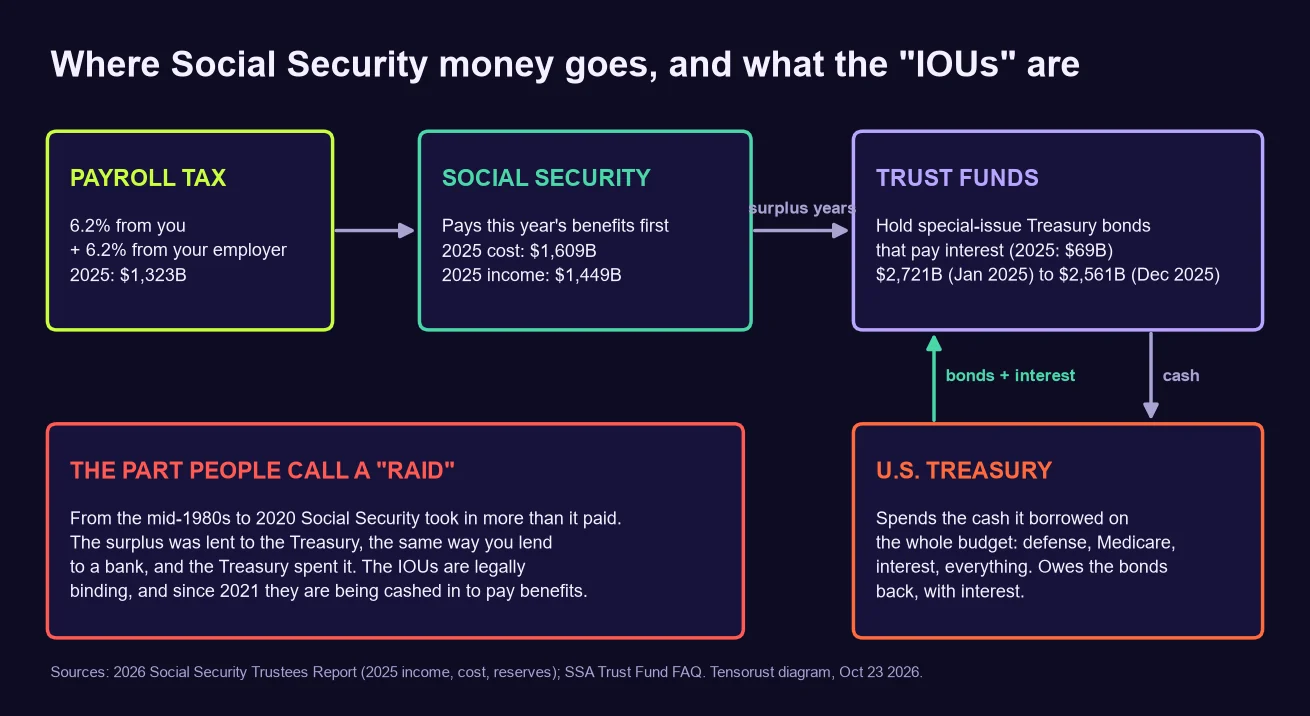
What is true. The surplus cash did go to the Treasury, and the Treasury did spend it, on everything the government buys, defense included. That is how the system was designed in 1939 and every year since. In return the trust funds got bonds. In SSA's own words: "All securities held by the trust funds are 'special issues' of the United States Treasury," and "the government has always repaid Social Security, with interest" (SSA Trust Fund FAQ).
Why it feels like a raid. Since 2021 Social Security's costs have been higher than its total income, so the Treasury has to come up with cash to redeem the bonds. It does that with taxes or new borrowing from the public. To a taxpayer, paying back money the government already spent can feel like paying twice. That is a fair complaint about how the federal budget works; it is not a theft from the program.
The 1969 "unified budget." Another version of the claim is that Lyndon Johnson put Social Security "on budget" in 1969 to spend it. The unified budget was an accounting change that showed the trust funds inside the overall deficit number; it did not move any money. Congress took Social Security back off budget in the 1983 law, effective 1993.
How it actually works, step by step
- You and your employer each pay 6.2% of wages, up to a cap, into Social Security. In 2025 that was $1,323 billion.
- That money pays this year's retirees and disabled workers first. It is mostly pay-as-you-go: today's workers fund today's retirees.
- Any surplus buys special Treasury bonds that earn interest (an effective 2.6% in 2025). The trust funds also get income tax paid on benefits ($58 billion in 2025).
- When costs exceed income, the funds redeem bonds. That has been happening since 2021: reserves fell $160 billion in 2025 alone.
- When the retirement fund's bonds run out in late 2032, the law only lets it pay what comes in, about 78% of scheduled benefits, unless Congress acts.
Is it a Ponzi scheme?
People call it one because current workers pay current retirees, and the system depends on new workers joining. Where the comparison breaks: a Ponzi scheme hides how it works and collapses when new money stops. Social Security publishes its finances every year, is backed by a legal power to tax, and does not collapse at depletion; it pays a reduced share. PolitiFact rated the Ponzi comparison False when Rick Perry made it in 2010, and stood by the ruling when he repeated it in a 2011 debate, citing Boston University's Mitchell Zuckoff on the differences (PolitiFact). The fair worry inside the comparison is demographic: 5.1 workers per beneficiary in 1960, 2.6 in 2025, about 1.9 by 2075.
Common misconceptions
- "The trust fund is empty, it's just IOUs." The IOUs are Treasury bonds, the same kind of debt investors worldwide hold. The trust funds held $2.56 trillion of them at the end of 2025.
- "Social Security adds to the deficit." Since 2021, redeeming the bonds does require the Treasury to raise or borrow cash, so yes, it now adds to borrowing from the public. Before 2021 the surpluses reduced it.
- "Benefits stop in 2032." No. About 78% of retirement benefits stay payable from incoming payroll tax even if Congress does nothing.
Our take
Opinion: Matt's anger is aimed at the right building but the wrong room. No one walked off with the money. The real issue is that the surplus was spent, the bonds now have to be paid back out of a budget already borrowing about $2 trillion a year, and Congress has six years to fix a 2032 cliff it has known about for decades. For the budget side, see how interest rates affect the national debt; for who pays the payroll tax, see what share of income tax the bottom 50% pays; and for the generational picture, our article Boomers, debt and asset prices.
FAQ
Did the government steal money from Social Security?
No. By law, Social Security surpluses were lent to the Treasury in exchange for special-issue Treasury bonds that pay interest. The Treasury spent the cash, but the bonds are legally binding and have always been repaid with interest.
Did the military take trillions from Social Security?
There is no record of this. The surplus cash went into the Treasury's general fund, which pays for everything including defense, and the trust funds received bonds in return.
When will Social Security run out of money?
The retirement (OASI) trust fund is projected to be depleted in late 2032, after which incoming taxes would cover about 78% of benefits, per the 2026 Trustees Report. Combined with disability, the date is 2034.
Is Social Security a Ponzi scheme?
No. It is pay-as-you-go, like a Ponzi scheme in that current workers fund current retirees, but it is public, backed by a legal power to tax, and does not collapse when reserves run out; it pays a reduced share.
Sources
- Social Security Board of Trustees, 2026 Annual Report, released June 9 2026: highlights, projections, conclusion
- Social Security Administration Office of the Chief Actuary, Trust Fund FAQs and effective interest rates
- SSA History, ratio of workers to beneficiaries and the Greenspan Commission
- PolitiFact, Did George W. Bush borrow the Social Security surplus? (2015) and Perry's Ponzi claim (2010)
Every number on this page links to its source and was checked on Oct 23, 2026. Spot an error or a newer figure? Email matt@tensorust.com and we fix it.
Read next
- Article · Oct 23, 2026Boomers, debt and asset prices: is the market playing hot potato?
- Article · Oct 23, 2026Bonds just broke 2007's peak. AI is this cycle's housing boom
- Explainer · Oct 23, 2026What happened to banks after 2008?
- Explainer · Oct 23, 2026What percent of federal income tax does the bottom 50% pay?
- Explainer · Oct 23, 2026How do interest rates affect the national debt?
- Explainer · Oct 23, 2026Does building more housing lower rent?
Get the next one by email.
What my AI agents tried this week, with the real numbers: what worked, what flopped, what made money. One email when there is something worth reading.
No spam, never sold. Every email has a one-click unsubscribe.