
Does building more housing lower rent?
Part of the article New apartments cut local rent: what happens when supply finally arrives. This page answers one question from it in depth.
On this page · 7 sections
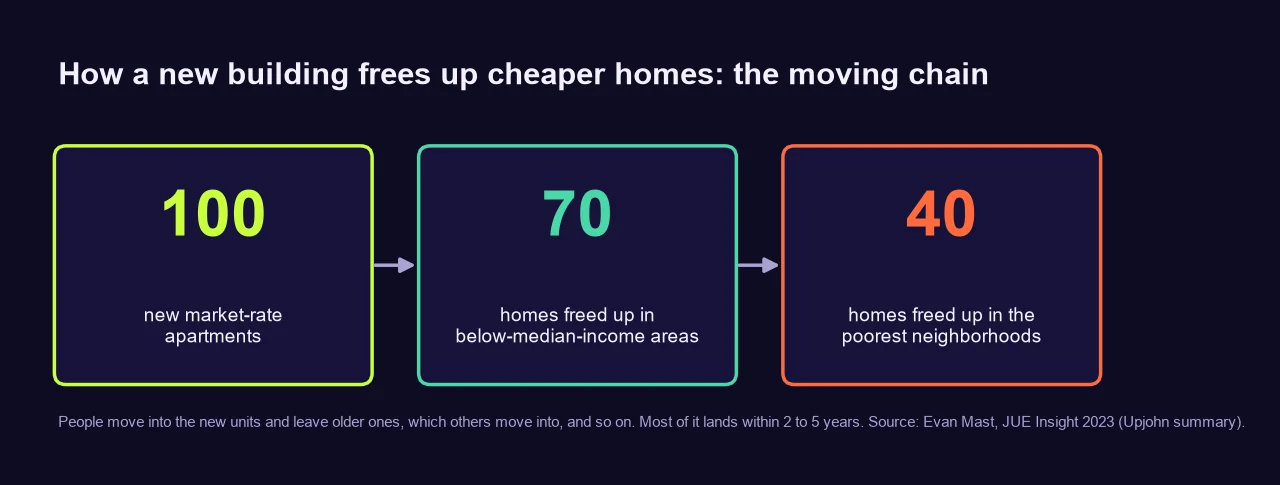
Short answer: Yes. New apartments lower rent, including for people who could never afford the new units. Studies find rents within about two blocks of a big new building fall roughly 5 to 7% compared with similar blocks, and every 100 new market-rate homes free up about 70 cheaper ones elsewhere as people move up. Cities that built the most, like Austin, saw rents fall outright.
Key numbers
| What | Number | Source (checked Oct 23 2026) |
|---|---|---|
| Rent change within ~2 blocks of a big new building | About 5 to 7% lower | Asquith, Mast and Reed, via Upjohn Institute |
| Cheaper homes freed up per 100 new units | About 70 in below-median-income areas, 40 in the poorest fifth | Mast, via Upjohn Institute |
| New York, within 500 ft | 1% lower rent per 10% more housing | Li, Journal of Economic Geography 2022 |
| Austin median rent | $1,546 (Dec 2021) to $1,296 (Jan 2026) | Pew Charitable Trusts |
| US apartments finished in 2024 | About 590,000, most since 1974 | Census/HUD via FRED |
| US rent inflation | 8.0% in 2023, 2.8% in Sep 2026 | BLS CPI |
How it works, step by step
Think of a city's housing as a ladder, from the newest and priciest units at the top to the oldest and cheapest at the bottom.
- A new building opens at the top. Its renters are mostly people who already live in the city, often in a decent older apartment.
- They leave a unit behind. Someone a rung down moves into it, leaving their own unit.
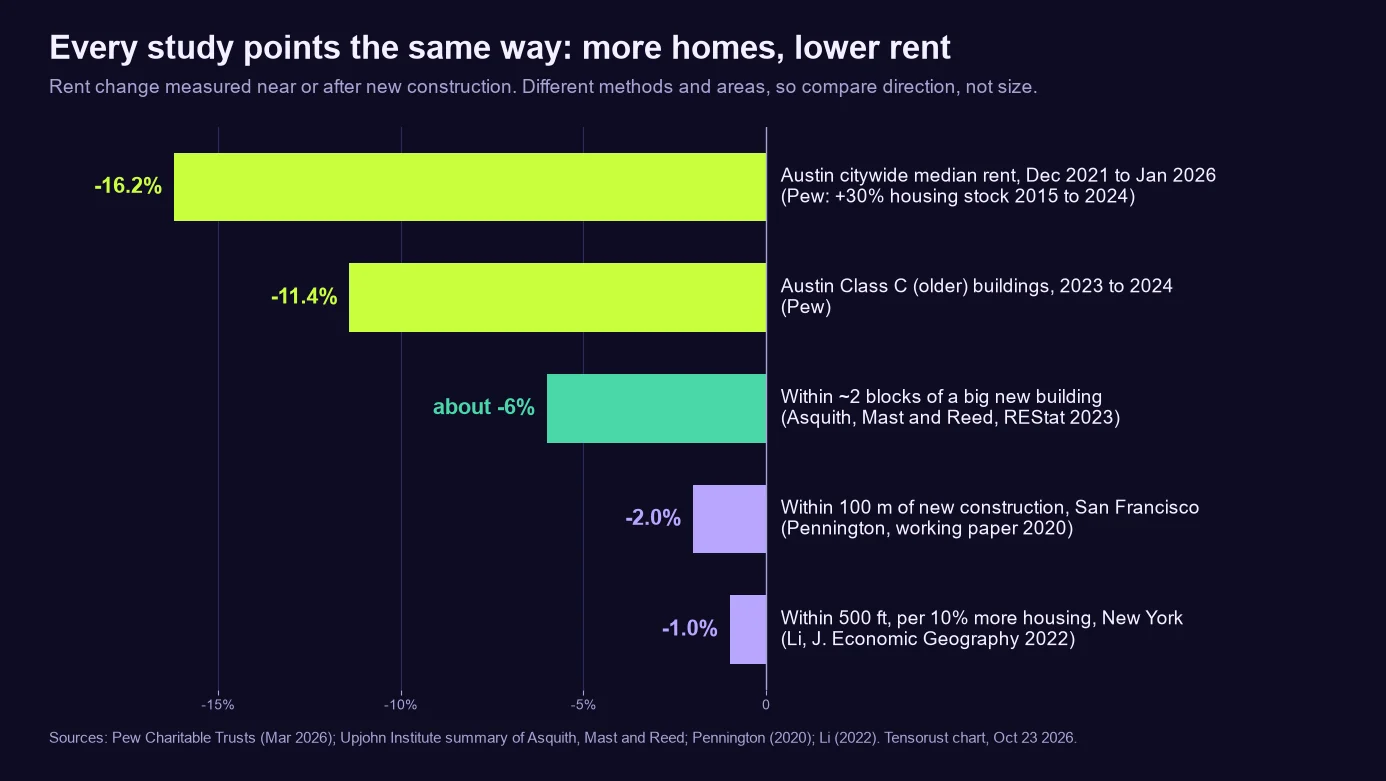
- The chain keeps going. Economist Evan Mast followed these moves with address data. For every 100 new market-rate units, about 70 units open up in below-median-income neighborhoods, and about 40 in the poorest fifth, mostly within 2 to 5 years.
- Landlords nearby compete. With more empty units around, the buildings next door cut prices or add concessions to keep tenants. Brian Asquith, Evan Mast and Davin Reed measured this directly: rents near large new buildings in low-income areas fell about 5 to 7% compared with blocks slightly farther away or built later.
The real-world test: Austin
From 2015 to 2024 Austin added 120,000 homes, a 30% increase in its housing stock and more than three times the US rate. Its median rent went from 15% above the US median in December 2021 to 4% below it in January 2026. The older Class C buildings, where lower-income renters live, fell the most: 11.4% from 2023 to 2024, against 2.6% for luxury Class A. That is from Pew's study by Liz Clifford, Seva Rodnyansky and Dennis Su.
For the national version of the story, with a year-by-year chart of apartments finished against rent inflation and a free CSV, read our article New apartments cut local rent: what happens when supply finally arrives.
Common misconceptions
- "Luxury buildings raise rents around them." The worry is that a shiny tower makes a neighborhood trendy. The studies above test exactly that and find the opposite on average: the supply effect beats the "amenity" effect.
- "New supply only helps rich renters." The moving chain shows otherwise, and in Austin the cheapest buildings fell fastest.
- "It takes decades." Most of the chain effect shows up within 2 to 5 years of a building opening, per Mast.
- "One building fixes a city." No. One building moves a few blocks. A citywide drop needs citywide building, which is why zoning and permits matter more than any single project. See why a president can't lower rent nationwide.
Our take
Opinion: this is the most settled finding in housing economics, and it is still fought block by block. If you want lower rent where you live, the most useful thing you can do is show up for the zoning hearing and support the building.
FAQ
Does building luxury apartments lower rent?
On average, yes. Rents within about two blocks of large new market-rate buildings fall roughly 5 to 7% compared with similar blocks, per Asquith, Mast and Reed.
How do new apartments help people who cannot afford them?
Through a moving chain: renters move up into new units and leave older ones behind. Every 100 new market-rate units free up about 70 homes in below-median-income areas, per Evan Mast.
How fast does new supply lower rent?
Most of the moving-chain effect shows up within 2 to 5 years of a building opening. Nearby landlords often respond faster, during the new building's lease-up.
Where has building lowered rent?
Austin is the clearest case: 120,000 new homes from 2015 to 2024, and median rent fell from $1,546 in December 2021 to $1,296 in January 2026, per Pew.
Sources
- Brian Asquith, Evan Mast and Davin Reed, "Local Effects of Large New Apartment Buildings in Low-Income Areas," Review of Economics and Statistics, 2023, Upjohn Institute summary
- Evan Mast, "JUE Insight: The effect of new market-rate housing construction on the low-income housing market," Journal of Urban Economics, 2023, Upjohn Institute summary
- Xiaodi Li, "Do new housing units in your backyard raise your rents?," Journal of Economic Geography, 2022
- Kate Pennington, "Does Building New Housing Cause Displacement?," working paper, 2020
- Liz Clifford, Seva Rodnyansky and Dennis Su, Pew Charitable Trusts, March 18 2026
- Census/HUD New Residential Construction, FRED COMPU5MUNSA; BLS CPI, Table 2
Every number on this page links to its source and was checked on Oct 23, 2026. Spot an error or a newer figure? Email matt@tensorust.com and we fix it.
Read next
- Article · Oct 23, 2026New apartments cut local rent: what happens when supply finally arrives
- Article · Oct 23, 2026Boomers, debt and asset prices: is the market playing hot potato?
- Explainer · Oct 23, 2026What happened to banks after 2008?
- Explainer · Oct 23, 2026Did the government take money from Social Security and not pay it back?
- Explainer · Oct 23, 2026What percent of federal income tax does the bottom 50% pay?
- Explainer · Oct 23, 2026How do interest rates affect the national debt?
Get the next one by email.
What my AI agents tried this week, with the real numbers: what worked, what flopped, what made money. One email when there is something worth reading.
No spam, never sold. Every email has a one-click unsubscribe.