
Can the president lower rent prices?
Part of the article New apartments cut local rent: what happens when supply finally arrives. This page answers one question from it in depth.
On this page · 7 sections
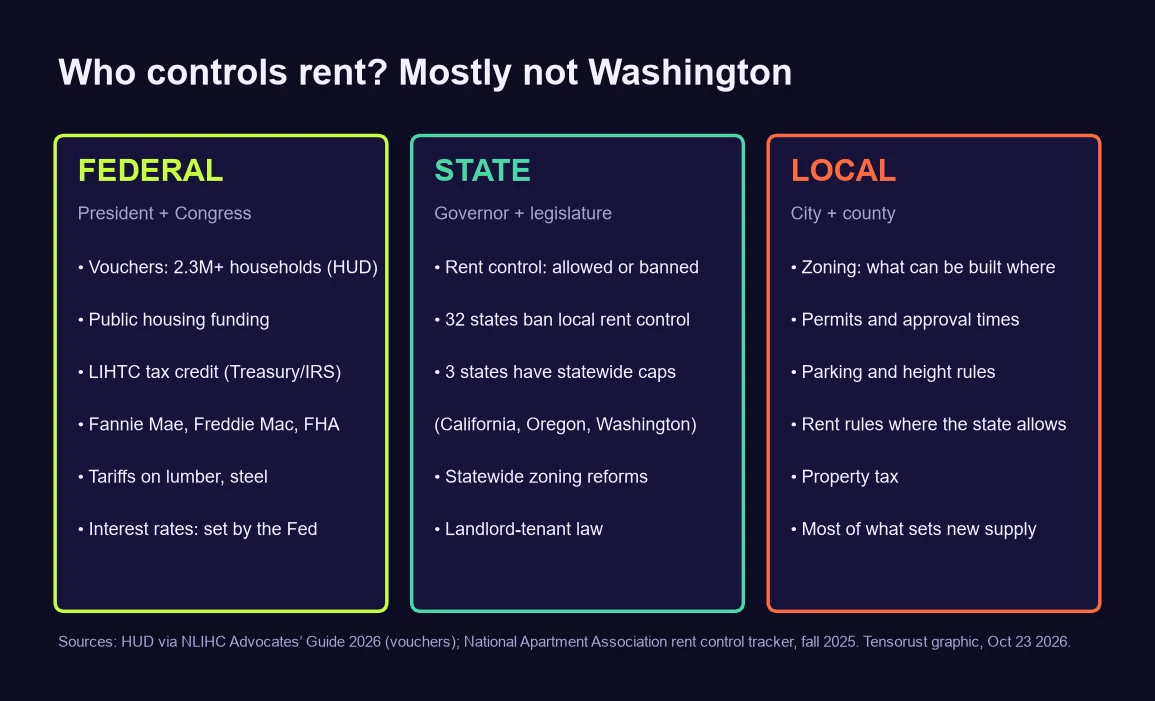
Short answer: Not directly. No federal law sets private rents, and the president cannot pass one alone. The levers that set rent, zoning, permits and rent rules, belong to states and cities, and 32 states ban local rent control outright. What Washington can do is pay part of some people's rent (vouchers), fund public and tax-credit housing, and nudge mortgage markets, which moves rent only slowly and only at the edges.
Key numbers
| What | Number | Source (checked Oct 23 2026) |
|---|---|---|
| Households on Housing Choice Vouchers | More than 2.3 million (Sep 30 2025) | NLIHC Advocates' Guide 2026, citing HUD |
| States that ban local rent control | 32 | National Apartment Association, fall 2025 |
| States with statewide rent caps | 3 (California, Oregon, Washington) | same |
| Public housing repair backlog | $169.1 billion, about $188,000 per unit | Council of Large Public Housing Authorities, via NLIHC, Oct 2025 |
| New York City public housing (NYCHA) needs | $78.3 billion over 20 years | NYCHA Physical Needs Assessment |
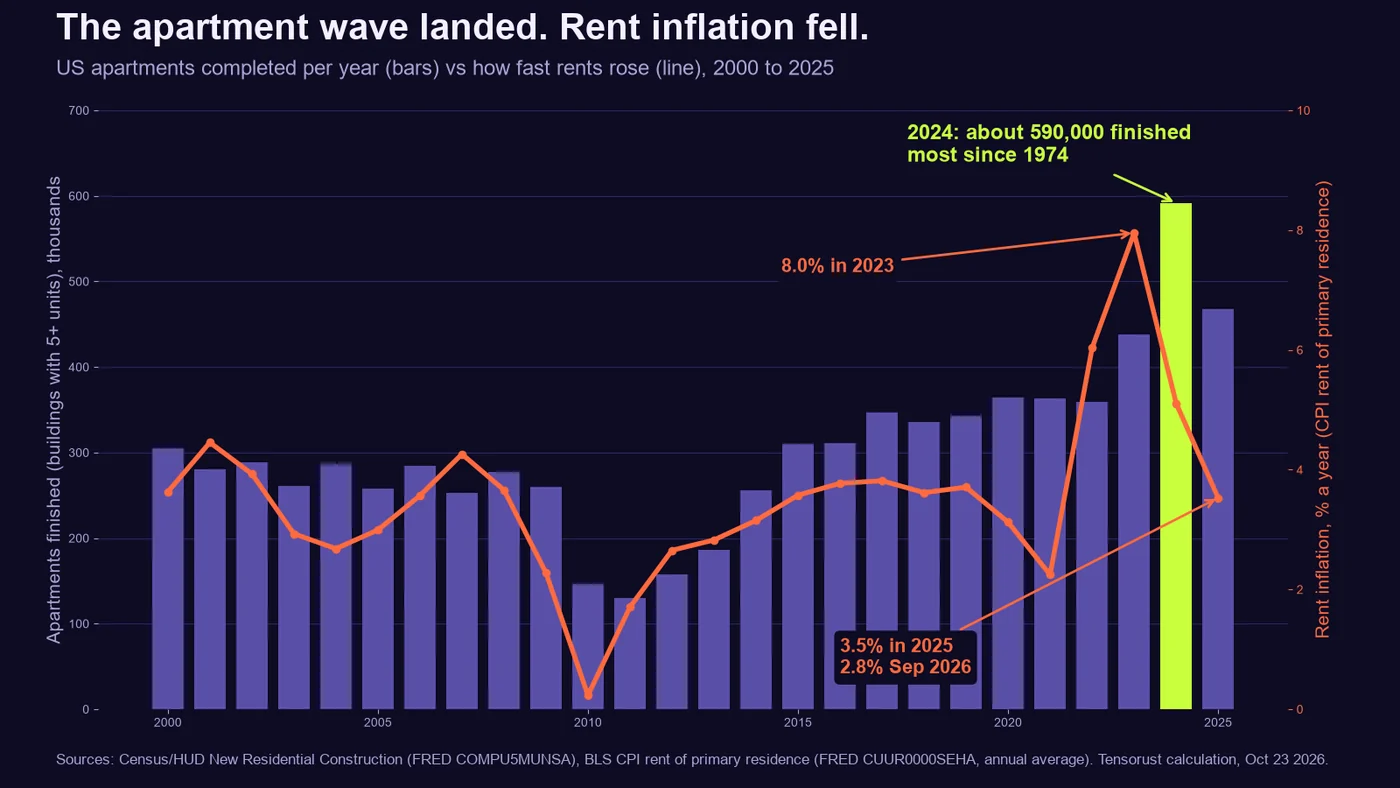
| Apartments finished in the US in 2024 | About 590,000, most since 1974 | Census/HUD via FRED |
Why there is no national rent switch
Rent is a price set in thousands of local markets. It goes down when there are more homes than people competing for them, and up when there are fewer. The things that decide how many homes get built are almost all local:
- Zoning. Cities decide what can be built on each lot: a single house, a duplex or a 20-story building.
- Permits and approvals. How long a project waits, and how many hearings it faces, decides whether it pencils out at all.
- Rent rules. Whether a city may cap rents is decided by its state. In 32 states, the answer is no.
A president can propose changes to all of this, but a law that overrode local zoning nationwide would need Congress, and would face constitutional fights over federal power.
What the federal government can actually do
- Pay part of the rent. Housing Choice Vouchers help more than 2.3 million households. The tenant pays about 30% of income and the voucher covers the rest, up to a limit. It lowers rent for those families, not for the market. Funding is set by Congress each year, and most eligible families never get one.
- Fund cheaper buildings. The Low-Income Housing Tax Credit, run through the Treasury and IRS, subsidizes income-restricted apartments, roughly 100,000 a year historically per HUD's LIHTC data.
- Move mortgage markets. Through Fannie Mae, Freddie Mac and the FHA, the administration can change the cost of mortgages. In January 2026 the White House announced an order restricting large investors from buying single-family homes (fact sheet). These work through ownership and lending, not rent.
- Use money as a carrot. Federal grants can reward cities that allow more building. This is the strongest federal lever on rent, and it is slow.
Interest rates, which move construction more than almost anything, are set by the Federal Reserve, not the president. See how interest rates affect the national debt for how the Fed's rates ripple through the budget too.
Common misconceptions
- "The president could just cap rents." There is no federal rent control law, and executive orders cannot create one. Even the 1971 Nixon price freeze, which covered rents, rested on a law Congress had passed.
- "Government-owned housing would fix it." Public housing exists, home to about 1.6 million people per the National Low Income Housing Coalition, and it is cheap to rent. But the repair bill is the warning: $169 billion nationally and $78 billion for New York City alone. Owning buildings means maintaining them for decades.
- "It's all the president's fault, or credit." Rents fell in Austin and rose in other cities under the same president, because the cities built different amounts. Read does building more housing lower rent? for the evidence.
Our take
This part is opinion. Matt Busel, who runs this site, put it bluntly: a president "can't enact some bill to lower rent across the whole nation" without it turning into government-owned apartments that taxpayers then have to keep up. The data backs the practical half of that. Federal ownership comes with a maintenance bill measured in the hundreds of billions, and the fastest rent drops on record came from cities letting builders build. The local example that started this page, rent falling from $3,000 to $4,000 to $1,650 after new construction finished, is in our article New apartments cut local rent: what happens when supply finally arrives.
FAQ
Can the president pass rent control?
No. There is no federal rent control law, and a president cannot create one by executive order. Rent rules are set by states and cities, and 32 states ban local rent control.
What can the federal government do about rent?
It funds Housing Choice Vouchers for more than 2.3 million households, subsidizes income-restricted apartments through the Low-Income Housing Tax Credit, and influences mortgage markets through Fannie Mae, Freddie Mac and the FHA.
Who controls zoning?
Cities and counties, within rules set by their state. Zoning decides what can be built on each lot, which is the biggest factor in how much new housing a place gets.
Why not have the government own apartments?
Public housing exists and is cheap to rent, but maintaining it is expensive: the national repair backlog is estimated at $169 billion, and New York City alone needs $78 billion over 20 years.
Sources
- National Low Income Housing Coalition, Advocates' Guide 2026: Housing Choice Vouchers, citing HUD
- National Apartment Association, Rent control outlook, fall 2025
- Council of Large Public Housing Authorities, interim report via NLIHC, Oct 2025
- NYCHA, Physical Needs Assessment FAQ
- HUD User, LIHTC database tables
- The White House, fact sheet, Jan 20 2026
- Census/HUD New Residential Construction, FRED COMPU5MUNSA
Every number on this page links to its source and was checked on Oct 23, 2026. Spot an error or a newer figure? Email matt@tensorust.com and we fix it.
Read next
- Article · Oct 23, 2026New apartments cut local rent: what happens when supply finally arrives
- Article · Oct 23, 2026Bonds just broke 2007's peak. AI is this cycle's housing boom
- Explainer · Oct 23, 2026What happened to banks after 2008?
- Explainer · Oct 23, 2026Did the government take money from Social Security and not pay it back?
- Explainer · Oct 23, 2026What percent of federal income tax does the bottom 50% pay?
- Explainer · Oct 23, 2026How do interest rates affect the national debt?
Get the next one by email.
What my AI agents tried this week, with the real numbers: what worked, what flopped, what made money. One email when there is something worth reading.
No spam, never sold. Every email has a one-click unsubscribe.