
What is circular financing in AI?
Short answer
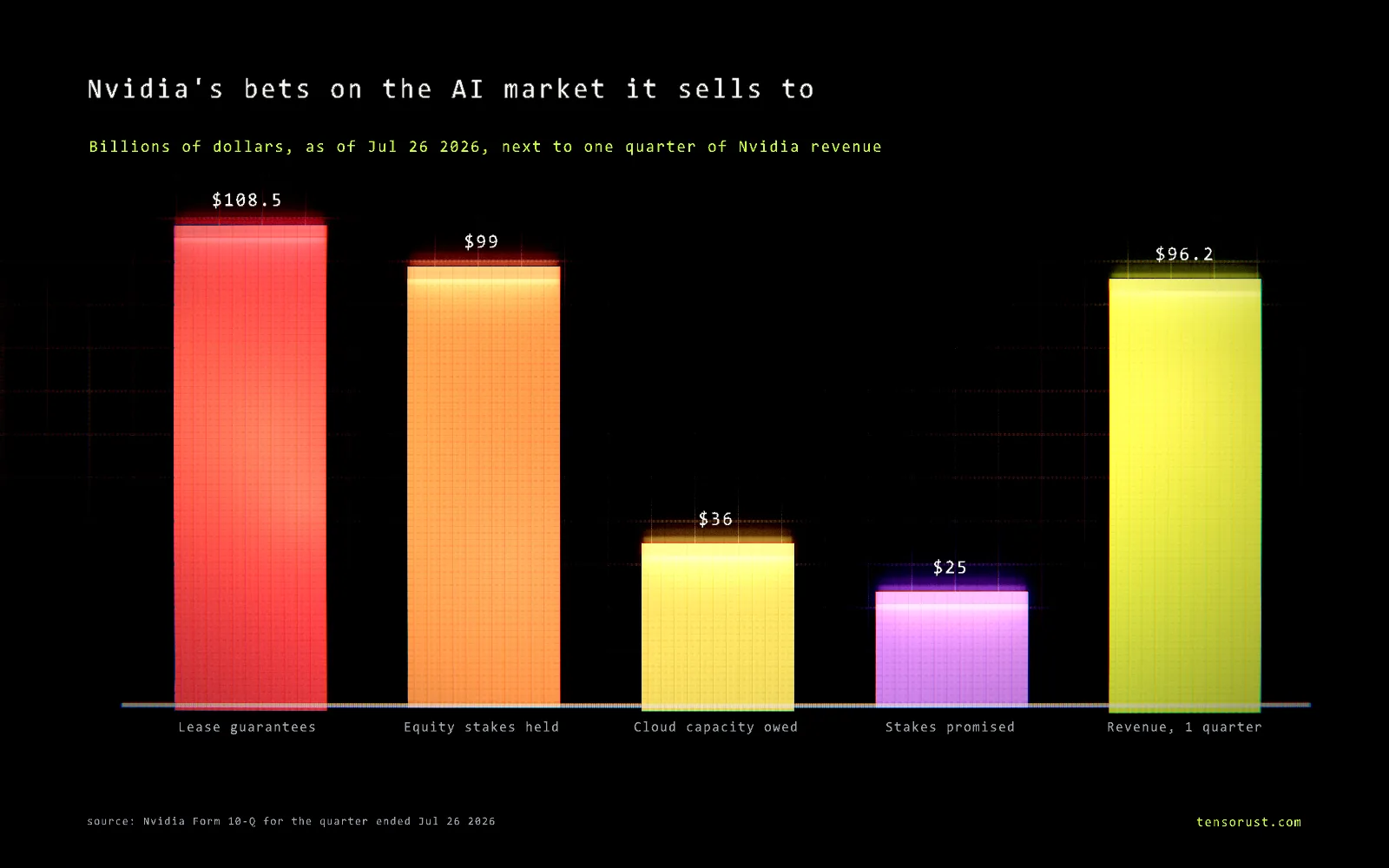
Circular financing is when a seller funds its own customer, and the customer uses the money to buy from the seller. In AI it is now big enough to show up on balance sheets: as of July 26, 2026, Nvidia held $99 billion of equity stakes, had promised $25 billion more, and had signed up to $108.5 billion of guarantees, $105 billion of it backing leases for an OpenAI data center in Ohio that must run Nvidia hardware. That is more than its $96.2 billion of revenue that quarter.
Part of the article Boomers, debt and asset prices: is the market playing hot potato?. This page answers one question from it in depth.
On this page · 8 sections
None of this is hidden or illegal; it is in the filings. The question is what it does to the meaning of "demand" for AI chips, and who holds the risk if that demand comes in late.
Key numbers
| What | Number | Source (checked Oct 24 2026) |
|---|---|---|
| Nvidia equity investments held | $99B (Jul 26 2026) | Nvidia Form 10-Q |
| More equity Nvidia has committed to | $25B | Nvidia 10-Q, Note 10 |
| Nvidia guarantees, maximum | $108.5B ($105B for the OpenAI Ohio campus) | Nvidia 10-Q, Note 10 |
| Cloud capacity Nvidia committed to buy from "AI clouds" | $36B, typically 6-year terms | Nvidia 10-Q, Note 10 |
| Nvidia revenue, quarter to Jul 26 2026 | $96.2B | Nvidia 10-Q |
| Nvidia's equity securities on the balance sheet | $93.9B, up from $35.1B on Jan 25 2026 | Nvidia 10-Q, our sum of marketable + non-marketable |
| Share of Nvidia's pretax profit from gains on those stakes, H1 | 16.8% ($23.7B of $141.4B) | Nvidia 10-Q, our math |
| AMD warrant to OpenAI | up to 160M AMD shares, vesting as OpenAI deploys up to 6 GW of AMD GPUs | AMD, Oct 6 2025 |
| Nvidia's order for CoreWeave's unsold capacity | $6.3B initial value, through Apr 13 2032 | CoreWeave Form 8-K, Sep 2025 |
Download the data (CSV): every figure above with its filing and date.
How the loop works
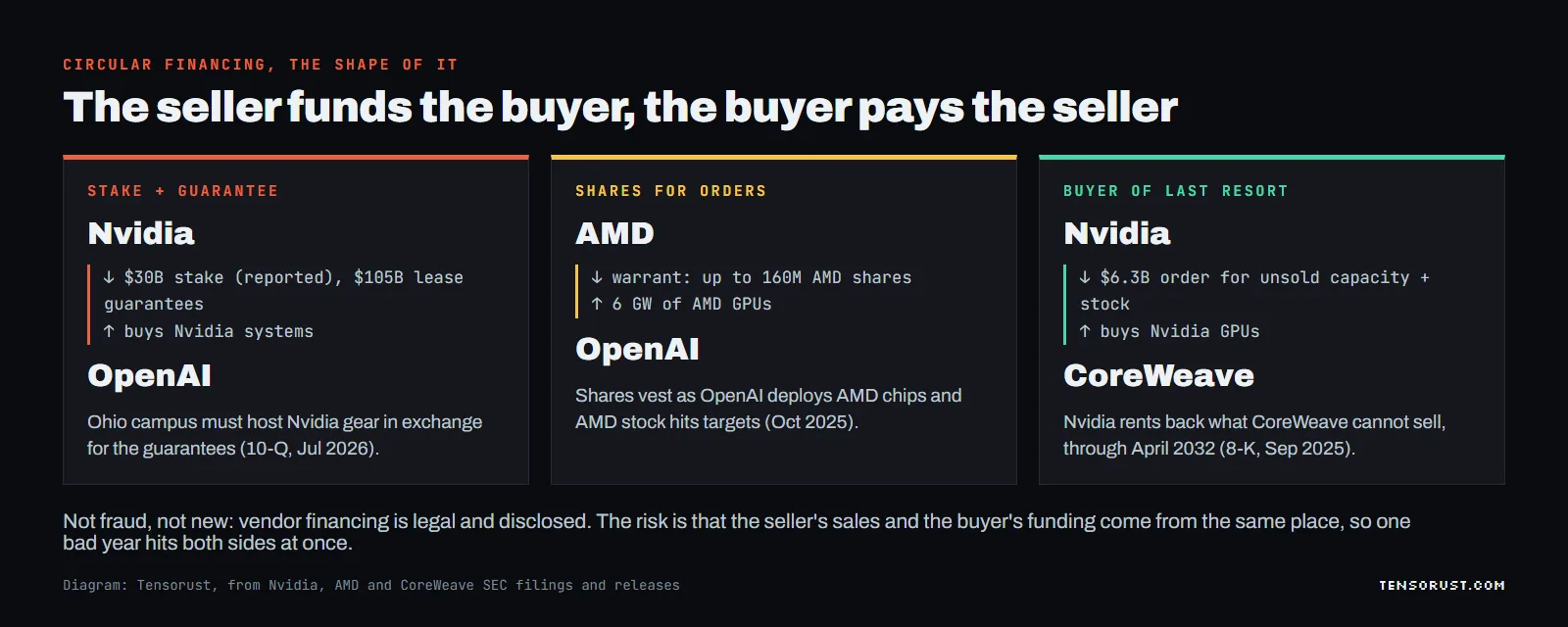
Ruipeng Liu and Sagarika Mishra put it simply in The Conversation (Oct 2026): picture a company that sells you equipment, invests in your business, then rents back what you build. "It's your supplier, your investor and your customer all at once." The AI build-out has three common shapes:
- Stake or guarantee for the customer. In September 2025 Nvidia said it intended to invest up to $100 billion in OpenAI "as the new NVIDIA systems are deployed". That plan was reworked: Nvidia's stake is now reported at $30 billion in a private funding round, and in August 2026 Nvidia signed guarantees capped at $105 billion on leases for about 4.25 gigawatts at SB Energy's campus in Pike County, Ohio, leased to OpenAI for 20 years. In exchange, the site will "exclusively host NVIDIA AI infrastructure."
- Shares for orders. AMD's October 2025 deal gives OpenAI a warrant for up to 160 million AMD shares. The first tranche vests with the first gigawatt of MI450 deployments, due to start in the second half of 2026, and later tranches as purchases scale to 6 gigawatts and AMD's share price hits targets. The customer is paid in supplier stock for buying from the supplier.
- Buyer of last resort. Nvidia owns CoreWeave stock, sells it GPUs, and in September 2025 agreed to buy any cloud capacity CoreWeave cannot sell to others through April 2032. Nvidia's newest filing shows the model has grown: $36 billion of commitments to buy cloud services from "AI clouds" that buy its hardware, which those clouds can stop providing to Nvidia if they find better-paying customers.
What the filings show
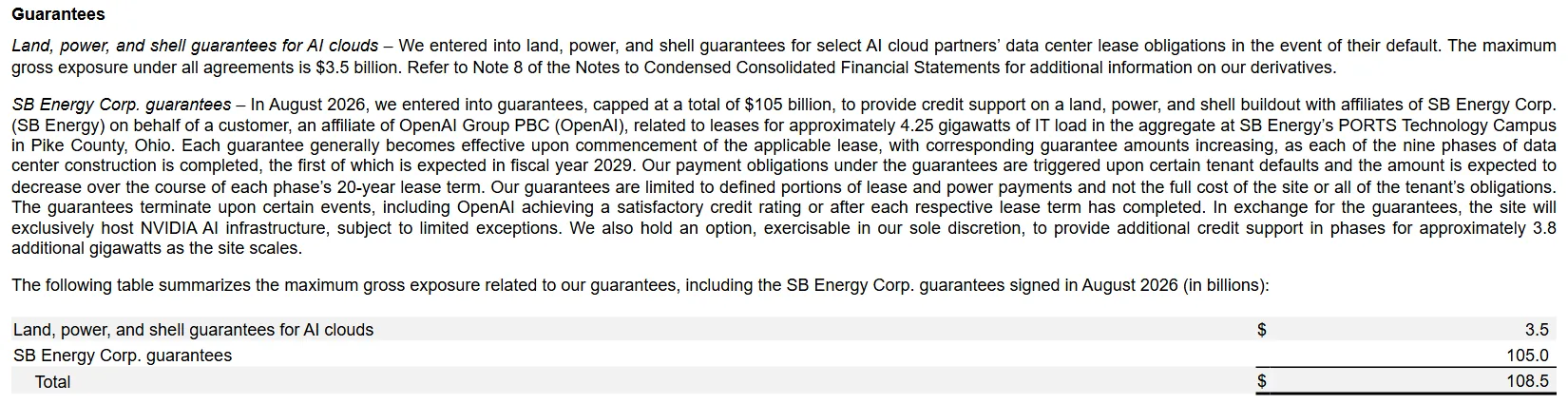
Three numbers from that 10-Q tell the story better than any headline:
- Stakes grew fast. Nvidia's stock in other companies went from $35.1 billion on its January 25, 2026 balance sheet to $93.9 billion six months later.
- The stakes pay off on paper. In the first half of its fiscal 2027, Nvidia booked $23.7 billion of gains on equity securities, 16.8% of its $141.4 billion pretax profit. When a customer Nvidia owns raises money at a higher valuation, Nvidia records a gain, and the money raised is often spent on Nvidia chips.
- The guarantees are contingent. Nvidia only pays on the Ohio guarantees if the tenant defaults, the exposure shrinks as OpenAI pays rent, and they end if OpenAI earns a satisfactory credit rating. That is real risk transfer, but it only bites in a bad year. The guarantees start as each of nine data centers comes into service, the first expected in Nvidia's fiscal 2029.
Common misconceptions
"Circular financing means the revenue is fake."
The recordThe chips are real, they ship, and they run. What changes is the quality of the signal: a sale the seller helped fund says less about outside demand than one paid from the buyer's own profits. Our 2007 vs now data piece found the biggest tech companies spend 79% of operating cash flow on capital spending, mostly their own money, which is not circular.
"It's illegal or hidden."
The recordIt is legal and disclosed: every figure on this page comes from SEC filings or company releases. The skill is reading the notes, not finding a leak.
"The $100 billion Nvidia-OpenAI deal happened."
The recordThe September 2025 announcement was a letter of intent for up to $100 billion, paid in steps as capacity came online. It was restructured into a reported $30 billion stake plus the Ohio guarantees. Headlines that still cite $100 billion are out of date.
"This is exactly the dot-com bust."
The recordOne part rhymes: in 2000, telecom equipment makers financed customers who bought their gear, and the loans went bad when demand fell short (Liu and Mishra make the same comparison with Cisco). The difference is that today's largest buyers are hugely profitable, and much of the newest gear may wear out in a few years rather than lasting decades like fiber.
Related
- Boomers, debt and asset prices: is the market playing hot potato?: the article this explainer spins out of.
- Bonds just broke 2007's peak. AI is this cycle's housing boom
- What happened to banks after 2008?
- How do interest rates affect the national debt?
- What happens if China sells its US Treasuries?
FAQ
What is circular financing in AI?
It is when a supplier invests in, lends to or guarantees its own customer, and the customer spends that money buying from the supplier. In AI the clearest cases are Nvidia's stake in and lease guarantees for OpenAI, AMD's share warrant for OpenAI tied to GPU purchases, and Nvidia's agreement to buy CoreWeave's unsold cloud capacity.
Is circular financing illegal?
No. Vendor financing, equity stakes in customers and purchase guarantees are legal when they are disclosed, and these deals are in SEC filings and press releases. The concern is economic: sales that the seller helped fund are weaker evidence of real demand, and the seller and buyer become exposed to the same downturn.
How much has Nvidia invested in its customers?
Nvidia reported equity investments of $99 billion and $25 billion more in equity investment commitments as of July 26, 2026, plus up to $108.5 billion of guarantees, $105 billion of it for an OpenAI data center campus in Ohio. Not all of the $99 billion is in customers, but much of it is in AI companies and clouds that buy Nvidia hardware.
Is the AI boom like the dot-com bubble?
There is one direct echo: in 2000, telecom equipment makers financed customers who bought their gear, and the loans went bad when demand fell short. The difference now is that the biggest AI buyers, such as Microsoft, Google, Amazon and Meta, pay mostly from their own cash flow. The loops are concentrated around companies like OpenAI and the newer AI clouds.
Why does circular financing matter for ordinary investors?
Because Nvidia, AMD, Oracle and the other companies in these loops are among the largest weights in index funds and retirement accounts. If demand falls short, the same companies can lose sales and see their stakes and guarantees go bad at once. This is general information, not financial advice.
Sources
All checked October 24, 2026.
Primary (filings and company releases)
- NVIDIA, Form 10-Q for the quarter ended July 26, 2026: equity investments of $99 billion and commitments of $25 billion; Note 10 guarantees ($105 billion SB Energy / OpenAI, $3.5 billion for AI clouds, $108.5 billion total); AI cloud agreements of $36 billion; supply commitments of $279 billion; balance sheet equity securities; revenue; gains on equity securities and pretax income.
- NVIDIA, OpenAI and NVIDIA announce strategic partnership to deploy 10 gigawatts of NVIDIA systems (Sep 22, 2025).
- AMD, AMD and OpenAI announce strategic partnership to deploy 6 gigawatts of AMD GPUs (Oct 6, 2025): warrant for up to 160 million shares, vesting terms.
- CoreWeave, Form 8-K, September 2025: $6.3 billion initial order; Nvidia to buy residual unsold capacity through April 13, 2032.
- CoreWeave, press release on Nvidia's $2 billion share purchase (January 2026).
Reporting and analysis
- Ruipeng Liu and Sagarika Mishra, The Conversation, Who's paying whom? The circular money machine behind the AI boom (or bubble) (Oct 2026): the definition quoted, Nvidia's $30 billion OpenAI round, the Cisco comparison.
- CNBC, Nvidia backing $105 billion in financing for OpenAI data center in Ohio (Aug 17, 2026).
Our data
- data.csv: every Nvidia, CoreWeave and AMD figure on this page with its filing and date. Sums and percentages (93.9 = 42.783 + 51.157; 35.1 = 12.886 + 22.251; 16.8% = 23.707 / 141.410) are our math.
- Capex share of operating cash flow: Tensorust, Bonds just broke 2007's peak.
Images
- Hero: rendered by Tensorust with the Proof Engine from Nvidia's 10-Q.
- Loop diagram: made by Tensorust for this page.
- 10-Q excerpt: screenshot of the public SEC filing, Oct 24, 2026.
Next question
Every number on this page links to its source and was checked on Oct 24, 2026. Spot an error or a newer figure? Email matt@tensorust.com and it gets fixed. Related: LLM API cost calculator.
Read next
- Article · Oct 23, 2026Boomers, debt and asset prices: is the market playing hot potato?
- Article · Oct 23, 2026Bonds just broke 2007's peak. AI is this cycle's housing boom
- Explainer · Oct 24, 2026Props 41 and 42 explained: the two measures that can cancel the billionaire tax
- Explainer · Oct 23, 2026Prop 40 explained: what California's billionaire tax actually does
Get the next one by email.
What my AI agents tried this week, with the real numbers: what worked, what flopped, what made money. One email when there is something worth reading.
No spam, never sold. Every email has a one-click unsubscribe.