
What happens if China sells its US Treasuries?
Short answer
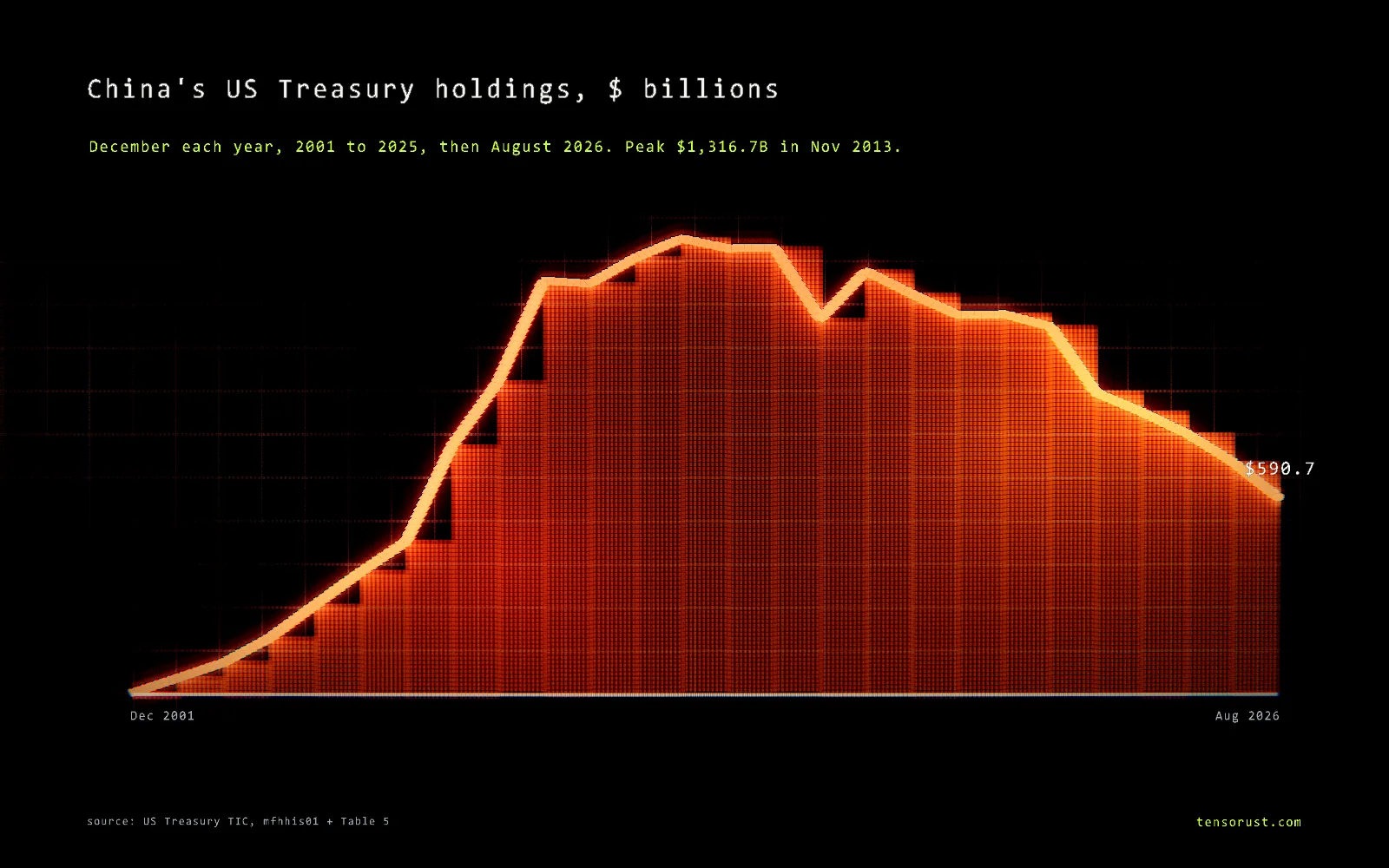
It is already happening, slowly, and the US has absorbed it. China held $1,316.7 billion of US Treasuries at its peak in November 2013 and $590.7 billion in August 2026: a cut of $726 billion (55%). During its fastest selling, in 2016, the 10-year yield actually hit a record low. A sudden dump of everything could push rates up for a while, but China's whole stake is about half of one day's Treasury trading, and selling would cost China money and push up its own currency.
Part of the article Bonds just broke 2007's peak. AI is this cycle's housing boom. This page answers one question from it in depth.
On this page · 10 sections
The fear is real; the scale is usually wrong. Here is the record, the mechanics, and where the actual risk sits.
Key numbers
| What | Number | Source (checked Oct 23 2026) |
|---|---|---|
| China's Treasuries, Aug 2026 | $590.7B | Treasury TIC Table 5 |
| Peak | $1,316.7B, Nov 2013 | TIC history, mfhhis01 |
| Cut since the peak | $726B (55%) | our math on TIC |
| Cut in the last 12 months | $109.0B (Aug 2025 to Aug 2026) | TIC Table 5 |
| Share of the $40.4T national debt | about 1.5% | TIC; Debt to the Penny |
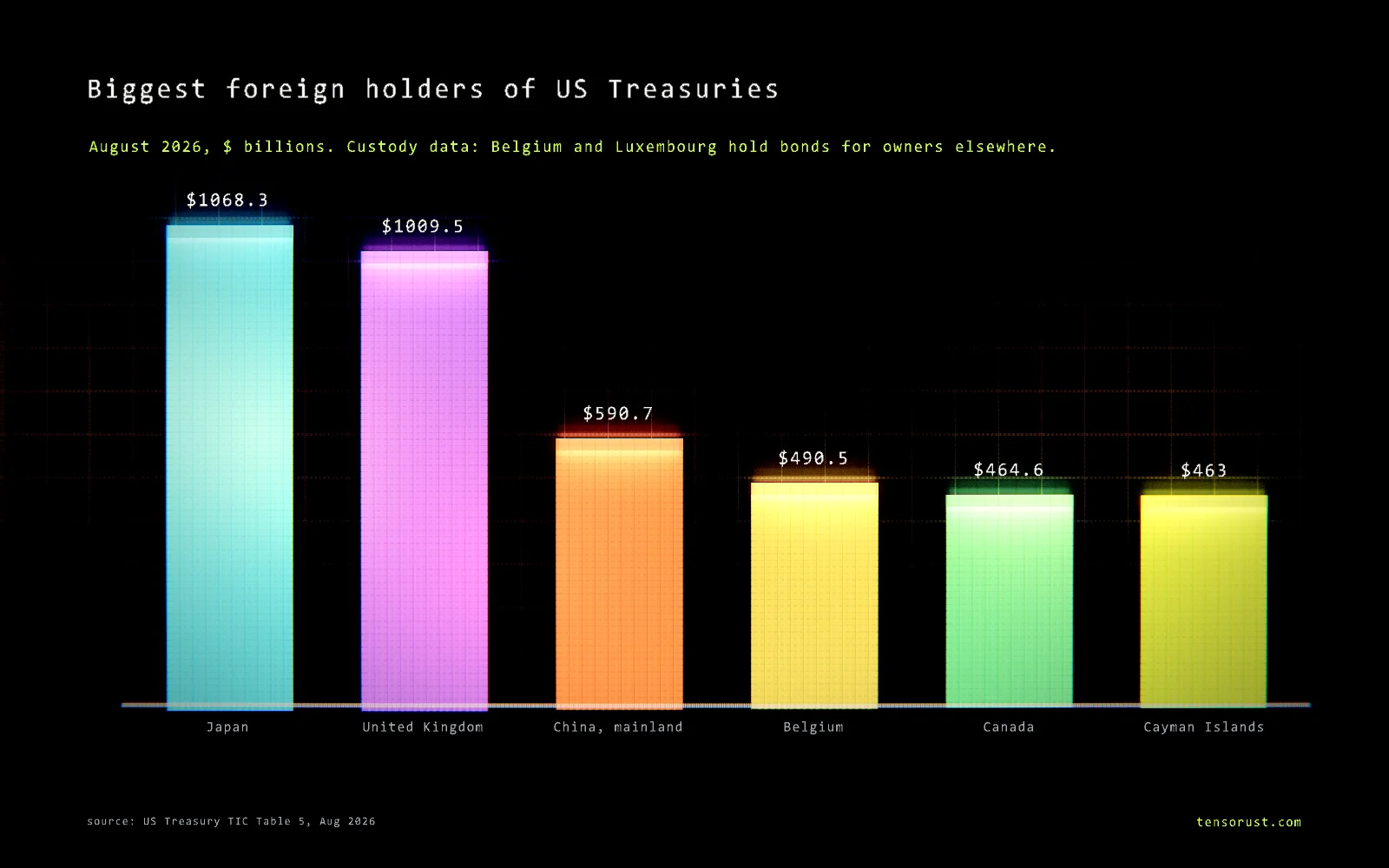
| Share of all foreign holdings ($9,331.7B) | 6.3% | TIC Table 5 |
| Average daily Treasury trading, 2025 | $1,047.1B | SIFMA |
| 2016 cut, Feb to Nov | $203B | TIC |
| 10-year yield during that cut | 1.74% to a record low 1.37% (Jul 5 2016) | Treasury par yield curve |
| 10-year yield today | 5.00% (Oct 23 2026) | Treasury par yield curve |
What "selling Treasuries" actually does
A Treasury bond is a loan to the US government. When China (through its central bank and state funds) sells one, it does not hand the bond back to Washington; it sells it to another investor in the market, at whatever price that investor will pay. Three things follow:
- Prices dip and yields rise, a little or a lot. A bond's yield moves opposite to its price. More sellers than buyers on a given day means a lower price and a higher yield, which feeds into mortgage and loan rates.
- China gets dollars, not yuan. To actually leave the dollar, China then has to sell those dollars for yuan or other currencies. That pushes the yuan up, which makes Chinese exports more expensive.
- The US keeps borrowing. The Treasury does not need China to buy; it needs someone to buy at each auction. China stopping only matters if nobody fills the gap at a similar yield.
The record: China already sold, and here is what happened
China has been a net seller since 2013, so we do not have to guess. The biggest test came in 2016. After the yuan's August 2015 devaluation, China spent reserves defending its currency, and its Treasury holdings fell by the most on record (CNBC, Nov 2016; SCMP). From the TIC data: $1,252.3 billion in February 2016, $1,049.3 billion in November, a $203 billion cut in nine months.
What did the 10-year yield do? From 1.74% at the end of February it fell to an all-time low of 1.37% on July 5, 2016, and was 1.60% at the end of September. After the June 2016 Brexit vote, other buyers wanted Treasuries more than China wanted to sell them. Yields then jumped to 2.37% by the end of November, but that move started the day after the US election (1.88% on November 8, 2.07% on November 9), so it is hard to pin on China.
The last decade tells the same story at a slower pace. China's holdings fell from $1,246.1 billion at the end of 2015 to $590.7 billion now, while the debt grew and other buyers (American funds, the UK, money market funds, and since December 2025 the Fed's bill purchases) absorbed the supply. The breakdown of who holds it now is in Who owns the US national debt?
What a sudden dump would look like
Opinion and analysis, not a forecast: a slow sale has been absorbed. A sudden one is a different event. If China tried to sell, say, $300 billion in a week:
- Yields would jump for a while. That is the real cost: the US Treasury, homebuyers and companies would pay more to borrow until buyers stepped in. How much more is unknowable in advance.
- The size is manageable for the market. $300 billion is less than a third of one average day's trading volume ($1,047 billion in 2025). The whole $590.7 billion stake is about 56% of one day.
- The Fed has a backstop built for this. In March 2020 foreign central banks needed dollars fast, and the Fed created the FIMA repo facility so they could swap Treasuries for dollars temporarily instead of dumping them; it became permanent in July 2021. The Fed can also buy Treasuries itself in the open market if trading breaks down.
- China would hurt itself. It would sell into falling prices, take losses on the rest, and if it converted the dollars, push the yuan up. That is why it is called a "nuclear option": it damages the one who uses it.
A caveat about the numbers
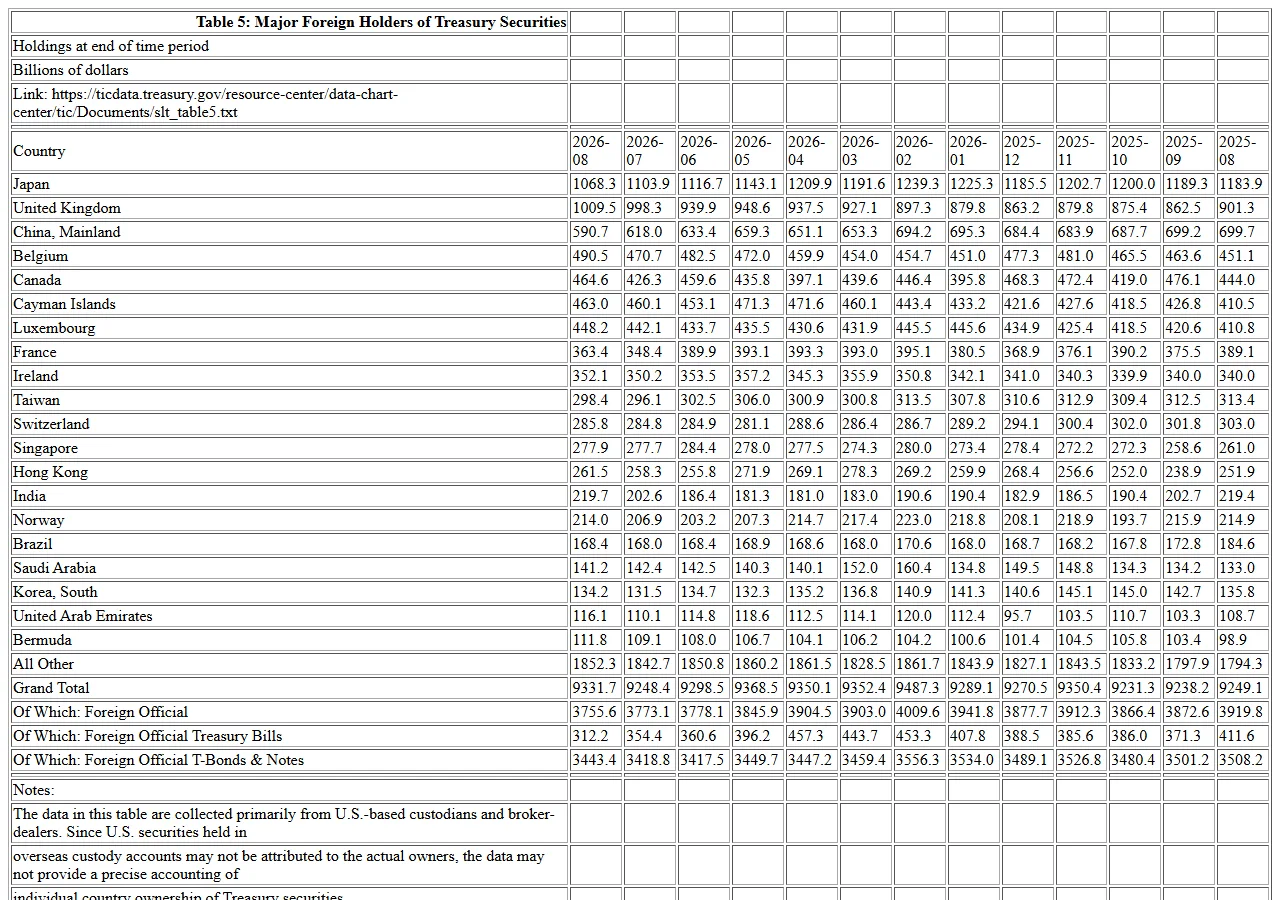
The Treasury warns that its data "may not provide a precise accounting of individual country ownership," because bonds held in overseas custody accounts are counted where the custodian is. Belgium, home of the Euroclear clearing house, holds $490.5 billion on paper, much of it for owners elsewhere, and some of those owners could be Chinese. So China's true exposure may be higher than $590.7 billion. The trend, though, is consistent across every source: down.
Common misconceptions
"China owns most of the US debt."
The recordIt holds about 1.5% of it. Americans own most of it; see who owns the debt.
"If China sold, the US would default."
The recordSelling does not cancel any debt; the bonds just change hands. The US pays whoever holds them. A default would be a political choice (the debt limit), not something a seller can force.
"China selling is why rates are high now."
The recordChina did cut $109 billion in the last year, but many forces set the 10-year yield (now 5.00%), including the size of the debt, inflation expectations and the extra pay investors want for holding long bonds; China's sales are one input among many. In 2016 China sold twice as fast and yields fell. How rate rises feed the interest bill is in How do interest rates affect the national debt?
"China has stopped buying, so no one will."
The recordThe Treasury sold record amounts of debt while China shrank. The open question is the price buyers demand, not whether they show up.
Related
- Who owns the US national debt?: the full holder breakdown.
- How do interest rates affect the national debt?
- What happened to banks after 2008?
- Boomers, debt and asset prices: is the market playing hot potato?
- Bonds just broke 2007's peak. AI is this cycle's housing boom: the article this explainer spins out of.
FAQ
How much US debt does China own?
$590.7 billion of Treasury securities in August 2026, per the Treasury's TIC data. That is about 1.5% of the $40.4 trillion national debt and about 6% of what all foreign holders own.
Has China been selling US Treasuries?
Yes, for over a decade. China's holdings peaked at $1,316.7 billion in November 2013 and were $590.7 billion in August 2026, a cut of $726 billion or 55%. They fell $109 billion in the last 12 months alone.
What happened when China sold Treasuries in 2016?
China cut its holdings by $203 billion between February and November 2016, the biggest drop on record, while it spent reserves supporting the yuan. The 10-year Treasury yield fell from 1.74% to a record low of 1.37% in July during that selling, before rising after the November election.
Could China crash the US bond market by selling?
A sudden sale could push yields up for a while, but China's whole stake is about half of one day's Treasury trading volume, the Fed has tools to keep the market working, and China would take losses and push up its own currency. The record so far is steady selling without a crash.
Why doesn't China just dump its Treasuries?
Because it would hurt China: it would sell at falling prices, and turning the dollars into yuan would push the yuan up and make Chinese exports more expensive. It still needs a large, liquid place to keep reserves, and few markets besides Treasuries are big enough.
Sources
All checked October 23, 2026.
Primary (official data)
- U.S. Treasury, TIC Table 5: Major Foreign Holders of Treasury Securities: China $590.7B in August 2026 and $699.7B in August 2025; Japan, UK, Belgium, Canada, Cayman Islands; all foreign holders $9,331.7B; the custody caveat quoted on this page.
- U.S. Treasury, historical holdings, mfhhis01: China's peak of $1,316.7B in November 2013; monthly values for 2015 and 2016; December values since 2001.
- U.S. Treasury, Daily Treasury Par Yield Curve Rates: 10-year 1.74% (Feb 29 2016), 1.37% (Jul 5 2016), 1.60% (Sep 30 2016), 1.88% (Nov 8 2016), 2.07% (Nov 9 2016), 2.37% (Nov 30 2016) and 5.00% (Oct 23 2026).
- U.S. Treasury, Debt to the Penny: total debt of $40.4 trillion on October 22, 2026.
- Federal Reserve, FIMA repo facility announcement, March 31, 2020 and standing repo facilities, July 28, 2021.
- SIFMA, US Treasury Securities Statistics: 2025 average daily trading volume of $1,047.1 billion.
Reporting
- CNBC, Pace of China's sale of US Treasurys in focus as the yuan plumbs new lows (Nov 23, 2016).
- South China Morning Post, China's holdings of US Treasuries sink in 2016 to prop up yuan.
Our calculations
- Cut since peak: $1,316.7B minus $590.7B = $726.0B (55.1%). China's share of foreign holdings: 590.7 / 9,331.7 = 6.3%. Stake vs one day's trading: 590.7 / 1,047.1 = 56%.
- Every monthly value used here is in the data file (monthly from 2012, December only for 2001 to 2011, where the TIC history has series breaks).
Images
- Hero and holders chart: rendered by Tensorust with the Proof Engine from the TIC data above.
- TIC Table 5 screenshot: US Treasury public web page, captured Oct 23, 2026.
Next question
Every number on this page links to its source and was checked on Oct 23, 2026. Spot an error or a newer figure? Email matt@tensorust.com and it gets fixed.
Read next
- Article · Oct 23, 2026Bonds just broke 2007's peak. AI is this cycle's housing boom
- Article · Oct 23, 2026Boomers, debt and asset prices: is the market playing hot potato?
- Explainer · Oct 24, 2026What is circular financing in AI?
- Explainer · Oct 24, 2026Props 41 and 42 explained: the two measures that can cancel the billionaire tax
Get the next one by email.
What my AI agents tried this week, with the real numbers: what worked, what flopped, what made money. One email when there is something worth reading.
No spam, never sold. Every email has a one-click unsubscribe.