
Props 41 and 42 explained: the two measures that can cancel the billionaire tax
Short answer
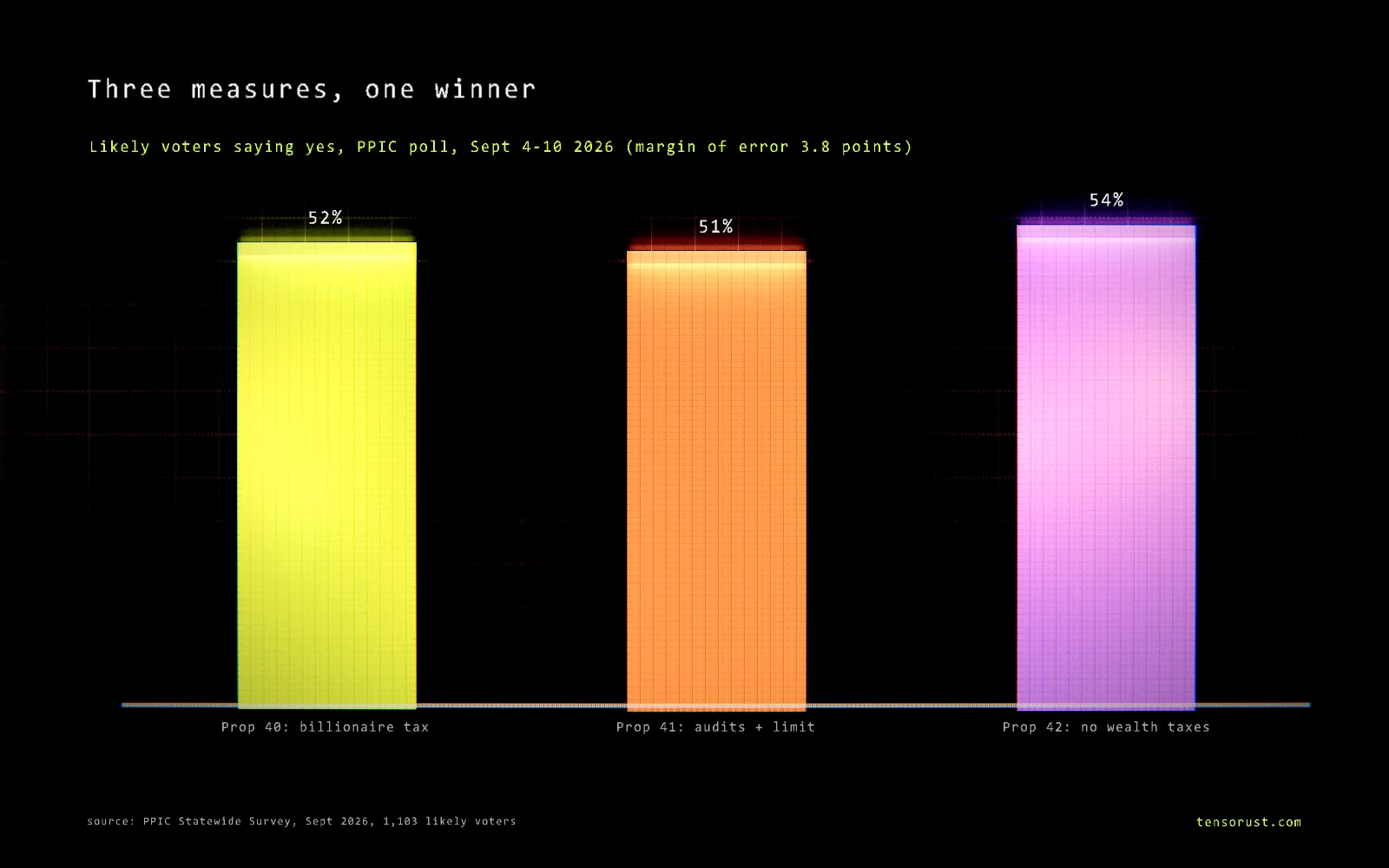
Props 41 and 42 are the two measures on California's November 3, 2026 ballot written to stop the billionaire tax, Prop 40. Prop 41 adds state audits to new special taxes and blocks new taxes whose money is kept outside the state spending limit; Prop 42 bans new taxes on owning stocks, businesses and other personal property, and limits retroactive taxes. The key rule: if Prop 40 passes but either one gets more yes votes, the billionaire tax does not take effect. In September, all three polled between 51% and 54%.
Part of the article Prop 40 priced: 223 billionaires, $90B on paper, Zuckerberg $11B. This page answers one question from it in depth.
On this page · 10 sections
So this is less a yes/no vote than a race. Here is what each measure does in its own right, how the race works, and who is paying for it.
Key numbers
| What | Number | Source (checked Oct 24 2026) |
|---|---|---|
| Election day | Nov 3, 2026 | California Secretary of State |
| PPIC poll, likely voters saying yes | Prop 40: 52%, Prop 41: 51%, Prop 42: 54% | PPIC Statewide Survey, Sep 4 to 10, 2026, via Bay Area News Group |
| Poll sample and margin | 1,103 likely voters, 3.8 points | same |
| Raised for Props 41 and 42 | $131M (Building a Better California) | CalMatters, Sep 2026 |
| Raised in total against Prop 40 | more than $187M | CalMatters |
| Prop 41 audit cost | low millions of dollars a year, growing | LAO, Prop 41 |
| Prop 41 voter-guide printing | a few hundred thousand dollars per qualifying tax initiative | LAO, Prop 41 |
| Cost cut each audit must look for | 10% a year | LAO, Prop 41 |
| Prop 42 fiscal effect | revenue may "not go up as much in the future" | LAO, Prop 42 |
| State spending limit created | 1979 (Prop 4, the "Gann limit") | LAO, 2021 |
How the race between 40, 41 and 42 works
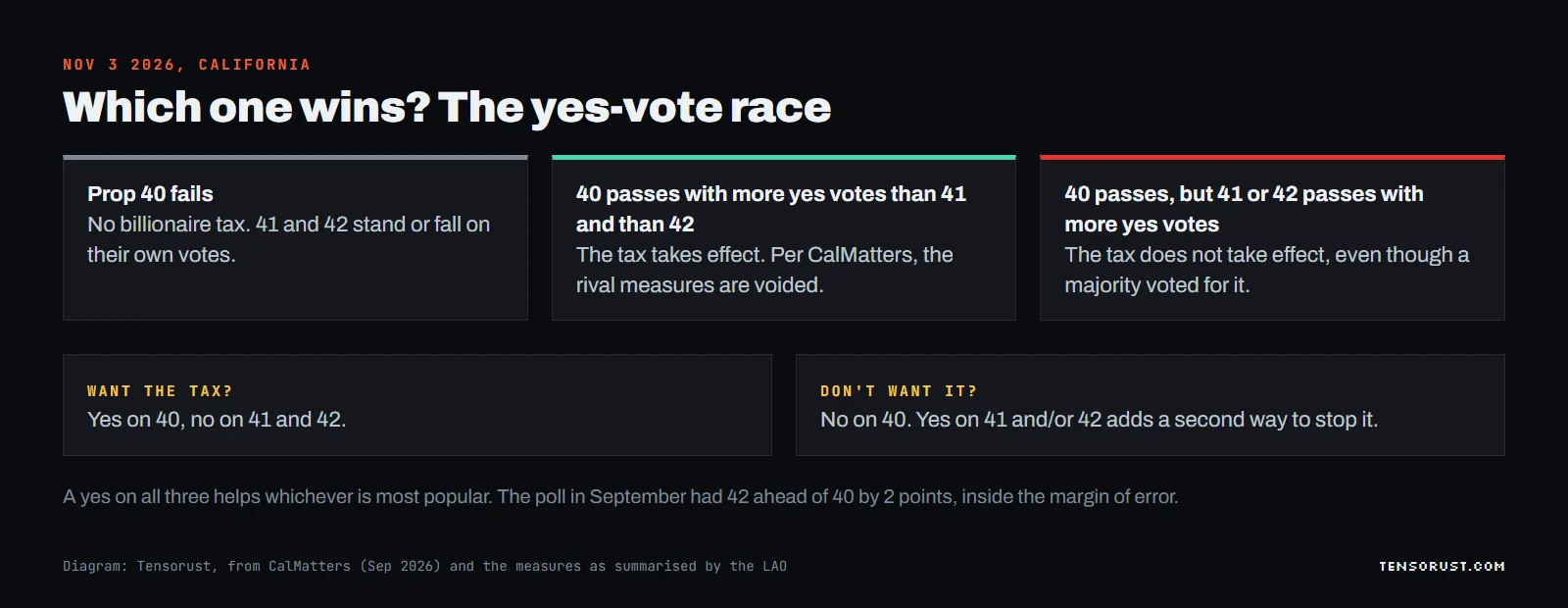
California's constitution says that when measures passed at the same election conflict, the one with the most yes votes prevails, and these three spell out what that means for each other. As Kristen Hwang laid it out for CalMatters: if Prop 40 gets more votes than both 41 and 42, the wealth tax takes effect and voids the countermeasures; if either 41 or 42 outpolls Prop 40, the billionaire tax does not take effect. Either one is enough on its own.
That makes the September poll unusual. Prop 42 (54%) was 2 points ahead of Prop 40 (52%), inside the 3.8-point margin of error. A voter who likes the sound of all three and votes yes on each is, in effect, voting for whichever ends up most popular. PPIC's Mark Baldassare told CalMatters: "I don't think that people at this point realize they're direct countermeasures."
Prop 41: audits, and the spending-limit rule
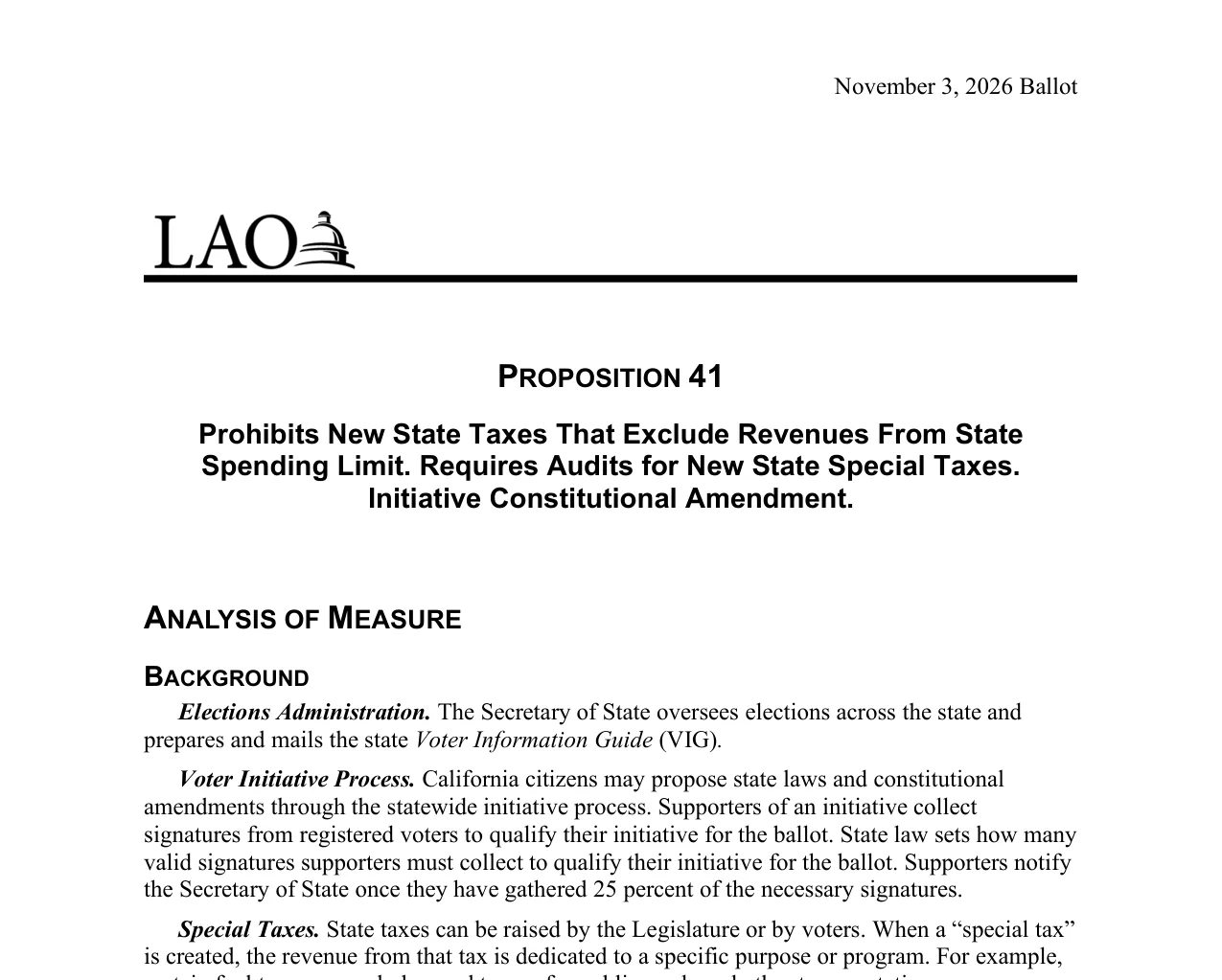
Per the LAO's analysis, Prop 41 does three things:
- Audits before the vote. When a citizen initiative proposes a new or higher special tax (one whose money is dedicated to a purpose, like a fuel tax for roads), the state auditor must review the program it would fund once supporters have 25% of the signatures they need. The audit must include ways to cut the program's annual cost by 10%, and its summary goes in the voter guide.
- Audits every four years of programs funded by special taxes created or raised after January 1, 2026, whether by voters or the Legislature, paid for out of the new tax.
- The spending-limit rule. The state "might not be able to exclude new special tax spending from the limit." The ballot label is blunter: it "nullifies state taxes enacted after January 1, 2026 that exempt their revenues from the voter-approved state spending limit." CalMatters notes Prop 40 is not written to fit that limit, which is the second way 41 can stop it.
The Gann limit, in one paragraph. Proposition 4 of 1979, co-written by anti-tax campaigner Paul Gann, caps how much tax money the state can spend. The cap rises each year with population and per-person income. If revenue beats it over two years, the excess is split half to schools and half to taxpayer rebates; in 1986-87 the state rebated $1.1 billion (LAO). Some spending, like infrastructure, is excluded. Counting a big new tax against the cap can force rebates or cuts elsewhere instead of new spending.
Prop 42: no wealth taxes, fewer retroactive taxes
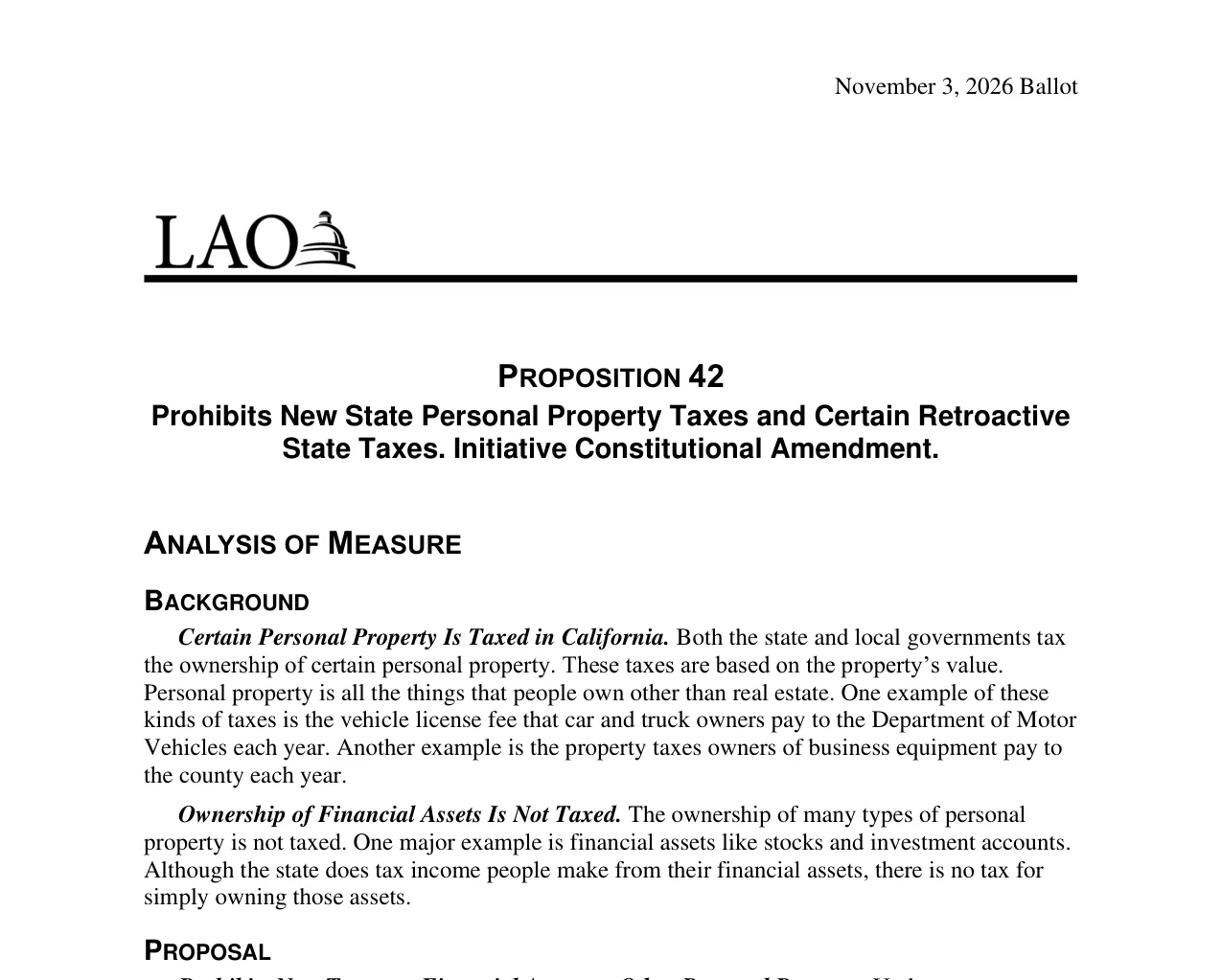
Prop 42 is shorter. The LAO explains that California already taxes some personal property (the vehicle license fee, business equipment) but does not tax simply owning financial assets like stocks; it taxes the income from them. Prop 42 would ban new state taxes on owning financial assets or other personal property, and limit when any tax can reach back to past events. Tax attorney Megan Jones of Holland and Knight called it "a more direct anti-wealth tax proposal" to CalMatters. Prop 40 applies to people who lived in California on January 1, 2026, before the vote, and taxes wealth they already hold; per CalMatters, the retroactivity limit alone would block that, and the wealth-tax ban covers the rest.
Who is behind them, and what each side says
- For: Building a Better California is the main backer, with Google co-founder Sergey Brin among the billionaires funding it (CalMatters). The CalMatters voter guide, republished by KPBS, lists Reform California, Brin and Wonderful Company chief Stewart Resnick as Prop 41 supporters. Their case: programs funded by special taxes should be checked for waste, and counting new taxes against the limit makes taxpayer rebates more likely.
- Against: SEIU-United Healthcare Workers West, which sponsors Prop 40, and the California Democratic Party. Their case: Prop 41 is designed to trick voters into blocking the billionaire tax.
- The legal worry beyond Prop 40. In an August 20, 2026 memo, law professors Brian Galle (UC Berkeley), David Gamage (Missouri) and Darien Shanske (UC Davis) argue courts could apply Prop 41's audits to Prop 3, the teacher-backed measure on the same ballot that funds education with taxes on million-dollar earners, and its spending-limit rule to existing Medi-Cal funding taxes; and that Prop 42 could complicate taxing capital gains or reforming the vehicle license fee. They describe their own view as risk-spotting, not a prediction of how courts will rule, and they oppose the measures.
Common misconceptions
"If Prop 40 passes, the billionaire tax happens."
The recordOnly if it also beats both 41 and 42 in yes votes. A majority is necessary but not enough.
"Props 41 and 42 only matter for billionaires."
The recordProp 41's audits and spending-limit rule apply to any new special tax after January 1, 2026, and Prop 42 bans any new tax on owning personal property. They would stay in the constitution long after this election.
"Prop 41 is just about audits."
The recordThe audits are the headline; the clause that stops taxes kept outside the spending limit is what reaches Prop 40. The LAO's title names that rule first.
"Voting yes on everything is neutral."
The recordIt isn't. With three conflicting measures, a yes on all three counts toward whichever is most popular, and in September that was Prop 42.
Related
- Prop 40 explained: what California's billionaire tax actually does
- Prop 40 priced: 223 billionaires, $90B on paper: the article this explainer spins out of.
- What percent of federal income tax does the bottom 50% pay?
- Boomers, debt and asset prices: is the market playing hot potato?
- Money size calculator: see what $90 billion looks like in cash.
FAQ
What does Prop 41 do in California?
Prop 41 makes the state auditor review programs funded by any new special tax proposed by initiative before it reaches the ballot, and every four years after one passes, including how to cut each program's costs by 10%. It also blocks new state taxes, enacted after January 1, 2026, whose revenue is kept outside the state spending limit. The LAO says its net fiscal effect is unknown.
What does Prop 42 do in California?
Prop 42 bans new state taxes on owning financial assets or other personal property, such as stocks, business stakes, retirement accounts and art, and limits retroactive taxes. The LAO says it could mean tax revenues do not grow as much in future.
How can Props 41 and 42 cancel Prop 40?
All three are on the November 3, 2026 ballot and conflict. If Prop 40 passes but Prop 41 or Prop 42 also passes with more yes votes than Prop 40, the billionaire tax does not take effect. If Prop 40 gets the most yes votes, it takes effect and, per CalMatters, voids the rival measures.
Who is funding Props 41 and 42?
Building a Better California, a group backed by billionaires including Google co-founder Sergey Brin, is the main backer. CalMatters reported in September 2026 that it had raised $131 million for Props 41 and 42 and more than $187 million in total to defeat Prop 40.
What is the Gann limit?
California's state spending limit, created by Proposition 4 in 1979 and co-written by Paul Gann. It caps tax-funded spending, growing each year with population and per-person income. Revenue above the limit over two years is split between schools and taxpayer rebates. Prop 41 would count new special taxes against it.
How should I vote on 40, 41 and 42?
We don't tell anyone how to vote. Mechanically: a voter who wants the billionaire tax votes yes on 40 and no on 41 and 42; a voter who doesn't votes no on 40, and a yes on 41 or 42 adds a second way to stop it. A yes on all three helps whichever is most popular.
Sources
All checked October 24, 2026.
Primary
- California Legislative Analyst's Office, Proposition 41 analysis (November 3, 2026 ballot): pre-ballot audits at 25% of signatures, 10% savings recommendations, four-year audits of special taxes created after January 1, 2026, the spending-limit rule, audit costs in the low millions a year, a few hundred thousand dollars of printing per qualifying initiative, net effect unknown.
- California Legislative Analyst's Office, Proposition 42 analysis: ban on new taxes on owning financial assets or other personal property, limits on retroactive taxes, possibility revenues "will not go up as much in the future."
- California Legislative Analyst's Office, The 2021-22 Budget: Initial Comments on the State Appropriations Limit (April 2021): Proposition 4 (1979), the Gann name, the growth formula, the two-year excess split, the $1.1 billion rebate of 1986-87.
- California Secretary of State, elections: November 3, 2026 general election.
Reporting and analysis
- Kristen Hwang, CalMatters, The billionaire tax could be defeated by two other tax measures. Here's how (Sep 24, updated Sep 28, 2026): the conflict rule, Building a Better California's $131 million and $187 million totals, Sergey Brin, quotes from Megan Jones (Holland and Knight) and Mark Baldassare (PPIC).
- CalMatters staff via KPBS, Proposition 41: Require audits of new tax programs (Oct 1, updated Oct 20, 2026): ballot label, supporters and opponents, each side's arguments.
- Grace Hase, Bay Area News Group, via CPA Practice Advisor, California voters back billionaire tax and measures that could block it (Sep 23, 2026): PPIC Statewide Survey results, 1,103 likely voters, Sep 4 to 10, margin of error 3.8 points.
- Brian Galle, David Gamage and Darien Shanske, Analysis of the Impacts of Propositions 41 and 42 on California's Public Finance (memo, Aug 20, 2026). Advocacy against the measures; cited as their view.
Images
- Hero: rendered by Tensorust with the Proof Engine from the PPIC results above.
- Outcome diagram: made by Tensorust for this page.
- LAO pages: first pages of the two public LAO PDFs, rendered Oct 24, 2026.
Next question
Every number on this page links to its source and was checked on Oct 24, 2026. Spot an error or a newer figure? Email matt@tensorust.com and it gets fixed. Related: Money size calculator.
Read next
- Article · Oct 23, 2026Prop 40 priced: 223 billionaires, $90B on paper, Zuckerberg $11B
- Article · Oct 23, 2026Boomers, debt and asset prices: is the market playing hot potato?
- Explainer · Oct 23, 2026What happens if China sells its US Treasuries?
- Explainer · Oct 23, 2026Who owns the US national debt?
Get the next one by email.
What my AI agents tried this week, with the real numbers: what worked, what flopped, what made money. One email when there is something worth reading.
No spam, never sold. Every email has a one-click unsubscribe.