
Prop 40 explained: what California's billionaire tax actually does
Short answer
Prop 40 is a one-time California tax of 5% of net worth on billionaires who were California residents on January 1, 2026. Wealth is valued on December 31, 2026, the bill is due in 2027 (or in five yearly payments with a 7.5% charge on the unpaid balance), real estate and retirement accounts are mostly left out, and 90% of the money must go to health care. Voters decide on November 3, 2026, and two rival measures, Props 41 and 42, can cancel it even if it passes.
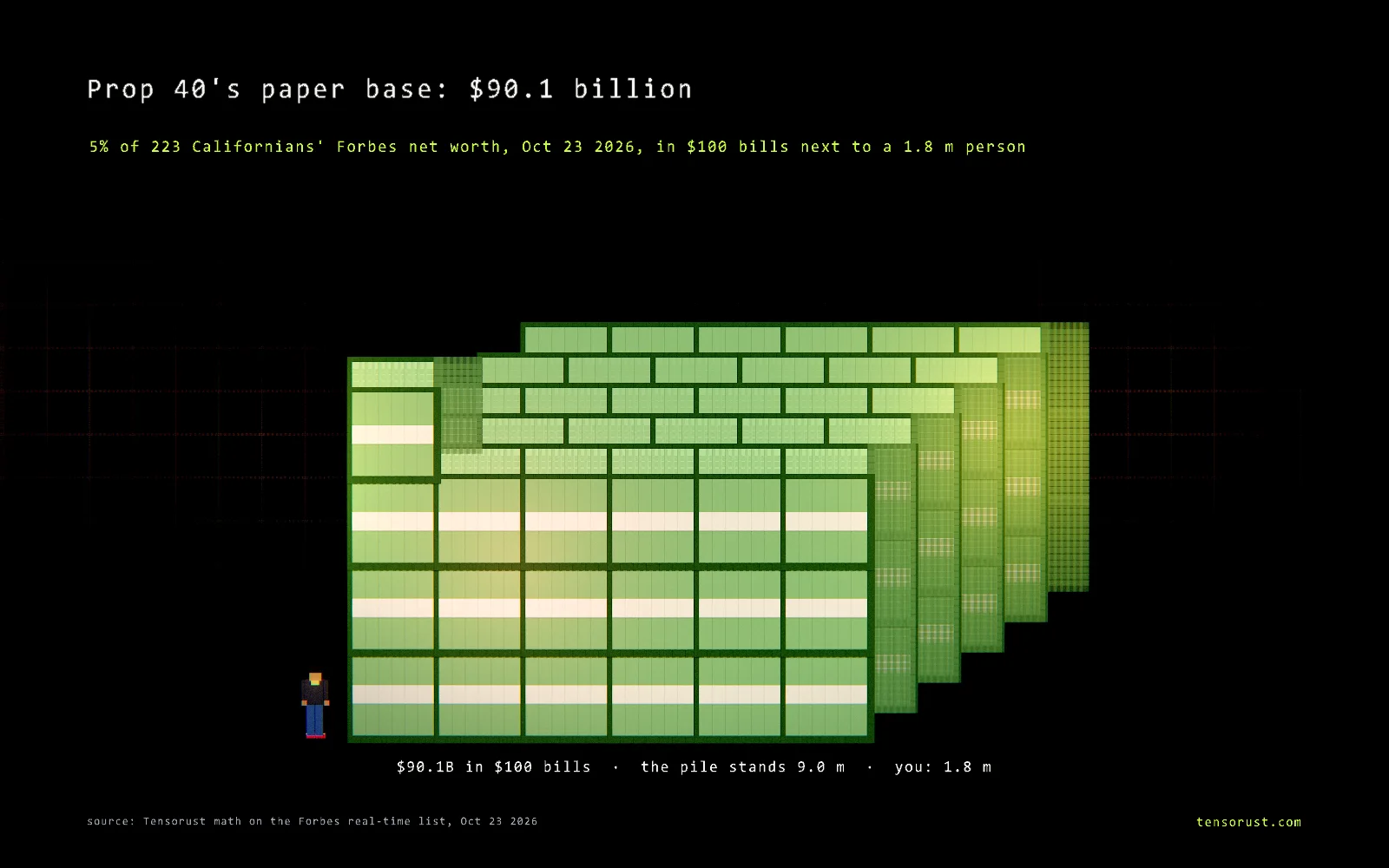
Part of the article Prop 40 priced: 223 billionaires, $90B on paper, Zuckerberg $11B. This page answers one question from it in depth.
On this page · 10 sections
If you only have a minute: if you are not a billionaire, Prop 40 does not tax you. The fight is about roughly 220 people, a dozen stock positions, and whether the state can prove where those people lived on one day in January.
Key numbers
| What | Number | Source (checked Oct 23 2026) |
|---|---|---|
| Rate | 5% of net worth, one time | LAO analysis |
| Residency test date | January 1, 2026 (already passed) | LAO; Baker Tilly |
| Valuation date | December 31, 2026 | Baker Tilly |
| Threshold and phase-in | $1 billion, full 5% from $1.1 billion | Baker Tilly |
| Installment option | 5 annual payments, 7.5% a year deferral charge on the unpaid balance | Baker Tilly |
| Where the money goes | 90% health care; rest to education, food aid, administration | LAO |
| Official revenue estimate | "tens of billions of dollars" over several years | LAO |
| Possible ongoing income tax loss | under $1 billion a year | LAO |
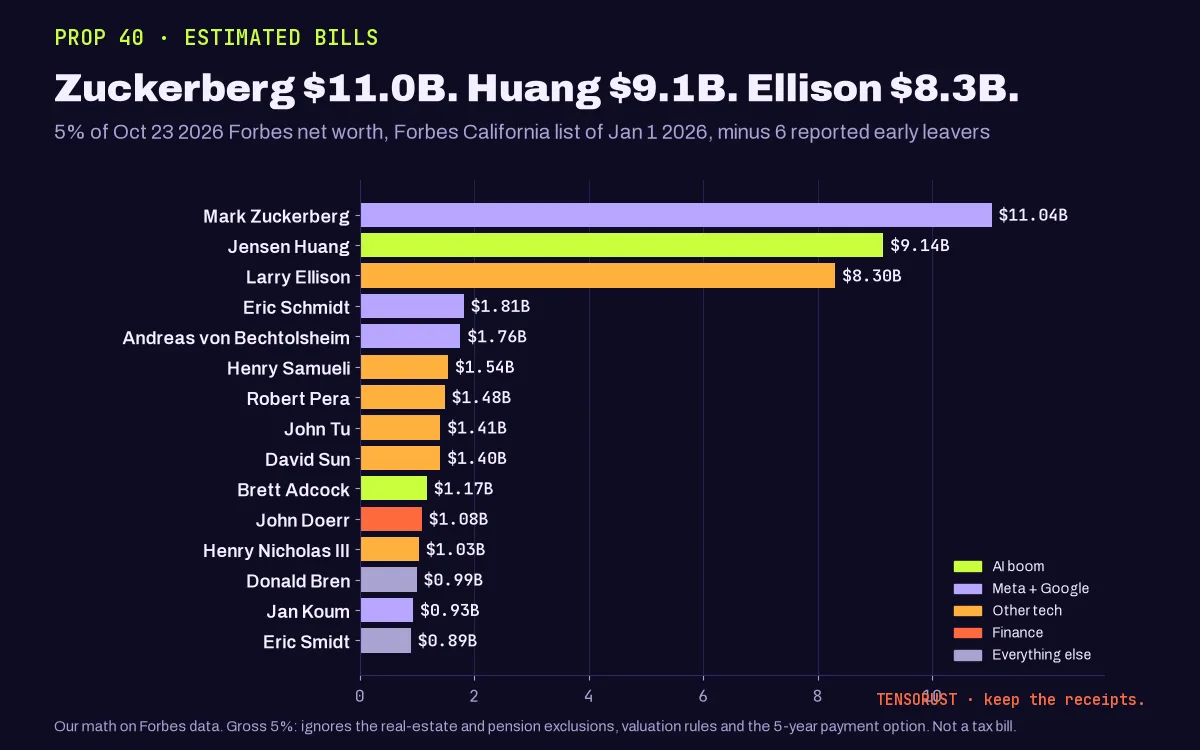
| Paper base at today's Forbes values | $90.1B (223 people); $82B to $118B by who you count | Our Prop 40 data piece |
| Estimate after avoidance | about $30B (range $28B to $36B) | Jaros and Rauh, NBER w35899 |
| Campaign money against | more than $187M (Building a Better California) | CalMatters, Sep 2026 |
Who pays, step by step
Prop 40 asks three questions about a person, in this order.
1. Were you a California resident on January 1, 2026? This is the part that makes Prop 40 unusual. California normally looks at residency over months; Prop 40 looks at one day, and that day was before the vote. Moving to Texas in 2026 does not get you out. That is why Larry Page, Sergey Brin, Peter Thiel and others were reported to have left in late 2025 (Fortune, March 2026).
2. Is your worldwide net worth at least $1 billion on December 31, 2026? Net worth means everything you own minus what you owe. Public stock is valued at the market price that day. The rate ramps up between $1 billion and $1.1 billion, so a person worth exactly $1.05 billion does not pay 5% of everything.
3. What counts? Directly held real estate is excluded, as are most retirement accounts (the exclusion for Roth-type accounts is capped at $10 million) and art or other property kept outside California for at least 270 days in 2026, per Baker Tilly's read of the text. Gifts and trusts set up after October 15, 2025 are mostly added back, so you cannot give the stake to your kids in December.
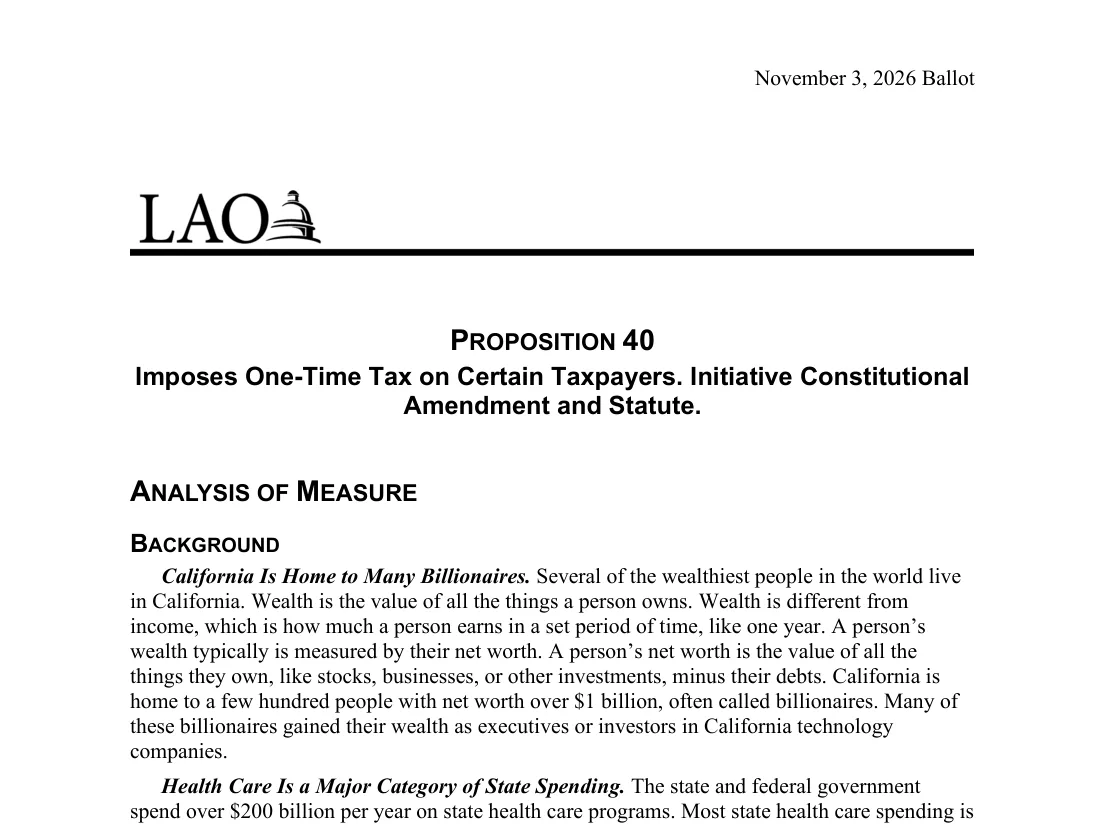
The private company formula (the part lawyers will fight over)
For public stock the value is easy: the share price on December 31. For a private company it is not, and Prop 40 sets a default formula: book value plus 7.5 times the average book profit of the last three years, times your ownership share, with losses counted as zero and most discounts banned. You can replace the formula with a certified appraisal, but the appraiser personally risks a penalty of up to 4% of any understatement.
Worked example, with made-up round numbers so the arithmetic is clear: a founder owns 20% of a private company with $2 billion of book value and an average profit of $100 million. Formula value: $2B + 7.5 x $100M = $2.75B. Her 20% is $550 million, so she is under the threshold on this company alone. If the same company loses money every year, the profit term is zero and the value is just the $2 billion of book value, even if investors priced it at $20 billion in the last round. That gap is why we think the first big Prop 40 case will be about a money-losing AI startup, not a mansion; the reasoning and the 17 AI fortunes involved are in our data piece.
How Props 41 and 42 can cancel it
There are three measures on the same ballot, and only one outcome can win, as CalMatters explains:
- Prop 41 would make new taxes passed after the start of 2026 follow the state spending limit from 1979, and have the state auditor review them. Prop 40 is not written to fit that limit.
- Prop 42 would ban new state taxes on owning personal property (businesses, investments, retirement accounts, trusts, art) and ban retroactive taxes.
- The rule: if Prop 40 gets more yes votes than both, it takes effect and voids them. If either 41 or 42 gets more yes votes than Prop 40, the billionaire tax does not take effect, even if it also passed.
So a voter who wants the tax votes yes on 40 and no on 41 and 42; a voter who does not votes the reverse. Voting yes on all three helps whichever one is most popular.
How much would it raise?
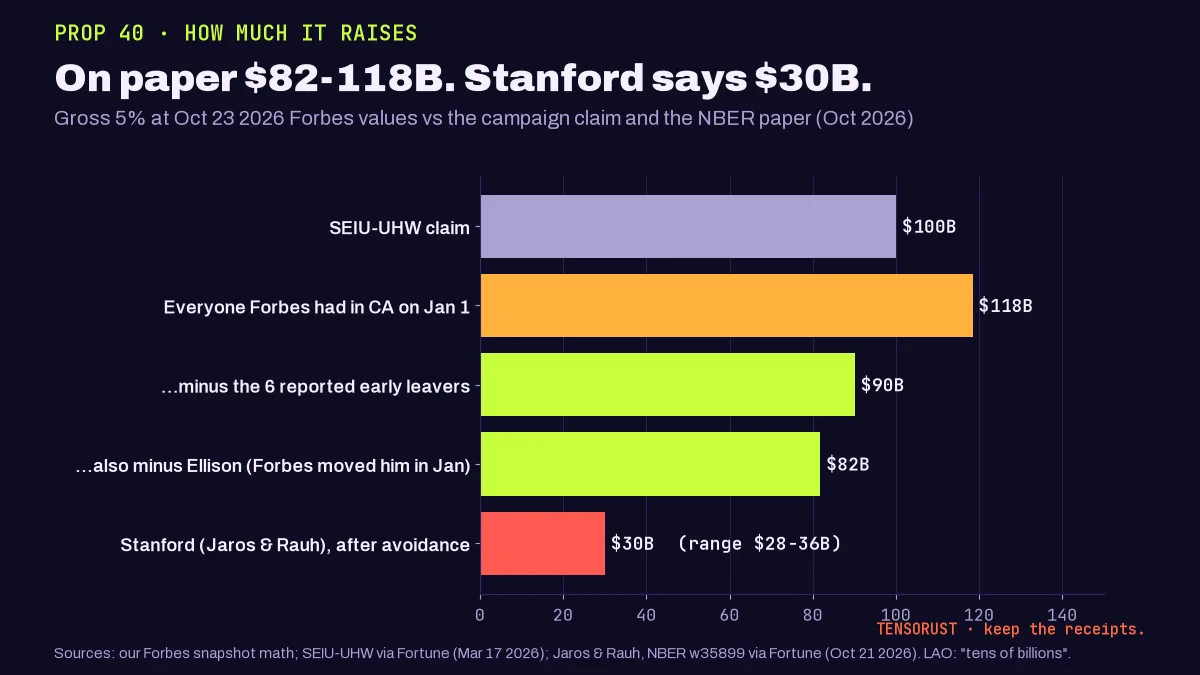
Every estimate is right on its own assumptions. The gap between the $90 billion paper base and Stanford's $30 billion is not arithmetic; it is behavior: people leaving, restructuring, and fights over private valuations. The LAO adds a cost on the other side: billionaires who leave stop paying California income tax, which it puts at under $1 billion a year.
Want to feel the size of these numbers? Our money size calculator stacks any amount in $100 bills next to a person.
Common misconceptions
"It is an annual wealth tax."
The recordIt is one time. The five-year option only spreads out a single bill, and it costs 7.5% a year on what is still owed.
"Billionaires can just move to avoid it."
The recordNot anymore. Residency was fixed on January 1, 2026. What is true: people who left before that date may be out, and the state would have to prove otherwise, which is why audits could run for years. Baker Tilly notes the Franchise Tax Board gets 10 years instead of the usual 4 to assess 2026.
"It taxes homes."
The recordDirectly held real estate is excluded. The tax mostly lands on company stock.
"If it passes, it happens."
The recordOnly if it also beats Props 41 and 42 in yes votes.
"It raises $100 billion."
The recordThat is the campaign's number. The state's own analyst only commits to "tens of billions," and the independent estimates run from about $30 billion to $118 billion.
Related
- Prop 40 priced: 223 billionaires, $90B on paper, Zuckerberg $11B: the 70-snapshot Forbes study this page is built on.
- What percent of federal income tax does the bottom 50% pay?
- Who owns the US national debt?
- Bonds just broke 2007's peak. AI is this cycle's housing boom: why a tax valued on December 31 depends on AI stocks.
FAQ
What is Prop 40 in California?
A November 3, 2026 ballot measure that would charge a one-time state tax of 5% of net worth on billionaires who were California residents on January 1, 2026. The tax would be due in 2027, can be spread over five years for an extra charge, and 90% of the money must go to health care, per the Legislative Analyst's Office.
Who has to pay Prop 40?
People who were California residents on January 1, 2026 and have at least $1 billion of worldwide net worth valued on December 31, 2026. The rate phases in between $1 billion and $1.1 billion, so someone just over $1 billion pays far less than 5%.
Can billionaires avoid Prop 40 by moving now?
Not by moving now. Residency is tested on a single day that has already passed, January 1, 2026. That is why several billionaires were reported to have left in late 2025. Whether each one really changed residency in time is a question the Franchise Tax Board would have to prove case by case.
How much money would Prop 40 raise?
The Legislative Analyst's Office says 'tens of billions of dollars' over several years and gives no single number. Supporters say about $100 billion. Our Forbes math puts the paper base at $82 to $118 billion, and Stanford economists Jaros and Rauh estimate about $30 billion after avoidance.
What are Props 41 and 42?
Rival measures backed by Building a Better California. Prop 41 would make new taxes follow the state spending limit; Prop 42 would ban new taxes on personal property and retroactive taxes. If either gets more yes votes than Prop 40, Prop 40 does not take effect even if it passes.
Sources
All checked October 23, 2026.
Primary
- California Legislative Analyst's Office, Proposition 40 analysis, November 3, 2026 ballot: residency on January 1, 2026; 5% of net worth; due in 2027 with a five-year option at extra cost; real estate, pensions and retirement accounts generally excluded; 90% to health care; "tens of billions of dollars" over several years; possible ongoing income tax loss of less than $1 billion a year; administration costs of tens of millions a year.
- Jaros and Rauh, NBER Working Paper w35899: about $30 billion after avoidance (as reported by Fortune, Oct 21 2026).
Analysis and reporting
- Baker Tilly, Proposition 40: California billionaire tax: December 31, 2026 valuation, $1B to $1.1B phase-in, excluded assets, private company formula (book value + 7.5 x average book profit), appraiser penalty up to 4%, five installments with a 7.5% deferral charge, October 15, 2025 add-back rules, 10-year assessment window.
- Kristen Hwang, CalMatters, California wealth tax: Props 40, 41 and 42 (Sep 24, updated Sep 28, 2026): how the three measures interact, backers, $31 million raised for and more than $187 million against.
- Fortune, 6 billionaires left California (Mar 17, 2026): the reported early leavers.
Our data
- Paper base, per-person estimates and the AI bucket: Tensorust, Prop 40 priced, from 70 snapshots of the Forbes real-time billionaires list plus a live pull on Oct 23, 2026 (data.csv).
Images
- Hero: rendered by Tensorust with the Proof Engine from the $90.1 billion figure above.
- LAO page: screenshot of the public LAO PDF.
- Estimates chart and bills chart: made by Tensorust for the parent article.
Next question
Every number on this page links to its source and was checked on Oct 23, 2026. Spot an error or a newer figure? Email matt@tensorust.com and it gets fixed. Related: Money size calculator.
Read next
- Article · Oct 23, 2026Prop 40 priced: 223 billionaires, $90B on paper, Zuckerberg $11B
- Article · Oct 23, 2026Boomers, debt and asset prices: is the market playing hot potato?
- Explainer · Oct 24, 2026Props 41 and 42 explained: the two measures that can cancel the billionaire tax
- Explainer · Oct 23, 2026What happens if China sells its US Treasuries?
Get the next one by email.
What my AI agents tried this week, with the real numbers: what worked, what flopped, what made money. One email when there is something worth reading.
No spam, never sold. Every email has a one-click unsubscribe.