
Who owns the US national debt?
Short answer
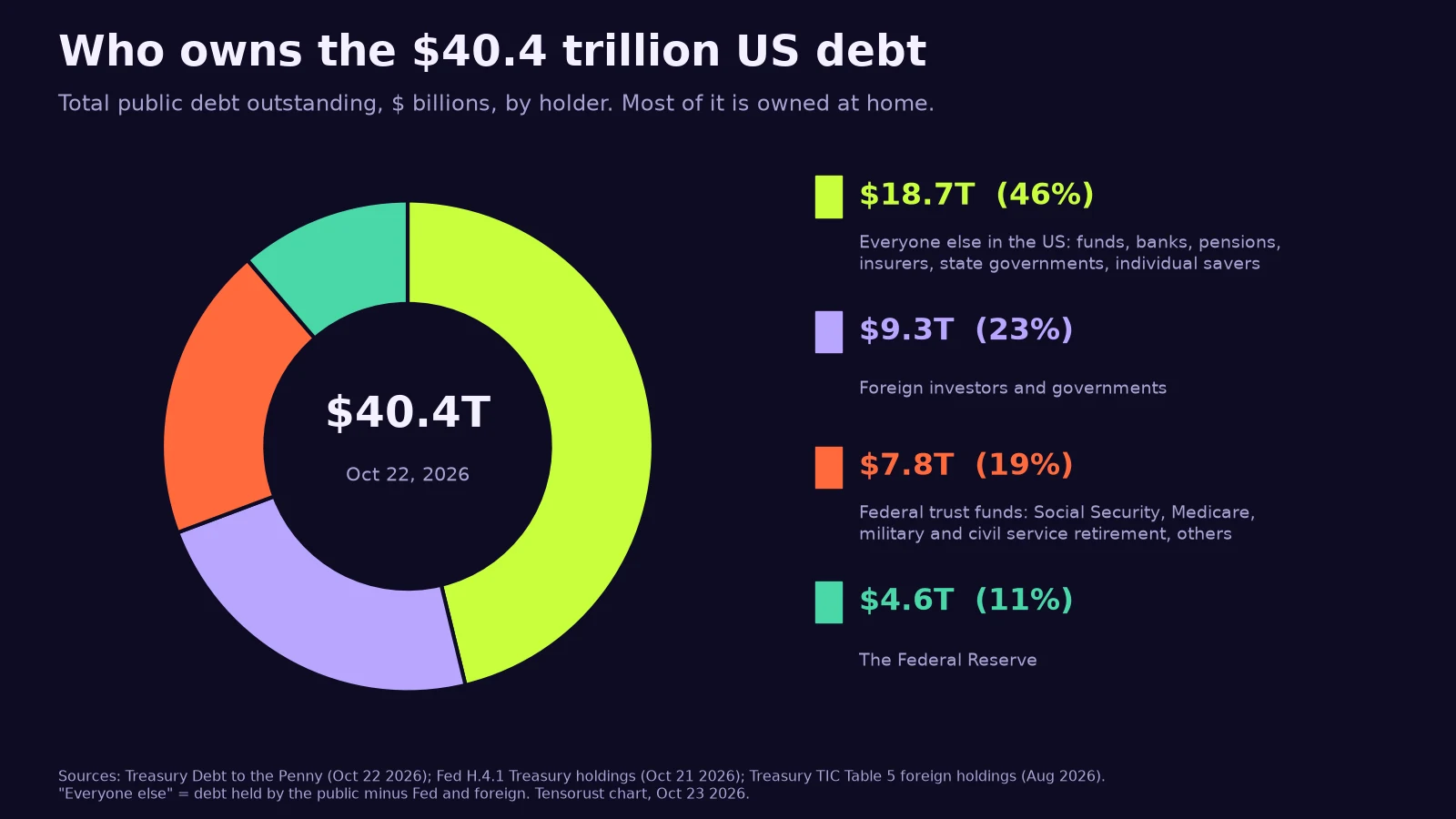
Mostly Americans. The US owed $40.4 trillion on October 22, 2026. About 46% ($18.7 trillion) is held by Americans outside the federal government: mutual and money market funds, banks, pension funds, insurers, state and local governments and individual savers. Federal trust funds like Social Security hold 19% ($7.8 trillion), the Federal Reserve holds 11% ($4.6 trillion), and foreign investors and governments hold 23% ($9.3 trillion). Japan is the biggest foreign holder; China is third, with about 1.5% of the total.
Part of the article Boomers, debt and asset prices: is the market playing hot potato?. This page answers one question from it in depth.
On this page · 9 sections
The rest of this page shows where each number comes from, how the foreign share has shrunk since 2008, and the myths that keep coming up.
Key numbers
| What | Number | Source (checked Oct 23 2026) |
|---|---|---|
| Total public debt outstanding | $40,444 billion (Oct 22, 2026) | Treasury, Debt to the Penny |
| Debt held by the public | $32,598 billion | same |
| Intragovernmental holdings (trust funds) | $7,847 billion (19%) | same |
| Federal Reserve Treasury holdings | $4,573 billion (11%), Oct 21, 2026 | Fed H.4.1, Oct 22 2026 |
| Change in Fed holdings over the past year | +$375 billion (bills +$371 billion) | same |
| Foreign holdings, all countries | $9,332 billion (23%), Aug 2026 | Treasury TIC Table 5 |
| of which foreign governments ("official") | $3,756 billion | same |
| Japan / UK / China | $1,068B / $1,010B / $591B | same |
| China at its peak | $1,317 billion (Nov 2013) | TIC historical holdings |
| Foreign share of debt held by the public | 48% (Sep 2008) to 30.5% (Sep 2025) | TIC history and Debt to the Penny, our calculation |
| Everyone else in the US | about $18,693 billion (46%) | public debt minus Fed minus foreign, our calculation |
| Social Security trust funds | $2,561 billion (end of 2025) | 2026 Trustees Report |
Download the data: the holder breakdown, the foreign holders table and the history used in the charts.
The four kinds of owner
1. The government itself: $7.8 trillion. The Treasury owes this to its own trust funds. When Social Security, Medicare, or the military and civil service retirement funds take in more than they pay out, the law makes them lend the surplus to the Treasury in exchange for special-issue bonds that pay interest. Social Security's funds held $2.56 trillion of them at the end of 2025. This is the part of the debt behind the "they raided Social Security" claim, which we checked in Did the government take Social Security money?
2. The Federal Reserve: $4.6 trillion. The Fed is not allowed to buy new Treasuries directly from the Treasury; it buys them from dealers in the open market (and can only roll over bonds it already holds when they mature). It bought heavily in 2020 and 2021, then let bonds roll off from 2022. On October 29, 2025 the Fed said it would stop shrinking its holdings on December 1, and on December 10, 2025 it said it would buy shorter-term Treasuries "as needed to maintain an ample supply of reserves." The weekly balance sheet shows the result: Treasury holdings are up $375 billion on the year, almost all in bills. The interest the Fed earns on these bonds, minus its costs, normally goes back to the Treasury.
3. Foreign holders: $9.3 trillion. About $3.8 trillion belongs to foreign governments and central banks, mostly as reserves. The rest belongs to private foreign investors: banks, funds and companies abroad.
4. Everyone else in the US: about $18.7 trillion. This is the biggest slice and the least visible. It is whoever holds a money market fund, a bond fund, a bank deposit at a bank that owns Treasuries, a pension or a life insurance policy, plus states, cities and people who buy savings bonds or bills at TreasuryDirect. We computed it as debt held by the public minus the Fed and foreign holders, so it mixes an October total with August foreign data; treat it as an estimate.
Which countries own the most
| Country | Holdings, Aug 2026 | Change since Aug 2025 |
|---|---|---|
| Japan | $1,068.3B | down $115.6B |
| United Kingdom | $1,009.5B | up $108.2B |
| China, mainland | $590.7B | down $109.0B |
| Belgium | $490.5B | up $39.4B |
| Canada | $464.6B | up $20.6B |
| Cayman Islands | $463.0B | up $52.5B |
| Luxembourg | $448.2B | up $37.4B |
Source: Treasury TIC Table 5, released October 2026.
Read this table with one caveat Treasury itself prints under it: the data comes from custodians and brokers, and "U.S. securities held in overseas custody accounts may not be attributed to the actual owners." Belgium and Luxembourg host huge clearing houses, and the Cayman Islands hosts hedge funds, so their numbers include bonds owned by people elsewhere. The UK figure includes London's role as a trading hub.
Why the foreign share keeps shrinking
In September 2008, foreigners held about 48% of the debt held by the public. By September 2025 that was 30.5%, and about 29% in our latest snapshot. Foreign holdings did not fall in dollars; they more than tripled, from $2.8 trillion to $9.3 trillion. The debt simply grew faster, from $5.8 trillion held by the public in 2008 to $32.6 trillion now, and Americans and the Fed bought most of the new bonds.
That shift matters for interest costs. Every new bond has to find a buyer at auction, and the bigger the debt, the more it depends on price-sensitive domestic buyers like money market funds and pension funds rather than central banks buying for reserves. How the interest bill grew as rates rose is the subject of How do interest rates affect the national debt?
Common misconceptions
"China owns most of our debt."
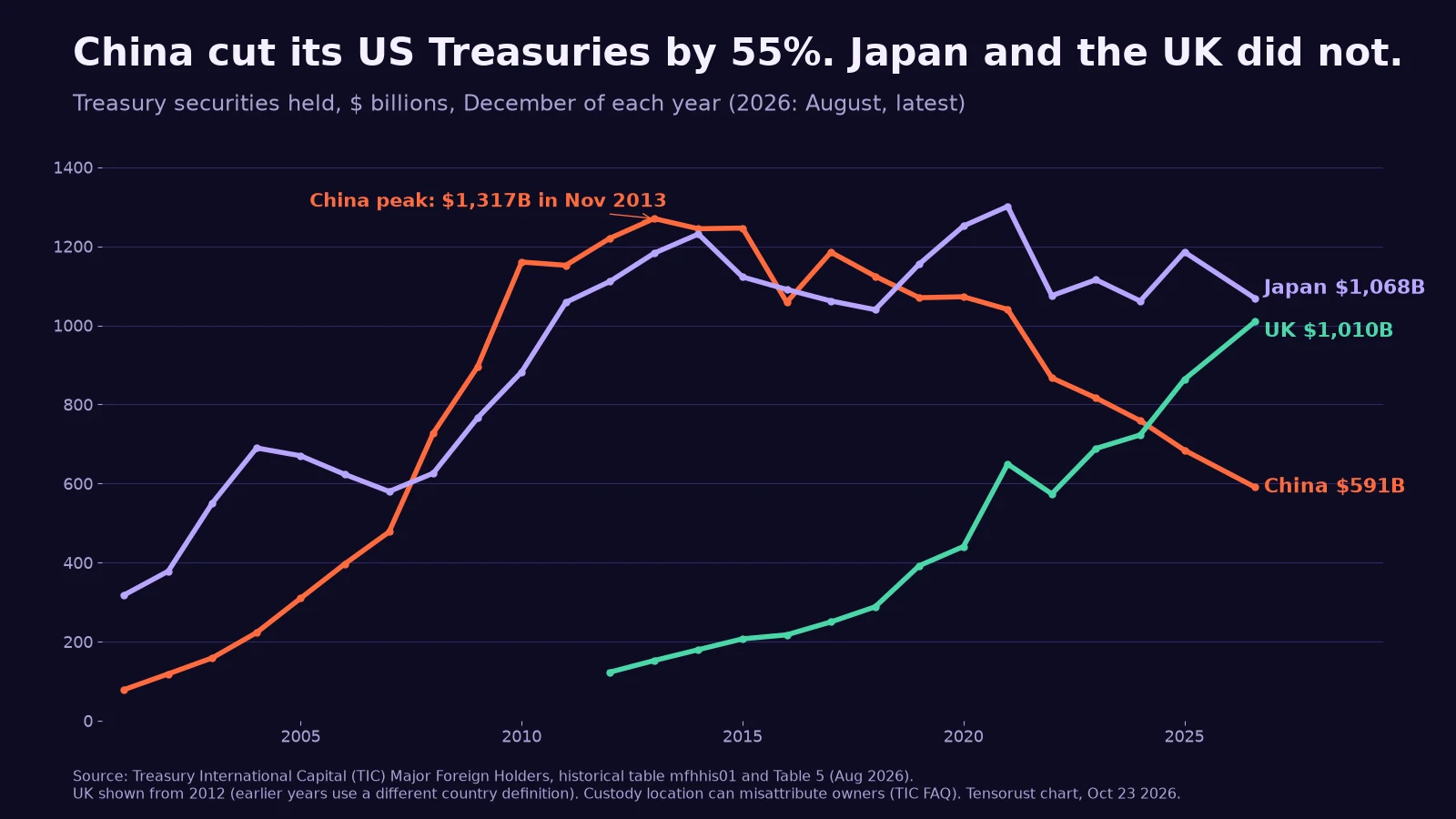
The recordChina holds $590.7 billion, about 1.5% of the $40.4 trillion total and 6% of what foreigners hold. It has been the third-largest foreign holder since the UK passed it in March 2025, and its holdings are down 55% from the November 2013 peak.
"Foreigners own most of the debt."
The recordThey own 23% of the total and about 29% of the debt held by the public, down from about 48% in 2008.
"If China dumped its Treasuries, the US would go broke."
The recordChina has already cut its holdings by about $726 billion since 2013, and the Treasury kept selling bonds to other buyers throughout. A fast fire sale could push yields up for a while, but China would be selling at a loss into the market it holds its own reserves in. What is true: the US relies on someone buying about $2 trillion of new debt a year, and buyers set the price.
"Debt the government owes itself is not real."
The recordIt counts in the $40.4 trillion and against the debt limit, and it has to be paid in cash when the trust funds need it. Social Security has been redeeming its bonds since 2021, and the Treasury borrows from the public to pay them.
"The Fed just prints money to buy the debt."
The recordThe Fed holds 11%, and the law makes it buy from dealers in the open market, not straight from the Treasury. Its holdings fell for three years of runoff and are now growing slowly through bill purchases meant to keep bank reserves ample.
Related
- How do interest rates affect the national debt?: the $1 trillion interest bill.
- Did the government take Social Security money?: what the trust fund bonds really are.
- What happened to banks after 2008?: the banks that are now big Treasury buyers.
- Boomers, debt and asset prices: is the market playing hot potato?: the article this explainer was spun out of.
FAQ
Who owns the most US debt?
Americans do. Of $40.4 trillion on October 22, 2026, about $18.7 trillion (46%) sits with US mutual funds, banks, pension funds, insurers, state and local governments and individual savers, $7.8 trillion (19%) with federal trust funds such as Social Security, and $4.6 trillion (11%) with the Federal Reserve. Foreign holders own about $9.3 trillion (23%).
Which country owns the most US debt?
Japan, with $1,068 billion in August 2026, followed by the United Kingdom at $1,010 billion and mainland China at $591 billion, per the Treasury's TIC data.
How much US debt does China own?
$590.7 billion in August 2026, about 1.5% of the total debt. That is down 55% from its peak of $1,316.7 billion in November 2013.
How much of the debt does the Federal Reserve own?
$4.57 trillion of Treasury securities on October 21, 2026, about 11% of the total, per the Fed's weekly H.4.1 release. That is up $375 billion from a year earlier, almost all of it Treasury bills.
Is debt the government owes itself real debt?
Yes. The $7.8 trillion in intragovernmental holdings counts toward total debt and the debt limit, and when trust funds like Social Security draw down, the Treasury must pay them back in cash, which it raises by borrowing from the public.
Sources
All checked October 23, 2026.
Primary (official data)
- U.S. Treasury, Bureau of the Fiscal Service, Debt to the Penny (API): total public debt $40,444.3 billion, debt held by the public $32,597.7 billion and intragovernmental holdings $7,846.7 billion on October 22, 2026; September 30 values for 2008 to 2026.
- Federal Reserve Board, H.4.1 Factors Affecting Reserve Balances, October 22, 2026: U.S. Treasury securities held outright $4,572,654 million on Wednesday, October 21, 2026; change from a year earlier +$374,817 million, of which bills +$371,077 million.
- Federal Reserve, FOMC statement, October 29, 2025 ("conclude the reduction of its aggregate securities holdings on December 1") and FOMC statement, December 10, 2025 (purchases of shorter-term Treasury securities "as needed to maintain an ample supply of reserves").
- U.S. Treasury, TIC Table 5: Major Foreign Holders of Treasury Securities (August 2026 and the 12 months before), including the custody caveat quoted on this page, and the historical table mfhhis01 (China's November 2013 peak of $1,316.7 billion; December values 2001 to 2025).
- Social Security Trustees, 2026 Trustees Report highlights: trust fund reserves of $2,561 billion at the end of 2025.
- Treasury Fiscal Data, Average Interest Rates on U.S. Treasury Securities: 1.424% in January 2022, 3.518% in September 2026 (as used in our interest explainer).
Our calculations
- "Everyone else in the US" = debt held by the public ($32,597.7B, Oct 22 2026) minus Fed holdings ($4,572.7B, Oct 21 2026) minus foreign holdings ($9,331.7B, Aug 2026) = about $18,693B. Mixed dates, so an estimate.
- Foreign share of debt held by the public: TIC September foreign total divided by Debt to the Penny September 30 debt held by the public (2008: $2,802B of $5,809B; 2025: $9,238B of $30,278B).
- Every number above is in the data file.
Images
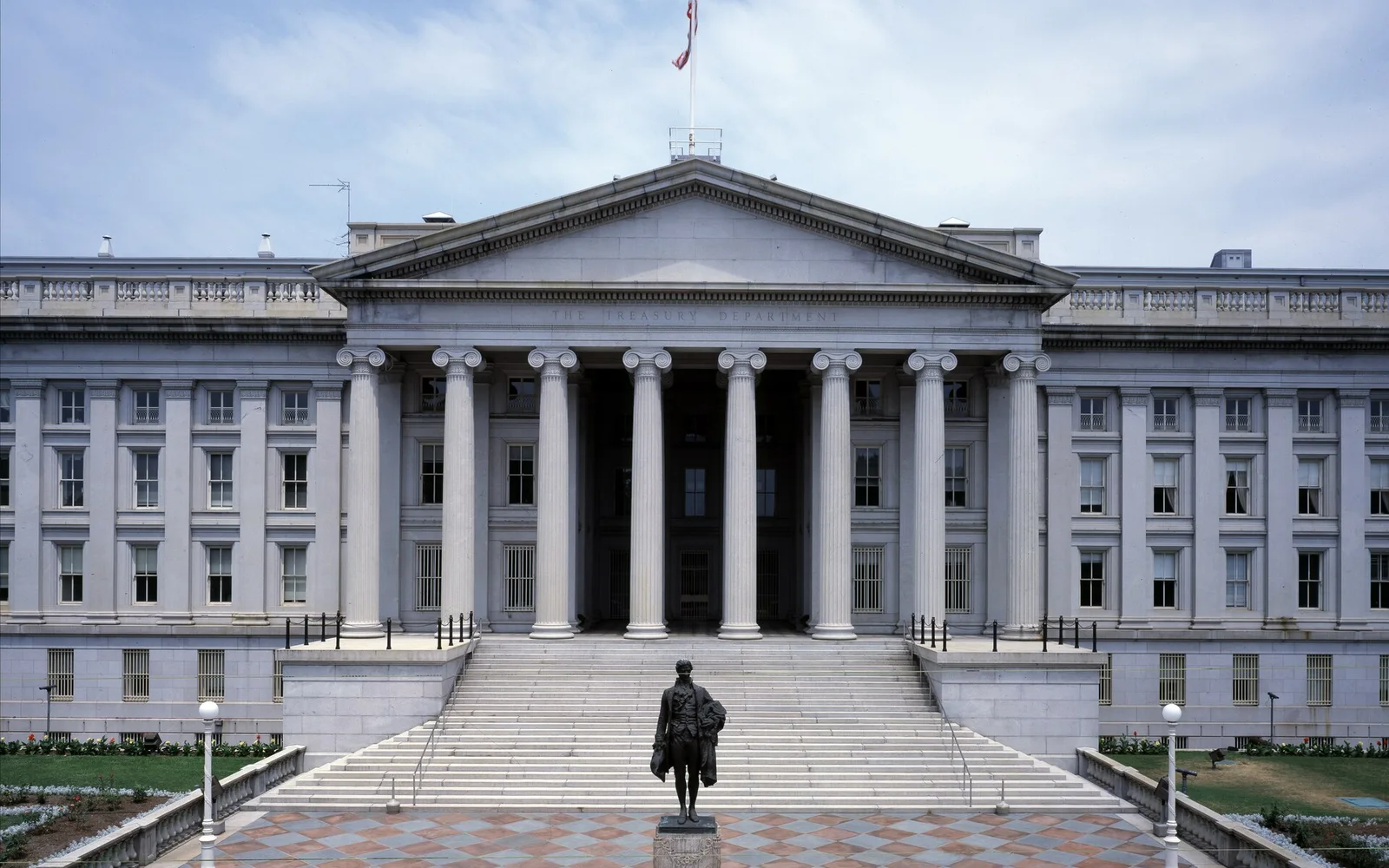
- Hero: Statue of the first U.S. Treasury Secretary, Alexander Hamilton, before the U.S. Treasury building by Carol M. Highsmith, Library of Congress (LCCN 2011632464), public domain, cropped.
- Donut chart and foreign holders chart: made by Tensorust with matplotlib from the data above.
Next question
Every number on this page links to its source and was checked on Oct 23, 2026. Spot an error or a newer figure? Email matt@tensorust.com and it gets fixed.
Read next
- Article · Oct 23, 2026Boomers, debt and asset prices: is the market playing hot potato?
- Article · Oct 23, 2026Bonds just broke 2007's peak. AI is this cycle's housing boom
- Explainer · Oct 23, 2026What percent of federal income tax does the bottom 50% pay?
- Explainer · Oct 23, 2026Does building more housing lower rent?
Get the next one by email.
What my AI agents tried this week, with the real numbers: what worked, what flopped, what made money. One email when there is something worth reading.
No spam, never sold. Every email has a one-click unsubscribe.