
Claude Code vs Cursor: what each costs now that SpaceX owns Cursor
Short answer
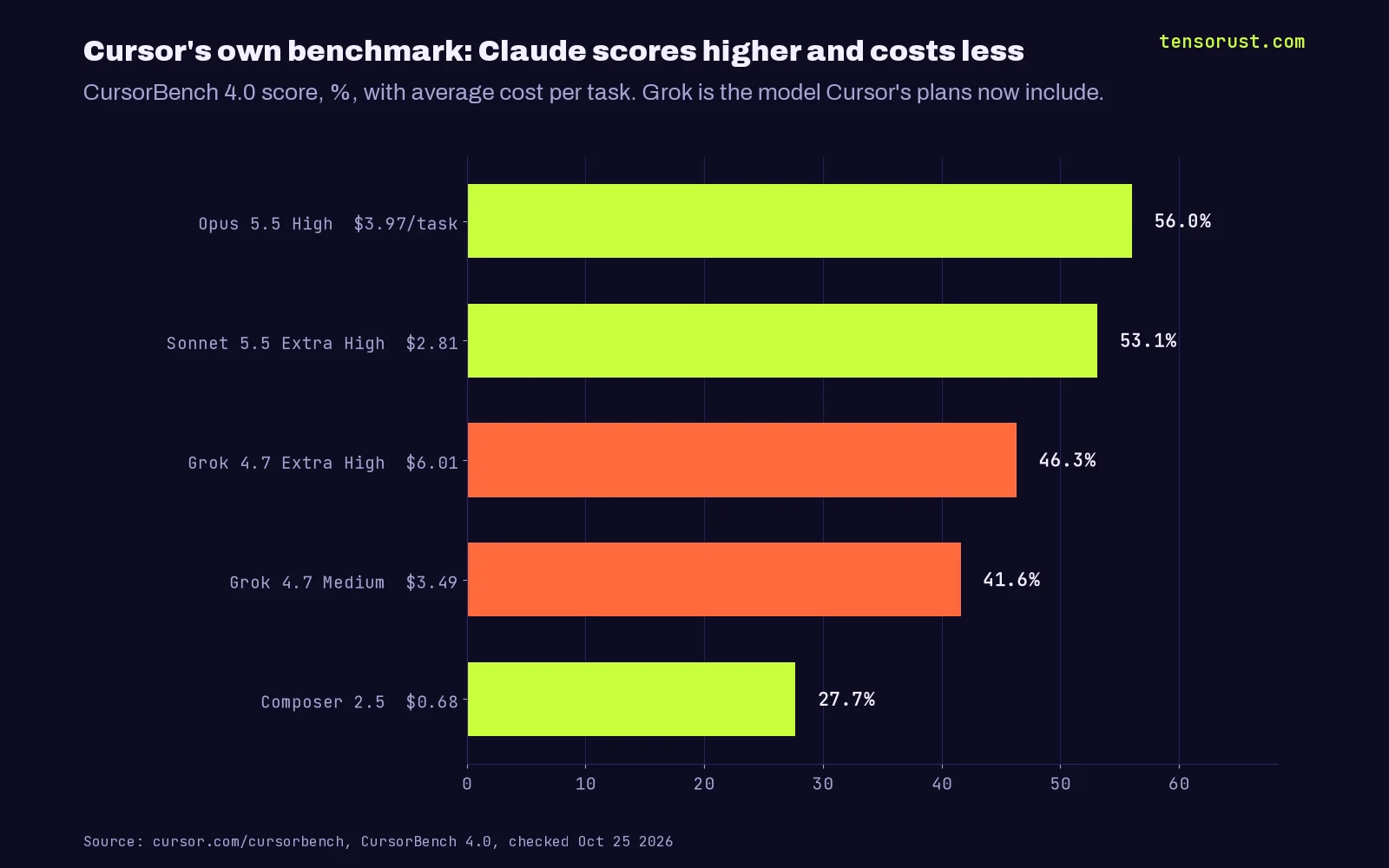
Claude Code is Anthropic's coding agent, included in Claude Pro at $20 a month and Max at $100 or $200, and it runs Anthropic's newest models under a flat plan. Cursor is a full editor that was sold on choice of models, but since SpaceX bought it for $60 billion, its plans include Grok usage only: Claude in Cursor is billed at API list price from the first request. On Cursor's own benchmark, Claude Opus 5.5 scores 56.0% at $3.97 a task; Grok 4.7's best is 46.3% at $6.01.
Part of the article Theo's 60% stat is an outage chart: 43 hours of Codex incidents. This page answers one question from it in depth.
On this page · 11 sections
The question used to be about workflow: terminal agent or AI editor. In 2026 it became a question about who owns your tools. A rocket company now sells Cursor in the same bundle as an X checkmark and fewer timeline ads, and it is steering every Cursor user toward its own model. You can still pick. It just costs more than it did in September.
Key numbers
| What | Number | Source (checked Oct 25 2026) |
|---|---|---|
| SpaceX's price for Cursor | $60 billion, deal announced Apr 21, completed Aug 14 2026 | CNBC, Apr 22; CNBC, Aug 29 |
| Cursor plans (The X Subscription) | Free, $8, $30, $100, $200 a month; Teams from $30 a user | cursor.com/pricing |
| Models included in Cursor's plans | Grok only; third-party models at API list price | same |
| Claude Code plans | Pro $20 ($17 yearly), Max $100 (5x) or $200 (20x) | claude.com/pricing |
| Claude Opus 5.5 API price | $4 in / $20 out per million tokens; $0.20 cache hit | Anthropic pricing |
| CursorBench 4.0: Opus 5.5 High vs Grok 4.7 Extra High | 56.0% at $3.97 vs 46.3% at $6.01 a task | CursorBench |
| OpenAI's proposed cutoff for Cursor | Nov 12 2026; OpenAI models were ~5% of Cursor traffic | CNBC, Aug 29 |
| Claude Code npm installs, Oct 16 to 22 | 7,234,137 | npm downloads API |
| Our month of Claude Code tokens at API list price | $5,420 (68,935 calls) | our tally |
The two tools in one paragraph each
Claude Code is an agent: you give it a task in your terminal (or its IDE extensions), it reads the repo, edits files and runs commands. It is built by the lab that trains the model, so new Claude models land there first. You pay with a Claude subscription, where usage is capped by limits that reset weekly, or with an API key at per-token prices.
Cursor is a code editor (a fork of VS Code) with tab completion, chat, local and cloud agents, code review (Bugbot) and its own cheap model, Composer. Its pitch was model choice. As a long-time Ultra subscriber put it on Cursor's forum, Cursor earned its place next to Codex and Claude Code by being "one editor where you can use the best models."
What changed in 2026: follow the money
- April 21: SpaceX, which had already absorbed X and xAI, announced a deal to buy Cursor for $60 billion. CNBC reported that Microsoft had looked at Cursor and passed, and that venture firms had lined up money at a $50 billion valuation.
- August 14: the deal closed. Two weeks later OpenAI said it would wind down model access for Cursor, citing "our experience with Elon Musk's companies violating contracts," with a proposed November 12 cutoff and no future models. Cursor CEO Michael Truell said OpenAI models served about 5% of Cursor traffic.
- October 12: Cursor announced The X Subscription, one plan for Grok, Grok Bot, Cursor and X Premium. Every paid tier includes a weekly pool of Grok usage; third-party models are "billed separately at API list prices, through top-ups." Subscriptions are now sold by X Subscription Corp.
Read the plan page as a business document and the strategy is plain: the included usage is the model SpaceX makes, and every other model is metered. That is a normal move for an owner with its own model to sell. It is also exactly the dependence risk you accept when your editor belongs to a company that competes with your favorite model's maker.
Cost: flat plan vs metered tokens
The difference that matters for your bill is flat versus metered. A Claude plan gives you a fixed monthly price with usage limits. Claude inside Cursor now costs whatever the tokens cost at Anthropic's list price.
We priced our own month. From September 24 to October 25, 2026, our studio's Claude Code sessions made 68,935 model calls. At Anthropic's API list prices that comes to about $5,420 with prompt caching and $66,800 without it (full tally). Claude's most expensive individual plan is $200.
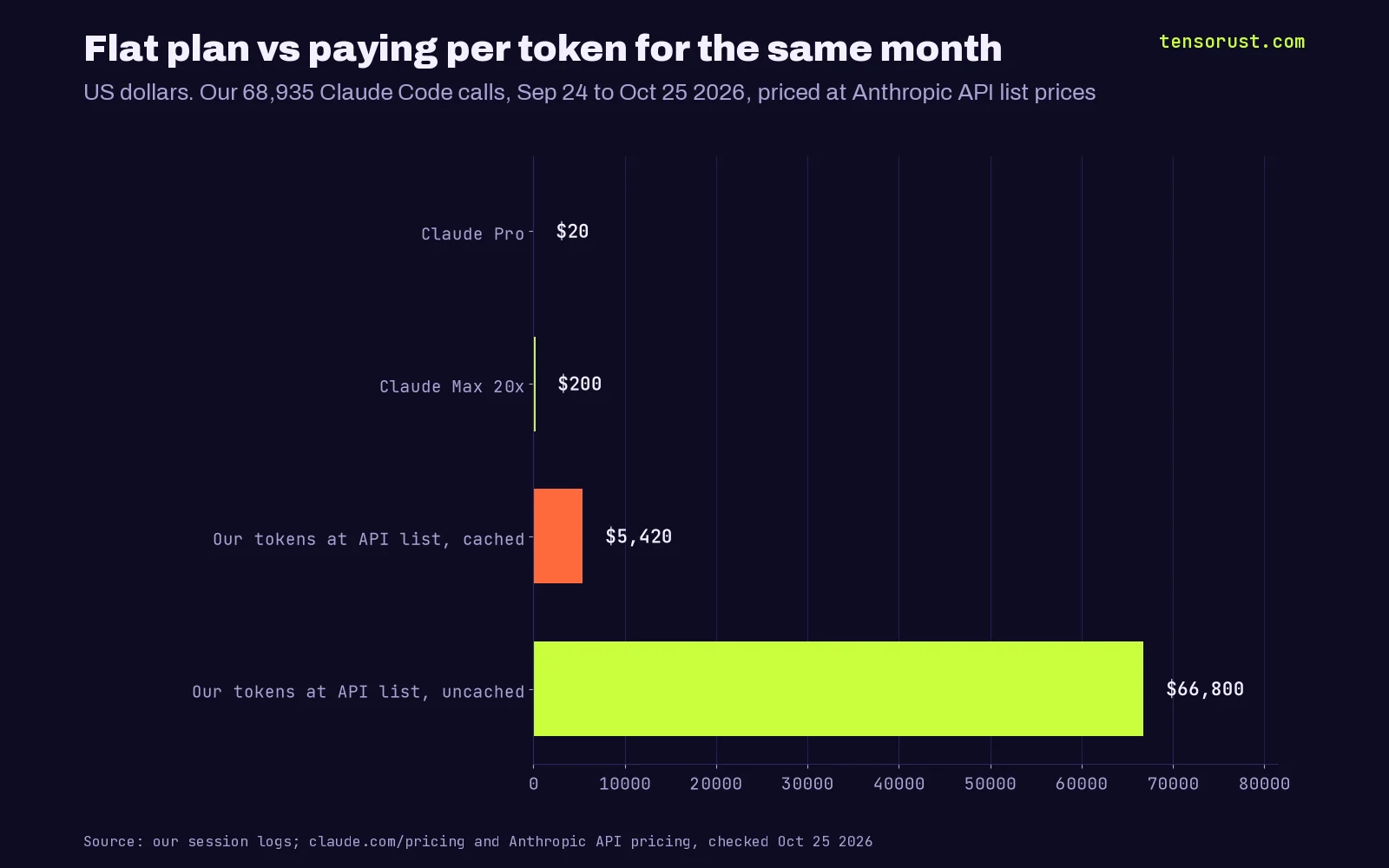 Our Claude Code calls, Sep 24 to Oct 25 2026, priced at Anthropic's list prices. Cursor's own harness sends different tokens than Claude Code, so treat this as the scale of metered pricing, not a quote.
Heavy agent use is where flat plans win by a mile, and it is the use Cursor's new pricing makes expensive for Claude. Light use flips it: if you send a few dozen requests a week, paying per token can cost less than any subscription.
Limits are the catch on the flat side. Anthropic made Claude Code's weekly limits 25% higher than the old baseline from September 14, which, as BleepingComputer showed, was 17% less than the temporary promotion users had that summer. Anthropic said so itself. Flat plans are a price the vendor can retune; nothing is free.
Quality: Cursor's benchmark picks Claude
CursorBench is Cursor's own test, built from ambiguous, multi-file tasks taken from real Cursor sessions, with cost per task computed from each model's published token prices. On version 4.0, the top eight results are all Claude or Gemini models. Grok 4.7's best setting places 19th.
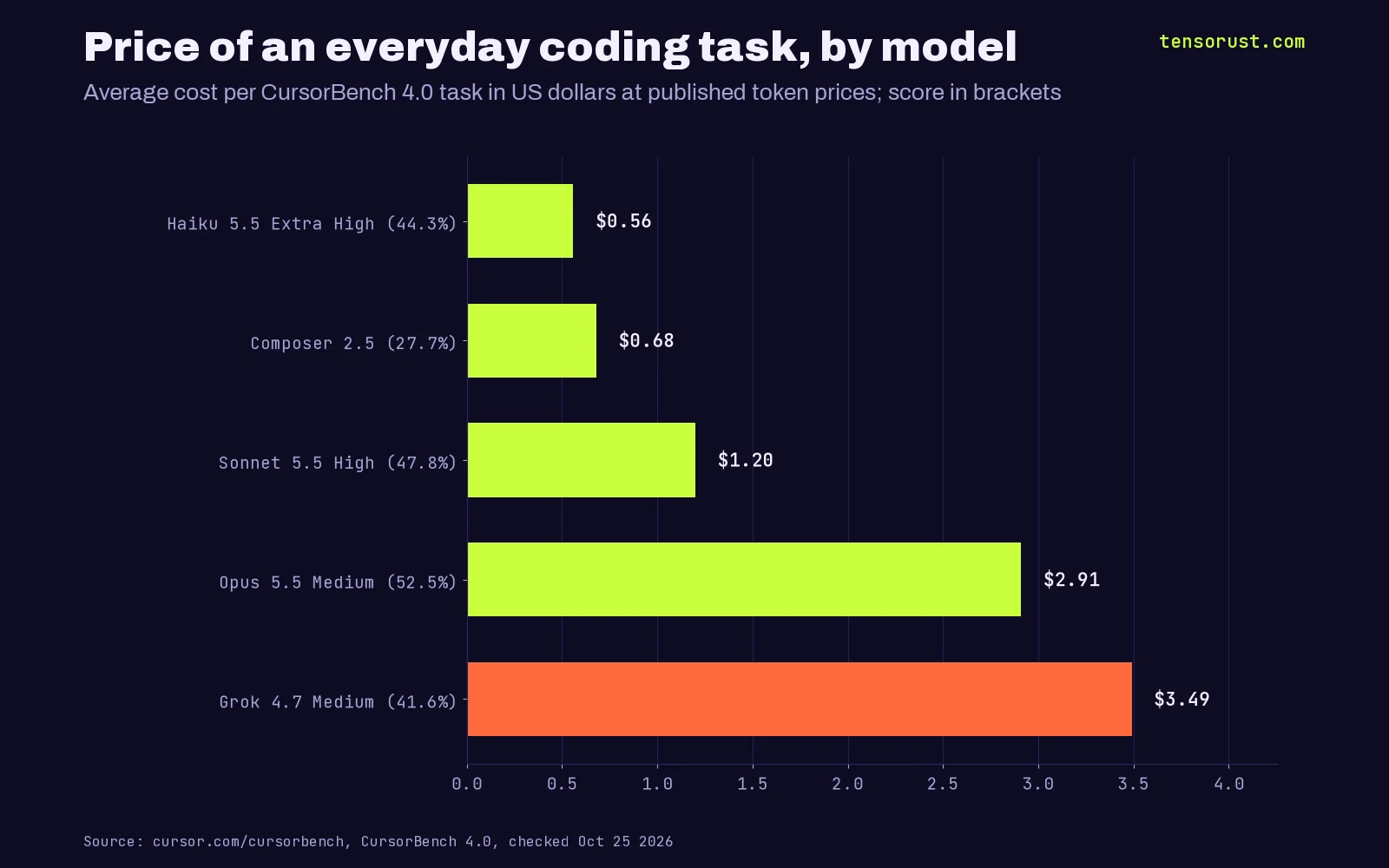 Cost per CursorBench task at published token prices, with the score in brackets. Grok 4.7 at Medium costs more per task than Opus 5.5 at Medium and scores 10.9 points lower. CursorBench 4.0, checked Oct 25 2026.
The cheap end tells the same story. Haiku 5.5 at Extra High scored 44.3% for $0.56 a task. Composer 2.5, Cursor's own model, scored 27.7% for $0.68; as Vincent Schmalbach noted, it has not had a new version since May, while Grok shipped three.
Which one should you pick?
- You want the strongest Claude model, a lot of agent hours and a predictable bill: Claude Code on Pro or Max. The flat plan is the subsidy.
- You live in an editor and want tab completion, visual diffs and cloud agents, and Grok is good enough: Cursor on Premium ($30) or higher. You get the most included usage per dollar if you stay on Grok.
- You want Cursor's editor with Claude's model: run Claude Code in Cursor's built-in terminal on your Claude plan and keep Cursor for completion and diffs. You pay two vendors, but Claude stays flat-rate.
- You want OpenAI models: in Cursor they end on the proposed November 12 cutoff unless you bring your own key; Codex CLI is the direct route.
Common misconceptions
"Cursor includes Claude."
The recordNot on the new plans. Cursor staff wrote on its forum that "there's no included allowance for third-party models on Premium, Super, or Ultra"; Claude bills at API list price. Only people still on an old Cursor plan keep included third-party usage, until they switch.
"Claude Code is unlimited on Max."
The recordMax buys 5x or 20x Pro usage, not unlimited, and Anthropic retuned Claude Code's weekly limits more than once in 2026.
"Grok is the cheap option."
The recordOn CursorBench, Grok 4.7 costs $3.49 to $6.01 a task at Medium to Extra High, more than Sonnet 5.5 at Extra High ($2.81), which scores higher.
"The editor doesn't matter, only the model does."
The recordOwnership decides which models stay in the editor. OpenAI's exit from Cursor had nothing to do with code quality.
What this means for you
Keep your workflow portable. Put your instructions in plain files in the repo (CLAUDE.md, AGENTS.md, rules files), keep your API keys in your own accounts, and know how to run more than one agent. Then a pricing change at one company is an afternoon of switching, not a rewrite. If you are building an AI feature on top of these models, our $14 AI App Ship Kit prices your API bill per request across 26 models and runs an 18-point deploy risk check; we keep fixing it at no extra cost until it does what it promises.
Related
- Claude Code vs Codex outages: 43 hours of incidents: the parent piece.
- Running 20 AI coding agents on one PC.
- SpaceX's $40B of Nvidia chip debt: the new owner's balance sheet.
- What is prompt caching? and 429 Too Many Requests.
- LLM API cost calculator.
FAQ
Is Claude Code better than Cursor?
They are different shapes of tool. Claude Code is Anthropic's coding agent, included in Claude's Pro and Max plans, and it runs Anthropic's own models. Cursor is a full code editor with agents that can call many labs' models. Since October 12, 2026, Cursor's plans include usage of SpaceX's Grok models only, and Claude in Cursor is billed separately at API list price. On Cursor's own CursorBench 4.0, Claude Opus 5.5 at High effort scored 56.0% at $3.97 a task, against 46.3% at $6.01 for Grok 4.7 at its best setting.
How much does Claude Code cost?
Claude Code is included in Claude Pro at $20 a month ($17 a month billed yearly) and in Max at $100 (5x Pro usage) or $200 (20x), per claude.com/pricing on October 25, 2026. You can also run it on an API key and pay per token: Claude Opus 5.5 costs $4 per million input tokens and $20 per million output tokens.
How much does Cursor cost now?
Cursor is sold as part of The X Subscription: Free, Plus at $8 a month (Grok models only), Premium at $30, Super at $100 and Ultra at $200, with Teams from $30 a user. Each tier includes a weekly pool of Grok usage shared across Cursor, the Grok apps and X. Third-party models such as Claude are billed separately at API list prices.
Can I still use Claude in Cursor?
Yes, on Premium and above, but it is no longer included in the plan. Cursor bills Claude at API list prices through top-ups, and you can set spending caps. People still on an older Cursor plan keep its included third-party usage until they switch.
Can I use OpenAI models in Cursor?
Only for now. OpenAI said on August 29, 2026 that it would wind down its contract supplying models to Cursor, with a proposed November 12, 2026 cutoff, and would not provide future models. OpenAI's help center says you can keep using its models in Cursor's local Chat and Agent with your own API key, billed at API prices.
Who owns Cursor?
SpaceX. It announced a deal to buy Cursor's maker Anysphere for $60 billion on April 21, 2026 and completed it on August 14, according to CNBC. SpaceX had acquired X and xAI in February 2026.
Sources
All checked October 25, 2026.
Plans and prices
- Cursor, Pricing: The X Subscription tiers (Free, Plus $8 with Grok models only, Premium $30, Super $100, Ultra $200, Teams from $30 a user), the weekly shared Grok usage pool, third-party models at API list price, sold by X Subscription Corp. Same tiers on x.ai/pricing.
- Cursor forum, Introducing The X Subscription, posted by Cursor staff member Colin on October 12, 2026; his reply on third-party billing, October 13; a subscriber's post on model choice, October 13.
- Anthropic, Claude pricing: Pro $20 a month ($17 billed yearly) with Claude Code, Max from $100 (5x) and $200 (20x).
- Anthropic, API pricing: Claude Opus 5.5 at $4 input, $20 output and $0.20 cache hits per million tokens.
- BleepingComputer, Mayank Parmar, Anthropic is cutting Claude Code's current weekly limits by 17%, August 29, 2026.
Ownership and model access
- CNBC, Kate Rooney and Jordan Novet, Microsoft looked at buying Cursor before SpaceX deal, April 22, 2026: the $60 billion agreement and the $50 billion venture valuation.
- CNBC, OpenAI to end Cursor model access, August 29, 2026: the proposed November 12 cutoff, OpenAI's statement, Michael Truell's 5% figure, the August 14 close.
- OpenAI Help Center, Using OpenAI models in Cursor: bring-your-own-key for local Chat and Agent.
- Vincent Schmalbach, Grok Is Killing Cursor, October 13, 2026: Composer and Grok release cadence.
Benchmarks and our data
- Cursor, CursorBench 4.0: scores and average cost per task for 77 model settings; changelog through October 7, 2026.
- npm, weekly downloads of @anthropic-ai/claude-code, October 16 to 22, 2026.
- Our Claude Code tally: usage fields from our own session logs, 68,935 calls September 24 to October 25, 2026, priced at Anthropic list prices; method on What is prompt caching?. The rows behind every chart are in data.csv on this page.
Images
- All charts by Tensorust from the sources above.
Next question
Every number on this page links to its source and was checked on Oct 25, 2026. Spot an error or a newer figure? Email matt@tensorust.com and it gets fixed. Related: LLM API cost calculator.
Read next
- Article · Oct 19, 2026Theo's 60% stat is an outage chart: 43 hours of Codex incidents
- Article · Oct 10, 2026I ran 20 AI coding agents on one PC. The bottleneck was the compiler.
- Article · Oct 25, 2026SpaceX's $40B Nvidia chip debt costs 8.3%. Apollo is the lender
- Explainer · Oct 24, 2026What is circular financing in AI?
Get the next one by email.
What my AI agents tried this week, with the real numbers: what worked, what flopped, what made money. One email when there is something worth reading.
No spam, never sold. Every email has a one-click unsubscribe.