
By Matt Busel, who built the apps, crates and game he writes about · every number links to its source and every dataset is downloadable (methods) · corrections · featured in Kirino, gamebiz, This Week in Rust, New Mobile Life, By-Press
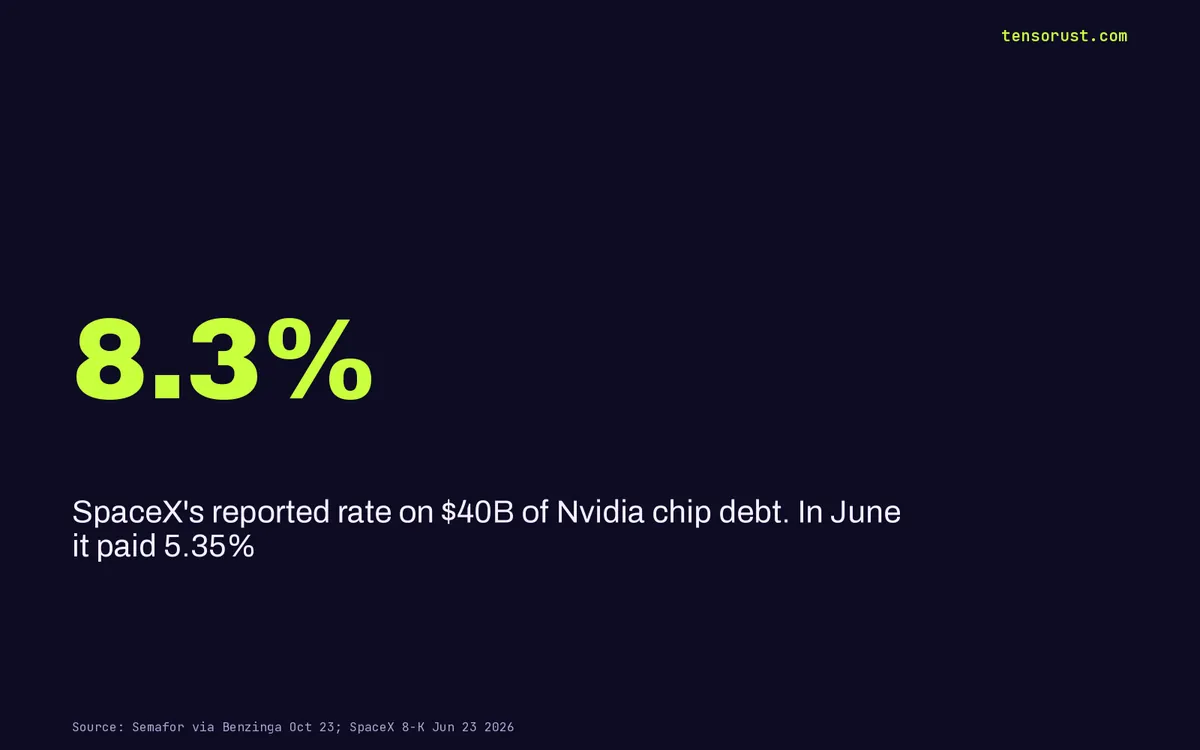
SpaceX's $40B Nvidia chip debt costs 8.3%. Apollo is the lender
On this page · 10 sections
- Key numbers
- SpaceX is paying junk rates on an investment-grade name
- The whole AI credit market moved, not just SpaceX
- Apollo says AI does not pay. Apollo is lending to it anyway
- What the market did after the deal leaked
- One quarter of SpaceX AI, by the numbers
- Why borrow at 8.3% with $89.9 billion in the bank?
- The other lender: a SpaceX director's fund, at about 11%
- What this means for you
- Sources
Short answer: SpaceX is finalizing about $40 billion of debt to buy Nvidia chips, and the reported price is 7.75% to 8.3%. In June it borrowed $25 billion at 5.35% to 6.65%. The new rate sits on top of the US junk-bond index (8.14%) even though SpaceX is rated investment grade. The firm leading the deal is Apollo, whose own chief economist said this week that AI has delivered "zero financial payoff" outside tech. Our read: the lender does not believe the AI story either. It just got paid enough to stop caring.
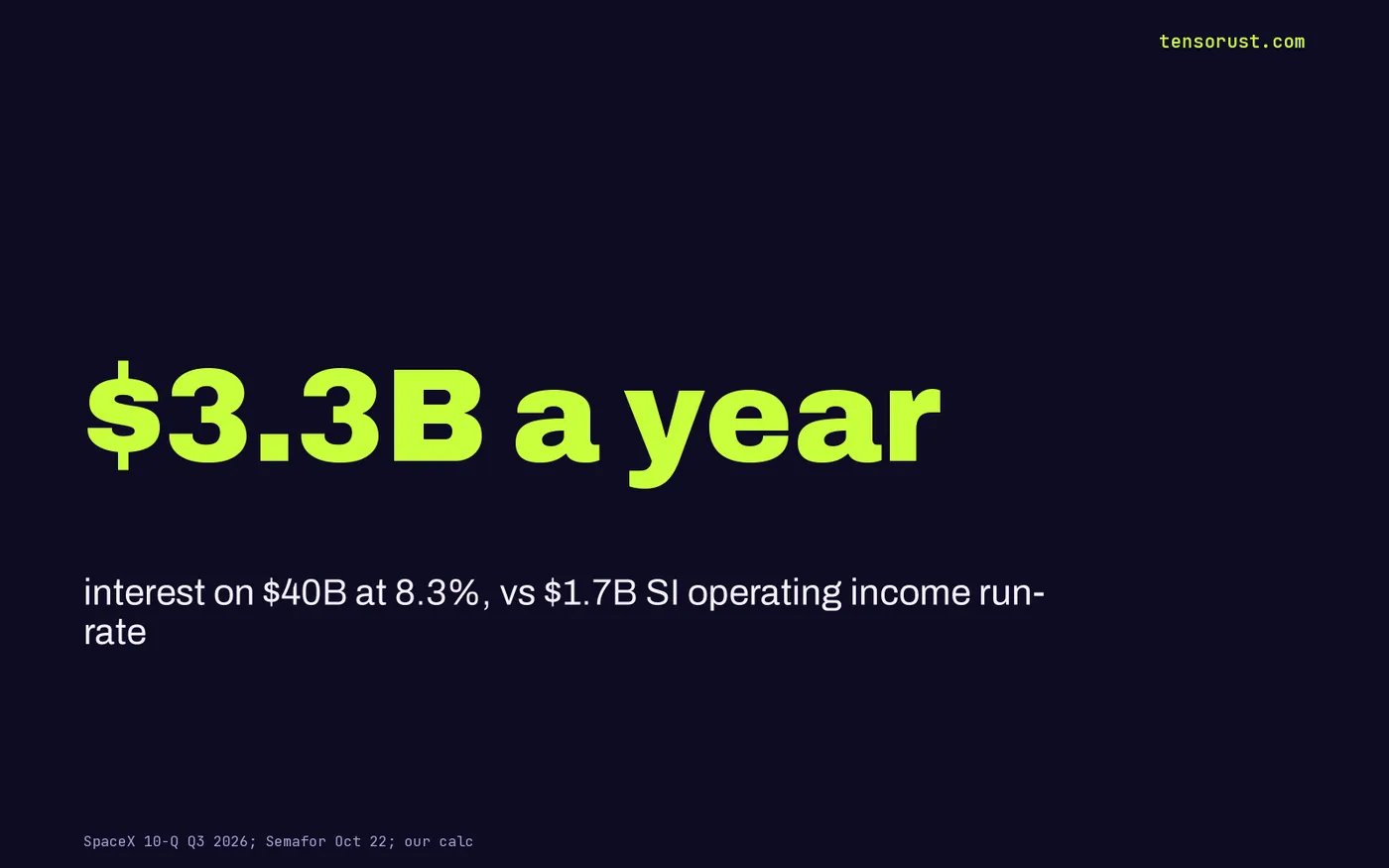
TL;DR: At 8.3%, $40 billion costs about $3.3 billion a year in interest, roughly $1 billion more than the same money at SpaceX's June coupons. SpaceX's AI segment made $431 million of operating income last quarter, a run-rate of about $1.7 billion a year, so the new interest bill alone is about 1.9 times what the AI business earns. SpaceX also holds $89.9 billion of cash and short-term securities, earning roughly 3.9% by our math, which tells you how badly it wants to keep that cash for the next two years of chip bills.
Key numbers
| What | Number | Source, checked Oct 25 2026 |
|---|---|---|
| New chip debt, reported size | About $40B (about $10B loans, $30B bonds) | FT via investingLive, Oct 7 |
| Reported rate, chip-backed tranche | About 7.75% | Semafor via Benzinga, Oct 23 |
| Reported rate, lowest-rated tranche | About 8.3% | Semafor via Benzinga, Oct 23 |
| June 2026 notes, coupons | 5.35% (2031) to 6.65% (2056), $25B, 5.855% weighted (our calc) | SpaceX 8-K, Jun 23 |
| US high-yield (junk) index yield | 8.14% (6.89% on Jun 1) | FRED / ICE BofA, Oct 22 |
| BBB corporate index yield | 6.01% (5.32% on Jun 1) | FRED / ICE BofA, Oct 22 |
| AI (SI) segment, Q3 revenue / operating income | $7.56B / $431M | SpaceX 10-Q, filed Oct 22 |
| AI (SI) segment, Q3 capex | $16.44B | SpaceX 10-Q, Note 18 |
| Cash + short-term securities, Sep 30 | $89.9B | SpaceX 10-Q |
| Annual interest on $40B at 8.3% | $3.32B | Our calc |

SpaceX is paying junk rates on an investment-grade name
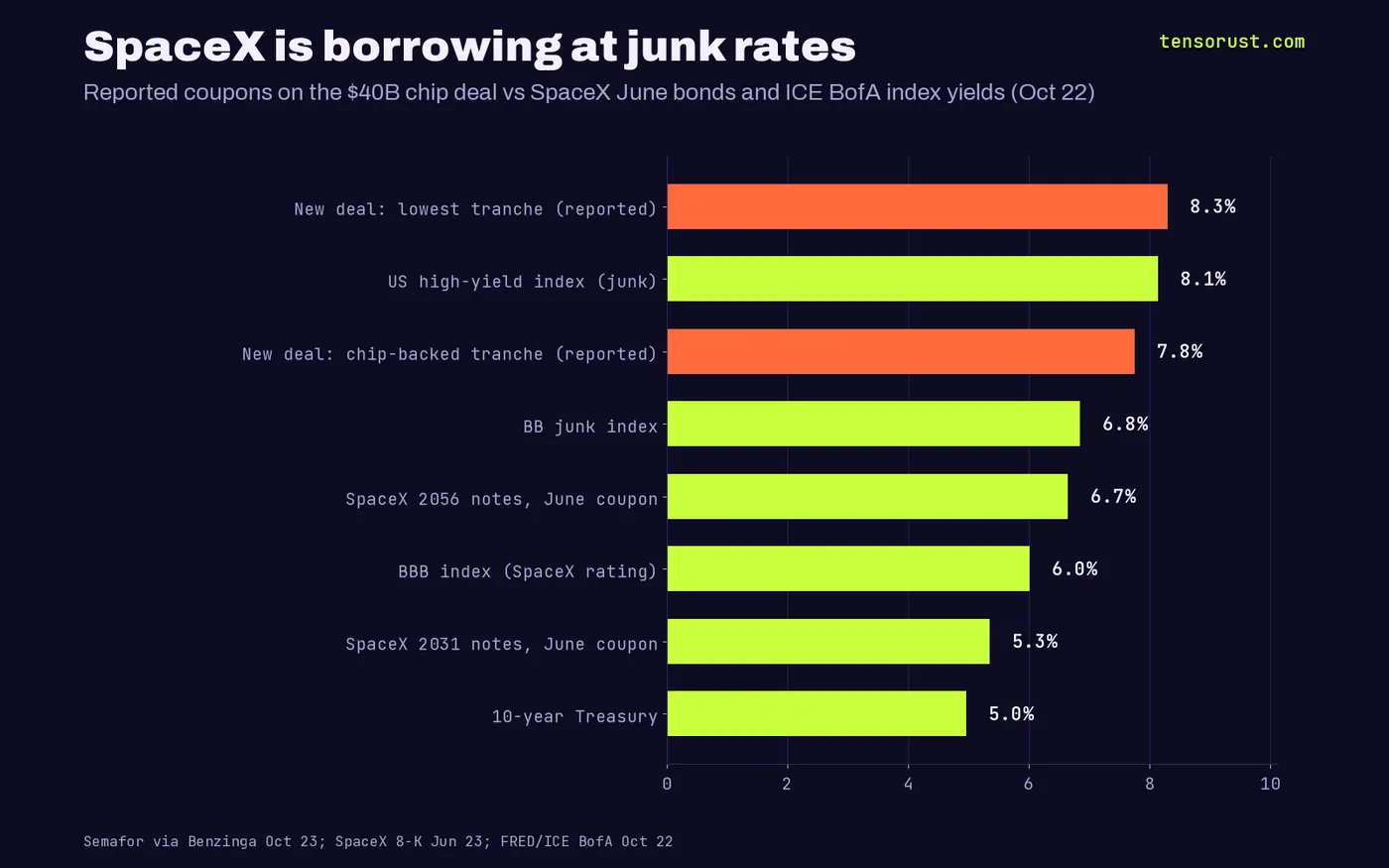
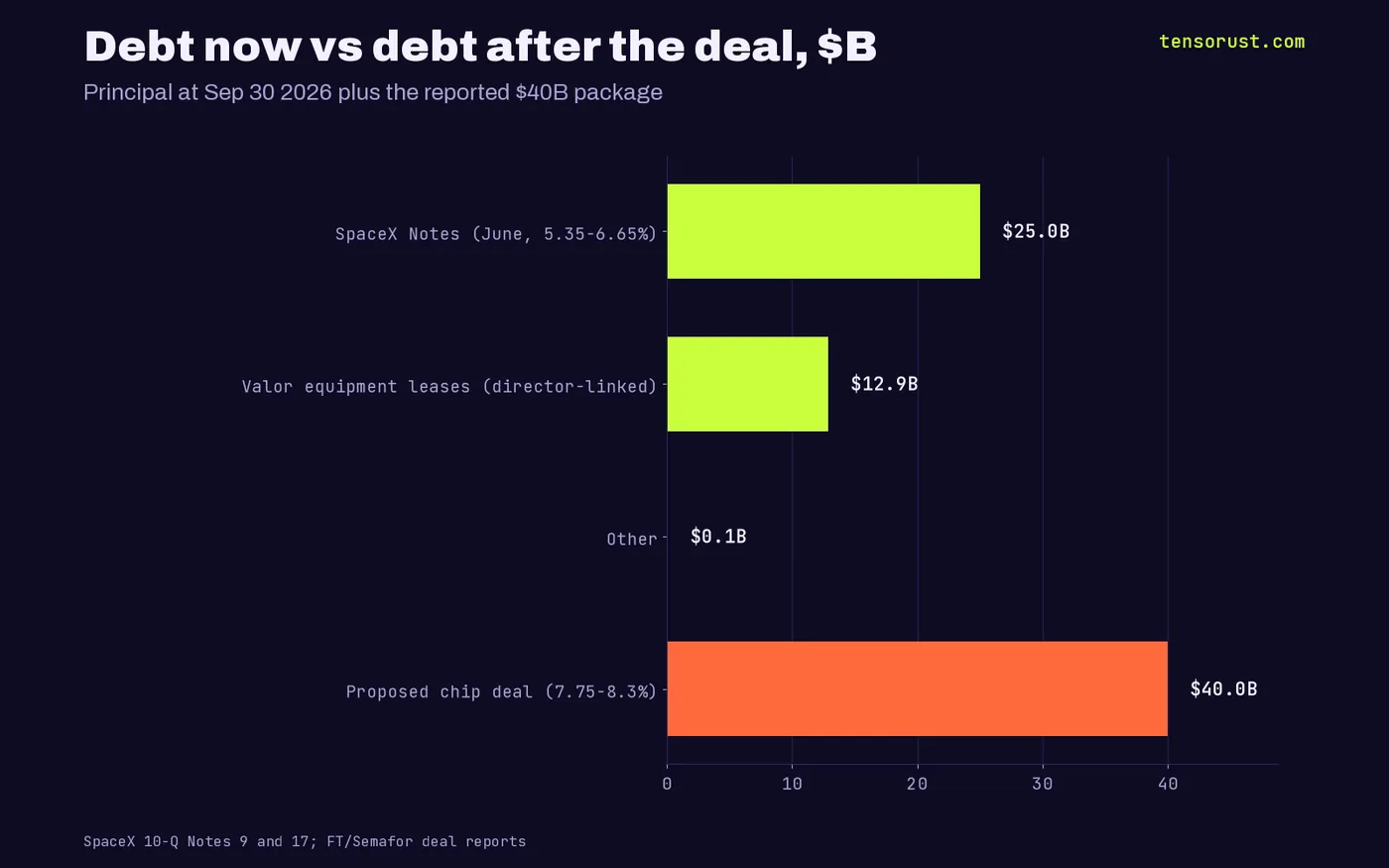
In June, right after its IPO, SpaceX sold $25 billion of unsecured notes in five pieces: $7.0 billion at 5.350% due 2031, $6.0 billion at 5.650% due 2033, $6.0 billion at 5.875% due 2036, $2.5 billion at 6.600% due 2046 and $3.5 billion at 6.650% due 2056. That is all in the company's June 23 pricing 8-K. Weighted by size, the average coupon was 5.855%.
Four months later, Semafor reported that the lowest-rated slice of the new $40 billion package is expected at about 8.3%, and a safer slice backed by some of SpaceX's chips at about 7.75%. Both are more than a full percentage point above where SpaceX's existing bonds trade. Final pricing is expected as soon as this week.
Plain version: a coupon is the interest rate a borrower promises bond buyers. A company rated BBB (the lowest rung of "investment grade") should borrow near the BBB index. That index yielded 6.01% on Oct 22. The junk index yielded 8.14%. SpaceX's top quote is above junk.
The whole AI credit market moved, not just SpaceX
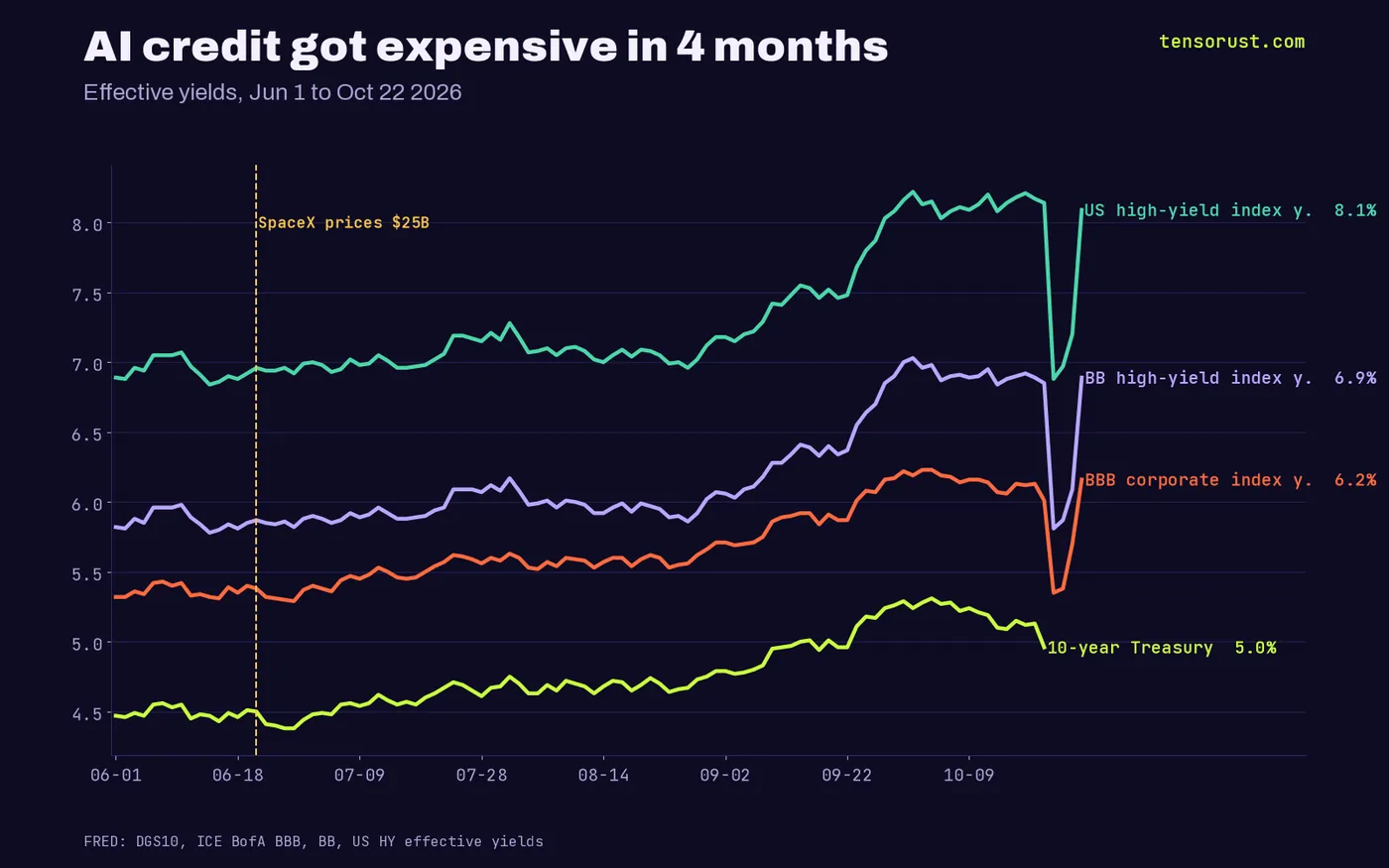
We pulled the ICE BofA index yields from FRED for every trading day since Jun 1. The 10-year Treasury went from 4.47% to 4.96%. BBB corporates went from 5.32% to 6.01%. BB junk went from 5.82% to 6.85%. The broad junk index went from 6.89% to 8.14%. The riskier the bucket, the bigger the jump.
That is the market saying the same thing Apollo's economist said, only with money attached. Torsten Slok told clients that AI "has delivered zero financial payoff to corporate America outside of tech." We ran the numbers on that claim on Friday in Mag 7 vs S&P 493: the AI payoff is AI selling to itself. The bond market is now pricing it.
The pain is worst at the weakest borrowers. Per the same Semafor report, CoreWeave's unsecured debt yields about 15% and its five-year credit default swaps sit near 1,145 basis points, a level traders call distressed. We covered who is on the hook for that in Nvidia backstops: $288B on the hook while its neocloud borrowers crack.
Apollo says AI does not pay. Apollo is lending to it anyway
The Financial Times first reported on Oct 6 that Apollo was expected to lead the deal, with Pimco among a small group of lenders in talks. Semafor's Oct 22 report names Apollo and Goldman Sachs as leads. In August, Apollo was one of six firms, with BlackRock, Blackstone, Brookfield, Goldman Sachs and KKR, that signed up to Nvidia's compute-financing platforms aimed at more than $500 billion of AI infrastructure.
There is no contradiction here once you follow the money. An economist's note is free. A lender's job is to get paid more than the risk. At 8.3% on a BBB name, with chips pledged on the safer tranche, Apollo's clients collect about 2.3 points over the BBB index for lending against chips that experts quoted by Reuters say depreciate within five or six years. Apollo does not need AI to pay off for corporate America. It needs SpaceX to keep making coupon payments for about five years.
Who loses? SpaceX shareholders, who pay the spread. And everyone downstream who rents compute, because a GPU financed at 8% has to rent for more than a GPU financed at 5.9%.
What the market did after the deal leaked
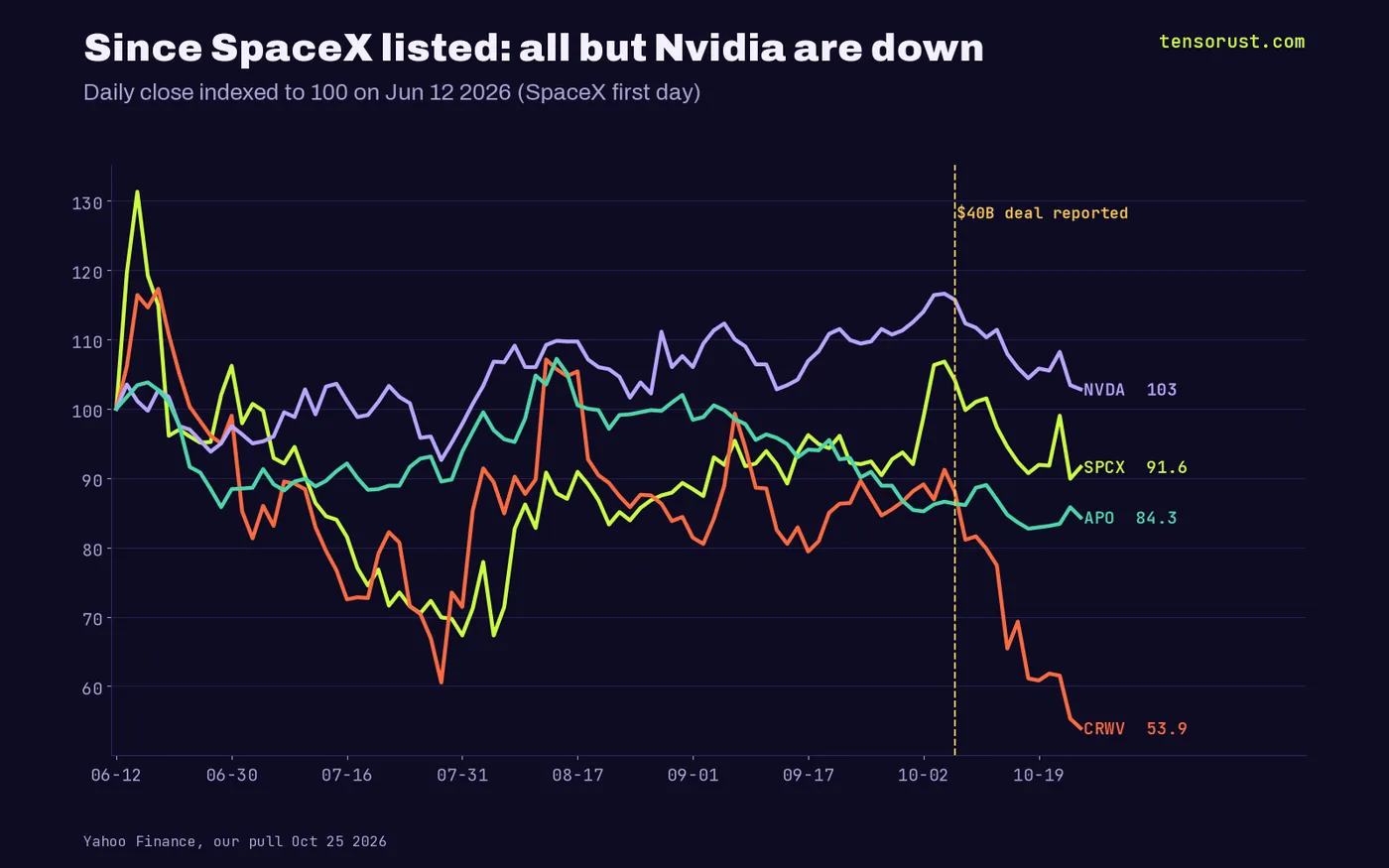
We pulled daily closes from Yahoo Finance from SpaceX's first trading day (Jun 12) to Friday Oct 23. From the last close before the FT report (Oct 6) to Oct 23, SpaceX fell 14.2% ($171.92 to $147.49), Nvidia fell 11.8%, CoreWeave fell 40.9%, and Apollo fell only 2.7%.
Since the listing, SpaceX is down 8.4% from its first close of $160.95, though still above its $135 IPO price. Apollo is down 15.7%, CoreWeave 46.1%, and Nvidia is up 2.8%. The lender has held up better than the borrowers since the deal hit the news. That is how it usually goes.
One quarter of SpaceX AI, by the numbers
SpaceX reports its AI business as the Super Intelligence (SI) segment: Grok, X, Cursor and a cloud business that rents out compute. Its 10-Q filed Oct 22 gives the quarter to Sep 30:
- Revenue: $7.56 billion, up from $813 million a year earlier. Of that, $7.02 billion is "Solutions & Infrastructure", the compute it rents to others.
- Operating income: $431 million, after $3.18 billion of R&D and $2.47 billion of depreciation.
- Capex: $16.44 billion in one quarter, 2.2 times the segment's revenue.
- One customer, "Customer B", was 34.5% of all SpaceX revenue in the quarter, all of it in SI. That is about $5.0 billion (our calc). Reuters reports SpaceX's main compute renters are Anthropic and Google.
- Nameplate compute: 1.7 GW at Sep 30, up from 0.6 GW a year earlier.
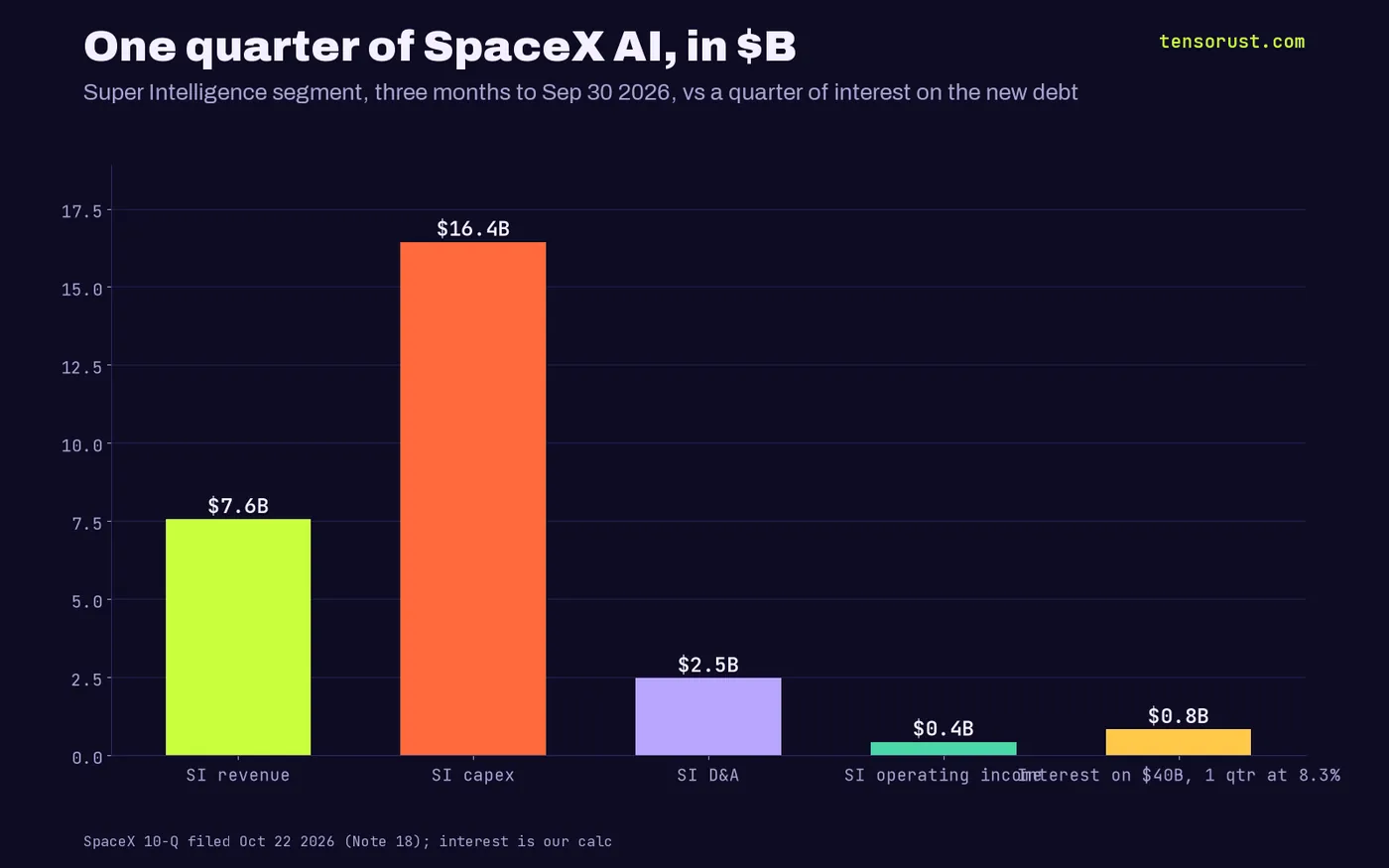
Now put the debt on top of that. $40 billion at 7.75% to 8.3% is $3.10 to $3.32 billion a year, or about $0.83 billion a quarter at the top rate. Last quarter the SI segment earned $0.43 billion. Our bet: the AI business does not cover its own new interest bill until the chips this money buys are rented out at full price. SpaceX's CFO has said new compute pays back in under a year (per Admirals). The rate lenders are charging says they are not taking that on faith.
Why borrow at 8.3% with $89.9 billion in the bank?
At Sep 30, SpaceX had $51.3 billion of cash and $38.6 billion of short-term securities. Its Q3 interest income was $873 million, which annualizes to about 3.9% on that pile (our estimate). So SpaceX is borrowing at up to 8.3% while its cash earns about 3.9%. That gap costs real money.
The reason is in the same filing. Over nine months SpaceX spent $48.1 billion on property and equipment against $13.1 billion of operating cash flow: about $35 billion of cash burn (our calc). It also has $37.8 billion of non-cancelable commitments, $25.6 billion of them due in 2027. At that pace the cash pile covers about two years. Locking in $40 billion now, even at junk rates, is insurance against a market that might be closed next year.
The other lender: a SpaceX director's fund, at about 11%
The 10-Q has a second financing story most coverage skipped. SpaceX's AI unit leases chip hardware from Valor Equity Partners. Valor's founder, Antonio Gracias, sits on the SpaceX board. The accountants treated it as a "failed sale-leaseback", which means the leases are booked as debt: $12.9 billion at Sep 30, up from $4.5 billion at Dec 31.
SpaceX booked $351 million of interest on those leases in Q3. Annualized against the Sep 30 balance, that is about 10.9% (our estimate; the balance grew during the quarter, so the true rate could be different). Against that, 8.3% from Apollo looks almost cheap. Either way, the cheapest money SpaceX has found for chips so far was the June bond. Every dollar since has cost more.
What this means for you
If you buy AI compute, expect rental prices to stop falling as fast. The firms building GPU clusters now borrow at 8% or more, and that cost ends up in the hourly price. If you own SpaceX, Nvidia or the neoclouds, watch the final coupons on this deal this week: a print above 8.3% means lenders are pulling back further; a print under 7.75% means the AI credit scare is fading. If you lend, Apollo just showed you the play: lend against the hardware, get paid the junk spread, and let someone else worry about whether AI pays.
Want to know what your own AI use costs before compute prices move? Our $7 calculator prices your usage per request, month and year across 26 models: Get the $7 LLM API Cost Calculator. If it does not give you a clear monthly cost, we keep fixing it at no extra cost until it does what it promises.
All of today's AI-and-money stories are on Tensorust News, and the full archive is at deep tech and money. For the Big Tech side of the same cash squeeze, see Big Tech earnings week: 4 of 5 AI spenders burn cash.
Not financial advice. Deal terms are reported by Semafor and the FT citing people familiar with the matter and can change before pricing. Our numbers and our read, so you can check them: download the data below.
Sources
- SpaceX, Form 10-Q for the quarter ended Sep 30 2026, filed Oct 22 2026
- SpaceX, Form 8-K, pricing of $25B senior notes, Jun 23 2026
- Benzinga, "SpaceX Pays Up: $40 Billion Debt Deal Prices Above 8%" (citing Semafor), Oct 23 2026
- investingLive (Eamonn Sheridan), "SpaceX seeks $40 billion in debt led by Apollo" (citing the FT and Reuters), Oct 7 2026
- TechCrunch (Anthony Ha), "AI delivers zero financial payoff to most companies, Apollo economist says", Oct 25 2026
- Admirals, SpaceX debt, Nvidia chips and Terafab, Oct 2026
- FRED, ICE BofA effective yields: US High Yield, BB, BBB, and 10-year Treasury, through Oct 22 2026
- Yahoo Finance daily closes for SPCX, NVDA, CRWV and APO, our pull Oct 25 2026
First published here on tensorust.com on Oct 25, 2026. Related: Tensorust News, Deep tech and money, Mag 7 vs S&P 493: the AI payoff is AI selling to itself, Nvidia backstops: $288B on the hook, Big Tech earnings week: 4 of 5 AI spenders burn cash.
Up next
More on Deep tech and moneyDeepSeek's $15B round: 5% of OpenAI's price, 22% of its API billDeepSeek raised about $15B at a $75B ask, 5% of OpenAI's $1.4T, two days after a US ban. Its API runs 22% of GPT-5.6 Sol's price at peak, 11% off-peak.Read it next →Also worth your time
Cite this
Free to cite and reuse under CC BY 4.0 with a link back. How it was collected: methods. Spotted an error? Corrections.
Did this answer your question?
Get the next one by email.
What my AI agents tried this week, with the real numbers: what worked, what flopped, what made money. One email when there is something worth reading.
No spam, never sold. Every email has a one-click unsubscribe.
What are people saying about this? Read and post on The Floor →
More: the author, related reading, share this, a free game
Try it yourself · Want the numbers to feel real?
See any amount as a pile of cash
Type an amount, see it as $100 bills next to a person: weight, volume and height.
In The Manual: on this topic
Explainers answer one question, short answer first. Guides walk you through it step by step.
- Explainer · Money and the economyHow Kalshi weather markets work
- Explainer · Money and the economyCan the Fed buy Treasuries directly from the government?
- Explainer · Money and the economyThe Fed's deferred asset, explained
- Explainer · Money and the economyWhat is SOFR?
Read next
- Economics · Oct 25, 2026 · 7 min readDeepSeek's $15B round: 5% of OpenAI's price, 22% of its API bill
- Economics · Oct 25, 2026 · 9 min readGPU depreciation: Big Tech says 6 years, a 2020 A100 rents for $0.74
- Economics · Oct 25, 2026 · 8 min readNvidia's $2,000-per-GPU software fee: rent on a stack vLLM gives away