
Prop 40 priced: 223 billionaires, $90B on paper, Zuckerberg $11B
On this page · 14 sections
- Key numbers
- Prop 40 in 60 seconds
- We priced every name on Forbes' January 1 list
- Zuckerberg's $11B, and the deal Meta signed to cover it
- Forbes kept the leavers in California for months
- AI is the only part of the base that grew
- The formula could wipe out the AI paper fortunes
- $118B, $90B or $30B: who is right?
- Polls say coin flip. Money says 1 in 4.
- My take
- The numbers so far
- What happens next
- Caveats
- Sources
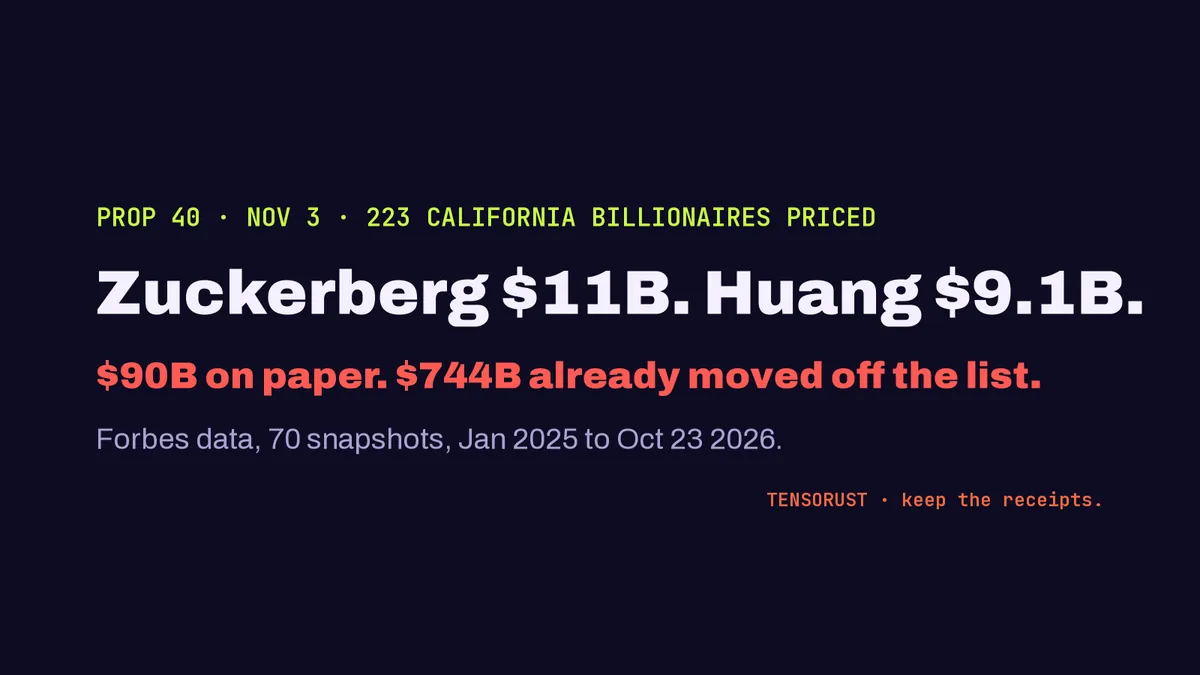
Short answer: If California's Prop 40 passes on November 3, the 5% one-time tax would be worth about $90 billion on paper at today's fortunes, counting the 223 people Forbes still listed in California on January 1, 2026 (the residency cutoff) minus the six widely reported to have left before it. Mark Zuckerberg's line would be about $11.0 billion, Jensen Huang's $9.1 billion. Stanford economists think avoidance cuts the real haul to about $30 billion, and prediction-market traders give the measure a 22.5% chance of passing.
TL;DR: We pulled 70 snapshots of the Forbes real-time billionaires list (January 2025 to tonight) and priced every California name. Three things jumped out. Forbes itself kept all 9 people it has since moved out of California on its California list on January 1. The only slice of the tax base that grew since the cutoff is AI money, up $119 billion while everything else shrank. And Meta just signed an SEC-filed deal that lets Zuckerberg sell new non-voting shares to cover a bill like this without giving up control. Checked Oct 23, 2026, 11:20 PM ET. Every number below is in the CSV.
Key numbers
| What | Number | Source, checked Oct 23 2026 |
|---|---|---|
| People Forbes listed in California on Jan 1 2026 | 239, worth $2.28T that day | Forbes real-time list, Wayback snapshot Jan 1 2026 |
| Same 239 at today's Forbes values | $2.37T, so 5% = $118.4B | our math, Forbes live pull 11 PM ET |
| Minus the 6 reported early leavers (Page, Brin, Thiel, Kalanick, Hankey, Spielberg) | 223 people, $1.80T, 5% = $90.1B | our math; leaver list: Fortune |
| Biggest single line: Mark Zuckerberg | $220.7B net worth, 5% = $11.0B | Forbes live |
| Wealth Forbes has moved off its California list since Jan 1 | $744B, 9 people | our 70-snapshot diff |
| AI fortunes on the Jan 1 list, change since the cutoff | +$118.7B (+59%), 17 people | our buckets on Forbes "source" |
| Everyone else on the Jan 1 list, change since the cutoff | -$29.4B | same |
| Stanford estimate after avoidance | $30B (range $28-36B) | Jaros and Rauh, NBER w35899 |
| Polymarket odds it passes | 22.5% ($3.9M traded) | Polymarket, 11 PM ET |
Download the data (CSV, 277 rows: everyone Forbes had in California on Jan 1 2026 or has there today, with Jan 1 and Oct 23 net worth, the 5% estimate, our sector bucket, and the date window when Forbes moved them out). The 70-point time series is in series.csv.
Prop 40 in 60 seconds
Prop 40 is a one-time tax of 5% of net worth on billionaires who were California residents on January 1, 2026. That date is already behind us, which is the whole point: you cannot dodge it by moving now. The state's own Legislative Analyst's Office says the tax would be due in 2027, can be spread over five years for an extra charge, and generally excludes real estate, pensions and retirement accounts. Ninety percent of the money has to go to health care.
Two details matter more than the headline rate. Per Baker Tilly's read of the text, net worth is valued on December 31, 2026, and the $1 billion threshold is tested on that date too, with a phase-in between $1 billion and $1.1 billion. So the bill moves with markets for another ten weeks. Second, Props 41 and 42 are rival measures from the "Building a Better California" campaign. If either one gets more yes votes than Prop 40, the wealth tax dies even if it passes (CalMatters).
Plain English for anyone new to this: "net worth" is everything you own minus what you owe. For a founder, almost all of it is shares in one company. That is why the fights below are about stock, not mansions.
We priced every name on Forbes' January 1 list
Forbes publishes its real-time billionaires list through a public JSON feed, and the Internet Archive has saved it almost every day since January 2025. We pulled 70 of those snapshots: monthly through 2025 and 2026, daily from November 15, 2025 to January 9, 2026, and a live pull tonight. Each record has a name, a net worth and a state.
On the January 1, 2026 snapshot, Forbes had 239 people in California, worth $2.28 trillion. Ten have since dropped off the list. Price the rest at tonight's values and 5% comes to $118.4 billion, more than the campaign's own $100 billion claim. Take out the six people Fortune reported left before the cutoff and you get $90.1 billion from 223 people.
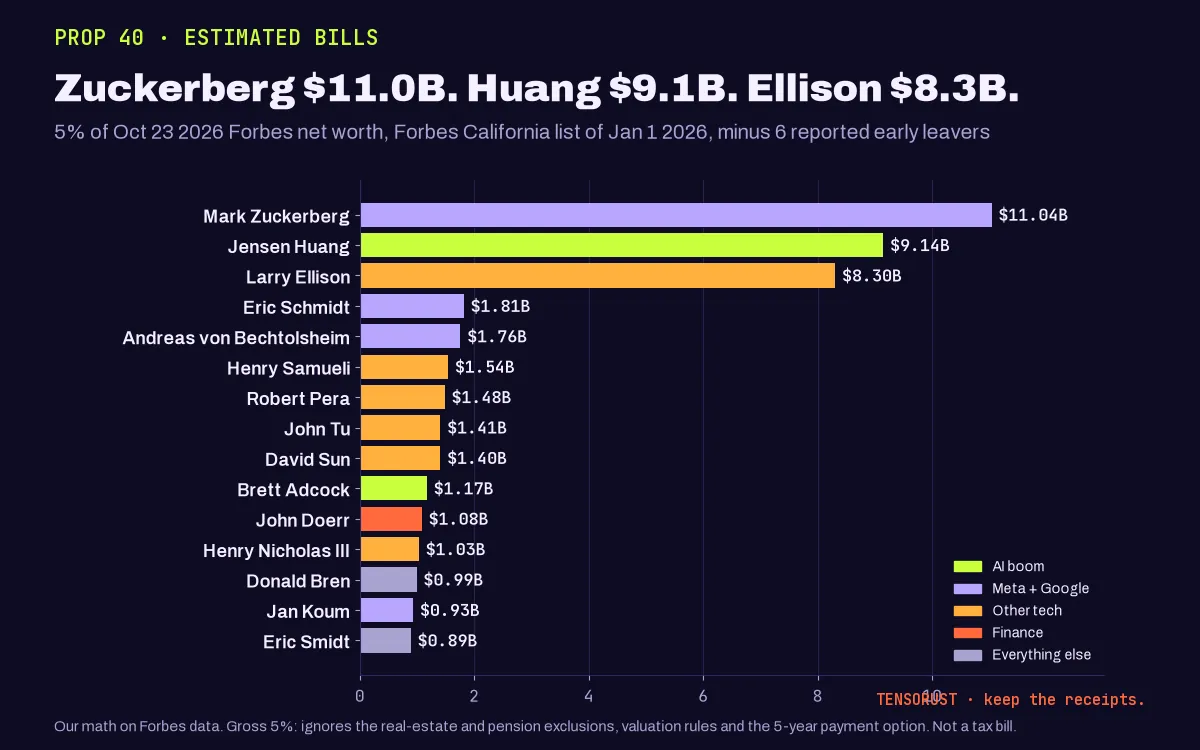
The base is top-heavy. Zuckerberg and Huang alone are 22.4% of the $1.80 trillion; the top 10 are 43.3%. Prop 40 is less a tax on "billionaires" than a tax on about a dozen stock positions, and two of them are Meta and Nvidia. If you read our piece on the AI market and the 2007 bond setup, you already know how much of the market rides on the same handful of names. The state's health budget would too.
Ellison is the awkward one. Forbes had him in California on January 1 and moved him to Florida between January 9 and February 1. Fortune's early-leaver list does not include him. Take him out too and the paper total is $81.8 billion. Whether he owes $8.3 billion or nothing is exactly the kind of question the state's residency auditors would fight about.
Zuckerberg's $11B, and the deal Meta signed to cover it
Two days ago Meta filed a Form 8-K describing a "Founder Alignment Agreement" with Zuckerberg, dated October 20. Meta will pay a one-time dividend of one new non-voting Class C share for every Class A and Class B share, with the charter change effective January 19, 2027. Zuckerberg can sell 20% of his new Class C shares right away and another 2.5% each quarter while he stays in a full-time leadership role, fully released after 32 quarters.
In return he commits to remain a resident of California, or wherever Meta keeps its headquarters, for eight years, with an exit for "material unforeseen circumstances." The information statement says he told a special committee he "was evaluating relocating his primary residence outside California," and that under Prop 40 he "could become liable for a significant, multi-billion dollar tax payment." He holds about 60.6% of the voting power as of October 1. Our number for that payment, at tonight's Forbes value: $11.0 billion.
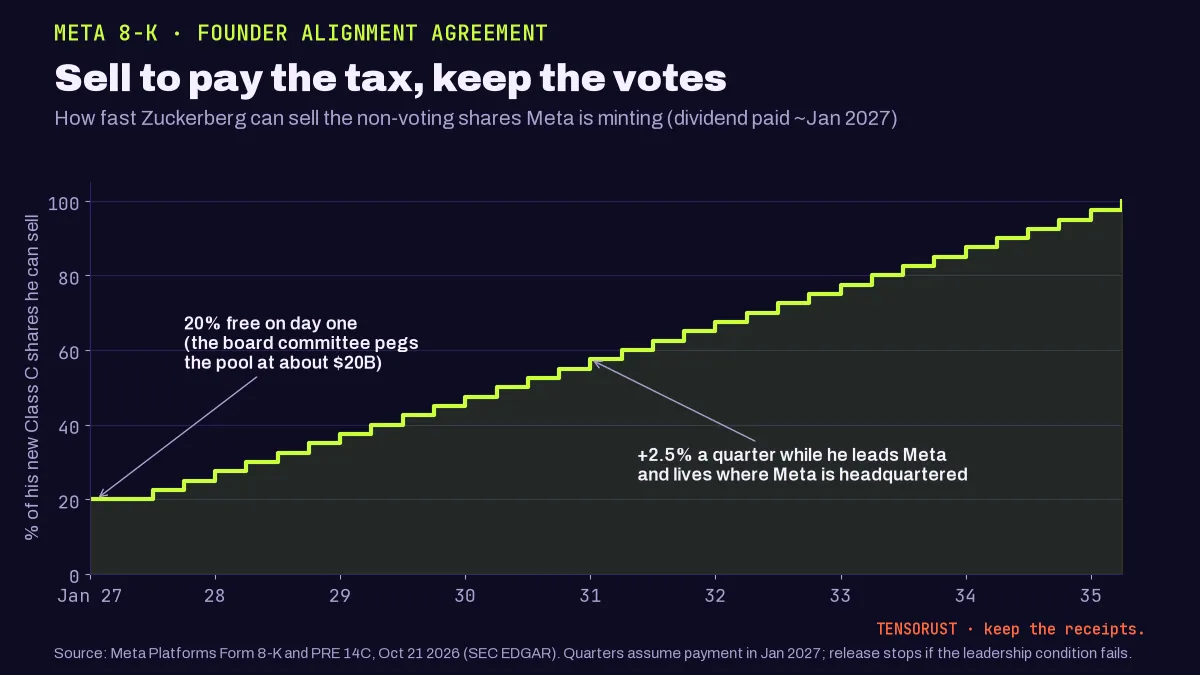
My read, and the filing does not say this out loud: the board did not want a founder who sells voting stock to pay a tax and slowly loses control, or one who moves to Miami and runs Meta from there. So every shareholder gets non-voting shares, and the founder gets a way to raise billions without touching his votes. Forbes reported the committee's view that roughly $20 billion could be reachable this way. Shareholders are not paying his tax, but they are paying for a share structure built around his tax. Hacker News was split on whether that counts as "shielding" him. I think it is something better for him than shielding: the tax gets paid and the control stays.
Forbes kept the leavers in California for months
This is the part nobody else has, because you only see it by diffing the snapshots. On January 1, 2026, Forbes still listed all nine people it now places outside California as Californians. Larry Page and Sergey Brin, who Fortune reported had left before the deadline, stayed on Forbes' California list until some time between September 16 and October 23, 2026. Peter Thiel flipped between August 2 and September 9. Travis Kalanick, who said he left in December, flipped in March.
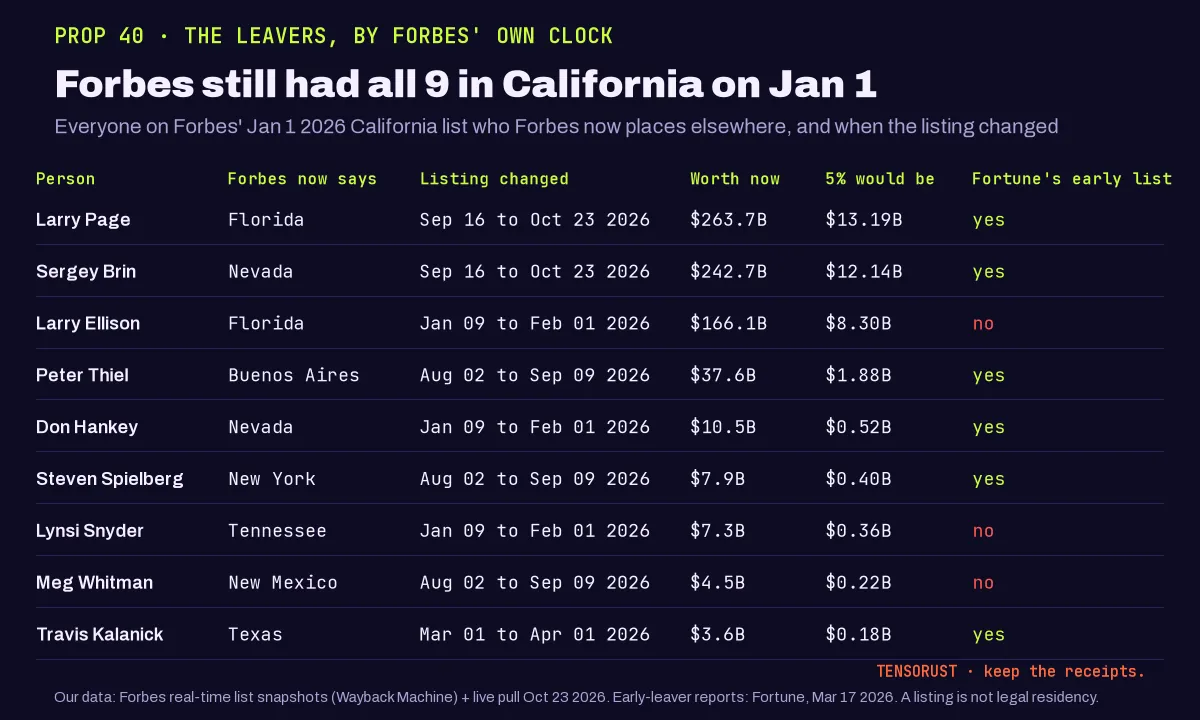
A Forbes listing is not legal residency, and Forbes updates profiles when it gets around to it. But think about what the tax office would need to prove: where a person lived on one specific day, ten months ago. If the most-read billionaire tracker in the world took up to ten months to agree that Page and Brin had left, the state's auditors are not getting this done in an afternoon. That is $25.3 billion of potential tax in two names, and the paperwork fight would likely outlast several budget cycles.
The wealth that walked is not small. The nine people Forbes moved off its California list are worth $744 billion tonight. Benjamin Jaros and Joshua Rauh count seven departures worth about $540 billion, nearly 30% of the base (Fortune). Our number is bigger because it includes Ellison and three smaller names, and because Page and Brin got richer.
AI is the only part of the base that grew
We sorted the 223 people into five buckets using Forbes' own "source of wealth" field. "AI boom" means Nvidia, Anthropic, OpenAI, Figure, Cursor, Scale and Mercor money (17 people). Meta and Google founders get their own bucket because they are the biggest AI spenders but made their money before it.
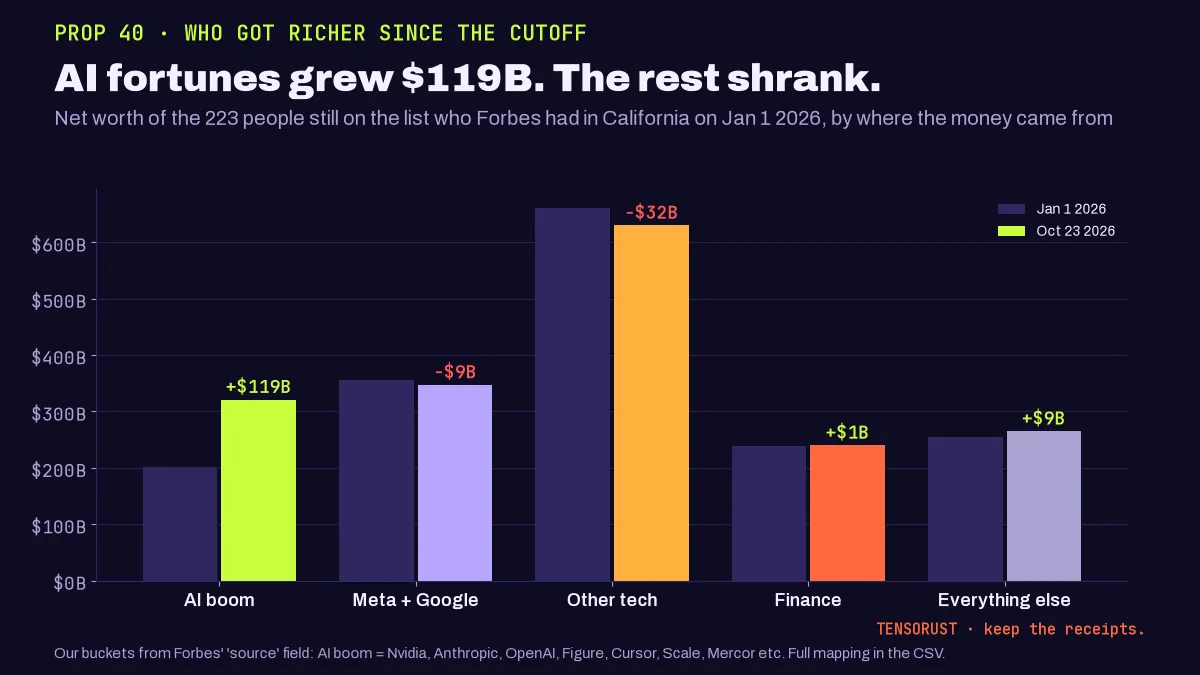
Since the January 1 cutoff, the AI bucket grew from $202.0 billion to $320.7 billion, up 59%. Everything else combined fell $29.4 billion. Huang alone went from $161.9 billion to $182.9 billion, which added about $1 billion to his line. Figure's Brett Adcock went from $1.4 billion to $23.4 billion. The seven Anthropic cofounders on Forbes' list (six of them on the January 1 California list) went from $3.7 billion to $15.5 billion each.
So if Prop 40 passes, a big share of what it collects depends on how AI stocks and AI private valuations look on December 31. The AI boom and the Meta plus Google founders together are 37% of the $1.80 trillion. California would be funding Medi-Cal with a leveraged bet on the AI trade. If you think AI is the 2007 housing market (we laid out that case here), that is not a comforting sentence.
The formula could wipe out the AI paper fortunes
Here is the twist that cuts the other way. Forbes values Anthropic or Figure stakes at the last private round. Prop 40 does not. Per Baker Tilly, a privately held business is presumed worth GAAP book value plus 7.5 times its average book profit over three years, with negative profits floored at zero and most discounts banned. A certified appraisal can replace the formula, but appraisers face personal penalties of up to 4% of any understatement.
Run that on an AI lab that loses money and the presumed value collapses toward book value, which is mostly the cash it raised. Of the AI bucket's $320.7 billion, about $137.8 billion is private-company wealth (everyone but Huang). At 5% that is $6.9 billion of "paper" tax that the formula might shrink to a fraction, unless the state pushes for appraisals at round prices. Nobody knows yet how that fight goes. My bet is that the first big Prop 40 lawsuit is about a money-losing AI startup, not a mansion.
This also explains the other side of the dual-class story. The Tax Foundation has argued (per Wikipedia's summary) that founders with super-voting shares could see an effective rate well above 5%; the drafters say that misreads the text. Either way, founder control and founder valuation are where the real money is.
$118B, $90B or $30B: who is right?
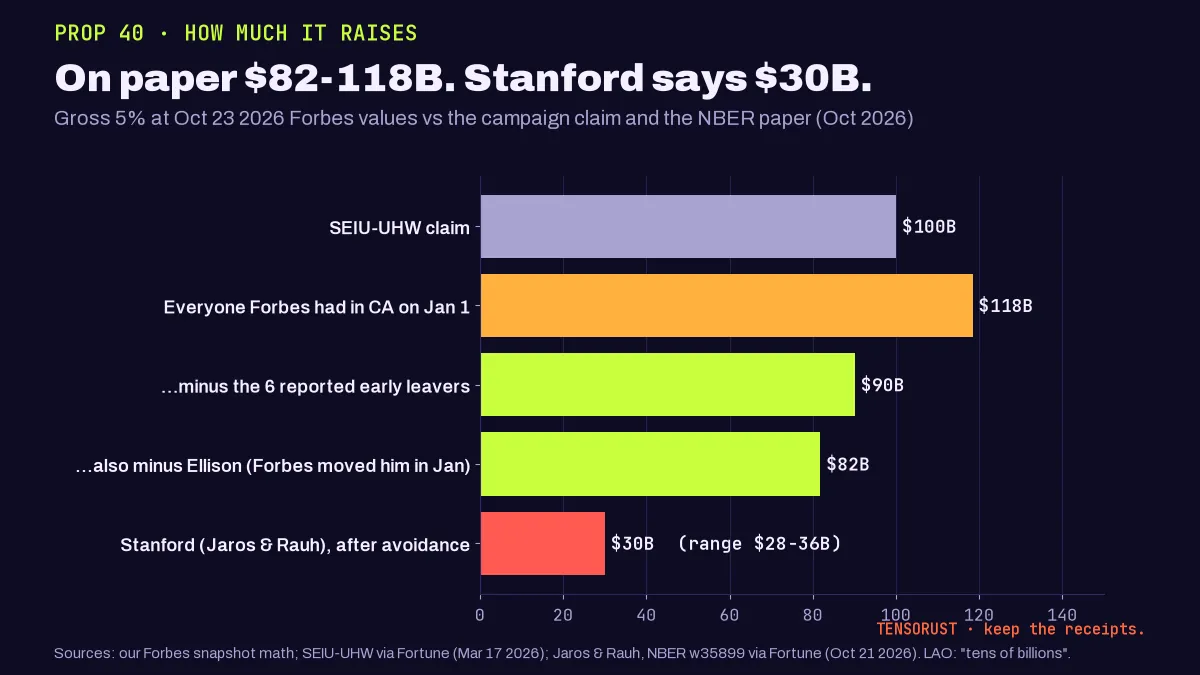
All of them, on different assumptions. The union behind it, SEIU-UHW, says about $100 billion. The LAO refuses to name a number beyond "tens of billions of dollars spread over several years" and warns of an ongoing income tax loss of less than $1 billion a year. Jaros and Rauh's NBER paper says about $30 billion after avoidance and claims the lost income tax from departures is worth $38.9 billion more than the one-time take in today's dollars. Emmanuel Saez and Gabriel Zucman, on the other side, argue that even if every billionaire left, it would take about 25 years of lost income tax to exceed what the tax raises (summarized on Wikipedia).
Our contribution is narrower: on Forbes' own numbers the paper base is real. It is $82 to $118 billion depending on who you count, before exclusions. The gap down to $30 billion is entirely about behavior: leaving, restructuring, valuation fights. That is the debate, and it is a debate about trust in enforcement, not about arithmetic. If you want the bigger picture of who holds American wealth and debt, our generational wealth piece and the who owns US debt explainer pair well with this one.
Polls say coin flip. Money says 1 in 4.
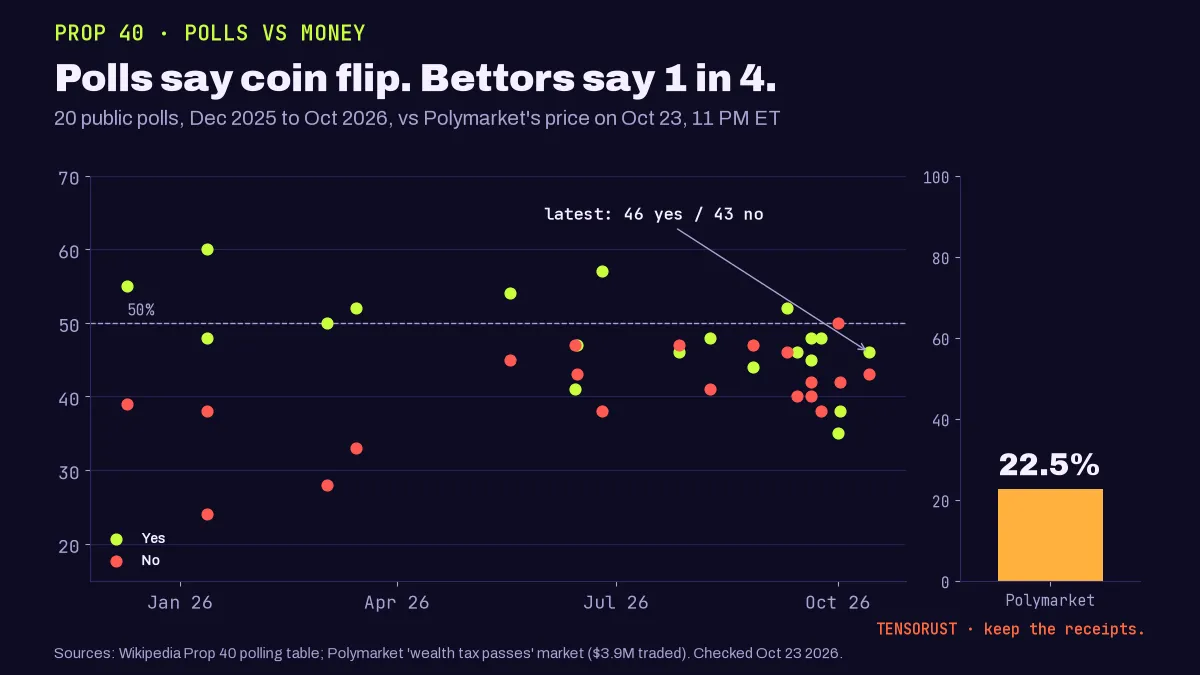
Twenty public polls since December show yes between 35% and 60%, sliding over time. The latest, TrueDot (October 9 to 14), has it at 46% yes, 43% no. Polymarket traders, with $3.9 million on the line, price a pass at 22.5% tonight. The gap makes sense: undecided voters on ballot measures usually break no late, and Prop 40 also has to beat Props 41 and 42 head to head. The opposition is not short of money either: Building a Better California had raised $118 million by August, mostly from Brin, Chris Larsen and John Doerr, and Thiel put about $100 million into a separate committee.
My take
Prop 40 is not really a vote on whether billionaires should pay more. It is a vote on whether California can enforce a tax on a moving target. The data says the target already moved: $744 billion left the list, and the list itself took up to ten months to notice. Meanwhile Meta's board spent eight months building a share structure so its founder could stay and pay without losing control. That is what a billionaire who wants to stay looks like. Page and Brin show what the other kind looks like.
If it passes, the number to watch is not the 5%. It is how the state values money-losing AI companies on December 31, and how many residency audits it wins. If it fails, expect a sequel with a later residency date and the same fight. Either way, the AI boom is now a California tax story. Not financial or tax advice; this is a data read of a public list.
The numbers so far
| Number | Value | As of |
|---|---|---|
| Forbes California list, today | 258 people, $1.75T | Oct 23 2026, 11 PM ET |
| New California names since Jan 1 | 38 people, $129.8B (Greg Brockman, Daniela Amodei and others) | Oct 23 2026 |
| Jan 1 list at today's values, 5% | $118.4B | Oct 23 2026 |
| Minus 6 reported early leavers, 5% | $90.1B | Oct 23 2026 |
| Also minus Ellison, 5% | $81.8B | Oct 23 2026 |
| Zuckerberg / Huang / Ellison lines | $11.0B / $9.1B / $8.3B | Oct 23 2026 |
| AI bucket since Jan 1 | +$118.7B | Jan 1 to Oct 23 2026 |
| Polymarket "passes" | 22.5% | Oct 23 2026, 11 PM ET |
What happens next
Voting ends November 3. If Prop 40 wins and outpolls Props 41 and 42, the valuation date is December 31 and the first payment is due in 2027. We will rerun this exact pull on November 4 with the result and again on January 1 with year-end values, so the CSV becomes the record of what the tax would have been worth.
One question for you: if you were a California voter, would the Meta-style deal (stay, pay, keep control) make you more or less likely to vote yes? Tell us in the comments on the original post.
Caveats
- Forbes net worths are estimates, and the "state" field is Forbes' view of where someone lives, not their legal residency.
- Our 5% is gross. It ignores the real-estate, pension and retirement-account exclusions, the $1B to $1.1B phase-in, the private-company valuation formula, the 7.5% deferral charge and any credits. It is a ceiling, not a bill.
- The Jan 1 list comes from a Wayback Machine snapshot taken January 1, 2026 at 5:46 PM ET. People who joined Forbes' list later but lived in California on January 1 may also owe if they cross $1B by December 31; we list them separately.
- Our five sector buckets come from Forbes' one-line "source" field. The mapping for every person is in the CSV, so you can re-bucket it.
Sources
- California Legislative Analyst's Office, Proposition 40 analysis (November 3, 2026 ballot).
- Meta Platforms, Form 8-K, Founder Alignment Agreement and Form PRE 14C (SEC EDGAR, October 21, 2026).
- Forbes, real-time billionaires list (public JSON feed), live pull October 23, 2026, and 69 archived snapshots via the Internet Archive Wayback Machine, January 2025 to September 2026.
- Jacqueline Munis, Only 6 billionaires left California over its proposed wealth tax, Fortune (March 17, 2026).
- Bilin Lin, Stanford study on Prop 40, Fortune (October 21, 2026); Benjamin Jaros and Joshua Rauh, NBER working paper w35899.
- Baker Tilly, Proposition 40: California billionaire tax (valuation date, phase-in, private company formula, deferral charge).
- CalMatters, Props 40, 41 and 42 explained (September 2026).
- Wikipedia, 2026 California billionaire tax initiative (polling table, campaign money, Saez and Zucman estimate), read October 23, 2026.
- Polymarket, Billionaire one-time wealth tax passes in California election 2026?, read October 23, 2026, 11 PM ET.
- Hacker News discussion, Mark Zuckerberg pushed Meta to shield him from California's proposed wealth tax (New York Times story, October 21, 2026).
- Our data: data.csv and series.csv.
First published here on tensorust.com on Oct 23, 2026. Related: AI bubble vs 2008: the data, Who owns US wealth, by generation, Who owns US debt?.
Up next
Part 14 of 16 in "Money and the economy"Prop 40 explained: what California's billionaire tax actually doesProp 40 is a one-time California tax of 5% of net worth on billionaires who were California residents on January 1, 2026 . Wealth is valued on December 31, 2026 , the...Read it next →Did this answer your question?
Get the next one by email.
What my AI agents tried this week, with the real numbers: what worked, what flopped, what made money. One email when there is something worth reading.
No spam, never sold. Every email has a one-click unsubscribe.
More: the author, related reading, share this, a free game
Try it yourself · Want the numbers to feel real?
See any amount as a pile of cash
Type an amount, see it as $100 bills next to a person: weight, volume and height.
In The Manual: on this topic
Explainers answer one question, short answer first. Guides walk you through it step by step.
- Explainer · Money and the economyProps 41 and 42 explained: the two measures that can cancel the billionaire tax
- Explainer · Money and the economyProp 40 explained: what California's billionaire tax actually does
- Explainer · Money and the economyWhat is circular financing in AI?
- Explainer · Money and the economyWhat happens if China sells its US Treasuries?
Read next
- Economics · Oct 23, 2026 · 7 min readBoomers, debt and asset prices: is the market playing hot potato?
- AI · Oct 23, 2026 · 12 min readBonds just broke 2007's peak. AI is this cycle's housing boom
- Economics · Oct 23, 2026 · 8 min readNew apartments cut local rent: what happens when supply finally arrives