
Money in cash · BEP figures · checked Oct 23, 2026
What does 100 million dollars look like?
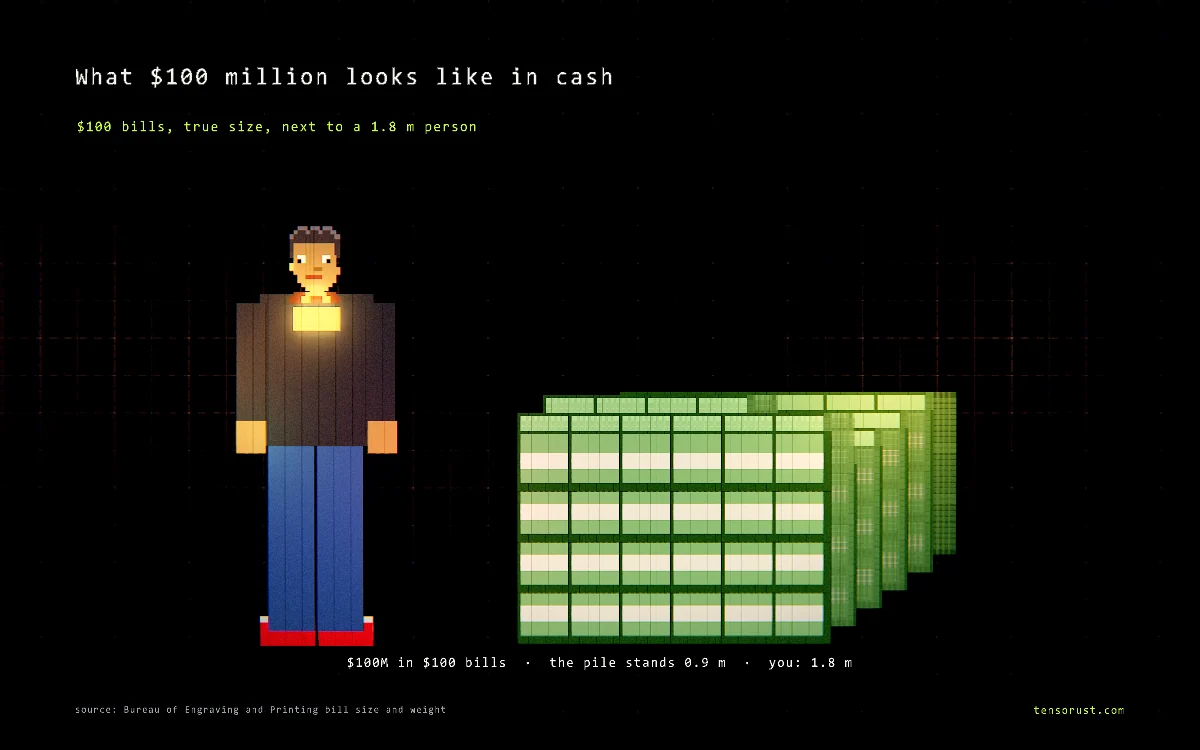
100 million dollars, pictured to scale in $100 bills next to a 1.8 m person, with the weight, the volume, how tall the stack is, and the same amount in $1 bills.
Short answer: $100 million in $100 bills is 1,000,000 bills. It weighs 1 metric tons (1.1 US tons), takes up 1.13 m³ (39.9 cu ft) (a cube 1.0 m on each side), and stacked in one column it would be 109.2 m tall. Fits in a 20-foot shipping container (or fills about 2.66 car trunks). In $1 bills it is 100 times bigger: 100 metric tons (110 US tons).
Key numbers
| Key numbers | In $100 bills | In $1 bills |
|---|---|---|
| Bills | 1,000,000 bills of $100 | 100,000,000 bills of $1 |
| Weight | 1 metric tons (1.1 US tons) | 100 metric tons (110 US tons) |
| Volume | 1.13 m³ (39.9 cu ft) | 113 m³ (3,988 cu ft) |
| As one cube | 1.0 m a side | 4.8 m a side |
| Stacked in one column | 109.2 m, taller than the Statue of Liberty, ground to torch (93 m) | 10.9 km, taller than Mount Everest (8,849 m) |
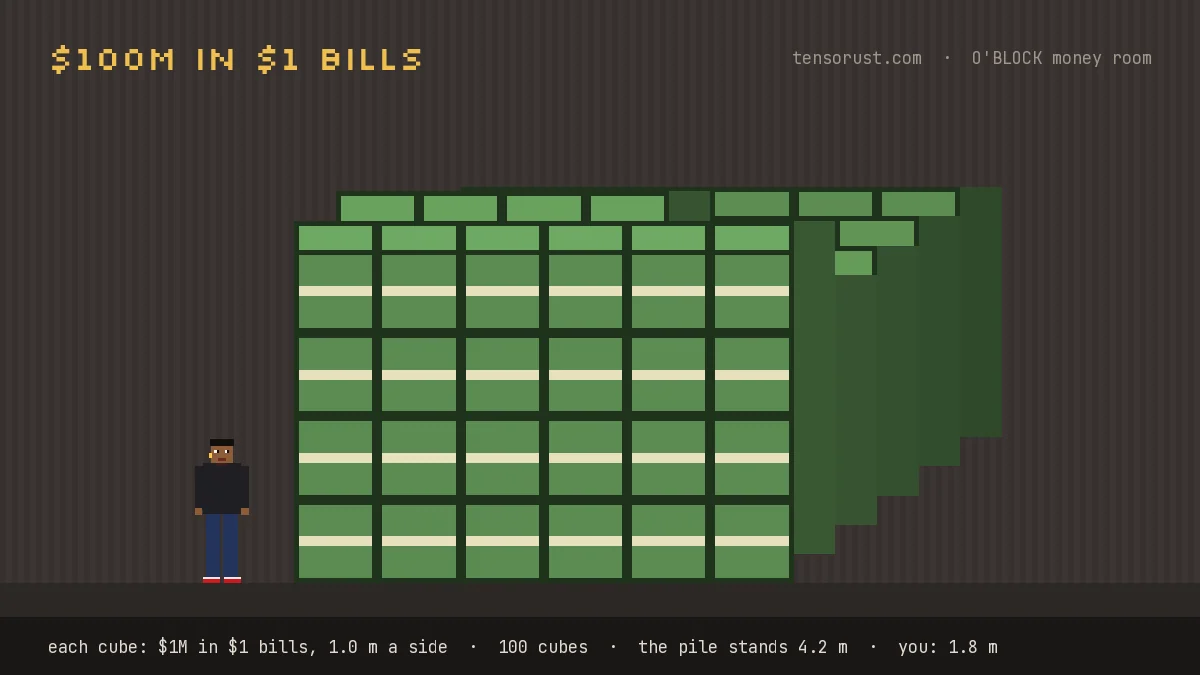
| Pile in the picture | 100 cubes of $1M, each 22 cm a side, 90 cm tall | 100 cubes of $1M, each 1.0 m a side, 4.2 m tall |
| Standard pallets | 1 pallet (48 x 40 in, 1 million bills each) | 100 pallets (48 x 40 in, 1 million bills each) |
| Compared to | Fits in a 20-foot shipping container (or fills about 2.66 car trunks) | Fits in a house (or fills about 1.67 40-foot shipping containers) |
| On a football field | 0.2 mm deep, end zones included | 2.1 cm deep, end zones included |
The same amount in $1 bills
100 million dollars in $1 bills is 100,000,000 bills: 100 metric tons (110 US tons) and 113 m³ (3,988 cu ft). Fits in a house (or fills about 1.67 40-foot shipping containers). Stacked, 10.9 km, taller than Mount Everest (8,849 m).
$100 million, in words
This is where cash stops being something you carry. $100 million in hundreds is one metric ton: one full pallet, moved with a forklift.
The picture is drawn to scale. Each cube is $1M in $100 bills (10,000 bills), drawn as a cube with the same volume as the bills, 22 cm a side. There are 100 of them, and the person next to the pile is 1.8 m tall in a black hoodie, jeans and red-and-white sneakers.
How it was measured
- Size. Every US note in circulation is 6.14 x 2.61 inches (156 x 66.3 mm), the size set in 1929 (U.S. Currency Education Program), and 0.0043 inches (0.109 mm) thick (Bureau of Engraving and Printing). One bill is about 1.13 cm³.
- Weight. About 1 gram per bill, any denomination (Bureau of Engraving and Printing). That is why $1 bills are exactly 100 times heavier than the same amount in hundreds.
- Volume. Bills times 1.13 cm³. Real bricks of cash have a little air and paper bands, so a real pile is slightly bigger.
- Pallets. One standard 48 x 40 inch pallet loaded about 0.91 m high holds a million bills: $100 million in hundreds, $1 million in ones, 1,000 kg either way.
- The picture. The pile is built the way O'BLOCK's money room builds it: one cube per $1M, a power of ten picked so there are at most 700 cubes, drawn in an oblique view.
Questions
How much does 100 million dollars weigh in $100 bills?
1 metric tons (1.1 US tons). Every US bill weighs about 1 gram (Bureau of Engraving and Printing), and $100 million is 1,000,000 hundred-dollar bills.
How tall is 100 million dollars in $100 bills?
Stacked in one column: 109.2 m, taller than the Statue of Liberty, ground to torch (93 m). Each bill is 0.0043 inches (0.109 mm) thick.
How much space does 100 million dollars take up?
1.13 m³ (39.9 cu ft) in $100 bills, the same as a cube 1.0 m on each side. Fits in a 20-foot shipping container (or fills about 2.66 car trunks).
What does 100 million dollars look like in $1 bills?
100 times bigger and heavier: 100,000,000 bills, 100 metric tons (110 US tons), 113 m³ (3,988 cu ft), a column 10.9 km tall. Fits in a house (or fills about 1.67 40-foot shipping containers).
Other amounts
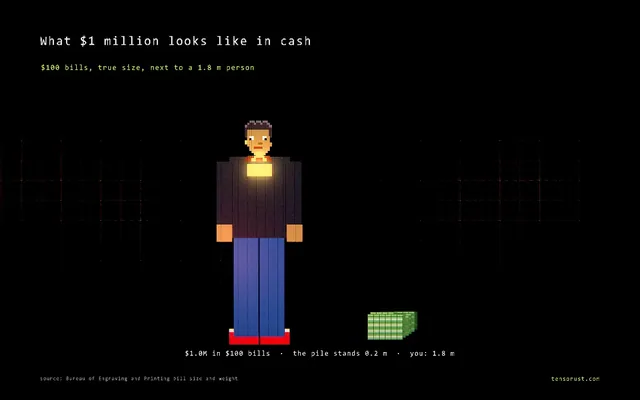 $1 million10 kg (22 lb) in hundreds
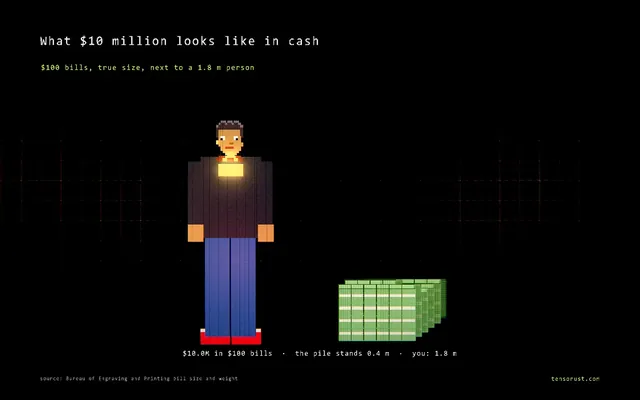 $10 million100 kg (220 lb) in hundreds
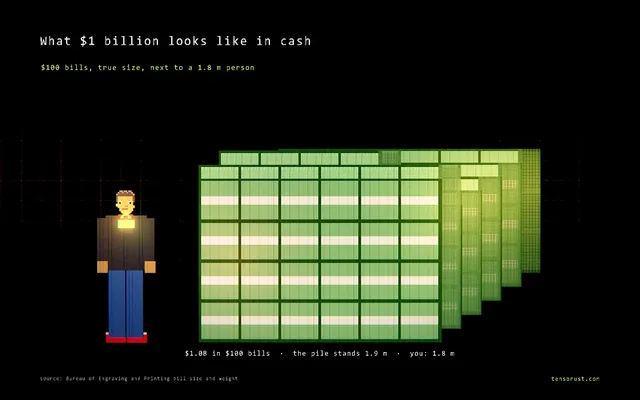 $1 billion10 metric tons (11 US tons) in hundreds
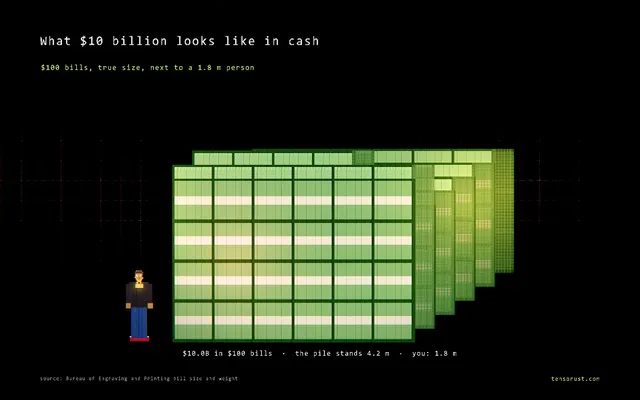 $10 billion100 metric tons (110 US tons) in hundreds
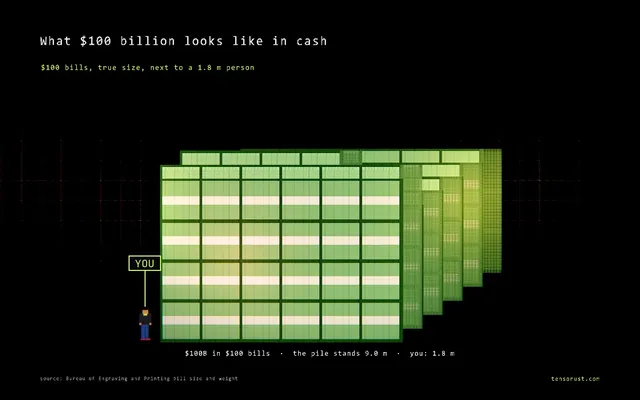 $100 billion1,000 metric tons (1,102 US tons) in hundreds
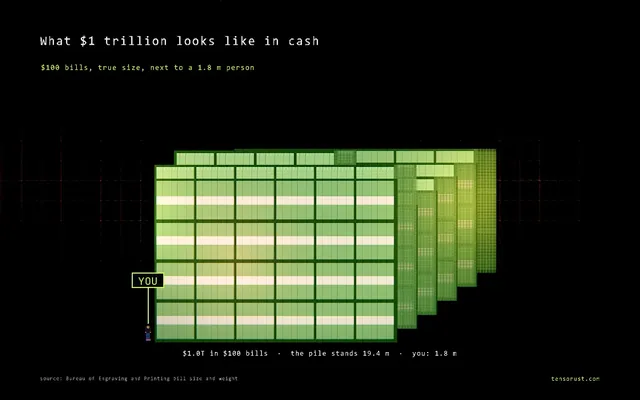 $1 trillion10,000 metric tons (11,023 US tons) in hundreds
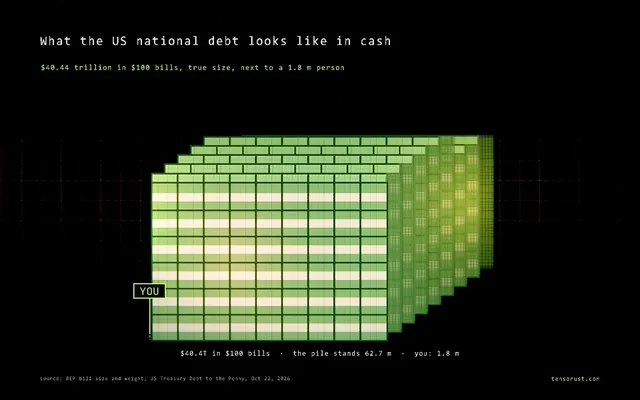 The US national debt404,443 metric tons (445,823 US tons) in hundreds
Try any amount in the money size calculator →
The same money room as O'BLOCK, free on Steam. Pictures: tensorust.com, free to share with a link.
Sources
- Bureau of Engraving and Printing: Currency FAQs ("The approximate weight of a note, regardless of denomination is one gram"), read Oct 23, 2026
- U.S. Currency Education Program (Federal Reserve): $20 note fact sheet (note size reduced to 6.14 x 2.61 inches in 1929, the size every note still uses), read Oct 23, 2026
- The Physics Factbook, quoting the Bureau of Engraving and Printing: "the thickness is .0043 inches", read Oct 23, 2026
- U.S. Treasury, Fiscal Data: Debt to the Penny, read Oct 23, 2026
- Empire State Building fact sheet: 37 million cubic feet, 1,454 ft to the tip, read Oct 23, 2026
- NFL rulebook: the field is 360 by 160 feet, end zones included, read Oct 23, 2026