
Money in cash · BEP figures · checked Oct 23, 2026
What does a million dollars look like?
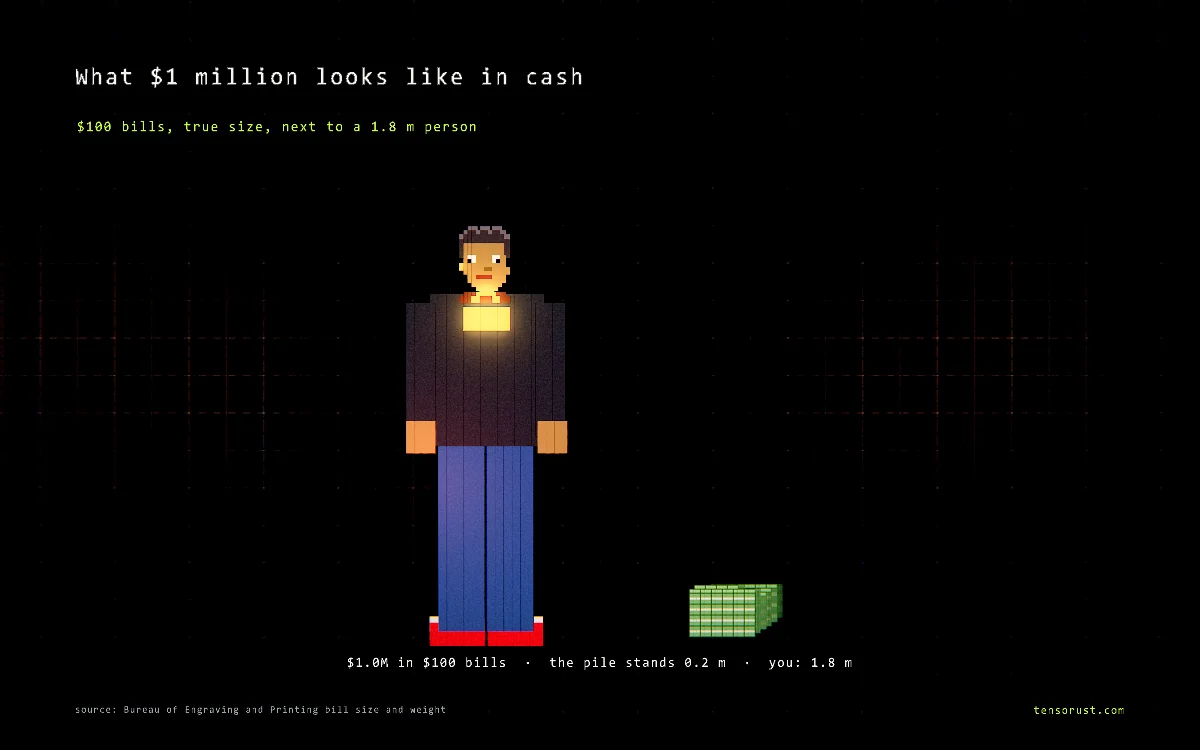
A million dollars, pictured to scale in $100 bills next to a 1.8 m person, with the weight, the volume, how tall the stack is, and the same amount in $1 bills.
Short answer: $1 million in $100 bills is 10,000 bills. It weighs 10 kg (22 lb), takes up 11.3 litres (0.399 cu ft) (a cube 22 cm on each side), and stacked in one column it would be 1.1 m tall. Fits in a briefcase. In $1 bills it is 100 times bigger: 1 metric tons (1.1 US tons).
Key numbers
| Key numbers | In $100 bills | In $1 bills |
|---|---|---|
| Bills | 10,000 bills of $100 | 1,000,000 bills of $1 |
| Weight | 10 kg (22 lb) | 1 metric tons (1.1 US tons) |
| Volume | 11.3 litres (0.399 cu ft) | 1.13 m³ (39.9 cu ft) |
| As one cube | 22 cm a side | 1.0 m a side |
| Stacked in one column | 1.1 m, shorter than a 1.8 m person | 109.2 m, taller than the Statue of Liberty, ground to torch (93 m) |
| Pile in the picture | 100 cubes of $10K, each 4.8 cm a side, 19 cm tall | 100 cubes of $10K, each 22 cm a side, 90 cm tall |
| Standard pallets | 1% of one pallet (48 x 40 in, 1 million bills each) | 1 pallet (48 x 40 in, 1 million bills each) |
| Compared to | Fits in a briefcase | Fits in a 20-foot shipping container (or fills about 2.66 car trunks) |
| On a football field | 0.0 mm deep, end zones included | 0.2 mm deep, end zones included |
The same amount in $1 bills
A million dollars in $1 bills is 1,000,000 bills: 1 metric tons (1.1 US tons) and 1.13 m³ (39.9 cu ft). Fits in a 20-foot shipping container (or fills about 2.66 car trunks). Stacked, 109.2 m, taller than the Statue of Liberty, ground to torch (93 m).

$1 million, in words
This is the one the movies get right: a million in hundreds fits in a briefcase and one person can carry it.
The picture is drawn to scale. Each cube is $10K in $100 bills (100 bills), drawn as a cube with the same volume as the bills, 4.8 cm a side. There are 100 of them, and the person next to the pile is 1.8 m tall in a black hoodie, jeans and red-and-white sneakers.
How it was measured
- Size. Every US note in circulation is 6.14 x 2.61 inches (156 x 66.3 mm), the size set in 1929 (U.S. Currency Education Program), and 0.0043 inches (0.109 mm) thick (Bureau of Engraving and Printing). One bill is about 1.13 cm³.
- Weight. About 1 gram per bill, any denomination (Bureau of Engraving and Printing). That is why $1 bills are exactly 100 times heavier than the same amount in hundreds.
- Volume. Bills times 1.13 cm³. Real bricks of cash have a little air and paper bands, so a real pile is slightly bigger.
- Pallets. One standard 48 x 40 inch pallet loaded about 0.91 m high holds a million bills: $100 million in hundreds, $1 million in ones, 1,000 kg either way.
- The picture. The pile is built the way O'BLOCK's money room builds it: one cube per $10K, a power of ten picked so there are at most 700 cubes, drawn in an oblique view.
Questions
How much does a million dollars weigh in $100 bills?
10 kg (22 lb). Every US bill weighs about 1 gram (Bureau of Engraving and Printing), and $1 million is 10,000 hundred-dollar bills.
How tall is a million dollars in $100 bills?
Stacked in one column: 1.1 m, shorter than a 1.8 m person. Each bill is 0.0043 inches (0.109 mm) thick.
How much space does a million dollars take up?
11.3 litres (0.399 cu ft) in $100 bills, the same as a cube 22 cm on each side. Fits in a briefcase.
What does a million dollars look like in $1 bills?
100 times bigger and heavier: 1,000,000 bills, 1 metric tons (1.1 US tons), 1.13 m³ (39.9 cu ft), a column 109.2 m tall. Fits in a 20-foot shipping container (or fills about 2.66 car trunks).
Other amounts
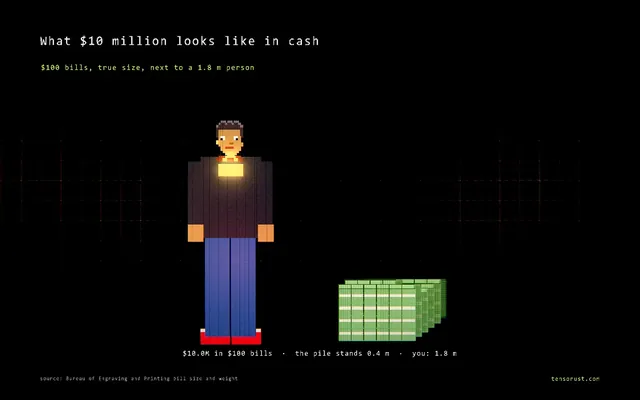 $10 million100 kg (220 lb) in hundreds
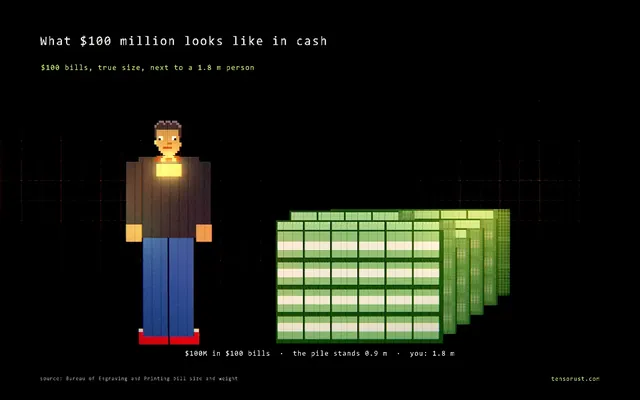 $100 million1 metric tons (1.1 US tons) in hundreds
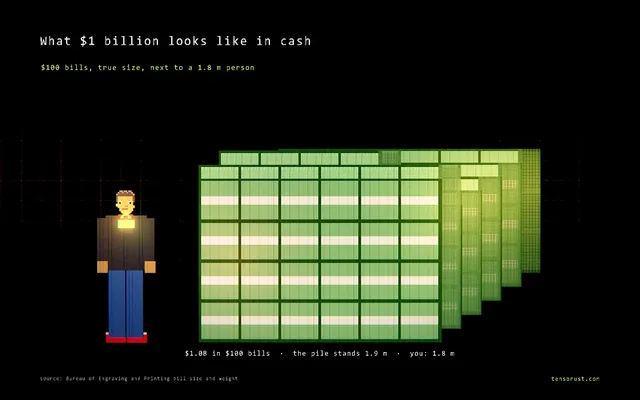 $1 billion10 metric tons (11 US tons) in hundreds
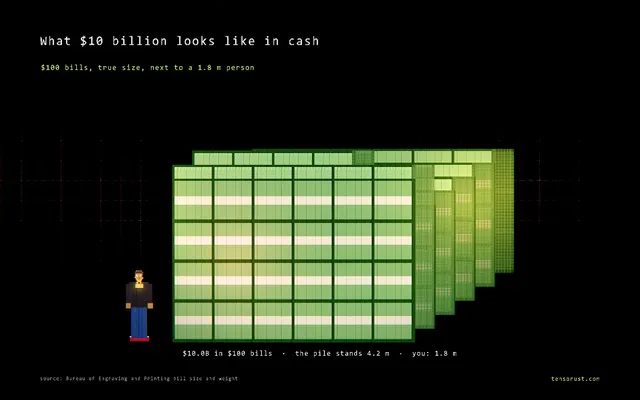 $10 billion100 metric tons (110 US tons) in hundreds
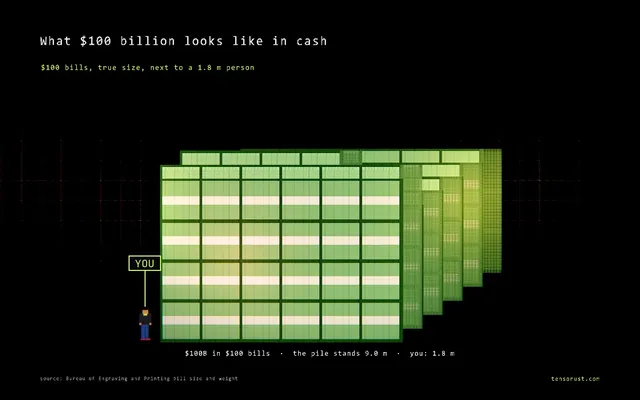 $100 billion1,000 metric tons (1,102 US tons) in hundreds
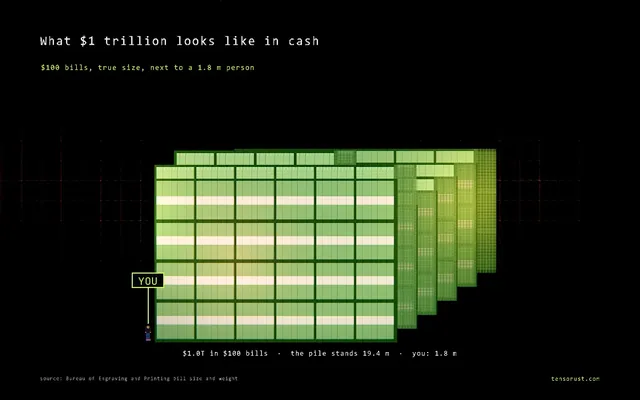 $1 trillion10,000 metric tons (11,023 US tons) in hundreds
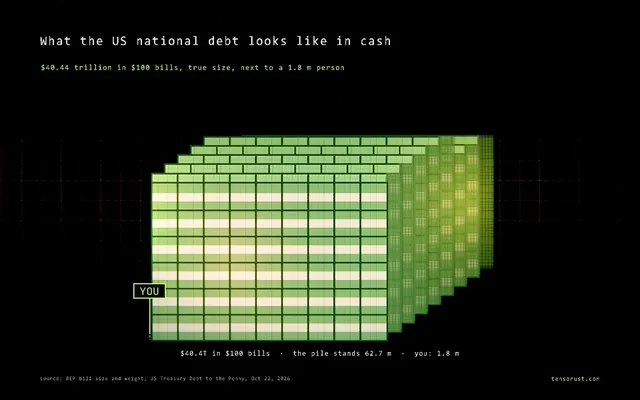 The US national debt404,443 metric tons (445,823 US tons) in hundreds
Try any amount in the money size calculator →
The same money room as O'BLOCK, free on Steam. Pictures: tensorust.com, free to share with a link.
Sources
- Bureau of Engraving and Printing: Currency FAQs ("The approximate weight of a note, regardless of denomination is one gram"), read Oct 23, 2026
- U.S. Currency Education Program (Federal Reserve): $20 note fact sheet (note size reduced to 6.14 x 2.61 inches in 1929, the size every note still uses), read Oct 23, 2026
- The Physics Factbook, quoting the Bureau of Engraving and Printing: "the thickness is .0043 inches", read Oct 23, 2026
- U.S. Treasury, Fiscal Data: Debt to the Penny, read Oct 23, 2026
- Empire State Building fact sheet: 37 million cubic feet, 1,454 ft to the tip, read Oct 23, 2026
- NFL rulebook: the field is 360 by 160 feet, end zones included, read Oct 23, 2026