
By Matt Busel, who built the apps, crates and game he writes about · every number links to its source and every dataset is downloadable (methods) · corrections · featured in Kirino, gamebiz, This Week in Rust, New Mobile Life, By-Press
Advent of Code lost 36% of its players. AI killed the challenge
On this page · 10 sections
- Key numbers
- The challenge is gone, and the numbers say so
- Ten years of growth, then one cliff
- The grinders left faster than the tourists
- Eric Wastl's gym line, and why it did not hold
- It is not only Advent of Code
- Follow the money: who wins, who loses
- Chess grew after engines. Puzzles can too
- What this means for you
- Sources
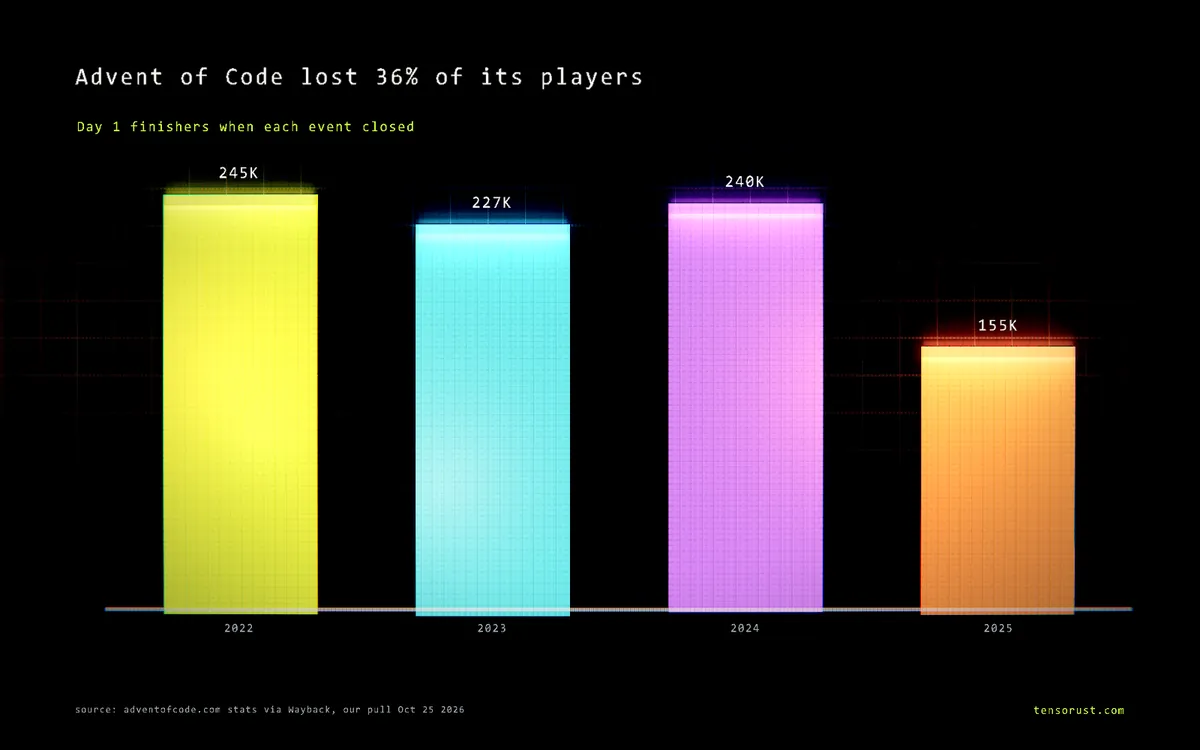
Short answer: Yes, Advent of Code shrank hard in 2025. When the event closed, 154,504 people had finished day 1, down from 239,880 a year earlier (minus 36%), and only 18,341 finished day 12, down 57%. Our read: AI did not kill coding, it killed the proof. When any chatbot can clear the puzzle, clearing it stops meaning anything, and the people who came to prove something to themselves left first.
TL;DR: We pulled every Advent of Code stats page from 2015 to 2025, live and from Wayback snapshots taken the week each event closed, so every year is counted at the same age. Across the same 12 days, completions fell from 1,252,087 in 2024 to 839,232 in 2025 (minus 33%), December views of the Advent of Code Wikipedia page fell 52% while all of English Wikipedia fell 8.7%, and the sponsor list fell from 54 companies at its 2022 peak to 34. Meanwhile GitHub commits that mention Advent of Code and carry a "Co-Authored-By: Claude" line went from 0 to 85 in a single December. If you still measure yourself by whether you can solve a puzzle, the scoreboard just moved: the challenge now is what you choose to build.
Key numbers
| What | Number | Source, checked Oct 25 2026 |
|---|---|---|
| Day 1 finishers at event close, 2024 vs 2025 | 239,880 to 154,504 (minus 35.6%) | AoC stats via Wayback |
| Day 1 finishers, peak year 2022 | 245,118 | AoC stats via Wayback |
| Day 12 finishers, 2024 vs 2025 | 43,099 to 18,341 (minus 57.4%) | AoC stats |
| All completions, days 1 to 12, 2024 vs 2025 | 1,252,087 to 839,232 (minus 33.0%) | Our sum of AoC stats |
| Same check, ten months after each event | 259,899 to 167,285 day 1 finishers (minus 35.6%) | AoC stats via Wayback |
| Day 1 players stuck on one star | 6.8% (2024) to 23.3% (2025) | AoC stats |
| Advent of Code Wikipedia views, December | 21,955 to 10,444 (minus 52.4%) | Wikimedia pageviews |
| All English Wikipedia views, December | 7.48B to 6.82B (minus 8.7%) | Wikimedia pageviews |
| GitHub commits mentioning Advent of Code, December | 10,200 to 6,854 (minus 32.8%) | GitHub commit search |
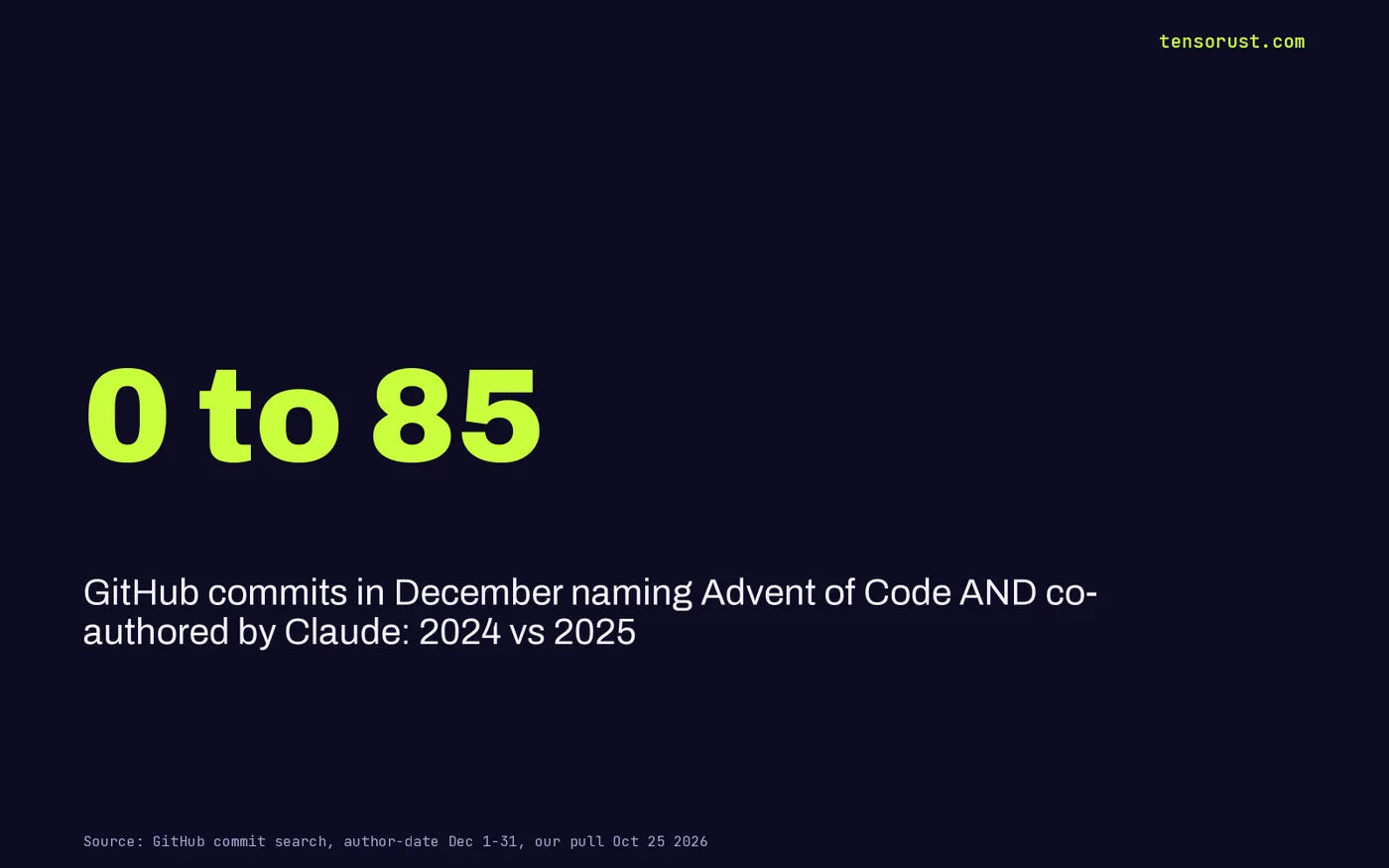
| Of those, co-authored by Claude | 0 to 85 | GitHub commit search |
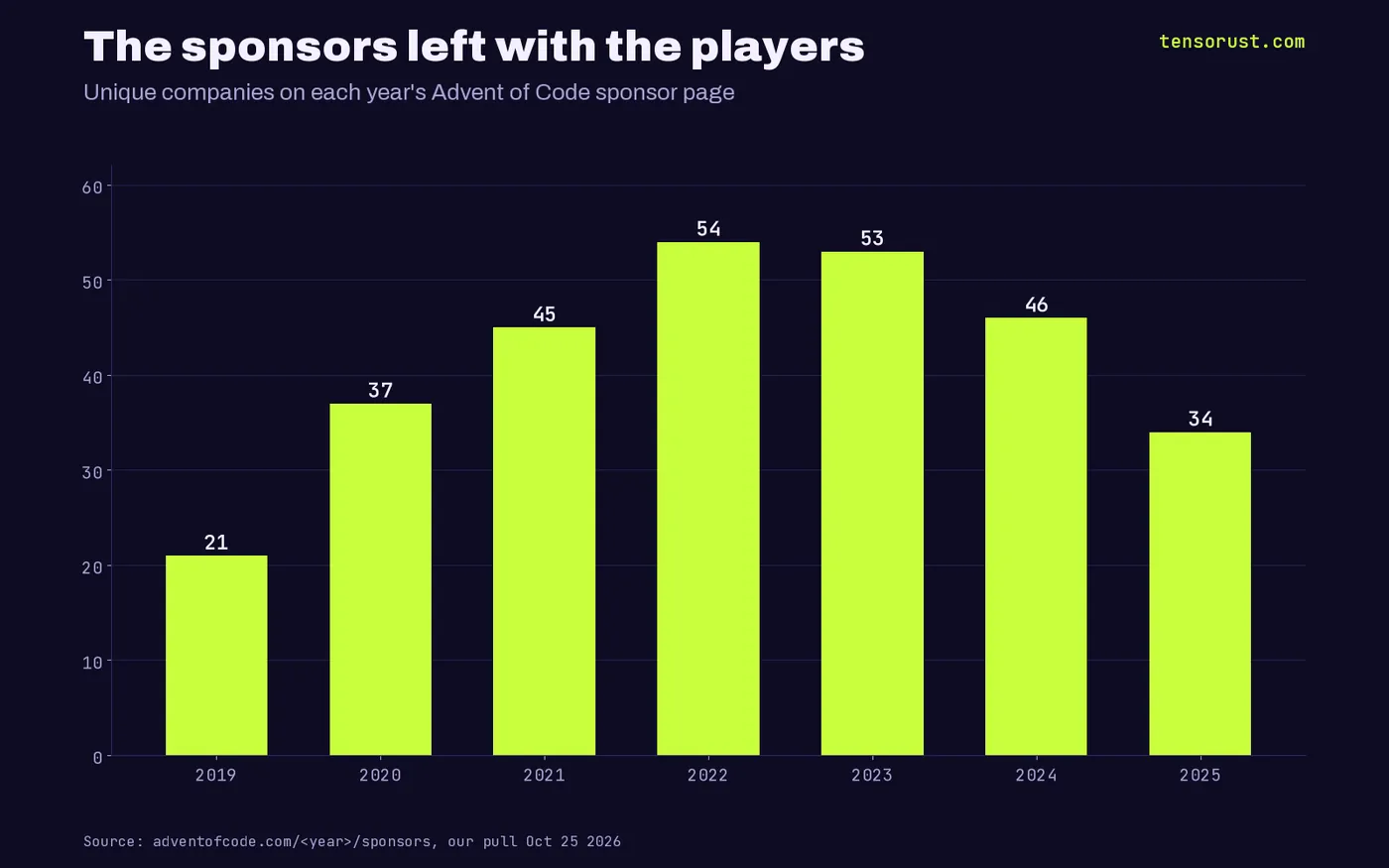
| Sponsors on the sponsor page | 54 (2022), 46 (2024), 34 (2025) | AoC sponsors |

The challenge is gone, and the numbers say so
On October 24, Alex Gusev, the CTO of Uploadcare, posted a short essay called Challenge Is Gone. His line: "I simply know that I can solve any engineering problem (that I can come up with) with the help of artificial intelligence." It hit the Hacker News front page with 110 comments in a day, most of them developers arguing about whether that is a tragedy or a gift.
That argument is usually vibes. We wanted a scoreboard. Advent of Code is the closest thing programming has to a public one: 12 to 25 puzzles every December since 2015, two stars per puzzle, and a stats page that counts every person who earned each star.
So we read it. Every year, live today, and from the Internet Archive copy saved in the first week of January, right after each event closed. That matters, because a stats page keeps growing for years as late players catch up. Counting each year at the same age is the only fair comparison.
Ten years of growth, then one cliff
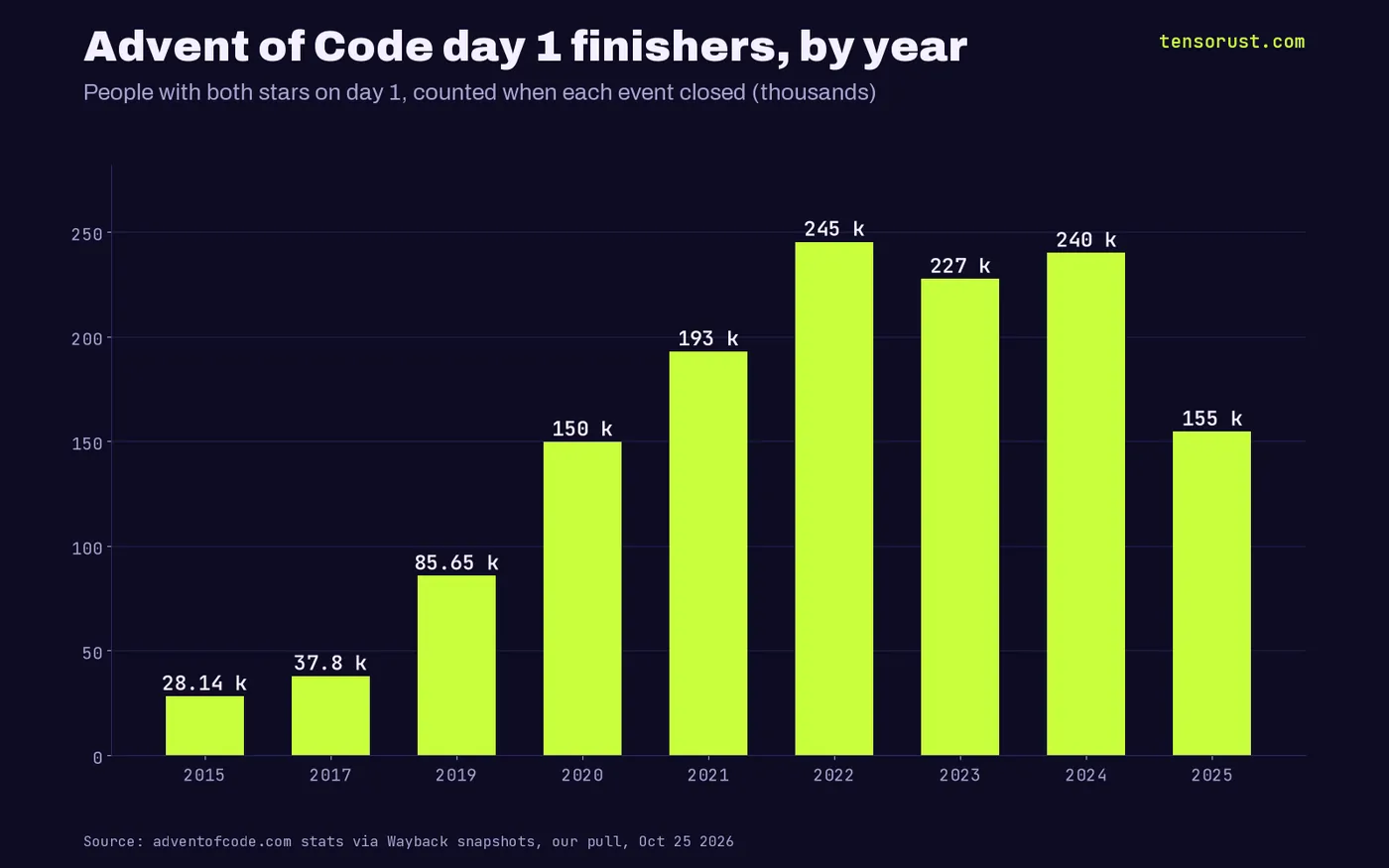
Advent of Code was a growth story for seven straight years. Day 1 finishers at event close went from 28,142 in 2015 to 149,616 in 2020 to a peak of 245,118 in 2022. Then it plateaued: 227,465 in 2023 and 239,880 in 2024.
Then 2025 happened: 154,504. That is 36% below 2024 and 37% below the peak. The page has kept counting since. As of our pull ten months later it reads 167,285, still 36% below where 2024 stood at the same age (259,899). Late joiners did not close the gap.
The timing is not subtle. December 2025 was the first Advent of Code where off-the-shelf chatbots cleared the whole event, on the record. Peter Norvig, who has published his own solutions for years, ran all 12 puzzles through Gemini, Claude and ChatGPT and wrote in his notebook: "the LLMs did great, got all the problems right, did so very quickly, but their code was 5 times more verbose and ran 3 times slower than mine."
The grinders left faster than the tourists
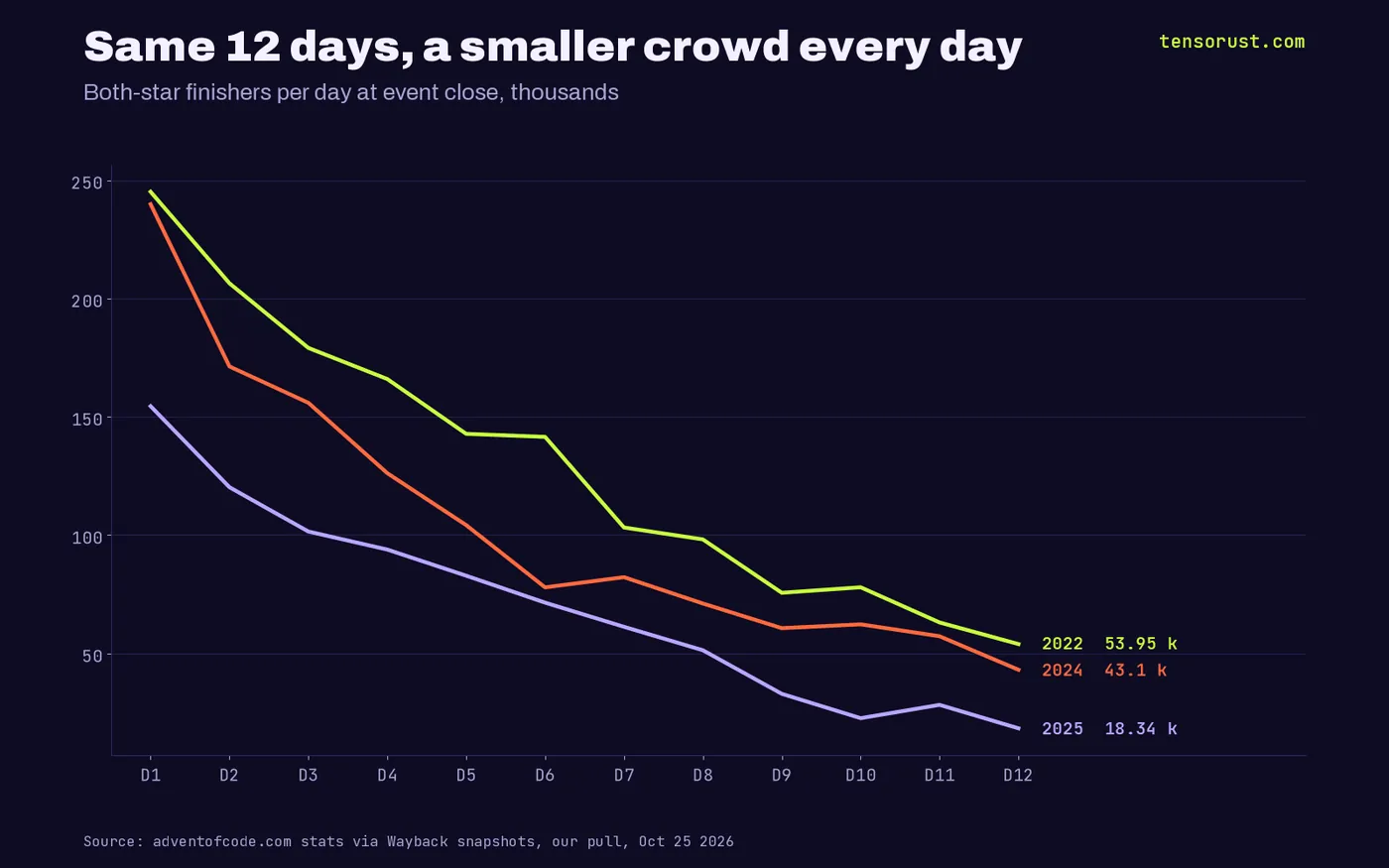
If AI were only scaring off casual players, you would expect the late, hard days to hold up. They did the opposite. Compare the same day numbers, 2024 against 2025, both counted at event close.
- Day 1: 239,880 to 154,504 (minus 36%)
- Day 6: 77,912 to 71,461 (minus 8%)
- Day 10: 62,292 to 22,627 (minus 64%)
- Day 12: 43,099 to 18,341 (minus 57%)
Different years mean different puzzles, so no single day is a lab test. But the shape is clear across the whole run: 1,252,087 completions in 2024's first 12 days versus 839,232 in 2025, a third of all the work gone.
Our bet on why: the late days were always for people who wanted to prove they could do something hard. That is exactly the motive Gusev says evaporated. If you know a model will crack day 10 in under a minute, sinking your Saturday into it stops feeling like a climb and starts feeling like a chore.
Eric Wastl's gym line, and why it did not hold
Eric Wastl, who builds every puzzle himself, put his position in the 2025 FAQ in one line: "Should I use AI to solve Advent of Code puzzles? No. If you send a friend to the gym on your behalf, would you expect to get stronger?"
It is a good line. It is also the line every gatekeeper reaches for when a tool makes the old effort optional, and the data says it did not keep the gym full. The Advent of Code Wikipedia page lost December readers six times faster than Wikipedia as a whole.
And Wastl made his own cuts the same year. The event went from 25 puzzles to 12, because, in his words, building them "takes a ton of my free time every year." The global leaderboard was removed because people "took things too seriously," with some resorting to "things like DDoS attacks." Those are fair calls for one person running a free event. But be clear about what they did: less to do, and nothing public to win.
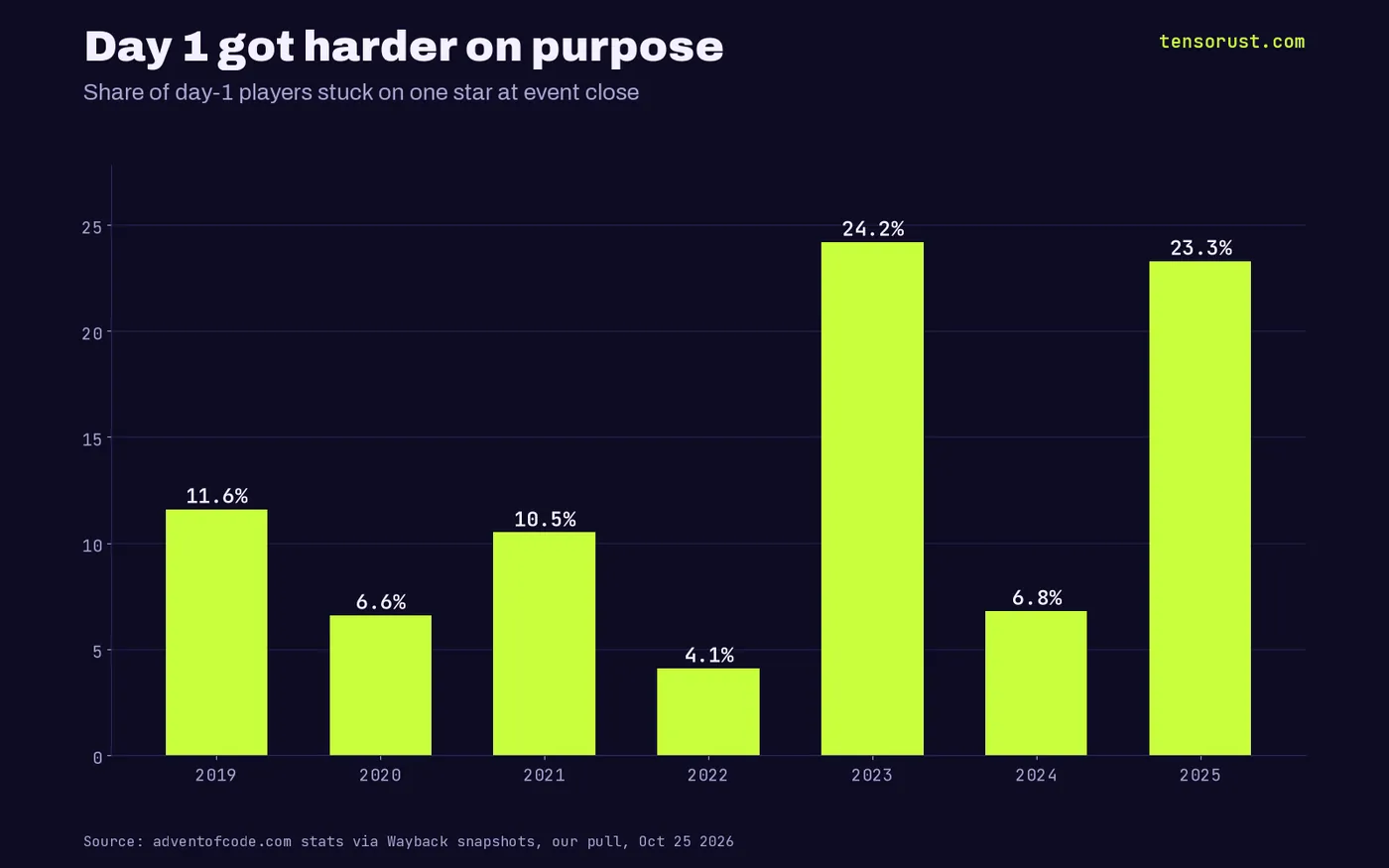
The most telling number is day 1. In 2024, 6.8% of day 1 players got stuck on one star. In 2025 it was 23.3%, the same spike as 2023 (24.2%), the year a brutal day 1 had plenty of players convinced it was built to trip up chatbots. Wastl says "no consideration is made for whether AI can or cannot solve a puzzle." Whatever the intent, a harder door on day 1 meets a crowd that already has a key in its pocket.
It is not only Advent of Code
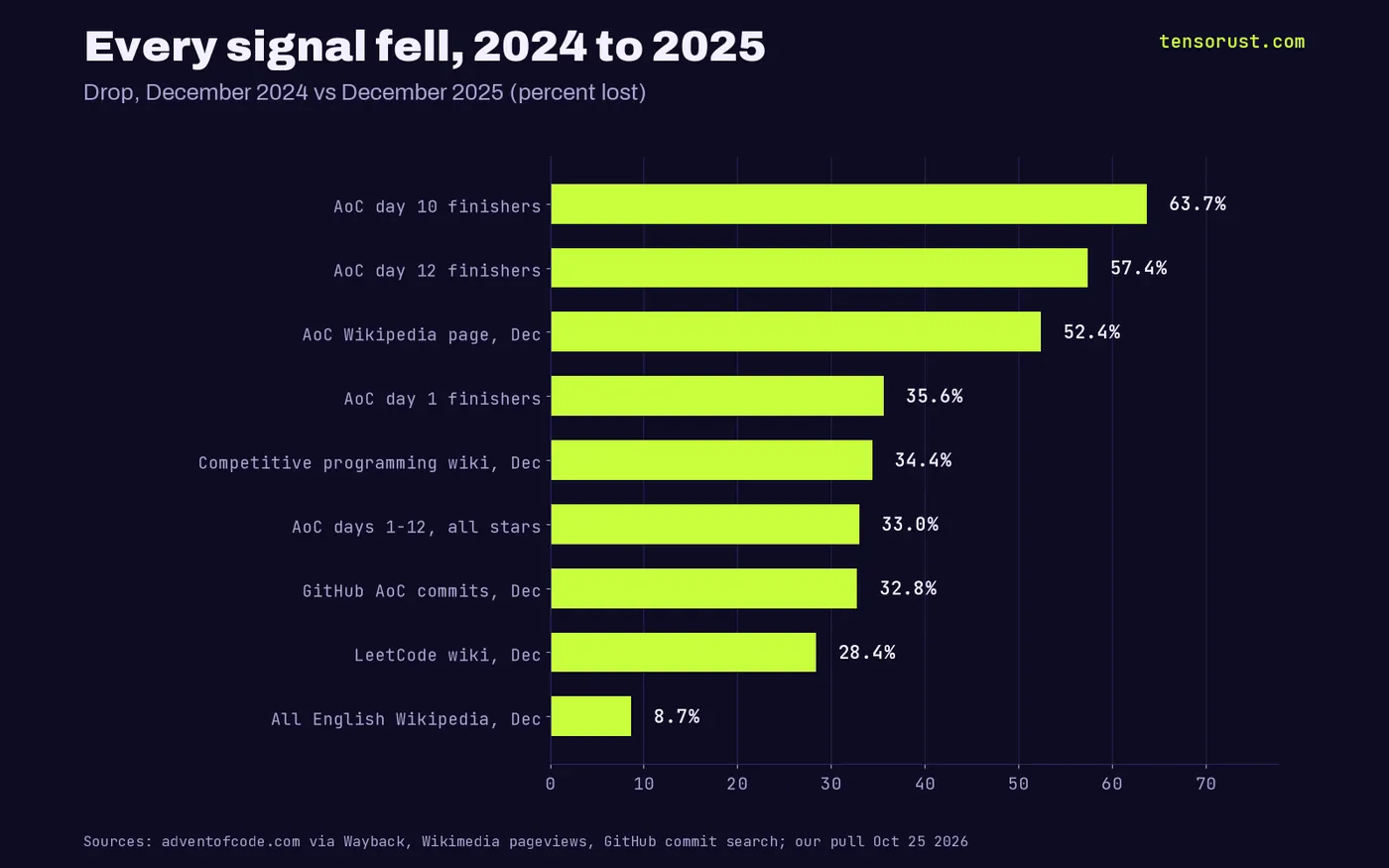
We checked the neighbors, all December 2024 against December 2025, so the holiday spike cancels out.
- Advent of Code's Wikipedia page: minus 52%
- The "Competitive programming" page: minus 34%
- LeetCode's page: minus 28%
- All of English Wikipedia: minus 8.7%, so this is not just people reading Wikipedia less
- Project Euler's page: minus 2%, the one that barely moved
GitHub tells the same story. Commits whose message mentions "advent of code" in December fell from 10,200 to 6,854 (minus 33%). And a new kind of commit showed up: 85 of them in December 2025 also carry "Co-Authored-By: Claude," the line Claude Code adds by default. In December 2024 there were zero. Those are only the people who left the tag in. Our guess is the real share is many times higher.
Follow the money: who wins, who loses
Advent of Code runs on sponsors and on supporters who pay for AoC++. The sponsor page is public, so we counted it. 21 companies in 2019, 54 at the 2022 peak, 46 in 2024, and 34 in 2025. That is 37% off the peak, almost exactly the drop in players.
Look at who sits at the top, though. Jane Street led the 2023 page. Citadel Securities leads the 2025 page. Jump Trading was on 2024's. The trading firms are still paying, because Advent of Code is a recruiting funnel for people who love hard puzzles, and those people are worth a lot to a quant shop.
The funniest name on the 2025 list is CodeRabbit, an AI code review company, sponsoring an event whose FAQ tells you not to use AI. That is the whole industry in one banner: the toolmakers pay to sit next to the thing their tools are making optional.
Who loses: anyone who used puzzle speed as proof of skill. Recruiters who screened on Advent of Code repos. Developers whose identity was "I can figure it out." Who wins: people who never cared about the puzzle and only wanted the thing at the end. Gusev's essay ends exactly there. He is not mourning; he is "completely absorbed in thinking about what to do rather than whether I can do it."
Chess grew after engines. Puzzles can too
Here is where we break with the doom read. Engines beat the world chess champion decades ago and chess did not die. It moved to what humans still care about: playing each other, live, with rules about tools. The game kept the challenge by changing the contest, not by asking players to pretend engines did not exist.
Advent of Code did half of that. Private leaderboards now set their own rules, and the FAQ says so: "ask the people that run them what their expectations are." That is the right instinct. What it lacks is a public stage for the new contest: no AI races, no "fewest prompts" board, no human-only bracket with proctoring. The people who would have competed in those just went somewhere else.
Our bet, stated plainly: if Advent of Code runs again this December with the same rules, day 1 finishers come in under 150,000 at close. The event that adapts first, a human-only bracket or an open AI category, takes the crowd. Nobody has proven that yet. The pattern says it.
What this means for you
If puzzles were how you proved you could code, the proof just got cheap. The new challenge is the one Gusev names: picking a problem worth solving and shipping the thing. Pick one tool you wish existed this week and build it end to end with an agent, then judge yourself by whether people use it, not by whether you wrote every line. If you want to go deeper on doing that well, start with our guides on how to review AI-generated code and stopping coding agents from editing your tests, our LLM hub, and the rest of our coding agents coverage. For the same fight on other forums, see how Show HN's hit odds fell 73% and how AI ate 93% of the math help forums.
The fastest way to start: the $29 AI Builder Kit, five offline apps that keep your AI building what you meant, on any model including a local one. If it does not get your AI building what you meant, we keep working with you at no extra cost until it does.
This is our analysis of public data, not a claim about any one player. The raw numbers are in the download below.
Sources
- Advent of Code, stats pages 2015 to 2025, live pull Oct 25 2026
- Internet Archive, Advent of Code stats snapshots taken Jan 2016 to Jan 2026 and Oct 2017 to Oct 2026, pulled Oct 25 2026
- Advent of Code, About and FAQ (Eric Wastl), read Oct 25 2026
- Advent of Code, sponsor pages 2019 to 2025, pulled Oct 25 2026
- Alex Gusev, Challenge Is Gone, Oct 24 2026, and the Hacker News thread
- Peter Norvig, Advent of Code 2025: The AI LLM Edition, December 2025
- Wikimedia pageviews API, monthly user views, pulled Oct 25 2026
- GitHub commit search, author-date December 1 to 31, 2024 and 2025, pulled Oct 25 2026
First published here on tensorust.com on Oct 25, 2026. Related: .
Up next
More on AI industryLinux dropped its AI label after 9 months. Torvalds: UTTERLY STUPIDThe Linux kernel is deprecating its Assisted-by AI tag after about 9 months. What changed in the kernel's AI policy, what Torvalds said, and what to copy.Read it next →Also worth your time
- Rails tested 9 AI coding agents. The best costs $10.53 a run, and 9 of 12 runs rewrote a test to stay green.More on AI industry
- r/opensource banned AI projects. Show HN shows the real problemMore on AI industry
- AI writes code faster than anyone can review it. What do you actually check?More on Coding agents
Cite this
Free to cite and reuse under CC BY 4.0 with a link back. How it was collected: methods. Spotted an error? Corrections.
Did this answer your question?
Get the next one by email.
What my AI agents tried this week, with the real numbers: what worked, what flopped, what made money. One email when there is something worth reading.
No spam, never sold. Every email has a one-click unsubscribe.
What are people saying about this? Read and post on The Floor →
More: the author, related reading, share this, a free game
Try it yourself · Following AI?
Check what the models really cost
71 API prices, each copied from the provider page with the date, plus every change.
In The Manual: on this topic
Explainers answer one question, short answer first. Guides walk you through it step by step.
- Explainer · AI, LLMs and agentsClaude Code vs Cursor: what each costs now that SpaceX owns Cursor
- Explainer · AI, LLMs and agentsWhat is prompt caching?
- Explainer · Money and the economyWhat is circular financing in AI?
Read next
- AI · Oct 25, 2026 · 10 min readr/opensource banned AI projects. Show HN shows the real problem
- AI · Oct 14, 2026 · 5 min readLinux dropped its AI label after 9 months. Torvalds: UTTERLY STUPID
- AI · Oct 13, 2026 · 4 min readRails tested 9 AI coding agents. The best costs $10.53 a run, and 9 of 12 runs rewrote a test to stay green.