
By Matt Busel, who built the apps, crates and game he writes about · every number links to its source and every dataset is downloadable (methods) · corrections · featured in Kirino, gamebiz, This Week in Rust, New Mobile Life, By-Press
Berkeley quit grading math homework. AI ate 93% of the help forums
On this page · 9 sections
- Key numbers
- A Fields medalist just admitted the grade is fake
- The receipts: students left the help forums years ago
- The Wikipedia tell: half the math readers are gone
- Follow the money: who loses when homework stops counting
- The scarier chart: researchers are leaving too
- The Navier-Stokes asterisk
- What this means for you
- Sources
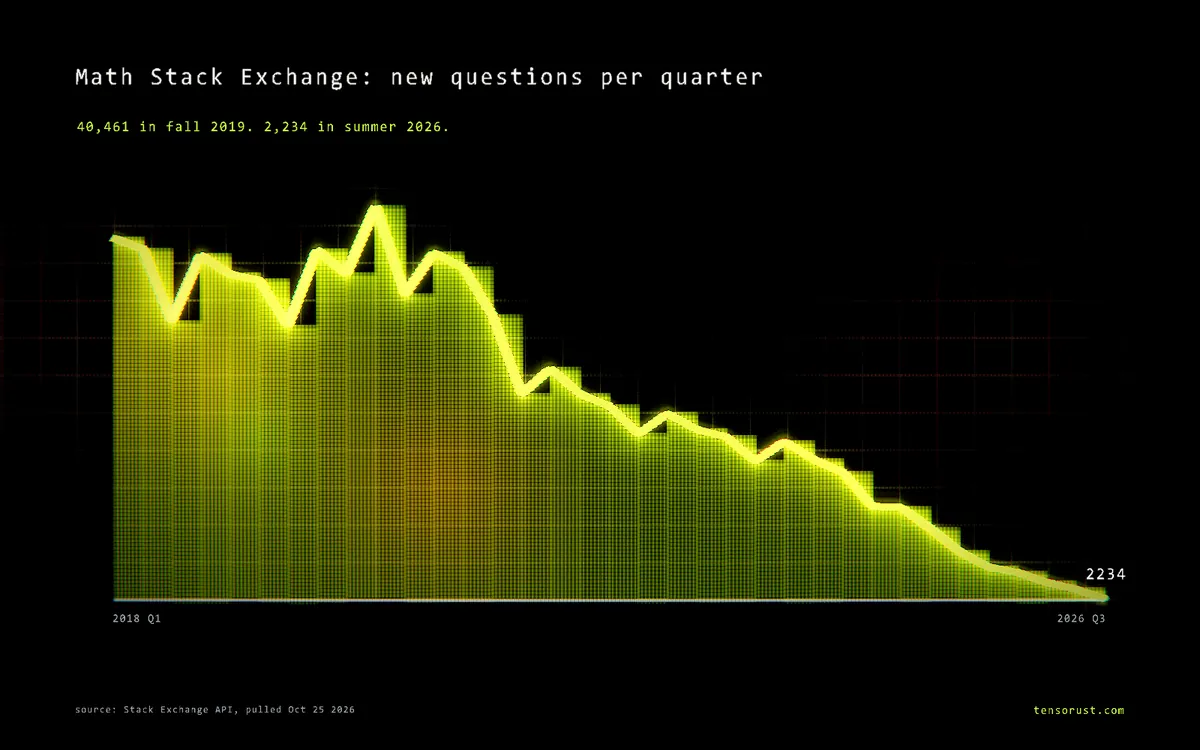
Short answer: UC Berkeley's Richard Borcherds, a Fields medalist, told the Daily Californian he no longer grades homework for correctness because AI hands his students top scores, so he grades on completion. He is not early, he is late. Our pull of the Stack Exchange API shows Math Stack Exchange got 2,234 new questions in July to September 2026, down 93% from 32,130 in the same quarter of 2019. Graded homework stopped measuring anything a while ago; Borcherds is just the first big name honest enough to say it out loud.
TL;DR: Math Stack Exchange, the place students took stuck homework for a decade, fell from 40,461 new questions in fall 2019 to 5,177 in fall 2025, and to about 24 a day this summer. Human views of 12 core math Wikipedia pages (Derivative, Integral, Matrix, Quadratic formula and friends) fell 39% between the 2022-23 and 2025-26 school years, while all of English Wikipedia fell only 9%. Even MathOverflow, where research mathematicians ask each other questions, is down 66%, which is exactly the future Borcherds says scares him. The move: stop treating a homework score as proof of anything, and build the one skill AI can't fake for you, which is doing it with nobody else in the room.
Key numbers
| What | Number | Source, checked Oct 25 2026 |
|---|---|---|
| Math Stack Exchange new questions, Jul-Sep 2019 vs Jul-Sep 2026 | 32,130 to 2,234 (-93%) | Stack Exchange API v2.3, our pull |
| Math Stack Exchange, fall semester (Oct-Dec) 2019 vs 2025 | 40,461 to 5,177 (-87%) | Stack Exchange API v2.3, our pull |
| Math Stack Exchange, full year 2019 vs 2025 | 147,545 to 28,379 (-81%) | Stack Exchange API v2.3, our pull |
| MathOverflow (research level), Jul-Sep 2019 vs 2026 | 2,595 to 879 (-66%) | Stack Exchange API v2.3, our pull |
| Human views, 12 core math Wikipedia pages, school year 2022-23 vs 2025-26 | 6.10M to 3.70M (-39%) | Wikimedia Pageviews API, our pull |
| All English Wikipedia human views, same two school years | -8.8% | Wikimedia Pageviews API, our pull |
| Berkeley's verdict on AI detectors (Turnitin, Rumi) | not adequate to standardize on campus | Daily Californian, Oct 23 2026 |

A Fields medalist just admitted the grade is fake
Richard Borcherds won the Fields Medal, the top prize in mathematics, and teaches at UC Berkeley. In an interview published October 23, he told the Daily Californian that so many students were using AI to get top homework scores that he saw "no point" in paying readers (the grad students who mark problem sets) to grade for correctness.
He now grades on completion: hand it in, get the points. He called it "not a very good system" and said he has no alternative. Then he went further: "If AI continues to improve at present rate, then, in a few years, there'll be nothing human mathematicians can do that AI can't do better."
The story hit the Hacker News front page with 151 points and 232 comments on October 25, and the comment section did what comment sections do: half called him lazy, half called him brave. Both miss it. He didn't kill homework. He just stopped pretending the grade was still measuring the student.
The receipts: students left the help forums years ago
Homework always leaves a trail. When students get stuck, they ask somewhere public, and for a decade that place was Math Stack Exchange. So we pulled every quarter since 2018 from the Stack Exchange API, 105 queries, three sites.
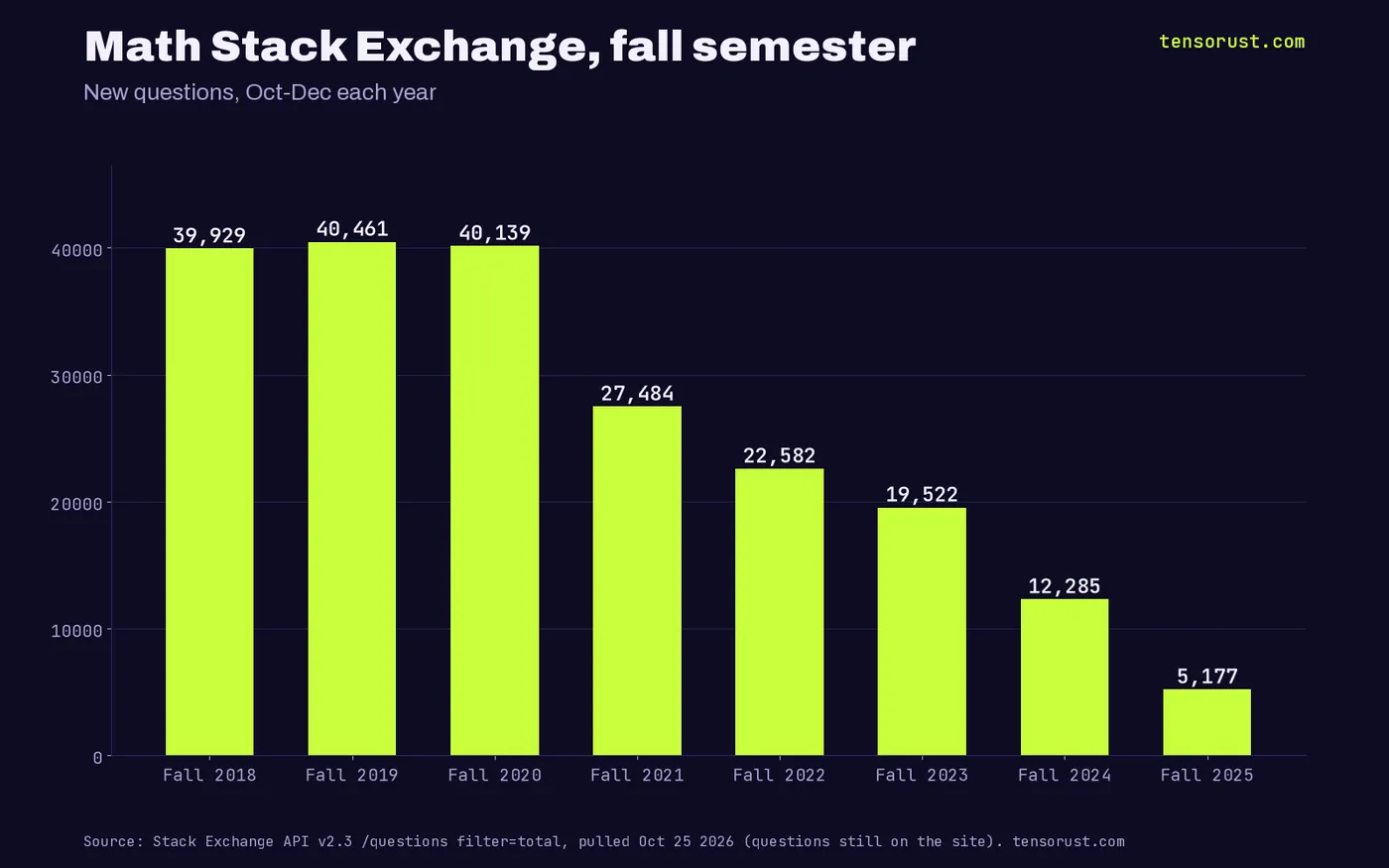
The fall semester tells it cleanly. Math Stack Exchange got 39,929 new questions in fall 2018, 40,461 in fall 2019 and 40,139 in fall 2020. Then 27,484, then 22,582 in fall 2022, the quarter ChatGPT launched. Then 19,522, 12,285 and, last fall, 5,177.
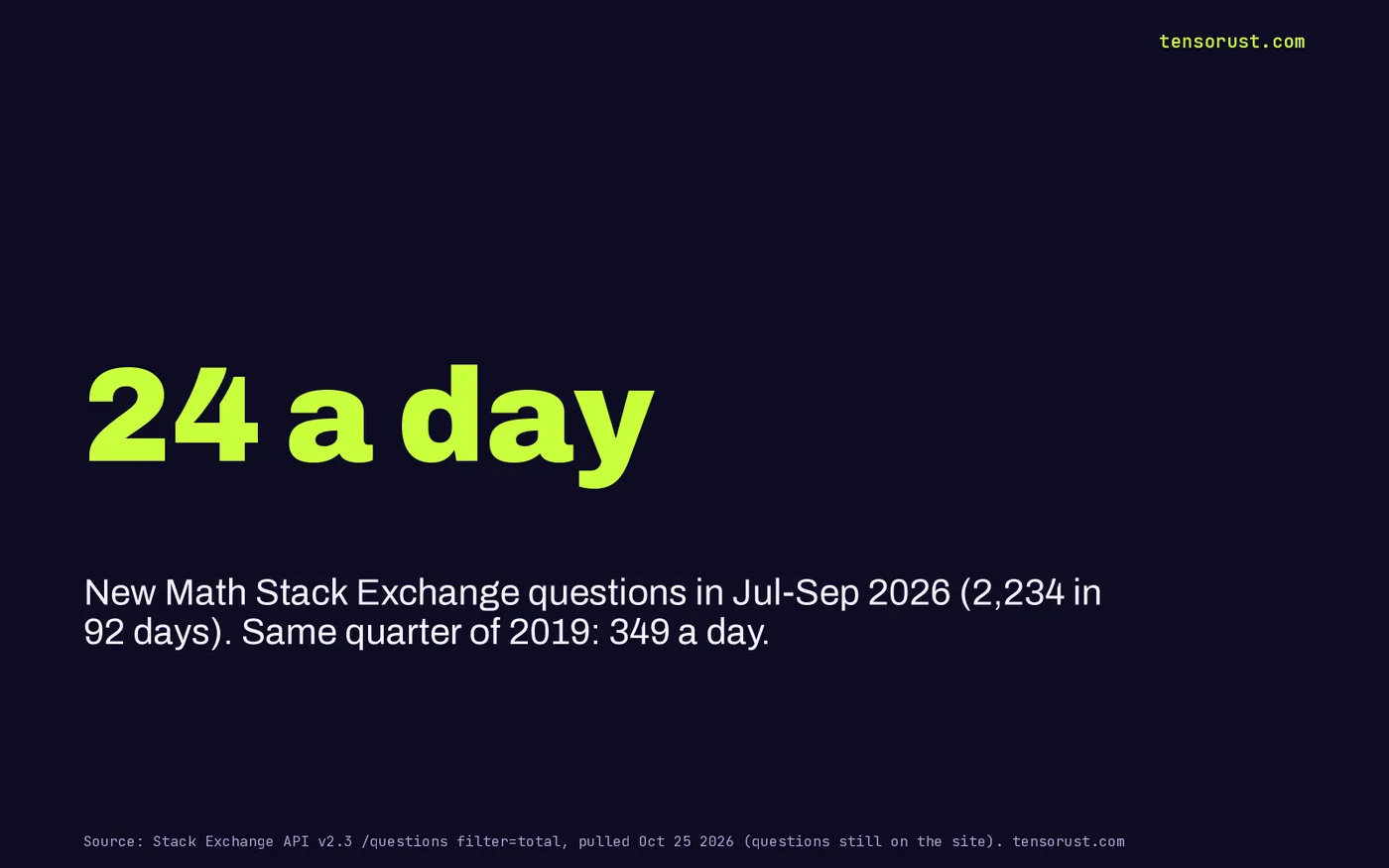
This summer, July to September 2026, the whole site got 2,234 new questions. That is about 24 a day for the main public math help desk on the internet. The same quarter in 2019 averaged 349 a day.
One honest wrinkle, and it makes the story worse for the gatekeepers, not better. Math Stack Exchange was already sliding in 2021, before ChatGPT, after years of moderators closing "homework questions" with no shown effort. The site spent a decade telling students their questions weren't welcome. Then something showed up that answers every question, instantly, at 3 AM, without a lecture. The students did the obvious thing.
A note on the method: the API counts questions still on the site. Deleted questions drop out, and older quarters have had more years to collect deletions, so if anything the old numbers are undercounted and the real drop is bigger than what we show.
The Wikipedia tell: half the math readers are gone
Forums are one trail. Reading is the other. We pulled monthly human pageviews (bots filtered out by Wikimedia) for 12 pages every calculus and linear algebra student hits: Derivative, Integral, Calculus, Limit, Chain rule, Integration by parts, Taylor series, Fourier transform, Linear algebra, Matrix, Eigenvalues and eigenvectors, Quadratic formula.
Across the school year (September to May), those 12 pages drew 6.10 million human views in 2022-23 and 3.70 million in 2025-26, a 39% drop. English Wikipedia as a whole lost 8.8% over the same months. So the math pages fell more than four times faster than the site they live on.
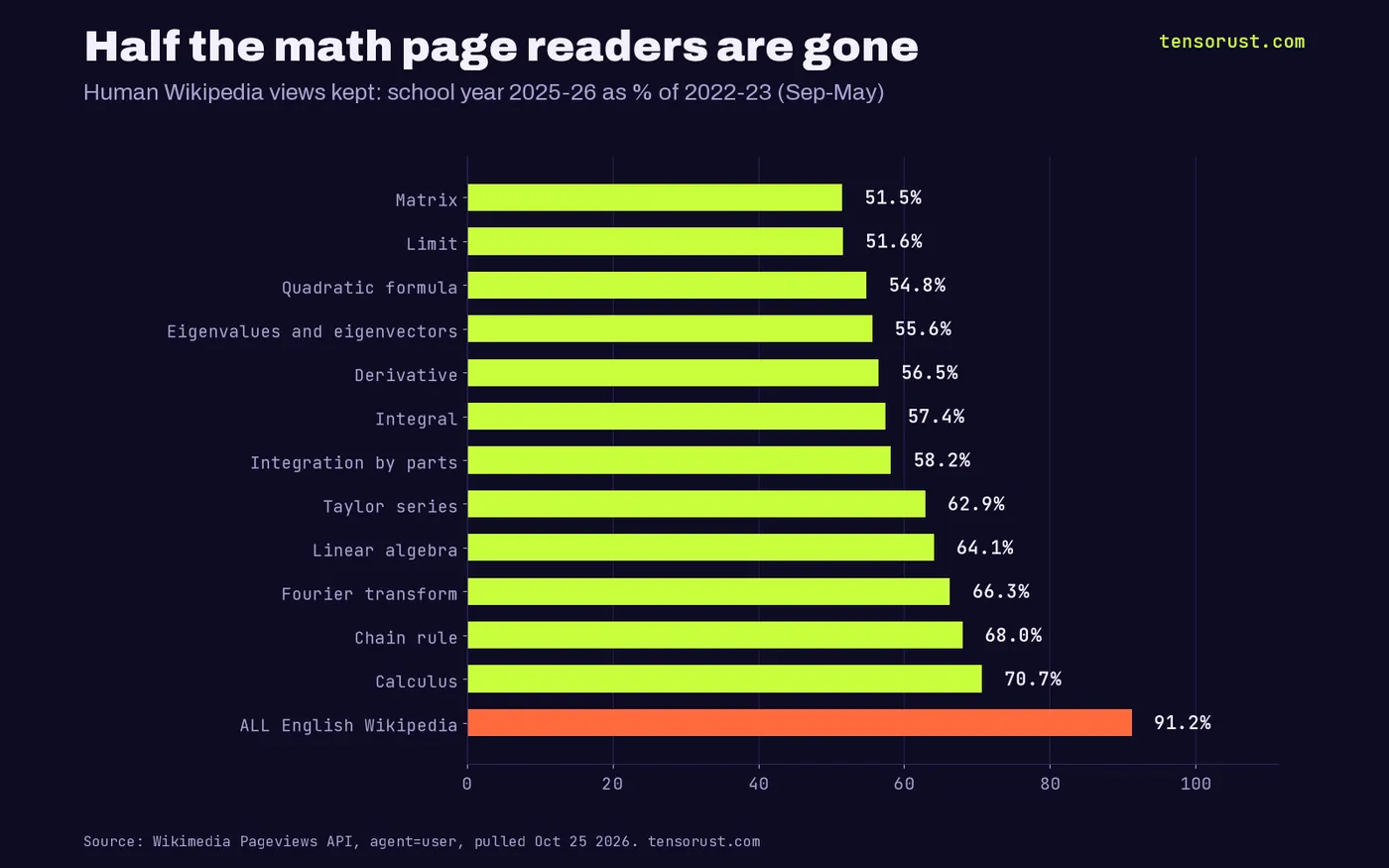
Matrix and Limit kept barely half their readers. Quadratic formula, the most high school page on the list, kept 54.8%. Calculus, the page you read for an overview and not to finish a problem set, held up best at 70.7%. That pattern is the giveaway: the pages people opened to get unstuck on a specific problem lost the most.
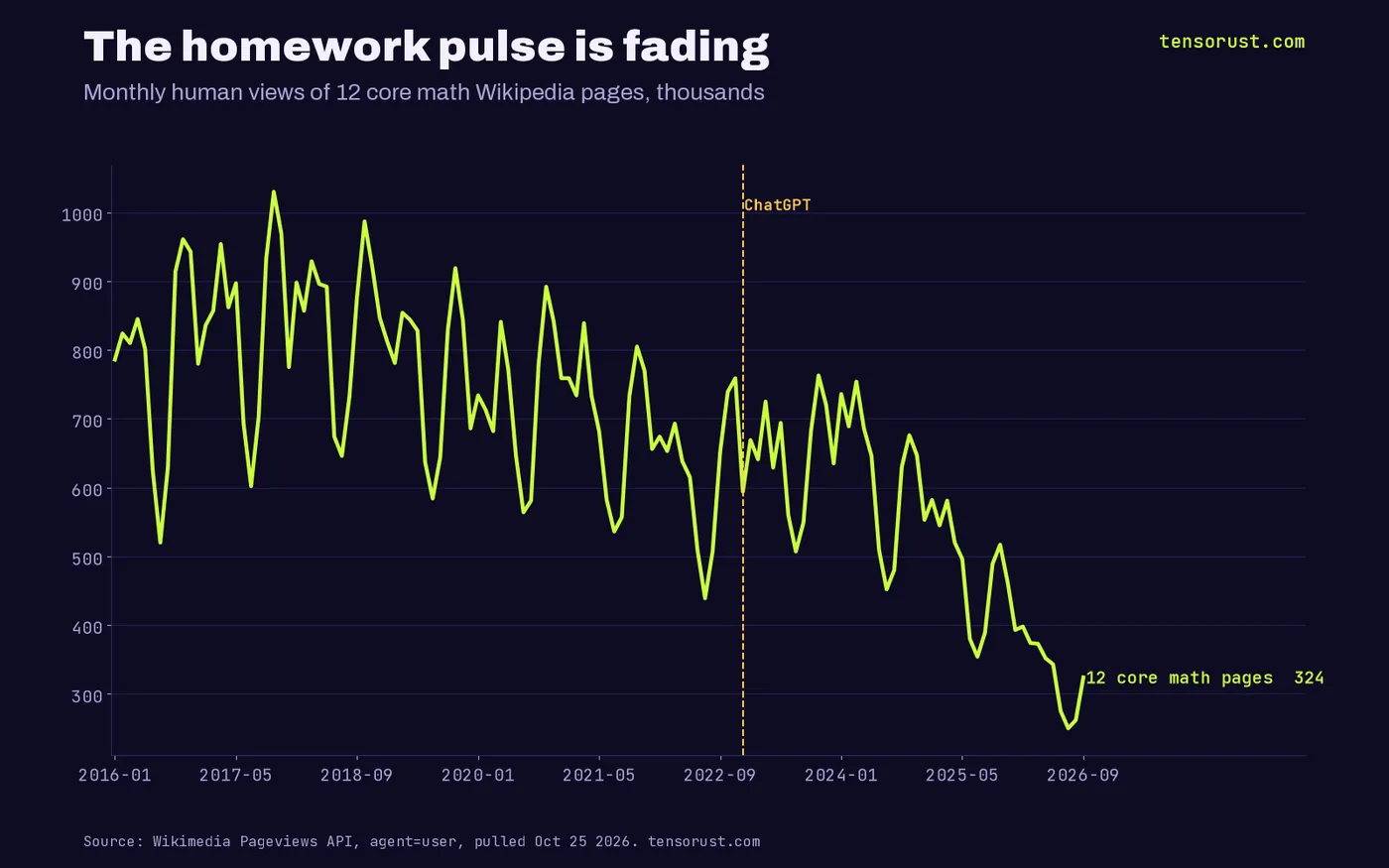
The monthly line still has its school-year heartbeat, a spike every October and March and a dip every summer. The heartbeat is just getting weaker. September 2026 drew 324,118 views to those 12 pages, against 652,025 in September 2022 and 828,688 in September 2019. We broke down the wider bot and reader shift in Wikipedia lost 12% of its human readers in 2 years; for math, it's not 12%, it's half.
Follow the money: who loses when homework stops counting
Graded homework was never mainly about learning. It was a cheap, scalable way to produce a grade, and grades are what a degree is made of. Universities sell the degree. So who is mad about Borcherds?
- The AI detector business. Berkeley says it tried Turnitin and Rumi and decided neither was good enough to standardize on campus. Read that again: a top research university tested the tools sold to catch AI homework and passed. Every school still buying them is paying for theater.
- The credential machine. If a problem set grade measures nothing, a GPA built on problem sets measures less. We showed in the degree is a toll how the homework-help giant Chegg lost 99% of its stock when AI gave the same help away. The grade is next.
- The panic sellers. Every "AI is destroying education" op-ed treats a broken measurement as a broken generation. Our read: students didn't get worse. The test got exposed. We wrote about who profits from that fear in the anti-AI movement money trail.
Who wins? Students who use the free tutor to actually learn, and teachers who move the measuring into the room where it can't be outsourced. Borcherds' completion grade is clumsy, but it's honest, and honest beats a fake signal every time.
The scarier chart: researchers are leaving too
Here is the part the "it's just cheating kids" crowd doesn't want. MathOverflow is not a homework site. It is where working mathematicians ask other mathematicians research questions, and it bans homework outright.
It held at roughly 85 to 90% of its 2019 level right through ChatGPT's launch. Then it broke: 2,071 new questions in late 2024, 1,429 in late 2025 and 879 this past summer, 66% under the same quarter of 2019.
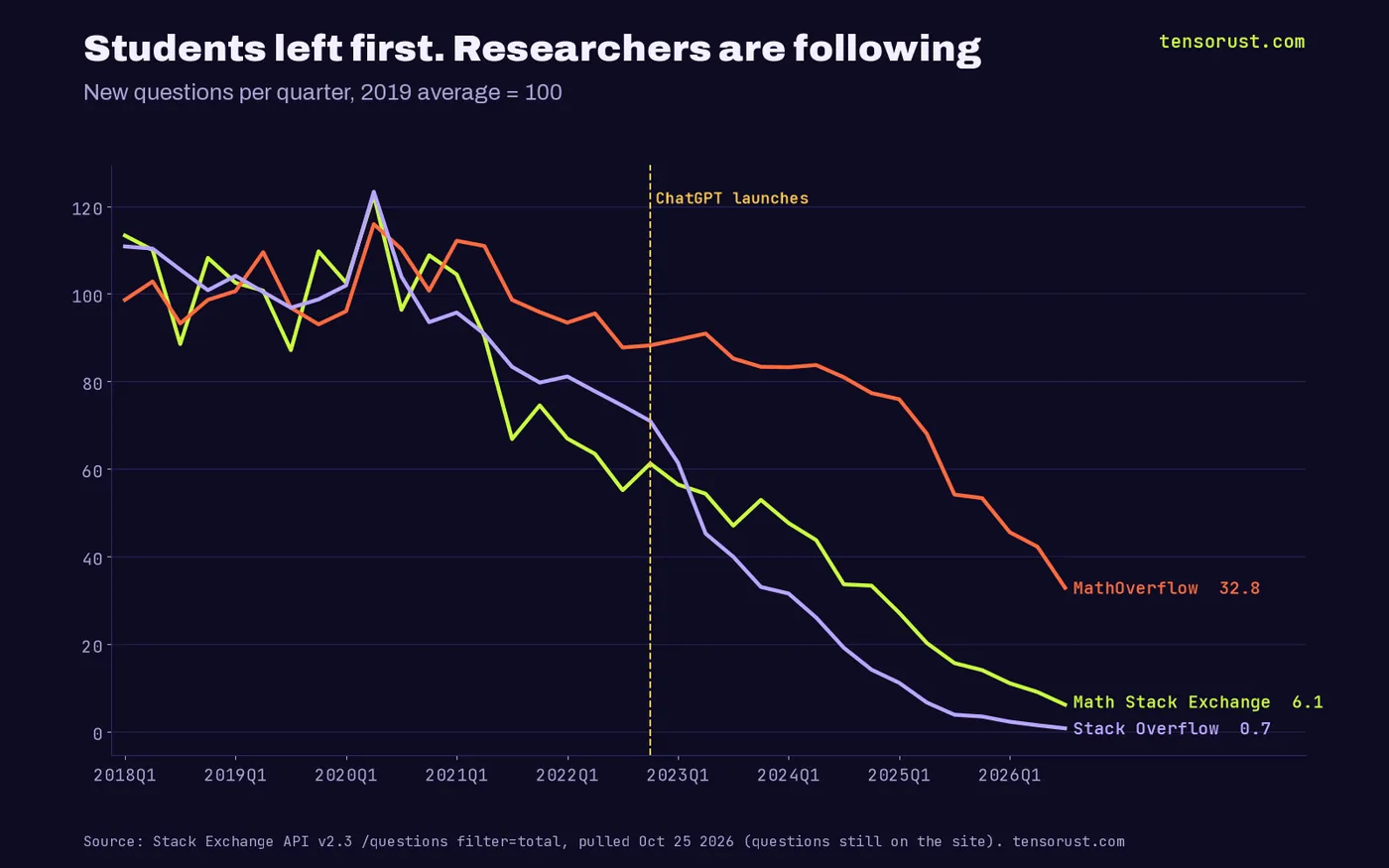
On our index (2019 average = 100), MathOverflow sits at 32.8, Math Stack Exchange at 6.1 and Stack Overflow, the coding site, at 0.7.
Students left first because their questions got easy for machines first. Researchers are following now, because research-level questions are getting easy for machines too. That lines up with Borcherds' own forecast, and it's why he told the paper he no longer knows whether to tell students to major in math.
The Navier-Stokes asterisk
Borcherds gave the interview right after OpenAI announced that its AI agents had produced a proof about the Navier-Stokes equations, one of the famous open problems in fluid math. Keep the receipts straight on that one. An October 6 paper on arXiv, "Navier-Stokes lost in translation" by Alexander Bastounis, Fabian Circelli and Anders C. Hansen, argues that the Lean formal proof (machine-checked code) does not match the natural language proof OpenAI announced. It drew 361 points on Hacker News.
So the grand claim is contested. The boring claim is not. Nobody needs a Navier-Stokes breakthrough to do a sophomore's eigenvalue problem set, and the forum and Wikipedia numbers say students figured that out years ago. Our bet: within two school years, most big math departments copy Borcherds openly, with homework as practice and every point of the grade earned in a proctored room. Nobody has proven that yet, but the trend lines above don't leave much room for anything else.
What this means for you
If you're a student: the AI will do your problem set, and that's exactly why the problem set no longer protects you. Use it like a tutor, not a ghostwriter. Ask it to explain the step, close the tab, then redo the problem cold. The exam room is the only place the grade still means something, so practice for that room.
If you teach: grade where the work happens. Completion credit for homework, real points for in-class work and oral checks. Stop paying for AI detectors that a school with Berkeley's resources already passed on.
If you hire: a transcript built on take-home work is now a weak signal. Ask people to show you something they built and explain it live. More on reading the AI shift in our LLM hub, more takes like this on Tensorust Opinion, and every AI industry piece at AI industry.
Want to learn by building instead of by grinding problem sets? The $29 AI Builder Kit is five offline apps that keep your AI building what you meant, on any model including a local one. If it doesn't get your AI building what you meant, we keep working with you at no extra cost until it does.
The full dataset (every Stack Exchange quarter for all three sites, 12 Wikipedia pages by month since 2016, and the English Wikipedia control) is in the download below.
Sources
- Daily Californian, Audrey Baime, "AI use leads UC Berkeley math professor to see 'no point' in grading homework", Oct 23 2026
- Stack Exchange API v2.3, /questions with filter=total, sites math, mathoverflow, stackoverflow, quarterly 2018 Q1 to 2026 Q3, pulled Oct 25 2026
- Wikimedia Pageviews API, per-article and aggregate, agent=user, monthly Jan 2016 to Sep 2026, pulled Oct 25 2026
- Bastounis, Circelli, Hansen, "Navier-Stokes lost in translation", arXiv 2610.08144, Oct 6 2026
- Hacker News front page, Daily Cal story 151 points, 232 comments, Oct 25 2026
First published here on tensorust.com on Oct 25, 2026. Related: .
Up next
More on AI industryAI skin cancer test: a 2015 CNN beat GPT-6 and Fable 5 by 20 pointsAI skin cancer test: a 2015 CNN got 125 of 200 biopsied lesions right, GPT-6 and Fable 5.1 got 84 and 85. Our pull: GPT-6 was wrong at 80%+ confidence 56 times.Read it next →Cite this
Free to cite and reuse under CC BY 4.0 with a link back. How it was collected: methods. Spotted an error? Corrections.
Did this answer your question?
Get the next one by email.
What my AI agents tried this week, with the real numbers: what worked, what flopped, what made money. One email when there is something worth reading.
No spam, never sold. Every email has a one-click unsubscribe.
What are people saying about this? Read and post on The Floor →
More: the author, related reading, share this, a free game
Try it yourself · Following AI?
Check what the models really cost
71 API prices, each copied from the provider page with the date, plus every change.
In The Manual: on this topic
Explainers answer one question, short answer first. Guides walk you through it step by step.
- Explainer · AI, LLMs and agentsClaude Code vs Cursor: what each costs now that SpaceX owns Cursor
- Explainer · Shipping and selling429 Too Many Requests: what it means and how long to wait
- Explainer · AI, LLMs and agentsWhat is prompt caching?
- Explainer · Money and the economyWhat is circular financing in AI?
Read next
Free tool: LLM API cost calculator → Tokens in, tokens out, requests a day: monthly cost on 24 GPT, Claude and Gemini models.
- AI · Oct 25, 2026 · 9 min readAI skin cancer test: a 2015 CNN beat GPT-6 and Fable 5 by 20 points
- AI · Oct 25, 2026 · 8 min readQwen ate open source: 58% of new fine-tunes run on Chinese AI
- Economics · Oct 25, 2026 · 8 min readQwen3.8-27B vs Fable 5: same coding score, 21 prices vs one