By Matt Busel, who built the apps, crates and game he writes about · every number links to its source and every dataset is downloadable (methods) · corrections · featured in Kirino, gamebiz, This Week in Rust, New Mobile Life, By-Press
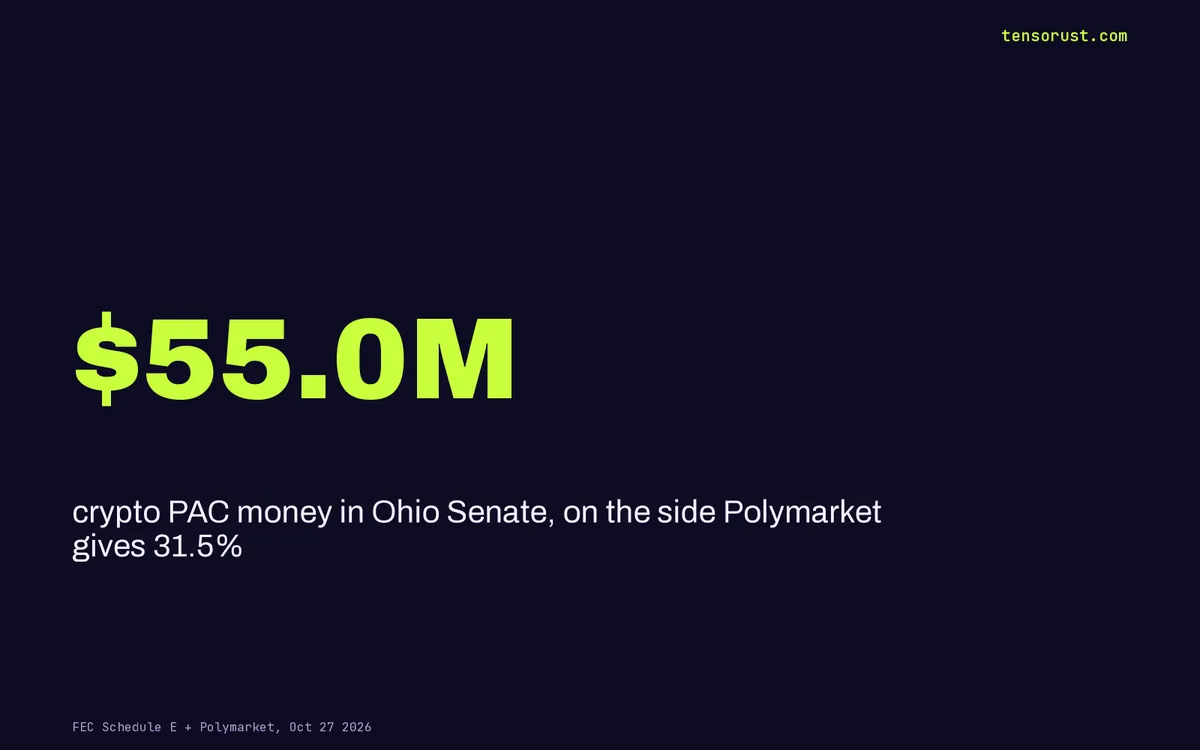
Crypto PACs put $55M on Ohio. Polymarket gives Husted 31.5%
On this page · 10 sections
- Key numbers
- One Senate race ate three quarters of the general-election budget
- The odds moved the wrong way
- Follow the money: who wins, who loses
- Safe seats, both parties, same check
- Nebraska is the bet that rides the favorite
- The split between the three PACs is the tell
- How to check any super PAC yourself in ten minutes
- What this means for you
- Sources
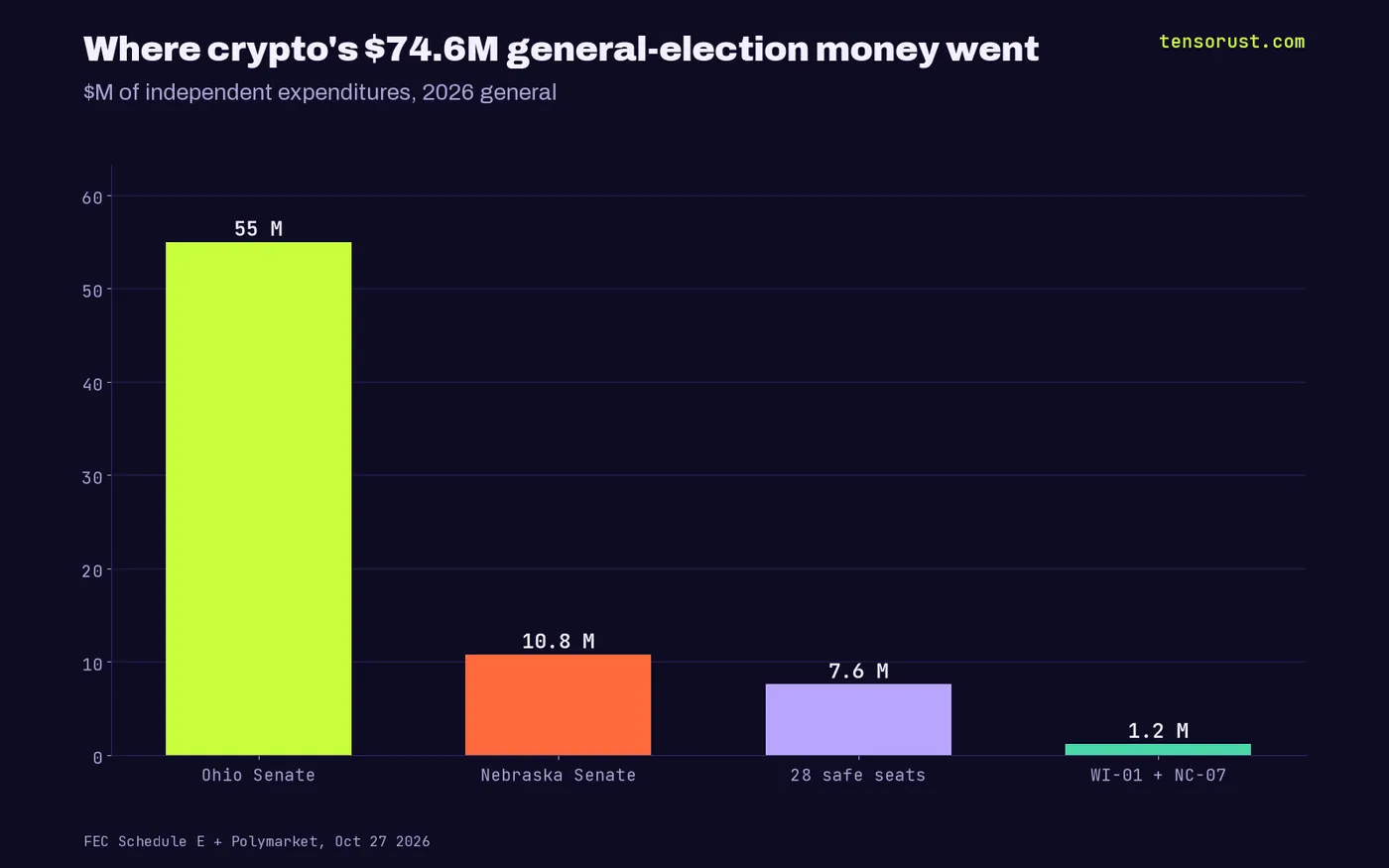
Short answer: The crypto industry's super PAC network (Fairshake, Defend American Jobs, Protect Progress) has reported $74.6M of general-election spending for 2026, and $55.0M of it, 73.7%, sits in one race: Ohio Senate, backing Jon Husted and attacking Sherrod Brown. Polymarket gives Husted 31.5%. The rest mostly went to House members who were never in danger.
TL;DR: We pulled every 2026 independent expenditure the three PACs filed with the FEC, removed duplicate 24/48-hour notices, and joined each target to its live Polymarket race. Husted's odds were 45.5% on Sep 20, the day before the first $11.4M Ohio buy, and are 31.5% today after $55.0M. Of 33 general-election targets, 28 are 90%+ favorites holding $7.6M, and only one House race (WI-01, 55%) is a real coin flip.
Key numbers
| What | Number | Source, checked Oct 27 2026 |
|---|---|---|
| All 2026 spending, three PACs, after dedupe | $144.7M on 98 candidates | FEC Schedule E |
| General-election spending | $74.6M on 33 candidates | FEC Schedule E |
| Ohio Senate (pro-Husted $35.3M + anti-Brown $19.7M) | $55.0M, 73.7% of general money | Defend American Jobs, FEC |
| Husted (R) win odds | 45.5% Sep 20, 31.5% Oct 27 | Polymarket |
| Nebraska Senate, against Dan Osborn (I) | $10.8M; Osborn at 28.5% | Polymarket |
| General targets at 90%+ odds | 28 of 33, $7.6M | Our join, data.csv |

One Senate race ate three quarters of the general-election budget
Defend American Jobs, the Republican-side arm of the Fairshake network, reported $35.3M supporting Husted and $19.7M opposing Brown. That is $55.0M in a single state, more than every other general-election target combined, nearly three times over.
Press counts so far stopped around $46M, from filings through mid-October. The Oct 19 and Oct 20 24-hour notices added $9.1M more to Main Street Media Group for Ohio ad time alone.
The motive is no secret. Brown chaired Senate Banking for four years and was crypto's loudest skeptic. Crypto PACs already spent over $40M to beat him in 2024, per Protos. This is the rematch, and it is a grudge match priced like one.
The odds moved the wrong way
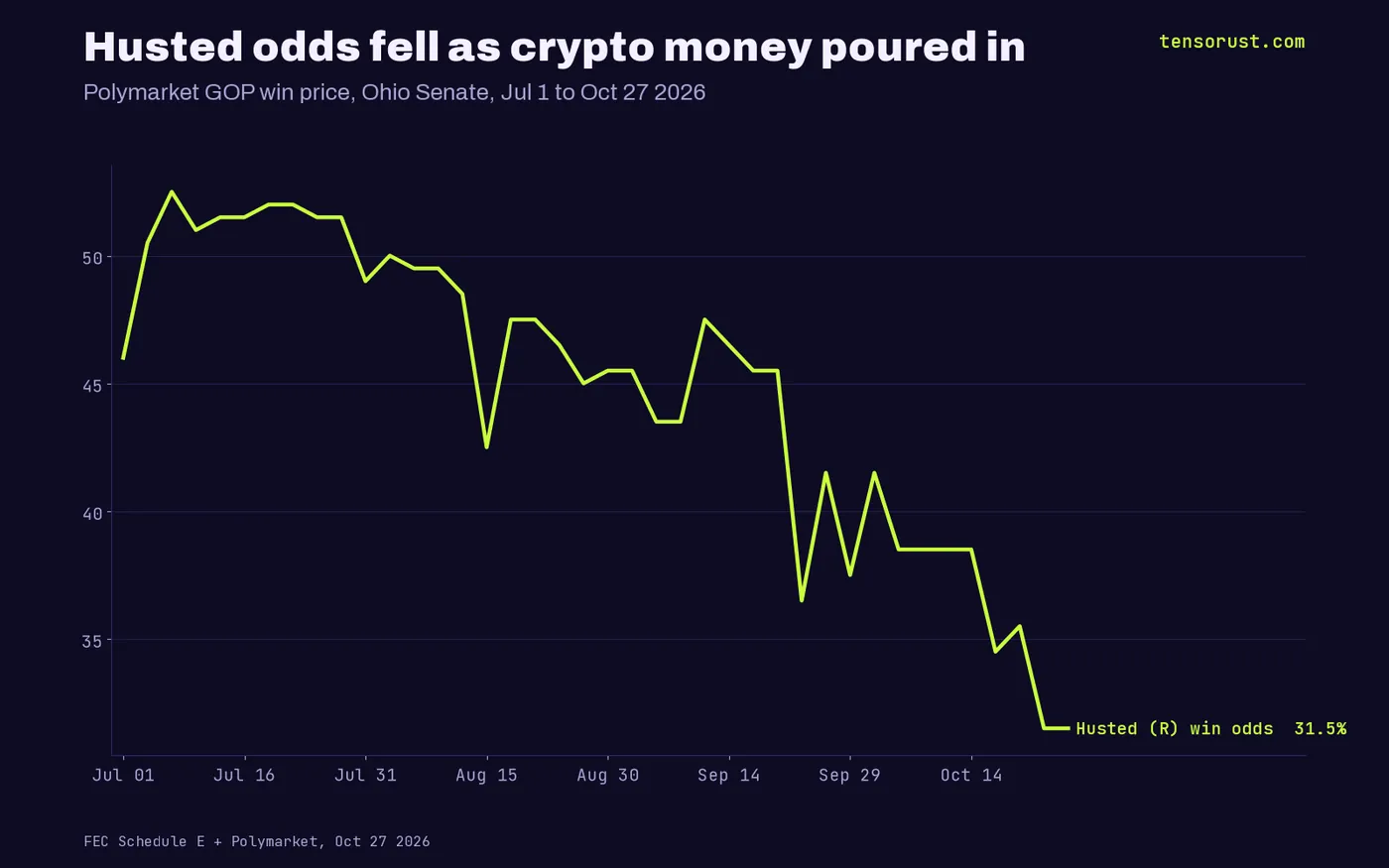
On Sep 20, Polymarket priced Husted at 45.5%. The first buy, $11.4M split evenly between pro-Husted and anti-Brown ads, was dated Sep 21. Since then the PAC has spent another $43.6M, and Husted is at 31.5%.
Nobody has proven money cannot move Ohio; correlation is not cause, and Brown's own campaign and the national mood are in the same chart. But the pattern says the most expensive single bet in crypto politics lost 14 points of market confidence while it paid.
Follow the money: who wins, who loses
Winners so far are the vendors. Main Street Media Group received the bulk of the Ohio buys in our rows, Dockside Strategies the production fees. Those firms get paid whether Husted wins or not.
The House side tells a different story. 30 House general-election candidates got money: 17 Republicans and 13 Democrats, $8.8M total. Most got about $150K, a flat ad buy that reads more like a thank-you note than a fight.
Safe seats, both parties, same check
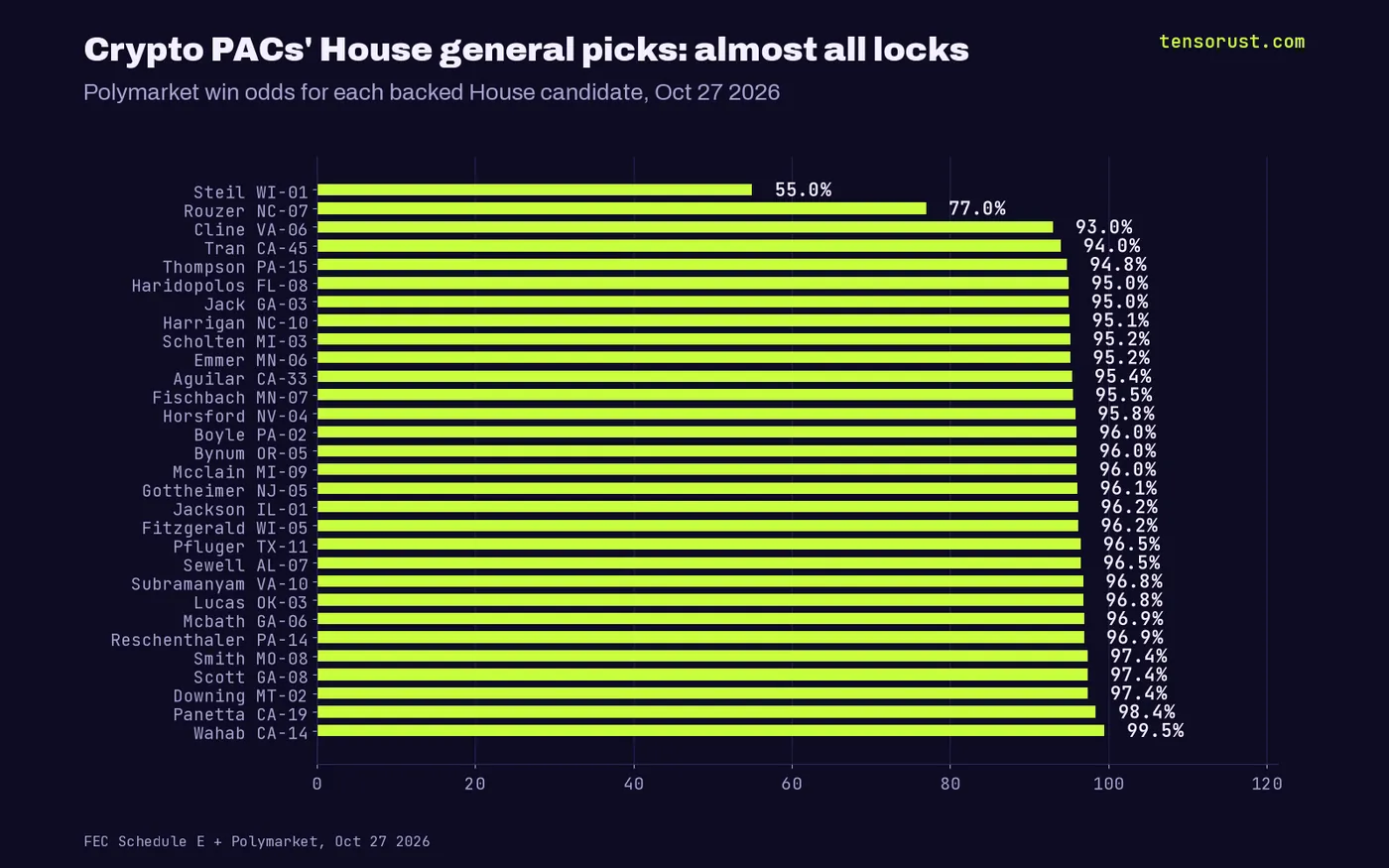
Jason Smith (MO-08, 97.4%), Troy Downing (MT-02, 97.4%), Brendan Boyle (PA-02, 95.9%) and Aisha Wahab (CA-14, 99.5%) all got crypto PAC money for November. Only Bryan Steil in WI-01 (55%) and David Rouzer in NC-07 (77%) face anything close to a race; together they drew $1.2M.
That is the real business model, in our read. The network does not need to win toss-ups; it needs future committee members in both parties to know whose ads ran. Bipartisan by design, and the safe-seat checks are cheap insurance.
Nebraska is the bet that rides the favorite
The one other big general bet is $10.8M against independent Dan Osborn in Nebraska. There, the market agrees: Republicans are at 71.5%. So crypto's two big Senate plays split: one rides a favorite, one fights the market.
The other $70.1M went to primaries and specials, including $10.1M against Illinois Senate candidate Juliana Stratton and $10.4M for Barry Moore in Alabama. Those rows sit in the data file.
The split between the three PACs is the tell
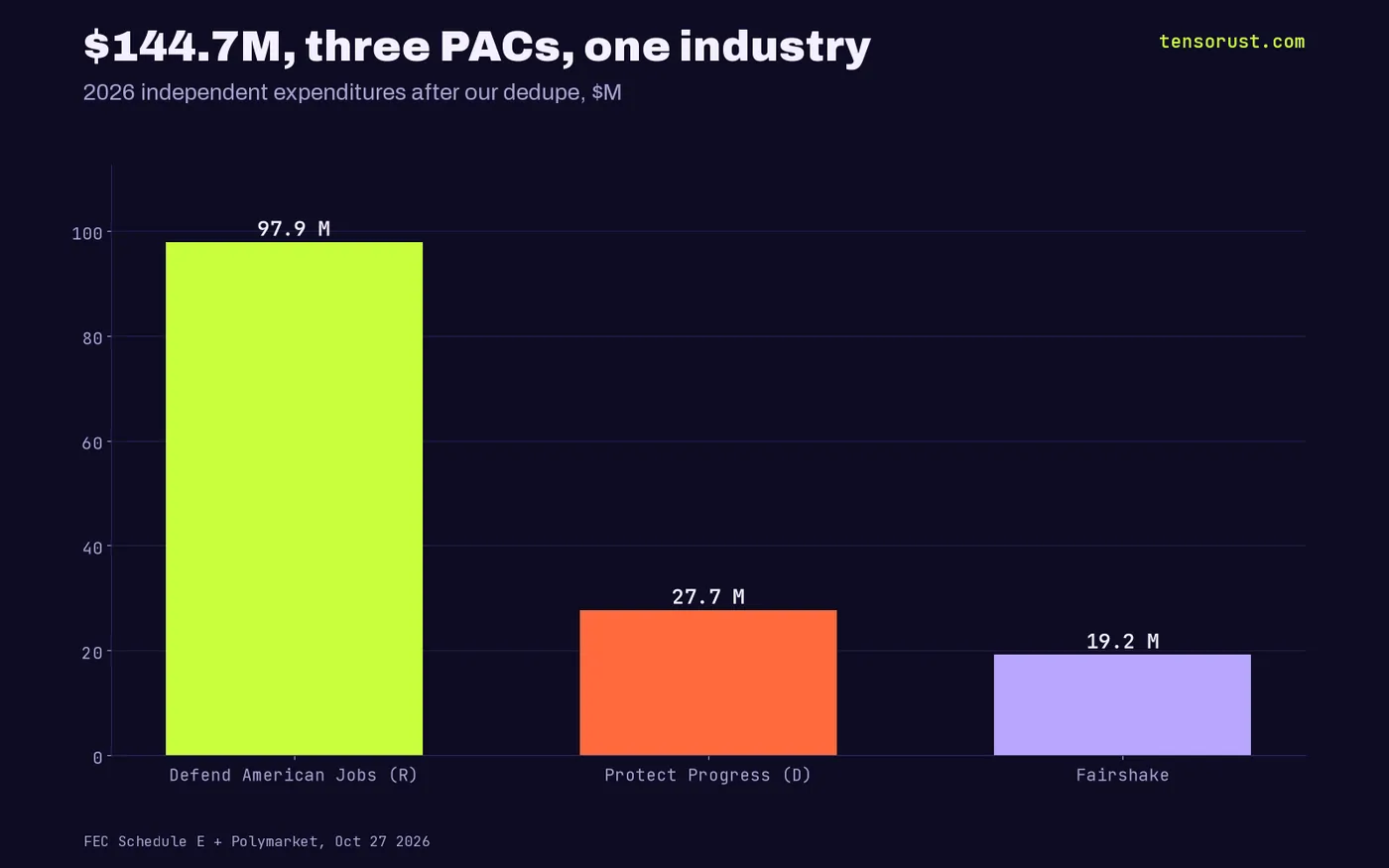
Defend American Jobs, which backs Republicans, reported $97.9M. Protect Progress, the Democratic-side arm, reported $27.7M. Fairshake itself, the parent, reported $19.2M, mostly in primaries. Roughly two thirds of the network's 2026 money is flowing through the Republican pipe.
That fits the moment. Republicans hold the committees that write market-structure rules today, and Husted backed the Clarity Act. But Polymarket gives Democrats 91.5% to take the House and 66.5% to take the Senate. If those prices hold, the network spent its biggest checks on the side markets expect to lose the gavel.
Our bet: the safe-seat Democratic checks to members like Pete Aguilar (CA-33) and Josh Gottheimer (NJ-05) are the hedge for exactly that. Cheap now, valuable in January.

How to check any super PAC yourself in ten minutes
Open the FEC independent-expenditure page for the committee and filter to cycle 2026. Every row is a dated ad buy, with the candidate, support or oppose, and the vendor paid.
The trap: the same buy shows up twice, once in a 24-hour or 48-hour notice and again in the regular report, plus amendments. Add the raw rows and you overcount. We kept the most recent version of each row and dropped repeats by transaction id, then by candidate, date, amount and vendor.
Then look up each race on Polymarket by district (for example "WI-01 House"), not by candidate surname, and read the party contract. Money divided by odds tells you whether a donor is fighting for seats or paying rent on friends.
Want the wider picture? See how AI super PACs parked their money in safe seats, Peter Thiel's House slate against the odds, and every piece on politics and the news desk.
What this means for you
If you are an Ohio voter, you now know who paid for most of the outside ads on your TV: one industry, one PAC, $55.0M. If you trade the market, the money is public and already priced. If you build in crypto, ask whether $144.7M of ads buys better rules than the same money in product would.
Download the data file: every candidate, dollars for and against, PAC, and Polymarket odds, with FEC and market links. It is free and machine-readable; point your own agent at it.
Want this kind of watch on a company, not a candidate? Company Watch flags federal filings, contracts and lobbying as they land for $99/mo. We keep fixing it at no extra cost until it does what it promises.
Not financial advice; prediction-market prices are odds, not outcomes.
Sources
- FEC, Defend American Jobs Schedule E, 2026, Oct 27 2026
- FEC, Protect Progress Schedule E, 2026, Oct 27 2026
- FEC, Fairshake Schedule E, 2026, Oct 27 2026
- Polymarket, Ohio Senate winner, Oct 27 2026
- Polymarket, Nebraska Senate winner, Oct 27 2026
- Polymarket, House control 2026 and Senate control 2026, Oct 27 2026
- Protos, Crypto PACs spend big on Ohio Senate race, Oct 2026
- Cointelegraph, crypto spending in Ohio Senate race, Sep 28 2026
Method: three committees' 2026 Schedule E rows (most_recent filter), memo rows dropped, duplicates removed by transaction id and by candidate+date+amount+payee. FEC's own running office total for Ohio reads $55.76M; our deduped $55.0M is the conservative figure. House odds are Polymarket "Will the [party] Party win the [district] House seat?" prices.
First published here on tensorust.com on Oct 27, 2026. Related: .
Up next
More on PoliticsPeter Thiel funded 38 House Republicans. Polymarket says 28 losePeter Thiel's 2026 money reached 38 House Republicans. Polymarket, which his Founders Fund backed, makes 28 of them underdogs and 20 under 20%.Read it next →Cite this
Free to cite and reuse under CC BY 4.0 with a link back. How it was collected: methods. Spotted an error? Corrections.
Did this answer your question?
Get the next one by email.
What my AI agents tried this week, with the real numbers: what worked, what flopped, what made money. One email when there is something worth reading.
No spam, never sold. Every email has a one-click unsubscribe.
What are people saying about this? Read and post on The Floor →
More: the author, related reading, share this, a free game
Try it yourself · Learning by doing?
The Manual has the next step
Short answers first, then step-by-step guides with the real commands.
From The Manual
Explainers answer one question, short answer first. Guides walk you through it step by step.
- Guide · iPhone appsHow to fix "MAC verification failed during PKCS12 import" (the legacy .p12 fix)
- Explainer · iPhone appsHow much does a GitHub Actions macOS runner cost?
- Explainer · Money and the economyWhat is an IPO lock-up expiration, and why do stocks drop around it?
Read next
- Politics · Oct 27, 2026 · 6 min readPeter Thiel funded 38 House Republicans. Polymarket says 28 lose
- Politics · Oct 27, 2026 · 7 min readAI super PACs put $47M of $61M into seats Polymarket calls 90%+ safe
- Politics · Oct 27, 2026 · 5 min readNY-21: Constantino's $17M haul is 99.6% his own loans