By Matt Busel, who built the apps, crates and game he writes about · every number links to its source and every dataset is downloadable (methods) · corrections · featured in Kirino, gamebiz, This Week in Rust, New Mobile Life, By-Press
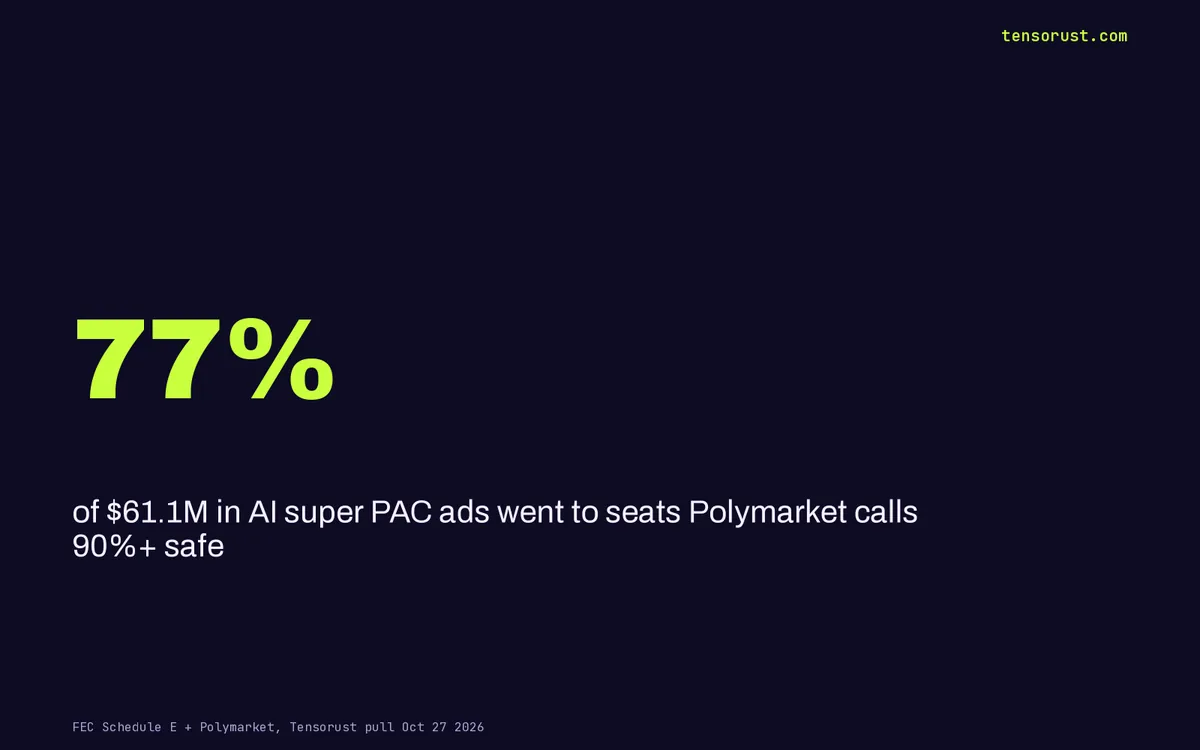
AI super PACs put $47M of $61M into seats Polymarket calls 90%+ safe
On this page · 10 sections
- Key numbers
- Two networks, four spending arms, one industry
- 77% of the money went where the general election is a formality
- The race nobody could win: $23.2M over Alex Bores
- Where the two AI camps collide
- Follow the money: the GOP bet against the market
- The underdog bets
- What the numbers say about AI policy
- What this means for you
- Sources
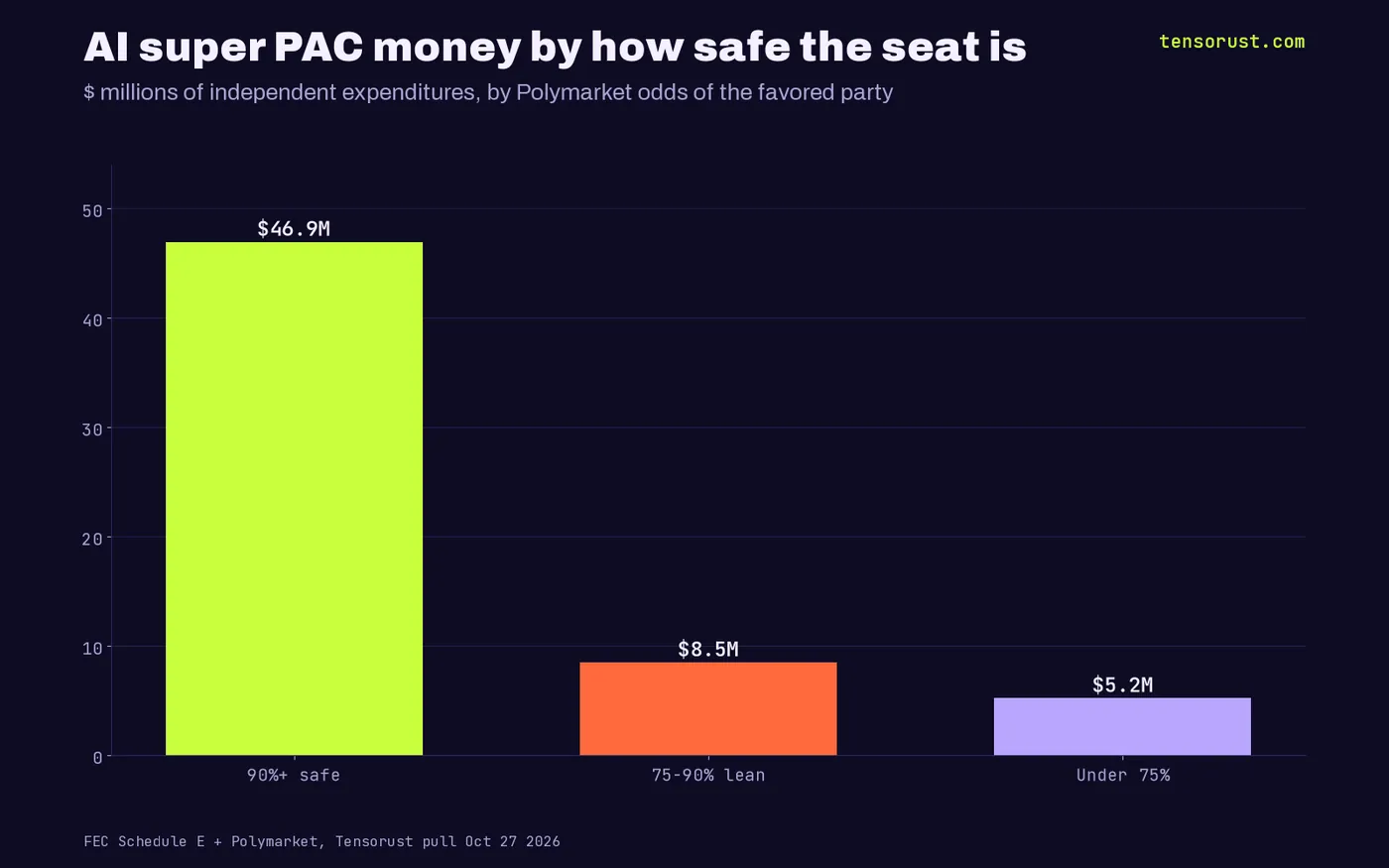
Short answer: The AI industry is not trying to win the midterms. We joined every independent expenditure filed by the two AI super PAC networks (the a16z and OpenAI-linked Leading the Future, and the Anthropic-backed Public First) to live Polymarket odds for each race: $46.9M of $61.1M, 77%, went to seats where the market gives one party 90% or better. Only $5.2M, 8.5%, touched a race that is actually close. The AI money is buying who sits in safe seats, not who controls Congress.
TL;DR: The four AI-funded spending arms filed $61.1M in ads and mail for or against 65 candidates this cycle, and $23.2M of it, 38%, went into one Manhattan primary over Alex Bores, who lost anyway. Since September 1, the Leading the Future network has spent $6.7M on the general election and 82% of it ($5.5M) backed Republicans, while Polymarket gives Democrats a 91.5% chance of taking the House. The pro-industry side still sat on $30.6M in cash on October 14, against $1.8M for the Anthropic-backed side, which tells you who plans to keep buying after November.
Key numbers
| What | Number | Source, checked Oct 27 2026 |
|---|---|---|
| AI super PAC independent expenditures, both networks (itemized) | $61.1M | FEC Schedule E |
| Share in seats where Polymarket favors one party 90%+ | 77% ($46.9M) | Our join, FEC + Polymarket |
| Share in races where the favorite is under 75% | 8.5% ($5.2M) | Our join |
| Spent on one race: NY-12 (Bores), both camps | $23.2M | FEC |
| Leading the Future network, general-election spend since Sep 1 | $6.69M, 82% to Republicans | FEC 24/48-hour reports |
| Polymarket: Democrats win the House / Senate | 91.5% / 66.5% | Polymarket |
| Cash on hand: Leading the Future network vs Public First network | $30.6M vs $1.8M | FEC committee totals |

Two networks, four spending arms, one industry
Leading the Future (FEC ID C00916114) raised $75.98M through October 14. Its biggest itemized donors are a16z Capital Management, Marc Andreessen, Ben Horowitz, OpenAI president Greg Brockman and Anna Brockman, per its Schedule A. It does not buy ads itself: it wires money to Think Big (Democrats, $25.0M raised) and American Mission (Republicans, $24.0M raised).
The other camp mirrors it. Public First (C00930503) took $1M from Anthropic CEO Dario Amodei, $999,900 from Anthropic's Peter Lofgren and six-figure checks from other Anthropic staff, per its filings. Most of the money in its spending arms, Jobs and Democracy PAC ($20.7M) and Defending Our Values PAC ($8.4M), comes from Public First Action Inc., a nonprofit that does not have to name its donors.
So both "sides" run the same play: one wallet, a Democratic shell and a Republican shell. Bipartisan on paper, one industry in practice.
77% of the money went where the general election is a formality
We matched every candidate to the Polymarket market for their seat. Of $61.1M, $46.9M sits in seats where one party is priced at 90% or better. Another $8.5M is in 75 to 90% seats. Only $5.2M is in races where the favorite is under 75%.
That is not a mistake. In a safe seat the primary is the real election, turnout is tiny and a $1M ad buy is enormous. Buying the nominee in NY-15 (Ritchie Torres, $1.12M for, Democrats 97.9%) or GA-14 (Clay Fuller, $687K for, Republicans 96.9%) buys a member for a decade. Our read: this is the cheapest seat-buying strategy in American politics, and the AI industry found it in year one.
The race nobody could win: $23.2M over Alex Bores
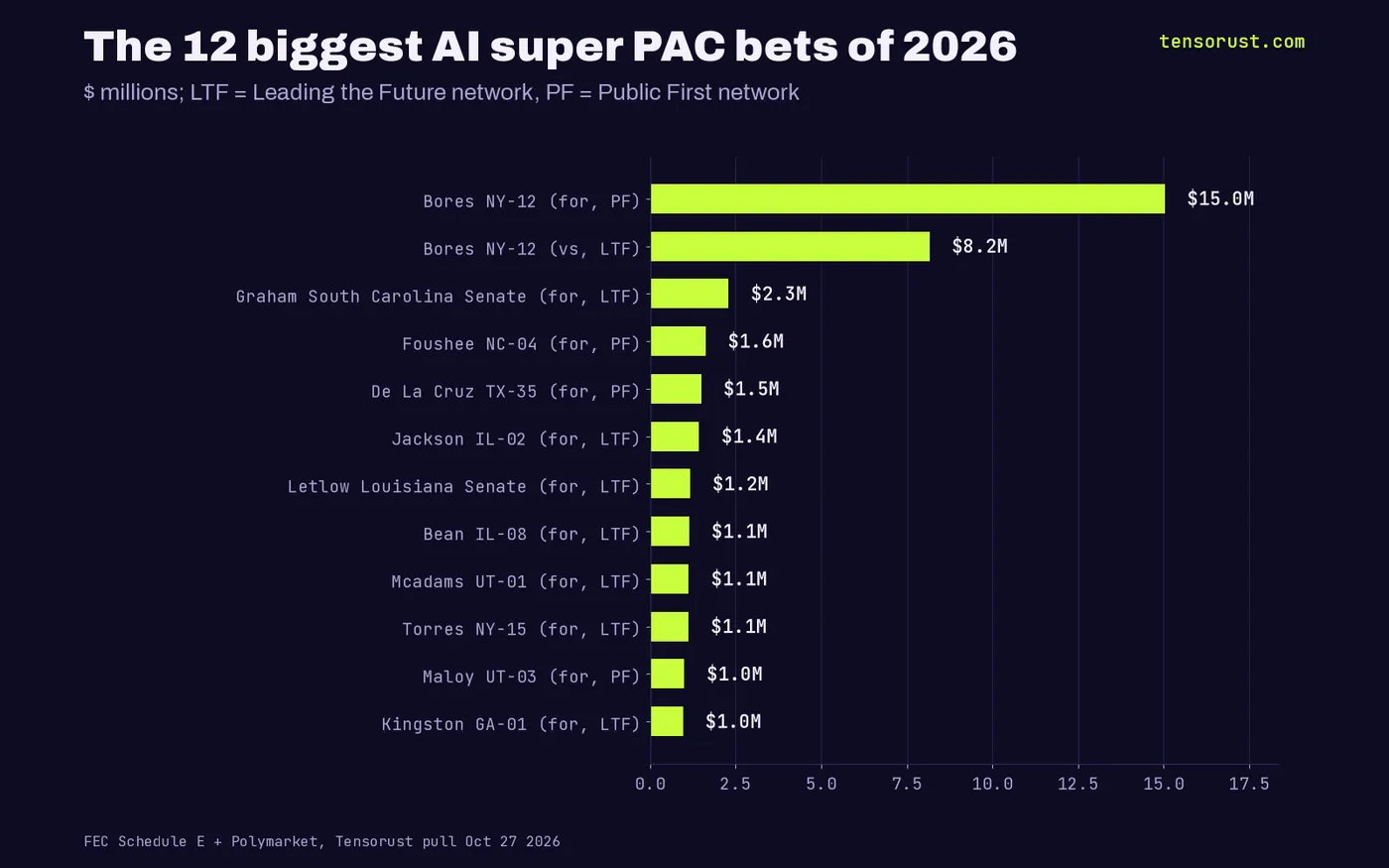
NY-12 alone soaked up 38% of all AI super PAC spending: Jobs and Democracy spent $15.0M for Bores and Think Big spent $8.2M against him. Bores was the author of New York's RAISE Act on frontier AI safety, which is why Leading the Future targeted him, as NPR reported. He lost the June primary to Micah Lasher, per Transformer.
Run the numbers on the Anthropic side: $15.0M for a candidate who finished second in a seat Democrats hold at 97.5%. That is more than half of everything the Public First network has spent all cycle, on one loss. The safety camp's flagship bet bought nothing.
Where the two AI camps collide
We found four races where both networks spent. In NY-12 they fought head on. In IL-02, Think Big spent $1.43M for Jesse Jackson Jr., while Jobs and Democracy filed a notice against him that it later zeroed out. In FL-25, the Anthropic-backed Defending Our Values spent $857K for Republican Scott Singer and $740K against Republican Daniel Franzese, while Think Big spent $310K for the Democratic incumbent, Jared Moskowitz. Polymarket gives Democrats 74% there.
And in the Oklahoma Senate race, both camps backed the same man: Kevin Hern got $808K from the Anthropic side and $474K from the a16z side. When the "AI safety" PAC and the "accelerate" PAC buy the same Republican, the fight is less about AI than about access.
Follow the money: the GOP bet against the market
Since September 1, the general-election window, the Leading the Future network has filed $6.69M. $5.46M of it backed Republicans: Graham in South Carolina ($1.60M since Sep 1), Julia Letlow in Louisiana, Andy Barr in Kentucky, Shelley Moore Capito, Bill Hagerty, Mike Rounds and a string of House incumbents like Guy Reschenthaler, Rudy Yakym and Brian Jack, all priced 90% or better. Only $1.23M backed Democrats (Joe Morelle, Greg Stanton, Emilia Sykes, Steven Horsford).
Polymarket gives Democrats 91.5% to take the House. So the pro-AI money is not hedging toward the likely majority. It is locking in the Republican members who will hold committee seats either way, plus a few safe Democrats for cover. Note: the FEC lists the South Carolina candidate ID used by American Mission as "Darline Graham" (S6SC04437); the same network also spent $374K for Lindsey Graham in June.
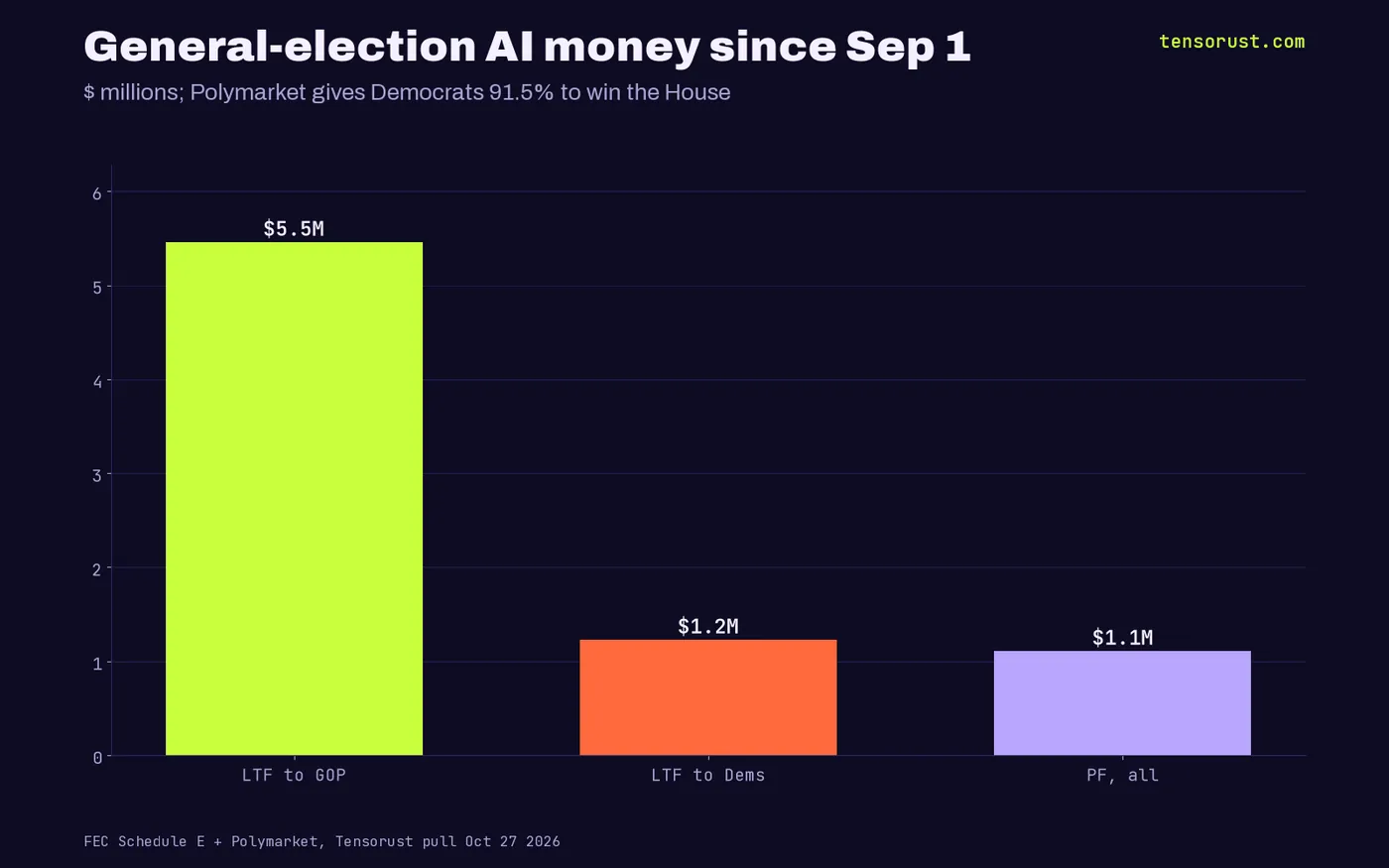
The Anthropic side has nearly run dry. Since September 1 it spent $1.11M, most of it $599K against Republican Rep. Gabe Evans in CO-08 (Democrats 85%) and about $257K each for John Cowan (GA-11) and Alexandra Mealer (TX-09). With $1.8M left against the other side's $30.6M, the safety camp has lost the money race before the votes are counted.
The underdog bets
Only $3.5M went to candidates whose party is the market underdog for November: Carlos De La Cruz Jr. in TX-35 ($1.49M, Republicans 34%), Scott Singer in FL-25 ($857K, 25%), Thomas Feely in AZ-01 ($616K, 20.5%) and Laurie Buckhout in NC-01 ($509K, 16%). Most of this was primary money, so it bought a nomination, not necessarily a seat. Our estimate: on today's odds, at most about $1.1M of that turns into a winner.

What the numbers say about AI policy
Strip the branding and both networks are doing one thing: picking the people who write AI rules in seats nobody can take from them. That is the anti-establishment read, and it cuts both ways. The a16z wing is buying a Republican bench that will chair committees no matter who wins the House. The Anthropic wing spent its war chest proving that a safety pitch cannot carry a primary.
Neither network has spent big on a single race that decides control of Congress. If you think AI policy is on the ballot on November 3, the data says it was mostly decided in primaries most voters skipped. See more joins like this on our politics desk, the Elon Musk midterm money piece, our anti-AI money trail and the latest on Tensorust News.
What this means for you
Download the data below: every AI super PAC expenditure by candidate, joined to that seat's Polymarket odds, with FEC and market links on every row. Check your own member: if they got AI money in a 90%+ seat, they owe the industry their nomination, and their next AI vote is worth watching. Builders who want AI rules written for them, not for incumbents, should call the members on this list before November.
If you track companies that spend in politics, Company Watch watches FEC, lobbying and federal contract filings for the names you pick and alerts you when they move, for $99 a month. If it misses a filing it promises, we keep fixing it at no extra cost until it does what it promises.
Sources
- FEC, independent expenditures for Think Big, American Mission, Jobs and Democracy PAC, Defending Our Values PAC, pulled Oct 27 2026
- FEC, Leading the Future committee totals and receipts, through Oct 14 2026
- FEC, Public First committee totals and receipts, through Sep 30 2026
- Polymarket, which party wins the House and per-district markets (linked per row in data.csv), Oct 27 2026
- Polymarket, which party wins the Senate, Oct 27 2026
- NPR, Groups tied to OpenAI and Anthropic are spending big on the midterms, Jun 22 2026
- Transformer, NY-12 race coverage, 2026
Method: we kept only the latest version of each regular-report line (dropping amended duplicates) and added 24/48-hour notices dated after each committee's last processed report. Our totals land within 1.6% of the committees' own reported totals for Think Big and American Mission and within 7% for the Public First arms, where late October notices are not yet in a regular report. Not financial advice; Polymarket prices are probabilities set by traders, not forecasts we endorse.
First published here on tensorust.com on Oct 27, 2026. Related: Politics desk, Tensorust News, Elon Musk midterm money, The anti-AI money trail.
Up next
More on PoliticsPeter Thiel funded 38 House Republicans. Polymarket says 28 losePeter Thiel's 2026 money reached 38 House Republicans. Polymarket, which his Founders Fund backed, makes 28 of them underdogs and 20 under 20%.Read it next →Cite this
Free to cite and reuse under CC BY 4.0 with a link back. How it was collected: methods. Spotted an error? Corrections.
Did this answer your question?
Get the next one by email.
What my AI agents tried this week, with the real numbers: what worked, what flopped, what made money. One email when there is something worth reading.
No spam, never sold. Every email has a one-click unsubscribe.
What are people saying about this? Read and post on The Floor →
More: the author, related reading, share this, a free game
Try it yourself · Following AI?
Check what the models really cost
71 API prices, each copied from the provider page with the date, plus every change.
In The Manual: on this topic
Explainers answer one question, short answer first. Guides walk you through it step by step.
- Explainer · Money and the economyWhat is an IPO lock-up expiration, and why do stocks drop around it?
- Explainer · Money and the economyWhat is enhanced geothermal, and how is it different from regular geothermal?
- Explainer · Money and the economyWhat is a stock warrant? The AMD and OpenAI deal, explained
- Explainer · Money and the economyWhat is an at-the-market offering, and why is Meta planning a $60 billion one?
Read next
- Politics · Oct 27, 2026 · 6 min readPeter Thiel funded 38 House Republicans. Polymarket says 28 lose
- Politics · Oct 27, 2026 · 5 min readNY-21: Constantino's $17M haul is 99.6% his own loans
- AI · Oct 27, 2026 · 6 min readExponential Time Hypothesis is false: 1,871 papers just lost a floor