
What is an IPO lock-up expiration, and why do stocks drop around it?
Short answer
An IPO lock-up is a contract that bars founders, employees and early investors from selling their shares for a set time after a company goes public, most often 180 days. The lock-up expiration is the day that ban ends, and a much bigger pool of shares is suddenly allowed to trade. Stocks often slide into and around that date because buyers know the new supply is coming. Fervo Energy, down 70% from its $27 IPO price, has a lock-up reported to end on November 10, 2026.
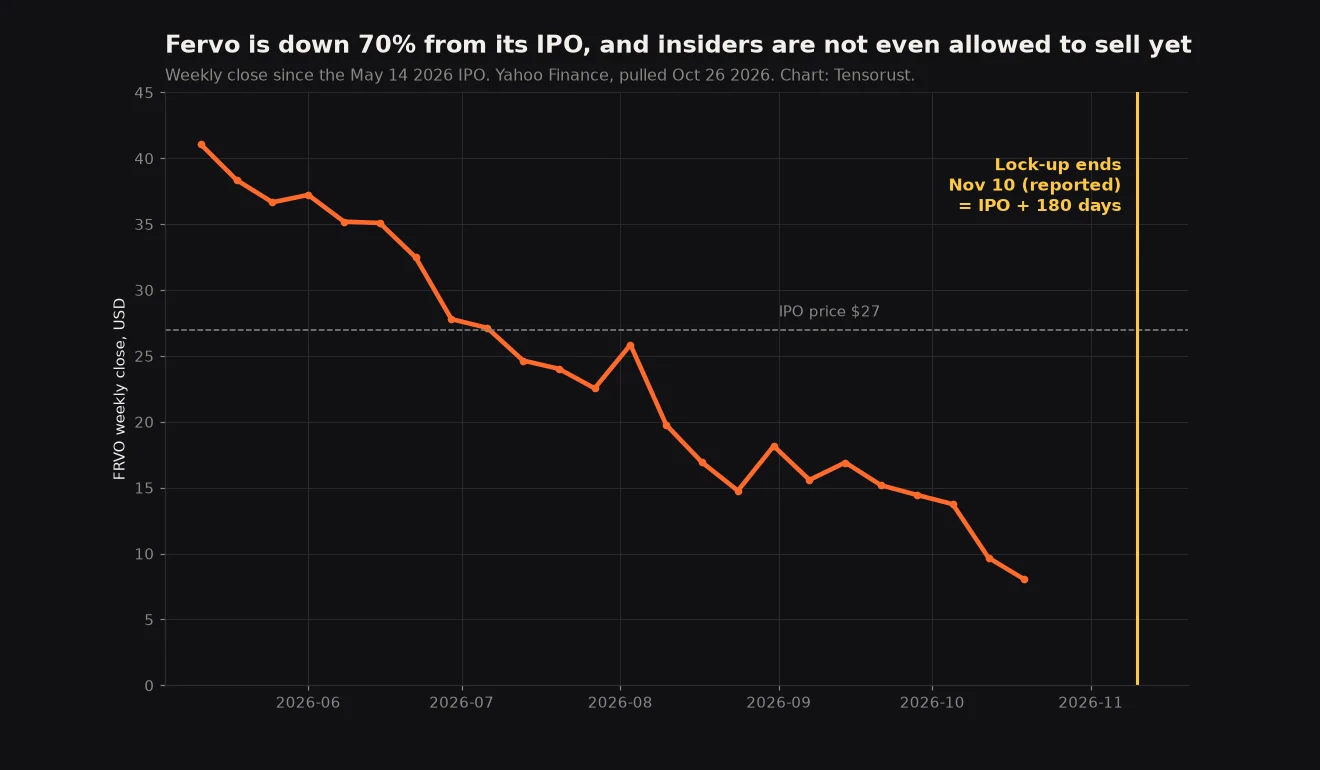
Part of the article Fervo stock fell 70% after geothermal's biggest win in 25 years. This page answers one question from it in depth.
On this page · 8 sections
Here is the part nobody puts in the IPO press release: on day one, the public is trading a thin slice of the company. The people who own most of it, and who bought it far cheaper than you, are waiting behind a door with a date on it. Lock-ups exist to make that door look solid. The date is printed in the prospectus for anyone who reads it, and the pros do.
Key numbers
| What | Number | Source (checked Oct 26 2026) |
|---|---|---|
| Typical lock-up length | 180 days ("most" lock-ups) | Investor.gov (SEC) |
| Average 3-day abnormal return at expiry | -1.5% | Field and Hanka, Journal of Finance, 2001 |
| Change in trading volume after expiry | +40%, permanent | Field and Hanka, 2001 |
| IPOs in that study | 1,948 (US, 1988-1997) | Field and Hanka, 2001 |
| Fervo IPO price, May 14 2026 | $27.00 | Fervo 10-Q, Q2 2026 |
| Fervo close, Oct 23 2026 | $8.04 (-70% vs IPO) | Yahoo Finance |
| Fervo reported lock-up expiry | Nov 10 2026 (May 14 + 180 days, our count) | Quiver Quantitative |
| Cerebras shares that can leave lock-up | Up to ~171.1M vs a 98.9M float | Cerebras 10-Q, via our Cerebras piece |
How a lock-up works, step by step
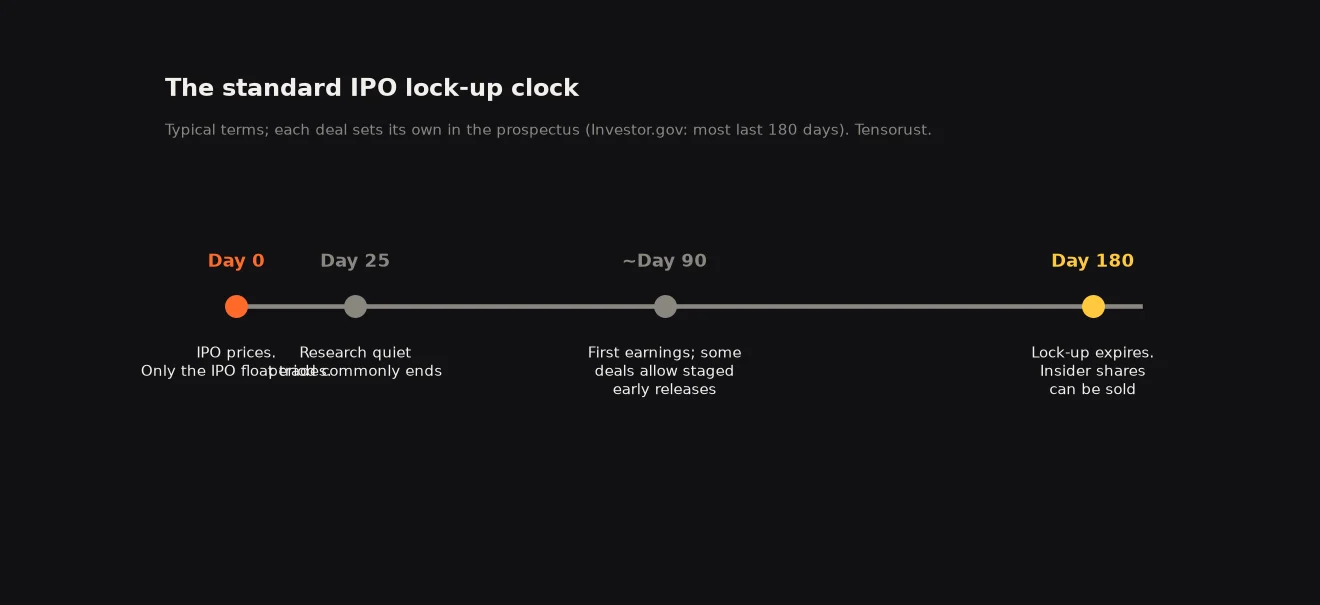 The standard lock-up clock. Each deal sets its own terms in the prospectus.
- Before the IPO, insiders sign. The underwriters ask founders, executives, employees and big pre-IPO investors to agree not to sell or hedge their shares for a period. It is a private contract, not a law; the SEC only requires that the terms be disclosed in the registration statement.
- IPO day: a thin float. The public trades only the shares sold in the offering, often a small fraction of the company. A thin float means a few buyers can move the price a lot, in either direction.
- Early releases. Newer deals often let a slice of shares out early if the stock holds above a price after an earnings report. Cerebras released about 19.4 million shares early on September 30, 2026, and its COO and CFO filed Form 144 notices to sell about $84.3M of stock.
- Expiry day. The contract ends. Every locked holder can now sell, subject to securities rules. Not all of them will, but the market has to price the possibility that many do.
- After. Volume jumps and stays higher, because the company now has a real float. Field and Hanka measured that rise at 40%, and it did not fade.
Why stocks drop around it
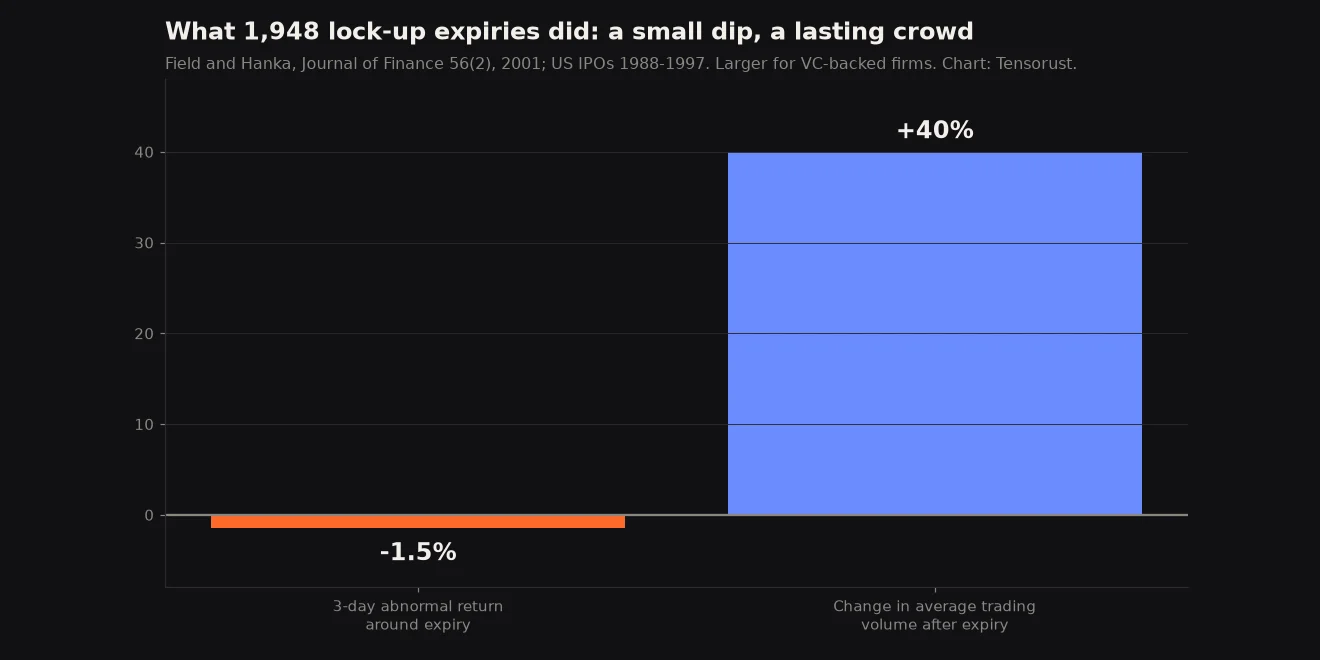 What 1,948 US lock-up expiries did, 1988 to 1997. Field and Hanka, Journal of Finance, 2001.
The simple version is supply and demand. A venture fund that bought Fervo shares years ago at a fraction of $27 is still sitting on a gain or a small loss even at $8, and funds have their own investors waiting for cash. Field and Hanka found the drop was much larger at venture-backed companies, and that venture capitalists "sell more aggressively" than executives.
The textbook says an expiry date known six months in advance should already be priced in. The record says it is not, fully, and that gap is where traders make money: short into the date, cover after. Retail holders are the ones on the other side of that trade. Follow the money and the lock-up mostly protects the underwriters' pricing on day one, not you on day 180.
Fervo is the live case. Its first enhanced geothermal plant went commercial on September 30 (the technology is in what is enhanced geothermal), and the stock fell 44% in the next three weeks anyway. Some of that is cash burn. Some of it is a calendar. We laid out both in Fervo's plant went live and the stock fell 44%. This is not financial advice.
How to find any company's lock-up date
- Open the company on SEC EDGAR and find the final prospectus (form 424B4) or the S-1.
- Search the document for "lock-up". Note the length, who is covered and any early-release triggers tied to earnings or price.
- Count from the pricing date. 180 days from Fervo's May 14 pricing lands on November 10.
- Watch Form 144 filings after the date. Those are insiders announcing planned sales, and they are public.
Or let something else watch for you: Company Watch emails you when a company you follow files with the SEC.
Common misconceptions
"Insiders will all dump on day one."
The recordMost do not. Many hold for tax, control or conviction, and executives face blackout windows around earnings. The measured average drop is about 1.5% over three days, not a crash. The damage usually comes in the run-up, as traders position early.
"Lock-ups are an SEC rule."
The recordNo. They are negotiated between the company, its insiders and the underwriters. The SEC requires disclosure of the terms, not the lock-up itself, and underwriters can waive it.
"If a stock is already down 70%, the lock-up does not matter."
The recordIt can matter more. Early investors with very low cost bases may still be in profit and willing to sell, and a beaten-down stock has fewer natural buyers to absorb them.
"An IPO under its offer price means the company failed."
The recordCerebras trades about 40% under its $185 IPO price while reporting $25.4B of contracted revenue. Price below offer says the IPO was priced for a hotter market, not that the business is gone.
Related
- Fervo's plant went live and the stock fell 44%
- What is enhanced geothermal (EGS)?
- Cerebras trades under its IPO price despite a $25B backlog
- What is an at-the-market offering?
- Anthropic's S-1 IPO filing
FAQ
What is an IPO lock-up expiration?
It is the day a lock-up agreement ends and company insiders, such as founders, employees and early investors, are allowed to sell shares they held before the IPO. Most lock-ups last 180 days, according to the SEC's Investor.gov.
Do stocks go down when the lock-up expires?
On average, a little. A study of 1,948 US IPOs from 1988 to 1997 by Field and Hanka in the Journal of Finance found a three-day abnormal return of about -1.5% around expiry and a permanent 40% rise in trading volume, with bigger effects at venture-backed companies. Much of the drop can happen in the weeks before, as traders front-run the date.
Is a lock-up required by law?
No. It is a contract between the company, its insiders and the underwriters. The SEC does require the terms to be disclosed in the registration statement and prospectus.
How do I find a company's lock-up expiration date?
Search the company's final prospectus (424B4) or S-1 on SEC EDGAR for 'lock-up'. It gives the length and any early-release triggers. Count the days from the IPO pricing date, then watch for Form 144 notices, which insiders file when they plan to sell.
Can a lock-up end early?
Yes. Many recent deals release some shares early if the stock trades above a set level after an earnings report, and underwriters can waive the lock-up at their discretion.
Sources
All checked October 26, 2026.
- Investor.gov (SEC), Initial public offerings: lockup agreements: who is locked up, most last 180 days, terms disclosed in the prospectus.
- Laura Casares Field and Gordon Hanka, The Expiration of IPO Share Lockups, Journal of Finance 56(2), 471-500, 2001: 1,948 lockups, -1.5% three-day abnormal return, +40% volume.
- Fervo Energy, 10-Q for Q2 2026: $27 IPO price, May 14 2026.
- Quiver Quantitative, Fervo Energy slides as investors weigh post-IPO pressure, Oct 2026: reported Nov 10 lock-up expiry.
- Yahoo Finance, FRVO price history, pulled Oct 26 2026.
- Cerebras Systems, 10-Q for Q2 2026: lock-up release terms and share counts.
- Tensorust, Cerebras trades under its IPO price and Fervo's plant went live and the stock fell 44%.
Next question
Every number on this page links to its source and was checked on Oct 26, 2026. Spot an error or a newer figure? Email matt@tensorust.com and it gets fixed.
Read next
- Article · Oct 26, 2026Fervo stock fell 70% after geothermal's biggest win in 25 years
- Article · Oct 25, 2026Cerebras stock is 40% under its IPO. Its $25.4B backlog isn't
- Article · Oct 26, 2026Anthropic S-1: $11.6B quarter, first profit, founders keep 50.1%
- Explainer · Oct 26, 2026What is a certificate of need law, and which states still have one?
- Explainer · Oct 25, 2026Claude Code vs Cursor: what each costs now that SpaceX owns Cursor
Get the next one by email.
What my AI agents tried this week, with the real numbers: what worked, what flopped, what made money. One email when there is something worth reading.
No spam, never sold. Every email has a one-click unsubscribe.

.jpg)