
By Matt Busel, who built the apps, crates and game he writes about · every number links to its source and every dataset is downloadable (methods) · corrections · featured in Kirino, gamebiz, This Week in Rust, New Mobile Life, By-Press
Oracle's $20B funding cap leaves out $30.1B of bonds due by FY30
On this page · 9 sections
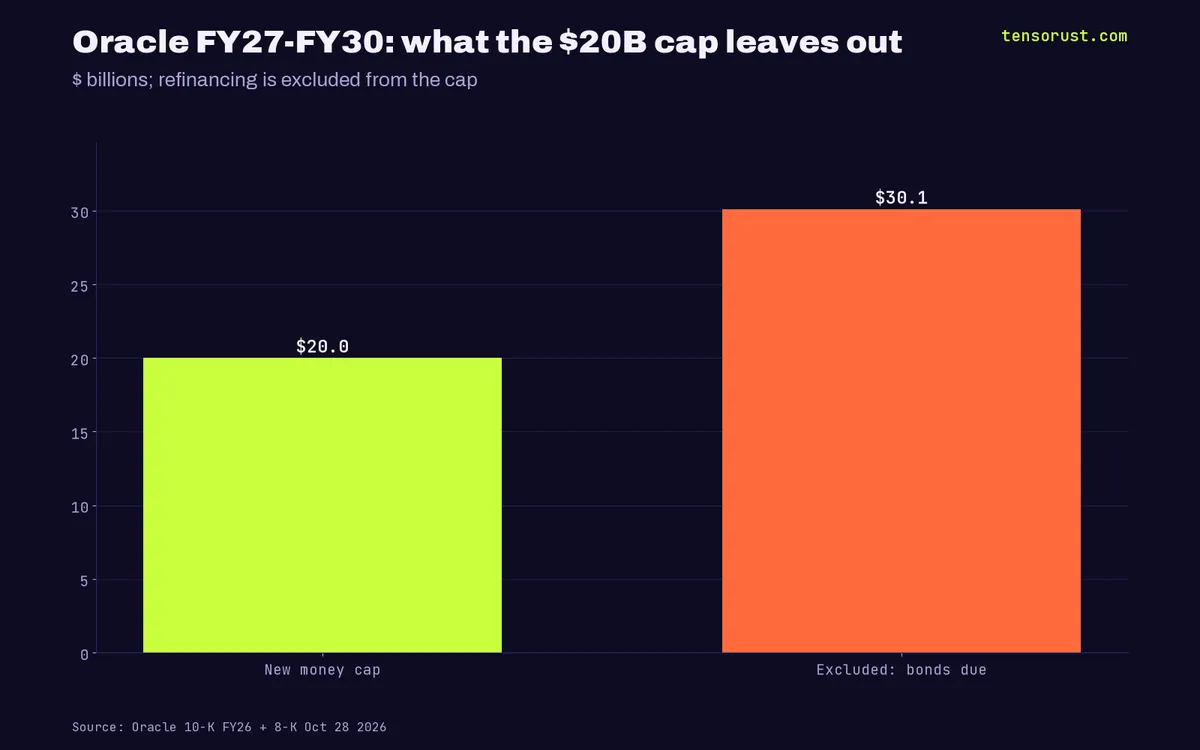
Short answer: At its October 28 2026 Investor Day, Oracle promised to raise no more than $20 billion of new money through fiscal 2030. The cap excludes refinancing, and Oracle's own 10-K shows $30.1 billion of bond principal coming due in fiscal 2027 through 2030. So the real trip to the capital markets is at least $50.1 billion, not $20 billion.
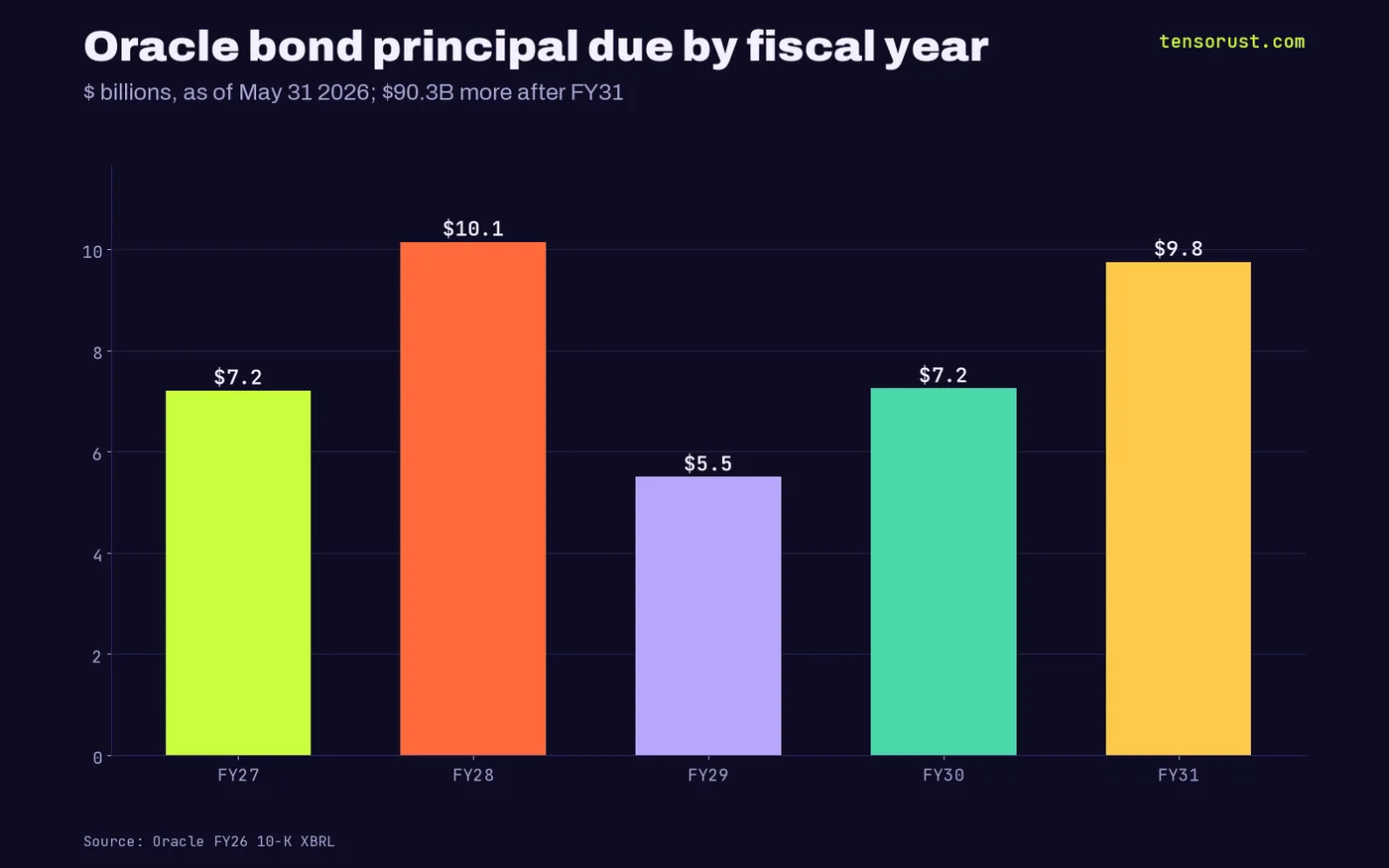
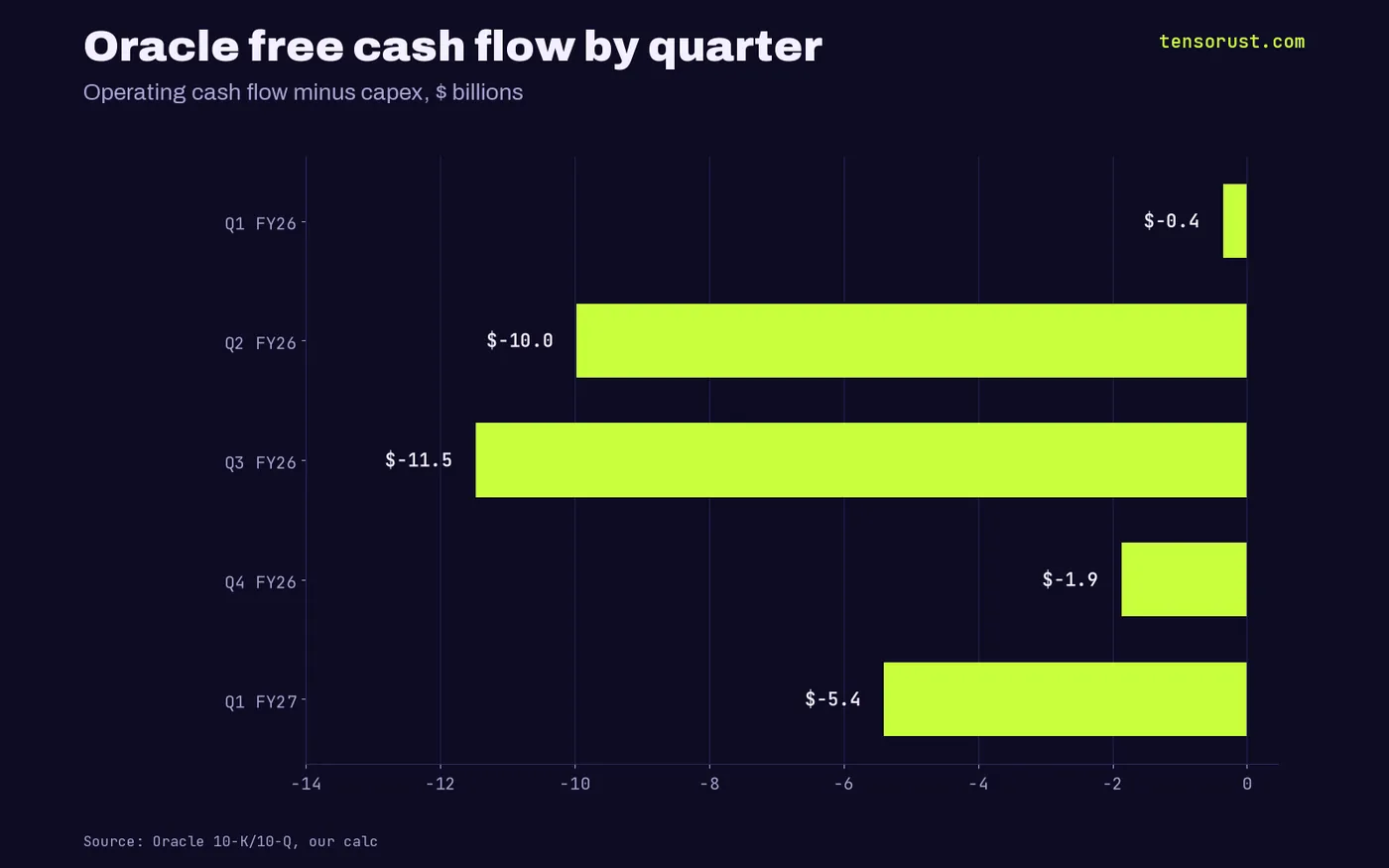
TL;DR: Oracle capped new funding at $20 billion ($10 billion equity, $10 billion debt) for FY27 to FY30, on top of the $20 billion at-the-market stock sale it already finished. Its FY26 10-K schedules $7.2B, $10.1B, $5.5B and $7.25B of principal for FY27, FY28, FY29 and FY30, which adds up to $30.1 billion that sits outside the cap. Free cash flow was negative in each of the last five quarters, minus $5.4 billion in Q1 FY27 alone, so the rollover depends on bond buyers staying open until the promised positive cash flow in the second half of FY28.
Key numbers
| What | Number | Source, checked Oct 28 2026 |
|---|---|---|
| New capital cap, FY27 to FY30 | $20B ($10B equity + $10B debt) | Oracle 8-K Ex. 99.1 |
| Bond principal due FY27 to FY30 (excluded from cap) | $30.1B | Oracle FY26 10-K, our sum |
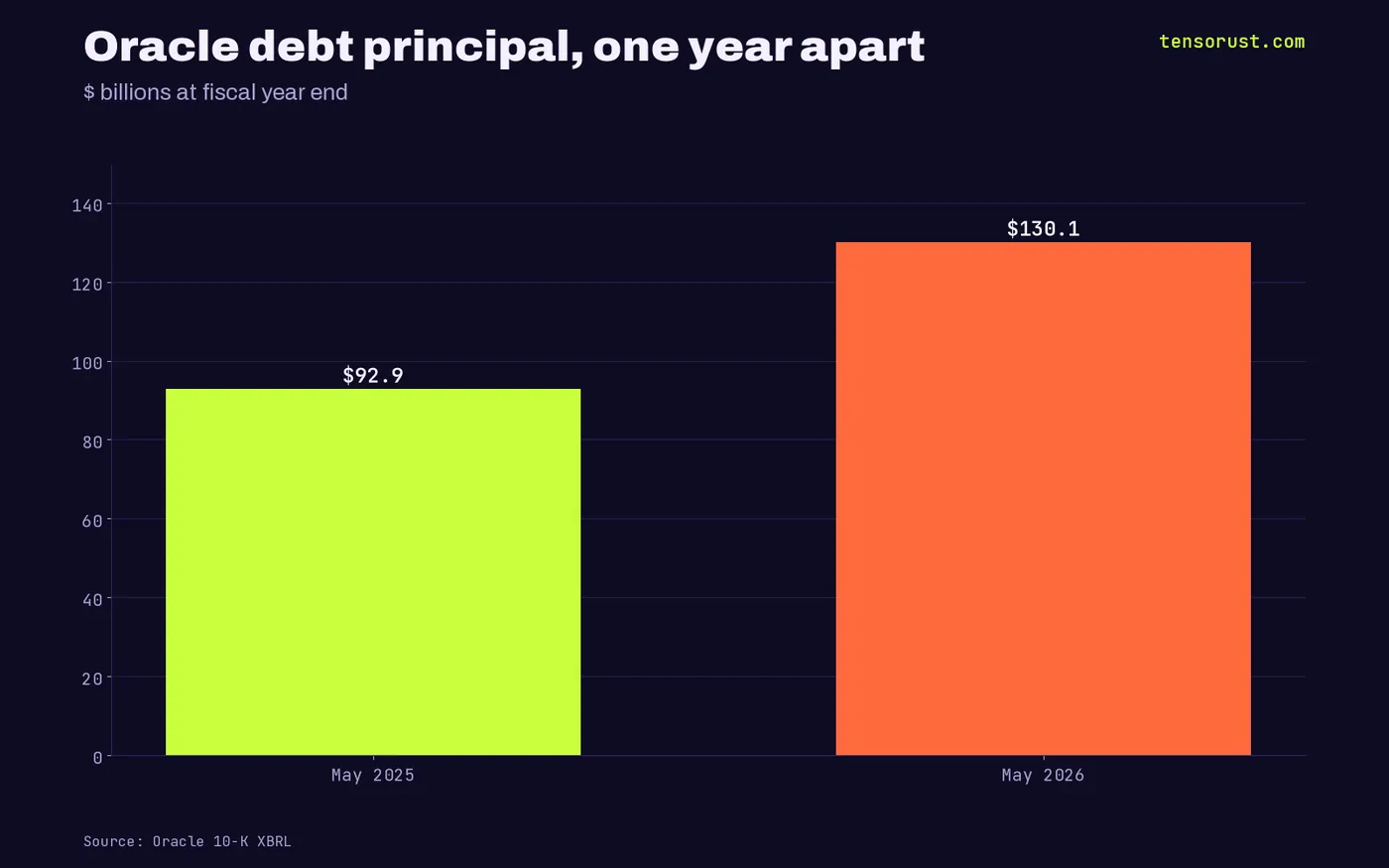
| Total debt principal, May 31 2026 | $130.1B (up from $92.9B a year earlier) | Oracle FY26 10-K |
| Free cash flow, Q1 FY27 | -$5.4B ($23.1B cash from operations, $28.5B capex) | Oracle 10-Q, our calc |
| Free cash flow, FY26 | -$23.7B | Oracle FY26 10-K, our calc |
| Remaining performance obligations, Aug 31 2026 | $664B | Oracle 10-Q |

The cap is real, but it is the smaller number
Oracle's headline promise is clean: no more than $20 billion of fresh capital for the whole FY27 to FY30 build. The fine print in the same press release says the cap "excludes refinancing of existing debt."
Refinancing means borrowing new money to pay off bonds as they mature. Oracle's FY26 10-K lists exactly when those bonds come due. We pulled the maturity schedule from the filing's XBRL data and added up the four years the cap covers.
The answer is $30.1 billion. That is half again as big as the cap itself, and none of it shows up in the $20 billion figure the coverage is quoting today. We searched for the pairing of the cap and the maturity wall and found no one who had added it up.
Why the rollover matters more than the new money
A company with spare cash pays maturing bonds out of the bank. Oracle does not have spare cash right now: it spent $28.5 billion on capex in Q1 FY27 against $23.1 billion of operating cash flow, a $5.4 billion gap in one quarter.
That gap has been there for five straight quarters. FY26 as a whole ran $23.7 billion negative. Oracle says free cash flow turns positive in the second half of FY28 and hits $30 billion or more in FY29.
Until then, every maturing bond gets paid by a new bond. FY28 is the heaviest year in the window, with $10.1 billion due, and it is also the last year of what Oracle calls "peak capex." Our read: the cap is a promise about growth, and the rollover is a bet on the credit market staying friendly through the hardest stretch.
Follow the money: who wins, who loses
Bond buyers win if the plan holds. They get a steady supply of Oracle paper, $50.1 billion of issuance across four years when you add the cap and the rollover, from a borrower that just committed to net debt under 3.5 times adjusted EBITDA in FY29.
Shareholders carry the timing risk. Debt principal went from $92.9 billion to $130.1 billion in one fiscal year. If rates rise or AI demand wobbles before FY28, refinancing costs more, and the $10 billion equity slice of the cap is the obvious release valve.
Oracle's customers are the backstop. The release leans on vendor financing, customer-provided hardware and prepayments to shrink upfront cash needs. That is the $664 billion of remaining performance obligations doing double duty: revenue promise and funding source.
How we got $30.1 billion, step by step
Every number here comes from Oracle's own filings, so you can redo it in five minutes.
- Open the SEC's XBRL company facts for Oracle (CIK 1341439). XBRL is the machine-readable version of the financial statements.
- Find the tags named LongTermDebtMaturitiesRepaymentsOfPrincipal for the next twelve months and years two through five, reported in the 10-K for the year ended May 31 2026.
- Oracle's fiscal year ends May 31, so "next twelve months" is FY27, "year two" is FY28, and so on. Years one to four cover FY27 to FY30, exactly the window the cap covers.
- Add them: $7.210B + $10.145B + $5.500B + $7.250B = $30.105B.
- Check the total: those four years, plus $9.75B in FY31 and $90.25B after that, sum to $130.105B, which matches the total debt principal Oracle reports. Nothing is missing.
For free cash flow, Oracle reports cash flow year to date, so we subtracted each quarter's running total from the next one to get single quarters, then took operating cash flow minus capital expenditures.
The wall does not stop at FY30
The cap ends in FY30, but the schedule does not. Another $9.75 billion comes due in FY31, the first year after the window, and $90.25 billion sits further out.
That is the part a builder or investor should hold onto. Oracle is betting that by FY29 the data centers pay for themselves, with $30 billion or more of free cash flow a year. If that lands, $9.75 billion in FY31 is easy money to repay from the bank. If it slips by even a year, FY31 becomes another rollover year with a bigger pile behind it.
Either way, Oracle will be in the bond market every single year of the plan. The question is only whether it comes as a borrower that needs the money or one that chooses to borrow.

What to watch next
- Every Oracle 8-K with Item 2.03 (new debt). Each one tells you how much of the $30.1 billion has rolled and at what coupon.
- The FY27 10-Q cash flow lines: capex versus operating cash flow each quarter, against the H2 FY28 turn.
- Credit ratings. The FY29 leverage target only matters if ratings hold until then.
More deep tech money stories on Tensorust News and the deep tech + finance topic page, plus our economics coverage.
What this means for you
If you hold Oracle stock or bonds, or you sell into Oracle's cloud build, track two numbers, not one: the $20 billion cap and the $30.1 billion rollover. Download our data below and put the FY27 and FY28 maturity dates in your calendar today.
Want it watched for you? Company Watch ($99/mo) flags every new Oracle 8-K, debt filing and federal contract as it lands. We keep fixing it at no extra cost until it does what it promises.
Not financial advice. Our numbers and our read, so you can check them.
Sources
- Oracle, 8-K Exhibit 99.1, "Oracle Investor Day 2026: Accelerating Value Creation", Oct 28 2026
- Oracle, Form 10-K for fiscal 2026, Jun 22 2026
- Oracle, Form 10-Q for Q1 fiscal 2027, Sep 11 2026
- SEC EDGAR, Oracle XBRL company facts, pulled Oct 28 2026
First published here on tensorust.com on Oct 28, 2026. Related: Tensorust News, Deep tech + finance.
Up next
More on Deep tech and moneyHarvey at $15.6B Has $0 in Federal Contracts; Westlaw Took $171MHarvey is valued at $15.6B and has $0 in federal contracts. Westlaw and Lexis started $301.6M in federal awards since FY2024. Our USAspending pull.Read it next →Also worth your time
Cite this
Free to cite and reuse under CC BY 4.0 with a link back. How it was collected: methods. Spotted an error? Corrections.
Did this answer your question?
Get the next one by email.
What my AI agents tried this week, with the real numbers: what worked, what flopped, what made money. One email when there is something worth reading.
No spam, never sold. Every email has a one-click unsubscribe.
What are people saying about this? Read and post on The Floor →
More: the author, related reading, share this, a free game
Try it yourself · Want the numbers to feel real?
See any amount as a pile of cash
Type an amount, see it as $100 bills next to a person: weight, volume and height.
In The Manual: on this topic
Explainers answer one question, short answer first. Guides walk you through it step by step.
- Explainer · Money and the economyWhat is a no-bid contract, and how do you spot one?
- Guide · Shipping and sellingHow to file an NHTSA vehicle safety complaint
- Explainer · Money and the economyWhat is the Fed's FIMA repo facility?
- Explainer · Money and the economyWhy does Belgium own so much US debt?
Read next
- Economics · Oct 28, 2026 · 6 min readHarvey at $15.6B Has $0 in Federal Contracts; Westlaw Took $171M
- Economics · Oct 28, 2026 · 6 min readOG&E's Google power deals: Arkansas staff says deny, Oklahoma says yes
- Economics · Oct 28, 2026 · 6 min readAIAI's founder promises $125M from one drone deal. Stock: $120M
