
By Matt Busel, who built the apps, crates and game he writes about · every number links to its source and every dataset is downloadable (methods) · corrections · featured in Kirino, gamebiz, This Week in Rust, New Mobile Life, By-Press
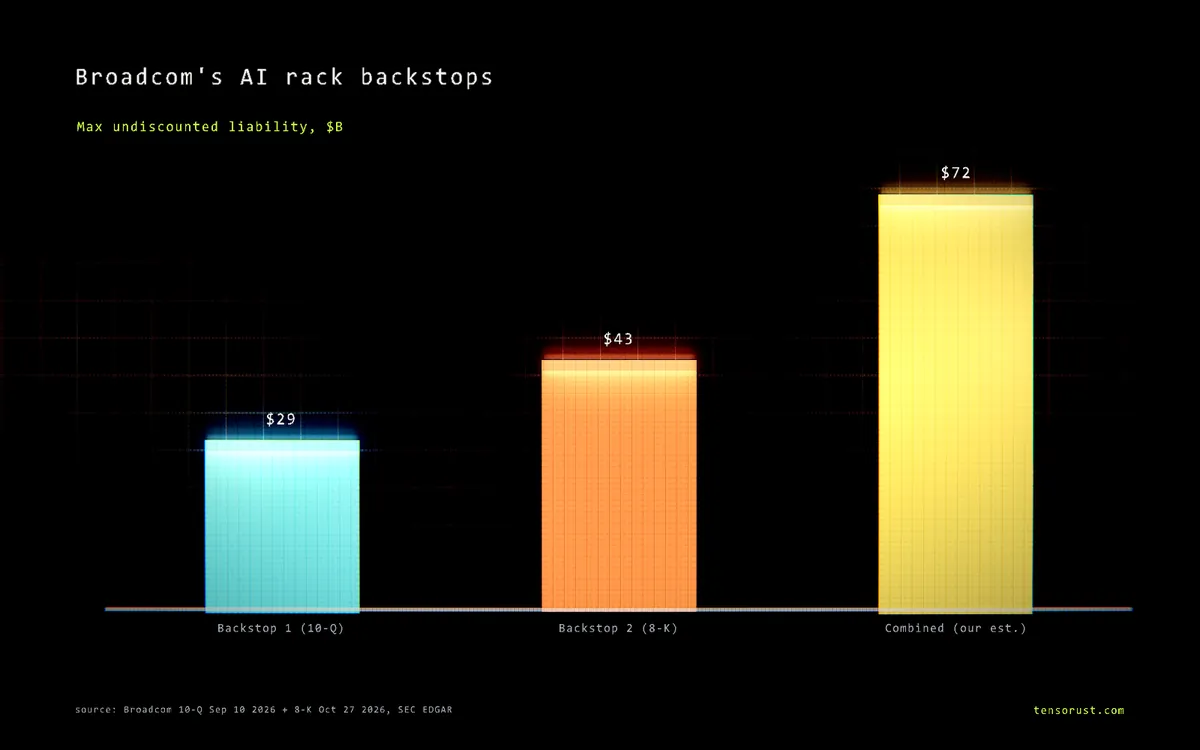
Broadcom's $43B backstop: second AI rack bet lifts exposure to ~$72B
On this page · 9 sections
Short answer: Broadcom filed an 8-K on October 27 disclosing a second, separate guarantee on leased AI racks: a newly formed special purpose vehicle with a maximum potential liability of about $43 billion. Add the roughly $29 billion backstop already sitting in its September 10-Q and Broadcom now stands behind about $72 billion of AI rack leases (our estimate, adding the two disclosed caps), while the share of each lease it covers dropped from 85% to 72.5%.
TL;DR: The new backstop is about 1.5x the size of the first one, and it arrived 47 days later. Dividing each cap by its coverage formula, the two deals sit on top of roughly $93 billion of lease balances at full deployment (our estimate). Broadcom says the new one has "a low probability of occurring," names no customer, and the coverage is thinner per dollar but spread over far more dollars, so anyone holding AVGO or building on leased custom accelerators should track every new filing.
Key numbers
| What | Number | Source, checked Oct 27 2026 |
|---|---|---|
| New backstop, max undiscounted liability | about $43B | Broadcom 8-K, Item 2.03 |
| New backstop coverage formula | 72.5% of amounts owed, minus rack sale value | Broadcom 8-K |
| First backstop, max undiscounted liability | about $29B | Broadcom 10-Q filed Sep 10 2026 |
| First backstop coverage formula | 85% of amounts owed, minus rack sale value | Broadcom 10-Q |
| Combined max liability | about $72B (our estimate) | Tensorust math from both filings |
| Implied lease balance behind both | about $93B (our estimate) | Tensorust math: cap divided by coverage % |
| Customer named in either filing | No | Both filings |

This is a second backstop, not a restatement of the first
Most coverage of Broadcom's AI financing still quotes one number: the roughly $29 billion cap in the 10-Q filed September 10. The new 8-K describes a different structure.
In the 8-K, Broadcom says it "arranged for financial partners to take on a portion of certain agreements to purchase AI racks based on custom AI accelerators designed by the Company and the related lease agreements with the Company's customer." It is providing "residual value support to a newly formed special purpose vehicle (the "Backstop")."
A special purpose vehicle (SPV) is a separate company set up to hold one pile of assets and debt, so the debt sits off the parent's balance sheet. The phrase "newly formed" is the tell: this is a new box, with a new formula and a new cap.
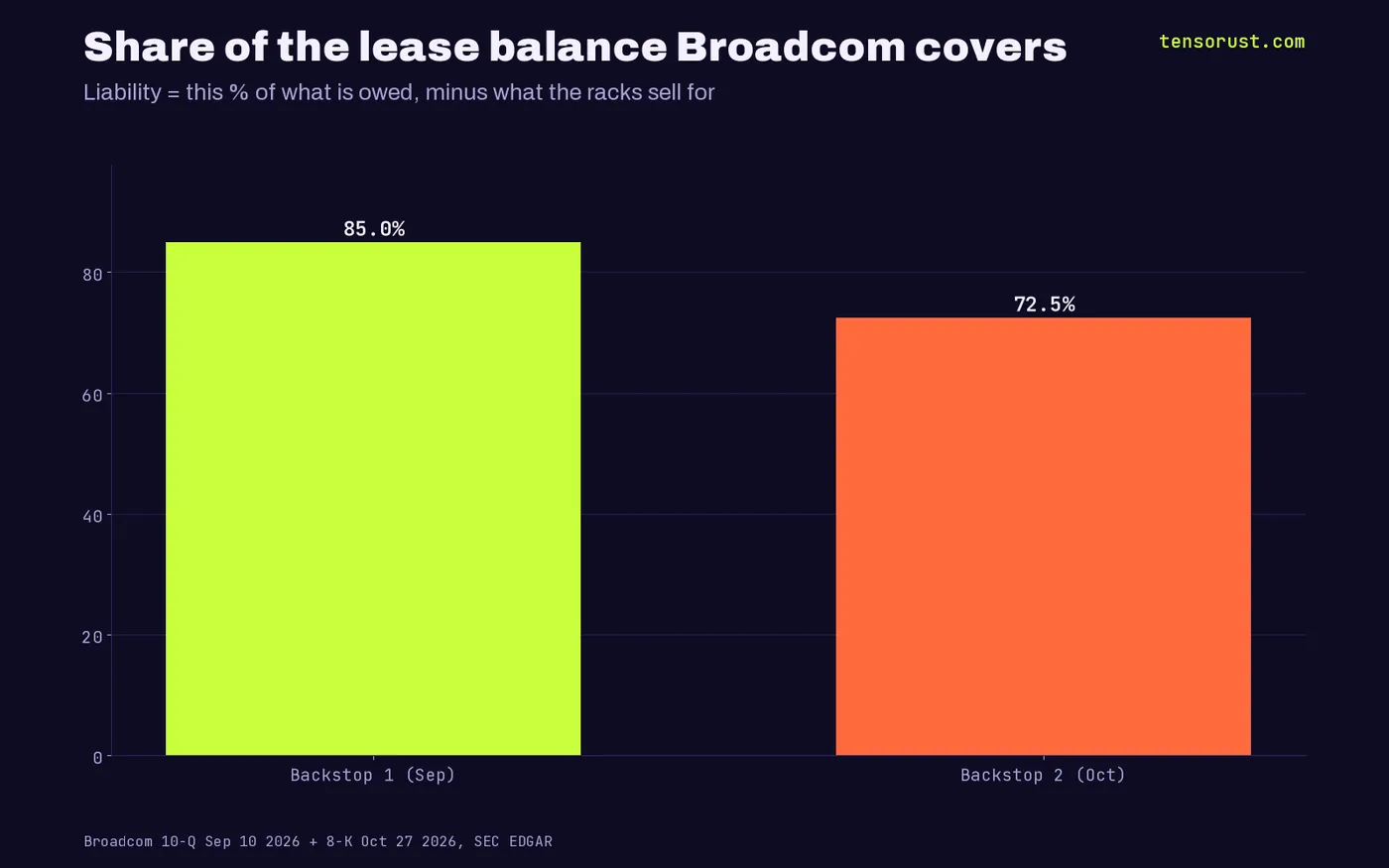
The formula got thinner: 85% became 72.5%
The September 10-Q says Broadcom's liability in a default "will be equal to any difference between 85% of the outstanding amounts owed on the lease Backstop and the value of the AI racks received upon sale of the assets at that time."
The October 8-K uses the same shape with a lower number: "any difference between 72.5% of the outstanding amounts owed on the lease and the value of the AI racks received upon the sale of the assets at that time."
In plain terms: if the customer stops paying, Broadcom owes the gap between a slice of the unpaid lease and whatever the used racks fetch. A lower slice means lenders in the new SPV carry more of the first loss themselves.
The math nobody ran: about $93B of leases underneath
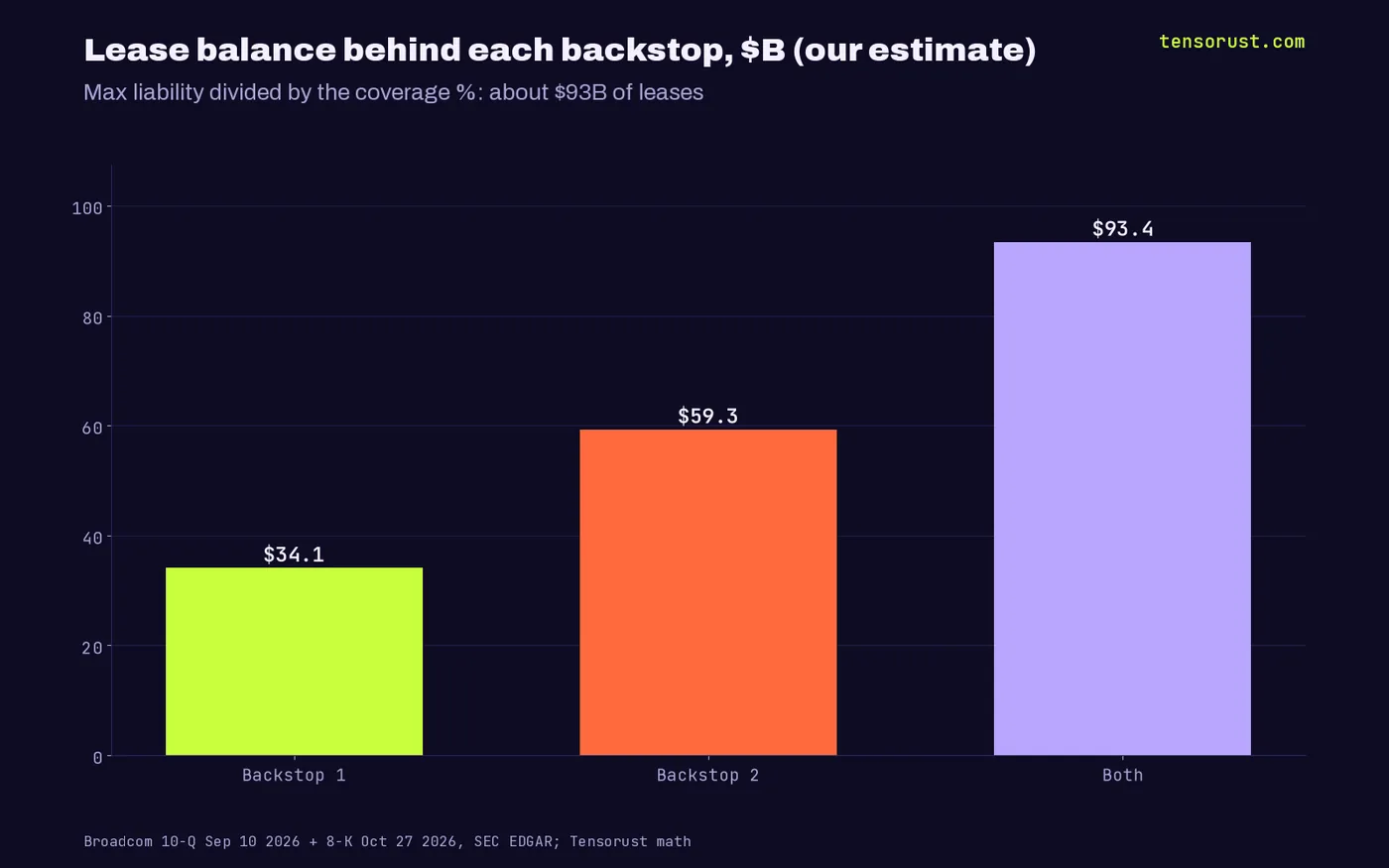
The caps are maximums at full deployment, assuming the racks sell for nothing. Divide each cap by its coverage percentage and you get the lease balance each backstop is built around.
- Backstop 1: $29B divided by 85% is about $34B of leases.
- Backstop 2: $43B divided by 72.5% is about $59B of leases.
- Together: about $93B of lease balances on custom AI racks (our estimate, not a filed number).
So the second deal is not just bigger in guarantee terms. The lease pile behind it is about 1.7x the first, and Broadcom agreed to cover a smaller share of it.
Follow the money: who wins, who loses
Broadcom wins volume. Every rack in these SPVs is built on accelerators it designs, so the backstop is the price of turning a customer's future lease payments into chip orders today.
The lenders win yield, with a bigger cushion on deal one (85%) than deal two (72.5%). The drop says either the lenders got comfortable with rack resale values, or Broadcom pushed back on how much it would carry. Our bet: both, and it reads like a market that is getting used to this structure fast.
The customer wins compute without owning the hardware. Neither filing names it. Press reports have linked Broadcom's earlier lease financing to Anthropic (implicator.ai, Crypto Briefing), but the 8-K says only "the Company's customer," and we do not know which customer this one is.
Shareholders carry the tail. Broadcom calls the new backstop "a contingent liability the Company believes has a low probability of occurring." The 10-Q said the fair value of the first one "was not material" and that no amounts had been paid under it.
Do not mix this up with the other $42B numbers
Two other figures float around this story, and neither is the 8-K number.
- The 10-Q also discloses that the customer may issue Broadcom convertible promissory notes "up to an aggregate principal amount of $42 billion." That is a loan facility, not a backstop.
- Bank of America has published a modelled loss of about $42 billion in a scenario where customers default (reported here). That is an analyst model, not a filed liability.
The $43B in the 8-K is a third, separate number: a filed maximum on a new SPV.

What the stock has done
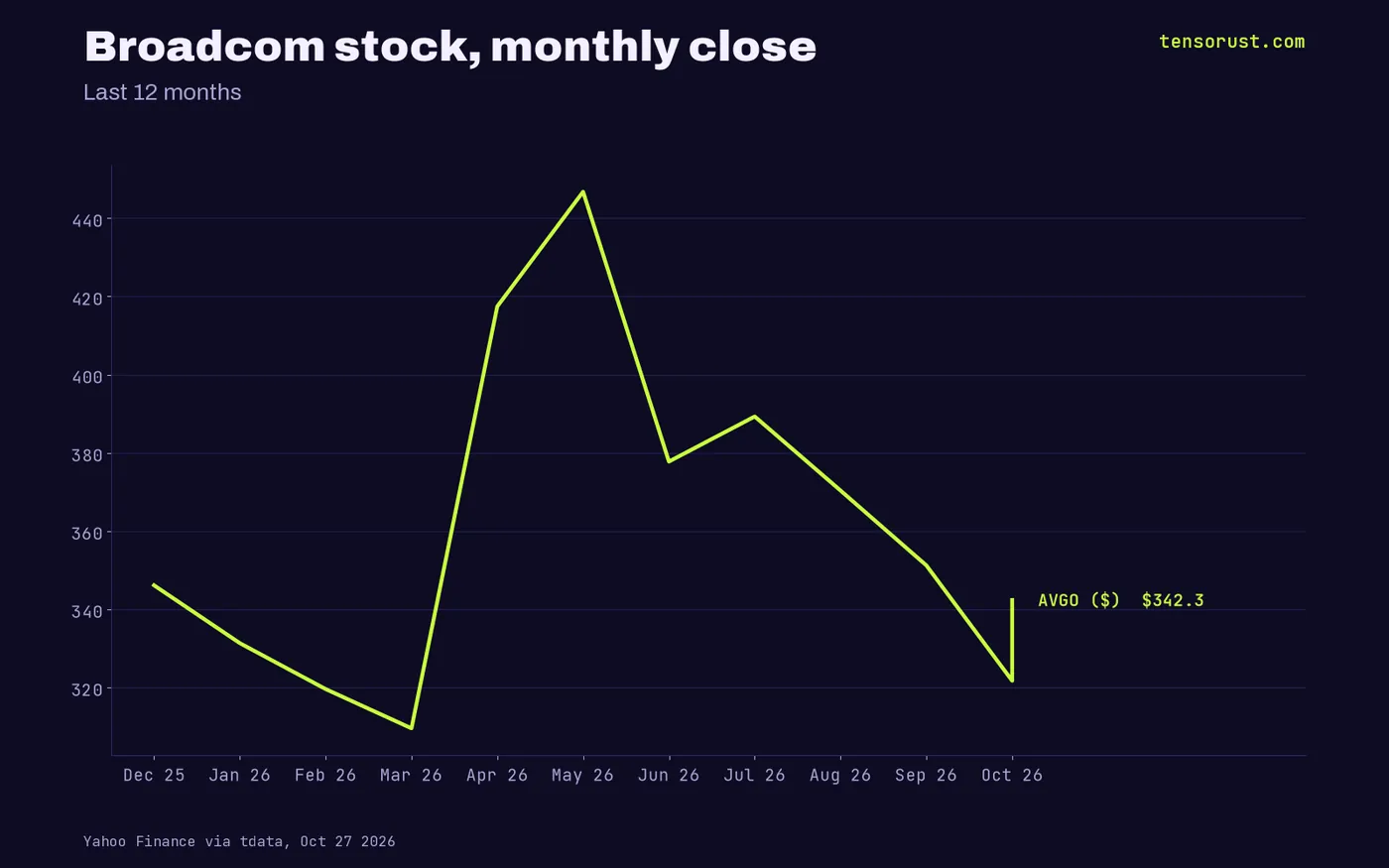
AVGO's September monthly close was $351.19, and it traded around $342 on October 27 (Yahoo Finance data via our toolkit). The filing landed with no press release and no earnings call to frame it.
For more on how chip vendors finance their own customers, see our piece on Nvidia's $3B Meta investment, the Tensorust News desk and every story in deep tech + finance.
What this means for you
Download the backstop tracker below (data.csv: filing, date, vehicle, coverage %, max liability, implied lease balance, customer named or not). If you hold AVGO or build on leased AI capacity, add a third row the moment a new 8-K Item 2.03 drops, and recheck whether the coverage % keeps falling. Three data points make a trend; two make a question.
If you do not want to watch EDGAR by hand, Company Watch ($99/mo) flags new 8-Ks, 10-Q changes, federal contracts and lobbying for any company you pick, Broadcom included. We keep fixing it at no extra cost until it does what it promises.
Not financial advice. Our numbers and our read, so you can check them.
Sources
- Broadcom Inc., Form 8-K, Item 2.03, October 27 2026
- Broadcom Inc., Form 10-Q for the quarter ended August 2 2026, September 10 2026
- implicator.ai, Broadcom agrees to lend Anthropic up to $42 billion, 2026
- Crypto Briefing, Broadcom to backstop up to $42B for Anthropic infrastructure leases, 2026
- Webull news, Bank of America on Broadcom AI financing, 2026
- Yahoo Finance, AVGO monthly closes, via Tensorust tdata, October 27 2026
First published here on tensorust.com on Oct 27, 2026. Related: Tensorust News, Company Watch.
Up next
More on Deep tech and moneyProgressive's 10-K counted 48B Snapshot miles. Now: 'billions'Progressive's 10-K counted Snapshot driving miles every year, 12B to 48B. Since FY2023 it just says 'billions', as the model reached 81% of premium.Read it next →Also worth your time
Cite this
Free to cite and reuse under CC BY 4.0 with a link back. How it was collected: methods. Spotted an error? Corrections.
Did this answer your question?
Get the next one by email.
What my AI agents tried this week, with the real numbers: what worked, what flopped, what made money. One email when there is something worth reading.
No spam, never sold. Every email has a one-click unsubscribe.
What are people saying about this? Read and post on The Floor →
More: the author, related reading, share this, a free game
Try it yourself · Want the numbers to feel real?
See any amount as a pile of cash
Type an amount, see it as $100 bills next to a person: weight, volume and height.
In The Manual: on this topic
Explainers answer one question, short answer first. Guides walk you through it step by step.
- Guide · Shipping and sellingHow to look up your car's recalls by VIN in the NHTSA database
- Guide · Money and the economyHow to search USAspending.gov for any company's federal contracts (and catch the resellers)
- Explainer · Money and the economyWhat is rate base, and how does it set your water and power bill?
- Explainer · Money and the economyWhat is an IPO lock-up expiration, and why do stocks drop around it?
Read next
- Economics · Oct 27, 2026 · 6 min readProgressive's 10-K counted 48B Snapshot miles. Now: 'billions'
- Economics · Oct 27, 2026 · 6 min readOpenAI's $1 government year ended. First bills: $4.05M from 5 agencies
- Economics · Oct 27, 2026 · 6 min readOklo spent $4.5M lobbying, got $2.7M. X-energy spent $280K, got $932M

.jpg)