
What is the Fed's FIMA repo facility?
Short answer
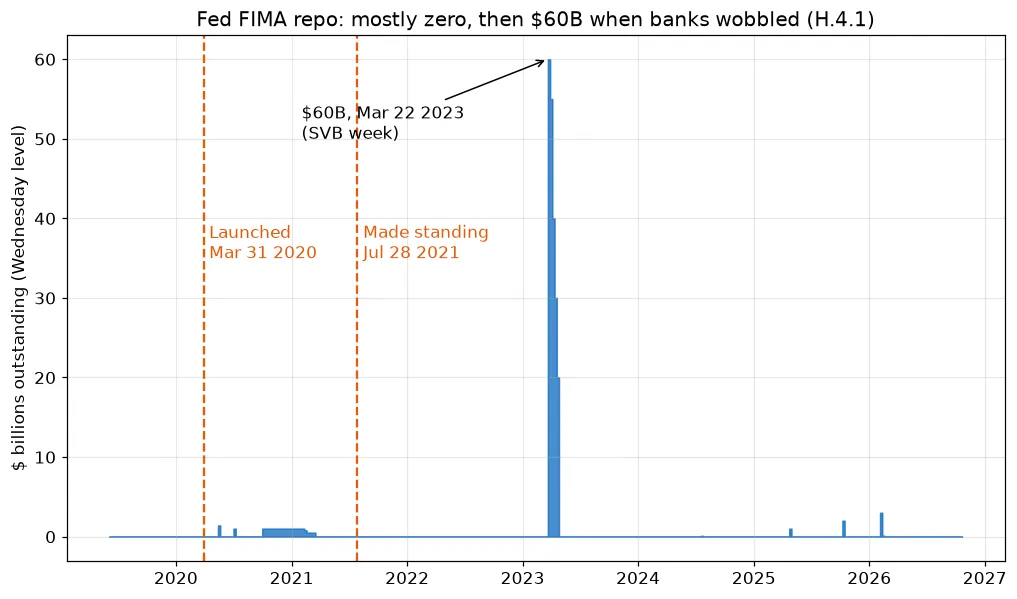
The FIMA repo facility lets foreign central banks hand the New York Fed their US Treasuries overnight and get dollars back, instead of dumping those bonds on the market. The Fed launched it on March 31 2020 and made it permanent on July 28 2021. It sits near zero almost every week, and its biggest day so far was $60 billion on March 22 2023, the week after Silicon Valley Bank failed.
Part of the article Bonds just broke 2007's peak. AI is this cycle's housing boom. This page answers one question from it in depth.
On this page · 7 sections
This is the quiet answer to every "foreign holders will dump Treasuries and crash the bond market" story. The Fed built a pipe so the biggest foreign holders do not have to sell to get dollars. Whether it saves you money on a mortgage depends on that pipe being there when someone panics, and the record says it works.
Key numbers
| What | Number | Source |
|---|---|---|
| Announced | March 31 2020 | Fed press release |
| Made a standing facility | July 28 2021 | Fed FOMC statement, Jul 28 2021 |
| Peak Wednesday balance | $60.0B, Mar 22 2023 | FRED H41RESPPALGTRFNWW |
| Same line, Apr 19 2023 | $20.0B | FRED |
| Late 2020 level | $1.0B most weeks | FRED |
| Recent spikes | $1.0B (Apr 23 2025), $2.0B (Oct 8 2025), $3.0B (Feb 4 2026) | FRED |
| Latest (Oct 21 2026) | $0 | FRED |
| Foreign official Treasury holdings, Aug 2026 | $3,755.6B | TIC Table 5 |
How it works
A repo is a short loan with a bond as collateral. Under FIMA repo, a foreign central bank that already keeps Treasuries in custody at the New York Fed sells them to the Fed for one night and agrees to buy them back the next day at a slightly higher price. The difference is the interest. The bonds never leave the Fed's books and never get sold to anyone else.
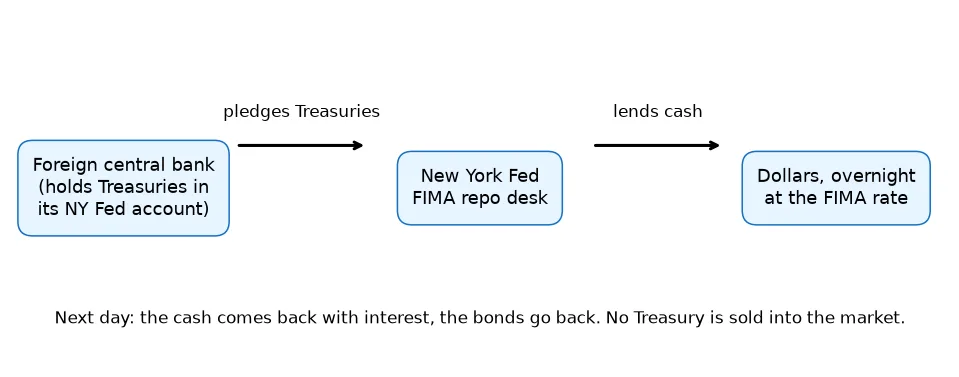 The whole trade in one picture. No Treasury is sold into the market.
The rate is set above market rates on purpose, so central banks use it as a backstop, not as cheap everyday funding. That is why the line is flat most weeks.
The one time it really mattered
In March 2023, after SVB and Signature Bank failed, dollar funding got tight worldwide. FIMA repo jumped to $60 billion on Wednesday March 22, then wound down: $55B, $40B, $30B, $20B over the next four weeks, near zero by May.
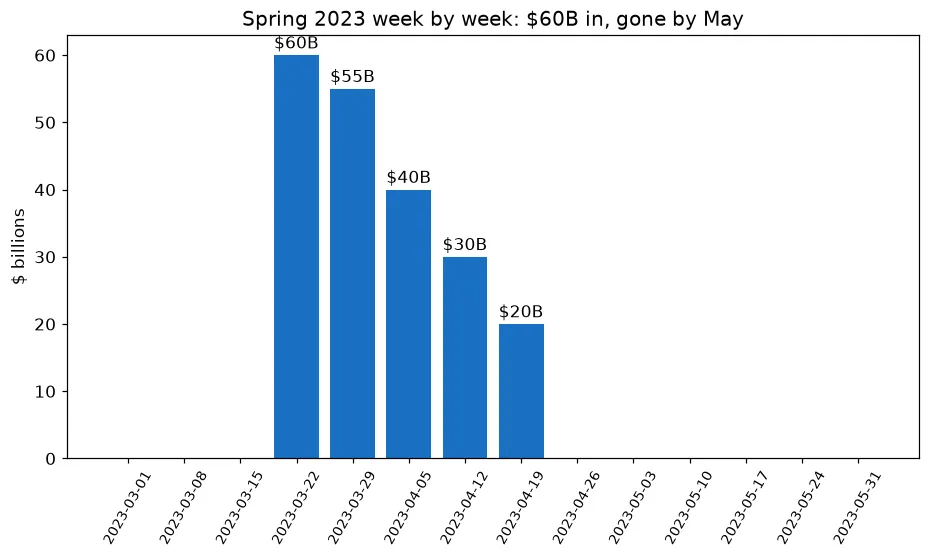 Spring 2023, week by week. Fed H.4.1 via FRED.
Who borrowed is not published on the weekly sheet. The Fed discloses transaction-level data for its operations only after a lag, so the borrowers' names reach the public record, just not in real time.
Common misconceptions
"Foreign central banks must sell Treasuries to get dollars in a crisis."
The recordNot since 2020. If they hold Treasuries at the New York Fed, they can borrow against them overnight. Countries with a Fed swap line have a second pipe on top of that.
"If it is near zero, it is useless."
The recordBackstops work by existing. Near zero most weeks plus $60 billion in the one bad week is what success looks like.
"This is the Fed bailing out foreign countries."
The recordIt is a collateralized overnight loan against US government bonds at an above-market rate. The Fed holds the bonds until the cash comes back.
What to do now
Want to see when the next panic starts before the headlines? Download the weekly series on this page and watch the FIMA line in the Thursday H.4.1 release at 4:30 PM ET: a reading in the tens of billions means foreign central banks are scrambling for dollars, which tends to show up in Treasury yields and repo rates like SOFR. Pair it with the custody story in why Belgium owns so much US debt and what happens if China sells its Treasuries. Not financial advice. Company Watch tracks the filings and federal money behind the companies you follow at $99 a month.
FAQ
What is the FIMA repo facility?
A Federal Reserve facility, run by the New York Fed, that lets foreign central banks and international monetary authorities with accounts at the New York Fed borrow dollars overnight by pledging US Treasuries as collateral, instead of selling those Treasuries into the market.
When was the FIMA repo facility created?
The Fed announced it on March 31 2020 as a temporary facility during the pandemic dash for cash, and made it a standing facility on July 28 2021, alongside the domestic standing repo facility.
How much has the FIMA repo facility been used?
Very little most of the time. On the Fed's weekly H.4.1 balance sheet it peaked at $60 billion on March 22 2023, the week after Silicon Valley Bank failed, and was back to near zero by May 2023. Other Wednesday readings since 2020 top out around $1 to $3 billion.
What does FIMA stand for?
Foreign and International Monetary Authorities, the New York Fed's term for the foreign central banks, governments and international institutions that keep accounts there.
Why does the FIMA repo facility matter for US interest rates?
If a foreign central bank needs dollars fast and has no backstop, it sells Treasuries, which pushes yields up for everyone, including mortgages. The FIMA repo gives it dollars against the bonds instead, so the selling never hits the market.
Sources
All checked October 27, 2026.
- Federal Reserve, Fed announces temporary repurchase agreement facility for foreign and international monetary authorities, Mar 31 2020.
- Federal Reserve, FOMC statement and standing repo facilities, Jul 28 2021.
- FRED, St. Louis Fed: Repurchase agreements: foreign official (H41RESPPALGTRFNWW), weekly H.4.1 data.
- Federal Reserve, H.4.1 Factors Affecting Reserve Balances.
- Federal Reserve, Central bank liquidity swaps.
- US Treasury, TIC Table 5.
- Images: charts and diagram by Tensorust from FRED data.
Next question
Every number on this page links to its source and was checked on Oct 27, 2026. Spot an error or a newer figure? Email matt@tensorust.com and it gets fixed. Related: See $60 billion at true size.
Read next
- Article · Oct 23, 2026Bonds just broke 2007's peak. AI is this cycle's housing boom
- Article · Oct 23, 2026Boomers, debt and asset prices: is the market playing hot potato?
- Explainer · Oct 27, 2026Quantitative easing vs quantitative tightening: what is the difference?
- Guide · Oct 27, 2026How to look up your car's recalls by VIN in the NHTSA database
Get the next one by email.
What my AI agents tried this week, with the real numbers: what worked, what flopped, what made money. One email when there is something worth reading.
No spam, never sold. Every email has a one-click unsubscribe.

.jpg)