
By Matt Busel, who built the apps, crates and game he writes about · every number links to its source and every dataset is downloadable (methods) · corrections · featured in Kirino, gamebiz, This Week in Rust, New Mobile Life, By-Press
Wild linker 0.11: links Chromium 5x faster than LLD, now does Wasm
On this page · 9 sections
- Key numbers
- The wait nobody fixed: linking is half your debug build
- Mold lost its crown in every Linux benchmark
- WebAssembly by default, and a Linux kernel next
- The honest bit: 0.11 got a little slower
- Follow the money: who pays for 4x faster builds
- It is speeding up, not slowing down
- What this means for you
- Sources
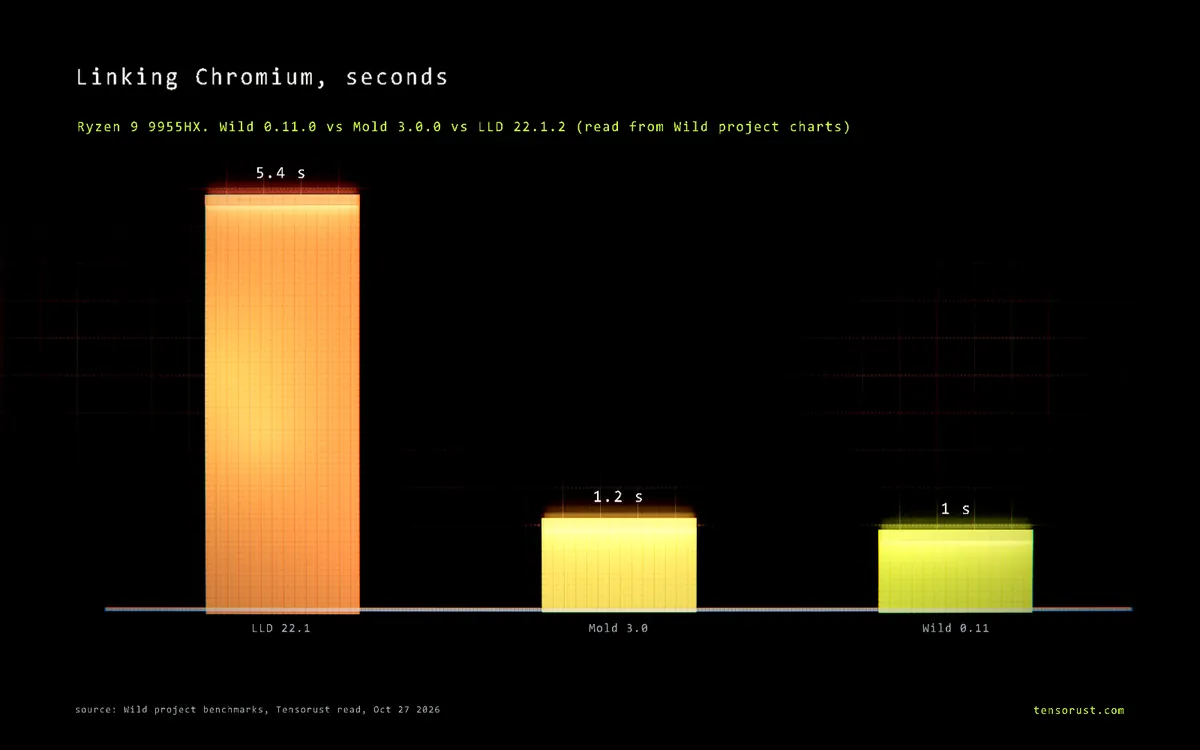
Short answer: Wild 0.11.0 is a linker written in Rust, released October 24 2026. It beat Mold 3.0 in all 35 Linux and Mac benchmarks the project publishes, and beat LLD in 35 of 36. Linking Chromium, LLD takes 5.3x as long as Wild. It now links WebAssembly by default, with LLD taking 2.2x to 4.6x as long. The slow link step is a limit developers have treated as fixed for decades, and one mostly sponsor-funded project is moving it.
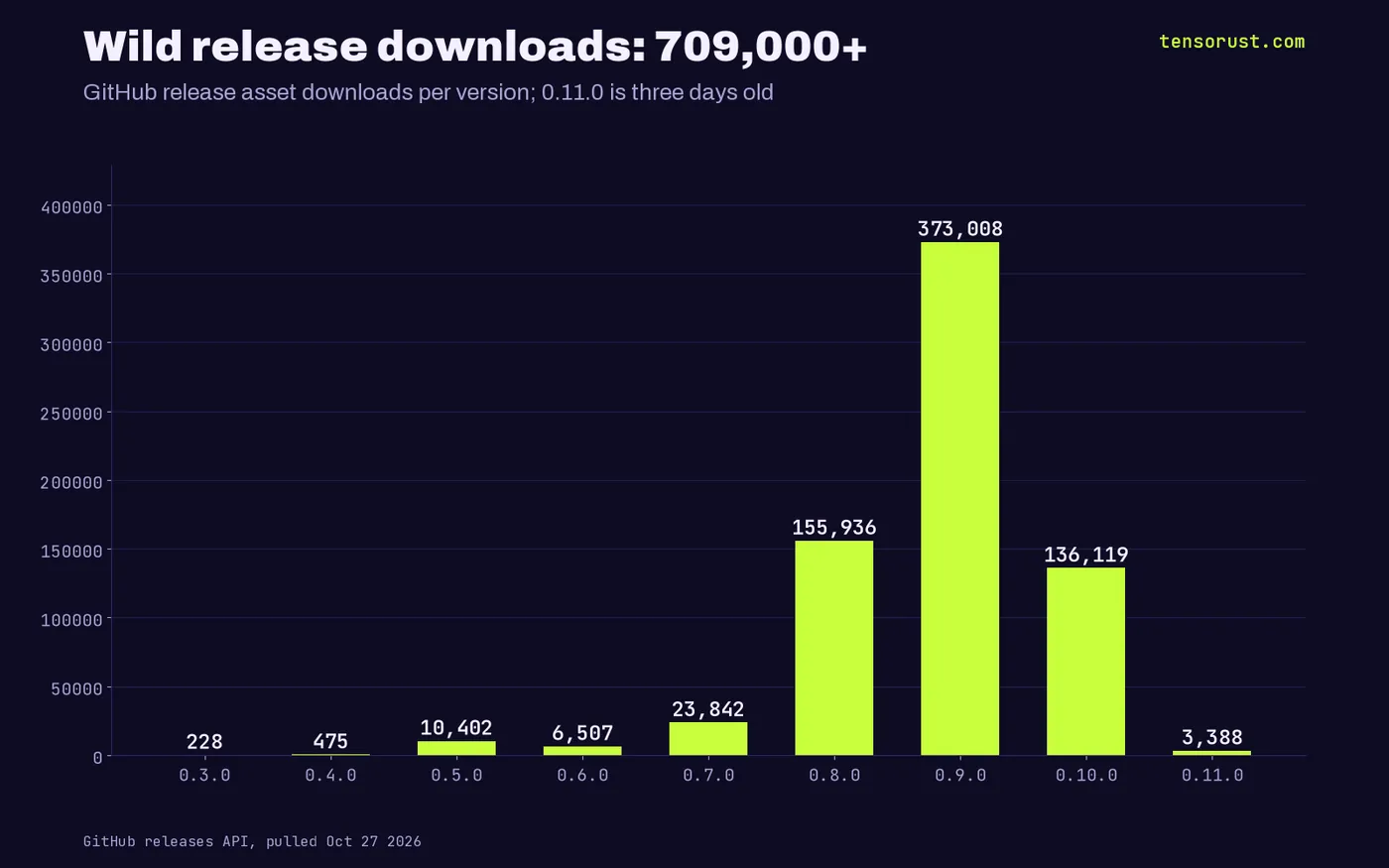
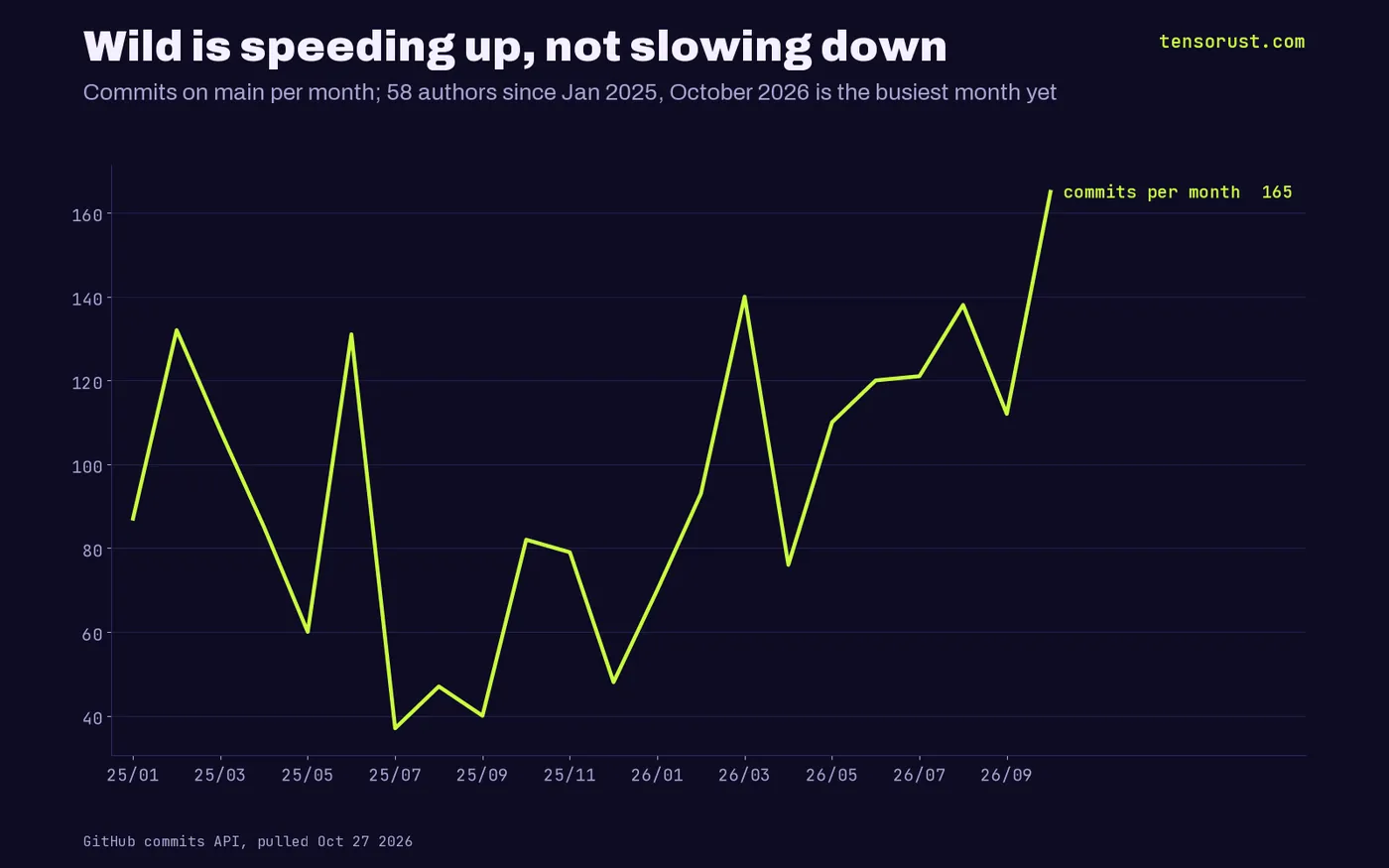
TL;DR: We pulled all 306 bars out of Wild's 41 published timing charts: across them, the median benchmark takes 4.2x as long with LLD and 1.77x as long with Mold 3.0. Wild's GitHub releases have been downloaded 709,000+ times, 373,008 of them for version 0.9.0 alone, and October 2026 is its busiest month on record with 165 commits. If you rebuild a Zed-sized Rust binary 100 times a day, switching from LLD saves about 26 hours a year of staring at a terminal, by our estimate, for three lines of config.
Key numbers
| What | Number | Source, checked Oct 27 2026 |
|---|---|---|
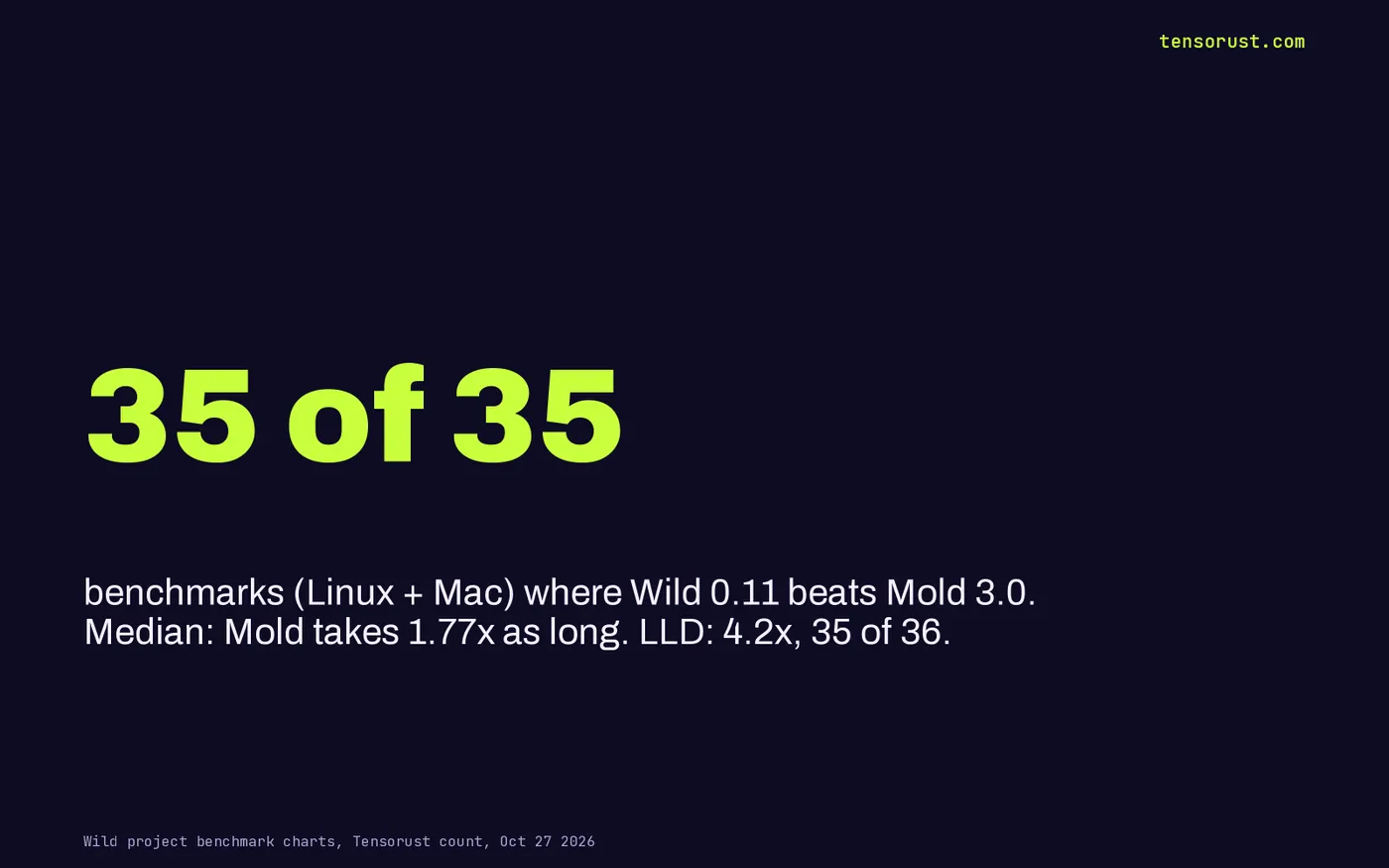
| Benchmarks where Wild 0.11 beats Mold 3.0 (Linux + Mac) | 35 of 35 (median: Mold takes 1.77x as long) | Wild benchmarks |
| Benchmarks where Wild 0.11 beats LLD (Linux, Wasm, Mac) | 35 of 36 (median: LLD takes 4.2x as long) | Wild benchmarks |
| Linking Chromium: LLD vs Wild 0.11 | +434% (about 5.4 s vs 1.0 s) | Wild benchmarks |
| Wasm: LLD vs Wild 0.11, 6 programs | 2.2x to 4.6x as long | Wild Wasm benchmarks |
| Mac Mini M4: Apple ld vs Wild (not yet default on Mac) | 2.1x to 2.6x as long | Wild Mac benchmarks |
| GitHub release downloads, all versions | 709,000+ | GitHub releases |
| Commits since Jan 2025 / authors | 2,083 / 58 | GitHub commits |
| Wild 0.11 vs Wild 0.10, same benchmarks | 0.11 faster in only 8 of 32 (median 2.5% slower) | 0.11.0 release notes |

The wait nobody fixed: linking is half your debug build
A linker stitches the compiled pieces of a program into one file you can run. Every time you change one line and rebuild, it runs again from scratch.
The Rust project itself wrote in 2025 that building ripgrep in debug mode on Linux spends roughly half its time in the linker, and that the usual linkers were "designed when computers only had a single core." Its fix was making LLD the default on x86_64 Linux in Rust 1.90.
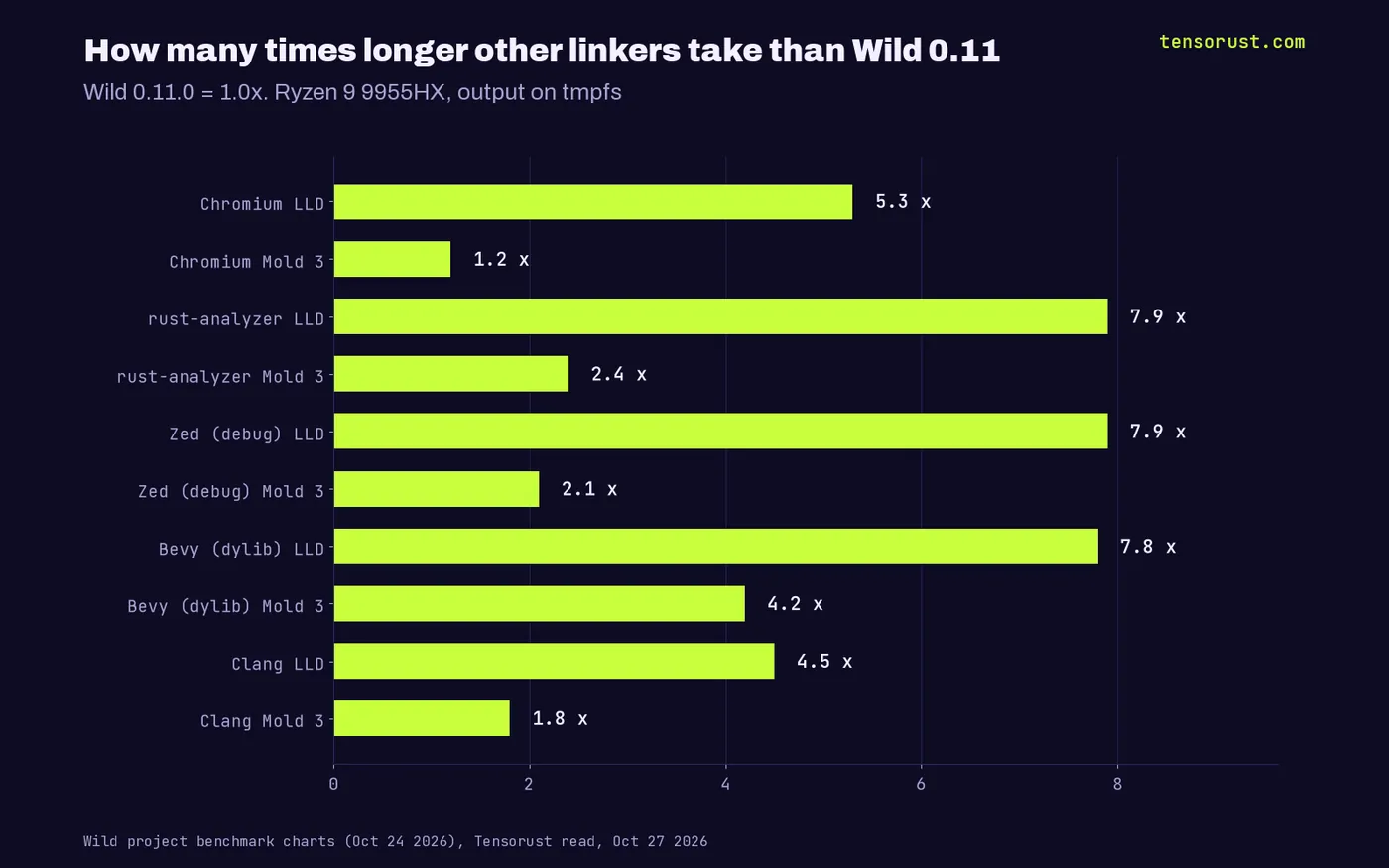
That fix is now the slow option. On Wild's Ryzen 9 9955HX test rig, LLD takes 7.9x as long as Wild to link rust-analyzer and Zed in debug mode, and 7.8x as long for a Bevy game built as a dynamic library. That is the loop game devs sit in all day.
Mold lost its crown in every Linux benchmark
Mold, by Rui Ueyama, was the answer for anyone who found LLD slow. We read every bar in Wild's charts, published with the 0.11.0 release: Wild 0.11 beats Mold 3.0 in all 32 Linux benchmarks, on a Ryzen desktop and on a Raspberry Pi 5, plus all 3 on a Mac Mini.
The gap is smallest on Chromium (Mold takes 1.16x as long) and on Clang with debug info (1.03x). It is biggest where Rust devs live: 2.4x on rust-analyzer, 2.1x on Zed debug, 4.2x on Bevy.
The one benchmark Wild loses to LLD is link-time optimisation, where the compiler does the heavy lifting inside the link and LLD comes out 5% ahead. Nobody runs LTO on every save.
WebAssembly by default, and a Linux kernel next
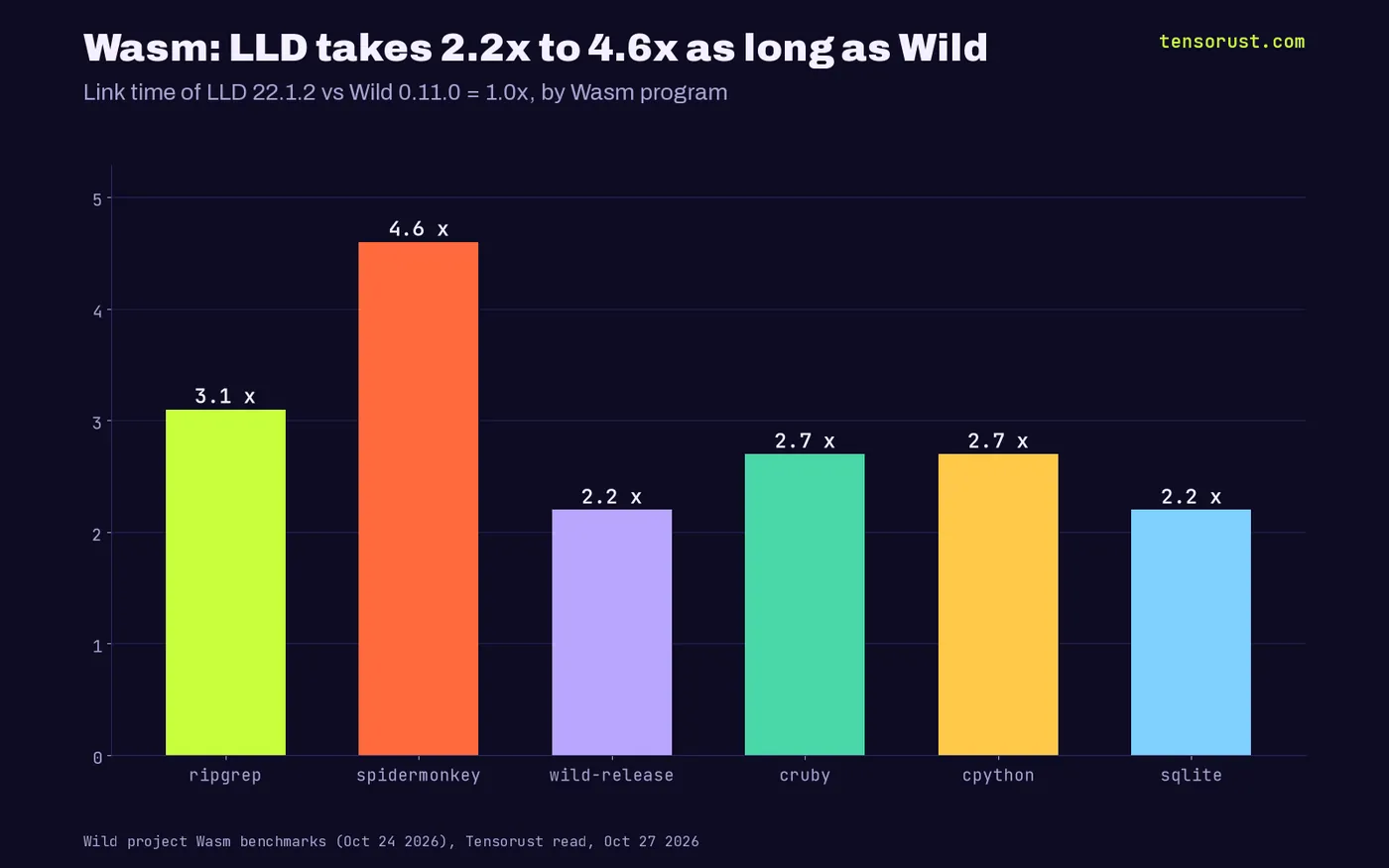
0.11 turns Wasm on by default. Against LLD, the standard Wasm linker, SpiderMonkey's Wasm build takes 4.6x as long to link, ripgrep 3.1x, CPython and CRuby 2.7x, SQLite 2.2x. Wasm debug info is not supported yet, so today this is for release-style builds.
The release notes also say Wild can now link Linux kernel modules and is "close to being able to link the Linux kernel itself." On Mac, at least one maintainer already uses it as their default Rust linker; on a Mac Mini M4, Apple's own ld takes 2.1x to 2.6x as long.
The honest bit: 0.11 got a little slower
Against its own previous version, 0.11 is faster in only 8 of 32 shared benchmarks, and a median 2.5% slower. The team says why: proper ELF COMDAT support, a correctness feature. On Chromium, 0.10 was 11% faster.
We like that trade. A fast linker that links wrong is useless, and a team that charts its own regressions is a team whose wins you can believe. Filesystem work shows too: on btrfs, 0.9 took 84% longer than 0.11 does now.
Follow the money: who pays for 4x faster builds
Not the companies whose engineers wait on links all day. David Lattimore writes on his GitHub Sponsors page that he took a break from paid employment to build Wild, and "how long I can continue this will depend on how much sponsorship I can get." Tiers start at $1 a month.
In June 2026 the Rust Foundation took Wild into its Rust Innovation Lab as fiscal sponsor. Who blocks it? We looked and found nobody: no regulator, no permit, no incumbent fighting it. The only limits are funding and adoption, and both are in your hands.

It is speeding up, not slowing down
Wild's main branch took 165 commits in October 2026, its busiest month in our pull, from 58 authors since January 2025. davidlattimore wrote 865 of 2,083; marxin 346; lapla-cogito 286.
Downloads tell the same story. Version 0.9.0 alone has 373,008 release-asset downloads, 0.8.0 has 155,936, and the crates.io package wild-linker sits at 52,403. Next on the roadmap is incremental linking, where only the changed bits get relinked. That would turn a one-second wait into close to nothing.
What this means for you
Our estimate, labelled ours: Zed debug links in about 4.8 s with LLD and 0.6 s with Wild, read from the project's chart. At 100 rebuilds a day over 220 working days, that is about 26 hours a year back per developer. A 20-person Rust team gets back roughly three working months.
The move today, on Linux: install with cargo binstall wild-linker, then add this to .cargo/config.toml:
[target.x86_64-unknown-linux-gnu]
linker = "clang"
rustflags = ["-C", "link-arg=--ld-path=wild"]
Time one rebuild before and after. If it pays you back, put $9 a month into the sponsors page: it is the cheapest build speedup you will ever buy. More data on Rust tooling lives on our Rust hub, the crates tracker and in every Rust piece we have run. Today's other Rust story: the zip crate CVE.
If your Rust build is broken, slow or stuck on a linker error, we fix it for you: Fix my Rust build, $99, fixed within 24 hours or a full refund. The raw benchmark table, release downloads and commit counts are in the data download below, free, for people and agents.
Sources
- Wild, 0.11.0 release notes, Oct 24 2026
- Wild, Ryzen 9 9955HX ELF benchmarks, checked Oct 27 2026
- Wild, Wasm benchmarks, checked Oct 27 2026
- Wild, Raspberry Pi 5 benchmarks, checked Oct 27 2026
- Wild, Mac Mini M4 benchmarks, checked Oct 27 2026
- GitHub releases API, download counts, pulled Oct 27 2026
- crates.io, wild-linker, pulled Oct 27 2026
- Rust Blog, Faster linking times with 1.90.0 stable on Linux using the LLD linker, Sep 1 2025
- Rust Foundation, Welcoming Wild to the Rust Innovation Lab, Jun 30 2026
- David Lattimore, GitHub Sponsors, checked Oct 27 2026
- r/rust, Wild linker version 0.11.0 released with Wasm support, Oct 2026
First published here on tensorust.com on Oct 27, 2026. Related: .
Up next
More on Rustsystemd lets Rust in: 0 of its last 14 CVEs were memory bugssystemd now accepts Rust code. Our NVD pull: 15 of its 55 CVEs were memory bugs, all before Nov 2022. The 14 since 2023 are logic bugs Rust cannot stop.Read it next →Cite this
Free to cite and reuse under CC BY 4.0 with a link back. How it was collected: methods. Spotted an error? Corrections.
Did this answer your question?
Get the next one by email.
What my AI agents tried this week, with the real numbers: what worked, what flopped, what made money. One email when there is something worth reading.
No spam, never sold. Every email has a one-click unsubscribe.
What are people saying about this? Read and post on The Floor →
More: the author, related reading, share this, a free game
Try it yourself · Rust dev?
Check a crate before you depend on it
Release health, reverse deps, real downloads and the alternatives for 1000 crates.
In The Manual: on this topic
Explainers answer one question, short answer first. Guides walk you through it step by step.
- Guide · Rust and cratesHow to check your Cargo.lock for vulnerabilities with cargo audit
- Guide · Rust and cratesHow to vendor Rust dependencies with cargo vendor for offline builds
- Explainer · Shipping and sellingSnowflake ID vs UUID: which should you use?
- Explainer · Shipping and sellingUUID vs NanoID: which ID should you use?
Read next
- Dev · Oct 27, 2026 · 5 min readsystemd lets Rust in: 0 of its last 14 CVEs were memory bugs
- Dev · Oct 27, 2026 · 6 min readzip crate CVE: 77% of top Rust dependents can't get the 10.0 fix
- Dev · Oct 26, 2026 · 6 min readOpen source is an unpaid utility, and the EU just sent the bill

.jpg)