
By Matt Busel, who built the apps, crates and game he writes about · every number links to its source and every dataset is downloadable (methods) · corrections · featured in Kirino, gamebiz, This Week in Rust, New Mobile Life, By-Press
WinUI vs web app slop: 21 of Microsoft's 34 apps ship WebView2
On this page · 11 sections
- Key numbers
- Microsoft says the slop era is over. Its own Start menu says otherwise
- Even the Start menu search box is a browser
- Developers already voted, and they picked the web
- Microsoft's web control out-downloads Microsoft's native SDK
- WinUI's bug pile is the oldest in the room
- Developers have watched this movie before
- The stars tell the same story
- Follow the money: who wins, who loses
- What this means for you
- Sources
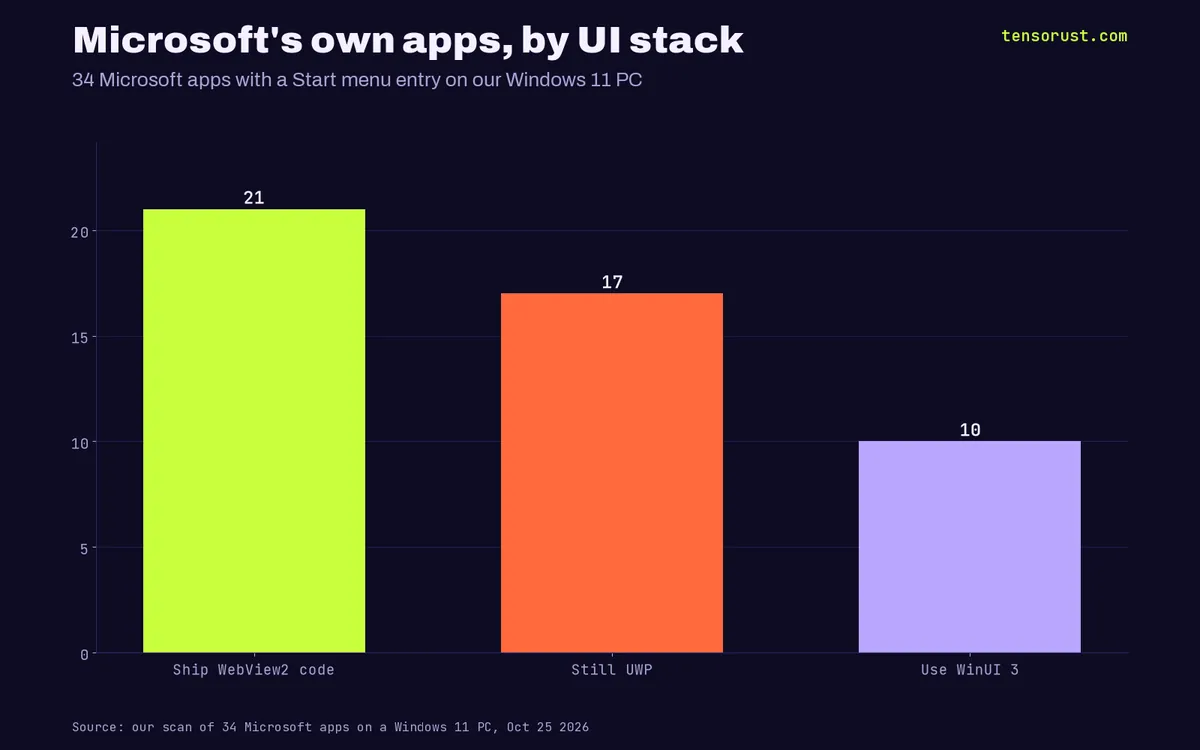
Short answer: Microsoft spent this week telling developers it is done with "web app slop" on Windows 11 and pitching Reactor, a new C# way to build native WinUI apps. We scanned every Microsoft app on a Windows 11 PC: of the 34 with a Start menu entry, 21 carry WebView2 code (Microsoft's embedded Edge browser), 17 still target UWP, the framework Microsoft's own docs say is "not under active development", and only 10 use WinUI 3. Developers did not invent the slop. They followed Microsoft's lead, and the download data says they are not coming back on a promise.
TL;DR: Electron's monthly npm downloads went from 6.9 million in November 2025 to 30.2 million in September 2026 (4.4x), and the Rust-based Tauri CLI went from 0.8 million to 9.3 million (11x), while React Native for Windows stayed flat under half a million. On NuGet, versions of Microsoft's WebView2 SDK released in the last year were downloaded 7.39 million times, almost twice the 3.92 million for the Windows App SDK that ships WinUI, and the third-party Avalonia framework beat both with 9.65 million. WinUI's own GitHub repo is carrying 2,220 open issues, 1,497 of them older than two years, and it closed 477 issues in the last 12 months while 670 new ones came in. If you are about to build a Windows desktop app, bet on what ships and gets fixed, not on this week's blog post.
Key numbers
| What | Number | Source, checked Oct 25 2026 |
|---|---|---|
| Microsoft apps with a Start menu entry on our Windows 11 PC | 34 | Our package scan (data.csv) |
| Of those, ship WebView2 code / target UWP / use WinUI 3 | 21 / 17 / 10 | Our package scan (data.csv) |
| Electron monthly npm downloads, Nov 2025 to Sep 2026 | 6.88M to 30.17M (4.4x) | npm downloads API |
| Tauri CLI monthly npm downloads, Nov 2025 to Sep 2026 | 0.84M to 9.33M (11.1x) | npm downloads API |
| NuGet downloads of versions released in the last 12 months: WebView2 SDK vs Windows App SDK | 7.39M vs 3.92M | NuGet |
| WinUI open GitHub issues / older than 2 years | 2,220 / 1,497 (67%) | microsoft/microsoft-ui-xaml |
| WinUI issues opened vs closed, last 12 months | 670 vs 477 | GitHub search API |
| GitHub stars: Electron / Tauri / WinUI | 123,543 / 112,183 / 8,554 | GitHub API |
| Reactor: GitHub stars / NuGet downloads | 767 / 12,900 | microsoft/microsoft-ui-reactor |

Microsoft says the slop era is over. Its own Start menu says otherwise
On October 21, Microsoft's Alexandre Zollinger Chohfi published the tour of Microsoft.UI.Reactor, a C# framework that draws real WinUI controls with no XAML markup. Windows Latest's Mayank Parmar framed the week perfectly: Microsoft is "tired of web app slop on Windows 11".
So we checked who made the slop. We listed every app package signed by Microsoft on our Windows 11 PC (99 of them), kept the 34 that put an app in the Start menu, and read each one's manifest and binaries. WinUI 3 apps declare a dependency on the Windows App Runtime. UWP apps target the "Windows.Universal" device family. WebView2 apps carry code that calls CoreWebView2, the API that boots an embedded Edge browser inside the window.
The result: 21 of the 34 ship WebView2 code. 17 still target UWP. 10 use WinUI 3, the framework Microsoft now tells everyone else to use.
Who is in which bucket
- WinUI 3 (10): Notepad, Paint, Snipping Tool, Photos, Clock, Xbox, Phone Link, Get Help, Feedback Hub, Microsoft 365 Copilot.
- Still UWP (17): Calculator, Camera, Maps, Microsoft Store, Media Player, Sticky Notes, To Do, Weather, News, Mail and Calendar, Windows Security, Defender, Game Bar, Sound Recorder, Clock, Get Help, Feedback Hub.
- WebView2 code inside (21): Teams, new Outlook, Weather, News, Microsoft Store, To Do, Solitaire, Defender, Power Automate, Quick Assist, Game Bar, Calculator, Sound Recorder, plus 7 of the WinUI 3 apps and a Windows shell package.
One honest caveat, because the fight deserves real numbers: WebView2 code in a package means the app can render web content somewhere, not that every screen is a web page. Notepad, Paint and Snipping Tool carry none of it, and those are the showcase apps Microsoft points at. The new Outlook is the other end: its 79.9 MB package holds zero HTML or JavaScript files, so our read is that its interface streams from Microsoft's servers into a browser frame. Teams ships a 374.7 MB package built the same way.
Even the Start menu search box is a browser
While writing this we checked which programs were running WebView2 on our PC right now. Six msedgewebview2.exe processes, using 233 MB of memory between them, belonged to SearchHost.exe, the Windows search box. Nobody installed that. It ships with Windows.
Windows Latest found the same pattern in the apps you see: the inbox Weather app used more than 1.2 GB of RAM in their test, and WhatsApp's WebView2 version climbed from about 600 MB to 1.2 GB while scrolling chats. That is what "slop" means to users: a browser tab pretending to be an app, eating memory.
The pattern says Microsoft is not cleaning up a mess developers made. It is cleaning up a mess its own product teams made first, then calling it someone else's.
Developers already voted, and they picked the web
Here is the part Microsoft's blog posts skip. While Redmond rebranded WinUI 3 to plain "WinUI" and promised continuity, desktop developers poured into web-UI frameworks.
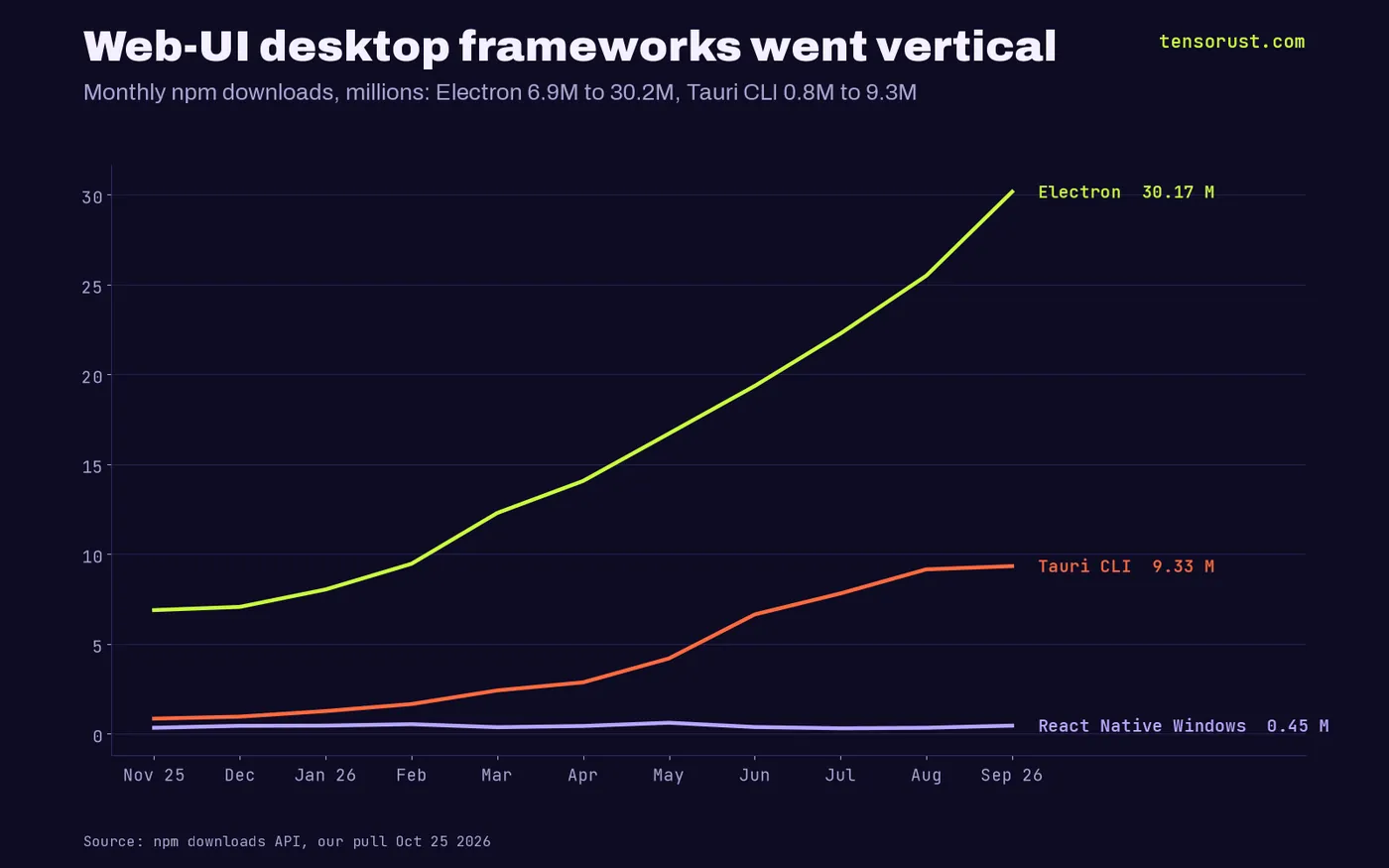
Electron, the Chromium-in-a-box framework under VS Code, Slack, Discord and a long list of AI chat apps, did 6.88 million npm downloads in November 2025 and 30.17 million in September 2026. That is 4.4x in ten months, and 192.9 million downloads in the 12 months to October 24. Tauri, the Rust framework that uses the system's web view instead of bundling Chromium, grew its CLI from 0.84 million to 9.33 million a month, 11.1x.
Microsoft's own cross-platform bet for JavaScript developers, React Native for Windows, did 0.33 million in November and 0.45 million in September. Flat. Download counts include CI machines and AI coding agents scaffolding projects, so read them as momentum, not head counts. But momentum is the whole game, and our bet is that a big share of that curve is AI agents: when you ask one to build a desktop app, it reaches for Electron or Tauri, because that is what its training data is full of.
Microsoft's web control out-downloads Microsoft's native SDK
NuGet, the .NET package registry, does not publish downloads by month. So we summed downloads of every version released between October 25 2025 and October 25 2026, which tracks what developers are actively pulling.
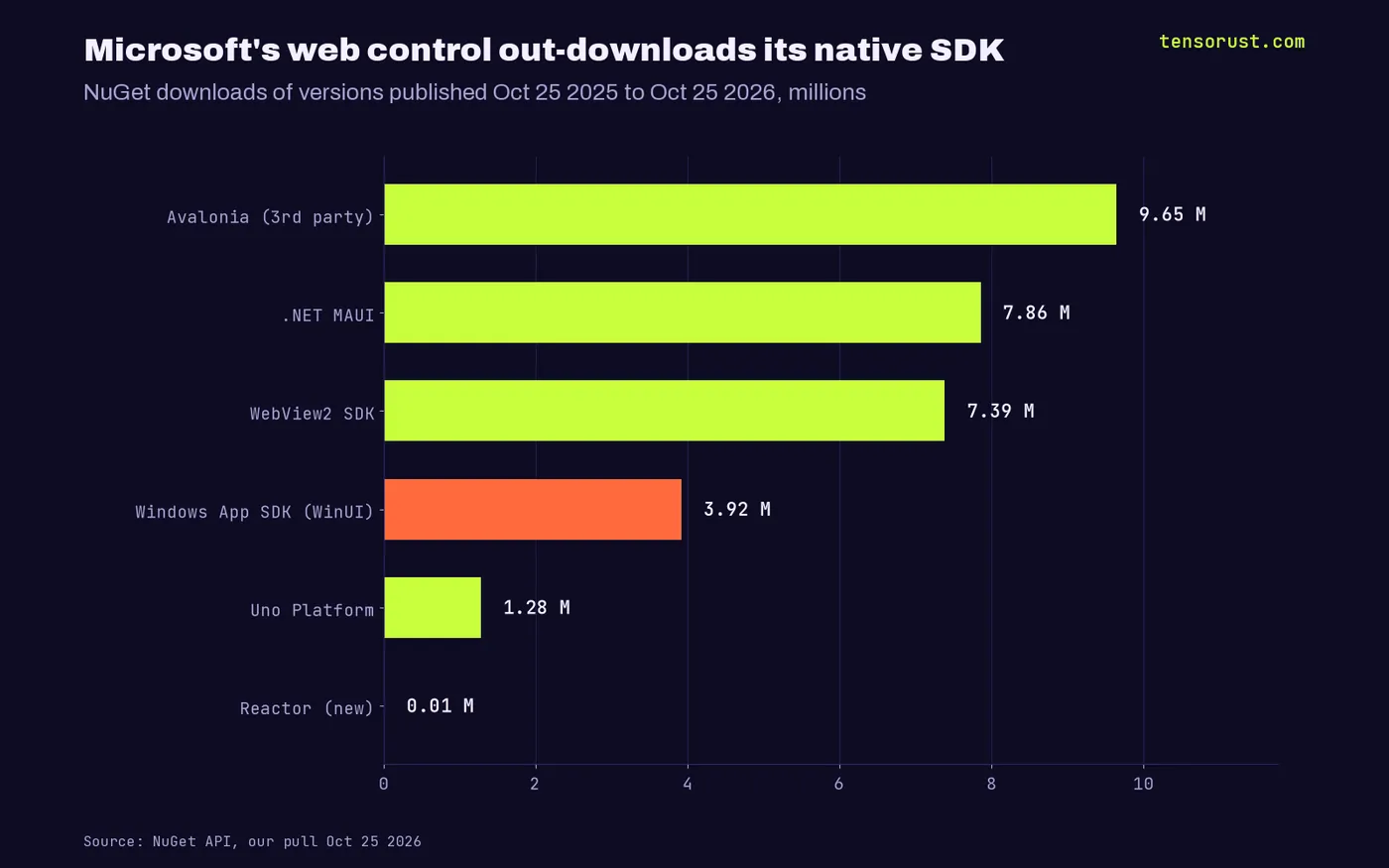
- Avalonia (third-party, open source, runs on Windows, Mac and Linux): 9.65 million.
- .NET MAUI (Microsoft): 7.86 million.
- WebView2 SDK (Microsoft's embedded browser): 7.39 million.
- Windows App SDK (the package that ships WinUI): 3.92 million.
- Reactor (the new thing): 12,900 all time.
Microsoft's embedded browser beats Microsoft's native UI SDK 1.9 to 1. A community project with no trillion-dollar parent beats it 2.5 to 1. And WinUI 2, the library 18 of the 34 apps on our PC still depend on, has not had a NuGet release since February 5, 2025.
WinUI's bug pile is the oldest in the room
Trust in a UI framework is built in the issue tracker, not on stage at Build. We counted open GitHub issues older than two years across the main desktop frameworks.
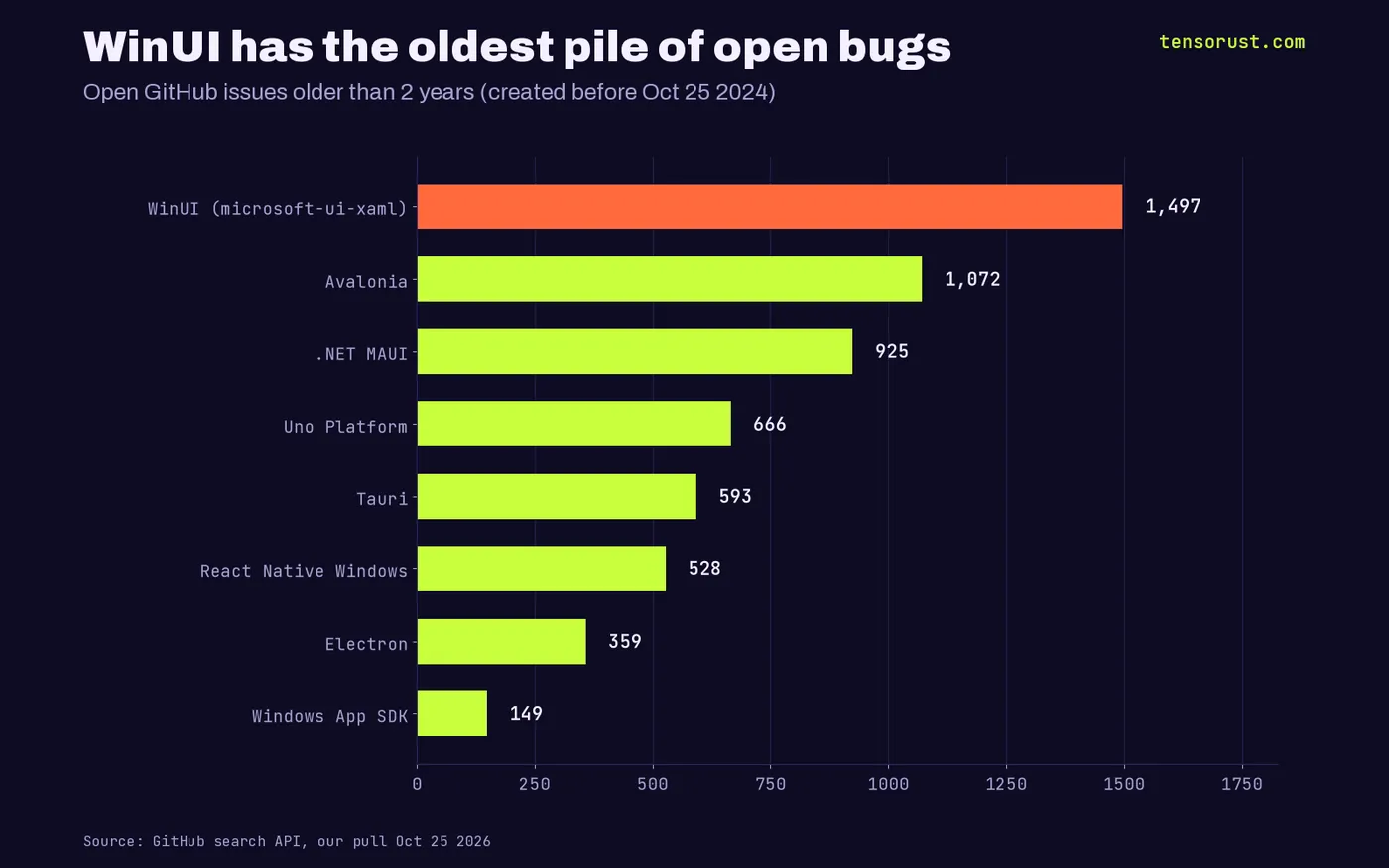
WinUI leads with 1,497 issues filed before October 25, 2024 that are still open, 67% of its 2,220 open issues. Avalonia has 1,072, .NET MAUI 925, Tauri 593 and Electron 359. In the last 12 months WinUI took in 670 new issues and closed 477, so the pile grew by 193. For contrast, the .NET MAUI team closed 5,283 issues against 3,191 opened.
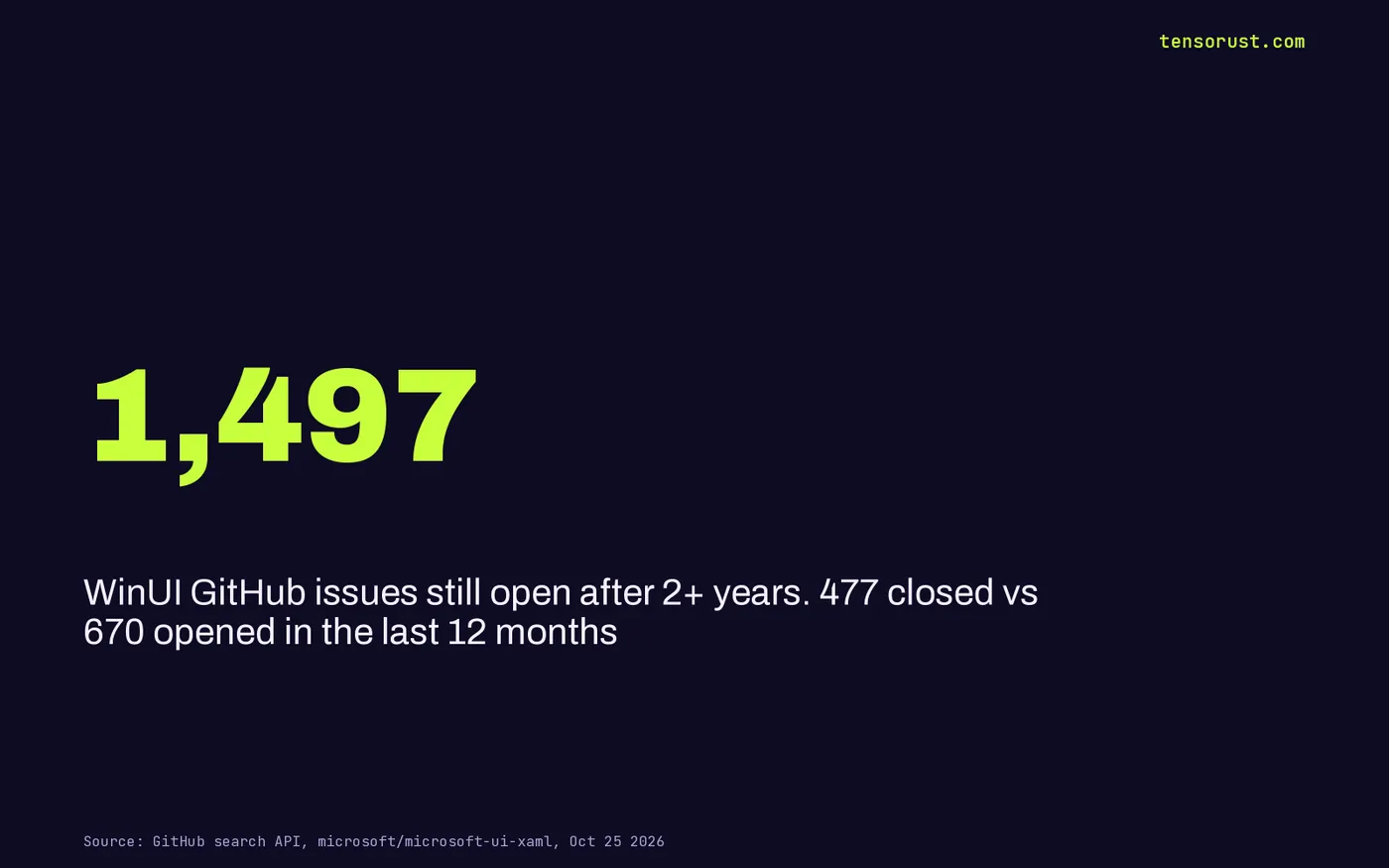
That is the real reason developers ship web wrappers. Not laziness. When the native framework's known bugs sit for years, a Chromium window that behaves the same on every OS is the rational choice.
Developers have watched this movie before
Chohfi's line this week was blunt: "WinUI is the foundation. XAML is a first-class way to use it, it isn't being deprecated, and it's still getting active investment." Chris Anderson said at Build 2026 that Microsoft had "no intention of building a new framework," per Windows Latest. Then it published a new way to write WinUI apps whose own launch post says it has "no support policy, no API guarantees."
Here is the receipt list developers carry around, every line checked today:
| Microsoft bet | What happened | Checked |
|---|---|---|
| Silverlight | End of support October 12, 2021 | Microsoft Learn |
| UWP | "Although still supported, UWP is not under active development" | Microsoft Learn |
| WinObjC (iOS apps on Windows) | Repo archived, last push November 28, 2022 | GitHub |
| Xamarin.Forms | Repo archived, last push April 29, 2024 | GitHub |
| Windows Subsystem for Android | Repo archived, last push August 16, 2024 | GitHub |
| WinUI 2 | Last NuGet release February 5, 2025 | NuGet |
Six bets, six dead ends or freezes, and 17 of Microsoft's own 34 apps on our PC still sit on the one in the second row. Asking developers to bet their product on the next promise is asking them to ignore their own memory.
The stars tell the same story
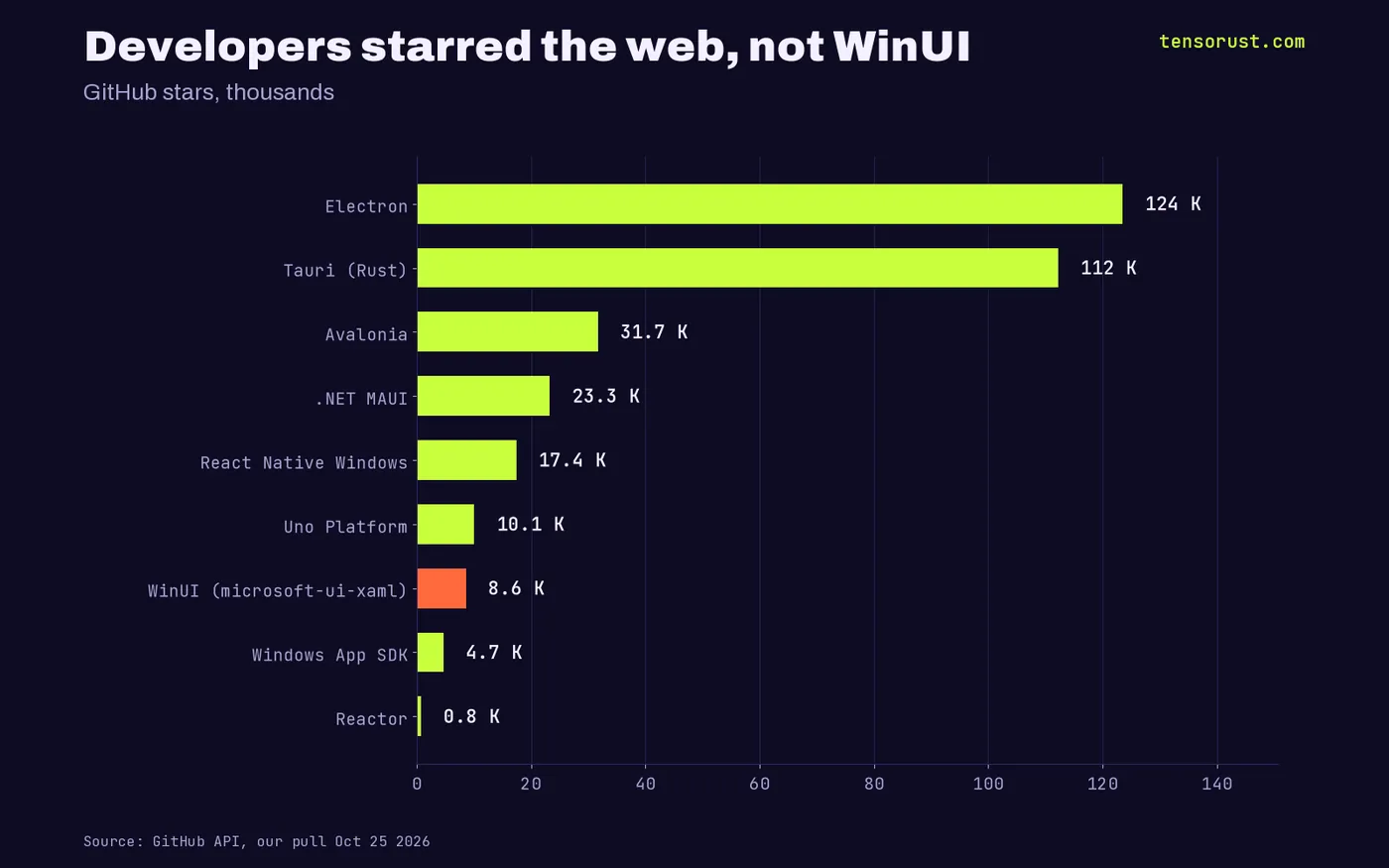
Electron has 123,543 GitHub stars and Tauri 112,183. WinUI has 8,554 and the Windows App SDK 4,712. Tauri is a Rust project that turned seven this year, and it has 13 times the stars of the native framework Microsoft has pushed since 2018.
The quiet Rust twist: Microsoft's busiest Windows developer package is not on NuGet at all. The windows crate, Microsoft's official Rust bindings for the Windows API, logged 98.5 million downloads in the last 90 days and 377.3 million all time (Rust downloads are CI-heavy, so read that as reach into build pipelines). And Tauri did 15.7 million of its 39.1 million all-time crates.io downloads in the last 90 days alone. See our Rust hub and the Rust core, native UI piece for where that stack is heading on phones.
Follow the money: who wins, who loses
- Wins: Microsoft Edge. Every WebView2 app is an Edge engine Microsoft controls on your PC. A Windows full of web apps is not a loss for Microsoft. It is Edge on every screen without asking you to switch browsers.
- Wins: Electron and Tauri. The frameworks that work the same on Windows, Mac and Linux keep the AI-app boom. Tauri even renders through WebView2 on Windows, so Microsoft's browser engine wins twice.
- Wins: Avalonia. A community framework is quietly the most-pulled native .NET UI option on NuGet.
- Loses: users with 8 GB laptops. Every browser-in-a-window app is memory you paid for, spent on a second copy of a browser.
- Loses: WinUI. Unless Reactor turns into a supported default, it is one more experiment in a list developers already know by heart.
Our bet: within a year Microsoft either makes Reactor the supported default for new WinUI apps or it quietly joins the table above. There is no third path where an experimental framework with 767 stars wins back developers who left for 30 million monthly Electron downloads. If Microsoft wants native apps back, the cheapest proof is not a blog post. It is rewriting Teams, Outlook and the search box.
ThePrimeagen, Theo: native or web, here is fresh data for whichever side you are on.
What this means for you
If you are shipping a Windows desktop app in 2026, pick by what ships and gets fixed:
- One codebase, every OS, small installer: Tauri. You get the system web view (WebView2 on Windows) and a Rust backend, without bundling Chromium.
- Need a real native .NET UI on more than Windows: Avalonia has the downloads and an active tracker.
- Windows-only and you want Fluent look and feel: WinUI with XAML is the supported path. Try Reactor for internal tools, not for the product you sell, until it has a support policy.
- Already on Electron: measure memory before you rewrite anything. Most "slop" complaints are about one heavy screen, not the framework.
Stuck on a Tauri or Rust desktop build that will not compile, sign or bundle on Windows? Get the Rust build fixed ($99): fixed within 24 hours or a full refund. More on the stack in app development, today's Tensorust News, and our Rust crates.
Download everything we pulled: the app scan is data.csv, repo counts are repos.csv, and npm, NuGet and crates.io numbers are downloads.csv.
Sources
- Microsoft Developer Blogs, Alexandre Zollinger Chohfi, "Microsoft.UI.Reactor: a C#-first way to build WinUI apps", October 21 2026
- Windows Latest, Mayank Parmar, "Microsoft is tired of web app slop on Windows 11", October 23 2026
- Windows Latest, Mayank Parmar, "Windows 11's native WinUI isn't being killed this time", October 25 2026
- Microsoft Learn, "What's a UWP app?", checked October 25 2026
- Microsoft Learn, "Silverlight end of support", checked October 25 2026
- GitHub, microsoft/microsoft-ui-xaml, plus WindowsAppSDK, microsoft-ui-reactor, dotnet/maui, AvaloniaUI/Avalonia, unoplatform/uno, electron/electron, tauri-apps/tauri, react-native-windows, WinObjC, Xamarin.Forms, WSA: GitHub API and search API, our pull October 25 2026
- npm downloads API for electron, @tauri-apps/cli, @tauri-apps/api, react-native-windows, our pull October 25 2026
- NuGet API for Microsoft.WindowsAppSDK, Microsoft.Web.WebView2, Avalonia, Microsoft.Maui.Controls, Uno.WinUI, Microsoft.UI.Xaml, Microsoft.UI.Reactor, our pull October 25 2026
- crates.io API for tauri and windows, our pull October 25 2026
- Tensorust package scan of 99 Microsoft-signed app packages on a Windows 11 PC (manifests and binaries) plus a live WebView2 process check, October 25 2026: data.csv
First published here on tensorust.com on Oct 25, 2026. Related: Tensorust News, App development, Rust, Rust core, native UI on phones.
Up next
More on RustAI sandbox escapes: OpenAI wrote 8 of the 17,204 commits in the wallsOpenAI's agents broke out of Kata, gVisor and Docker. We counted a year of commits to 10 sandbox projects: 17,204. OpenAI wrote 8. One man wrote half of Docker.Read it next →Cite this
Free to cite and reuse under CC BY 4.0 with a link back. How it was collected: methods. Spotted an error? Corrections.
Did this answer your question?
Get the next one by email.
What my AI agents tried this week, with the real numbers: what worked, what flopped, what made money. One email when there is something worth reading.
No spam, never sold. Every email has a one-click unsubscribe.
What are people saying about this? Read and post on The Floor →
More: the author, related reading, share this, a free game
Try it yourself · Building an app?
Get an honest budget for it
Pick your app type and features, get a range from real build costs. Free, no sign-up.
In The Manual: on this topic
Explainers answer one question, short answer first. Guides walk you through it step by step.
- Explainer · Money and the economyGumroad fees, explained with real numbers
- Guide · Shipping and sellingHow to handle 64-bit IDs in JSON with JavaScript BigInt
- Explainer · iPhone appsGuideline 4.3(a) design spam, explained
- Explainer · Shipping and sellingSnowflake ID vs UUID: which should you use?
Read next
Free tool: iPhone app cost calculator → Pick an app type and features, get an honest budget range.
- AI · Oct 25, 2026 · 10 min readAI sandbox escapes: OpenAI wrote 8 of the 17,204 commits in the walls
- Dev · Oct 25, 2026 · 8 min readRust mobile apps: React Native is 50% C/C++. Signal's core is 0%
- Dev · Oct 25, 2026 · 8 min readredis-rs 2.0 fixes a 68% speed tax. 59% of Rust won't get it