
Guideline 4.3(a) design spam, explained
Short answer
Guideline 4.3(a) is Apple's rule against duplicate apps: "Don't create multiple Bundle IDs of the same app." If your app shares a template, a code skeleton or a concept with other apps and differs only in small ways, App Review files it as "Design - Spam". Its twin, 4.3(b), rejects apps that copy a crowded category (Apple names dating, flashlight, wallpaper, simple timers and more). We have 22 of these rejections on 11 apps, so this page is the rule text plus what our data says actually triggers it.
Part of the article Apple's 4.3 spam check is a 30-second batch job. 22 rejections prove it. This page answers one question from it in depth.
On this page · 9 sections
Key facts
| What | Number | Source (checked Oct 24 2026) |
|---|---|---|
| What 4.3(a) bans | "multiple Bundle IDs of the same app" | App Review Guidelines 4.3 (updated Oct 16 2026) |
| What 4.3(b) bans | apps "indistinguishable from what's already widely available" | same |
| Categories 4.3(b) names | dating, flashlight, sound effects, wallpaper, simple timers, fortune telling | same |
| Apple submissions reviewed / rejected, 2025 | 9,100,620 / 2,093,244 (about 23%) | App Store Transparency Report 2025 |
| Rejections under Design (includes spam), 2025 | 415,532 | same |
| Appeals of app removals / restored, 2025 | 26,305 / 423 (1.6%) | same |
| Our 4.3 rejections | 22 on 11 new apps, Oct 5 and Oct 12 2026 | our receipts article |
| Time Apple took to reject all 11 | 30 seconds, then 27 seconds | our App Review emails |
| Our appeals answered | 0 of 3 forms after 19 days (inbox checked Oct 24 2026) | our inbox |
What the rule actually says
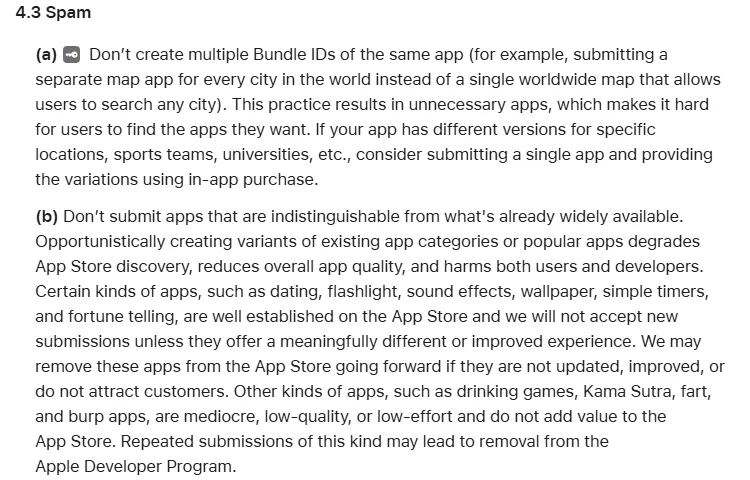
There are two parts, and rejections usually name one of them in the title ("Guideline 4.3(a) - Design - Spam").
4.3(a), duplicates. One app shipped many times. Apple's own example is a map app per city instead of one map that searches any city, and its fix is in the same sentence: submit a single app and sell the variations (cities, teams, universities) as in-app purchases. In 2026 the label is also applied far more broadly, to apps that share "a similar binary, metadata, and/or concept" with other apps, which is the wording in the rejection notes we and other developers received.
4.3(b), crowded categories. Apps that copy something "already widely available". The categories named in the rule (dating, flashlight, sound effects, wallpaper, simple timers, fortune telling) will not be accepted "unless they offer a meaningfully different or improved experience". Drinking games, fart and burp apps are called "low-effort", and repeat submissions can get you removed from the Developer Program.
A close relative is Guideline 4.2.6: apps made from "a commercialized template or app generation service" are rejected unless the content owner submits them. Our 11 rejections cited 4.3 and 4.2.6 together.
What triggers it, from our 22 rejections
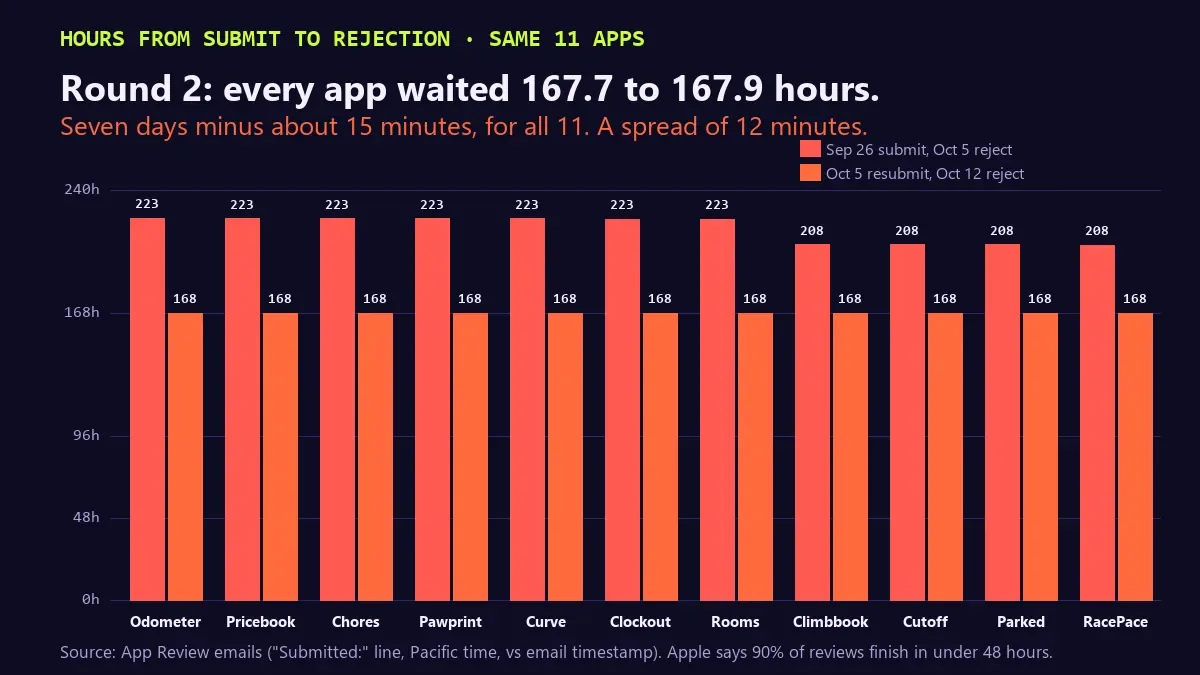
The rule text talks about apps. Our data says the filter behaves like it is looking at accounts and code. On September 26, 2026 we submitted 11 new iPhone apps, each for a different job (car maintenance, parking meters, pet meds, grade math and so on). All 11 were rejected on October 5 within 30 seconds of each other, and again on October 12 within 27 seconds, in an order unrelated to the order we submitted them.
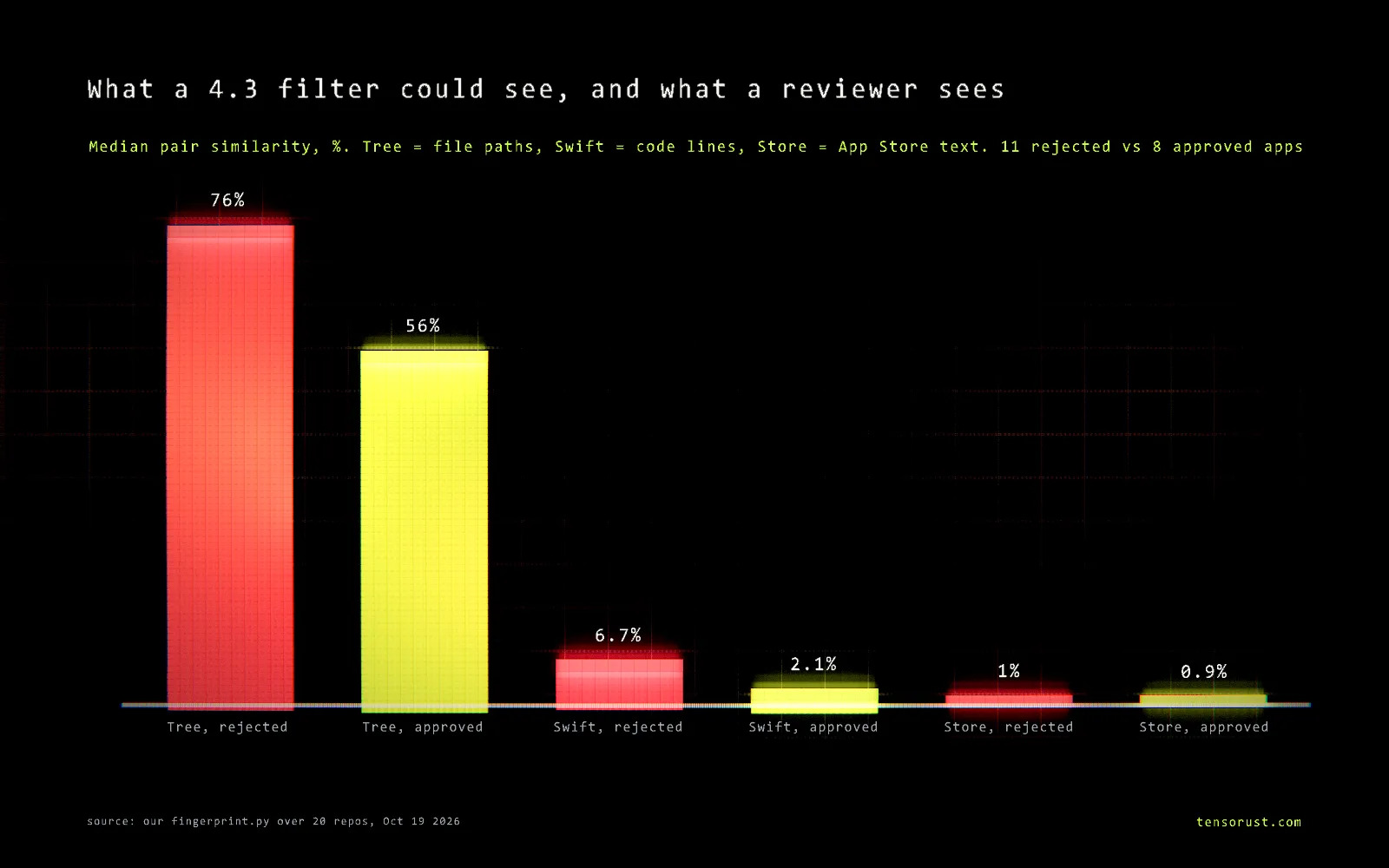
We then compared all 19 apps (11 rejected, 8 approved) at the exact commit Apple saw, 190 pairs. What separated them (hero chart above):
- Project skeleton. Rejected pairs shared a median 76% of file paths, approved pairs 56%. Rejected pairs also shared about three times the Swift lines (6.7% vs 2.1%).
- A paywall on day one. 11 of 11 rejected apps shipped a StoreKit "Pro" unlock in their first submission. 0 of 8 approved apps did; they added it later in updates, which passed.
- Not the store page. App Store text overlap was 1.0% for rejected pairs and 0.9% for approved ones. A human reading the listings could not tell the groups apart.
- Not raw similarity. Our single most similar pair (a golf journal and a tennis journal sharing a third of their Swift lines) is approved and live.
That is a small sample, so read it as evidence, not proof. The full breakdown, with the heatmap and code, is in our 4.3 receipts article.
How to get past it
- Reply first, do not resubmit unchanged. The rejection says so, and we learned it the hard way: our unchanged resubmits sat on a seven-day timer and died in 27 seconds. Answer App Review's questions in App Store Connect (among them: what the app does, who it is for, how it differs from your other apps, how you tested it, and what code it shares). Keep each reply under the 4,000-character box limit; there is no need for a PDF.
- If your apps are variants, merge them. That is the fix 4.3(a) itself prescribes: one app, variations as in-app purchases.
- Launch lean, monetize in an update. Our only clean split was the day-one paywall. Updates adding it were approved every time.
- Space out new apps. Updates can ship as fast as you like; brand-new apps from one account in a burst look like a template farm.
- Make the difference visible. Different screens, different screenshots, a store description that names the specific user and job. If one sentence describes two of your apps, a reviewer will use it.
- Talk to a human. Apple offers App Review appointments to discuss guidelines, and the App Review Board appeal takes up to 5 apps per form. Expect a wait: ours has had no answer in 19 days.
If your rejection says your app is stuck instead, see what "Waiting for Review" means and how long is normal.
Common misconceptions
"4.3 means you copied someone else's app."
The recordThe record: 4.3(a) is mostly applied to your own apps resembling each other, or to a shared template. None of our 11 copied anyone; they shared our own project skeleton and a paywall pattern.
"Changing the icon and screenshots fixes it."
The recordThe record: in our data the store-facing parts (text and screenshots) were no more alike in rejected apps than in approved ones. The difference was inside the bundle, so cosmetic changes alone are unlikely to help.
"Resubmitting gets you a different reviewer."
The recordThe record: our 11 resubmits came back with identical text, all at once, exactly seven days later. Apple's rejection explicitly asks you to reply instead.
"Apple will tell you which app yours duplicates."
The recordThe record: none of our 22 rejections named another app, a file or a screen.
Related
- Article: Apple's 4.3 spam check is a 30-second batch job: 22 rejections prove it
- App stuck in "Waiting for Review": how long is normal
- How to create an App Store Connect API key and use it in CI
- Article: How long App Store review takes: 64 real decisions
- Tool: What an iPhone app costs to build
FAQ
What does Guideline 4.3(a) design spam mean?
It is Apple's rule against submitting several apps that are really one app: 'Don't create multiple Bundle IDs of the same app.' Apple's example is a separate map app for every city instead of one worldwide map. In practice it is applied to apps that share a template, a code skeleton or a concept with other apps, from your account or from others, with only minor differences.
What is the difference between Guideline 4.3(a) and 4.3(b)?
4.3(a) is about duplicates: many bundle IDs of the same app. 4.3(b) is about crowded categories: apps 'indistinguishable from what's already widely available', and Apple names dating, flashlight, sound effects, wallpaper, simple timer and fortune telling apps as categories it no longer accepts unless they are meaningfully different or improved.
How do I fix a 4.3 spam rejection?
Reply in App Store Connect and answer App Review's questions instead of resubmitting unchanged. If you have variants, merge them into one app and sell the variations as in-app purchases, as 4.3(a) suggests. Make the app's purpose, screens and store text clearly its own, avoid submitting many new apps at once, and if you still disagree, book an App Review appointment or appeal to the App Review Board.
Can you appeal a Guideline 4.3 rejection?
Yes, through the App Review Board form on developer.apple.com, which takes up to 5 apps per request. We appealed 11 rejections on October 5, 2026 and had no reply 19 days later. Apple's 2025 transparency report counts 26,305 appeals of app removals and 423 restorations, about 1.6%.
Does Guideline 4.3 apply to app updates?
The rule covers every submission, but in our account it hit new apps, not updates. While 11 new apps were rejected twice under 4.3, our 8 live apps had 14 updates approved between October 20 and 23, 2026, including updates that added the same paywall code the rejected apps had.
Sources
All checked October 24, 2026.
Primary
- Apple, App Review Guidelines, 4.3 Spam and 4.2.6 (page updated October 16, 2026): the rule text quoted here.
- Apple, App Store Transparency Report 2025: submissions reviewed and rejected, Design rejections, appeals of removals and restorations.
- Apple, App Review: review time promise (90% in under 48 hours) and App Review appointments.
- Apple, Appeal to the App Review Board.
- Apple Newsroom, The App Store stopped over $2.2 billion in fraudulent transactions in 2025 (May 2026).
Other developers who reported the same pattern (credited in the parent article)
- @krPorsche918 (October 5, 2026), @vovalukashov (Luka Shaw, October 8, 2026), @martindonadieu (Martin Donadieu, October 12, 2026).
Our data
- 22 App Review rejection emails for 11 apps (October 5 and 12, 2026), the fingerprint comparison of 20 app repos at their reviewed commits (October 19, 2026), the iTunes Search API lookup of our live apps (8 live, October 24, 2026) and an inbox check for App Review Board replies (none, October 24, 2026). Method and code: our receipts article.
Images
- Hero chart rendered by Tensorust with the Proof Engine from our fingerprint data. Wait-time chart from our parent article. Guideline screenshot: developer.apple.com, captured October 24, 2026.
Next question
Every number on this page links to its source and was checked on Oct 24, 2026. Spot an error or a newer figure? Email matt@tensorust.com and it gets fixed. Related: iPhone app cost calculator, App Store fee calculator.
Read next
- Article · Oct 19, 2026Apple's 4.3 spam check is a 30-second batch job. 22 rejections prove it
- Article · Oct 18, 2026App Store review time: 64 real decisions, median 73 hours
- Article · Oct 16, 2026Build an iOS app on Windows: how 21 apps shipped with no Mac
- Guide · Oct 24, 2026How to handle 64-bit IDs in JSON with JavaScript BigInt
- Explainer · Oct 24, 2026UUID vs NanoID: which ID should you use?
Get the next one by email.
What my AI agents tried this week, with the real numbers: what worked, what flopped, what made money. One email when there is something worth reading.
No spam, never sold. Every email has a one-click unsubscribe.