
Flock camera map: its own inventory lists 214,073 devices, not 120K
On this page · 12 sections
- Key numbers
- Flock's own file is almost twice Flock's own number
- Volunteers found 68% of it with ladders and phones
- Georgia is the test market, and it's cooked
- Texas paid for it with a $1 insurance fee
- 83,427 more devices were already planned, including drones
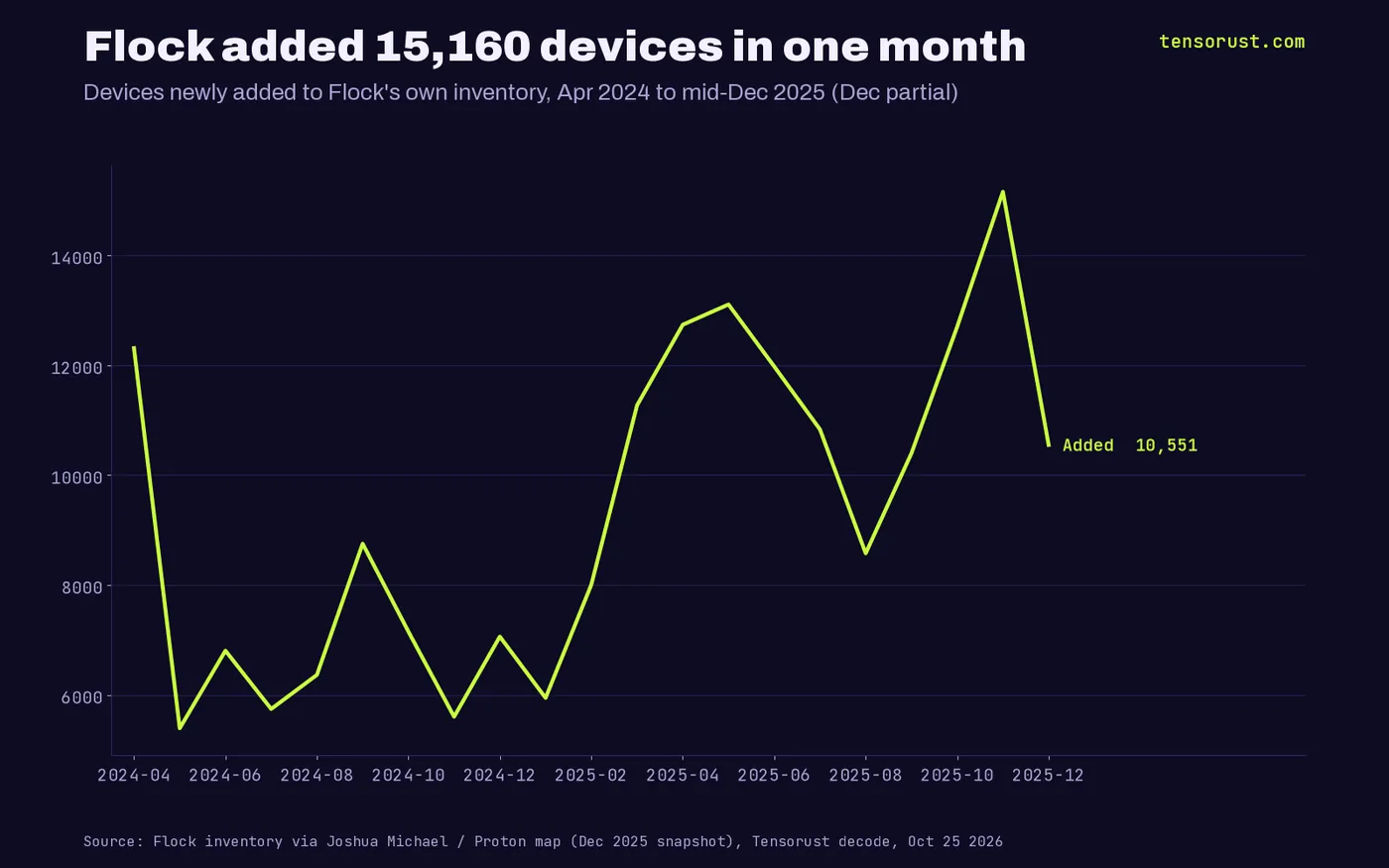
- It grew 52% faster in 2025, peaking at 15,160 a month
- Your local Lowe's is part of the network
- Flock's answer was a lawyer, not a fix list
- What this means for you
- How we did it
- Sources
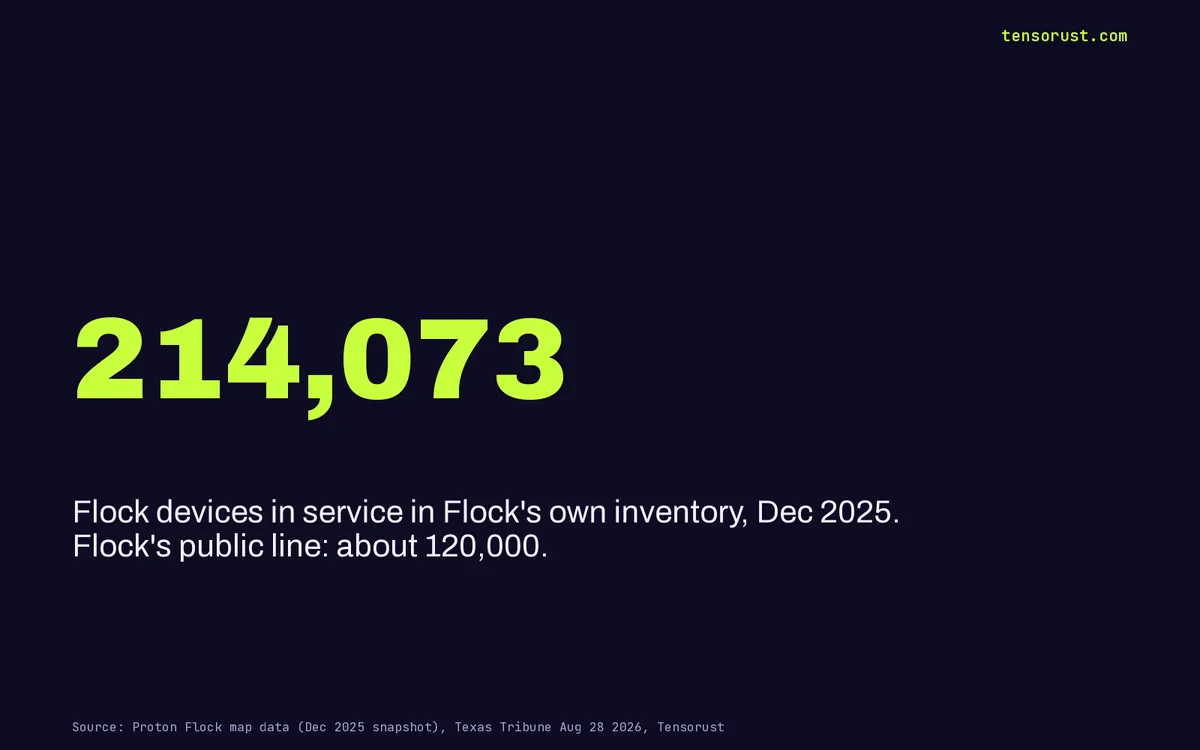
Short answer: The Flock camera map Proton published this week is built from Flock Safety's own device inventory, and it is bigger than anything Flock says out loud. We decoded the raw file behind the map: 335,701 devices, 214,073 of them marked in service in December 2025 and 83,427 more marked "in planning". In August, Flock officials told the Texas Tribune the figure was about 120,000 cameras and other products.
TL;DR: Flock's inventory has 126,070 in-service plate readers, and volunteers on DeFlock and OpenStreetMap had already pinned 68% of them within 100 meters before the inventory went public. Georgia, Flock's home state, runs 254 Flock devices per 100,000 people, four times the U.S. average of 62. Flock added devices at a 52% faster clip in 2025 than in 2024, peaking at 15,160 in one month. Its answer to the researcher who exposed all this was a cease-and-desist letter. Assume your daily drive is already in the database.
Key numbers
| What | Number | Source, checked Oct 25 2026 |
|---|---|---|
| Devices in Flock's inventory (Dec 2025 snapshot) | 335,701 | Proton Flock camera map data, our decode |
| Marked in service / in planning / decommissioned | 214,073 / 83,427 / 38,190 | Proton map data, our decode |
| In-service devices that read license plates | 126,070 | Proton map data, capability flags |
| Flock's public count (Aug 2026) | about 120,000 "cameras and other surveillance products", 7,000 agencies | Texas Tribune |
| Flock plate readers mapped by volunteers on OpenStreetMap | 111,738 (of 144,648 ALPRs of any brand) | Overpass API, our pull Oct 25 2026 |
| Share of in-service plate readers volunteers found first (100 m) | 68.2% (85,950 of 126,070) | Our match, OSM nodes created before Sep 23 2026 |
| Georgia devices in service per 100,000 people | 253.8 (U.S. 62.3) | Our math, FRED state population 2025 |
| Devices added per month, 2025 vs 2024 | 10,974 vs 7,243 (+52%) | Proton map data, "added to dataset" dates |
| Flock funding and valuation | $950M raised, $7.5B valuation | Wikipedia, Flock Safety |
| Flock Safety Wikipedia views, Jan 2024 vs Aug 2026 | 3,133 vs 297,541 a month | Wikimedia Pageviews API |

Flock's own file is almost twice Flock's own number
Here is how the map exists. Security researcher Joshua Michael says that in November 2025 he found a Flock access token anyone could get without logging in, and it returned device locations. He reported it, archived the inventory in December, and published a 160-page paper and map on September 23 2026.
Proton now hosts that map. The page loads one 5 MB binary file with every device's location, product type, status, capability flags and the date it entered the dataset. We pulled that file and decoded it column by column using the map's own JavaScript. The header says 335,701 devices. The file agrees.
Flock's public line is softer. Flock officials told the Texas Tribune in August that about 7,000 law enforcement agencies use "a total of 120,000 cameras and other surveillance products." Flock's own inventory, eight months earlier, had 214,073 devices in service. Even the plate readers alone, 126,070, beat the public total.
The kindest reading: the 120,000 counts police only, and the other 94,000 belong to private customers like stores, malls and homeowner associations. That is not a defense. It means the private half of the network is nearly as big as the police half, and it gets almost no public oversight.
Volunteers found 68% of it with ladders and phones
Flock does not disclose how many cameras it has in the field, the Texas Tribune noted. Turns out the public already knew most of it. On October 25 we pulled every license plate reader on OpenStreetMap, the open map that the anti-surveillance project DeFlock feeds: 144,648 ALPRs, and 111,738 tagged as Flock Safety.
Then we checked every in-service Flock plate reader in the inventory against those volunteer pins. To keep it clean we dropped the 3,160 Flock nodes created on OpenStreetMap after the inventory went public on September 23. Result: 85,950 of 126,070 Flock plate readers, 68.2%, already had a volunteer pin within 100 meters.
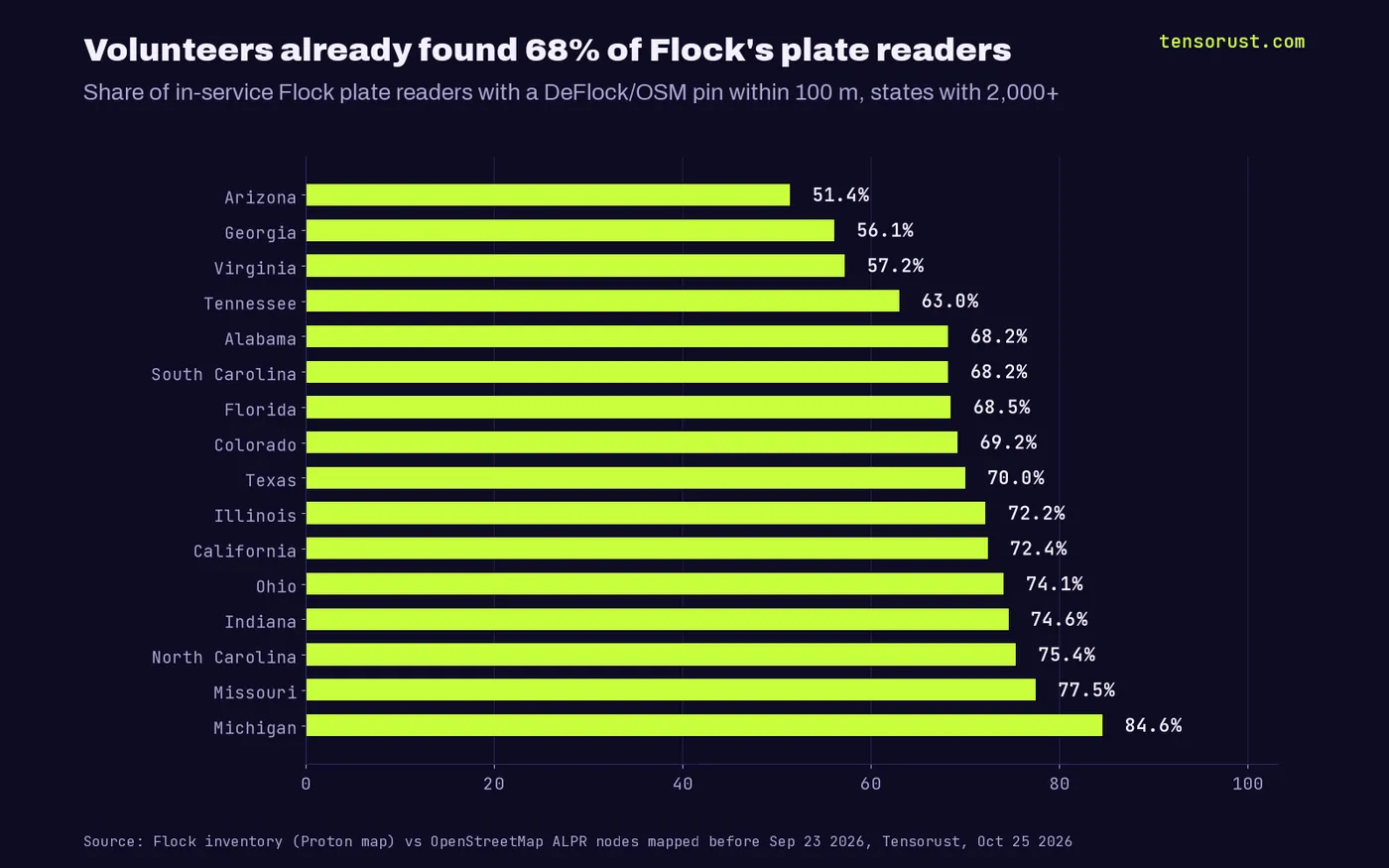
Michigan volunteers found 84.6%. Missouri 77.5%. The weak spots tell you where the network grows fastest: Arizona at 51.4%, Georgia at 56.1%, Virginia at 57.2%. Unpaid people with phone cameras mapped two thirds of a $7.5 billion company's footprint. That's lowkey the most embarrassing number in this whole story for Flock.
Georgia is the test market, and it's cooked
Flock is headquartered in Atlanta, per Wikidata. Its home state is also its densest. Georgia has 28,686 Flock devices in service for 11.3 million people, 253.8 per 100,000 residents, four times the national rate of 62.3. Texas has almost three times Georgia's population and fewer devices in service, 27,469.
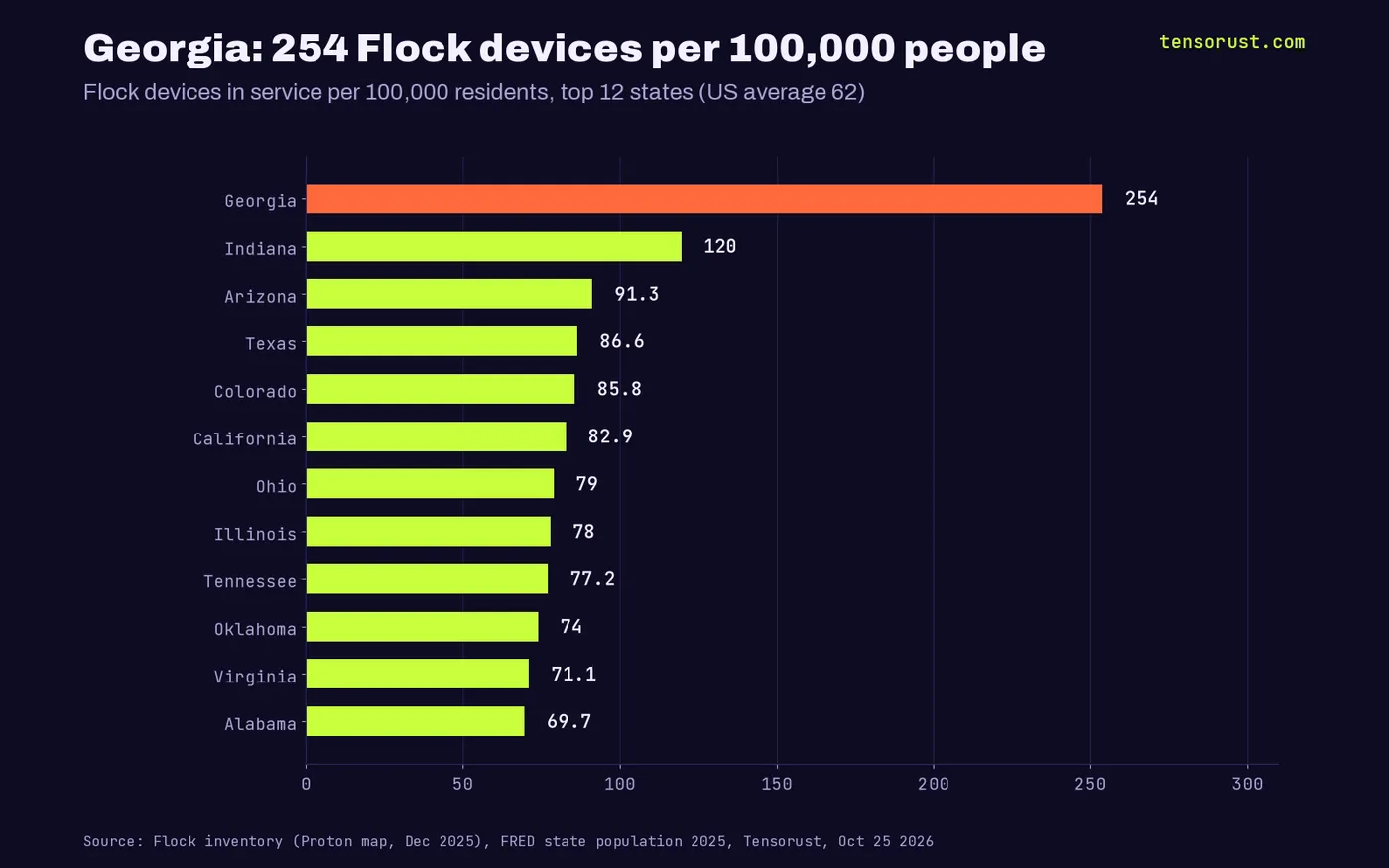
On plate readers alone Georgia runs 132.5 per 100,000 people, 3.6 times the U.S. 36.7. At the other end, New Hampshire has 13 devices in service and Vermont 10. If you want to see where the rest of the country is headed, our bet is it looks like the Atlanta suburbs.
Texas paid for it with a $1 insurance fee
Follow the money and it runs through your car insurance. The Texas Tribune found a $1 a year fee lawmakers added to Texas car insurance policies, sold as a catalytic converter theft fix, raised an estimated $81 million, and at least $30 million of it went to at least 3,200 Flock cameras. The bill's own author said surveillance cameras were never discussed.
The inventory shows how far Texas got. In December 2023 a Flock spokesperson told the state board there were about 7,500 Flock cameras in Texas. Flock's own file two years later lists 27,469 Texas devices in service and 13,803 more in planning, the biggest pipeline of any state. Governor Abbott paused state grant money for Flock on August 28, after the Tribune asked.
Who wins: Flock, with $950 million raised at a $7.5 billion valuation per Wikipedia, and $1 million spent lobbying in 34 states from 2025 to July 2026. Who loses: every driver who paid the fee and now sits in a searchable database without a warrant.
83,427 more devices were already planned, including drones
The scariest column in the file is the status column. In December 2025, 83,427 devices were marked "in planning", 39% on top of everything in service. That is the pipeline Flock had sold or scoped before most cities ever held a hearing.
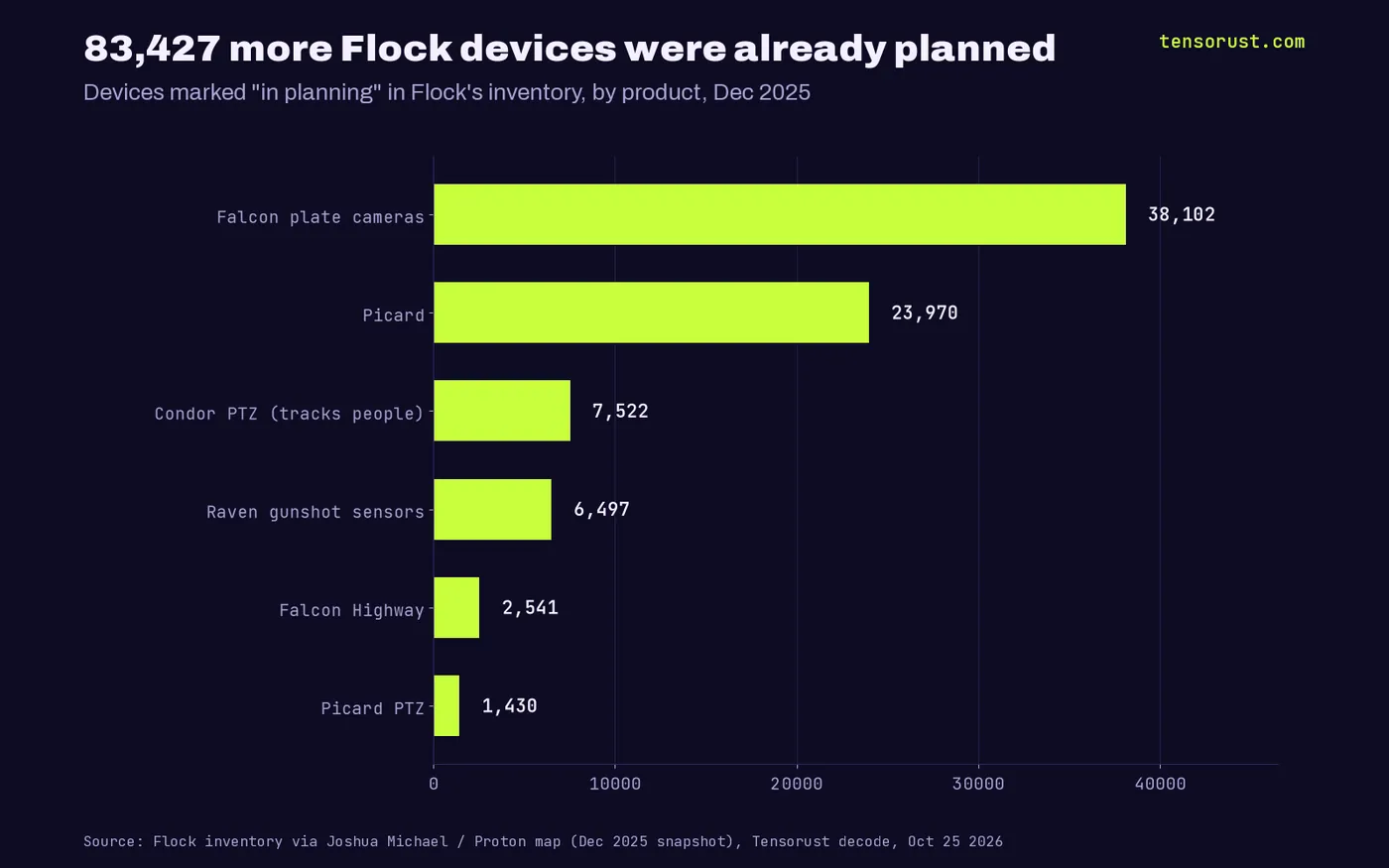
The mix is shifting from plate cameras to things that watch people. Condor, the pan-tilt-zoom camera Wikipedia describes as able to zoom in on people, faces and phone screens, had 13,231 in service and 7,522 planned. Picard PTZ units: 181 in service, 1,430 planned. Drones: 14 in service, 163 planned, plus 130 drone docking stations planned against 63 live. The plate reader was the wedge. The pipeline is a sky.
It grew 52% faster in 2025, peaking at 15,160 a month
Every device carries an "added to dataset" date, starting March 2024. From April to December 2024 Flock added an average of 7,243 devices a month. From January to November 2025, 10,974 a month, up 52%. November 2025 set the record at 15,160, a month after the Ring partnership was announced.
Flock also says it performs over 20 billion vehicle scans a month (per Wikipedia, citing the company, July 2026). Spread across the 126,070 in-service plate readers in the inventory, that is about 158,600 scans per camera per month, roughly 5,300 a day. Our math, mixing a December 2025 count with a July 2026 claim, so treat it as a ballpark. Either way: that's a lot of license plates.
Your local Lowe's is part of the network
Police are not the biggest named operators. Of the 13,303 Flock cameras on OpenStreetMap that carry an operator tag, the top one is Lowe's with 1,645, then The Home Depot with 1,111. San Francisco Police Department is third with 386. Simon Property Group, the mall owner, has 124.
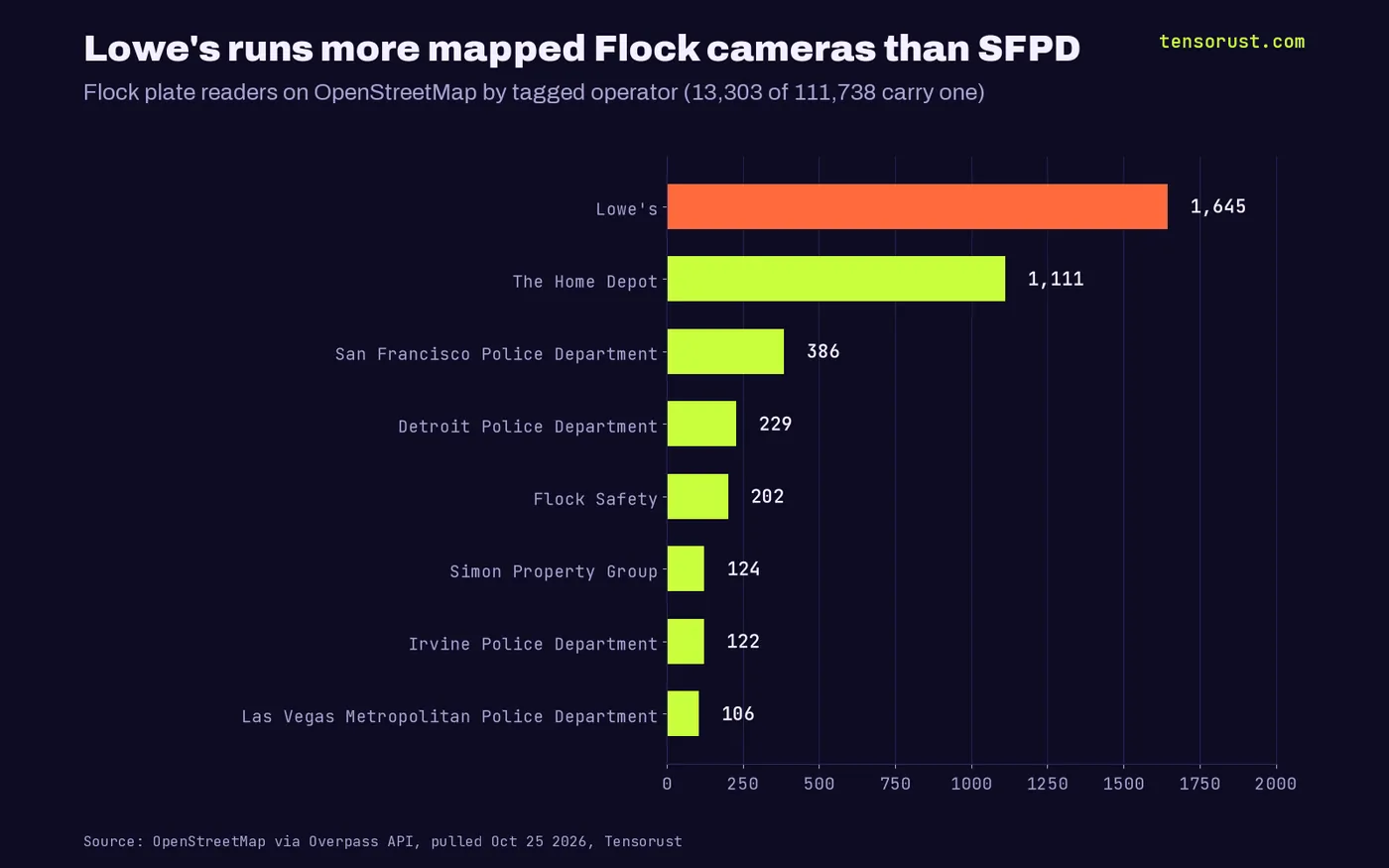
This is the part Flock's 120,000 line never mentions. Retail parking lots feed a network that police can search, and those stores answer to shareholders, not city councils. You never voted on the camera at your hardware store. Flock's pitch to cities is "public safety." The receipts say it is a retail data network with a police front end.
Flock's answer was a lawyer, not a fix list
When the paper dropped, Flock sent Michael a cease-and-desist letter threatening litigation and told customers it had notified law enforcement, per CyberInsider and his own timeline. The same customer notice said Flock found no evidence of unauthorized access when it closed the hole in December, then found "anomalous activity" involving the token in September. That gap is the whole point of his research.
Meanwhile the courts are moving. On October 3 a federal judge in Oklahoma ruled a deputy's warrantless Flock search of a woman's plate violated the Fourth Amendment and called the practice "indiscriminate" cataloging of people's whereabouts, TechCrunch reported. CEO Garrett Langley built a $7.5 billion company on the idea that nobody would count. Volunteers counted. A researcher counted. Now we counted. The pattern says the next count is a jury's.
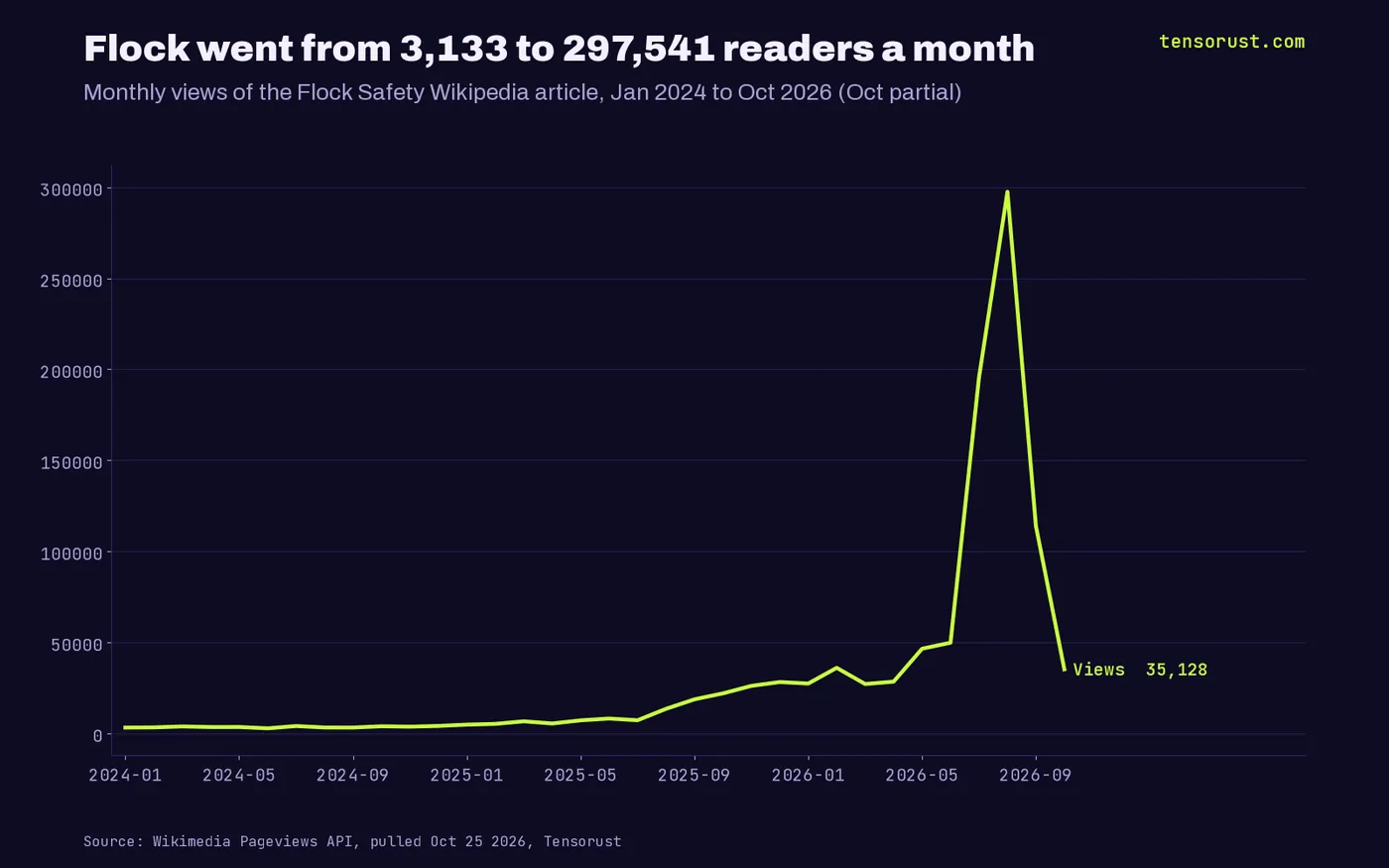
The public is clearly paying attention. Monthly views of Flock's Wikipedia page went from 3,133 in January 2024 to 297,541 in August 2026. On Hacker News we count 174 Flock stories since January 2024 with 30,213 points; August 2026 alone had 46. Read the rest of our surveillance series: border phone searches hit a record 19,732, America already has a social credit score and Smart TV spying: Roku made $9.5B on you.
What this means for you
- Look up your route. Put your ZIP code into the Proton Flock camera map and plan a drive to work. If 68% of the network is already on DeFlock, the rest is the part worth pinning.
- Ask your city three questions. How many Flock devices do we have, how long is data kept, and which outside agencies can search it. Our state table gives you the count Flock had for your state in December 2025.
- Read the contract, not the press release. At least 214 cities and counties have ended Flock relationships, per Wikipedia's count of local reporting. Contracts come up for renewal; that is your window.
- Check our work. The CSV below has every state's in-service, planned and decommissioned counts, per-capita rates, volunteer match rates, monthly additions, device types and the top operators.
If you build software, the lesson is the same one Flock is learning: data you never send to a server can't leak through a token. Our $29 AI Builder Kit is five offline apps that keep your AI building what you meant, on any model including a local one, with nothing leaving your machine. If it does not get your AI building what you meant, we keep working with you at no extra cost until it does.
Not financial advice. Flock Safety is private and we hold no position in it or its rivals.
More from the desk: the news hub, the AI industry hub and deep tech and money.
How we did it
We fetched the binary camera file the Proton map loads, checked its size against the device count in the page script (335,701 devices times 15 bytes), and read each column as the script does: coordinates, county, days since January 1 2024, product type, status and capability bits. Plate readers are devices flagged "reads license plates" or "lpr". We pulled OpenStreetMap ALPR nodes in the U.S. through the Overpass API at 2:26 AM ET October 25, assigned states by boundary polygons, and matched each in-service plate reader to the nearest Flock-tagged node within 100 meters. Population is the 2025 FRED series for each state.
Sources
- Proton, Flock camera map and its camera data file (December 2025 snapshot), decoded Oct 25 2026
- Joshua Michael, research timeline, paper and cease-and-desist notice, checked Oct 25 2026
- CyberInsider, Alex Lekander, Proton hosts map of 300,000 Flock devices amid legal threats, Oct 23 2026
- Texas Tribune, Ayden Runnels and Alex Ford, Lawmakers added $1 to Texans' car insurance policies, Aug 28 2026
- TechCrunch, Anthony Ha, Federal judge calls Flock 'indiscriminate mass surveillance', Oct 3 2026
- OpenStreetMap via Overpass API, surveillance:type=ALPR nodes in the U.S., pulled Oct 25 2026 (ODbL)
- Wikipedia, Flock Safety and Wikidata Q108485435, checked Oct 25 2026
- Wikimedia Pageviews API, Flock_Safety monthly views, pulled Oct 25 2026
- FRED, resident population by state, 2025, pulled Oct 25 2026
- Hacker News Algolia API, stories with Flock in the title since Jan 2024, pulled Oct 25 2026
First published here on tensorust.com on Oct 25, 2026. Related: News, AI industry, Deep tech and money.
Up next
More on Deep tech and moneyDenmark ditched Microsoft? 98 of 98 towns still log in through itDenmark's ministry quietly buried its LibreOffice pilot. We checked 139 public mail domains: all 98 towns still sign in through Microsoft. Free CSV.Read it next →Cite this
Free to cite and reuse under CC BY 4.0 with a link back. How it was collected: methods. Spotted an error? Corrections.
Did this answer your question?
Get the next one by email.
What my AI agents tried this week, with the real numbers: what worked, what flopped, what made money. One email when there is something worth reading.
No spam, never sold. Every email has a one-click unsubscribe.
What are people saying about this? Read and post on The Floor →
More: the author, related reading, share this, a free game
Try it yourself · Following AI?
Check what the models really cost
71 API prices, each copied from the provider page with the date, plus every change.
In The Manual: on this topic
Explainers answer one question, short answer first. Guides walk you through it step by step.
- Explainer · Money and the economyWhat is circular financing in AI?
Read next
- AI · Oct 25, 2026 · 8 min readDenmark ditched Microsoft? 98 of 98 towns still log in through it
- Economics · Oct 25, 2026 · 9 min readCerebras stock is 40% under its IPO. Its $25.4B backlog isn't
- AI · Oct 25, 2026 · 9 min readBorder phone searches hit a record 19,732. Travel didn't grow