
Border phone searches hit a record 19,732. Travel didn't grow
On this page · 9 sections
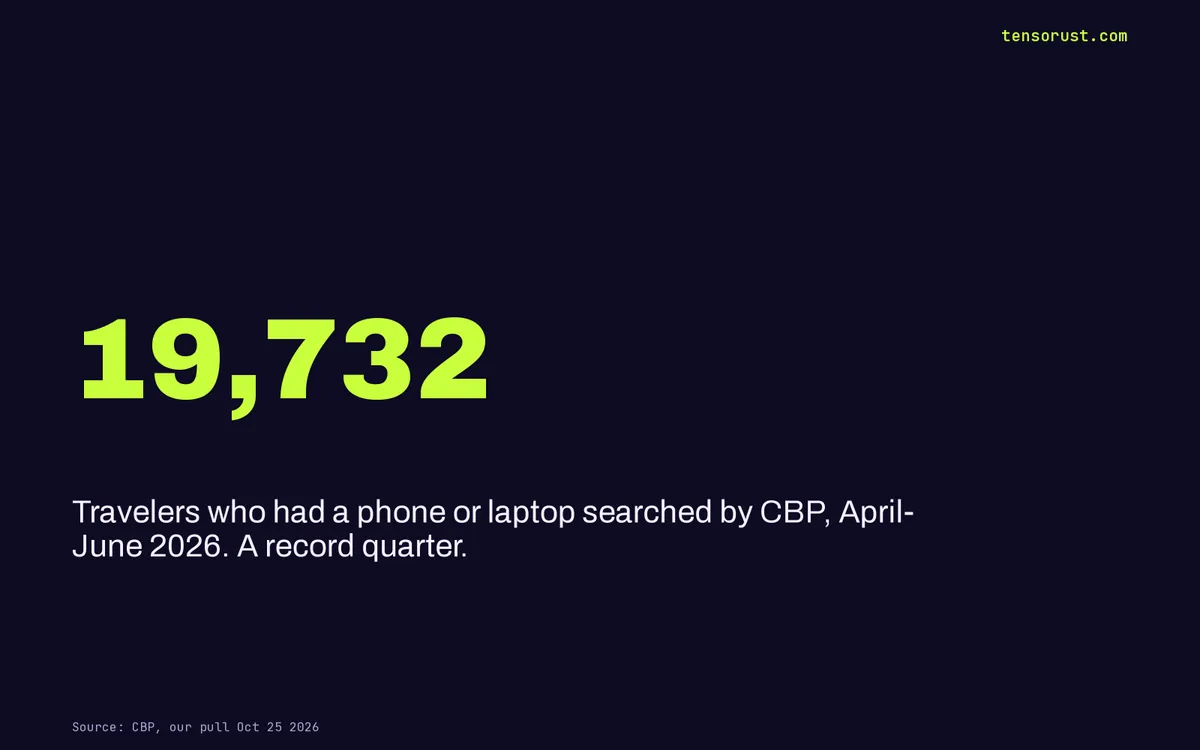
Short answer: Yes, U.S. border phone searches are at a record. CBP searched the phones, laptops or other devices of 19,732 travelers between April and June 2026, the highest quarter in its published data, and 52,081 in the first nine months of fiscal 2026, up 32.7% on the same stretch a year earlier. The number of people crossing did not move. The searching did.
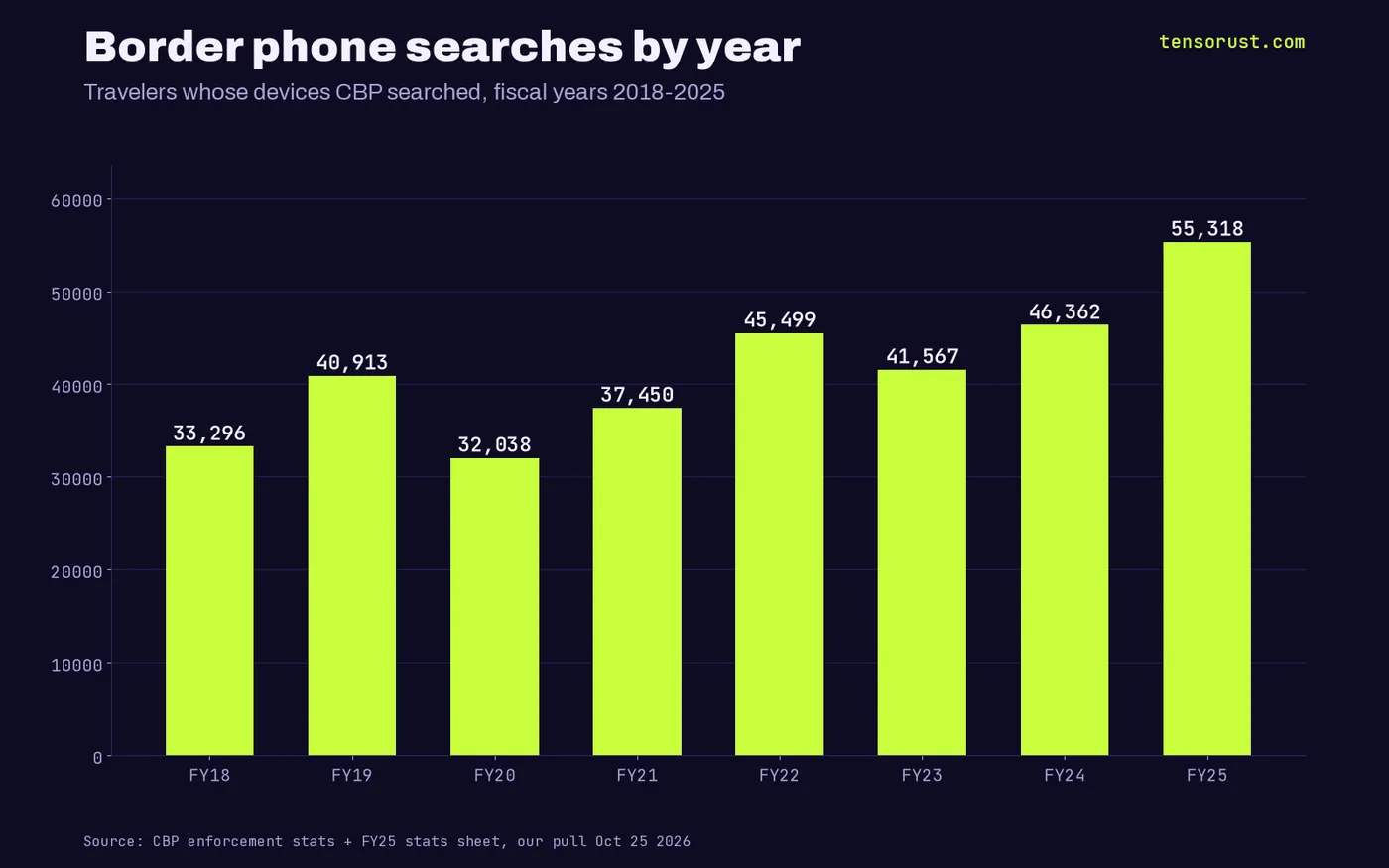
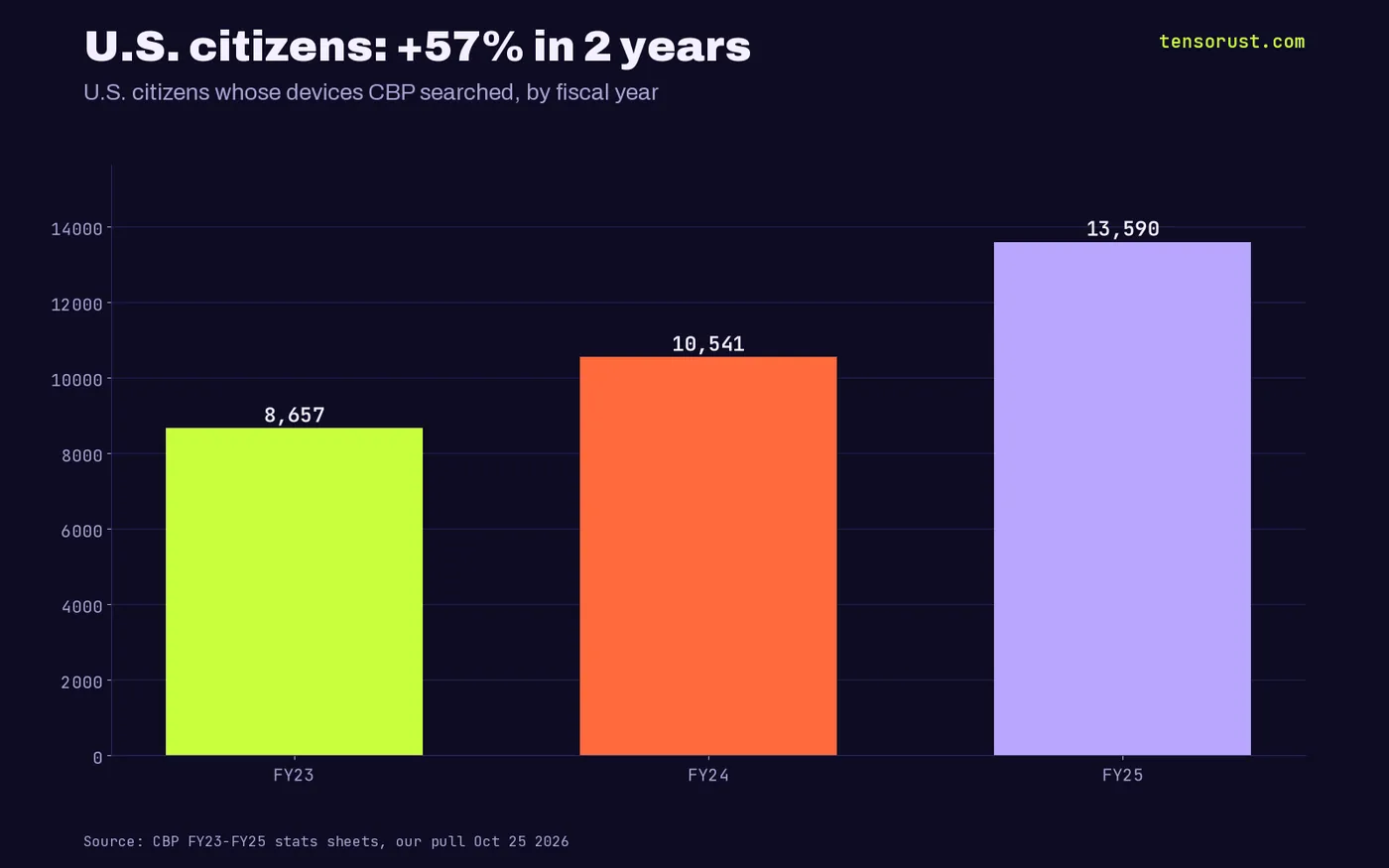
TL;DR: CBP processed 419.2 million travelers in FY2025, 0.3% fewer than FY2024, yet device searches rose 17.6% to 55,318 and searches of U.S. citizens are up 57% in two years, from 8,657 to 13,590. A rewritten search rulebook took effect January 1 2026, the old 2018 version now returns a 404 on cbp.gov, and the next quarter set the record. The vendor that sells the unlocking kit, Cellebrite, booked $14.9 million from CBP and ICE in fiscal 2026, double fiscal 2023, so if you fly back into the U.S. this year, plan your phone like it will be read.
Key numbers
| What | Number | Source, checked Oct 25 2026 |
|---|---|---|
| Travelers with devices searched, Apr-Jun 2026 (FY26 Q3) | 19,732 (record quarter) | CBP device search page |
| FY26 first 9 months vs FY25 first 9 months | 52,081 vs 39,251 (+32.7%) | CBP quarterly table |
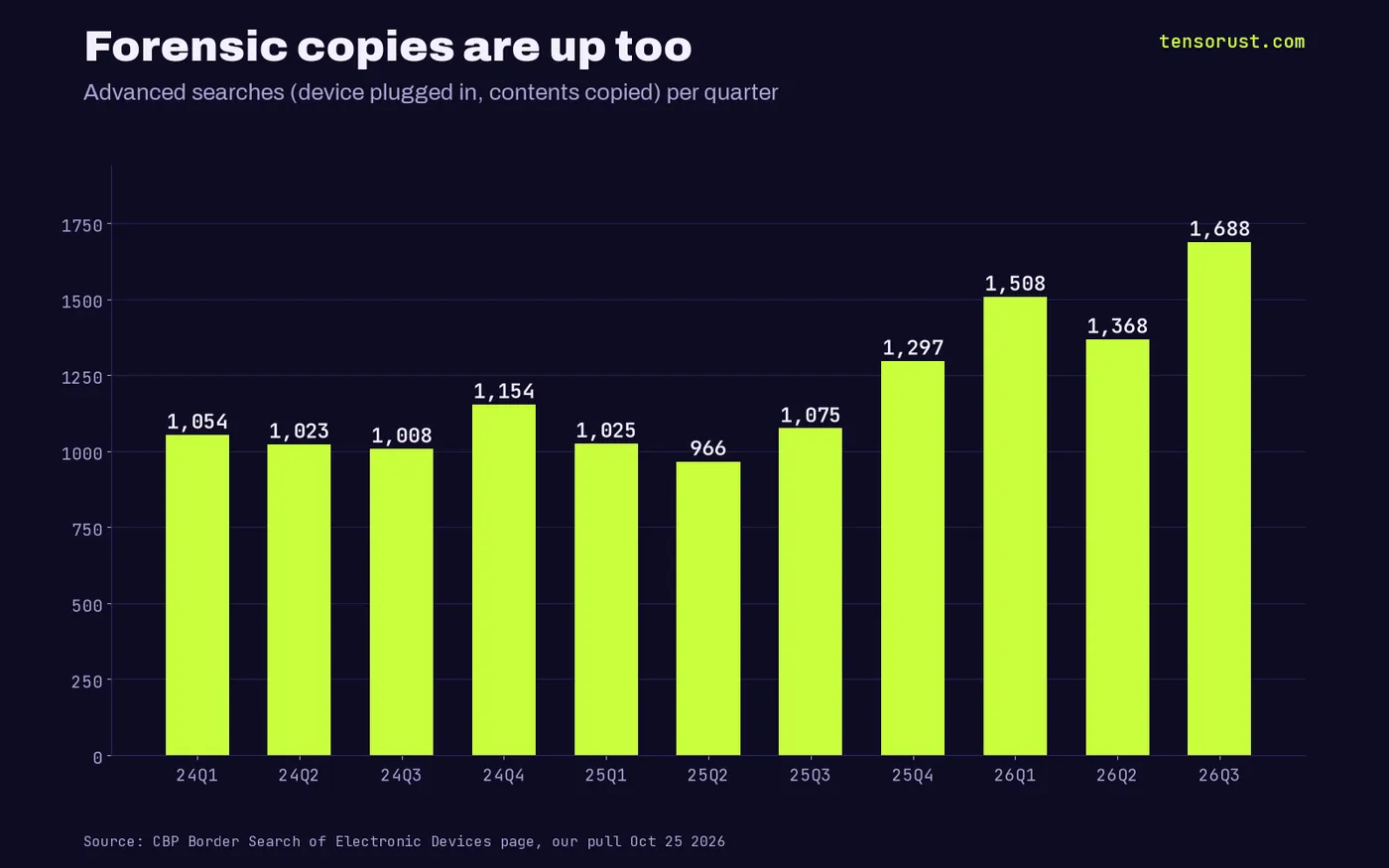
| Advanced searches (device plugged in, data copied), same 9 months | 4,564 vs 3,066 (+48.9%) | CBP quarterly table |
| Travelers processed, FY24 to FY25 | 420.5M to 419.2M (-0.3%) | CBP FY25 stats sheet |
| Device searches, FY24 to FY25 | 47,047 to 55,318 (+17.6%) | CBP FY24 and FY25 sheets |
| U.S. citizens searched, FY23 to FY25 | 8,657 to 13,590 (+57.0%) | CBP FY23 and FY25 sheets |
| Cellebrite obligations from CBP + ICE, FY23 to FY26 | $7.11M to $14.86M | USAspending.gov awards API, our pull |
| Share of Cellebrite 2025 revenue from U.S. federal customers | about 16% of $475.7M | Cellebrite 2025 Form 20-F |

The record is real, and it is not a travel boom
The 32% headline that hit Gizmodo on October 23, from data CBC News got out of CBP, checks out against CBP's own quarterly table. We pulled every number CBP publishes on device searches, from October 2017 through June 2026, and put it in one file you can download.
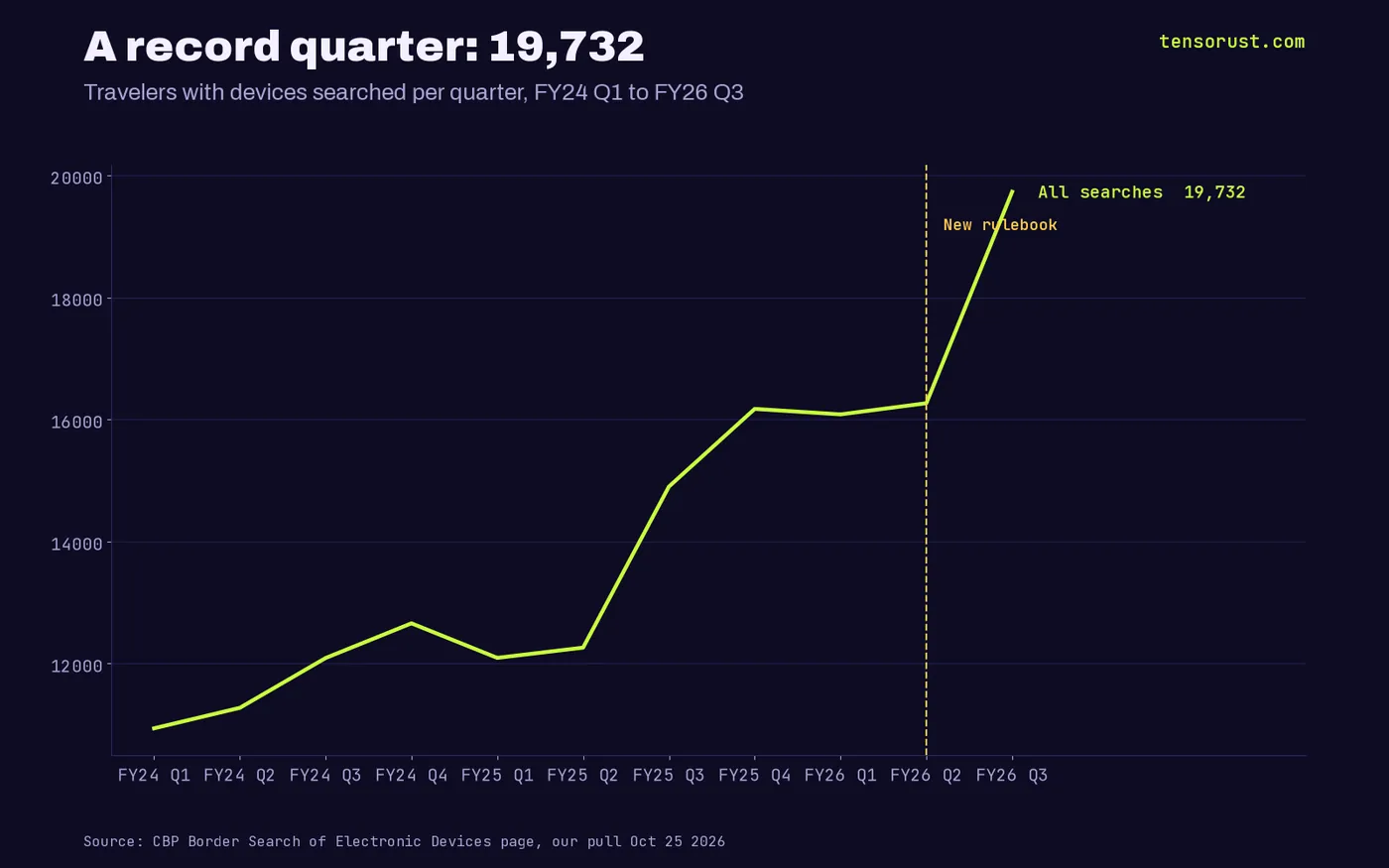
Apr-Jun 2026 is the top quarter in that whole series. The biggest quarter in the old monthly data was Jan-Mar 2022 at 12,766. The new record is 19,732, about 55% higher.
Now the part the agency does not lead with. CBP processed 420,521,616 travelers in FY2024 and 419,157,270 in FY2025. Traffic went down a hair. Searches went up 17.6%.
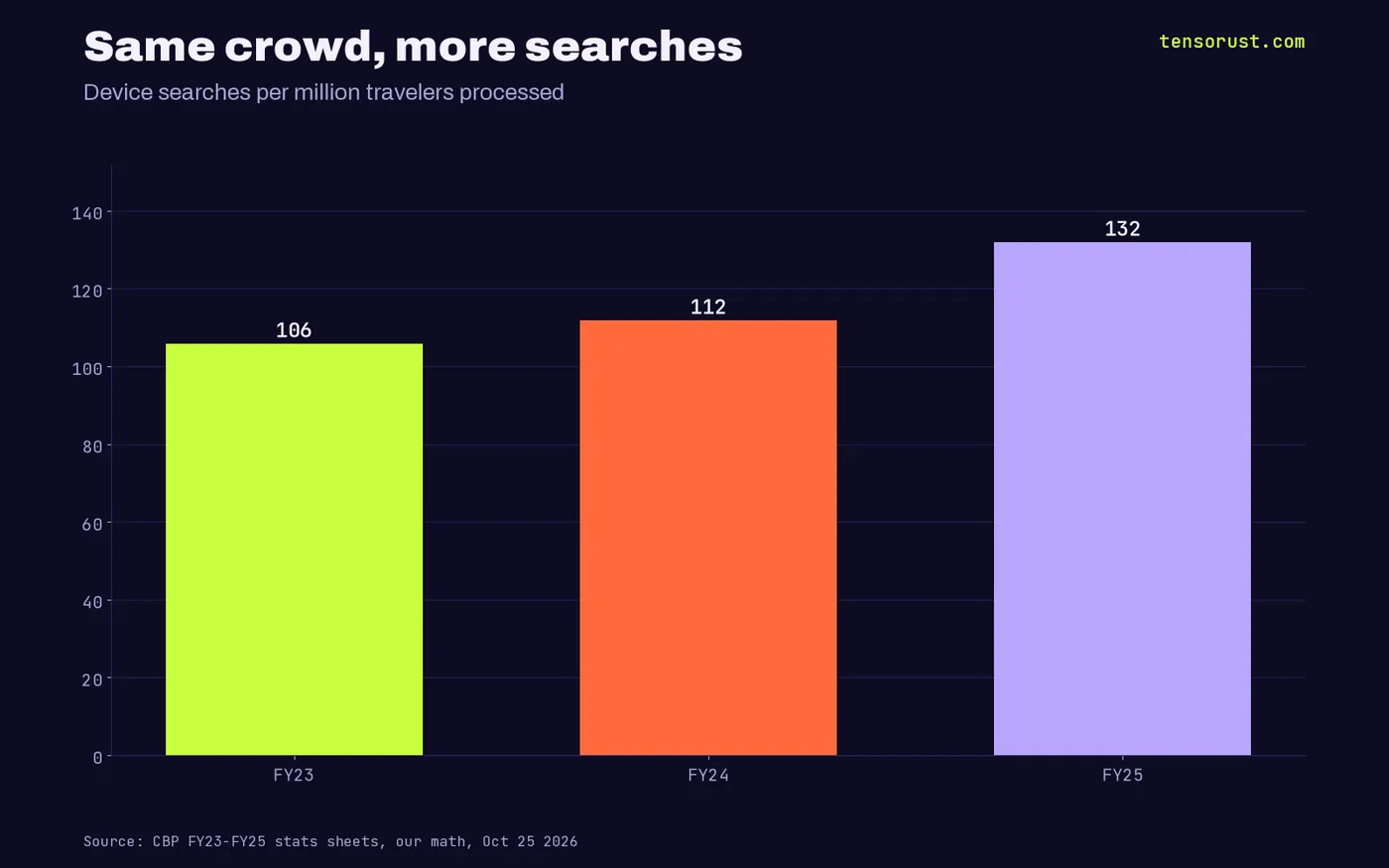
Searches per million travelers tell the same story: 105.9 in FY2023, 111.9 in FY2024, 132.0 in FY2025. Secondary inspections, the back room where searches happen, actually fell 8.3% to 11,612,366 in FY2025. Inside that smaller room, the search rate went from 3.4 per 1,000 people in FY2023 to 4.8 in FY2025.
That is not more people. That is more appetite.
The rulebook changed on January 1, and the old one vanished
CBP replaced its 2018 device search directive, 3340-049A, with Directive 3340-049B, effective January 1 2026. The memo announcing it is dated January 12, eleven days after it took effect, signed by Commissioner Rodney S. Scott, and two lines of it are blacked out under FOIA exemption (b)(2).
The 2018 PDF now returns a 404 on cbp.gov. We pulled the copy the Wayback Machine saved on January 1 2026 and diffed the two, sentence by sentence. The new one runs 6,006 words against 5,510.
What got wider:
- What counts as a device. The 2026 text names SIM cards, GPS units, drones ("unmanned aircraft systems"), smart watches and vehicle infotainment systems. Your car's dashboard is now on the list by name.
- Who gets your data. Sharing of retained copies now lists federal, state, local, tribal, territorial and foreign agencies. The 2018 list stopped at federal, state, local and foreign.
- A new reason to keep copies. A fresh section lets CBP hold information "consistent with discovery obligations" in ongoing or expected litigation, with storage decided "on a case-by-case basis."
- Who signs off. Long detentions past 15 days can be approved and re-approved in 7-day blocks by a director "or their delegate."
What got tighter, to be fair to the text: CBP can no longer use search incident to arrest as its legal basis for a phone, passcodes "should not be uploaded into CBP systems," withholding the search notice now needs a supervisor, and an advanced search on a "national security concern" without reasonable suspicion now needs a director's approval first. It also admits that "binding circuit precedent" in some courts forces different rules, which tells you the judges are the ones pulling the brakes, not the agency.
Then look at the timing. FY26 Q2 (Jan-Mar 2026), the first quarter under the new rules, came in at 16,266. The quarter after that set the record.
The scary searches are growing faster
CBP splits searches in two. A basic search is an officer scrolling your phone by hand, and the directive says it can happen "with or without suspicion." An advanced search means plugging in equipment to copy and analyze what is on the device, and it needs reasonable suspicion or a "national security concern" plus a senior manager's approval.
Basic searches are still 92% of the total (50,922 of 55,318 in FY2025). But advanced searches grew faster this year: 4,564 in the first nine months of FY2026 against 3,066 a year earlier, up 48.9%. Apr-Jun 2026 alone had 1,688, the most in the table.
And this is not a foreigners-only story. U.S. citizens whose devices got searched went from 8,657 in FY2023 to 10,541 in FY2024 to 13,590 in FY2025, up 57%. Non-citizen searches rose 26% over the same two years. Citizens went from 20.7% of all searches to 24.6%.
Our read: the "it is about visa fraud" defense covers less of the chart every year. One in four searched travelers is a citizen who cannot be refused entry.
CBP cannot agree with itself on the count
Small thing, big tell. CBP publishes three different FY2024 totals: 46,362 in its monthly enforcement table, 46,958 if you add its own quarterly table, and 47,047 on the FY2024 stats sheet. For FY2025 the stats sheet says 55,318 and the quarterly table adds up to 55,424.
CBP's footnote says year-end numbers get finalized after the monthly pull. Fine. But every revision we found went up, never down. When an agency's own numbers drift in one direction, the first number you hear is the low one.
The agency's pitch on its own page is that searches happen "on rare occasions" and touch "less than 0.01 percent" of travelers. Both true. Also true: 0.01% of 419 million people is a stadium of phones every year, and the count is compounding.
Follow the money: who sells the keys
An advanced search runs on forensic kits, and two vendors show up again and again in federal buying: Cellebrite and Magnet Forensics, which owns the GrayKey phone-cracking product from Grayshift. We pulled every federal contract award to both from USAspending.gov: 2,367 awards since 2008.
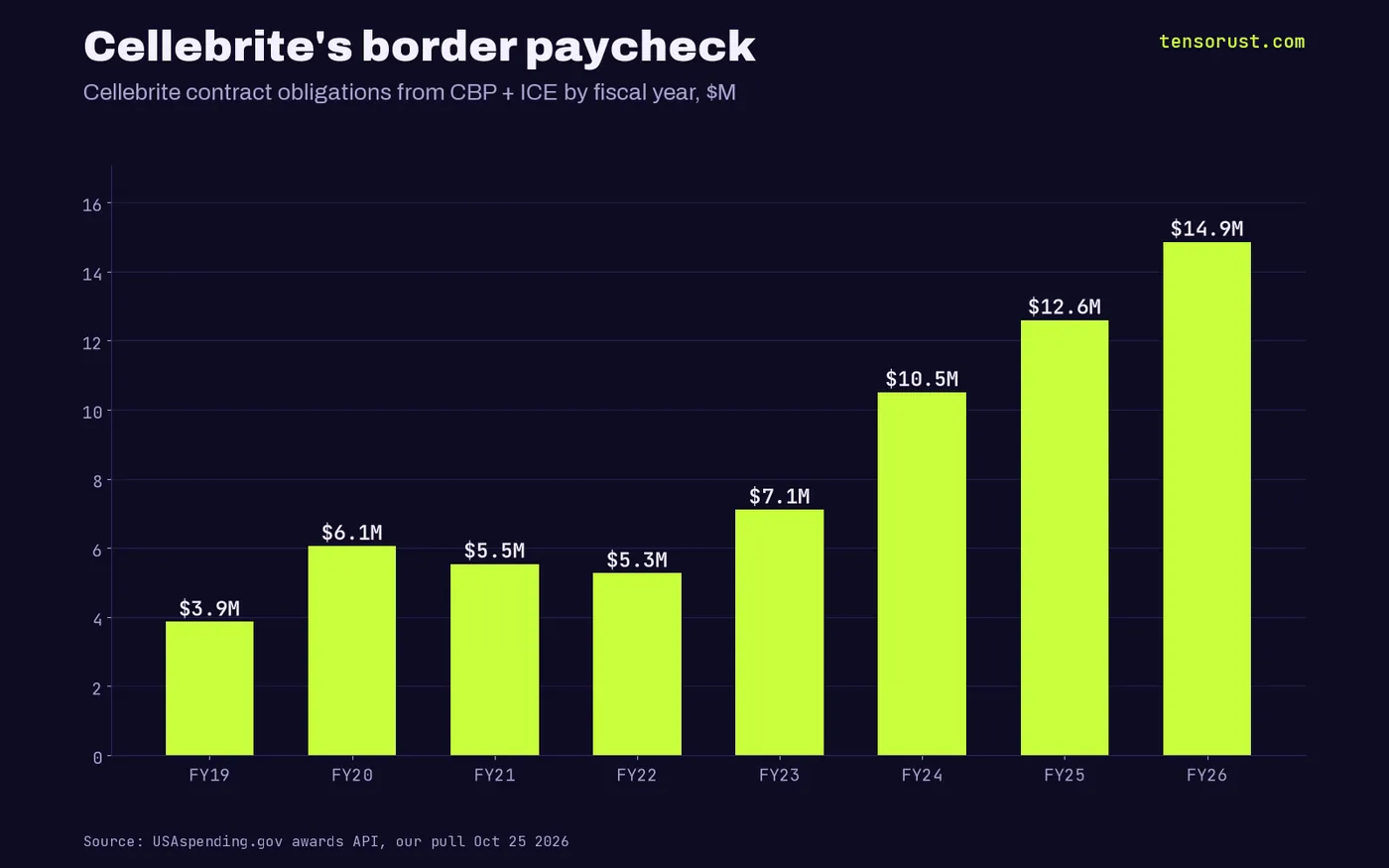
Cellebrite's obligations from CBP and ICE combined, by award start year: $7.11 million in FY2023, $10.51 million in FY2024, $12.60 million in FY2025, $14.86 million in FY2026. ICE is the big buyer at $13.03 million in FY2026. CBP's own Cellebrite awards hit $1.83 million in FY2026, its highest in our pull, including $1,327,390 for "software licenses, hardware and training for CBP National Targeting Center" starting August 1 2026 and $985,033 for sixteen Inseyets Ultimate licenses.
CBP also bought GrayKey: $455,226 of licenses in September 2024 and $532,723 more in September 2025.
Zoom out. Cellebrite booked $475.7 million of revenue in 2025, up from $270.7 million in 2022, and its 20-F says U.S. federal customers were about 16% of it. That puts the federal slice near $76 million (our math). In Q2 2026 it reported $131.1 million of revenue, up 16%, with an 80.8% gross margin and $507.8 million of recurring revenue.
The same filing uses the word "AI" 86 times. Its Pathfinder product "uses AI" to sort text, video and image evidence pulled from phones. So the stack is now: officer takes your phone, a kit copies it, software ranks what looks interesting. The more phones, the more seats.
Who wins: the vendors, whose per-seat licenses scale with every new search team. Who loses: the traveler, who pays for none of it and gets no say. CBP says officers still decide who gets searched. Fair. The sales pitch is that software makes every search cheaper, and cheaper searches are exactly how you get more of them.
Cellebrite is not all roses, by the way. On August 13 it swapped CEOs, naming Shiven Ramji, and cut its full-year 2026 revenue outlook. A government growth line is the steady part of its story, and border work is growing.
Our bet on the next number
CBP has not posted Jul-Sep 2026 yet. If that quarter just matches Apr-Jun, fiscal 2026 lands at 71,813 searches, our estimate, about 30% above FY2025 and more than double FY2018's 33,296.
Our bet: it beats that. Summer is peak travel, the new rulebook is in its first full year, and the purchase orders say CBP is buying for more capacity, not less. Nobody at CBP will call it a policy shift. The chart will.
What this means for you
If you are flying back into the U.S., treat your phone as something that can be read at the border, because under CBP's own rules a basic search needs no suspicion at all.
- Travel light. Carry only what you need on the device. CBP's directive says officers must not access data "stored remotely," and it asks travelers to switch on airplane mode before a search.
- Know the passcode rule. CBP's FAQ says a U.S. citizen "will not be denied entry" for not unlocking a device, but the device "may be subject to exclusion, detention, or other appropriate action." Past 5 days a detention needs a Port Director's sign-off.
- Get the receipt. If they keep the device, the directive says you get a Form 6051D. Keep it.
- Check the data yourself. Download our CSV below; it has every month and quarter CBP has published since October 2017, plus every federal Cellebrite and Magnet award.
If you build software, the lesson travels too: the safest data is the data you never ship to a server. Our $29 AI Builder Kit is five offline apps that keep your AI building what you meant, on any model including a local one, with nothing leaving your machine. If it does not get your AI building what you meant, we keep working with you at no extra cost until it does.
Not financial advice. We hold no position in Cellebrite.
More from us on who is reading your data: America already has a social credit score, Smart TV spying: Roku made $9.5B on you, Gmail ads are back, the news desk and the AI industry hub.
Sources
- CBP, Border Search of Electronic Devices at Ports of Entry (FAQ and FY24 Q1 to FY26 Q3 table), checked Oct 25 2026
- CBP, Enforcement Statistics (monthly device searches FY2018 to FY2024), checked Oct 25 2026
- CBP FY2023, FY2024 and FY2025 device search statistics sheets, checked Oct 25 2026
- CBP Directive 3340-049B (effective Jan 1 2026) and Commissioner's memo of Jan 12 2026, checked Oct 25 2026
- CBP Directive 3340-049A (2018), Wayback Machine copy of Jan 1 2026, checked Oct 25 2026
- Gizmodo, Justin Caffier, Password, Please: Border Searches of Laptops, Phones Up 32% This Year, Oct 23 2026
- USAspending.gov, spending_by_award API, contract awards to Cellebrite and Magnet Forensics, pulled Oct 25 2026
- Cellebrite DI Ltd., Form 20-F for 2025, filed Mar 3 2026
- Cellebrite, Q2 2026 results and CEO change (Form 6-K, Exhibit 99.1), Aug 13 2026
- SEC EDGAR XBRL company facts, Cellebrite revenue 2022 to 2025, checked Oct 25 2026
First published here on tensorust.com on Oct 25, 2026. Related: News, AI industry, Deep tech and money.
Up next
More on Deep tech and moneyDenmark ditched Microsoft? 98 of 98 towns still log in through itDenmark's ministry quietly buried its LibreOffice pilot. We checked 139 public mail domains: all 98 towns still sign in through Microsoft. Free CSV.Read it next →Cite this
Free to cite and reuse under CC BY 4.0 with a link back. How it was collected: methods. Spotted an error? Corrections.
Did this answer your question?
Get the next one by email.
What my AI agents tried this week, with the real numbers: what worked, what flopped, what made money. One email when there is something worth reading.
No spam, never sold. Every email has a one-click unsubscribe.
What are people saying about this? Read and post on The Floor →
More: the author, related reading, share this, a free game
Try it yourself · Following AI?
Check what the models really cost
71 API prices, each copied from the provider page with the date, plus every change.
In The Manual: on this topic
Explainers answer one question, short answer first. Guides walk you through it step by step.
- Explainer · Money and the economyWhat is circular financing in AI?
Read next
- AI · Oct 25, 2026 · 8 min readDenmark ditched Microsoft? 98 of 98 towns still log in through it
- AI · Oct 25, 2026 · 10 min readFlock camera map: its own inventory lists 214,073 devices, not 120K
- Economics · Oct 25, 2026 · 9 min readCerebras stock is 40% under its IPO. Its $25.4B backlog isn't