
America already has a social credit score. Data brokers run it
On this page · 13 sections
- Key numbers
- The Chinese score you fear is mostly a myth
- The American version is a line item in five 10-Ks
- Scoring you is the best business in America
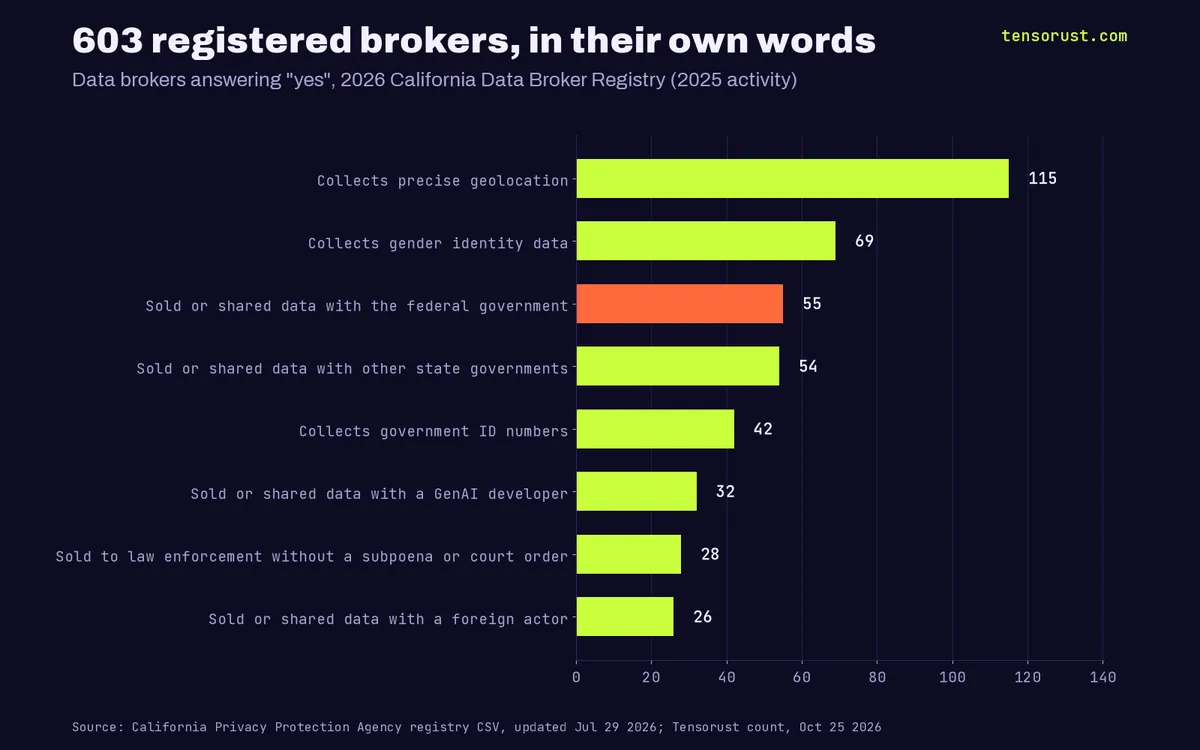
- 603 brokers told California exactly what they do
- 37 days: what Washington actually did about it
- Follow the money: the lobby that wanted it that way
- Who benefits from "only China does that"
- No notice, no appeal, no off switch
- The strongest case for the scorers, and why it fails
- AI is about to turn the dial up
- What this means for you
- Sources
Short answer: Does America have a social credit score? Yes. It is not one number run by one government, it is a private stack of fraud, risk, identity and "trust" scores sold by companies that grossed more than $20 billion in 2025, and 603 of the data brokers feeding it just told California, in writing, that dozens of them sell to the federal government, state governments, police and AI labs. The scary Chinese score most Americans picture is largely a media myth. The American one is real, it is in SEC filings, and the China panic is the best cover it ever had.
TL;DR: Equifax's The Work Number alone holds 813 million employment records fed by payroll data from over 4 million employers, while Equifax reported just 685 deletion requests to California for all of 2025. FICO's Scores segment ran an 87.8% operating margin in fiscal 2025, and in 2025 the US put a rule in force banning bulk sales of Americans' data to China, then 37 days later withdrew the rule that would have limited the same sales to everyone else. Americans read the Wikipedia page on China's Social Credit System 410,339 times in 2025 and the page on data brokers 39,201 times, and that 10 to 1 gap is the whole trick.
Key numbers
| What | Number | Source, checked Oct 25 2026 |
|---|---|---|
| 2025 revenue: Equifax, RELX Risk, TransUnion, Verisk, FICO | $6.07B, $4.60B (GBP 3,485m, our conversion), $4.58B, $3.07B, $1.99B | SEC 10-K and 20-F filings, Tensorust pull |
| Employment records in Equifax's The Work Number, Dec 31 2025 | 209 million active, 813 million total | Equifax 2025 10-K |
| FICO Scores segment operating margin, fiscal 2025 | 87.8% ($1,026M on $1,169M) | FICO FY2025 10-K, our calc |
| Registered California data brokers (2025 activity) | 603 | CPPA Data Broker Registry, updated Jul 29 2026 |
| Brokers that sold or shared data with the federal government / law enforcement without a subpoena / a GenAI developer | 55 / 28 / 32 | CPPA registry CSV, Tensorust count |
| DOJ rule on bulk data sales to China in force vs CFPB data-broker rule withdrawn | Apr 8 2025 vs May 15 2025 (37 days) | Federal Register 2024-31486, 2025-08644 |
| Federal lobbying by CDIA, Equifax, Experian, TransUnion, 2024 | $5.6 million | Senate LDA filings, Tensorust sum |
| Wikipedia views in 2025: "Social Credit System" vs "Data broker" | 410,339 vs 39,201 | Wikimedia Pageviews API, Tensorust pull |
| Flight tickets China denied to blacklisted people, as of June 2019 | 26.82 million | NDRC figures via Wikipedia |

The Chinese score you fear is mostly a myth
Start with the thing everyone thinks they know. The picture in American heads is a Black Mirror episode: every citizen gets one number, an AI watches everything, and a low score gets you banned from trains.
The record is less cinematic. The Wikipedia entry on China's social credit system, citing Yale's Jeremy Daum and researchers like Filip Sebok, calls the single numerical score "perhaps the most common myth" about it. What China actually runs is a patchwork of blacklists, the biggest being a court list of people who refuse to pay judgments they can afford to pay.
That list has teeth. By June 2019, China's planning agency said 26.82 million flight tickets and 5.96 million high-speed rail tickets had been denied to blacklisted people. Nobody should want that system. But note one detail: before a person or company lands on a Chinese blacklist, they must be told the decision and its legal basis, and there is a formal credit repair process to get off.
Hold that thought. It is the part of the Chinese system America does not copy.
The American version is a line item in five 10-Ks
Here is ours. It has no single number either. It has thousands of them, sold by private companies, and you will never see most of them.
Equifax, RELX's LexisNexis Risk business, TransUnion, Verisk and FICO together booked more than $20 billion of revenue in 2025, by our sum of their SEC filings. That is not credit scores alone. It is employment verification, fraud scores, device risk, identity checks, insurance risk and "decisioning," the industry word for a machine telling a business whether to say yes to you.
The crown jewel is a database most people have never heard of. Equifax's 2025 annual report says The Work Number held about 209 million active and 813 million total employment records at the end of 2025, built from payroll data received from over 4 million organizations. Equifax says it generally does not charge employers to add their data. Your employer hands over your salary history for free, and Equifax sells verifications of it to lenders, landlords and government agencies.
TransUnion's 10-K says it holds information on over one billion consumers and sells "TruValidate Device Risk," which flags suspicious transactions by recognizing your phone or laptop. Riskified, which scores online checkouts for big retailers, says its merchants ran $155.1 billion of sales through its platform in 2025, up 10%. Every one of those orders got a verdict on you before the box shipped.
Scoring you is the best business in America
If you want to know whether something is a sideline or a system, look at the margin.
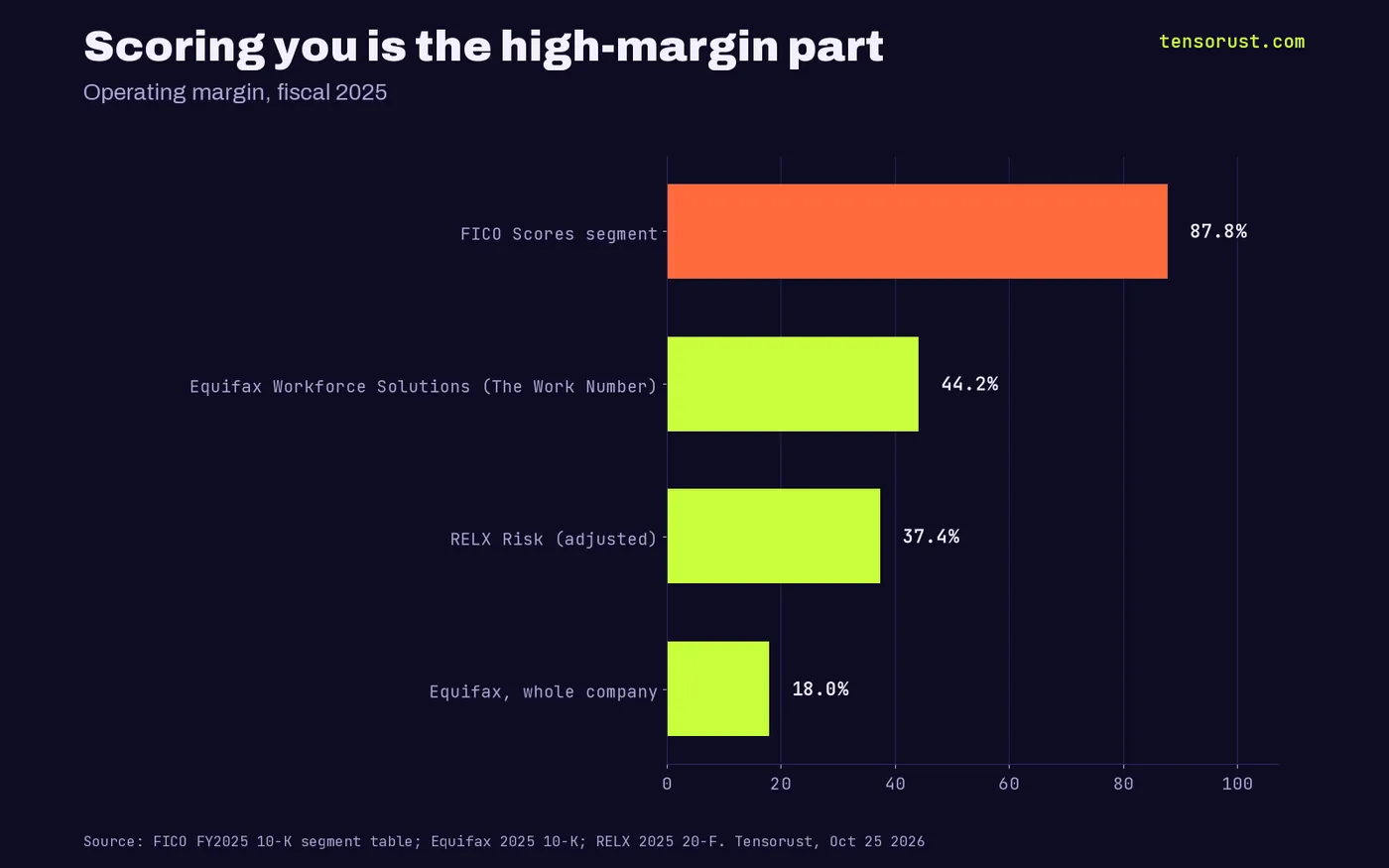
FICO's fiscal 2025 segment table shows its Scores business made $1,026 million of segment operating income on $1,169 million of revenue. That is an 87.8% margin, by our calculation from the filing. Scores were 59% of FICO's revenue in 2025, up from 51% two years earlier.
Equifax's Workforce Solutions segment, home of The Work Number, ran a 44.2% operating margin in 2025, against roughly 18% for Equifax as a whole. RELX's Risk business made GBP 1,305 million of adjusted operating profit on GBP 3,485 million of revenue, a 37.4% margin, and RELX credits "AI-enabled analytics and decision tools."
And it keeps growing. Equifax's revenue went from $3.41 billion in 2018 to $6.07 billion in 2025, up 78%. TransUnion's went from $2.32 billion to $4.58 billion, nearly double. A product with 87.8% margins and growing demand is not going to regulate itself away. It is going to look for cover.
603 brokers told California exactly what they do
Most writing about data brokers is guesswork. This part is not. California makes every data broker register each year and answer a questionnaire, and the 2026 registry, covering 2025 activity, lists 603 of them. We downloaded the full CSV and counted the answers.
115 brokers said they collect precise geolocation. 69 collect gender identity data. 42 collect government ID numbers. 55 said they sold or shared consumer data with the federal government in the past year, 54 with other state governments, and 28 with law enforcement outside of a subpoena or court order. 32 said they sold or shared data with a developer of a generative AI system. 26 said they sold or shared it with a foreign actor.
The big names are in there, in their own words. Equifax Workforce Solutions, the Work Number business, answered yes to collecting minors' data, government IDs, citizenship and immigration status and biometric data, and yes to sharing with the federal government, other states and law enforcement outside a subpoena. LexisNexis Risk Solutions answered yes to precise geolocation, government IDs and minors, and yes to the federal government, states and law enforcement. TransUnion Risk and Alternative Data Solutions said yes to biometric data, gender identity and selling to a GenAI developer.
That is the thing people say they fear from Beijing: the state and private data fused, scoring citizens, no off switch. Here it is self-reported, on a government website, in a spreadsheet.
37 days: what Washington actually did about it
Now the cleanest receipt in this whole story. Two federal rules, both public in the Federal Register.
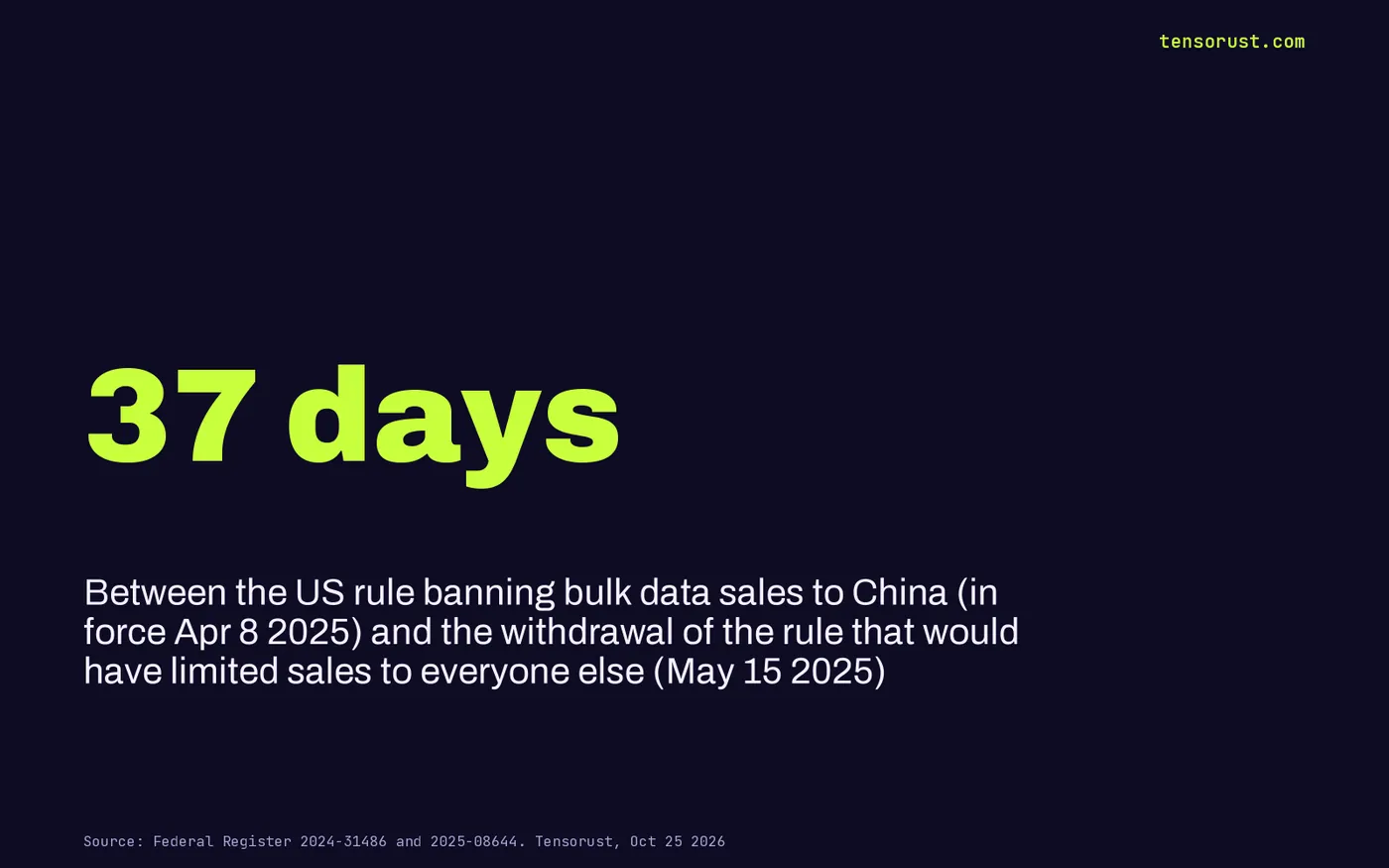
On January 8 2025 the Justice Department published a final rule under Executive Order 14117 restricting bulk transfers of Americans' sensitive personal data to "countries of concern," China among them. It took effect on April 8 2025.
A month earlier, in December 2024, the Consumer Financial Protection Bureau had proposed a 61-page rule called "Protecting Americans from Harmful Data Broker Practices." It would have treated the sale of "credit header" data, your name, date of birth, addresses, Social Security number and phone number, as a consumer report under the Fair Credit Reporting Act, so brokers could only sell it to buyers with a legal reason. The CFPB's own text said stalkers and domestic abusers buy this data to find people who do not want to be found.
On May 15 2025, 37 days after the China rule took effect, the CFPB withdrew the domestic rule in two pages signed by Acting Director Russell Vought, citing "updates to Bureau policies" and its "changed policy objectives."
That is documented. Here is our reading, stated plainly: America did not decide that selling your Social Security number and home address is dangerous. It decided that selling it to China is dangerous. Selling it to anyone else, including the people the CFPB itself said stalk domestic violence survivors, is a business.
Follow the money: the lobby that wanted it that way
The industry's trade group is the Consumer Data Industry Association, CDIA. Its own lobbying reports to the Senate list the same three words in its issue description quarter after quarter through 2024 and 2025: "credit headers." That is the exact product the CFPB rule would have restricted.
By our sum of Senate lobbying disclosures (quarterly reports, amendments left out), CDIA, Equifax, Experian and TransUnion spent about $5.6 million lobbying Washington in 2024 and about $6.2 million in 2023. Experian's outside firm Venable listed "Data brokers" as a lobbying issue in every 2024 quarter, and in the second half of the year added "Protecting Americans' data from foreign" adversaries. Equifax's 2025 filings list H.J. Res 74, the resolution to overturn the CFPB's rule keeping medical debt off credit reports.
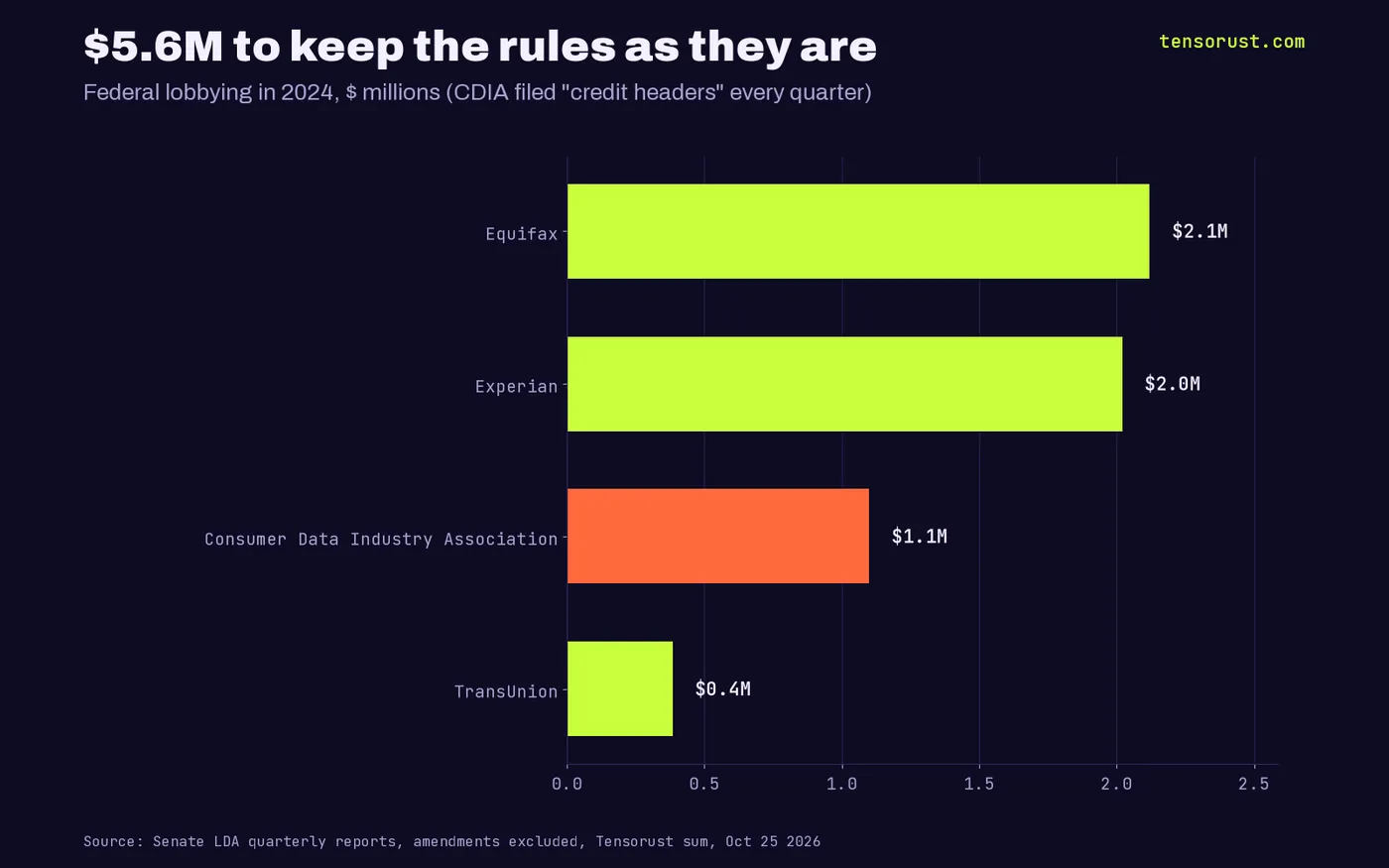
We are not saying any of that is illegal. Lobbying is legal and disclosed, which is how we can count it. We are saying the record shows an industry that worked on the foreign-adversary framing and on keeping the domestic rules loose at the same time, and got both.
Who benefits from "only China does that"
Every story needs a villain, and the China social credit score is the perfect one for this industry. It is far away, it is run by a rival government, and it lets Americans feel that scoring people is something other countries do.
The attention data says the frame works. English Wikipedia's page on China's Social Credit System drew 410,339 human pageviews in 2025. The page on data brokers drew 39,201. LexisNexis Risk Solutions, one of the largest scorers of Americans alive, drew 16,846. Readers spent ten times more attention on a system that does not score them than on the one that does.
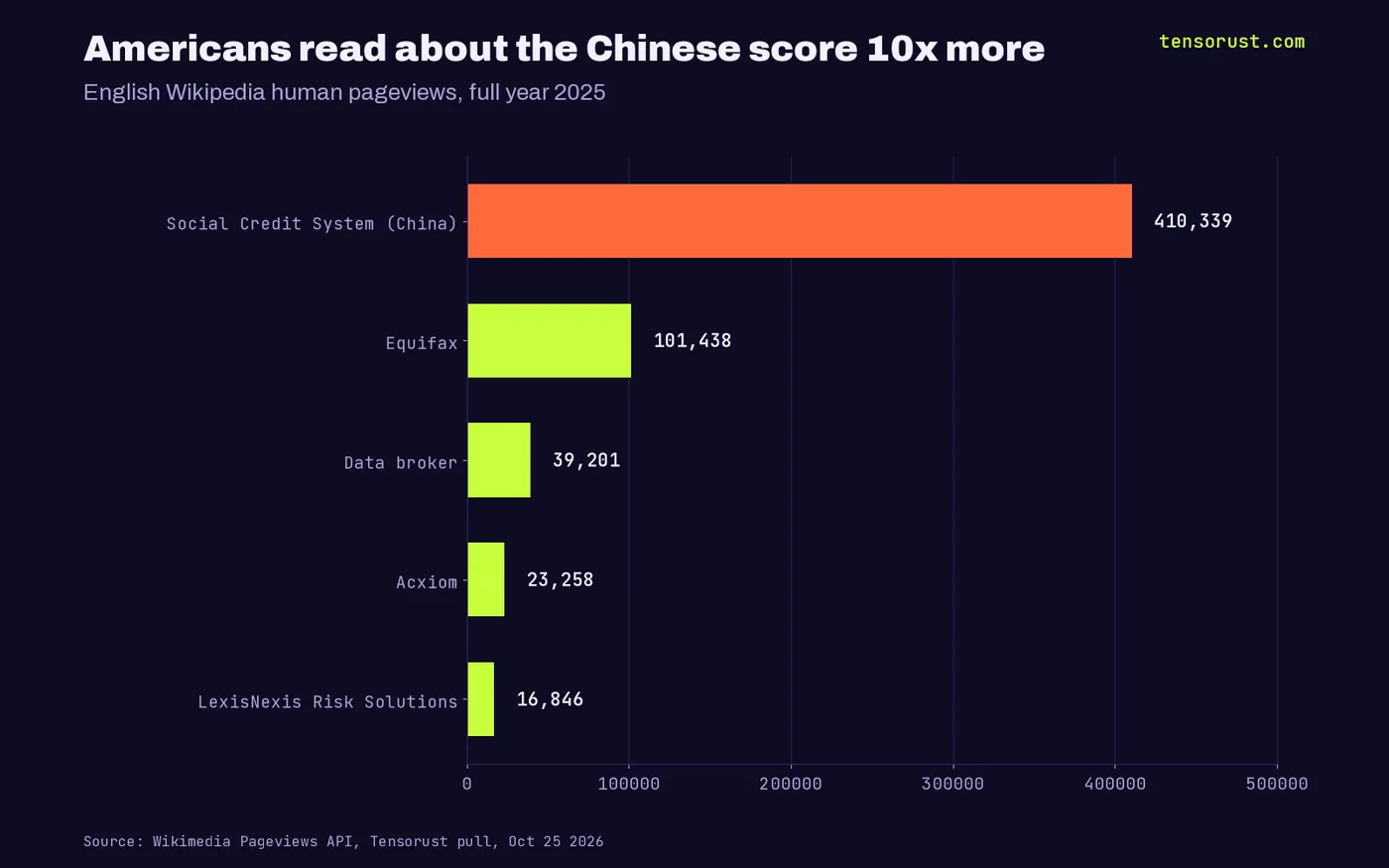
On Hacker News, the tech crowd's front page, stories matching "social credit" peaked at 68 in 2018, the year the Black Mirror version went viral. Our bet is that this was not an accident of the news cycle. A foreign bogeyman is the cheapest privacy policy money can buy: it lets politicians look tough, it lets the industry write the rules for "foreign adversaries" and it keeps the domestic market off the front page. Nobody had to plan it. Everyone just had a reason to keep pointing east.
No notice, no appeal, no off switch
Remember the Chinese rule about being told before you are blacklisted? Here is the American experience.
Take returns. In Hayden v. The Retail Equation, shoppers sued The Retail Equation, a unit of Appriss, along with Sephora, CVS, The Home Depot, The Gap, TJX, Bath & Body Works and Bed Bath & Beyond. The court's May 4 2022 order summarizes their claims: the company gave retailers an individual "risk score" each time a customer tried to return something, built from purchase history and ID data, including data on "people thought to be related or associated with the consumer" and on "other customers in the merchant location" at the time.
The shoppers alleged they were never asked, could not review or correct their scores, were not told what score they needed, and had returns rejected. The court granted the motions to dismiss in part, and those are allegations, not findings. But read the mechanism again: a private score that counts who you are related to and who was standing near you in the store. That is the exact Black Mirror feature people attribute to Beijing.
Then look at the deletion math. California's privacy law exempts data covered by the Fair Credit Reporting Act, and Equifax told the registry that about 80% of its Workforce Solutions revenue comes from FCRA-regulated products. Equifax reported 685 requests to delete for 2025. The Work Number holds 813 million records.
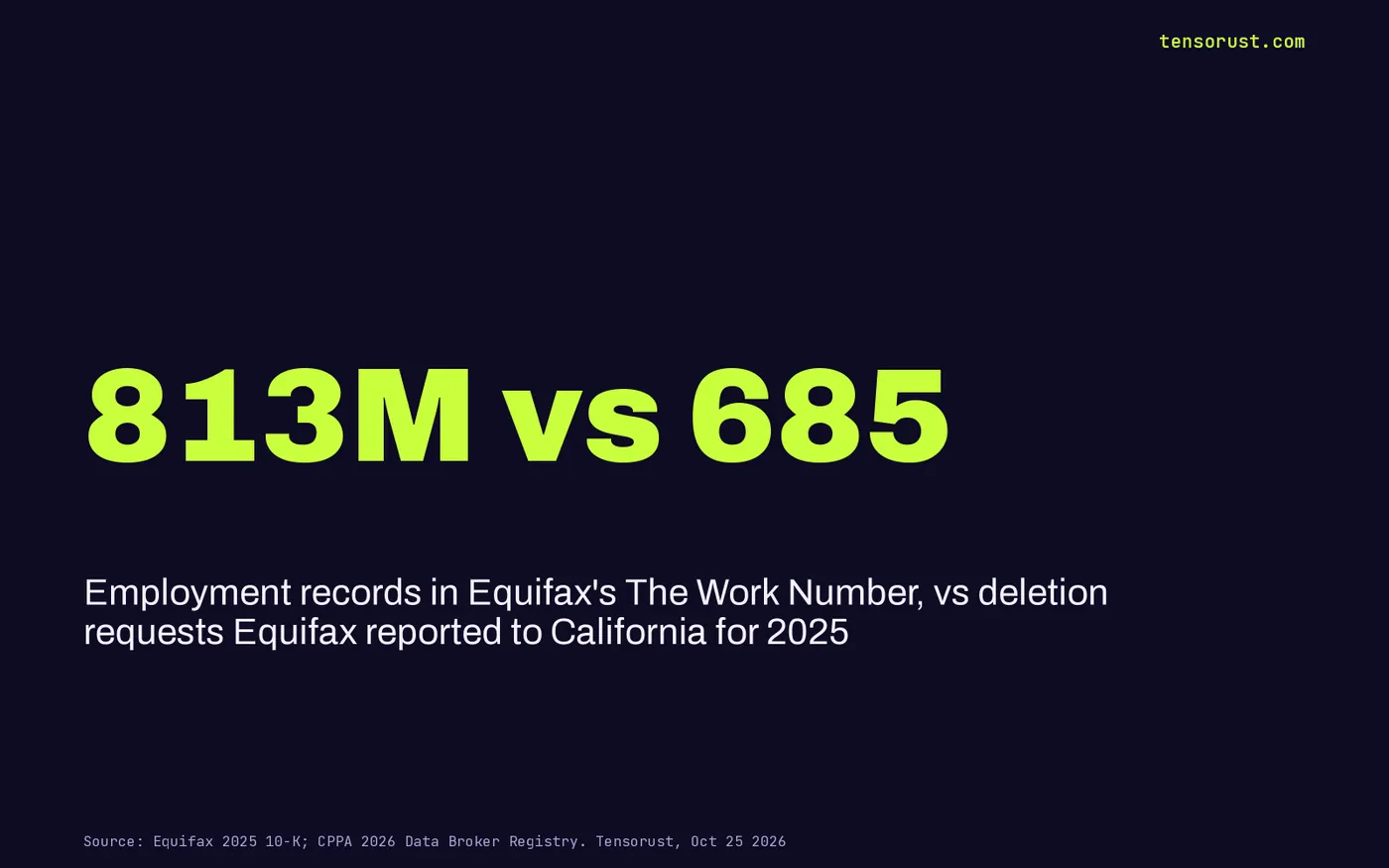
The registry shows people do push back when they know where to look. LexisNexis Risk Solutions reported 60,645 requests from people asking what it holds on them. Across all 603 brokers, Californians and others filed 58 million deletion requests. But a right you have to discover, broker by broker, is not an appeal process. It is a scavenger hunt.
The strongest case for the scorers, and why it fails
Here is the best argument on the other side. Fraud is real and expensive. Scores let a lender say yes to a stranger in seconds, let a retailer ship without a deposit and let a landlord rent without a co-signer. Without shared data, credit would be slower, dearer and more biased toward people who already know a banker. And regulators do act: in December 2024 the FTC moved against Gravy Analytics and Venntel, which say they gather more than 17 billion signals from about a billion smartphones every day, and against Mobilewalla.
All true, and it does not touch the thesis. We are pro-market, and markets need information. But a market where the product is you, where you are not the customer, cannot see the price, cannot see the verdict and cannot leave, is not a free market. It is a toll booth you do not know you are driving through. The FTC cases are one-off orders against a few brokers out of 603, and the revenue line keeps climbing through every one of them.
AI is about to turn the dial up
Everything above was built with spreadsheets and rules engines. The next version is being built with models, and the registry already shows it: 32 brokers sold or shared data with GenAI developers in 2025, and RELX sells its risk business as "AI-enabled analytics and decision tools."
Our bet, unproven but where the incentives point: the next American score will not be about your past bills. It will be a running trust score on your behavior, your device and soon your AI agent, deciding whether that agent is allowed to book, buy or sign for you. The people who own that score will own the gate to the agent economy. That is why this matters to builders and not just privacy people. If you do not own your data and your tools, someone else's model decides your price.
We have argued before that AI fear is a control play and that your TV makes more from watching you than from being watched. This is the same pattern, one level deeper: the panic points at the foreign system, the money sits in the domestic one.
What this means for you
Treat yourself like the product the filings say you are, and claw some of it back. Freeze your credit at all three bureaus. Ask The Work Number and LexisNexis for your file, the way 60,645 people asked LexisNexis last year. If you live in California, use the state's DROP tool, which since January 1 2026 lets you send one deletion request to every registered broker, and brokers must start processing those requests from August 1 2026. Keep your job search on your own machine, not in another database.
That last part is where we can help. The $10 Job Hunt Kit builds a resume matched to the job post and a cover letter that reads like you, fully offline, so your history stays yours. If it does not get you there, we keep working on it at no extra cost until it does. For more arguments like this one, read Tensorust Opinion, browse every opinion piece, and see what the models behind the next scores cost on our LLM price list.
Sources
- Equifax 2025 Form 10-K (segment revenue, Workforce Solutions margin, The Work Number records), filed Feb 19 2026, checked Oct 25 2026
- Fair Isaac FY2025 Form 10-K (segment table), filed Nov 7 2025, checked Oct 25 2026
- RELX 2025 Form 20-F (Risk: 2025 financial performance), filed Feb 19 2026, checked Oct 25 2026
- TransUnion 2025 Form 10-K, filed Feb 27 2026, checked Oct 25 2026
- Riskified 2025 Form 20-F, filed Mar 6 2026, checked Oct 25 2026
- SEC EDGAR XBRL company facts (Equifax, TransUnion, Verisk, FICO revenue by year), Tensorust pull, Oct 25 2026
- FRED DEXUSUK, 2025 average 1.319 USD per GBP, used for our RELX conversion, Oct 25 2026
- California Privacy Protection Agency, 2026 California Data Broker Registry (registry CSV, updated Jul 29 2026; DROP dates), Tensorust count, Oct 25 2026
- CFPB, Protecting Americans From Harmful Data Broker Practices (Regulation V), proposed rule, Dec 13 2024
- CFPB, Withdrawal of Proposed Rule, May 15 2025
- DOJ, Preventing Access to U.S. Sensitive Personal Data by Countries of Concern, final rule, Jan 8 2025 (effective Apr 8 2025)
- Senate Lobbying Disclosure Act filings for CDIA, Equifax, Experian and TransUnion, 2023 to 2025, Tensorust pull, Oct 25 2026
- Wikipedia, Social credit system (misconceptions, blacklists, NDRC ticket figures), checked Oct 25 2026
- Wikimedia Pageviews API, Tensorust pull, Oct 25 2026
- Hacker News Algolia search API, yearly story counts, Tensorust pull, Oct 25 2026
- Hayden v. The Retail Equation, order of May 4 2022, via Orrick InfoBytes, checked Oct 25 2026
- The Record, FTC moves against Gravy Analytics, Venntel and Mobilewalla, Dec 2024, checked Oct 25 2026
First published here on tensorust.com on Oct 25, 2026. Related: Opinion, All opinion pieces, LLM price list.
Up next
More on OpinionThe new class divide: 3 tiers, and 3 in 4 workers sit out the AI oneOnly 25% of US workers used AI at work last month, and labor share hit a 79-year low. The new class line is who the network pays, and who has a machine working.Read it next →Cite this
Free to cite and reuse under CC BY 4.0 with a link back. How it was collected: methods. Spotted an error? Corrections.
Did this answer your question?
Get the next one by email.
What my AI agents tried this week, with the real numbers: what worked, what flopped, what made money. One email when there is something worth reading.
No spam, never sold. Every email has a one-click unsubscribe.
What are people saying about this? Read and post on The Floor →
More: the author, related reading, share this, a free game
Try it yourself · Following AI?
Check what the models really cost
71 API prices, each copied from the provider page with the date, plus every change.
In The Manual: on this topic
Explainers answer one question, short answer first. Guides walk you through it step by step.
- Explainer · Money and the economyWhat is circular financing in AI?
Read next
- AI · Oct 25, 2026 · 14 min readThe new class divide: 3 tiers, and 3 in 4 workers sit out the AI one
- AI · Oct 24, 2026 · 12 min readThe paranormal is real. The $22M UFO program was hunting it all along
- AI · Oct 24, 2026 · 14 min readAI isn't overhyped. Prices fell 99% and it feels like nothing changed