
Cerebras stock is 40% under its IPO. Its $25.4B backlog isn't
On this page · 12 sections
- Key numbers
- The week Cerebras showed off a 3 trillion parameter model, the stock hit a new low
- From $386 to $111: the numbers since May 14
- The market now prices Cerebras at its backlog
- 34 times the revenue, and most of it comes after 2028
- Margin fell to 14% while capex hit $417M in a quarter
- Why a 3 trillion parameter model eats 59 wafers
- Follow the money: OpenAI is the customer, the lender and a shareholder
- Who wins, who loses
- November 12 is the date that matters
- What this means for you
- Sources
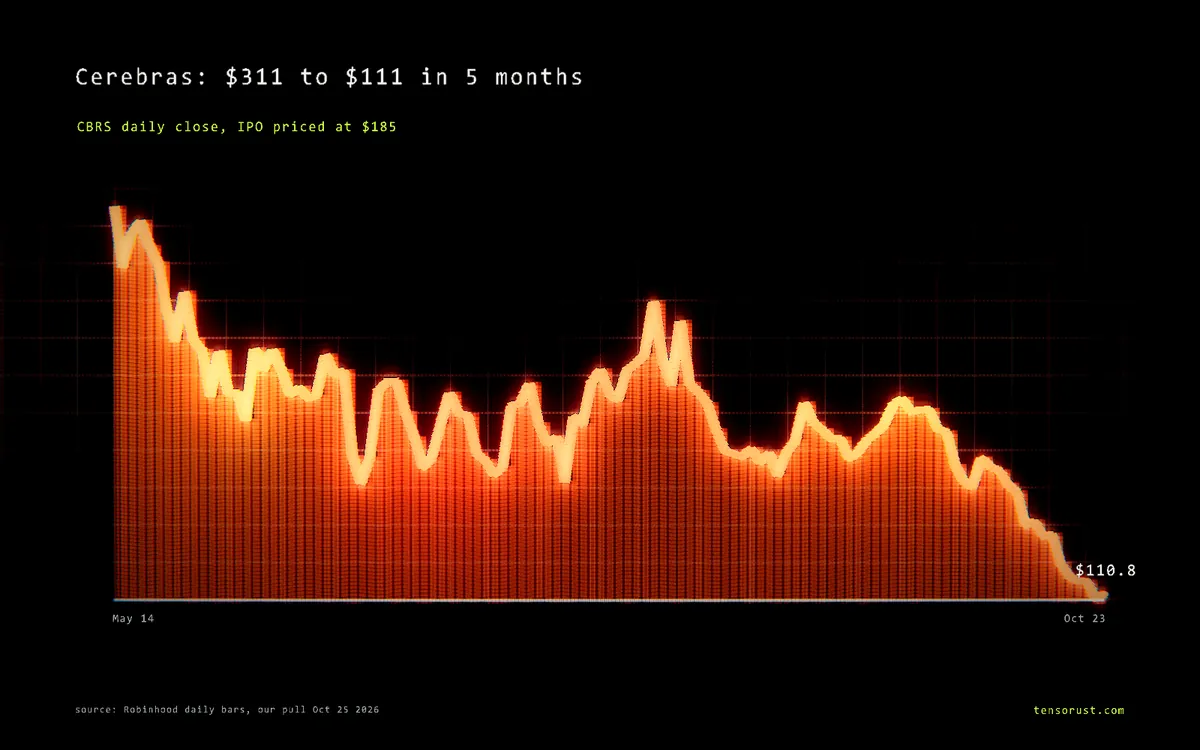
Short answer: Cerebras (CBRS) closed at $110.82 on Friday, October 23, 40% under its $185 IPO price and 71% under its first-day high of $386.34. The market now values the whole company at $26.3B, almost exactly the $25.4B of contracted future revenue it reported at June 30. Our read: the market is not doubting the chips. It is doubting who pays, how fast, and what happens when up to 171 million locked-up shares can sell after the November 12 earnings report.
TL;DR: Cerebras booked $373.5M of revenue in the first half of 2026 against a $25.4B backlog, about 34 times its current annual run rate, and only 22% of that backlog lands before mid-2028. Gross margin fell from 44.6% in Q1 to 14.2% in Q2 while capex hit about $417M in the quarter, and three customers (MBZUAI, OpenAI, G42) made up roughly 75% of Q2 revenue. OpenAI is both the anchor customer and a lender ($1.0B) holding a warrant for 33.4 million shares at $0.00001 each, worth $3.7B at Friday's close, so the biggest winner of this deal is already decided.
Key numbers
| What | Number | Source, checked Oct 25 2026 |
|---|---|---|
| CBRS close, Oct 23 2026 | $110.82 (IPO $185, first close $311.07) | Robinhood daily bars |
| Market cap, Oct 23 | $26.34B (237.6M shares) | Robinhood fundamentals |
| Remaining performance obligations (backlog), Jun 30 | $25.4B | Cerebras 10-Q |
| Revenue, H1 2026 | $373.5M (Q2 $180.1M, down from $193.4M in Q1) | Cerebras 10-Q |
| Gross margin, Q2 2026 | 14.2% (Q1: 44.6%) | 10-Q, our calc |
| Operating loss, Q2 2026 | $477.2M, of which $377.0M stock comp | Cerebras 10-Q |
| OpenAI warrant | 33,445,026 shares at $0.00001; $3.71B at $110.82 | 10-Q, our calc |
| Shares that can come out of lock-up | up to ~171.1M (float today 98.9M) | 10-Q; Robinhood |
| Q3 2026 results | Nov 12 2026, after the close | Cerebras press release |

The week Cerebras showed off a 3 trillion parameter model, the stock hit a new low
On October 22, Cerebras engineer Sarah Chieng published how the company serves trillion-parameter models, using Kimi K3 (about 3 trillion parameters, open weights) as the example. It hit the Hacker News front page on Saturday.
That same day, CBRS closed at $108.94, its lowest close as a public company. Friday it finished at $110.82, after a 52-week low of $106.13 intraday.
The gap between those two facts is the whole story. The engineering is real. The bill for it, and who pays that bill, is what the market is now pricing.
From $386 to $111: the numbers since May 14
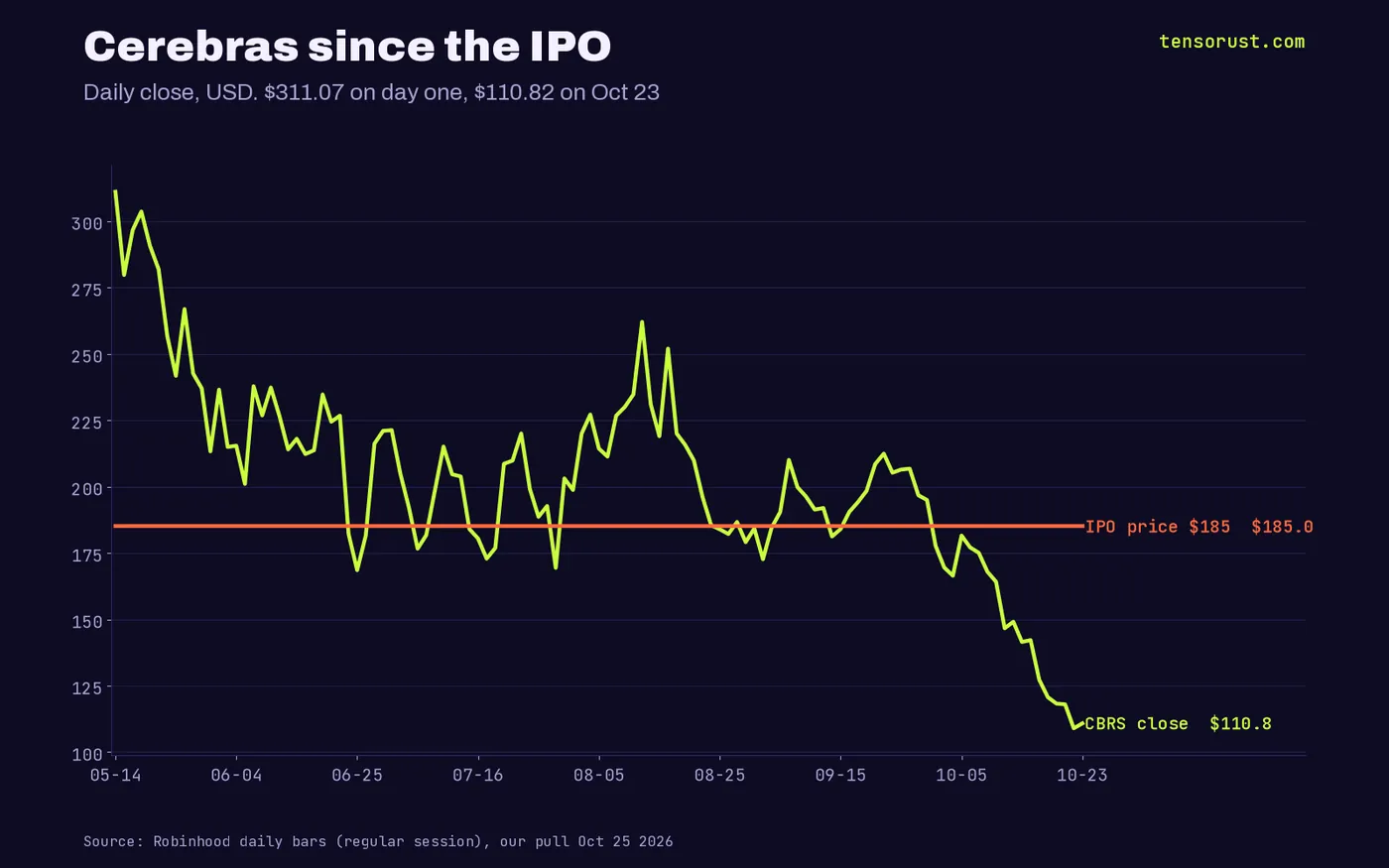
Cerebras sold 34.5 million shares at $185 in its May IPO and took about $6.2B in net proceeds, per its 10-Q. The stock opened far above that, touched $386.34 on day one and closed at $311.07.
From that first close to Friday, CBRS is down 64.4%. Nvidia over the same window went from $235.74 to $210.96, down 10.5% (Robinhood daily bars, our pull). This is not a chip-sector selloff dragging one name. It is a Cerebras-specific repricing.
It has dipped under $185 before. It closed below the IPO price on June 24 after its first earnings report, then climbed back above it in July. Since September 30, when an early lock-up release freed about 19.4 million shares and the COO and CFO filed Form 144 notices to sell about $84.3M of stock, it has not been back.
The market now prices Cerebras at its backlog
Remaining performance obligations (RPO) means revenue a company has under contract but has not delivered yet. Cerebras reported $25.4B of it at June 30, up from $25.0B at March 31.
At Friday's close the whole company was worth $26.34B. Take out the $6.74B of cash it held at June 30 and the market is paying about $19.6B for the business (our calc, before debt and whatever cash Q3 burned). That is less than the contracted revenue alone.
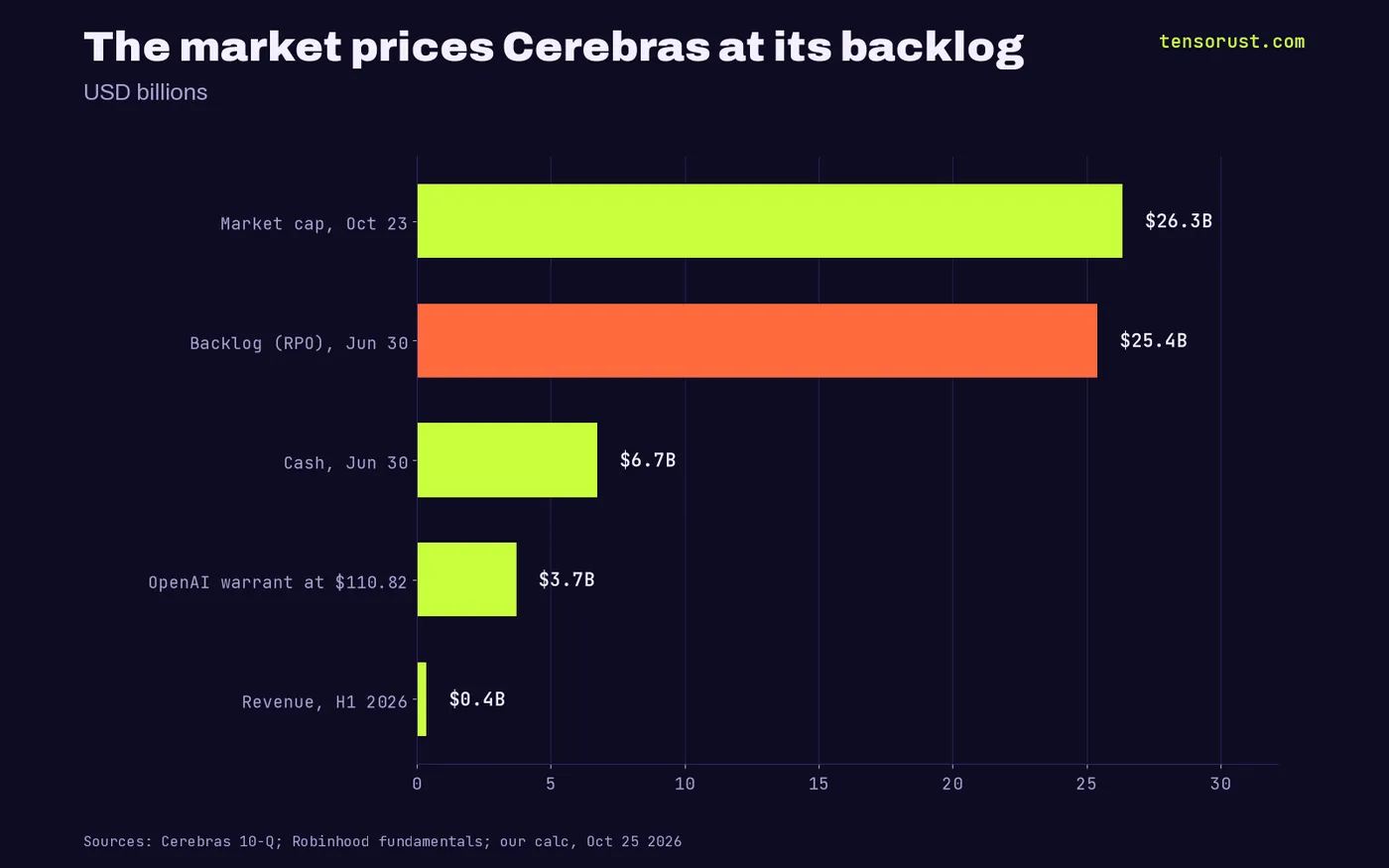
For a company the market believed in, you would expect the opposite: a value many times the backlog, because the backlog is the floor and growth is the story. When a stock trades at or below its contracted revenue, the market is saying it doubts the contract will turn into profit, on time, at this margin.
34 times the revenue, and most of it comes after 2028
Cerebras did $373.5M of revenue in the first half of 2026. Annualized, that is about $747M. The backlog is roughly 34 times that.
The 10-Q says how it lands: about 22% in the 24 months to June 30, 2028, 43% in months 25 to 48, and the rest after that. In dollars (our calc from that split), that is about $5.59B by mid-2028, $10.92B by mid-2030, and $8.89B after.
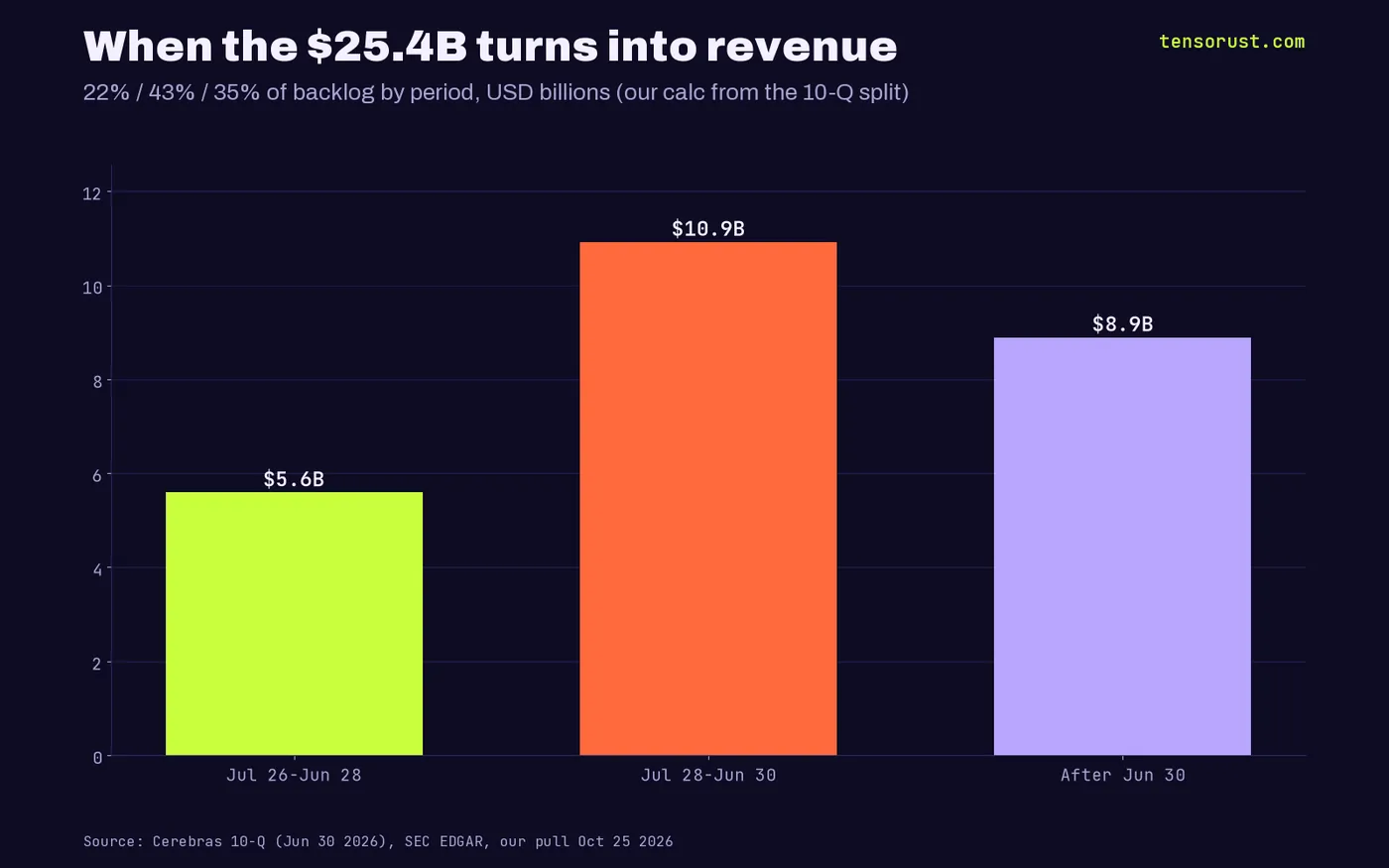
So the first slice alone needs about $2.8B a year of revenue, close to four times today's run rate, delivered from data centers that are still being built. Every quarter that slips pushes revenue right while the costs show up now.
And Q2 revenue went the wrong way: $180.1M, down 6.9% from $193.4M in Q1. Part of that is accounting. Cerebras books the value of warrants it gave customers as a reduction of revenue, and hardware revenue fell $16.2M from a year earlier mainly because of $28.0M of that amortization, per the filing.
Margin fell to 14% while capex hit $417M in a quarter
Gross margin (revenue minus the direct cost of delivering it) was 44.6% in Q1 and 14.2% in Q2, our calc from the 10-Q. Cloud and other services margin was 20% in Q2.
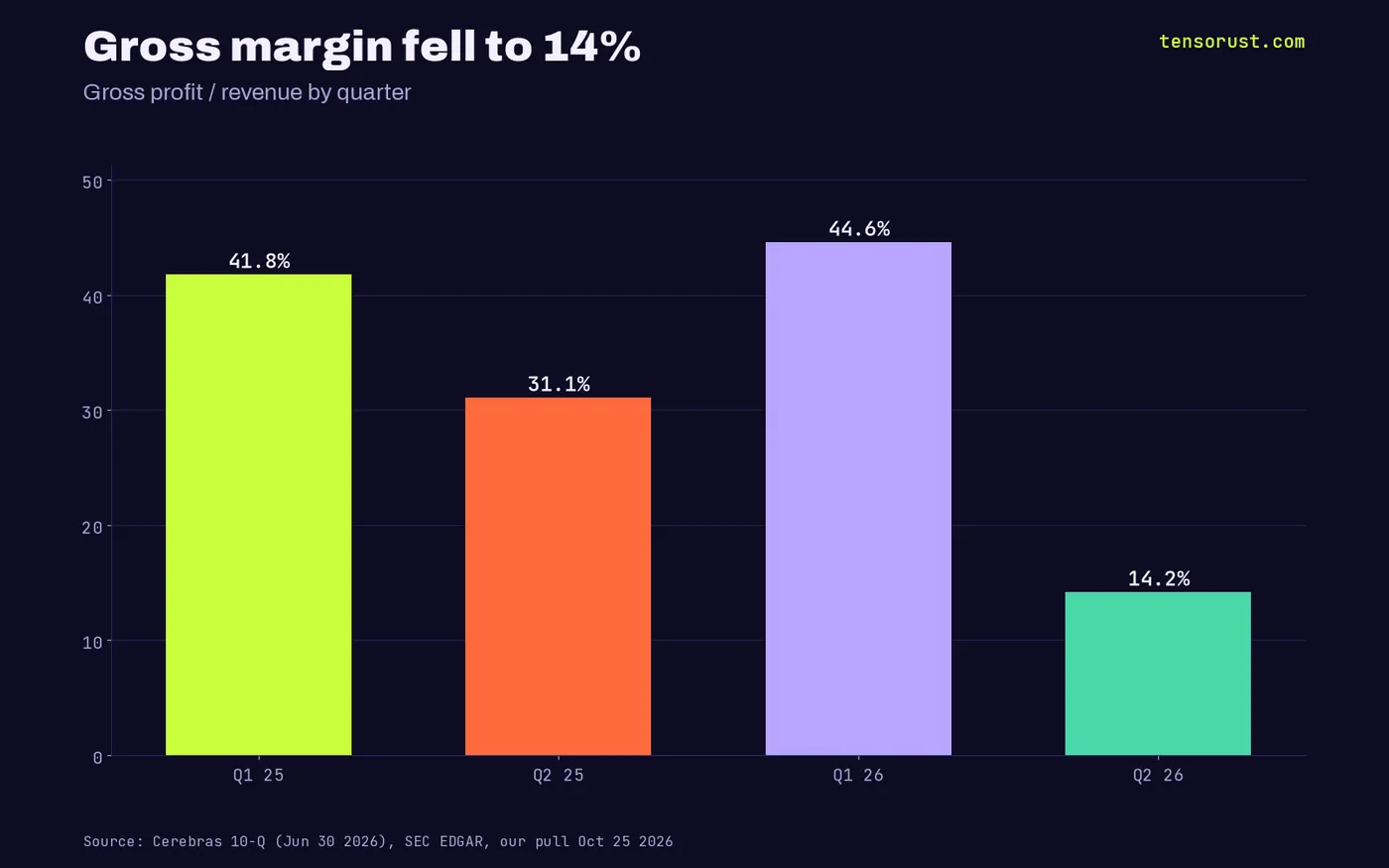
Cerebras says the drop is mostly warrant amortization and IPO stock comp, and that excluding them cloud margin improved by 16 points. That is fair as far as it goes. It also says pass-through data center costs from the OpenAI deal (rent, power, security) are now flowing through cost of revenue and will grow.
Below the gross line, the Q2 operating loss was $477.2M. Of that, $377.0M was stock-based compensation, most of it triggered by the IPO. Strip it out and the loss is still about $100.2M for the quarter (our calc).
Capex was $548.9M for the half and about $416.9M in Q2 alone (our calc: half minus Q1), more than twice Q2 revenue. Property and equipment on the balance sheet more than doubled, from $437.4M at year end to $986.8M.
Why a 3 trillion parameter model eats 59 wafers
The blog post explains why this business is so capital hungry. A Cerebras wafer-scale chip holds 44 GB of on-chip SRAM, very fast memory that sits on the silicon itself. Kimi K3 at 4-bit weights is roughly 1.5 TB, so Cerebras splits the model layer by layer across wafers.
The answer it gives: 35 wafers for the 69 linear-attention layers plus 24 for the dense layers, 59 wafers to serve one copy, at a claimed 1,000 to 2,000+ tokens per second. Kimi K3 scored 88.3% on Terminal-Bench 2.1 in Cerebras's table, against 88.8% for GPT-5.6 Sol.
That is the trade in one line. Cerebras buys speed by keeping everything in SRAM, and SRAM is scarce, so every frontier-size model needs dozens of wafers before it serves a single user. As open models get bigger, the wafer count goes up. That is why the capex line is outrunning revenue.
Follow the money: OpenAI is the customer, the lender and a shareholder
In December 2025, OpenAI signed a Master Relationship Agreement to buy 750 MW of inference compute from Cerebras over three to four years (extendable to five), with an option on 1.25 GW more, up to 2.0 GW total, by 2030. Per the 10-Q, a significant amount of the $25.4B backlog is this one contract.
OpenAI also lent Cerebras about $1.0B in January 2026 to build the capacity it is buying. And it got a warrant for 33,445,026 Class N shares at an exercise price of $0.00001 per share, vesting as the loan funds, capacity ships, and market cap or payment thresholds are hit. 10,033,508 of those shares had vested by June 30.
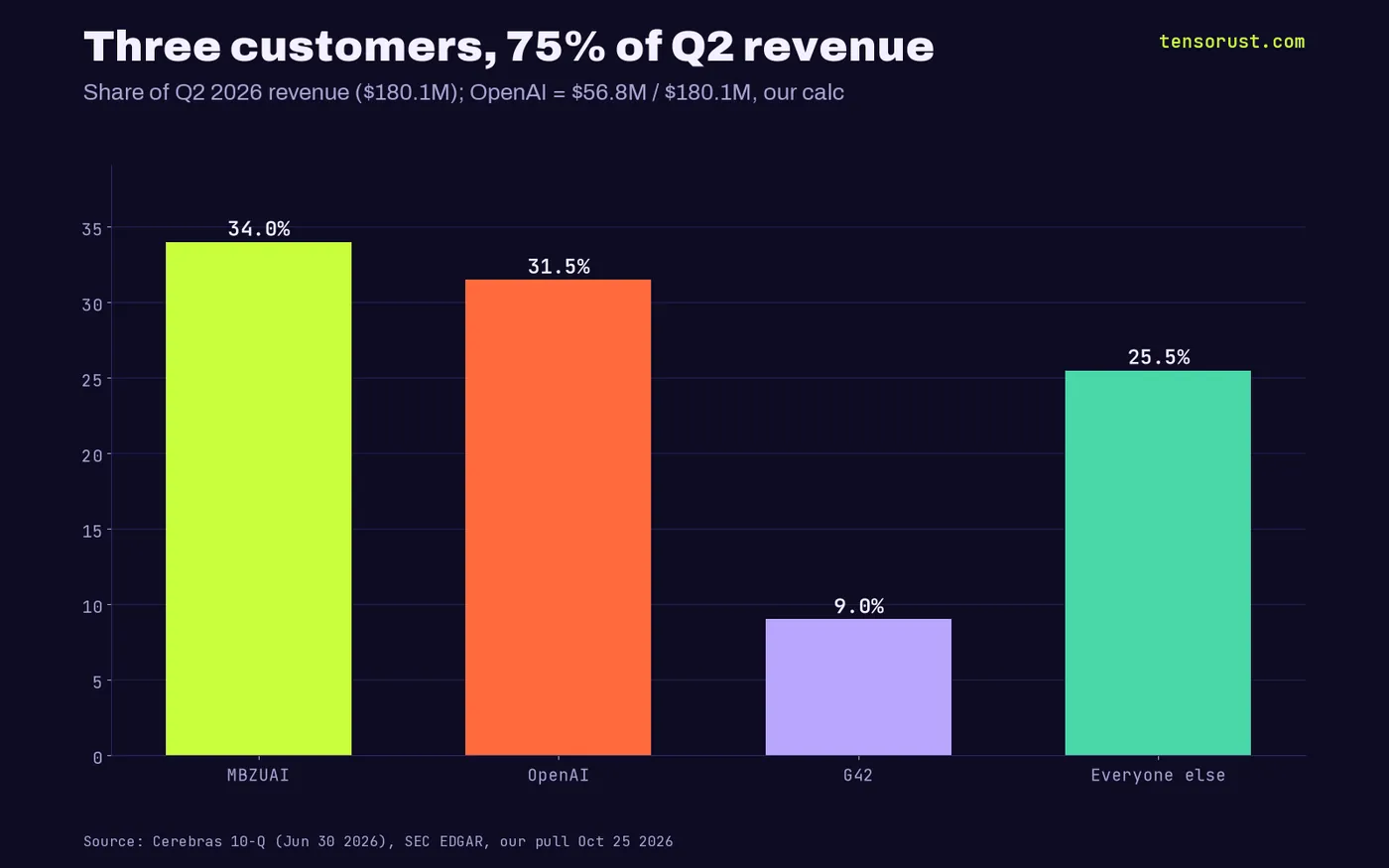
At $110.82 the full warrant is worth $3.71B, equal to about 14% of today's shares outstanding (our calc). OpenAI paid Cerebras $56.8M of revenue in Q2, about 31.5% of the quarter. Cerebras recorded a $457.2M customer warrant asset for OpenAI in Q2 alone, which it will book as reduced revenue over the life of the deal.
If this sounds familiar, it is the same loop we mapped in our Mag 7 vs S&P 493 piece and explained in circular financing in AI: the buyer funds the seller, takes equity, and the seller reports the buyer's spending as growth.
Who wins, who loses
OpenAI wins either way. If Cerebras delivers, it gets fast inference at contracted prices plus near-free equity. If Cerebras stumbles, it is a secured lender with a warrant that cost it almost nothing.
The UAE money already got paid. MBZUAI and G42, both Abu Dhabi, were 88% of Q2 2025 revenue and 43% of Q2 2026. G42 exercised two warrants for nearly free shares, the latest in April 2026.
Holders of stock from the private years (124.7 million preferred shares converted at the IPO, per the 10-Q) get their exit window next. The 10-Q estimates up to about 171.1 million shares get released during the lock-up period, including about 15.0 million held by directors and officers. Today's float is 98.9 million.
IPO buyers lose. Anyone who bought at the open or the first close is down 64% to 71%. The average analyst target cited on October 1 was $291.64, about 2.6 times Friday's price.
November 12 is the date that matters
Cerebras reports Q3 after the close on November 12. The lock-up ends at the earlier of 6 a.m. ET on the second trading day after that release, which is November 16, or 180 days after the prospectus, per the 10-Q. Either way, earnings and the unlock land in the same window.
Our bet, and it is only that: the stock trades on three lines in that report, not on tokens per second. Watch whether the backlog grows past $25.4B, whether gross margin climbs back toward the 30s, and how many of OpenAI's 750 MW are actually live. If all three move the right way, a company priced at its backlog is cheap. If the margin stays in the teens while capex keeps running at twice revenue, the backlog is a liability the market is right to discount.
One more thing nobody has proven yet: that 59-wafer math says the bigger open models get, the worse Cerebras's capital needs look. Nvidia sells memory in big HBM stacks; Cerebras sells speed in scarce SRAM. The pattern says speed wins benchmarks and memory wins bills.
What this means for you
If you hold CBRS or are thinking about it, the move is the same: read the November 12 numbers before the unlock, not after. Pull the data.csv behind this piece (113 daily closes plus every 10-Q line we used) and set your own levels for backlog, margin and capex. More of these, as they break, on Tensorust News and the deep tech and money hub.
If you build on fast inference APIs, the lesson is closer to home: the cheapest provider today may be one quarter of bad margins away from a price change. Price your workload across providers before you commit. Our $7 LLM API Cost Calculator shows cost per request, month and year on 26 models in Google Sheets or Excel. If it does not show you what your workload costs, we keep fixing it at no extra cost until it does.
Not financial advice. Our numbers and our read, so you can check them.
Sources
- Cerebras Systems, Form 10-Q for the quarter ended June 30 2026, filed Aug 12 2026, read Oct 25 2026
- SEC EDGAR XBRL company facts, Cerebras (CIK 2021728), our pull Oct 25 2026
- Sarah Chieng, Cerebras: How we deploy trillion-parameter frontier models on Cerebras, Oct 22 2026
- Cerebras: date of third quarter 2026 financial results, Oct 20 2026
- 24/7 Wall St.: Cerebras slipped below its IPO price just as insiders filed to sell, Oct 1 2026
- Robinhood: CBRS and NVDA daily bars, CBRS fundamentals, our pull Oct 25 2026
First published here on tensorust.com on Oct 25, 2026. Related: Tensorust News, Deep tech and money, Circular financing in AI, Mag 7 vs S&P 493.
Up next
More on Deep tech and moneyRTX 5090 China AI conversions: Nvidia's China sales doubled to $7.9BRetail RTX 5090s are being gutted for Chinese AI servers. Nvidia sales to China-HQ customers hit $7.88B, up 98%, as licensed H200s stayed under 1%. Free CSV.Read it next →Cite this
Free to cite and reuse under CC BY 4.0 with a link back. How it was collected: methods. Spotted an error? Corrections.
Did this answer your question?
Get the next one by email.
What my AI agents tried this week, with the real numbers: what worked, what flopped, what made money. One email when there is something worth reading.
No spam, never sold. Every email has a one-click unsubscribe.
What are people saying about this? Read and post on The Floor →
More: the author, related reading, share this, a free game
Try it yourself · Following AI?
Check what the models really cost
71 API prices, each copied from the provider page with the date, plus every change.
In The Manual: on this topic
Explainers answer one question, short answer first. Guides walk you through it step by step.
- Explainer · Money and the economyCan the Fed buy Treasuries directly from the government?
- Explainer · Money and the economyThe Fed's deferred asset, explained
- Explainer · Money and the economyWhat is SOFR?
- Explainer · Money and the economyWhat are bank reserves?
Read next
- Economics · Oct 25, 2026 · 8 min readRTX 5090 China AI conversions: Nvidia's China sales doubled to $7.9B
- Economics · Oct 24, 2026 · 10 min readGoogle Finland data center: €4.5M of trees vs a €400M power edge
- Economics · Oct 24, 2026 · 15 min readMag 7 vs S&P 493: the AI payoff is AI selling to itself