
Gmail ads are back: Google's 5-year promise now ends in 'unless'
On this page · 10 sections
- Key numbers
- The one sentence Google changed on October 16
- We diffed 55 versions of Google's privacy policy
- The pattern: "we will not" becomes "depending on your settings"
- Follow the money: why Gmail is worth an "unless"
- Is this a scandal? Our honest read
- What Google's next "unless" looks like
- How to check your Gmail ad settings in 2 minutes
- What this means for you
- Sources
Short answer: Yes, Google can now use your Gmail, Drive and Google Photos content to pick your ads, if you have connected those apps to Search or Gemini through Personal Intelligence. The privacy policy line "We don't show you personalized ads based on your content from Drive, Gmail, or Photos" lasted 1,933 days before Google added an "unless" on October 16 2026. We diffed all 55 versions of Google's privacy policy since 1999, and this is not the first promise that ended this way.
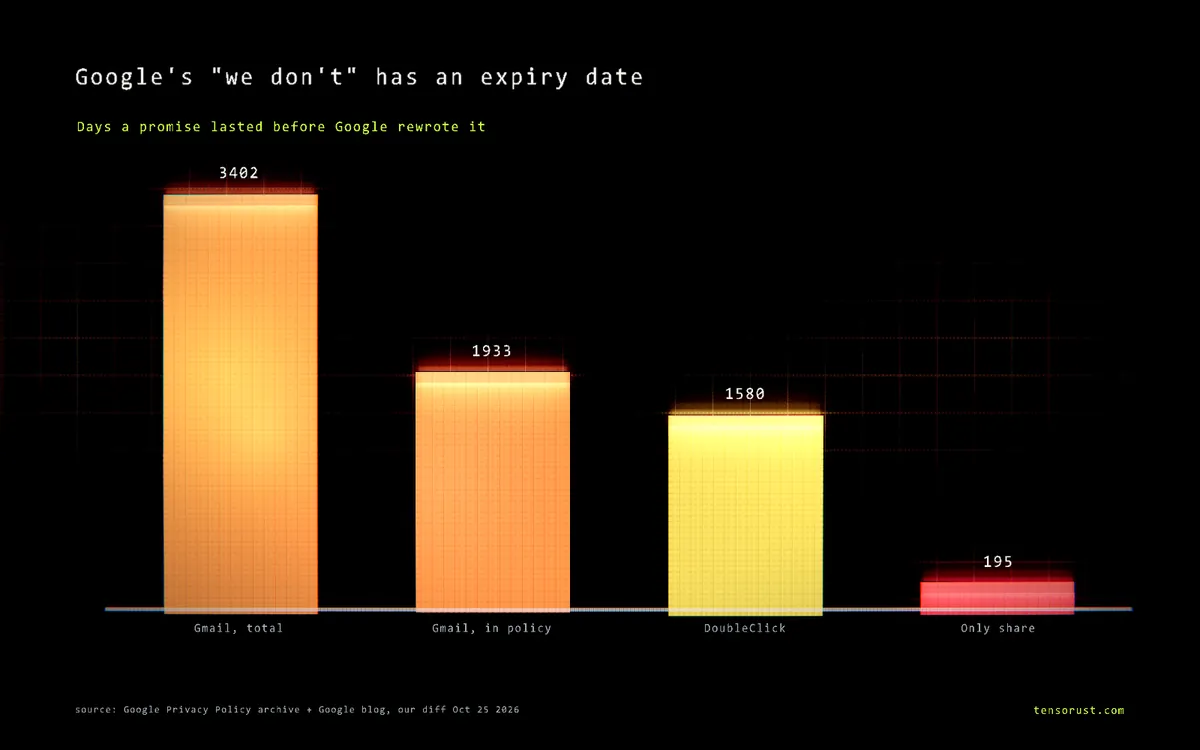
TL;DR: Google's 2017 pledge that consumer Gmail "will not be used or scanned for any ads personalization" held for 3,402 days, and Google quietly appended an update to that same 2017 blog post on October 16 2026. In 2016 the same move hit the DoubleClick promise: a "we will not combine" line that lasted 1,580 days was swapped for "depending on your account settings", a phrase that went from 0 uses to 6 in the policy. All of it protects a machine that made $81.6 billion in Google advertising in one quarter, so check your Personal Intelligence settings today and treat every "we don't" from an ad company as a lease, not a deed.
Key numbers
| What | Number | Source, checked Oct 25 2026 |
|---|---|---|
| Google privacy policy versions we diffed | 55 (June 9 1999 to October 16 2026) | Google Privacy Policy archive |
| Days the Gmail/Drive/Photos ad promise stayed word for word in the policy | 1,933 (July 1 2021 to October 16 2026) | Google comparison view, Oct 1 vs Oct 16 2026 |
| Days since Google's 2017 "no Gmail ad scanning" blog post | 3,402 (June 23 2017 to October 16 2026) | Google blog, Diane Greene |
| Days the DoubleClick "we will not combine" promise lasted | 1,580 (March 1 2012 to June 28 2016) | Google comparison view, 2016 |
| Policy length, first version vs now | 617 words to 10,535 words (17x) | Our count, Google archive |
| Mentions of ads or advertising | 1 to 100 | Our count, Google archive |
| Google advertising revenue, Q2 2026 | $81.6B, 68.1% of Alphabet's $119.8B | Alphabet 10-Q, SEC EDGAR |
| Google advertising revenue, last 4 quarters | $315.3B | Alphabet 10-Q and 10-K, our sum |

The one sentence Google changed on October 16
Here is the line as it read in the October 1 2026 policy: "We don't show you personalized ads based on your content from Drive, Gmail, or Photos." Clean. No conditions.
Here is the line now: "We don't show you personalized ads based on your content from Drive, Gmail, or Google Photos, unless you choose to make data from these services available to other Google services that support personalized ads."
The October 16 version is 203 words longer than October 1 (10,332 to 10,535 in our count). Almost all of the new words sit in the ads section. Google also added that "Search may process some of the data that you allow Search to access to personalize content, including ads," and it rewrote its ad example to say you may see ads "based on your interests, activity, or personalized content from Google services."
The feature doing the work is Personal Intelligence. You connect Gmail, Drive or Photos to Search's AI Mode or Gemini so the AI can answer "what should I do near my hotel" from your booking email. Google's own new policy example is exactly that hotel email. The catch: that same connected data can now steer ads, depending on your settings.
"If users choose to enable these new features, data from Workspace Apps will be processed to personalize other Google experiences, and depending on a user's settings, that same subset of data can also be used to show ads." Google, update appended October 16 2026 to its June 23 2017 Gmail blog post
Credit where it is due: Shimul Sood at Android Authority spotted the change on October 23, and Jess Weatherbed's write-up at The Verge hit 379 points on Hacker News. We wanted to know something different: is this a one-off, or is it how Google's promises always end?
We diffed 55 versions of Google's privacy policy
Google keeps every version of its privacy policy online, back to June 9 1999. We pulled all 54 archived copies plus the live one, stripped them to plain text, and counted what changed. Every row is in the CSV at the bottom of this page.
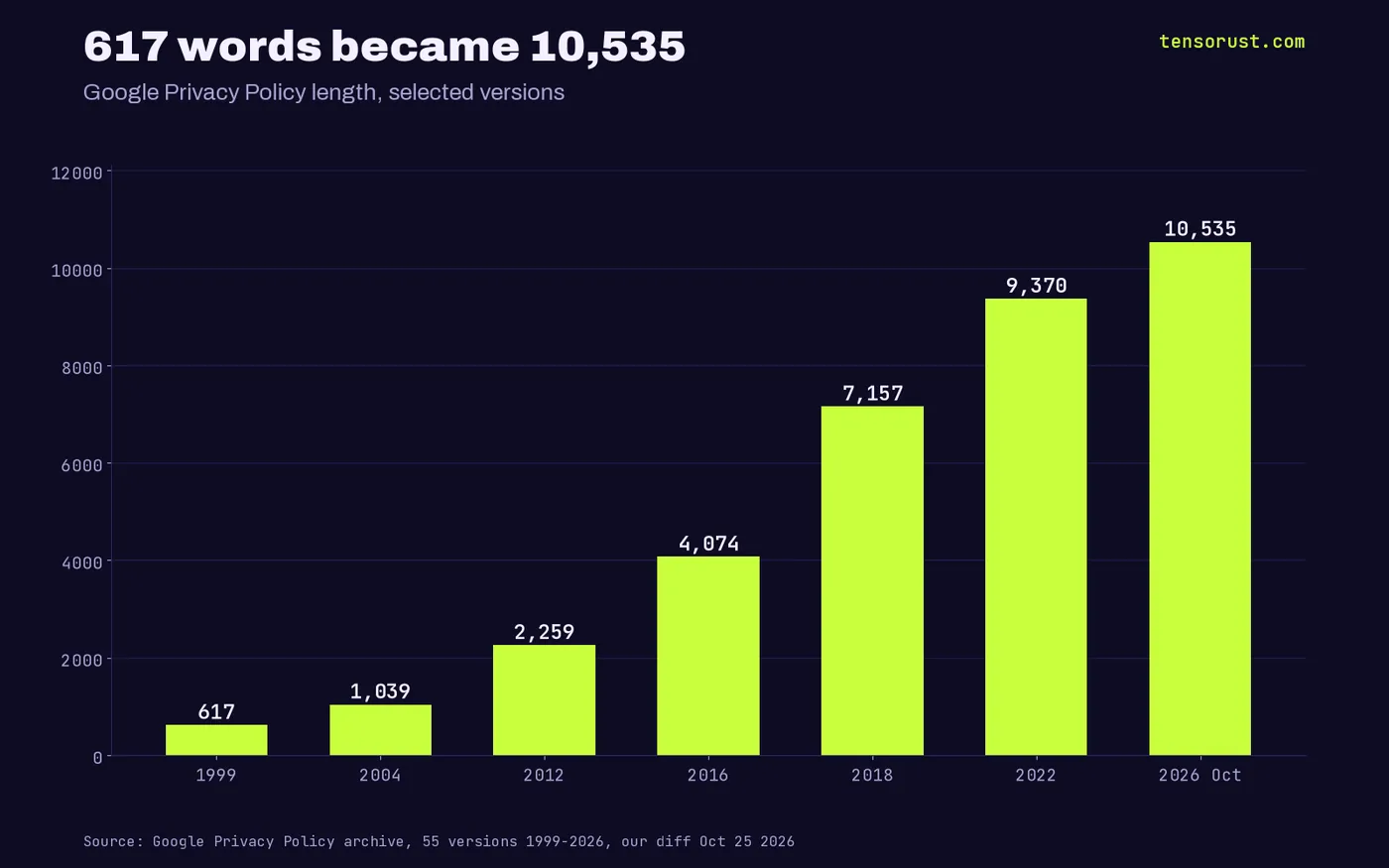
The first policy was 617 words and mentioned ads once. Today's is 10,535 words and mentions ads or advertising 100 times. The word "AI" (or Gemini, machine learning, generative) did not appear at all until July 2023; it now appears 10 times, and Gemini alone 4 times.
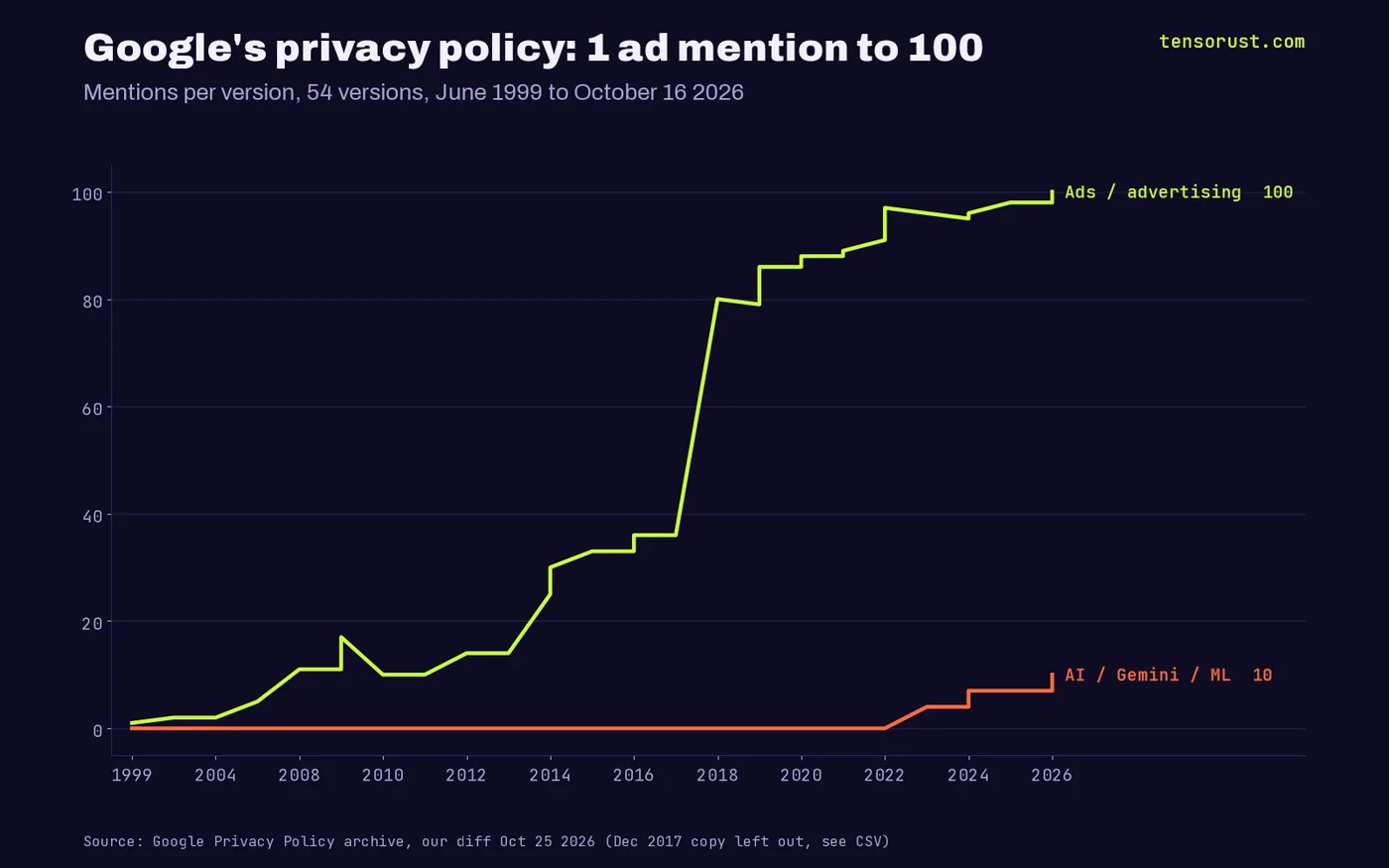
Length is not evil on its own; GDPR forced every company to spell more out in May 2018, which is the big jump on the chart. But the trend line tells you what the document is for. It started as a note about search logs. It is now the legal wiring diagram for the biggest ad business on Earth.
The pattern: "we will not" becomes "depending on your settings"
We pulled every sentence that starts with a hard promise ("we will not", "we don't", "Google does not") and tracked how long each one survived word for word. Three of the big ones ended the same way.
DoubleClick, 2012 to 2016. From March 1 2012 the policy said: "We will not combine DoubleClick cookie information with personally identifiable information unless we have your opt-in consent." On June 28 2016, after 1,580 days, that sentence was replaced with: "Depending on your account settings, your activity on other sites and apps may be associated with your personal information in order to improve Google's services and the ads delivered by Google."
"We only share your information as described in this policy", 2019 to 2020. It arrived December 19 2019 in the California (CCPA) section and was gone by July 1 2020. 195 days.
Gmail, Drive and Photos, 2021 to 2026. The line entered the policy July 1 2021 and got its "unless" October 16 2026. 1,933 days. Counting from the 2017 blog pledge, 3,402 days.
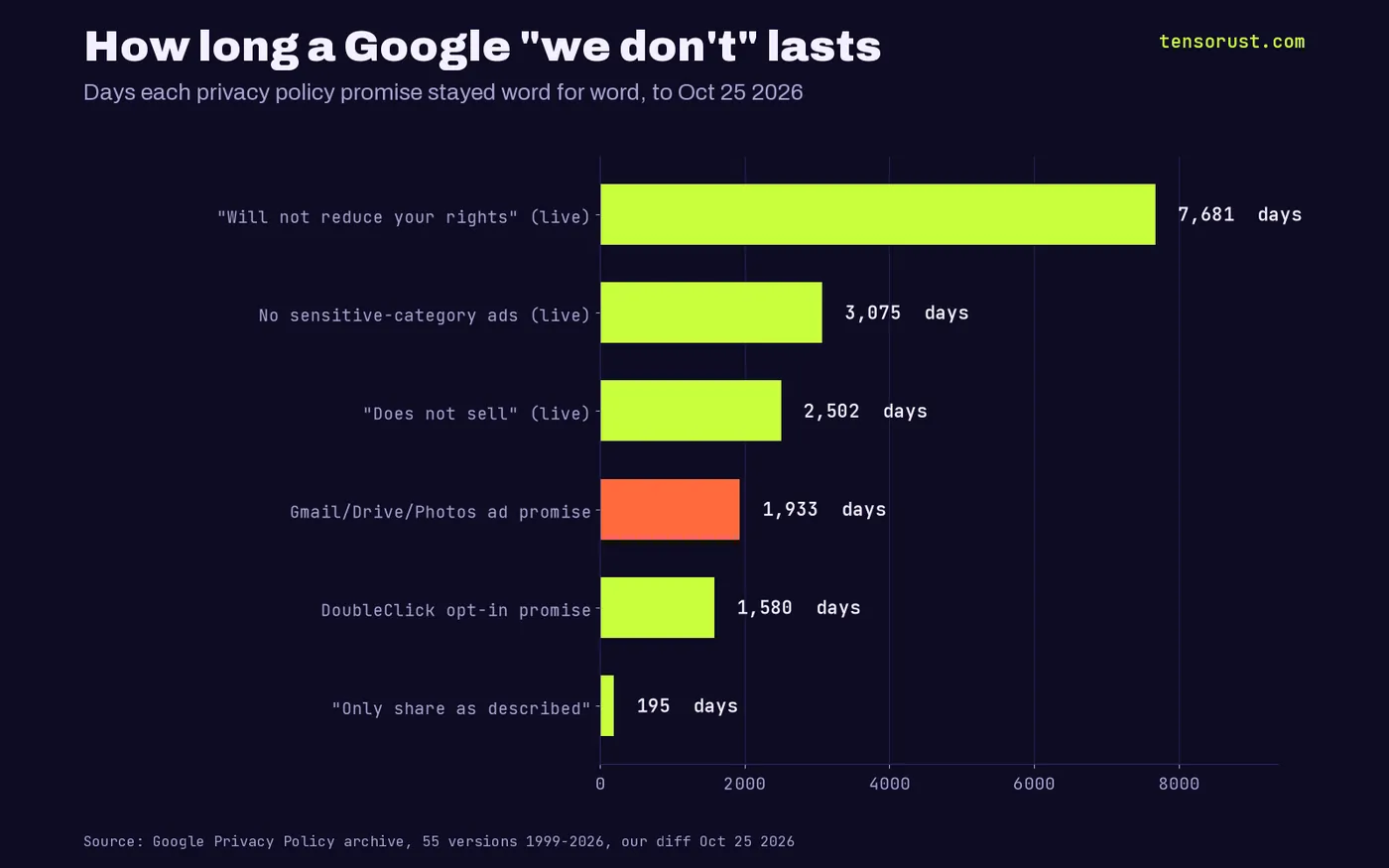
Notice what never changes. "We will not reduce your rights under this Privacy Policy without your explicit consent" has been in the policy in some form since October 2005, about 7,681 days. Our read: Google never needs to break that sentence. It moves the promise out of the rulebook and into a toggle, and a toggle you flipped counts as consent.
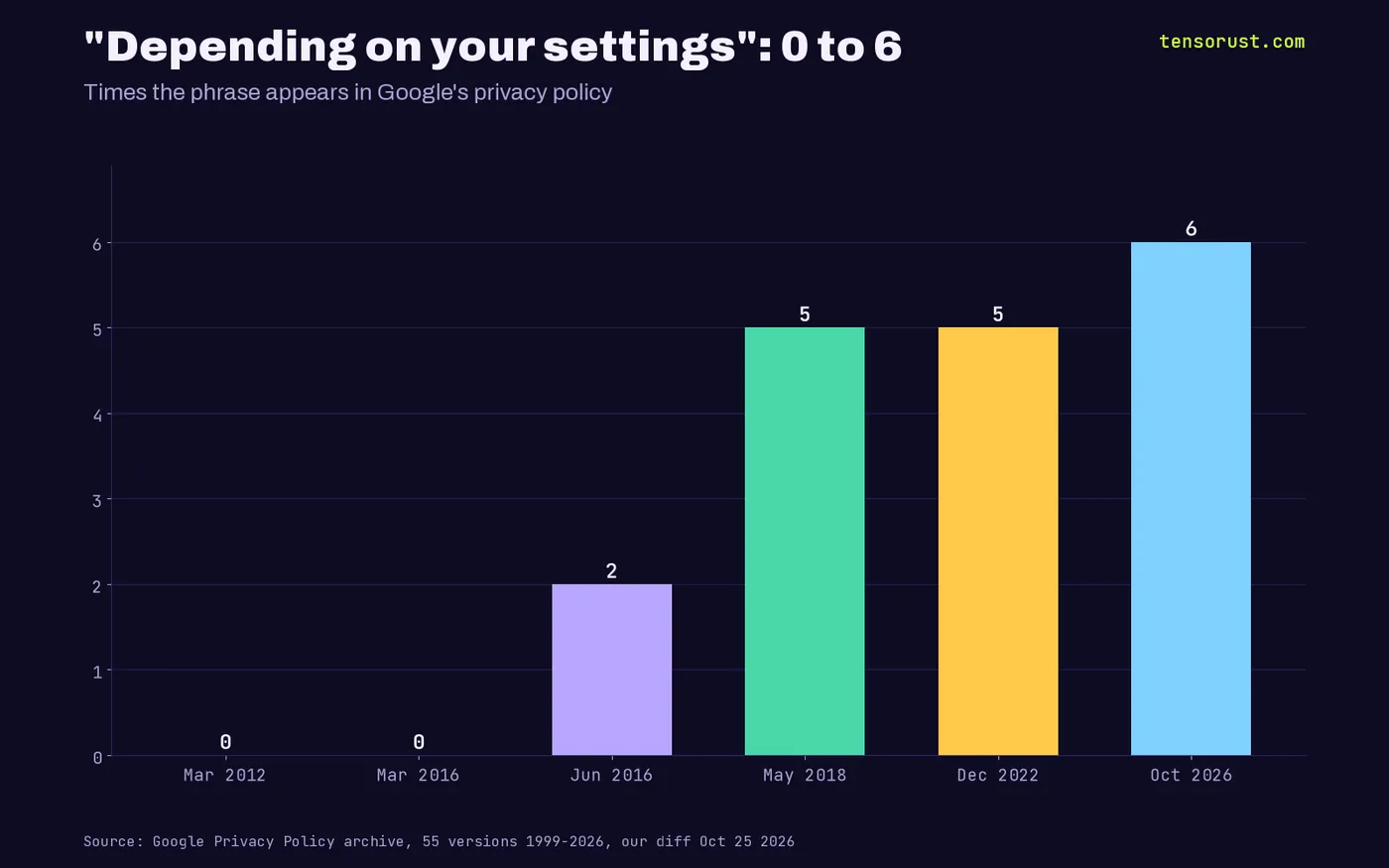
The phrase "depending on your settings" (or "account settings") appeared zero times in March 2016. It appeared twice in June 2016, five times by May 2018 and six times today. That phrase is the replacement part for a promise. Each time it shows up, a fixed rule has become a setting, and settings are something a product team can redesign, default and A/B test.
Follow the money: why Gmail is worth an "unless"
Google advertising made $81.6 billion in Q2 2026, about $897 million a day, and 68.1% of all Alphabet revenue. Over the last four quarters it made $315.3 billion.
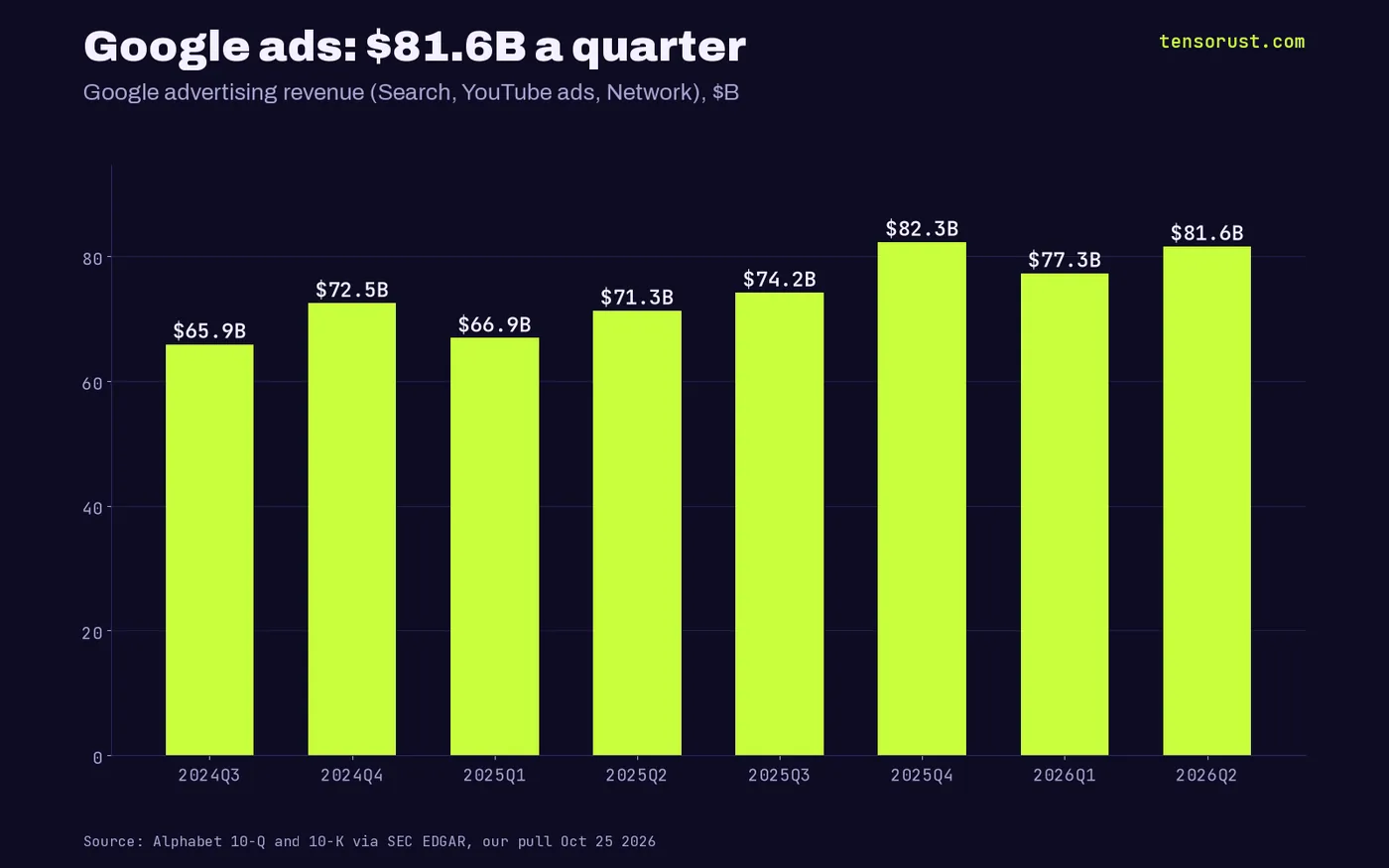
Inside that, "Google Search & other" made $63.3 billion in Q2 2026, up 16.8% from $54.2 billion a year earlier, with paid clicks up 13%. Alphabet's own 10-Q says Search & other already includes "other Google owned and operated properties like Gmail, Google Maps, and Google Play." Gmail was never outside the ad business. Only its content was.
Now look at what AI does to Search. An AI answer that knows your flight, your hotel and your kid's school schedule is more useful than ten blue links. It is also the best ad targeting signal ever built: not what you searched, but what is literally in your inbox about your next week. Google in 2017 said Gmail had "more than 1.2 billion users." That is the inventory this sentence unlocks, one opt-in at a time.
Who wins: Google, which gets richer signals for AI Mode ads without breaking a single "we will not". Advertisers, who get intent nobody else can see. Who loses: anyone who flipped on Personal Intelligence to get a better travel answer and did not read that the same switch feeds ads. And every rival without a 1.2 billion user inbox to mine, because this is a data moat, not a model moat.
Is this a scandal? Our honest read
We are pro-market. Trading your data for a free product is a legit deal, and plenty of people will happily take better AI answers plus more relevant ads. Google also says advertisers do not get your Gmail content or your name, and it still will not target ads on sensitive categories like health or religion, a line that has held since May 2018.
The problem is the bundle. "Make my AI smarter" and "use my email to sell me stuff" are two different trades, and Google glued them to one switch. A real market would price them separately. Our bet: that is not an accident, it is the business model, and the AI features are the bait that makes the ad toggle feel like a gift.
It is also a lesson in how incumbents talk. Nobody at Google had to announce "Gmail ads are back." They added an 18-word clause to a 10,000 word document and an addendum to a nine-year-old blog post. If you only read press releases, you would never know.
What Google's next "unless" looks like
Two promises are worth watching. "Google does not sell your personal information" has held for 2,502 days since December 2019. "We don't share information that personally identifies you with advertisers, such as your name or email, unless you ask us to" already carries its "unless" and has held since May 2018.
Our prediction, and it is a prediction, not a leak: the next Gemini app update brings ads that use connected content, because the new policy sentence already names "Search or Gemini Apps" side by side. Nobody has proven that is coming. The pattern says the policy text shows up before the product does, every time.
The bigger pattern is about power. A company this size can always rewrite its own rulebook, so the only promises that last are the ones you enforce yourself: your own settings, your own tools, your own stack. That is the whole case for owning the software you depend on, which we keep making on our LLM hub and in how to run an LLM in your browser, where your data never leaves the machine.
How to check your Gmail ad settings in 2 minutes
- Open your Google Account, then Data & privacy.
- Under Personalization & activity, open Personalization settings, then Manage Personalized Recommendations in Search services.
- Under Connected Content apps (Additional Personal Intelligence), disconnect Google Workspace and Google Photos if you do not want Search reading them.
- Or turn off Personalized Recommendations in Search services entirely, and check My Ad Center for personalized ads.
- Android Authority notes that data already saved may stay in Search Services History, so clear that too if it matters to you.
These steps follow Google's help page and Android Authority's walkthrough as of October 25 2026. Google says these settings are still rolling out, so names may differ on your account.
More from us on the same fight: smart TV spying and the ad money behind it, Google's Finland data center, and every story on the news desk and the AI industry topic page.
What this means for you
If you use Gmail: go flip those settings now, and keep anything truly private (legal, medical, money) somewhere that is not funded by ads. If you love Personal Intelligence, keep it, but know you are paying for it with ad targeting, and decide that on purpose.
If you build apps, the lesson cuts the other way. Your own privacy policy is a promise too, and the gap between what it says and what your app actually leaks is where trust dies. Our $49 Launch Check reads your live URL the way an attacker does and finds that gap before your users do.
Get the $49 Launch Check: exposed keys, open tables and missing headers, worst first, with the exact fix in 48 hours. If a problem we checked turns up later, we keep fixing it at no extra cost until it does what it promises.
Your turn: is bundling "smarter AI" with "ads from your inbox" a fair trade, or should Google have to sell them as two separate switches? Tell us in the comments on the original post.
Sources
- Google, Privacy Policy archive (55 versions, 1999 to 2026), checked Oct 25 2026
- Google, Privacy Policy, effective October 16 2026, checked Oct 25 2026
- Google, comparison of the October 1 and October 16 2026 policies, checked Oct 25 2026
- Google, comparison of the March 25 and June 28 2016 policies, checked Oct 25 2026
- Google blog, Diane Greene, "As G Suite gains traction in the enterprise...", June 23 2017, update October 16 2026, checked Oct 25 2026
- Android Authority, Shimul Sood, Google Personal Intelligence privacy change, Oct 23 2026
- The Verge, Jess Weatherbed, "Now Google says it might use your Gmail and Google Photos data to target ads", Oct 23 2026
- Google Search Help, Manage Personalized Recommendations in Search services, checked Oct 25 2026
- Alphabet Form 10-Q, quarter ended June 30 2026, SEC EDGAR, our pull Oct 25 2026
- Alphabet Form 10-K, year ended December 31 2025, and 10-Qs for Q1 2026 and Q3 2025, SEC EDGAR, our pull Oct 25 2026
- Hacker News front page, Oct 23 to 25 2026
Not legal advice. Our counts come from Google's own archive pages as rendered on October 25 2026; the December 18 2017 archive copy comes back about a third shorter than the versions on either side, so we kept it in the CSV but left it off the trend chart.
First published here on tensorust.com on Oct 25, 2026. Related: News, AI industry, LLM hub.
Up next
More on AI industrySmart TV spying: Roku lost $356M on TVs and made $9.5B on youRoku lost $356M selling hardware since 2021 and made $9.5B on ads and data. Vizio kept tracking 100% of opted-out runs. AI jailbreaks fight back. Free CSV.Read it next →Cite this
Free to cite and reuse under CC BY 4.0 with a link back. How it was collected: methods. Spotted an error? Corrections.
Did this answer your question?
Get the next one by email.
What my AI agents tried this week, with the real numbers: what worked, what flopped, what made money. One email when there is something worth reading.
No spam, never sold. Every email has a one-click unsubscribe.
What are people saying about this? Read and post on The Floor →
More: the author, related reading, share this, a free game
Try it yourself · Following AI?
Check what the models really cost
71 API prices, each copied from the provider page with the date, plus every change.
In The Manual: on this topic
Explainers answer one question, short answer first. Guides walk you through it step by step.
- Explainer · Money and the economyWhat is circular financing in AI?
Read next
- Dev · Oct 25, 2026 · 12 min readPHP Foundation: 69% of the web, $645K a year, and Laravel just left
- AI · Oct 25, 2026 · 14 min readThe new class divide: 3 tiers, and 3 in 4 workers sit out the AI one
- AI · Oct 25, 2026 · 14 min readAmerica already has a social credit score. Data brokers run it