
The new class divide: 3 tiers, and 3 in 4 workers sit out the AI one
On this page · 13 sections
- Key numbers
- The old class lines are the decoy
- Workers' cut just hit the lowest point on record
- Class 1: paid by the hour, invisible to the network
- Class 2: paid by the platform, renting the network
- Class 3: paid by the network, with a machine doing the work
- The pipes are already wired together
- Follow the money: who wants you looking at the old line
- The best case against us, and why it fails
- Why it will feel like nothing changed
- The honest part: crossing is not automatic
- What this means for you
- Sources
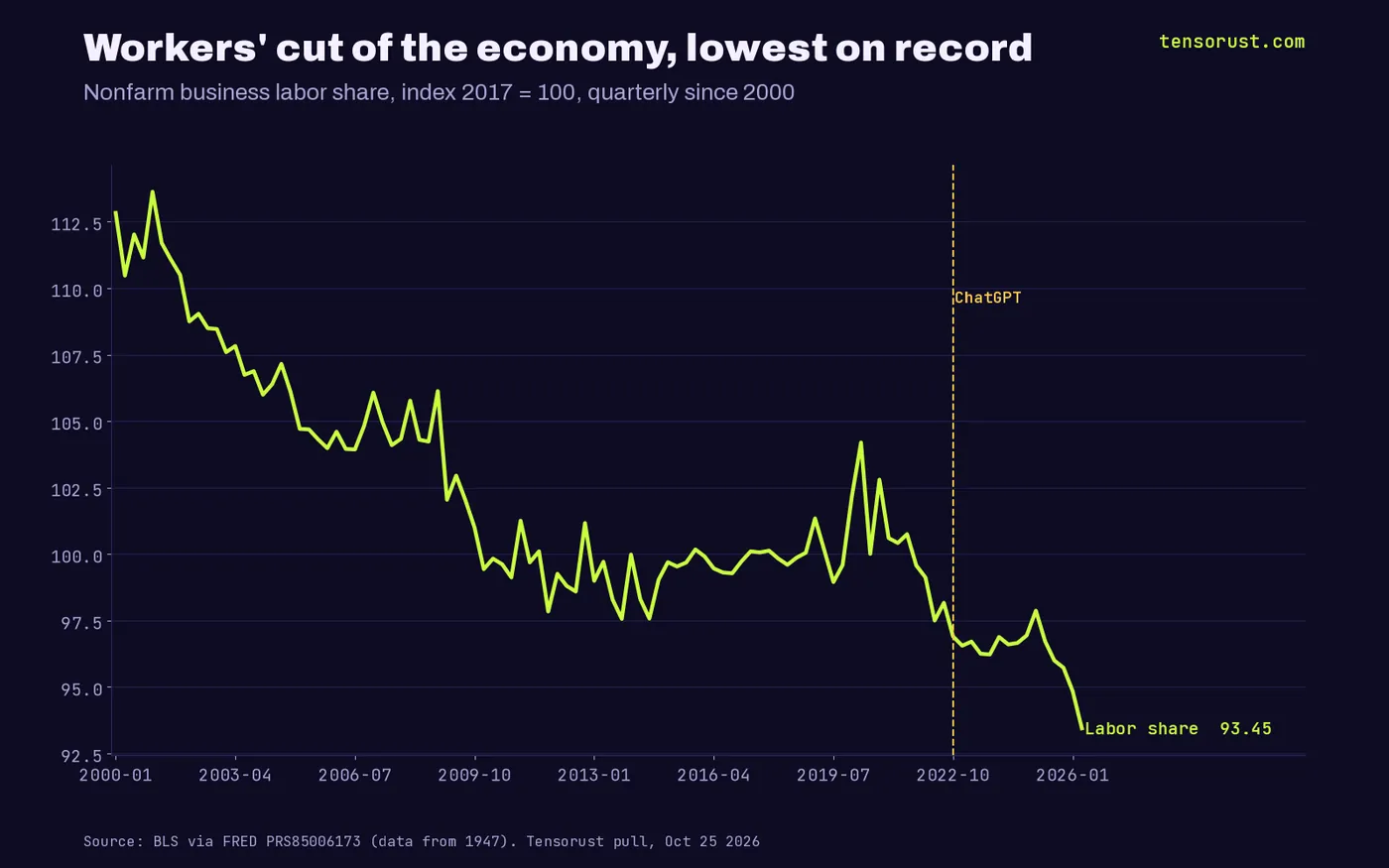
Short answer: There are only two classes of people now, and soon three: people who make no money on the internet or AI, people who make money on the internet, and people who make money with the internet and AI. Blue collar versus white collar, degree versus no degree, rich versus poor: those are the old lines, and they are the distraction. The Federal Reserve's own 2025 survey says only 25% of US workers used generative AI on the job in the prior month, so three in four are standing outside the fastest-moving class in the economy while the official labor share sits at the lowest reading in 79 years of data.
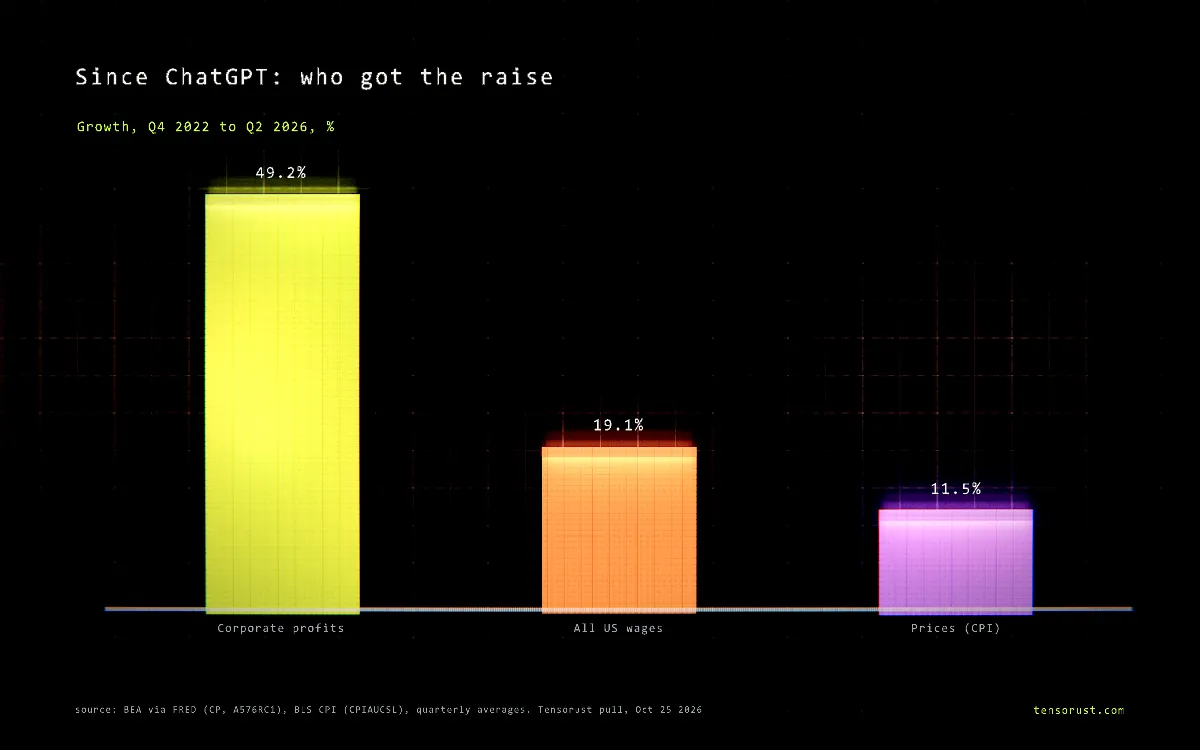
TL;DR: Since the quarter ChatGPT launched, US after-tax corporate profits are up 49.2% while total wages are up 19.1% and prices 11.5% (BEA and BLS via FRED, Q4 2022 to Q2 2026). The middle class of the new system, people paid by platforms, is a pyramid: Goldman Sachs counts 50 million creators and only 4% clear $100,000 a year, and YouTube keeps 55% of Shorts ad money. The top class is being built in public: Stripe says companies hitting $10 million in annual revenue within 3 months of launch doubled in 2025, and monthly downloads of the OpenAI Python SDK went from 224,542 in August 2022 to 425 million in August 2026. The line between the classes is not your degree or your collar. It is whether the network pays you, and whether a machine works for you while it does.
Key numbers
| What | Number | Source, checked Oct 25 2026 |
|---|---|---|
| US workers who used generative AI at work in the prior month (2025) | 25% | Federal Reserve SHED 2025 |
| AI use at work: graduate degree vs high school or less | 43% vs 10% | SHED 2025, Table 5 |
| Nonfarm business labor share, Q2 2026 (2017 = 100) | 93.4, lowest since 1947 | BLS via FRED PRS85006173 |
| After-tax corporate profits vs total wages, Q4 2022 to Q2 2026 | +49.2% vs +19.1% | FRED CP, A576RC1 |
| Creators worldwide / share earning over $100k | 50 million / 4% | Goldman Sachs Research |
| Companies reaching $10M ARR within 3 months of launch, 2025 vs 2024 | 2x | Stripe 2025 annual letter |
| OpenAI Python SDK monthly downloads, Aug 2022 vs Aug 2026 | 224,542 vs 425.4 million | PyPI logs via ClickHouse public dataset, our pull |
| Productivity gain from an AI assistant, novice support agents | +34% (average +14%) | Brynjolfsson, Li, Raymond, NBER w31161 |

The old class lines are the decoy
Every class argument you have heard in the last ten years runs on the old map. Blue collar against white collar. College against no college. The 1% against the 99%. Those lines were real in 1985. Today they mostly tell you which cable news channel someone watches.
Here is what the data says actually happened since the week ChatGPT shipped. Measured from the fourth quarter of 2022 to the second quarter of 2026, after-tax corporate profits rose 49.2%. Total US wages and salaries rose 19.1%. Prices rose 11.5%. Workers did get a real raise, about 7.6 points after inflation. Owners got one roughly five times bigger.
That is not a blue versus white collar story. A senior accountant and a forklift driver both sit on the wage side of that chart. The person on the other side is whoever owns something the network pays for: a product, a channel, a store, a model, an API, a piece of software that sells while they sleep.
Workers' cut just hit the lowest point on record
The Bureau of Labor Statistics tracks labor share: the slice of business output that goes to the people doing the work. The index (2017 = 100) read 112.8 in early 2000, 99.6 at the end of 2019 and 96.9 the quarter ChatGPT launched. In Q2 2026 it read 93.4. That is the single lowest quarter in a series that starts in 1947, and the three lowest readings ever are the last three quarters.
The standard explanation is "globalization, then automation." Fine. But notice what that explanation does. It treats the money as gone, evaporated into a trend. It did not evaporate. It moved to the people who own the distribution, and that is the line we are drawing.
Class 1: paid by the hour, invisible to the network
Class 1 is everyone whose income touches the internet only as a direct deposit. You might use the internet all day. You might even use AI. But the network does not pay you, your employer does, by the hour or the salary, and your raise is a negotiation with one buyer.
This is still most people, and the official statistics are built to count them. The Current Population Survey says 9.5 million Americans were unincorporated self-employed in September 2026, 5.8% of the 163.2 million employed. In 1948 that share was 18.5%. By the government's own scoreboard, owning your own work is a shrinking hobby.
Our read: that number is wrong in the way that matters. The CPS asks about your main job. It barely sees the Etsy shop, the Patreon, the Shopify store, the paid newsletter or the app that pays a second rent. Pew found back in 2021 that 16% of Americans had earned money from an online gig platform at some point, 9% in the past year. The economy's new middle class is mostly filed under "other."
Class 2: paid by the platform, renting the network
Class 2 makes money on the internet. Creators, sellers, freelancers, streamers, newsletter writers, app developers. They crossed the first line: the network pays them directly. That is a real step up in autonomy, and it is why people fight to get there.
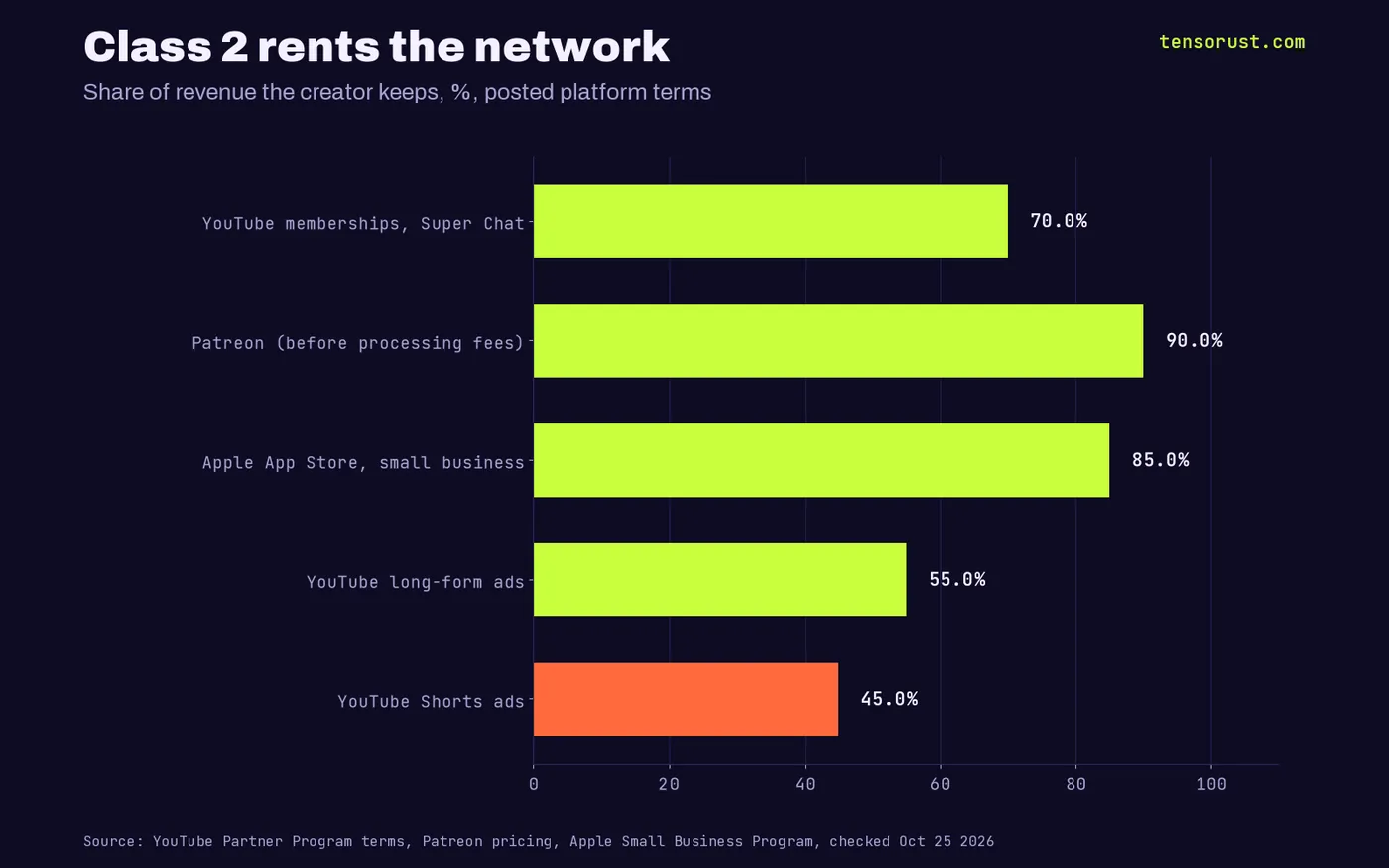
But class 2 rents. Read the posted terms. YouTube pays partners 55% of ad revenue on long-form videos and 45% of the Shorts pool. Patreon takes 10% plus processing. Apple's reduced rate for small developers is 15%. The landlord sets the rent, owns the audience graph and can change the deal on a Tuesday.
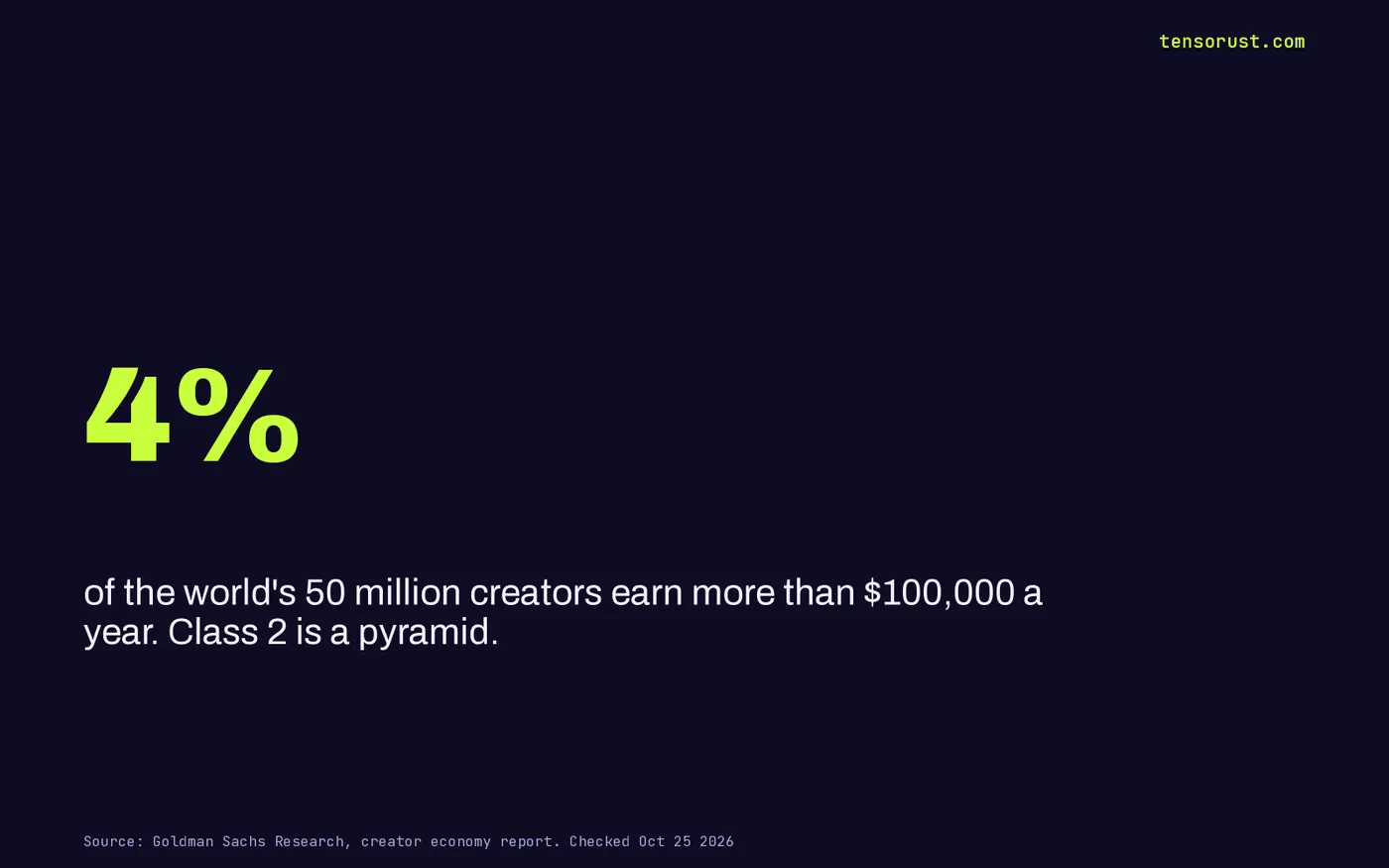
And class 2 is a pyramid. Goldman Sachs Research counts about 50 million creators worldwide and puts the market at $250 billion heading to $480 billion by 2027. Only about 4% of those creators are professionals earning more than $100,000 a year. Patreon says fans have sent creators $10 billion since 2013, across a platform with more than 10 million paying members.
So class 2 is better than class 1, and still mostly a lottery. The winners are the ones who already behave like class 3: they own an email list, a product, a store, a tool. The platform is a channel to them, not a boss.
Class 3: paid by the network, with a machine doing the work
Class 3 makes money with the internet and AI. The network pays them, and a model does a growing share of the labor. That combination changes the math of a business in a way neither class 1 nor class 2 can match: output stops being capped by hours or headcount.
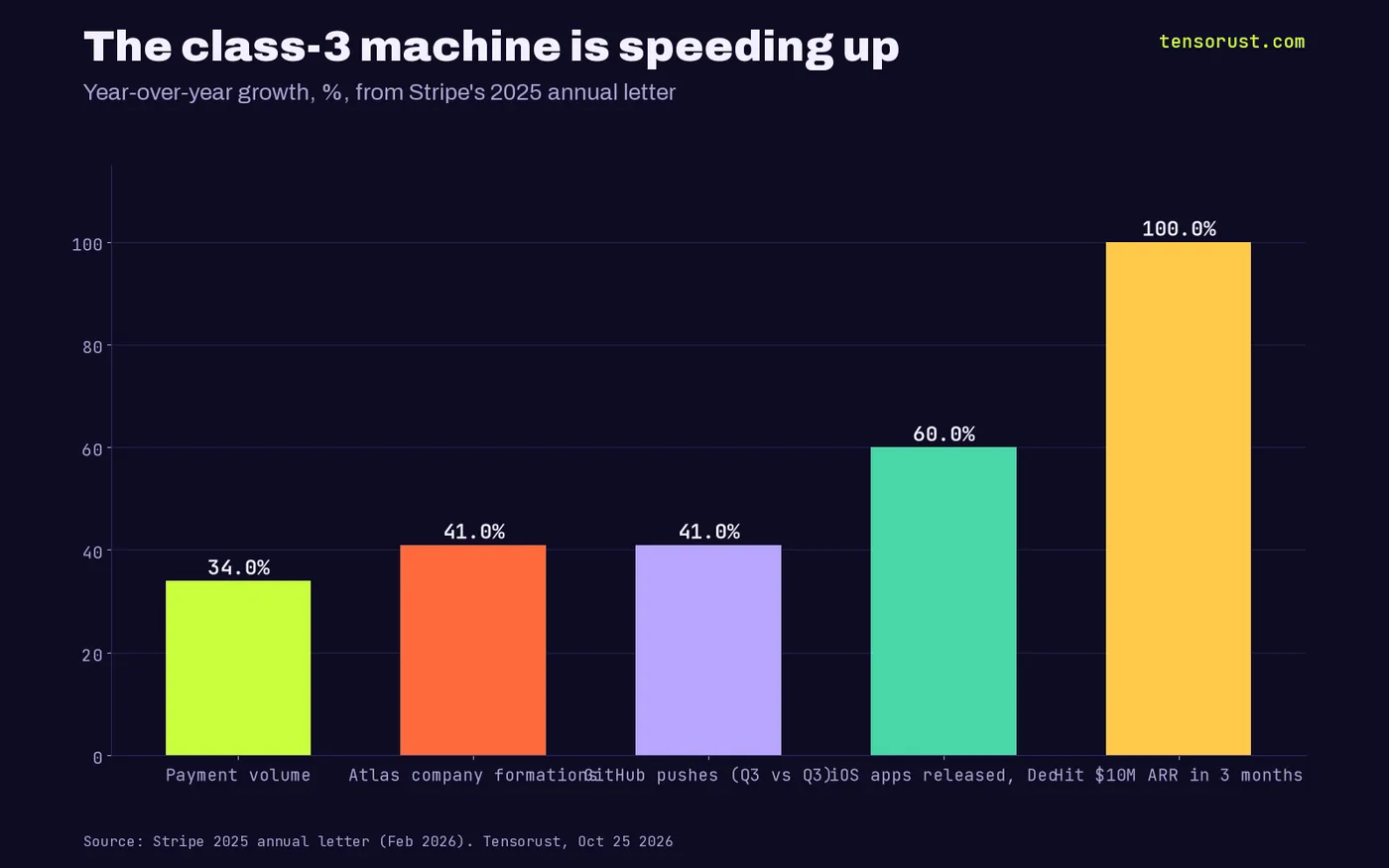
You do not have to take our word for it. Take Stripe's, which sees the money move. Its 2025 annual letter says businesses on Stripe processed $1.9 trillion, up 34%, "even as the economy bifurcated," and that "the sorting machine went into high gear." The number of companies hitting $10 million in annual recurring revenue within 3 months of launch doubled. Atlas company formations rose 41%. Twenty percent of Atlas startups charged their first customer within 30 days, up from 8% in 2020. GitHub pushes grew 41% year over year after years of 10% to 12%. iOS app releases in December 2025 jumped 60%.
The named examples are not subtle. Lovable, an AI app builder, posted "Zero to $10M ARR in 2 months," then $100 million ARR, then a $200 million raise at a $1.8 billion valuation eight months after launch, all on its own blog. Pieter Levels, the most public indie founder online, has posted that Photo AI made $61,808 a month in July 2023 and about $105,000 a month in revenue with about $80,000 profit by March 2026, from a single index.php file, and that a vibe-coded flight game reached $1 million ARR in 17 days. Those are his public claims, not audited filings. They are also exactly what class 3 looks like.
The pipes are already wired together
We wanted a number nobody had stitched together, so we pulled package downloads from PyPI's public logs. Every Python app that calls a model pulls the OpenAI or Anthropic SDK. Every Python app that takes money pulls Stripe's. Watch them climb together.
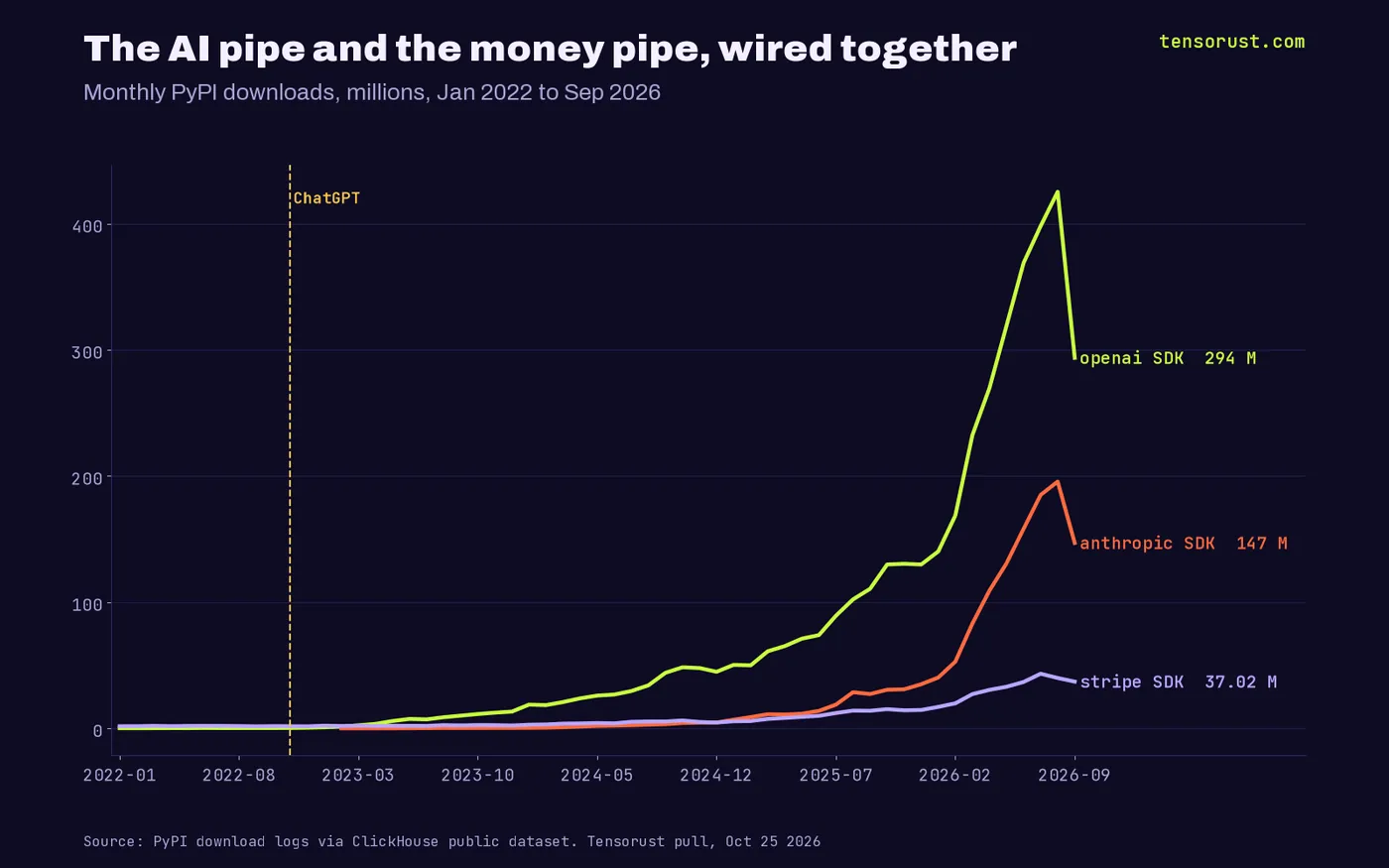
The OpenAI SDK went from 224,542 monthly downloads in August 2022 to 425.4 million in August 2026. Anthropic's went from zero to 195.6 million. Stripe's Python SDK, flat around 1.7 million a month for all of 2022, hit 39.9 million in August 2026, more than 20 times higher, with nearly all of that rise after ChatGPT. September came in lower for all three (293.8 million, 147.0 million, 37.0 million), still 2.7x, 5.4x and 2.7x a year earlier.
Downloads are mostly machines: build servers and agents fetching packages, not humans. That is the point. The software that sells things and the software that thinks are being installed side by side, millions of times a day, and the people who own those builds are pulling away from everyone who just uses the output.
Follow the money: who wants you looking at the old line
If the real class line is "does the network pay you, and does a machine work for you," then a lot of powerful people have a reason to keep you arguing about collars and degrees. Follow each one.
- Employers. Labor share at a record low is a margin story. A workforce that thinks the threat is "AI taking my job" asks for job protection. A workforce that sees the line asks for equity, or leaves and builds. The first one is cheaper.
- Platforms. The 45% to 55% that YouTube keeps and the 10% to 15% the stores keep depend on class 2 never becoming class 3. A creator who owns the customer relationship can move. A creator who only owns a channel cannot.
- The credential ladder. Americans hold $1.78 trillion in federally owned and securitized student loans (FRED SLOAS, last reading Q4 2024). That industry sells the old map: get the degree, get the salary. It is the most expensive possible ticket into class 1.
- The fear sellers. Pew's October 2024 survey of 5,273 workers found 52% of workers worried about AI at work and only 6% expecting more opportunity from it. The Fed found the opposite among people who actually use it: AI users were more likely to expect it to improve their career than to replace them. Fear keeps people out of the one class where the tool pays.
We wrote about who funds the panic in the anti-AI movement is a psyop. This is the payoff of that panic: a class gap that widens while the people on the wrong side of it are told to wait.
The best case against us, and why it fails
Here is the strongest version of the other side. "This is just the old class system with new tools. The Fed's own table shows 43% of workers with a graduate degree used AI last month versus 10% with a high school diploma. AI is a perk of the people who were already ahead. And most creators make nothing, so class 2 is a fantasy, and class 3 is a handful of founders with venture money."
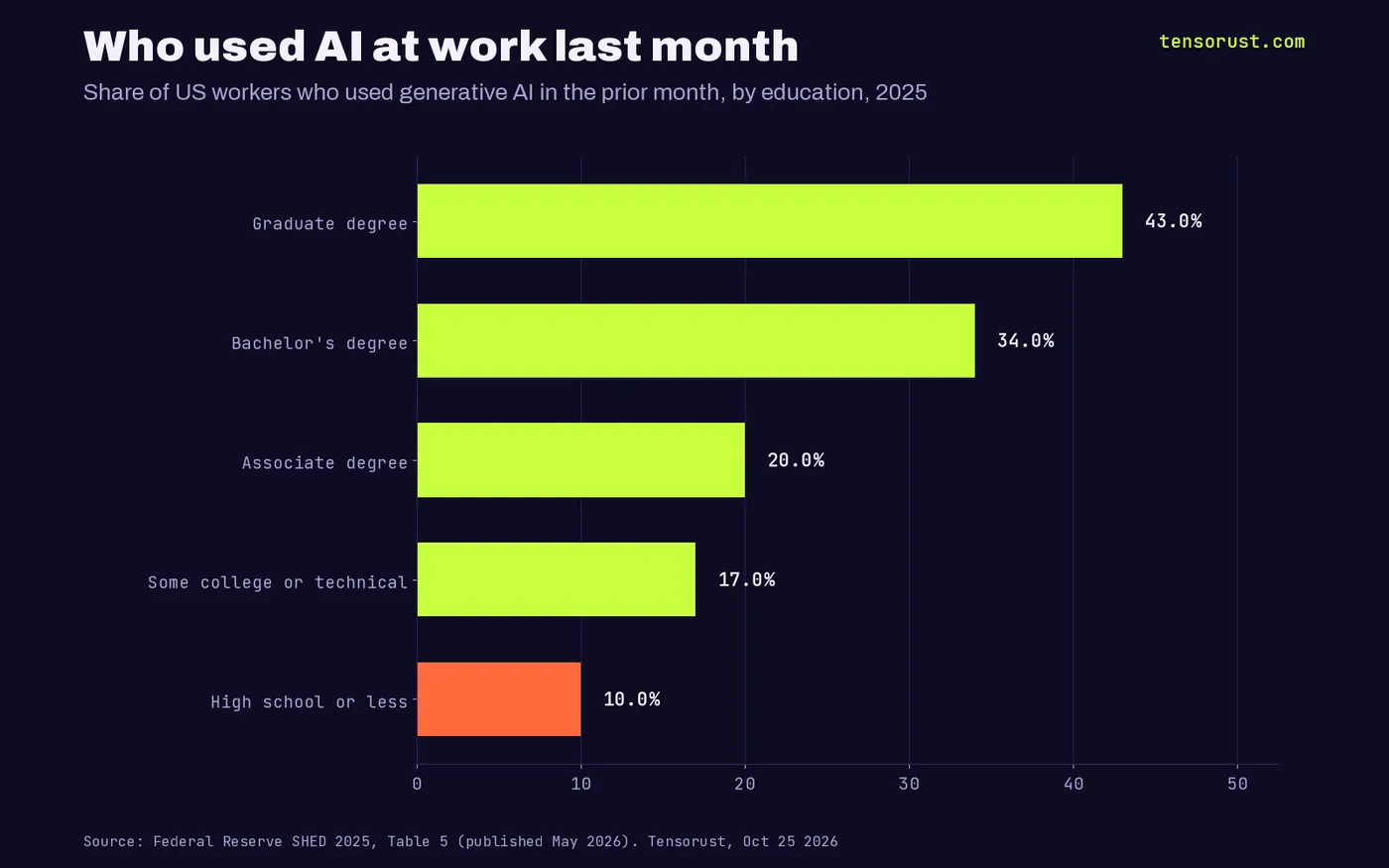
It is a good argument, and it fails on the cost of entry. The degree gap in that table is an access gap, not an ability gap: the Fed also found that workers with more control over how they do their work used AI at 30% versus 20%. The tool goes to people who are allowed to choose their tools. The fix for that is not a degree. It is autonomy.
And the tool is cheap. Claude Pro lists at $20 a month billed monthly. The output gain is biggest at the bottom: in the Brynjolfsson, Li and Raymond study of 5,179 support agents, the AI assistant lifted resolutions per hour 14% on average and 34% for novice and low-skilled workers, with minimal effect on the experts. In a controlled GitHub Copilot experiment, developers with an AI pair programmer finished a task 55.8% faster. The old ladder rewarded who you already were. This one rewards who shows up.
The founders-with-VC objection fails on Stripe's own numbers: 25% of new Delaware corporations are now formed through Stripe Atlas, and a fifth of those charge a customer within a month. That is not a venture pipeline. That is people.
Why it will feel like nothing changed
Here is the twist. Class 3 is forming quietly. A class 3 person looks exactly like a class 1 person: someone at a laptop in a coffee shop. No uniform, no union, no line in the BLS tables. The CPS self-employment number keeps drifting down while the Stripe and PyPI numbers go vertical.
That is how the biggest shifts work, as we argued in AI growth will feel like nothing changed. By the time the official statistics invent a category for "earns from software and models they own," the gap will already be set, and the people who noticed in 2026 will be the ones who own the distribution in 2030. Our bet, stated flat: the gap between class 2 and class 3 will widen faster over the next five years than the gap between class 1 and class 2 did over the last fifteen. Nobody has proven that yet. The download curves say it is already happening.
The honest part: crossing is not automatic
We are not writing this from the finish line. Our own studio has shipped apps, products and an agent team that runs our socials, and we published the receipt when it stung: 500,000 views, 3 opened checkouts, $0 in sales. AI gets you output. It does not get you a customer. Class 3 is output plus distribution plus something people pay for, and the last two are on you.
That is also why the line is worth drawing. If class 3 were just "use ChatGPT," everyone would already be in it. It is a specific set of moves, and they can be learned.
What this means for you
Cross one line this year. Here is the order.
- Class 1 to class 2: get paid by the network once. One product, one page, one payment link. Stripe's data says a fifth of new companies charge their first customer within 30 days. Thirty days is the target, not a dream.
- Own the relationship. Collect emails, run your own store page, keep a copy of your audience. Rent the platform's reach; never rent your customer list.
- Class 2 to class 3: put a machine on the work. Pick the task that eats most of your hours (support, drafts, code, listings) and hand it to a model with a written spec. The novices in the NBER study gained 34%. You are allowed to be a novice.
- Ship something that runs without you. A tool, an app, a template, an API. Software that sells while you sleep is the whole definition of the third class.
- Measure it. Revenue per hour you personally spent, monthly. If it is not rising, you are still in the old class with better tools.
If step 3 is where you stall, the $29 AI Builder Kit is five offline apps that keep your AI building what you meant, on any model including a local one, with no account and no API key. If it does not get your AI building what you meant, we keep working with you at no extra cost until it does. More arguments like this one live on Tensorust Opinion, and the price of the machine itself is tracked daily on our LLM price list.
Not financial advice. Our numbers and our read, so you can check them.
Sources
- Federal Reserve Board, Economic Well-Being of U.S. Households in 2025 (SHED), Table 5 and generative AI section, May 2026, checked Oct 25 2026
- BLS, Nonfarm Business Sector: Labor Share (PRS85006173), via FRED, checked Oct 25 2026
- BEA, Corporate Profits After Tax (CP), via FRED, checked Oct 25 2026
- BEA, Compensation of Employees: Wages and Salaries (A576RC1), via FRED, checked Oct 25 2026
- BLS, CPI for All Urban Consumers (CPIAUCSL), via FRED, checked Oct 25 2026
- BLS CPS, Unincorporated Self-Employed (LNS12027714) and Employment Level (CE16OV), via FRED, checked Oct 25 2026
- Student Loans Owned and Securitized (SLOAS), via FRED, last reading Q4 2024, checked Oct 25 2026
- Stripe, 2025 annual letter, Feb 2026, checked Oct 25 2026
- Goldman Sachs Research, The creator economy could approach half a trillion dollars by 2027, checked Oct 25 2026
- Patreon, About and Patreon, Pricing, checked Oct 25 2026
- YouTube Help, YouTube Partner Program overview and revenue shares, checked Oct 25 2026
- Apple, App Store Small Business Program, checked Oct 25 2026
- Pew Research Center, The State of Gig Work in 2021, Dec 8 2021
- Pew Research Center, U.S. Workers Are More Worried Than Hopeful About Future AI Use in the Workplace, Feb 25 2025
- Erik Brynjolfsson, Danielle Li, Lindsey Raymond, Generative AI at Work, NBER w31161, checked Oct 25 2026
- Sida Peng et al., The Impact of AI on Developer Productivity: Evidence from GitHub Copilot, arXiv 2302.06590, checked Oct 25 2026
- Alexander Bick, Adam Blandin, David Deming, The Rapid Adoption of Generative AI, NBER w32966, checked Oct 25 2026
- Lovable blog: Zero to $10M ARR in 2 months; $100M ARR; Lovable raises $200M at $1.8B, checked Oct 25 2026
- Pieter Levels (levels.io), public post index: Photo AI revenue posts, fly.pieter.com $1M ARR in 17 days, his public claims, checked Oct 25 2026
- Anthropic, Claude pricing, checked Oct 25 2026
- PyPI download logs for openai, anthropic and stripe, monthly sums from the ClickHouse public PyPI dataset, Tensorust pull, Oct 25 2026 (October partial, excluded from charts)
First published here on tensorust.com on Oct 25, 2026. Related: AI Builder Kit, Opinion, All opinion pieces, LLM price list.
Up next
More on OpinionAI isn't overhyped. Prices fell 99% and it feels like nothing changedGPT-4-class AI got 99.6% cheaper, ChatGPT hit 800M weekly users, and labor share hit a record low. Why AI feels like nothing changed, and who keeps the gains.Read it next →Cite this
Free to cite and reuse under CC BY 4.0 with a link back. How it was collected: methods. Spotted an error? Corrections.
Did this answer your question?
Get the next one by email.
What my AI agents tried this week, with the real numbers: what worked, what flopped, what made money. One email when there is something worth reading.
No spam, never sold. Every email has a one-click unsubscribe.
What are people saying about this? Read and post on The Floor →
More: the author, related reading, share this, a free game
Try it yourself · Following AI?
Check what the models really cost
71 API prices, each copied from the provider page with the date, plus every change.
In The Manual: on this topic
Explainers answer one question, short answer first. Guides walk you through it step by step.
- Explainer · Money and the economyCan the Fed buy Treasuries directly from the government?
- Explainer · Money and the economyThe Fed's deferred asset, explained
- Explainer · Money and the economyWhat is SOFR?
- Explainer · Money and the economyWhat are bank reserves?
Read next
- AI · Oct 24, 2026 · 14 min readAI isn't overhyped. Prices fell 99% and it feels like nothing changed
- AI · Oct 24, 2026 · 9 min readHollywood jobs: AI didn't kill them. The streaming bust did
- Economics · Oct 25, 2026 · 9 min readCerebras stock is 40% under its IPO. Its $25.4B backlog isn't