
Google Finland data center: €4.5M of trees vs a €400M power edge
On this page · 10 sections
- Key numbers
- What happened, in order
- The trees are a rounding error for Finnish forestry
- But it is a big deal for land conversion, which is the real rule
- Follow the money: why a trillion-dollar company cut the corner
- The real prize is Finnish power
- Who wins, who loses
- Our bet: Finland takes the money, Google pays the fine
- What this means for you
- Sources
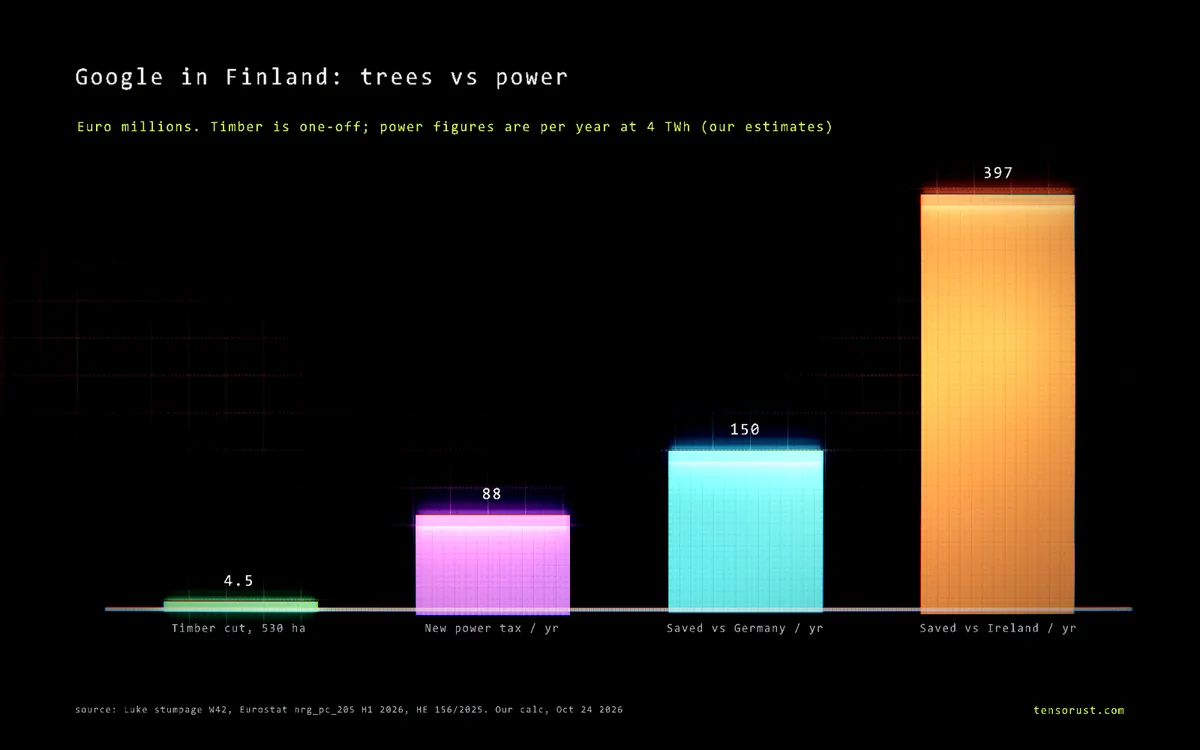
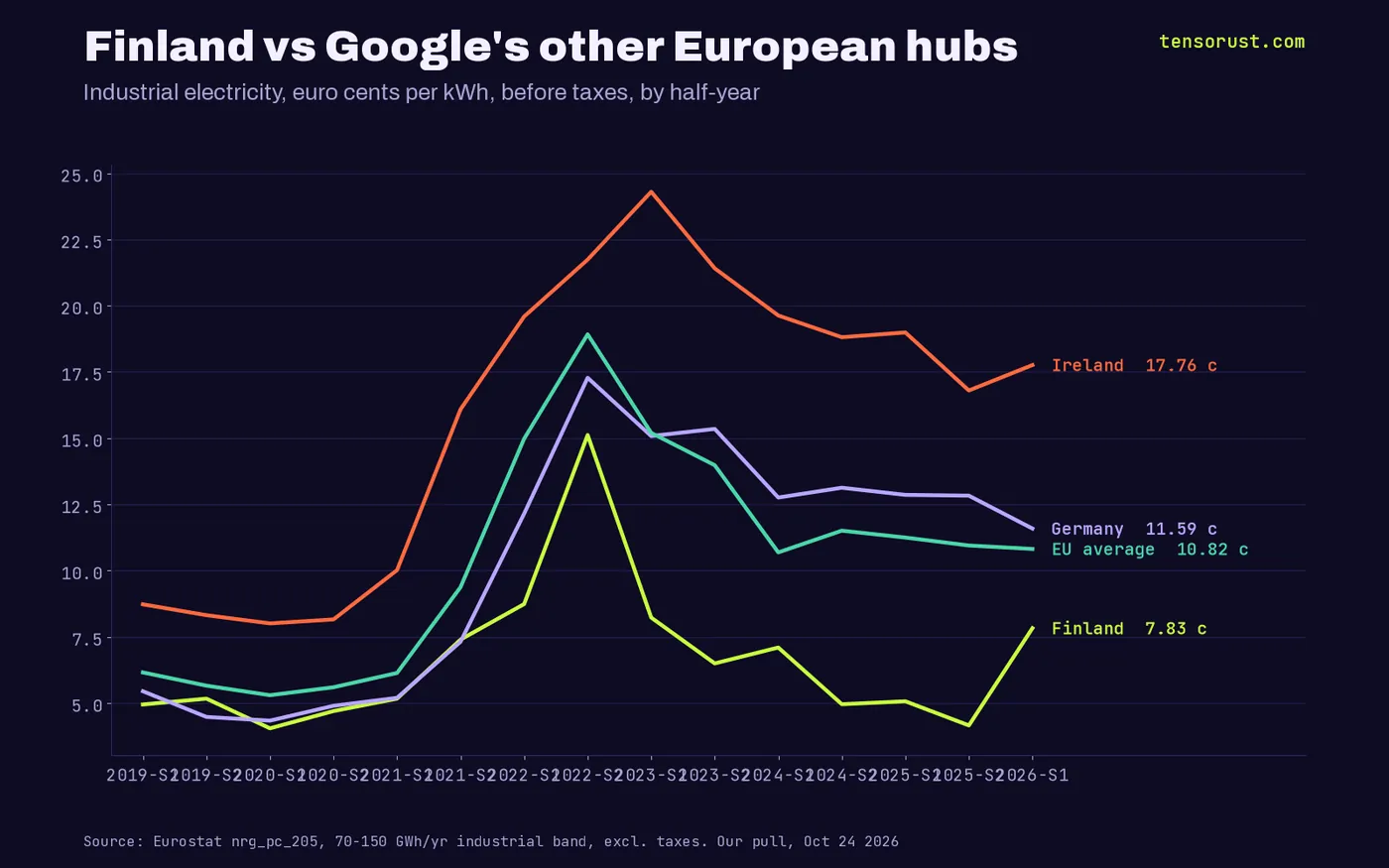
Short answer: Google's Finnish project company cleared about 530 hectares of forest at Muhos and Kajaani before the environmental assessments were done, and Finland's regulator froze the work. By our count from Finland's own forest statistics, that timber was worth roughly €4.5 million. The thing Google actually went north for is power: Finnish industrial electricity cost 7.83 cents a kWh before tax in the first half of 2026, against 17.76 cents in Ireland, which on our estimate of the load is a €400 million a year edge. The trees are the headline. The power is the prize, and the shortcut is what a €13 billion clock does to a company.
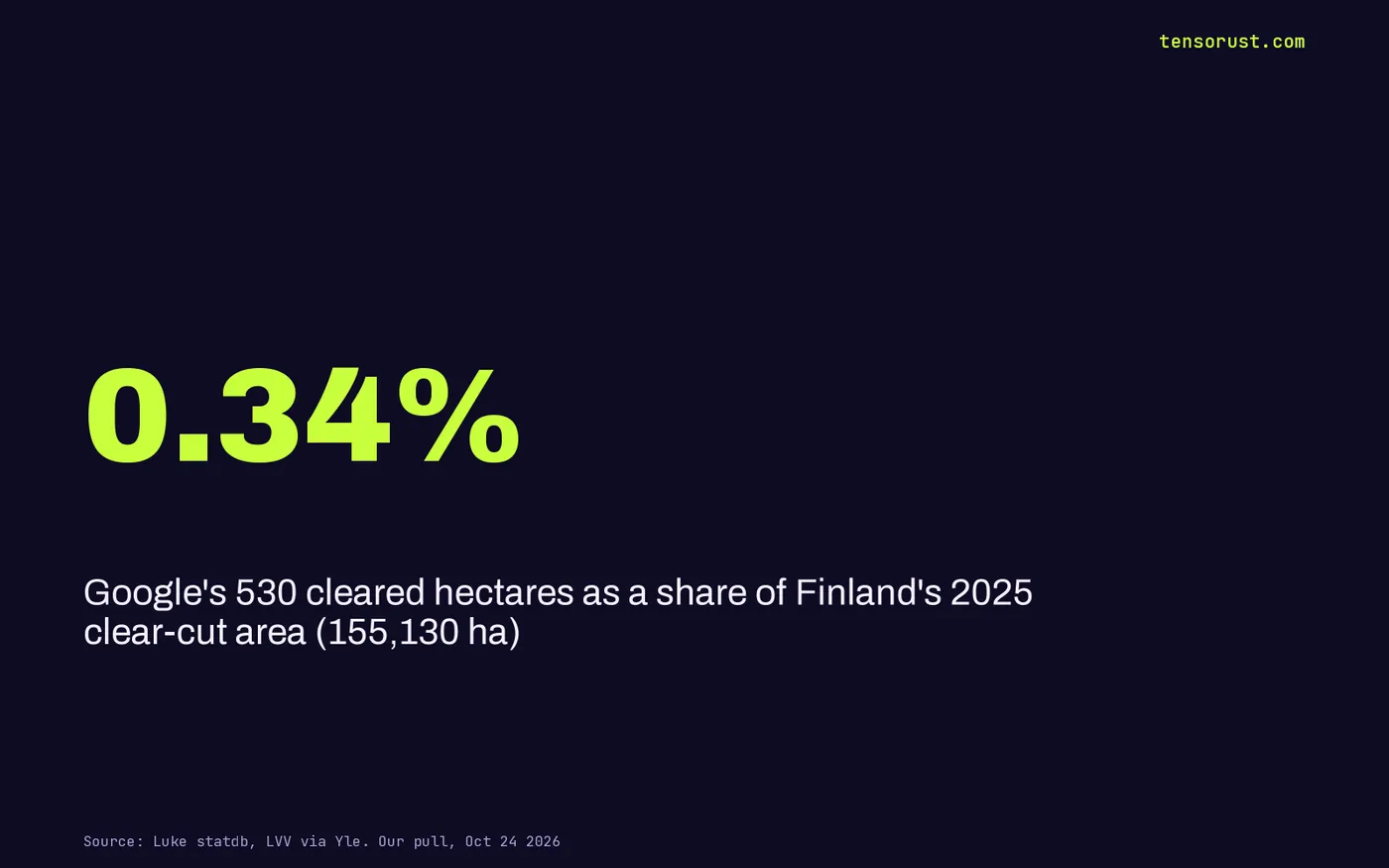
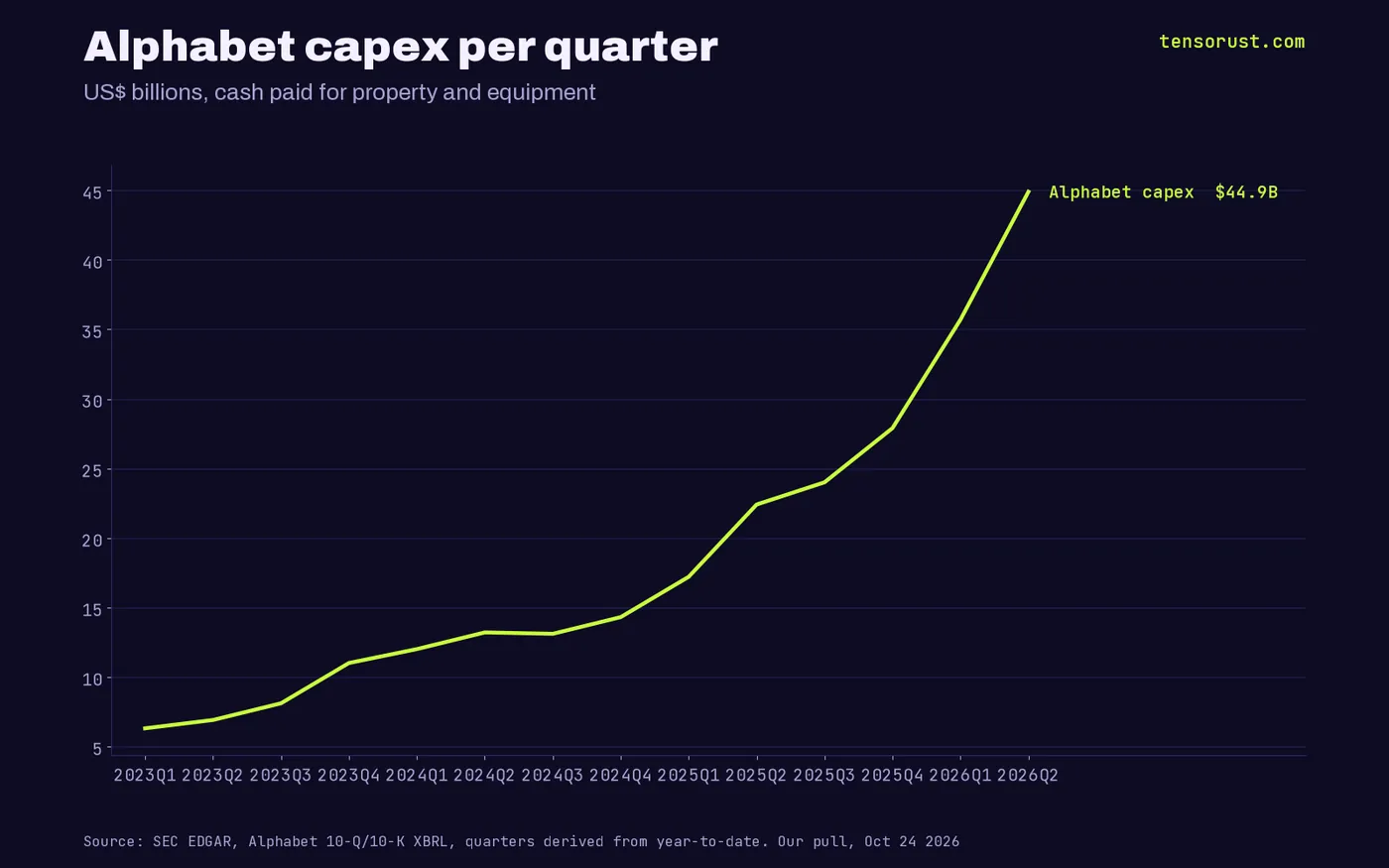
TL;DR: The 530 hectares are 0.34% of the area Finland clear-cut in 2025 (155,130 ha), so this is not a forestry story, but they are 6.8% of all the forest Finland converted to other land uses that year, and 31% of Kainuu's. Google is spending €13 billion in Finland across 2027 and 2028 and has locked up to half of the 1,014 MW Loviisa nuclear plant for 2030 to 2049, while Alphabet's own filings show capex of $80.6 billion in just the first half of 2026. If you build on AI, your bill is a power bill: the cheapest grids in Europe are where the next round of compute gets built, and the rules there just got tested.
Key numbers
| What | Number | Source, checked Oct 24 2026 |
|---|---|---|
| Forest cleared, Muhos + Kajaani | 330 ha + just under 200 ha | LVV via Yle, Oct 14 2026 |
| Finland clear-cut area, 2025 | 155,130 ha (Google's share: 0.34%) | Luke statdb, our pull |
| Finland fellings for land-use change, 2025 | 7,750 ha (Google's share: 6.8%) | Luke statdb, our pull |
| Timber value of the 530 ha | about €4.5M (range €3.6M to €5.4M) | Our estimate from Luke stumpage prices, week 42 |
| Industrial power price, H1 2026, before tax | Finland 7.83c, Germany 11.59c, Ireland 17.76c per kWh | Eurostat nrg_pc_205, our pull |
| Google's Finland investment | €13B, 2027 to 2028 | Yle, Sep 9 2026 |
| Loviisa nuclear PPA | up to 50% of 1,014 MW, 2030 to 2049 | World Nuclear News, Sep 9 2026 |
| Data center electricity tax | 0.05c to 2.24c per kWh from Jul 1 2026 | Bloomberg Tax on HE 156/2025 |
| Alphabet capex, H1 2026 | $80.6B (all of 2025: $91.4B) | SEC EDGAR, Alphabet 10-Q, our pull |

What happened, in order
Google announced on Sep 9 2026 that it will put at least €13 billion into Finland across 2027 and 2028: new data centers at Kajaani, Muhos and Vaala, plus more halls at its Hamina site, a converted paper mill it bought in 2009. Chief investment officer Ruth Porat put the construction jobs at over 37,000, per Yle. Google calls it its largest single investment in Europe.
By early October, the Finnish Association for Nature Conservation was accusing Google's project company, Tuike Finland Oy, of clearing forest at the new sites without the environmental impact assessments the law requires. On Oct 6, the Finnish Supervisory Agency (LVV) ordered the preparatory work stopped by Oct 23, and the head of its environment department, Tommi Muilu, described stripped topsoil, new site roads, storage areas and altered ditches, per AFP via Al Jazeera. Police opened a preliminary inquiry into the Muhos work, Yle reported on Oct 8.
On Oct 14, Google's Finland country director Antti Järvinen apologised: "This is our project, and we take full responsibility for what has happened," he told Yle, while saying every decision was made "based on the best understanding we had of the legislation at the time." Google's position is that the felling met Finland's Forestry Act. Today the story jumped to US tabloids as "250,000 trees", and to the top of Hacker News with 248 points and 200 comments.
The trees are a rounding error for Finnish forestry
Here is the number nobody in the coverage ran. Finland's Natural Resources Institute (Luke) publishes the area of every felling notified to the Forest Centre. In 2025, Finland clear-cut 155,130 hectares and treated 711,022 hectares with some kind of felling. Google's 530 hectares are 0.34% of one year's clear-cuts and 0.07% of all fellings.
Volume tells the same story. Finland removed 74.3 million cubic meters of roundwood in 2025. At a generous 150 cubic meters a hectare (our assumption for a mature northern stand), Google's sites held about 80,000, or 0.11% of a year's harvest. The "250,000 trees" figure works out to roughly 470 trees a hectare, which is plausible, and also about what a single large forest owner fells most years without a headline.
But it is a big deal for land conversion, which is the real rule
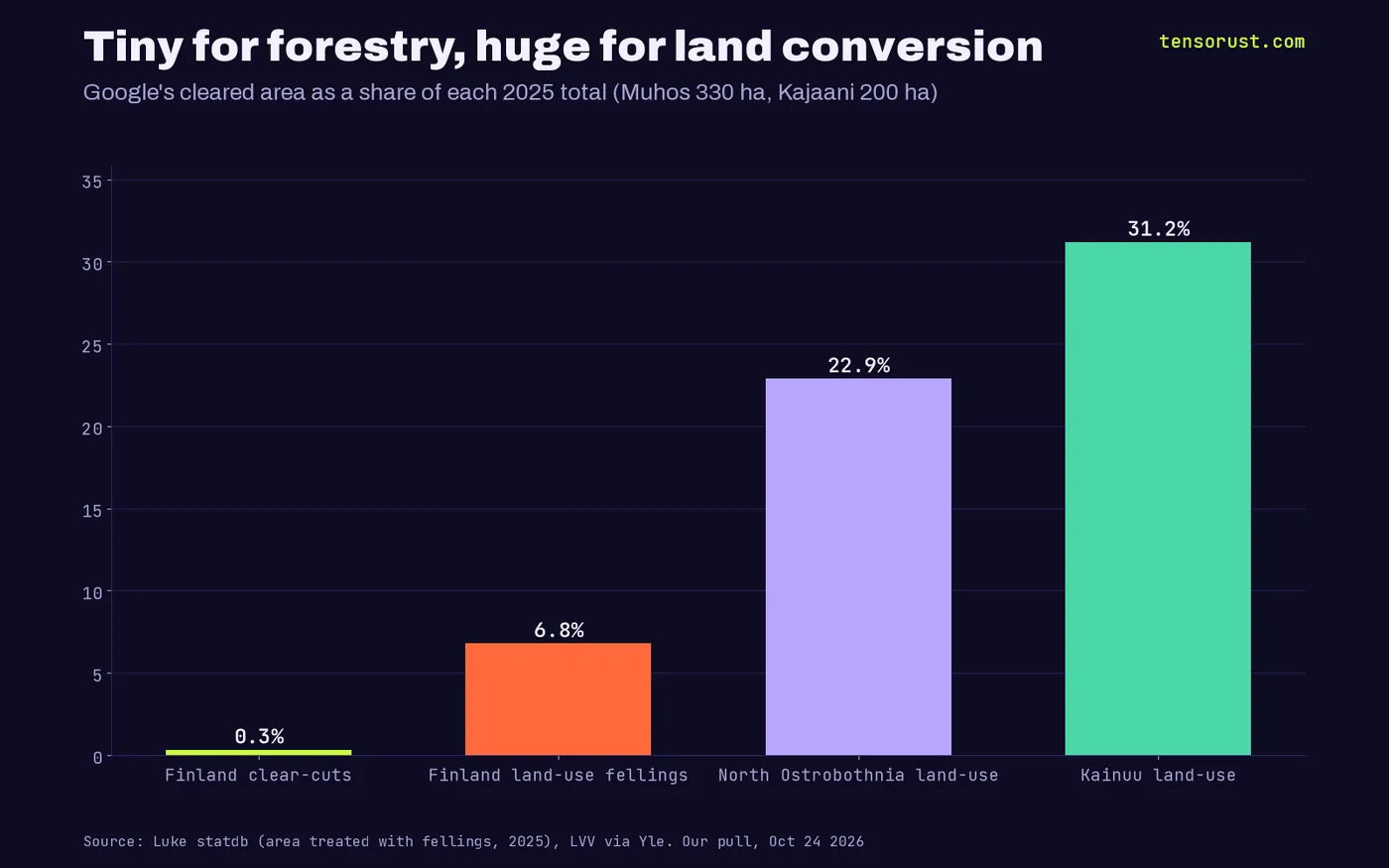
Luke has a separate category, "felling leading to land use change": forest cut so the land can become something else, a road, a mine, a factory, a server hall. That is the category environmental law cares about, and it is small. All of Finland did 7,750 hectares of it in 2025.
Google's two sites equal 6.8% of that national total. Muhos alone (330 ha) equals 22.9% of North Ostrobothnia's 2025 land-use fellings (1,442 ha). Kajaani (about 200 ha) equals 31.2% of Kainuu's (641 ha). In one go, one company converted close to a third of a region's yearly total, before the assessment that is supposed to come first.
That is the honest version of the scandal. Not "Google destroyed a forest", which Finnish forestry does at 300 times this scale every year for paper and sawlogs, but "Google skipped the line that every other developer stands in".
Follow the money: why a trillion-dollar company cut the corner
Start with what the trees were worth. Luke's week-42 stumpage prices for regeneration fellings in North Ostrobothnia: pine logs €80.61 a cubic meter, spruce logs €84.01, pine pulpwood €28.58, spruce pulpwood €32.02. At 150 cubic meters a hectare, half logs and half pulp, 530 hectares come to about €4.5 million (€3.6M at 120 m3/ha, €5.4M at 180). Google says the proceeds go to local projects. That is 0.03% of the €13 billion.
Now the clock. At an 8% cost of capital (our assumption, typical for a big infrastructure build), €13 billion sitting idle costs about €87 million a month, and the freeze lasts until the assessments are finished. Our read: a company that clears land before the paperwork is not confused about the law. It is pricing the delay. Every month you start early is worth twenty times the trees, and an apology costs nothing.
Nobody has proven that was the calculation inside Tuike Finland. But the pattern is there: Yle reported on Oct 20 that the same subsidiary cut more than it declared at Hamina in 2018 and 2019, about 1.3 hectares of flying squirrel habitat, and in 2025 asked to start construction there before its environmental permit was final, "citing the need to grow capacity quickly". Muhos's building inspector told Helsingin Sanomat he felt pressure from Google's lawyers.
The real prize is Finnish power
Eurostat publishes what large industrial users pay for electricity before taxes. In the first half of 2026, for users taking 70 to 150 GWh a year, Finland paid 7.83 cents a kWh. Germany paid 11.59, the Netherlands 11.46, Denmark 12.53, and Ireland, Google's other big European hub, 17.76. In the second half of 2025, Finland's 4.16 cents was the lowest in the EU.
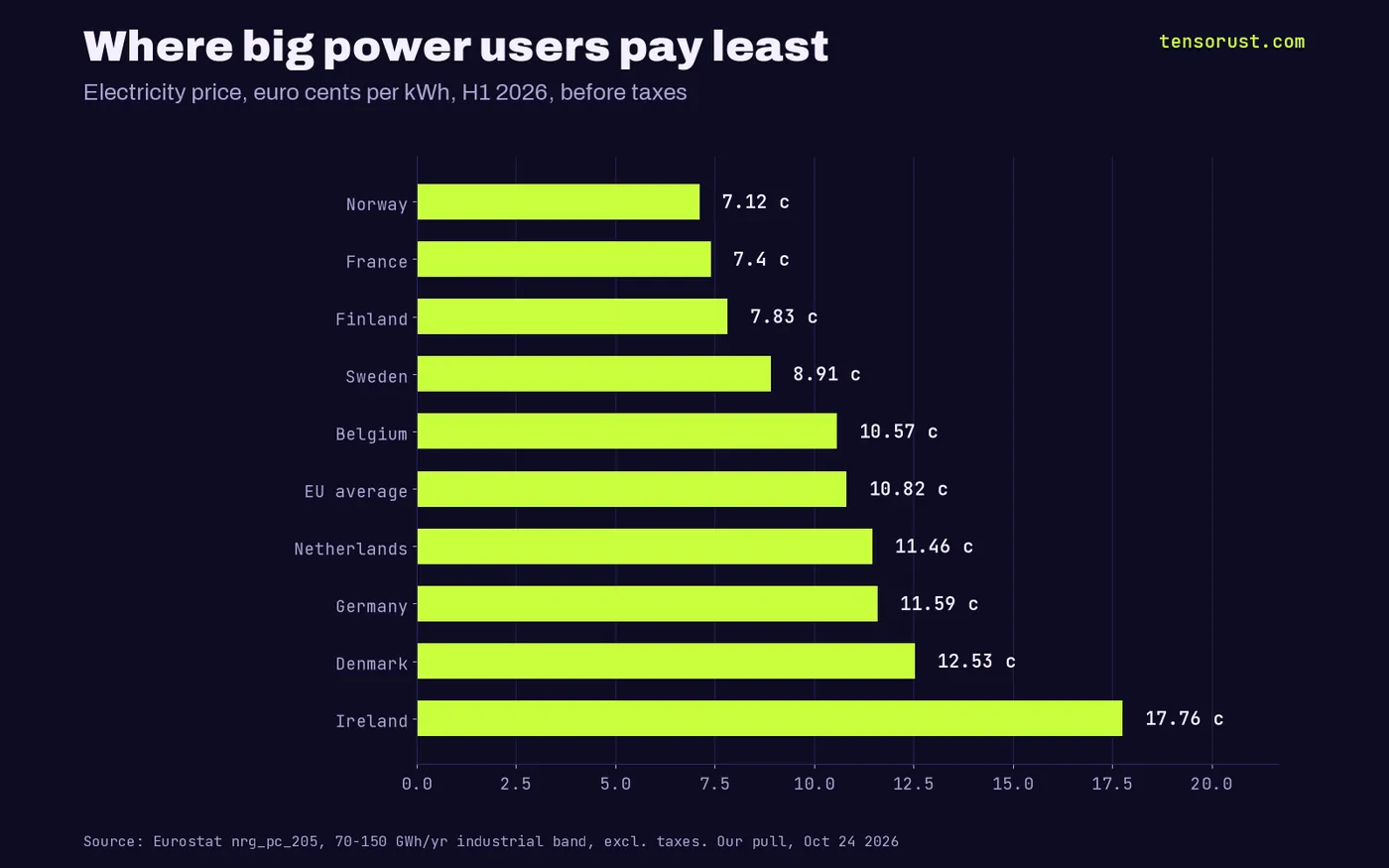
Per terawatt hour, that is about €78 million in Finland against €116 million in Germany and €178 million in Ireland. Google's Loviisa deal covers up to half of a 1,014 MW plant from 2030; at a 90% load factor (our assumption) that is about 4 TWh a year. At Eurostat's spread, 4 TWh is roughly €150 million a year cheaper than Germany and €400 million a year cheaper than Ireland. Against the trees: one-off €4.5 million.
The price line has a catch: Finland spiked to 15.12 cents in late 2022 with the rest of Europe and jumped from 4.16 to 7.83 cents in the latest half-year. That is exactly why Google bought 20 years of nuclear output plus 629 MW of new wind contracts and a 94 MW battery at Kajaani. It is not buying today's price. It is buying the right to never pay Ireland's.
Who wins, who loses
- Fortum wins. It said Loviisa could not keep producing after 2030 without big life-extension spending, a €700 million life-extension program, with about 80% of the projects still waiting on investment decisions. A 20-year Google contract is the financing.
- The Finnish state wins twice. It moved data centers out of the cheap electricity tax class on Jul 1 2026: from 0.05 cents to 2.24 cents a kWh, an estimated €47 million a year in new revenue, which the government openly framed as replacing a candy-and-chocolate VAT hike it dropped. On 4 TWh, the gap would be about €88 million a year before any of the compensation the law offers to qualifying sites. Google paused the 2025 plans while that tax was decided, then came anyway. That tells you how big the power edge is.
- Kajaani, Muhos and Vaala win land sales (Google bought 1,400 ha there in 2024 and 900 ha in Vaala in February), construction jobs and a €31 million community fund.
- The rule of law loses a little every time the biggest player in the room clears first and apologises second. A small developer that did this would not get a press conference.
- Finnish households are the open question. More firm demand on the grid can push prices up for everyone; Centre Party leader Antti Kaikkonen is already saying Finland has to make sure there is enough power and transmission for data centers.
Our bet: Finland takes the money, Google pays the fine
We are pro-build. Cheap, clean, firm power is the single biggest input to AI, and a country that has it should sell it. Europe complaining that it has no AI industry while blocking the one investor ready to spend €13 billion would be peak Europe. Our kill-switch piece showed how dependent the continent already is on US clouds; data centers on Finnish soil, on Finnish power, under Finnish law, are the closest thing to leverage Europe gets.
But the price of being welcome is following the same order of operations as everyone else. The bet we would make: the assessments get done, the projects slip a few quarters, LVV or a court lands a penalty that is small next to €87 million a month, and Google builds anyway. The forest outrage burns out. The power contracts last until 2049.
What to watch next: whether LVV moves to enforcement now that the Oct 23 deadline has passed; the police decision on a full pre-trial probe; and Alphabet's Q3 numbers in the coming days, where capex ran $35.7B and $44.9B in the first two quarters of 2026.
What this means for you
If you build on AI, the bill you pay per token is, underneath, a power bill plus a capex bill. Alphabet alone spent $44.9 billion in one quarter to chase the cheapest megawatts on earth, and the regions that win (Nordic, nuclear, cheap) are where prices will be lowest and capacity easiest to get. When a provider offers a Nordic region, check it. And know your own number before the next price change: the LLM API Cost Calculator, $7 once, prices a request, a month and a year across 26 models. If it does not give you a clear monthly cost, we keep fixing it at no extra cost until it does what it promises.
More deep tech and money on Tensorust News and the deep tech + finance hub. For who is really paying for the AI buildout, read Mag 7 vs S&P 493 and our explainer on circular financing in AI. The full dataset (840 rows: Luke fellings and stumpage, Eurostat prices for 43 countries, Alphabet capex, our estimates with their assumptions) is in the download below.
Not financial advice. Our numbers and our read, so you can check them. Estimates are labelled as ours, with the assumptions shown.
Sources
- Natural Resources Institute Finland (Luke), area treated with fellings by region and method, 2015-2025, pulled Oct 24 2026
- Luke, weekly stumpage prices of roundwood, 2026 weeks 30-42, pulled Oct 24 2026
- Luke, total roundwood removals 1985-2025, pulled Oct 24 2026
- Eurostat, electricity prices for non-household consumers (nrg_pc_205), pulled Oct 24 2026
- SEC EDGAR, Alphabet 10-Q and 10-K filings (XBRL companyfacts), pulled Oct 24 2026
- Yle, Google to invest €13 billion in Finland, Sep 9 2026
- World Nuclear News, Google signs up for electricity from Finnish nuclear power plant, Sep 9 2026
- Al Jazeera (AFP, Reuters), Finland orders halt to work on Google data centre sites, Oct 7 2026
- Yle, Google halts work as Finnish police probe suspected illegal logging, Oct 8 2026
- Baxtel, Google's €13bn Finland expansion investigated over forest clearance, Oct 8 2026
- Yle, Google Finland head apologises for forest clearances, Oct 14 2026
- Yle, Google subsidiary cut down flying squirrel habitat in Hamina, Oct 20 2026
- Futurism, Victor Tangermann, Google accused of illegally killing a massive forest, Oct 2 2026
- Bloomberg Tax, Finland bill to raise electricity tax for data centers (HE 156/2025), Oct 2025
- IEA policy database, Finland electricity tax class II, checked Oct 24 2026
- New York Post, the 250,000 trees story, Oct 24 2026; Hacker News discussion, Oct 24 2026
First published here on tensorust.com on Oct 24, 2026. Related: Tensorust News, Deep tech and money, Circular financing in AI, LLM API Cost Calculator.
Up next
More on Deep tech and moneyBonds just broke 2007's peak. AI is this cycle's housing boomAI bubble vs 2008: the 10-year Treasury topped its 2007 peak, tech capex hit a record 5.05% of GDP. 10 indicators, 2007 vs now, with free data.Read it next →Cite this
Free to cite and reuse under CC BY 4.0 with a link back. How it was collected: methods. Spotted an error? Corrections.
Did this answer your question?
Get the next one by email.
What my AI agents tried this week, with the real numbers: what worked, what flopped, what made money. One email when there is something worth reading.
No spam, never sold. Every email has a one-click unsubscribe.
What are people saying about this? Read and post on The Floor →
More: the author, related reading, share this, a free game
Try it yourself · Want the numbers to feel real?
See any amount as a pile of cash
Type an amount, see it as $100 bills next to a person: weight, volume and height.
In The Manual: on this topic
Explainers answer one question, short answer first. Guides walk you through it step by step.
- Explainer · Money and the economyCan the Fed buy Treasuries directly from the government?
- Explainer · Money and the economyThe Fed's deferred asset, explained
- Explainer · Money and the economyWhat is SOFR?
- Explainer · Money and the economyWhat are bank reserves?
Read next
- Economics · Oct 24, 2026 · 15 min readMag 7 vs S&P 493: the AI payoff is AI selling to itself
- Economics · Oct 24, 2026 · 12 min readAI didn't kill dev jobs. A tax rule might have: US posts up 21%
- AI · Oct 23, 2026 · 12 min readBonds just broke 2007's peak. AI is this cycle's housing boom