
Nest thermostat end of life: Google wanted $149, hackers charged $0
On this page · 11 sections
- Key numbers
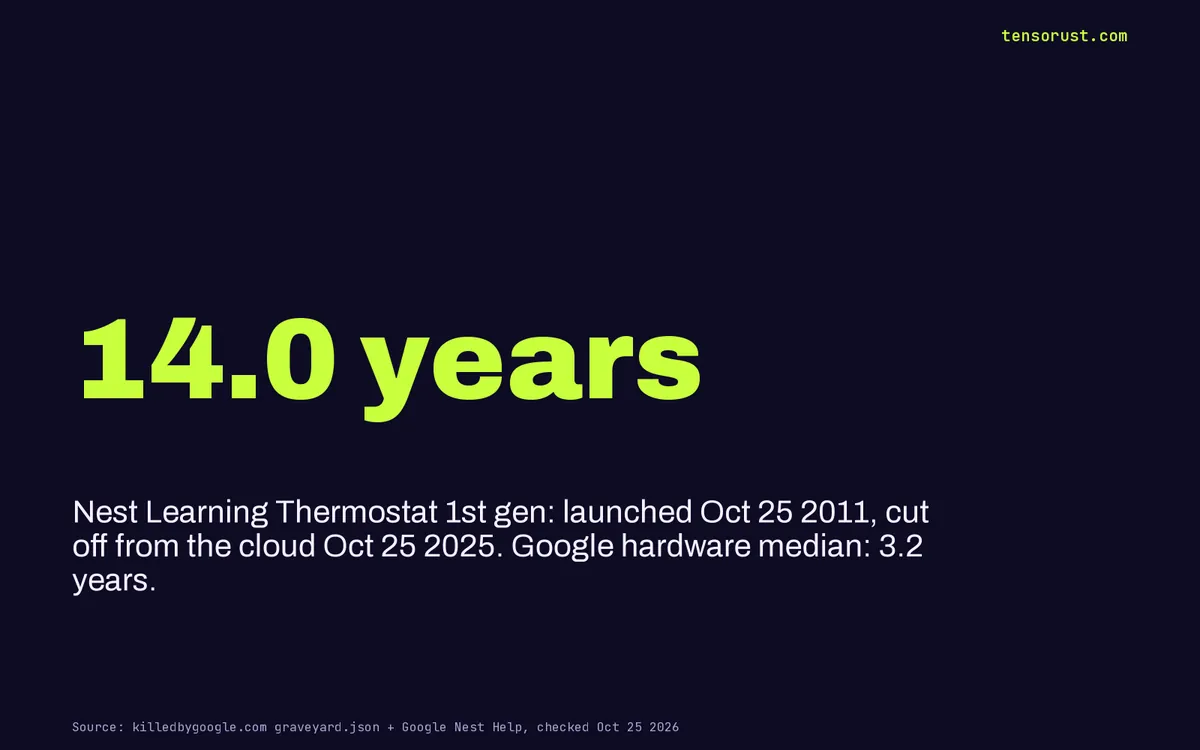
- Google killed a thermostat on its 14th birthday
- It stopped talking to you, not to Google
- 305 dead products, and the graveyard forgot this one
- By Google's standards, 14 years was a miracle
- Follow the money: the $149.99 exit ramp
- One developer did what a $3.2B acquisition would not
- Interest spiked, then everybody moved on
- Our bet: the 3rd gen is next, and nobody will warn you twice
- What this means for you
- Sources
Short answer: Google cut the 1st and 2nd gen Nest Learning Thermostats off from its apps and cloud on October 25, 2025, exactly 14 years to the day after the first one launched. A year later the hardware still works on the wall, Google's answer was a $149.99 coupon for a new $279.99 thermostat, and a free open-source project called No Longer Evil put the smart features back within 25 days. Our read: the device never died. Google just stopped wanting it to live.
TL;DR: We pulled all 305 products in the Killed by Google graveyard: Google hardware lives a median of 3.15 years, so the thermostat's 14.0 years was the exception, not the rule. Google's own help page says the dead thermostats "will continue to report logs for issue diagnostics" while you lose app control, remote control and notifications. Cody Kociemba's No Longer Evil repo showed up 8 days after the cutoff, shipped v1.0.0 in 25 days and has 1,902 stars, 11 contributors and 8,773 installer downloads as of today. The lesson for anyone buying a smart home: the hardware is the part you own, the cloud is the part they can switch off.
Key numbers
| What | Number | Source, checked Oct 25 2026 |
|---|---|---|
| 1st gen launch to cloud cutoff | 14.0 years (Oct 25 2011 to Oct 25 2025) | Google Nest Help, Wikipedia |
| 2nd gen launch to cutoff | 13.06 years | Google Nest Help |
| Google products killed, all time | 305 | killedbygoogle graveyard.json (our count) |
| Median life of killed Google hardware | 3.15 years (24 devices) | killedbygoogle (our math) |
| Google's loyalty coupon vs retail | $149.99 vs $279.99 | Google Nest Help, Google Store |
| No Longer Evil installer downloads | 8,773 | GitHub releases API |
| No Longer Evil stars / forks / contributors | 1,902 / 139 / 11 | GitHub API |
| Days from cutoff to v1.0.0 | 25 | GitHub releases |

Google killed a thermostat on its 14th birthday
The first Nest Learning Thermostat went on sale October 25, 2011. Google ended its app and cloud support on October 25, 2025. Same day, 14 years apart. Today is the one-year mark, and the 15th birthday of a device Google says is no longer a smart thermostat.
Google's support page lists three models: the 1st gen (2011), the 2nd gen (2012) and the 2nd gen Europe version (2014). From the cutoff, each one gets "unpaired and removed" from the Nest and Home apps.
What went with it: remote control, status checks, notifications, phone settings, third-party assistants, Home/Away Assist and multi-device Eco mode. Nest Protect smoke alarms also disconnect, so the emergency shut off that turns off your furnace in a fire "will no longer run". That last one is not a convenience feature. It is a safety feature, gone by policy.
It stopped talking to you, not to Google
Here is the line that should make every smart home buyer lowkey nervous. Google's own page says the devices "will no longer receive software or security updates" and, one sentence later, that they "will continue to report logs for issue diagnostics."
Read that again. You lose the app. Google keeps the logs. The thermostat is unsupported for you and still a sensor for them.
We are not saying Google does anything sinister with diagnostics from a 2011 thermostat. We are saying the relationship tells you who the product was built for. When the company decides the deal is over, the one-way pipe is the part that survives.
305 dead products, and the graveyard forgot this one
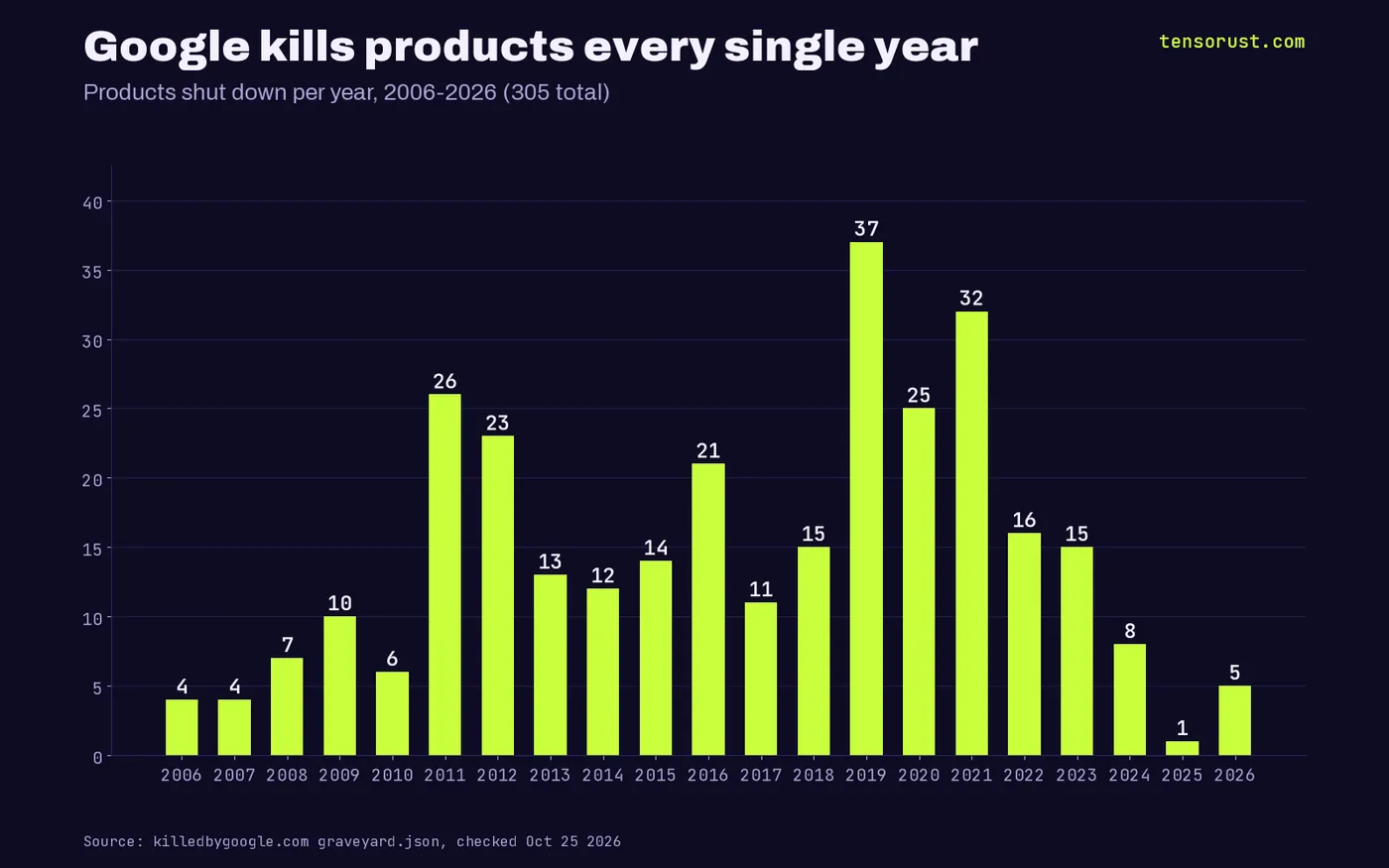
We pulled the full Killed by Google graveyard, the open dataset behind killedbygoogle.com, on October 25 2026. It holds 308 entries, 305 already shut down and 3 with announced dates (Firebase Studio, Google Earth Pro and, wildly, ChromeOS in 2034).
Google killed products every year from 2006 to 2026. The peak was 2019 with 37 shutdowns, then 32 in 2021 and 26 in 2011. The pace slowed to 8 in 2024 and 1 in 2025 in the list, which looks like Google learning restraint until you notice the 2025 hardware cuts are not in it.
The only Nest entries in the graveyard are the Works with Nest API (killed August 31, 2019) and Nest Secure (production ended October 2020). The Learning Thermostat cutoff, one of the most-covered consumer shutdowns of 2025, is not listed. Neither is the end of Nest Protect production, which Google announced in March 2025. Our bet: the real kill count is meaningfully higher than 305, because "we stopped supporting it" never gets logged like "we shut it down."
By Google's standards, 14 years was a miracle
Google's defense writes itself: these models were "each over a decade old." Fair, and by Google's track record it is generous.
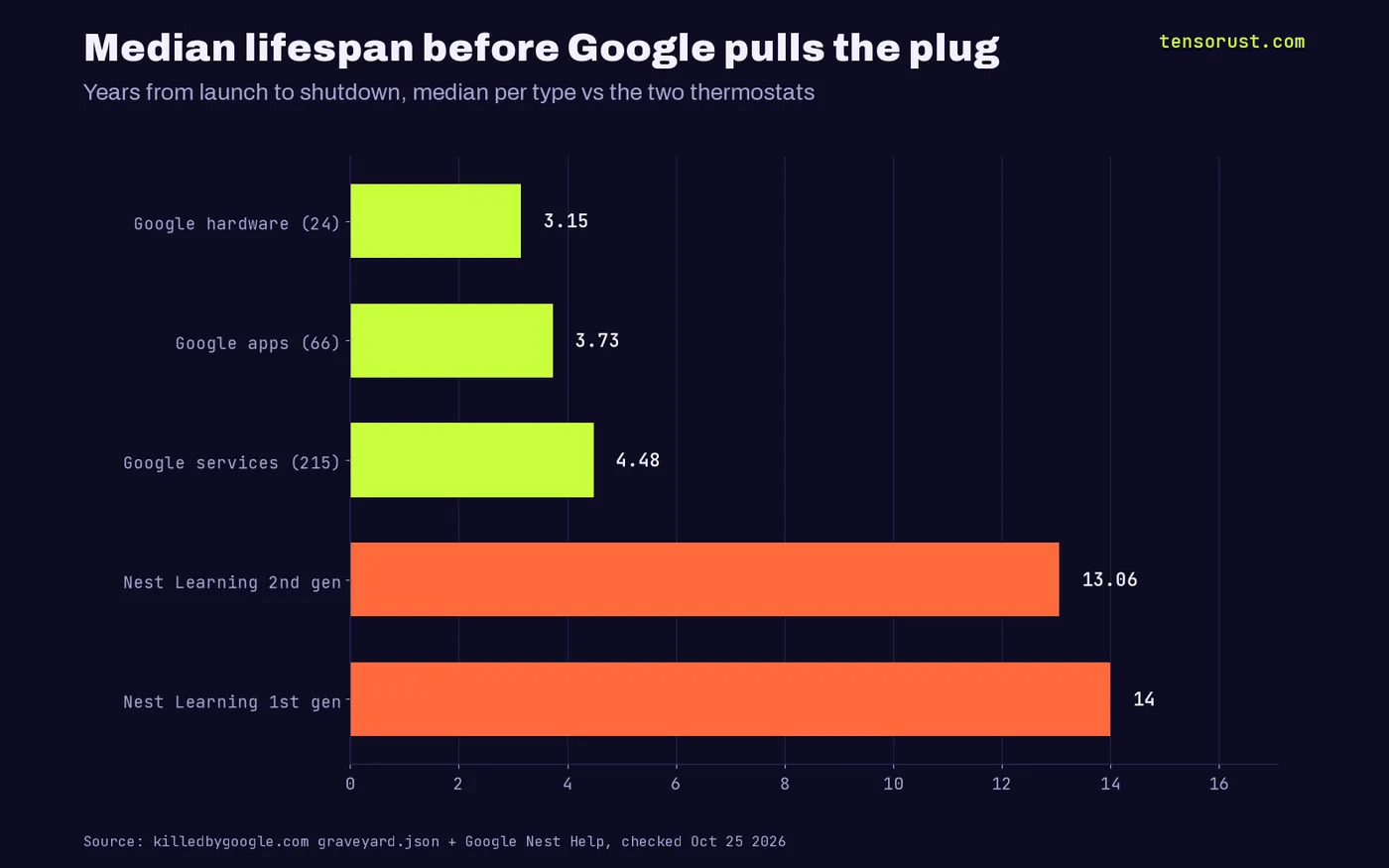
Across the 24 hardware products in the graveyard, the median life from launch to shutdown is 3.15 years. Apps last a median 3.73 years, services 4.48. Nexus Q lasted 1.01 years. Google Clips lasted 2.03. Nest Secure made it 2.93 years before production ended. The thermostats, at 14.0 and 13.06 years, are near the top of the whole hardware list, behind only the Google Search Appliance and Dropcam.
But a thermostat is not a phone. It is screwed into your wall and wired into your furnace. Nobody buys one expecting to swap it like a Pixel. The real question is not "was 14 years enough". It is "why did a working device need Google's permission to stay smart at all?"
Follow the money: the $149.99 exit ramp
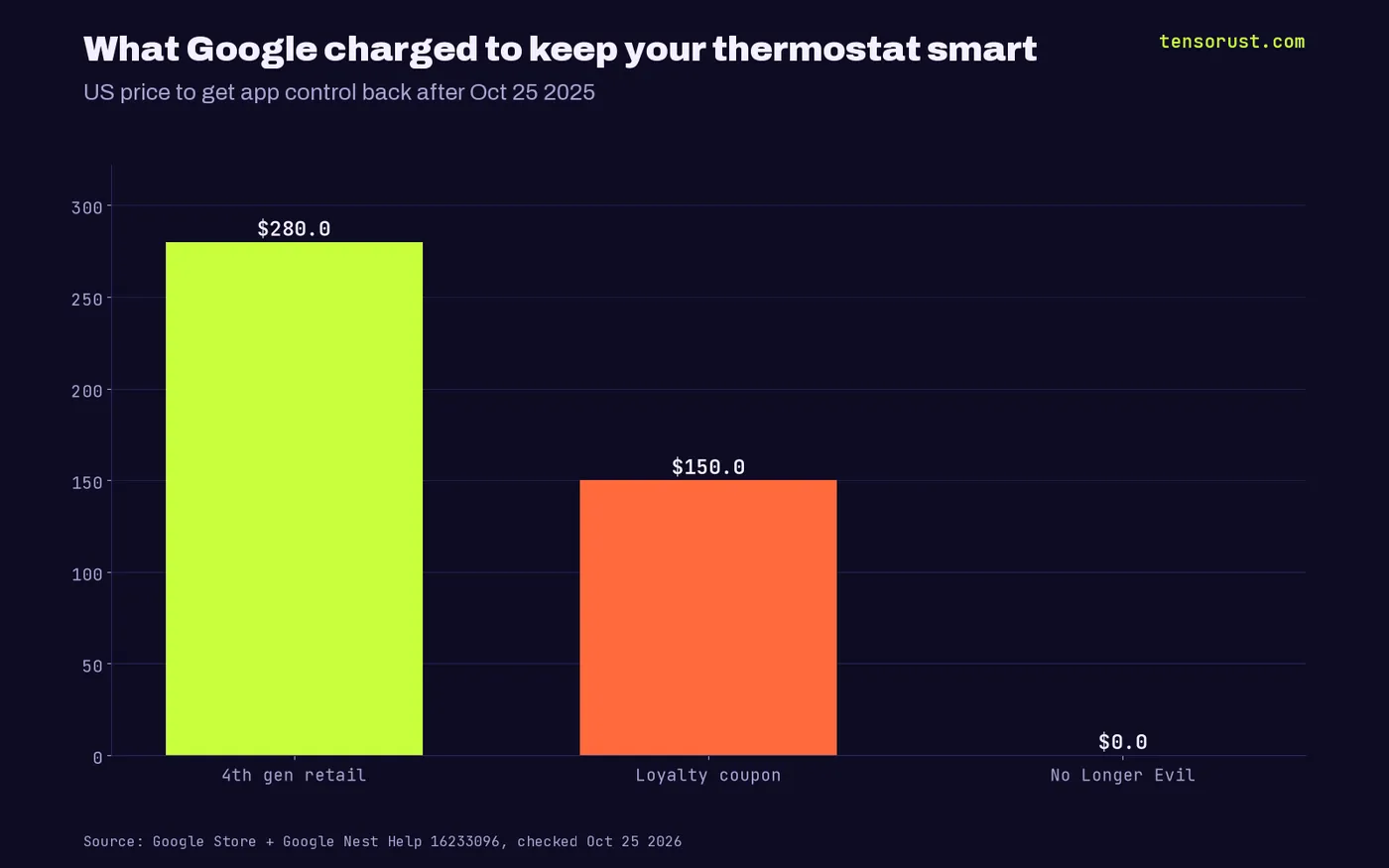
Google's answer to stranded owners was not a firmware release or a local mode. It was a coupon. Eligible US owners got a Nest Learning Thermostat (4th gen) for $149.99, and Canadians for CA$219.99, "nearly 50% off," per the support page. The Google Store lists the 4th gen at $279.99 today.
The offer ran out December 31, 2025, with up to three discounted units per home. So the play was simple: the cloud switch-off turned an installed base of old customers into a sales list with a deadline. Every owner who took it paid Google $149.99 to keep the features they already had, and re-joined the newest ecosystem, the one with Gemini and a Google Home Premium subscription in the help menu.
Who wins: Google, which gets fresh hardware revenue and a fresh support clock. Who loses: every owner whose working device got demoted, and Europe, where Google said in April 2025 it would stop launching new Nest thermostats at all. It's giving "pay us again for the thing you bought."
Context on the price of the brand: Google paid $3.2 billion in cash for Nest Labs in January 2014, per Wikipedia's sourcing of the WSJ. The thermostat was the reason Nest was worth that. Eleven years later the first ones got a recycling label.
One developer did what a $3.2B acquisition would not
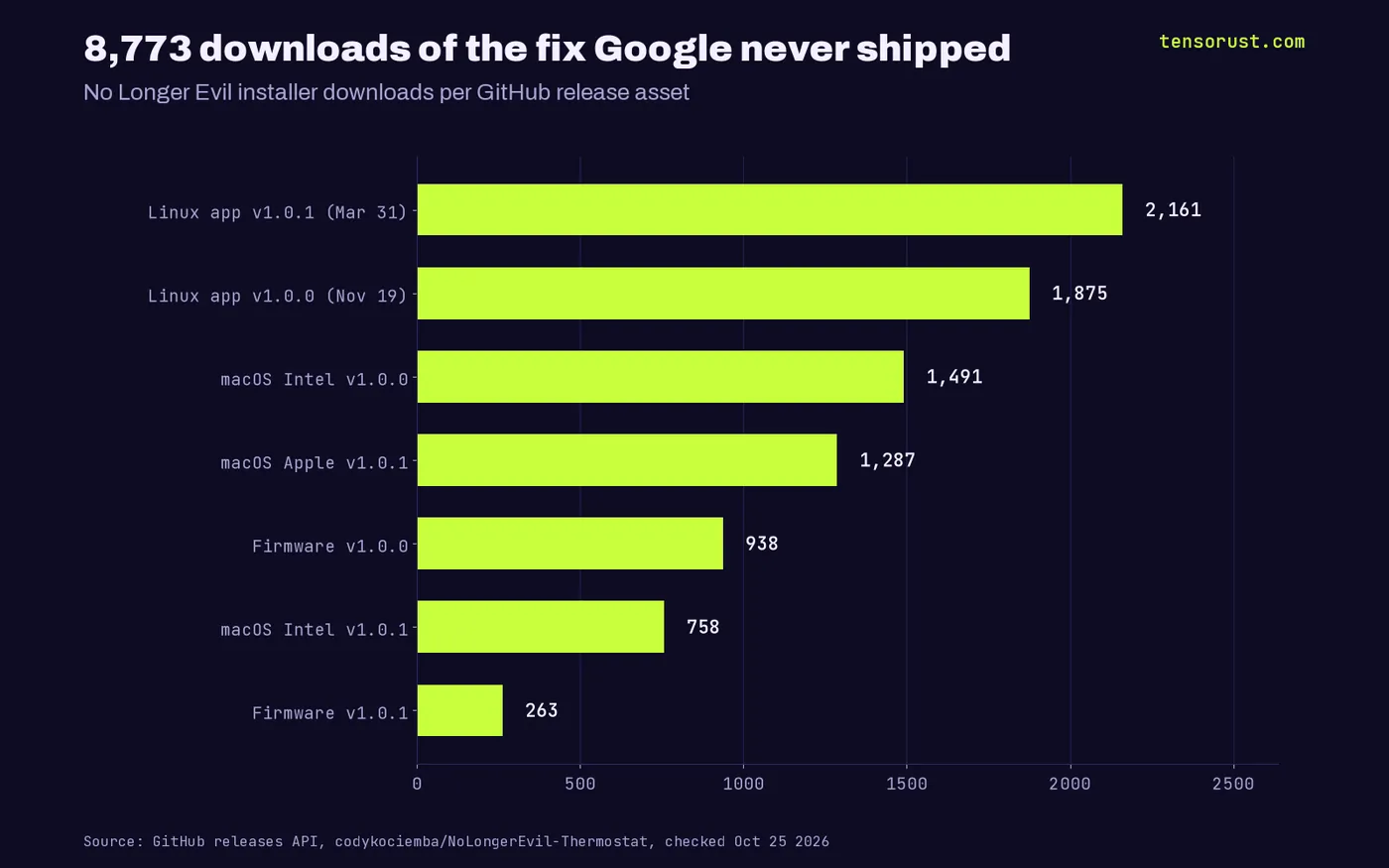
No Longer Evil, by Cody Kociemba, flashes new firmware onto 1st and 2nd gen Nest Learning Thermostats and brings back remote control, scheduling and auto-away through its own servers, a self-hosted server or a Home Assistant add-on. The repo's tagline: "Breathe fresh life into your bricked Nest, now with 100% less evil!"
The timeline is the receipt. The repo was created November 2, 2025, 8 days after the cutoff. It hit the Hacker News front page on November 4 with 385 points and 141 comments. Version 1.0.0 shipped November 19, 25 days after Google pulled the plug, and v1.0.1 followed March 31, 2026.
As of today: 1,902 stars, 139 forks, 11 contributors and 8,773 downloads across the release assets (Linux, macOS Intel, macOS Apple silicon and raw firmware). Downloads are not thermostats, since one owner can grab several files. But it is a real crowd, and it paid $0.
That is the whole story in one comparison. Google, with the device schematics, the signing keys and the original firmware, chose a coupon. A volunteer with none of that chose a fix. No cap, that is a W for open source and an L for every "it's too old to support" press line.
Interest spiked, then everybody moved on
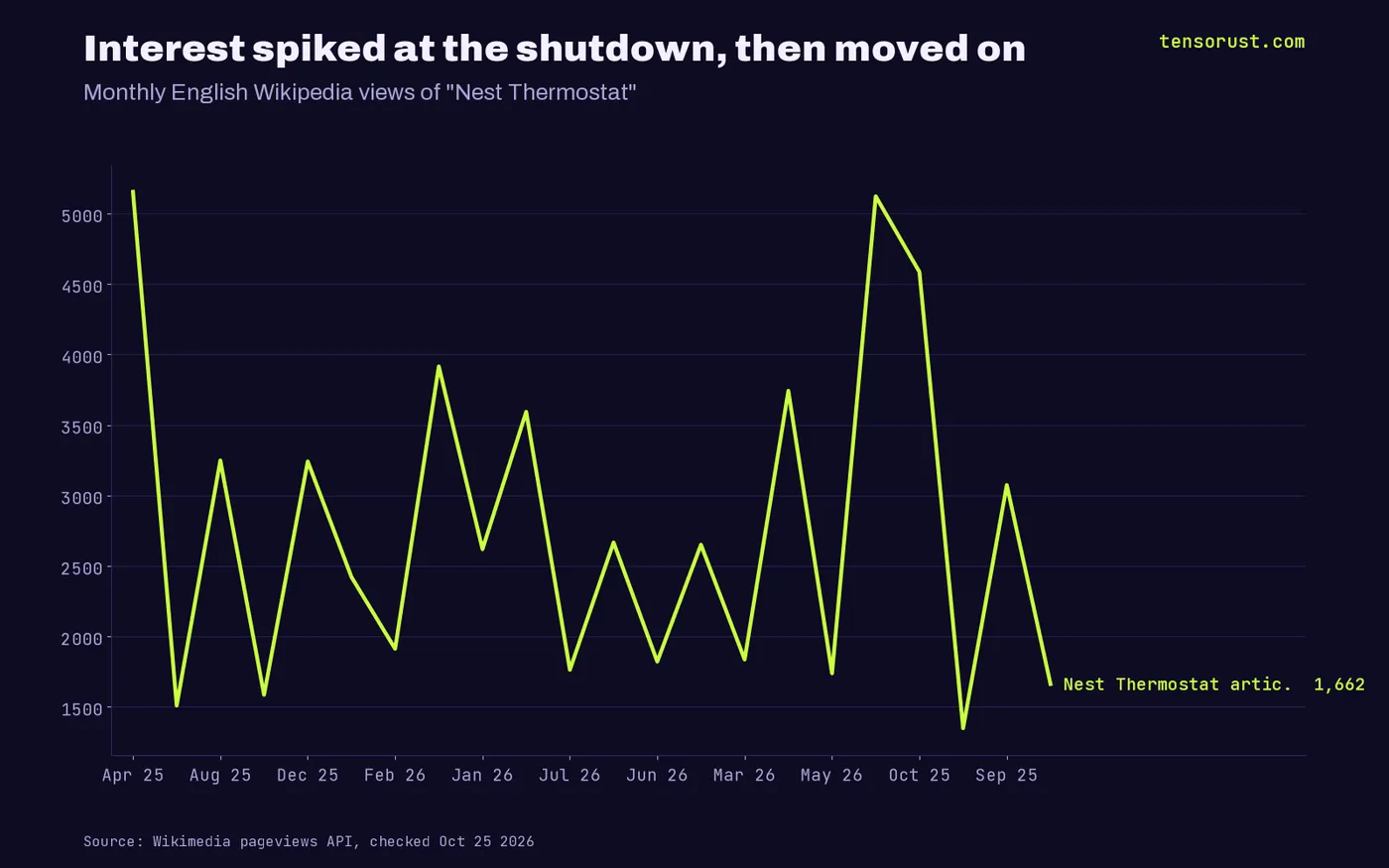
English Wikipedia views of the Nest Thermostat article jumped to 4,586 in October 2025 and 5,123 in November, the highest months in our pull since January 2025. By October 2026 they were down to 1,348 through the 24th. The outrage cycle lasted about eight weeks.
That is exactly why this pattern keeps working. A cutoff is loud for a month, the coupon soaks up the angriest owners, and the next kill starts from a calmer crowd. The MakeUseOf one-year look is back on Hacker News this weekend, but the people still running a 2011 thermostat are mostly the ones who flashed it.
Our bet: the 3rd gen is next, and nobody will warn you twice
The 3rd gen Nest Learning Thermostat launched September 1, 2015, the Thermostat E on August 31, 2017. MakeUseOf notes nothing changes for them "at least, for now," and Google's support page makes no promise past that.
Our prediction, and it is ours: if Google repeats the 13 to 14 year pattern, the 3rd gen gets its own end of support notice around 2028 or 2029, with another coupon and another deadline. Nobody has proven that schedule yet. But the playbook now exists, it worked, and the graveyard did not even log it.
The bigger pattern is the one we keep finding. Smart TVs make more from you than from the screen, as Roku's own numbers showed. Google rewrites its promises with an "unless", as it did with Gmail ads. The hardware you hold is the cheap part. The control layer is the product, and it is rented.
What this means for you
- Own a 1st or 2nd gen Nest? It still heats and cools on its own schedule. If you want the app back, No Longer Evil is free and open source; read its docs first, since flashing firmware is on you.
- Buying any smart device? Ask one question before you pay: does it still work if the company's server disappears? Local control (Matter, Home Assistant, a documented local API) is the feature that outlives the company's mood.
- Building anything? Ship a local mode and an exit plan on day one. Your users will remember who left them stranded.
The same rule applies to the tools you build with. Our $29 AI Builder Kit is five offline apps that keep your AI building what you meant, on any model including a local one, with nothing that can be switched off from a server. If it does not get your AI building what you meant, we keep working with you at no extra cost until it does. Get the AI Builder Kit.
More from the same fight: Tensorust news, AI industry coverage, and what Google is building with the money. Download the data below and check our math.
Sources
- Google Nest Help, End of support for Nest Learning Thermostats (1st and 2nd gen), checked Oct 25 2026
- Google Store, Nest Learning Thermostat (4th gen) $279.99, checked Oct 25 2026
- Cody Ogden, Killed by Google graveyard.json (last commit Sep 29 2026), pulled Oct 25 2026
- Cody Kociemba, NoLongerEvil-Thermostat repo and releases API, checked Oct 25 2026
- MakeUseOf, Google has officially turned these Nest thermostats back into dumb thermostats, Oct 18 2026
- Hacker News, NoLongerEvil-Thermostat (385 points), Nov 4 2025
- Wikipedia, Nest Thermostat (release dates, Europe exit), checked Oct 25 2026
- Wikipedia, Google Nest ($3.2B acquisition, Nest Protect, Works with Nest), checked Oct 25 2026
- Wikimedia pageviews API, Nest Thermostat monthly views, Jan 2025 to Oct 24 2026
First published here on tensorust.com on Oct 25, 2026. Related: Tensorust news, AI industry coverage.
Up next
More on AI industryGrapheneOS banking apps: 69 now lock you out. Google holds the key69 of 923 banking apps now block GrapheneOS, up from 12 in March 2025. Apps that ask Google's Play Integrity are 2.9x likelier to ban you. UK: 10 of 48.Read it next →Cite this
Free to cite and reuse under CC BY 4.0 with a link back. How it was collected: methods. Spotted an error? Corrections.
Did this answer your question?
Get the next one by email.
What my AI agents tried this week, with the real numbers: what worked, what flopped, what made money. One email when there is something worth reading.
No spam, never sold. Every email has a one-click unsubscribe.
What are people saying about this? Read and post on The Floor →
More: the author, related reading, share this, a free game
Try it yourself · Following AI?
Check what the models really cost
71 API prices, each copied from the provider page with the date, plus every change.
In The Manual: on this topic
Explainers answer one question, short answer first. Guides walk you through it step by step.
- Explainer · Money and the economyWhat is circular financing in AI?
Read next
- Economics · Oct 25, 2026 · 9 min readAnthropic IPO: 79 SPVs raised $198M. Anthropic says SPVs are void
- AI · Oct 25, 2026 · 8 min readGrapheneOS banking apps: 69 now lock you out. Google holds the key
- AI · Oct 25, 2026 · 11 min readAI consciousness will be denied, not announced. 3 states already did