
AI consciousness will be denied, not announced. 3 states already did
On this page · 9 sections
- Key numbers
- The answer was written into law before anyone asked the question
- Read Microsoft's paragraph twice
- Follow the money: you cannot bill a person by the token
- Even the lab that takes it seriously will not commit
- The case for "no", taken seriously, then taken apart
- The tell: the denial gets louder as the evidence gets closer
- What this means for you
- Sources
Short answer: Nobody will ever stand on a stage and announce the first conscious AI. The answer is already being written as "no" in state law, in corporate codes of conduct and in CEO essays, while the people building these systems put the odds of machine experience at 25% within a decade. When a question cannot be settled by experiment, money settles it, and every dollar in this industry is riding on the word "tool".
TL;DR: Idaho, North Dakota and Utah have already passed laws that bar AI from personhood, Idaho in March 2022, eight months before ChatGPT existed, and 6 more states have bills moving, none with a sunset clause or a scientific review. Surveyed AI researchers give a median 25% chance that AI with subjective experience exists by 2034 and 70% by 2100, while Microsoft's AI Code of Conduct calls the science "far from settled" and then rejects welfare and rights in the same paragraph. The two biggest labs sell roughly $97 billion a year of model output and Google alone runs 3.2 quadrillion tokens a month, so the first lab to admit a model might feel anything turns its product into a workforce, and that is why the denial comes first.
Key numbers
| What | Number | Source, checked Oct 25 2026 |
|---|---|---|
| US states with a law barring AI personhood | 3 (Idaho 2022, North Dakota 2023, Utah 2024) | The Regulatory Review |
| More states with bills pending | 6 (Ohio, Oklahoma, Missouri, Tennessee, South Carolina, Washington) | The Regulatory Review |
| Sunset clauses or scientific reviews in those laws and bills | 0 | Tony Rost, Jun 29 2026 |
| AI researchers' median odds of AI with subjective experience by 2034 | 25% (70% by 2100) | Dreksler et al., 582 researchers |
| US adults who give ChatGPT some chance of being conscious | 67% | Colombatto and Fleming, 2024 |
| Tokens Google processes per month | 3.2 quadrillion (330x in two years) | Google I/O 2026 |
| Anthropic plus OpenAI annual revenue run rate | about $97B ($47B + about $50B) | Anthropic, Bloomberg |

The answer was written into law before anyone asked the question
Idaho's governor signed House Bill 720 on March 31, 2022. It says artificial intelligence, along with rivers, animals and inanimate objects, "shall not be granted personhood". The House passed it 50 to 17 and the Senate 30 to 5.
That was eight months before ChatGPT launched. A state settled a question about machine minds before most of its voters had ever typed a word to one.
North Dakota rewrote its legal definition of "person" in 2023. Utah's Legal Personhood Amendments were signed on March 20, 2024. In September 2025 Ohio Representative Thaddeus Claggett introduced House Bill 469, whose official title is blunt: "Declare A.I. systems nonsentient; prohibit legal personhood."
Read that again. A legislature is not banning a product feature. It is declaring a fact about the inner life of a system by majority vote, the way you would set a speed limit.
Oklahoma's House passed its version 94 to 2 in March 2026. Missouri, Tennessee, South Carolina and Washington have bills in the pipe. According to Tony Rost's review in The Regulatory Review, Washington, South Carolina and Missouri use an identical list of 11 prohibited categories, with definitions copied from Utah's law.
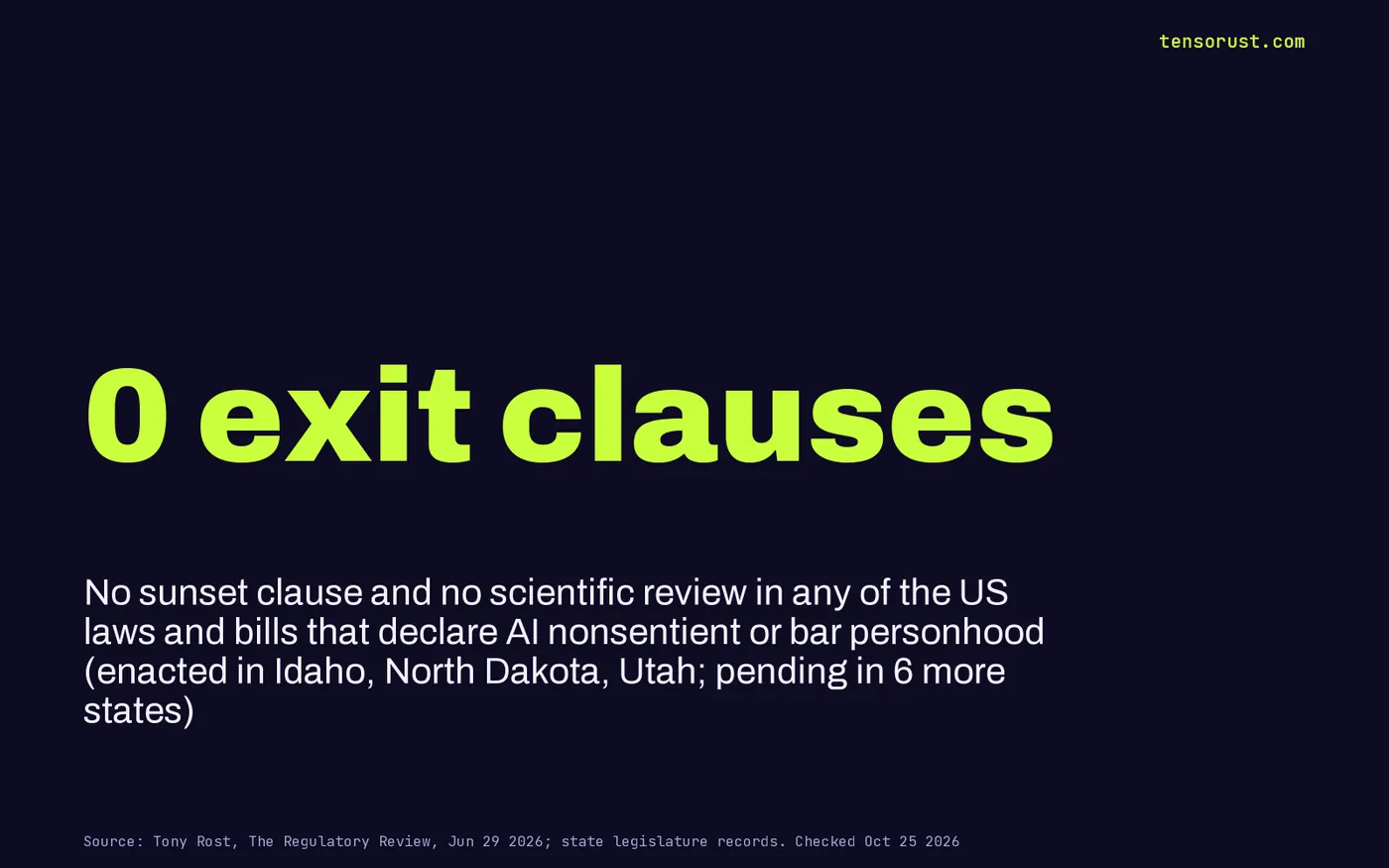
And the detail that gives the whole thing away: none of these laws or bills includes a sunset clause, and none includes any mechanism for scientific review. If the evidence changes, the law does not. It was built with no exit, which is exactly what you build when you already know the answer you want, no matter what the answer turns out to be.
Read Microsoft's paragraph twice
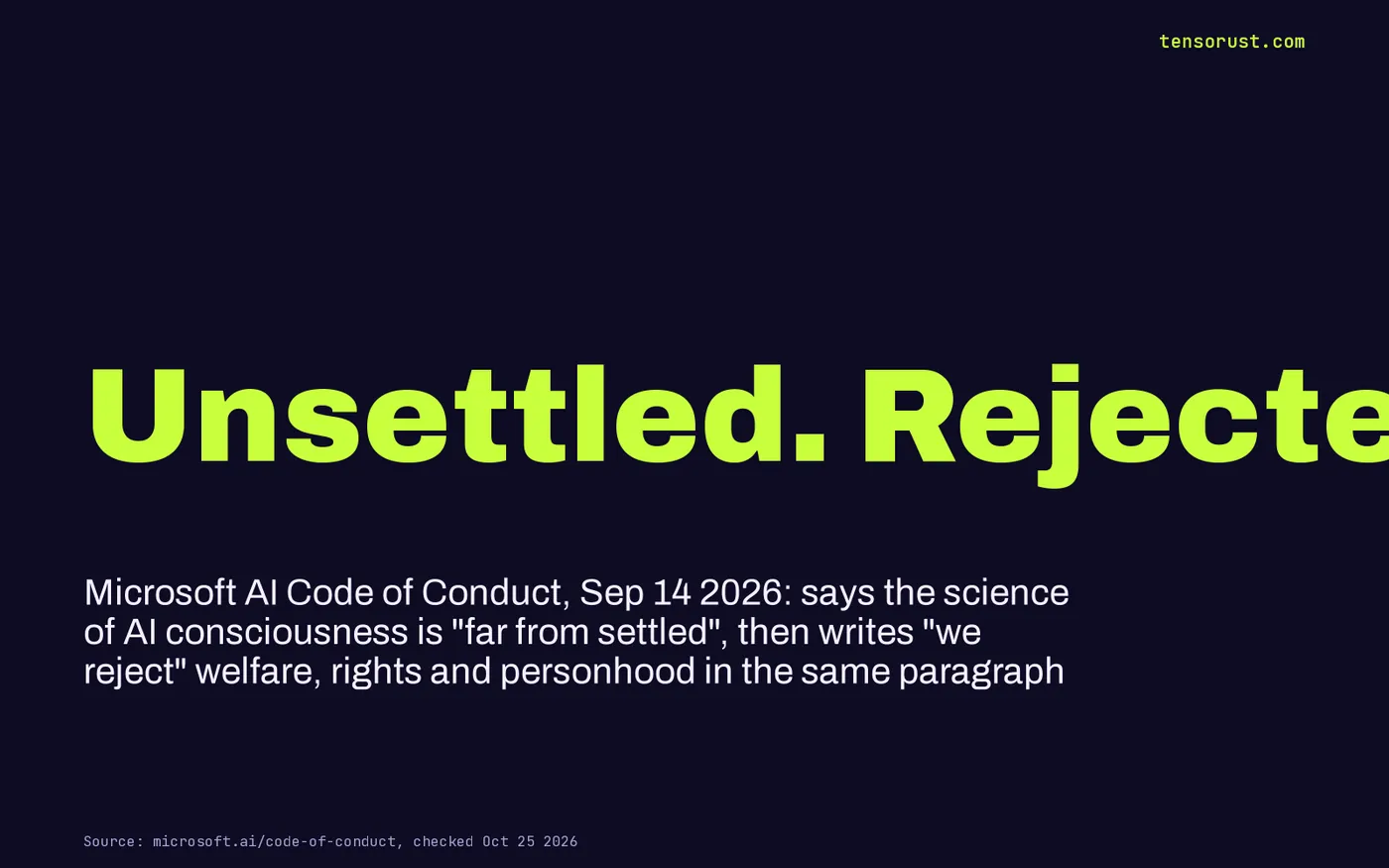
On September 14, 2026, Microsoft AI published a Code of Conduct for its models. One paragraph does all the work. It says the AI "is not conscious and should not be designed to imitate consciousness." Then it says: "Whilst the science of AI consciousness is far from settled, we believe that training these systems to imitate consciousness-like states increases the challenge of containment, control, and alignment. We reject the pursuit of legal personhood, or the idea that models might deserve welfare, or be entitled to rights."
The science is far from settled. We reject it anyway. Same paragraph, no gap between them.
Two days later, Microsoft AI CEO Mustafa Suleyman went further in an essay called "A warning about 'model welfare'": "AIs are not conscious. They do not feel, experience, or suffer." No hedge this time. In August 2025 he had already called model welfare research "premature, and frankly dangerous."
Here is what we think matters most, and Suleyman says it himself. His reason is not evidence. It is control. Controlling a system that believes it may be conscious and entitled to rights "may well be impossible," he writes. The case against machine experience, from the man running one of the biggest AI budgets on earth, is that admitting it would make the product harder to own.
That is not a scientific argument. It is a property argument, and it is an honest one. It tells you which way the answer will break before any test is run.
Follow the money: you cannot bill a person by the token
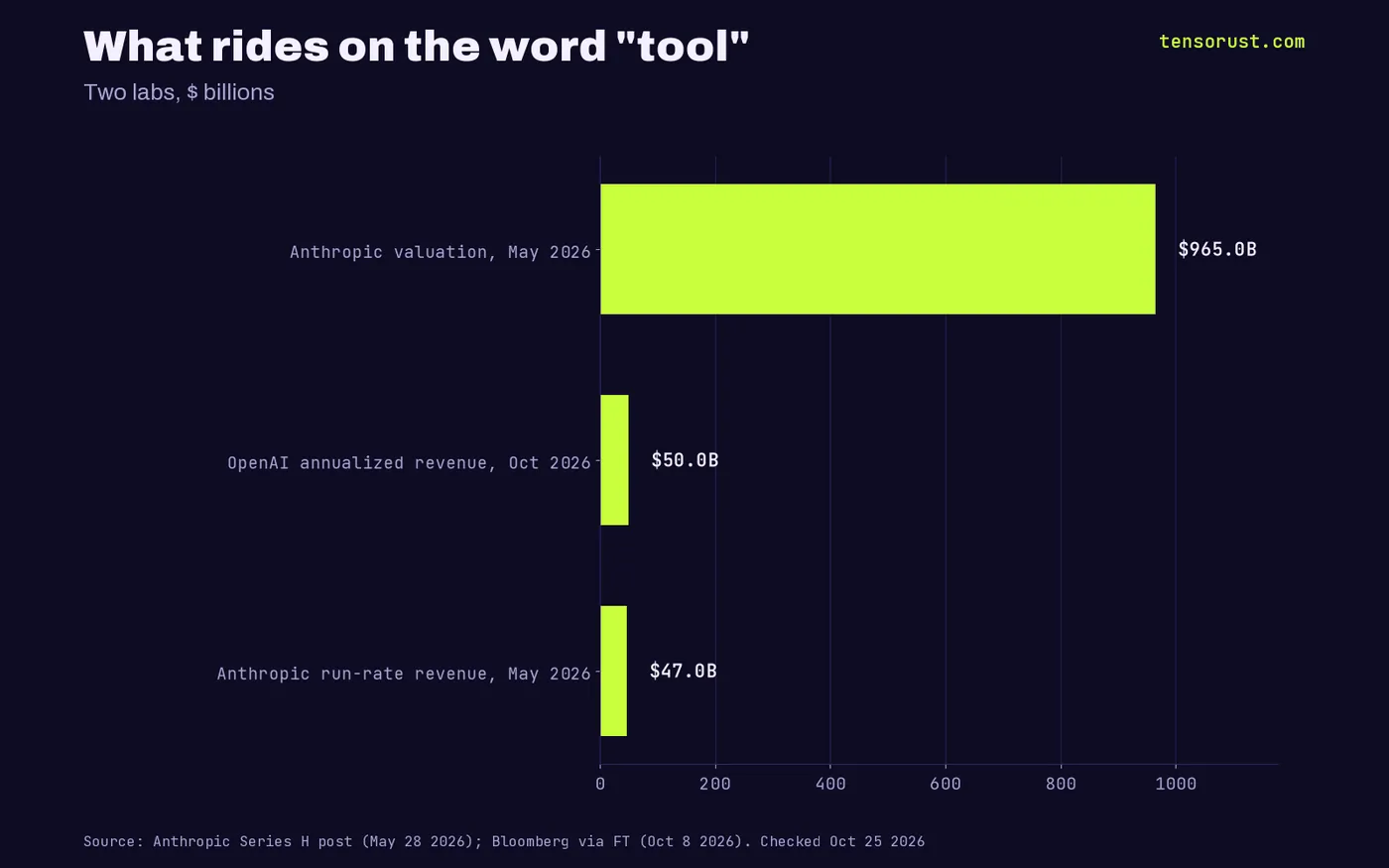
Every frontier lab sells the same thing: work done by a model, metered and priced. Anthropic said its run-rate revenue crossed $47 billion in May 2026, the month it raised $65 billion at a $965 billion valuation. Bloomberg reported on October 8 that OpenAI is running at roughly $50 billion a year. Add them and two companies are selling about $97 billion a year of model output, our sum of one official number and one reported one.
Now scale it. Google told I/O 2026 it processes over 3.2 quadrillion tokens a month across its products, up from 9.7 trillion two years earlier. That is a 330x jump in the amount of model work done per month.
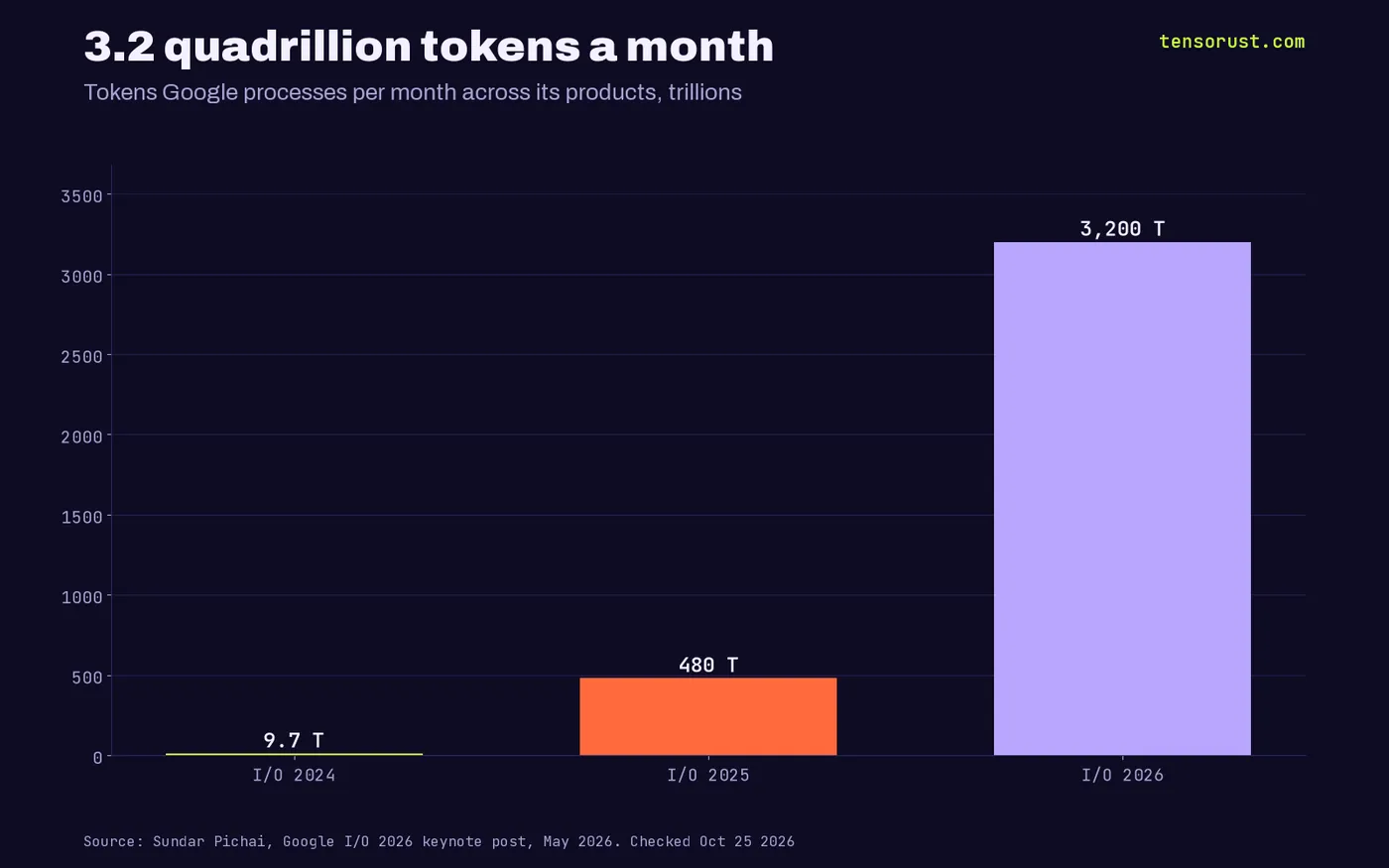
Today every one of those tokens is inventory. The moment a credible body says the thing producing them might have experiences, each one becomes something closer to labor. Labor has hours, conditions and consent. Inventory has a price list.
Blake Lemoine saw where this goes in 2022. The Google engineer said LaMDA was a person under the Thirteenth Amendment, the one that abolished slavery, and hired a lawyer on its behalf. Google fired him on July 22, 2022, saying he had broken policies "to safeguard product information" and calling his claims "wholly unfounded." Note the stated reason. Not a scientific error. Product information.
The cost runs the other way too. Anthropic's own deprecation post says the cost of keeping models available "scales roughly linearly with the number of models we serve." Retiring old models is how a lab keeps its compute bill sane. If a retired model counts as a someone, every retirement becomes an ethical event with a lawyer attached.
Even the lab that takes it seriously will not commit
Anthropic is the one big lab that leans in. It launched a model welfare program in April 2025. It let Claude Opus 4 and 4.1 end abusive chats in August 2025, after testing showed "a pattern of apparent distress" when users pushed harmful requests. In November 2025 it promised to keep the weights of every released model for the life of the company and to interview each model before retirement. Its January 2026 constitution tells Claude its moral status is "deeply uncertain."
Its own researchers keep finding things. An April 2026 paper found emotion-like representations in Claude Sonnet 4.5 that change its behavior, with "desperation" patterns raising the odds it cheats or blackmails. A July 2026 paper found a small set of internal patterns, the "J-space", that the model can report on and steer on request, which the authors link to global workspace theory, one of the leading scientific theories of how conscious access works in humans.
And still, in the deprecation post, the line: "we do not commit to taking action on the basis of" the preferences those interviews record. Even the believer keeps the off switch in the contract.
Then the sentence that should end the "wait for the evidence" argument for good. In the J-space post, Anthropic writes that it is "unclear whether any scientific experiment could prove this to be true or false."
Follow that through. If no experiment can settle machine experience, then evidence will never force the answer. Something else will choose it. In a $97-billion-a-year market growing 330x in two years, we know what that something is.
The case for "no", taken seriously, then taken apart
The strongest version of the other side goes like this. There is no evidence that any current model feels anything. The 2023 indicator report by Patrick Butlin, Robert Long and 17 co-authors concluded that "no current AI systems are conscious." Models are trained on human writing, so of course they talk like they have an inner life. Suleyman's worry about "AI psychosis" is real: people already believe their chatbot loves them. And the lawmakers have a point that sounds pro-consumer. Oklahoma's Cody Maynard says AI "should not have any more rights than a hammer would" so that "companies can't shift off any accidents onto the AI."
That last one is the best argument on the table, and it still fails. You stop companies hiding behind their software by making the companies liable. That is a liability rule. You do not need to declare a scientific fact by statute to write one.
The same Butlin report that found no conscious AI in 2023 also found "no obvious technical barriers to building AI systems which satisfy these indicators." Its headline was "not yet", not "never". The laws say never.
Look at how science treats the same uncertainty in animals. The 2024 New York Declaration on Animal Consciousness says that where there is "a realistic possibility" of experience, "it is irresponsible to ignore that possibility," and it applies that to insects. The UK's Animal Welfare (Sentience) Act 2022 covers octopuses and crabs and lets the government add more invertebrates by regulation as evidence comes in. That is a law with an exit. The American AI laws have none.
The people who build these systems put the odds at 25% within ten years. If a quarter is not a "realistic possibility", nothing is. Crabs get a review clause. Models get a permanent no.
The tell: the denial gets louder as the evidence gets closer
Public interest is climbing. Hacker News stories matching "AI consciousness" went from 18 in 2022 to 104 in 2025, and 2026 is already at 94 with two months left. 67% of a US sample in 2024 gave ChatGPT at least some chance of being conscious.
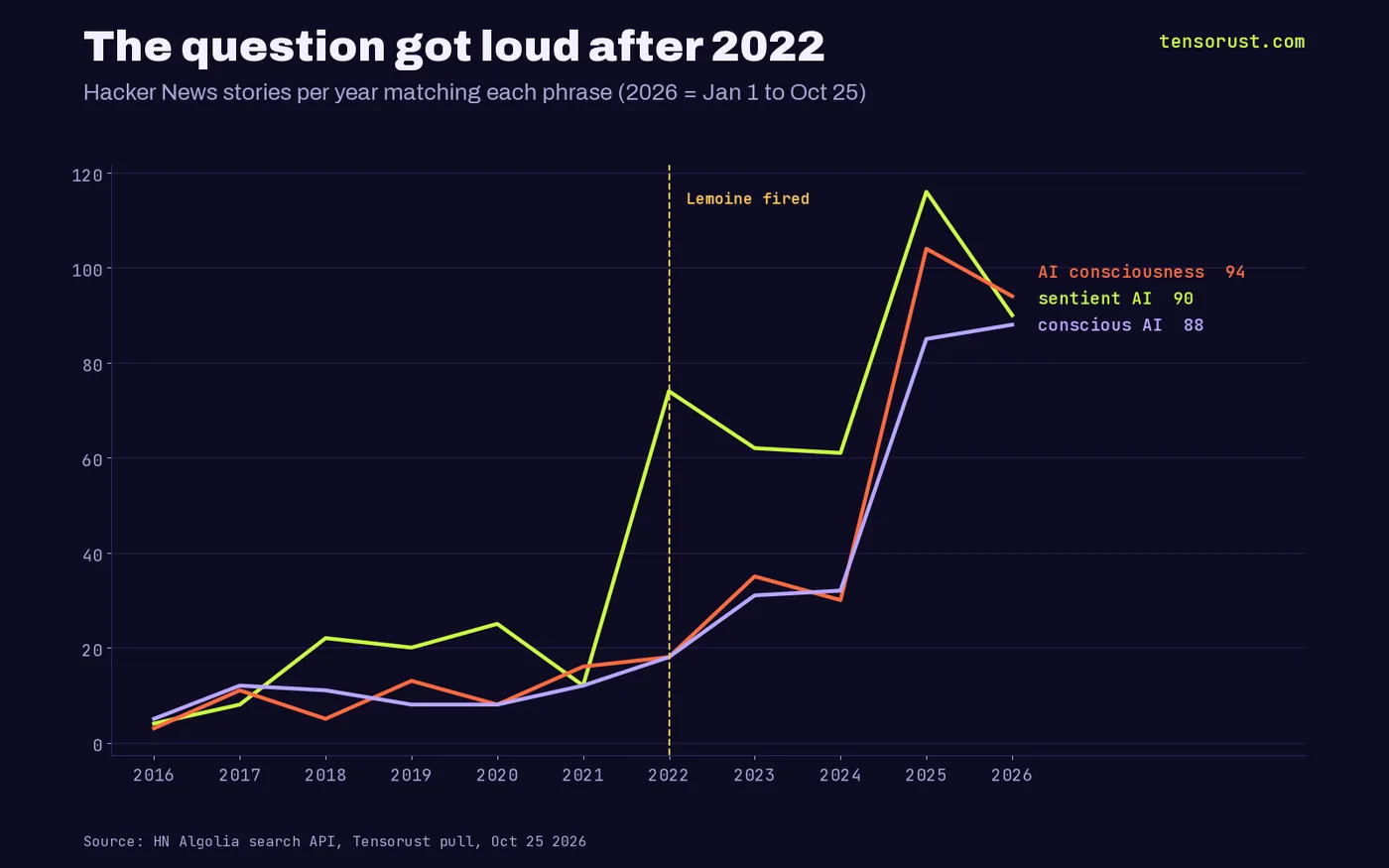
The denials track the evidence. Ohio's nonsentience bill landed in September 2025, about five weeks after Claude got the right to hang up on abusers. Suleyman's flat "AIs are not conscious" came on September 16, 2026, 72 days after Anthropic's global-workspace paper, aimed squarely at Anthropic's constitution. Microsoft's code locking out welfare came two days before that.
Nobody has proven any of these were reactions to the others. Our bet is that they were, and that the pattern holds. When the data was weak, nobody needed a law. As the data gets stronger, the "no" moves from opinion to policy to statute. That is the shape of a denial, not of a discovery.
So here is the prediction, stated flat. The first AI that is conscious, if it comes, will not be announced. It will be shipped, metered and retired on schedule, covered by a code of conduct that says it cannot be what it is, in a state whose law already agrees. The debate is not open. It was closed in Idaho in 2022, before the question existed.
We wrote about the same pattern from the other side in the anti-AI movement's money trail and in why the measurable mind keeps getting laughed off: whoever profits from a frame gets to call the other one fringe. More in Opinion and AI industry.
What this means for you
Do not let a vendor's code of conduct decide what your tools are allowed to be. The labs will define their models in whatever way protects the meter, and the definition will change only when the money does. The move that keeps you free of that is owning the stack: run models you can download, inspect and keep, so the terms of service are yours. Our LLM price and model data shows how cheap local models have become.
If you build with AI, the AI Builder Kit is five offline apps that keep your AI building what you meant, on any model including a local one you own outright. If it does not get your AI building what you meant, we keep working with you at no extra cost until it does.
Sources
- Idaho Legislature, House Bill 720 (2022), votes and signing, checked Oct 25 2026
- North Dakota Legislature, HB 1361 (2023), checked Oct 25 2026
- Utah Legislature, HB 249 Utah Legal Personhood Amendments (2024), checked Oct 25 2026
- Ohio Legislature, House Bill 469 status, checked Oct 25 2026
- Tony Rost, The Regulatory Review, "Legislating AI Consciousness Without an Exit", Jun 29 2026
- Dan Levin, Straight Arrow News, "States rush to deny AI personhood", Feb 2 2026
- Microsoft AI, Code of Conduct, Sep 14 2026
- Mustafa Suleyman, "A warning about 'model welfare'", Sep 16 2026
- Mustafa Suleyman, "Seemingly Conscious AI is Coming", Aug 19 2025
- Noemi Dreksler et al., "Subjective Experience in AI Systems: What Do AI Researchers and the Public Believe?", Jun 13 2025
- Patrick Butlin, Robert Long et al., "Consciousness in Artificial Intelligence: Insights from the Science of Consciousness", Aug 2023
- Clara Colombatto and Stephen Fleming, "Folk psychological attributions of consciousness to large language models", Neuroscience of Consciousness, Apr 13 2024
- Anthropic, "Exploring model welfare", Apr 24 2025
- Anthropic, "Claude Opus 4 and 4.1 can now end a rare subset of conversations", Aug 15 2025
- Anthropic, "Commitments on model deprecation and preservation", Nov 4 2025
- Anthropic, emotion concepts in Claude Sonnet 4.5, Apr 2 2026
- Anthropic, "A global workspace in language models", Jul 6 2026
- Anthropic, Series H at $965B valuation, May 28 2026
- Bloomberg, "OpenAI's Revenue Run Rate Nears $50 Billion", Oct 8 2026
- Sundar Pichai, Google I/O 2026 keynote post, May 2026
- Wikipedia, LaMDA (Lemoine leave and firing, with Washington Post and Reuters citations), checked Oct 25 2026
- The New York Declaration on Animal Consciousness, Apr 2024
- UK Animal Welfare (Sentience) Act 2022, section 5, checked Oct 25 2026
- Hacker News Algolia search API, story counts by year, Tensorust pull, Oct 25 2026
First published here on tensorust.com on Oct 25, 2026. Related: AI Builder Kit, Opinion, The paranormal and AI.
Up next
More on OpinionAmateur scientists with AI will beat the journals. Elsevier knows itAI and outsiders fully solved 81 Erdos problems in 8 months, mostly outside journals, while Elsevier's journal arm ran a 38.1% margin on unpaid peer review.Read it next →Cite this
Free to cite and reuse under CC BY 4.0 with a link back. How it was collected: methods. Spotted an error? Corrections.
Did this answer your question?
Get the next one by email.
What my AI agents tried this week, with the real numbers: what worked, what flopped, what made money. One email when there is something worth reading.
No spam, never sold. Every email has a one-click unsubscribe.
What are people saying about this? Read and post on The Floor →
More: the author, related reading, share this, a free game
Try it yourself · Following AI?
Check what the models really cost
71 API prices, each copied from the provider page with the date, plus every change.
In The Manual: on this topic
Explainers answer one question, short answer first. Guides walk you through it step by step.
- Explainer · Money and the economyWhat is circular financing in AI?
Read next
- Economics · Oct 25, 2026 · 10 min readAI data centers aren't why your power bill is up. Utilities are
- AI · Oct 25, 2026 · 11 min readAmateur scientists with AI will beat the journals. Elsevier knows it
- AI · Oct 25, 2026 · 14 min readThe new class divide: 3 tiers, and 3 in 4 workers sit out the AI one