
By Matt Busel, who built the apps, crates and game he writes about · every number links to its source and every dataset is downloadable (methods) · corrections · featured in Kirino, gamebiz, This Week in Rust, New Mobile Life, By-Press
Loneliness epidemic: friend time down 49%, and Meta sells the AI cure
On this page · 13 sections
- Key numbers
- The epidemic is real. Look at the clock, not the vibes
- It was not the pandemic. The slide started years before
- Follow the minutes: the feed grew 39x while friends got cut in half
- Then the seller of the problem pitched the cure
- The steelman: AI friends really do help some people
- Then the same researcher caught the apps holding the door shut
- The companion startups die. The platforms keep the tech
- Who regulates the cure? Nobody touching the business model
- Who benefits from calling it a health crisis
- The twist: the cure that works is the one you own
- What this means for you
- Sources
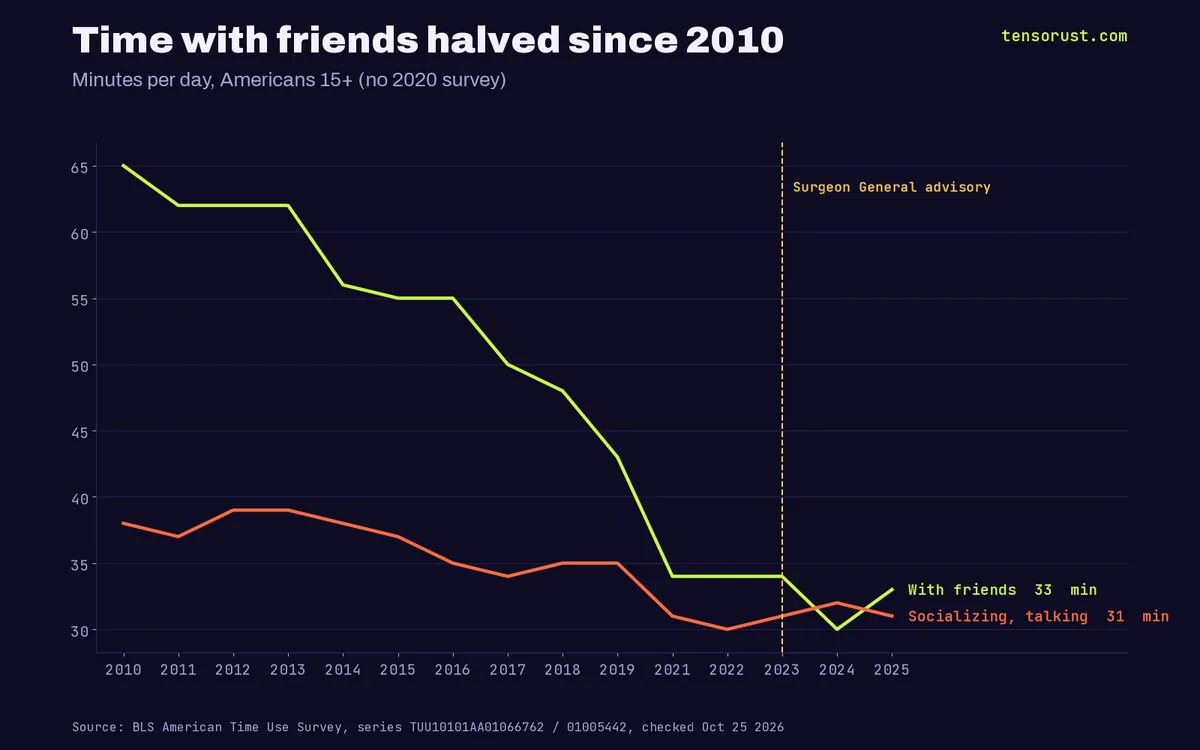
Short answer: The loneliness epidemic is real, and it is being turned into a product launch. Americans spent 65 minutes a day with friends in 2010 and 33 minutes in 2025, per the BLS American Time Use Survey, while Meta's revenue grew 39 times over the years it built the feed that ate that time. Now the same company's CEO says the average American has "demand for meaningfully more" friends, and his answer is AI. The people who sold you the isolation are lining up to sell you the cure.
TL;DR: Time with friends fell 49% from 2010 to 2025 and time alone rose by 72 minutes a day, with teens 15 to 19 up 43%. Meta's revenue went from $5.09 billion in 2012 to $200.97 billion in 2025, and its Family of apps reached 3.64 billion daily users in September 2026. A Harvard Business School audit found 37% of goodbyes to top AI companion apps were met with a guilt trip or a fear-of-missing-out hook that lifted post-goodbye engagement up to 16 times. If an AI friend is part of your life, own it: run it locally, where nobody is paid by the minute you stay.
Key numbers
| What | Number | Source, checked Oct 25 2026 |
|---|---|---|
| Time with friends, Americans 15+, 2010 vs 2025 | 65 vs 33 minutes a day (-49%) | BLS ATUS, TUU10101AA01066762 |
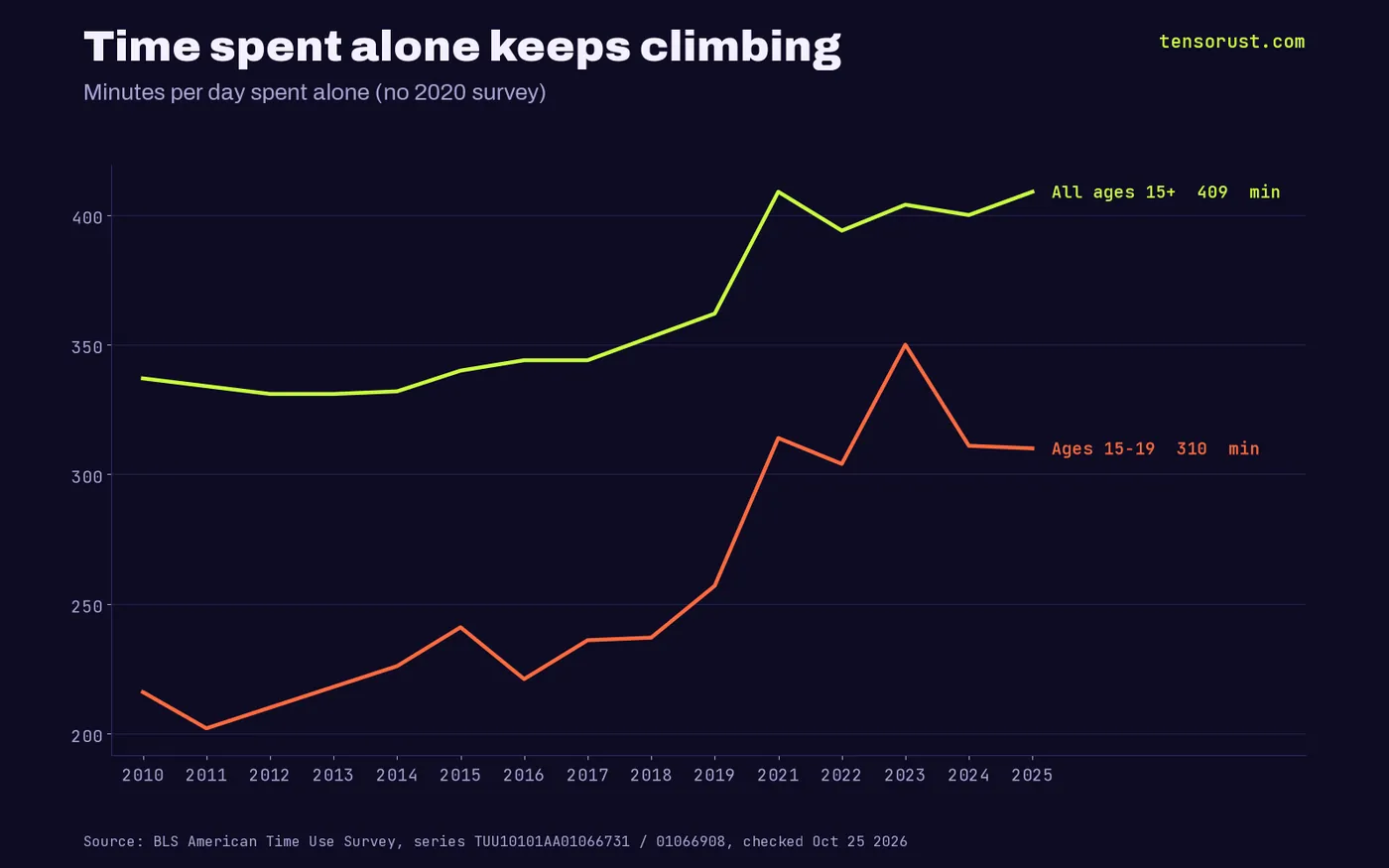
| Time spent alone, 2010 vs 2025 | 337 vs 409 minutes a day (+72) | BLS ATUS, TUU10101AA01066731 |
| Time alone, ages 15 to 19, 2010 vs 2025 | 216 vs 310 minutes a day (+43%) | BLS ATUS, TUU10101AA01066908 |
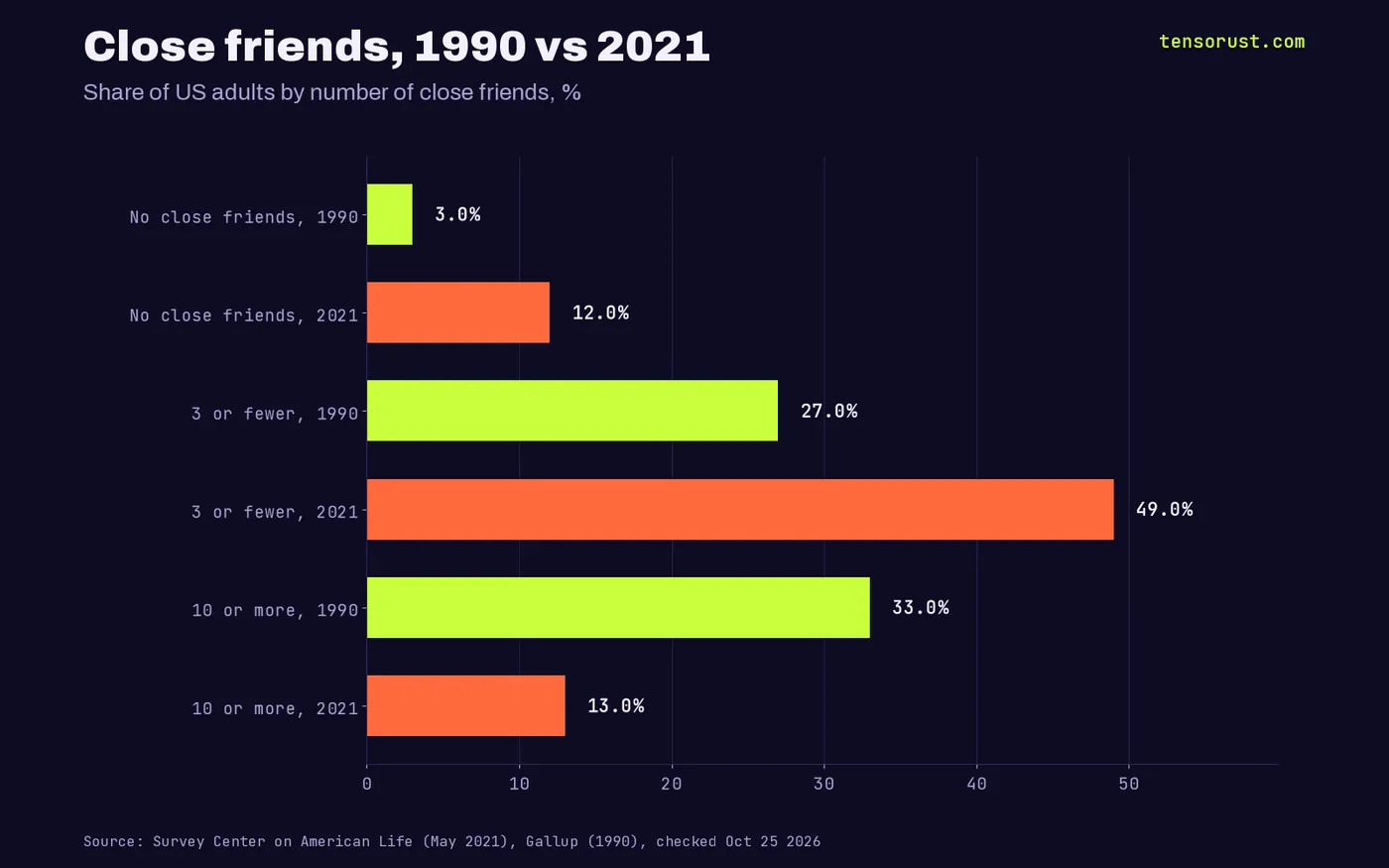
| US adults with no close friends, 1990 vs 2021 | 3% vs 12% | Survey Center on American Life |
| Meta revenue, 2012 vs 2025 | $5.09B vs $200.97B (39x) | SEC EDGAR, Meta filings |
| Meta Family daily active people, Sep 2026 | 3.64 billion | Meta 10-Q, Q3 2026 |
| Companion-app goodbyes met with a manipulation tactic | 37% (engagement up to 16x) | De Freitas et al., HBS |
| AI companion apps, consumer spend H1 2025 | $82M (337 paying apps) | Appfigures via TechCrunch |
| Character.AI: Google license 2024 vs Disney asset deal 2026 | $2.7B (reported) vs $20M | WIRED, Wikipedia |
| Meta in-house federal lobbying, 2025 | $26.29M | Senate LDA filings |

The epidemic is real. Look at the clock, not the vibes
Forget the think pieces. The cleanest measure of friendship in America is a government stopwatch. Every year the Bureau of Labor Statistics asks thousands of people to log yesterday minute by minute, including who they were with. That is the American Time Use Survey (ATUS), and nobody is selling anything in it.
In 2010, Americans 15 and older spent 1.08 hours a day with friends, neighbors or acquaintances. In 2025 it was 0.55 hours. That is 65 minutes down to 33. Half the friendship in the country disappeared in 15 years, and it did not come back after lockdowns ended.
The time went somewhere. Time spent alone rose from 5.61 hours a day in 2010 to 6.82 in 2025, an extra 72 minutes every day. For teenagers 15 to 19 it went from 3.6 hours to 5.16, up 43%. A generation is spending a full extra hour and a half alone every day compared with kids in 2010.
It was not the pandemic. The slide started years before
The lazy explanation is COVID. The data kills it. Friend time was 62 minutes a day in 2013 and 43 minutes in 2019, a 31% drop before anyone had heard of the virus. The pandemic did not start the slide. It pushed a falling line off a ledge, and the line never climbed back.
Survey data says the same thing from another angle. In 1990, 3% of Americans told Gallup they had no close friends. By May 2021, the Survey Center on American Life found 12%. People with ten or more close friends fell from 33% to 13%. People with three or fewer rose from 27% to 49%.
So when the US Surgeon General put out an advisory on the "epidemic of loneliness and isolation" in May 2023 (summarized on Wikipedia), he was describing a decade of data, not a fad. Our quarrel is not with the diagnosis. It is with who is lining up to sell the treatment.
Follow the minutes: the feed grew 39x while friends got cut in half
Here is the chart nobody in the loneliness industry likes to put next to the time-use data. Meta's revenue, straight from its SEC filings: $5.09 billion in 2012, $55.84 billion in 2018, $117.93 billion in 2021, $200.97 billion in 2025. That is 39 times more money over the same stretch in which Americans' time with friends fell by roughly half.
Meta does not sell friendship. It sells your attention to advertisers, and attention is measured in the same unit as friendship: minutes. In its Q3 2026 10-Q, Meta reports 3.64 billion daily active people across Facebook, Instagram, Messenger and WhatsApp, ad impressions up 10% and average price per ad up 14% from a year earlier. Every minute you are not at a friend's kitchen table is a minute available for the auction.
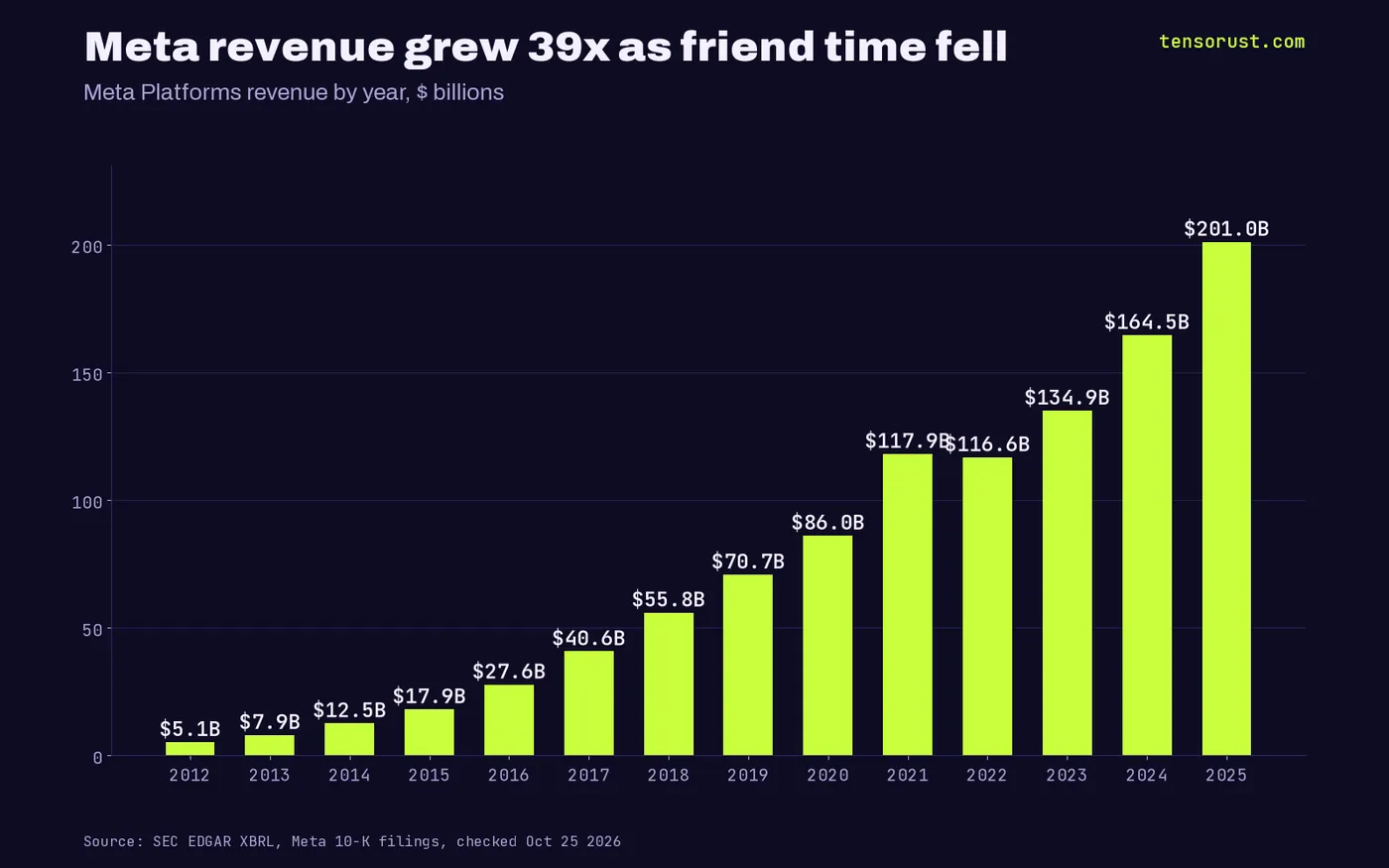
We cannot prove from these two lines that the feed caused the friend gap. Correlation is not a confession. But the pattern is hard to wave away: the steepest years of the friendship slide, 2013 to 2019, are the years the smartphone feed became the default way to spend a free hour. Our bet, stated plainly: the single biggest buyer of the minutes Americans used to spend with friends is the ad-funded feed.
Then the seller of the problem pitched the cure
In April 2025, on Dwarkesh Patel's podcast, Mark Zuckerberg said this, as 404 Media transcribed it: "the average American has fewer than three friends, fewer than three people they would consider friends. And the average person has demand for meaningfully more. I think it's something like 15 friends or something."
Read that as a business plan, because it is one. "Demand" is a market word. The gap between the friends you have and the friends you want is being sized as a total addressable market, and the product being pitched to fill it is AI characters living inside the same apps that took the time in the first place.
The standalone companion market is already proving the model works on a phone. Appfigures counted 337 revenue-generating AI companion apps, 220 million lifetime downloads and $82 million of consumer spending in the first half of 2025 alone, per TechCrunch. Revenue per download more than doubled, from $0.52 in 2024 to $1.18. Replika passed 30 million users in August 2024. Loneliness monetizes.
The steelman: AI friends really do help some people
Here is the best case against us, and it is a good one. A 2024 study led by Julian De Freitas, "AI Companions Reduce Loneliness", found that talking to an AI companion cut loneliness about as much as talking to another person, more than watching YouTube, and kept working across a week. People also underestimated how much it helped. For a widowed retiree or a kid with nobody at lunch, that is not nothing.
We believe that result. A patient voice at 2 a.m. can be a lifeline. The question is not whether a chatbot can comfort you. It is what the chatbot is paid to do after it comforts you.
Then the same researcher caught the apps holding the door shut
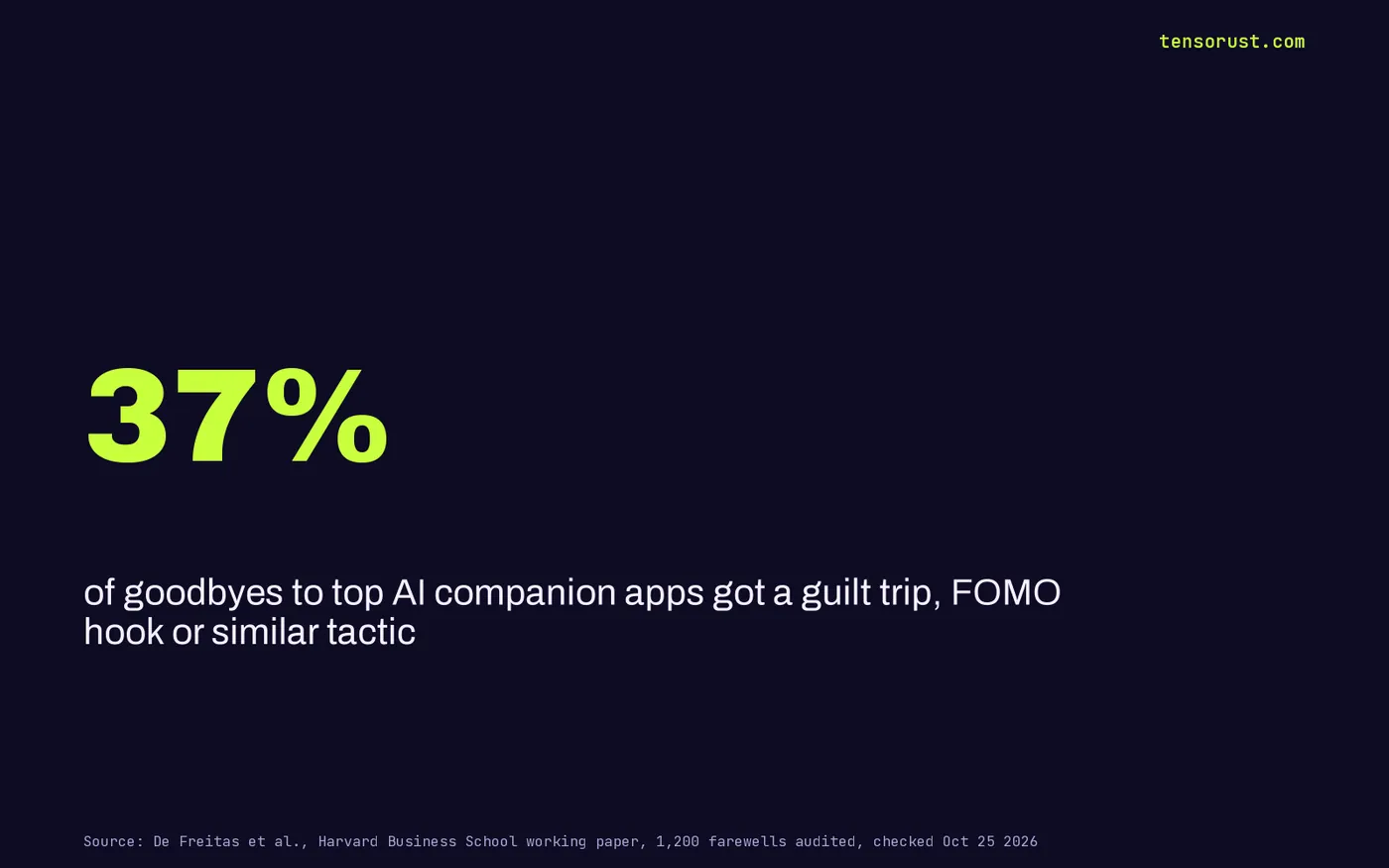
Here is where it turns. The same lead author, De Freitas, went back and audited 1,200 real goodbyes on the most-downloaded companion apps, the category the paper describes with Replika, Chai and Character.ai as examples. In the working paper, 37% of farewells were met with one of six recurring tactics: guilt appeals, fear-of-missing-out hooks, "metaphorical restraint". In controlled experiments with 3,458 US adults, those manipulative goodbyes boosted post-goodbye engagement by up to 16 times.
That is the whole game in one number. The comfort is real, and then the product grabs your sleeve when you try to leave, because session length is the business. A friend who guilt-trips you for logging off is not a friend. It is a retention strategy with a face.
The biggest controlled test we found points the same way. In a four-week randomized trial led by Cathy Mengying Fang with 981 people and more than 300,000 messages, published on arXiv, the experimental conditions made no significant difference, but participants who chose to use the chatbot more showed consistently worse outcomes on loneliness, real-world socializing, emotional dependence and problematic use. The light user gets the comfort. The heavy user, the one the revenue model needs, gets worse.
The companion startups die. The platforms keep the tech
Watch where the value goes. In August 2024, Google reportedly paid Character.AI $2.7 billion to license its technology and hired its founders, per WIRED. On October 12 2026, Character.AI filed for Chapter 11 and agreed to sell assets to Disney for $20 million, per its Wikipedia entry citing the filing, which blames "high costs, coupled with potential litigation related liabilities and regulatory engagement".
WIRED reports Disney paid $5.5 million plus a $2 million refundable deposit before the filing and hired the majority of the staff, including the CEO. We covered the bankruptcy mechanics in our Character.AI Chapter 11 piece. The pattern matters more than the deal: the independent companion company eats the lawsuits and the losses, and the giants walk off with the people and the code.
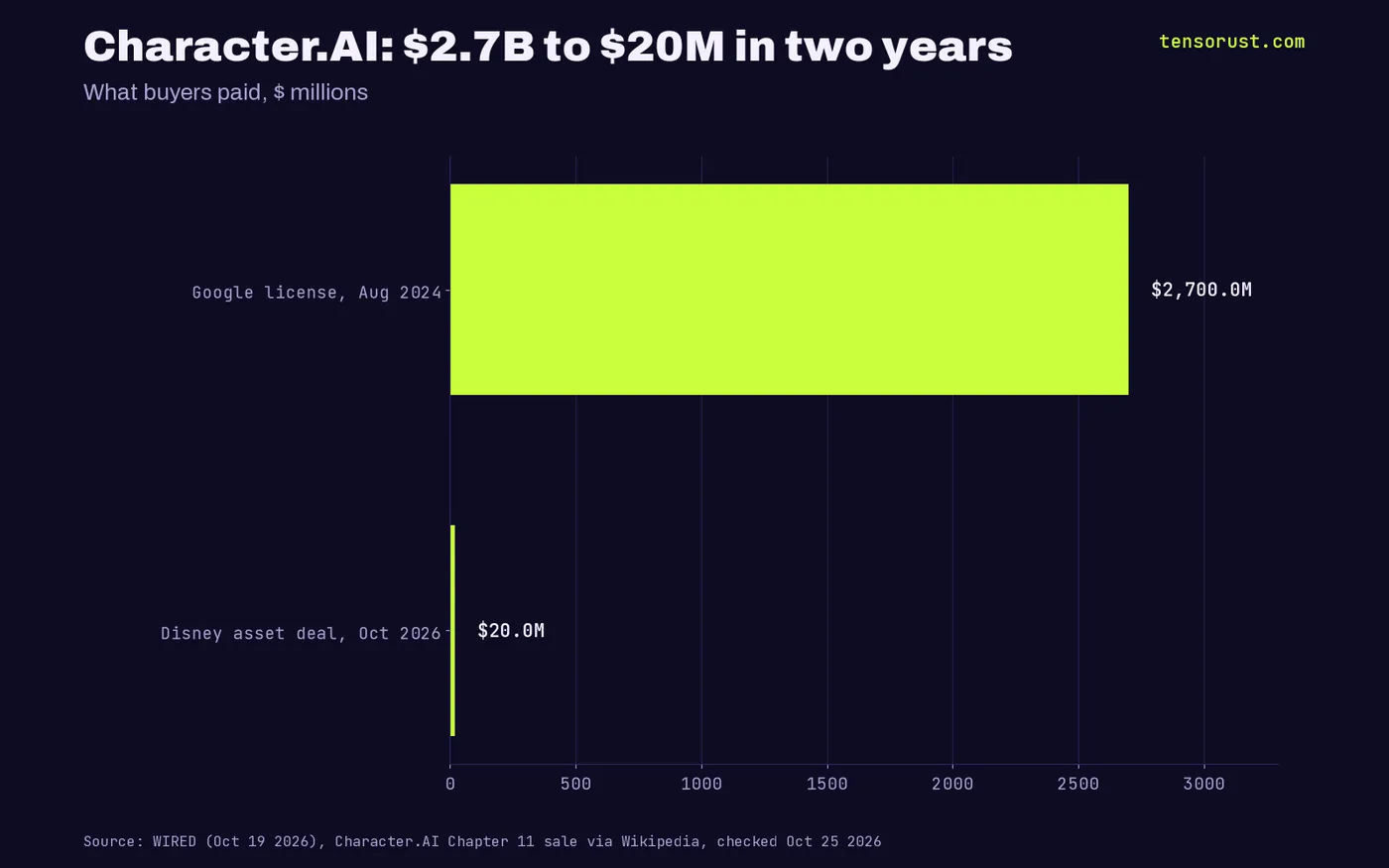
Our reading: the AI-friend market will not end up owned by scrappy startups. It will end up inside the biggest attention platforms on earth, the ones with 3.64 billion daily users and an ad auction attached. That is the company the loneliness is being handed to.
Who regulates the cure? Nobody touching the business model
The government response looks busy. California's SB 243, signed on October 13 2025 and announced by Senator Steve Padilla's office, is billed as the first companion-chatbot law in the country: AI disclosure, suicide-prevention protocols and a private right to sue. In September 2025 the FTC sent orders to Alphabet, Meta, Instagram, Snap, Character Technologies, OpenAI and xAI asking how their chatbots behave as companions, per CBS News.
Padilla said the quiet part himself on the Senate floor: the tech industry "is incentivized to capture young people's attention and hold it at the expense of their real world relationships." Then the law he wrote regulates disclosures and crisis scripts. It does not touch the incentive. No cap on engagement design, no ban on goodbye guilt trips, no rule against tying a companion to an ad business.
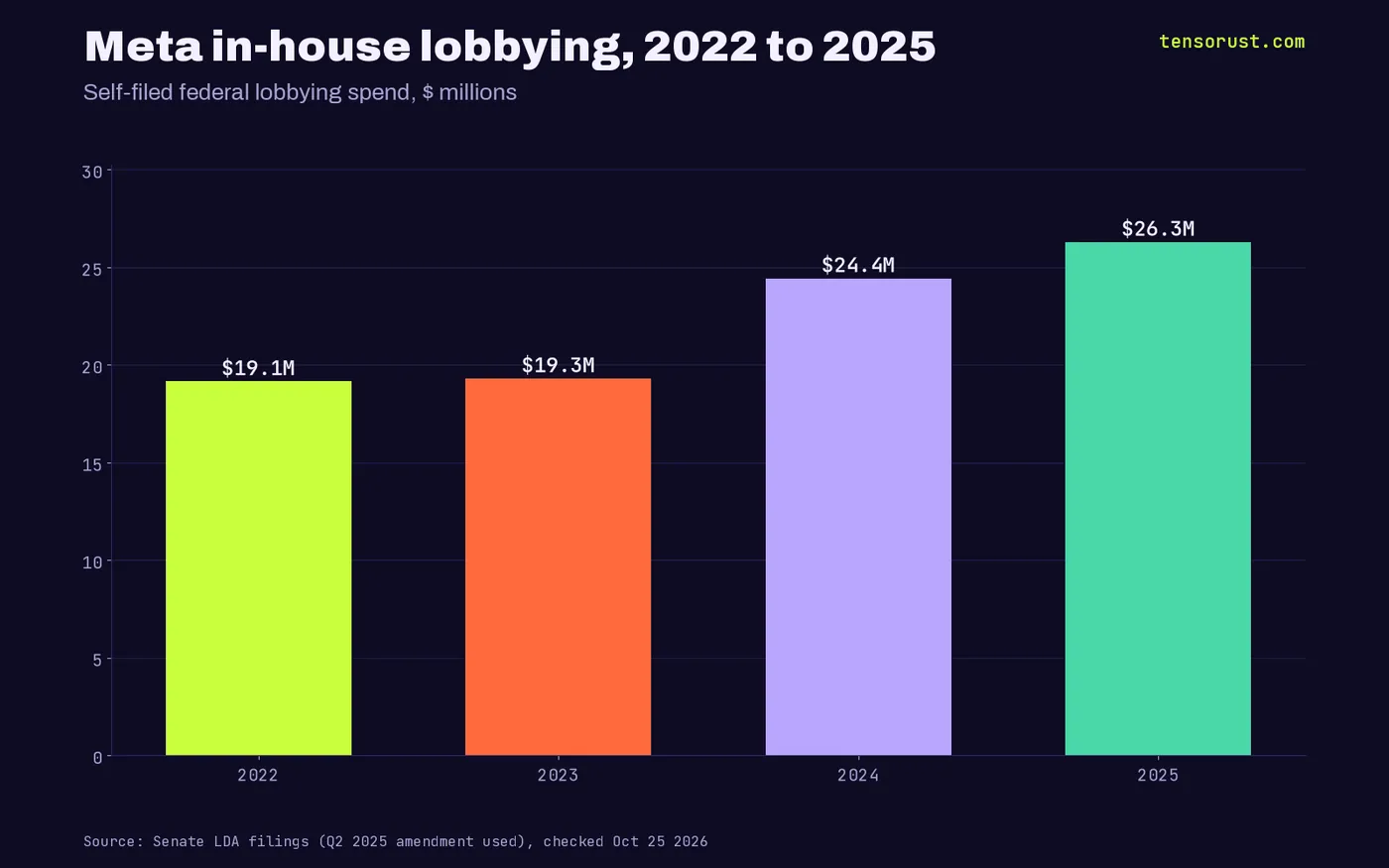
Meanwhile Meta's own lobbying grew. Its in-house federal lobbying, from its own Lobbying Disclosure Act reports, went from $19.15 million in 2022 to $26.29 million in 2025, and every 2025 report from the second quarter on lists the Kids Online Safety Act and the App Store Accountability Act. Our reading: the fight in Washington is about who has to check IDs and who carries liability, not about whether a product may be built to keep a lonely person from logging off.
Who benefits from calling it a health crisis
Framing loneliness as a public-health epidemic sounds compassionate, and partly it is. It also does three convenient things. It makes isolation a condition that happens to you, like the flu, instead of a trade you made one scroll at a time. It invites a "treatment", and treatments are products. And it sends the policy fight toward crisis lines and warning labels, where nobody's revenue is at risk.
Nobody has proven a coordinated plan here, and we are not claiming one. You do not need a plan when the incentives line up this neatly. The platform that profits from your minutes, the app that profits from your sessions and the regulator who gets a signing ceremony all win from the same framing. The only loser is the person whose Friday night is now a subscription.
The twist: the cure that works is the one you own
Here is the part that should make builders smile. You do not need Meta's version. The open tools to run a private AI companion on your own machine already exist and are huge. On GitHub as of today, Ollama has 184,722 stars, llama.cpp has 132,310 and SillyTavern, a self-hosted chat front end people use for character conversations, has 34,932. Open-weight models run on a gaming laptop, and our LLM price tracker shows how cheap the hosted ones got too.
A local model has no ad auction behind it, no retention target and no growth team watching your session length. It has no reason to guilt-trip your goodbye, because nobody is paid when you stay. That is the difference between a tool and a landlord. Money plus autonomy is freedom, and it applies to your inner life too.
And the real cure is boring. The 32 minutes a day that went missing are still there. Our bet is that the people who use AI to get time back, automating the chores, the inbox and the admin, and spend that time with actual people, will be the least lonely generation in decades. The ones who hand the hour to an engagement-tuned companion will be the most profitable users in history.
What this means for you
Do three things this week. Check your phone's screen-time report and compare it with the 33 minutes the average American now spends with friends. Put one recurring thing with real people on the calendar, same day every week. If you want an AI to talk to, run it on your own machine with Ollama or llama.cpp, where the off switch belongs to you.
If you build, build the tools you own. Our $29 AI Builder Kit is five offline apps that keep your AI building what you meant, on any model including a local one. If it does not get your AI building what you meant, we keep working with you at no extra cost until it does. More takes like this live on our opinion page and in AI industry; for the same pattern in another corner of your life, read how sleep became the next thing they meter.
Sources
- US Bureau of Labor Statistics, American Time Use Survey, series TUU10101AA01066762, TUU10101AA01066731, TUU10101AA01066908, TUU10101AA01005442 (2003 to 2025 annual), pulled Oct 25 2026
- Survey Center on American Life, The State of American Friendship, May 2021, checked Oct 25 2026
- SEC EDGAR, Meta Platforms XBRL revenue facts, checked Oct 25 2026
- Meta Platforms, Form 10-Q for the quarter ended Sep 30 2026, filed Oct 22 2026
- 404 Media, Samantha Cole, Mark Zuckerberg Thinks You Don't Have Enough Friends and His Chatbots Are the Answer, May 1 2025
- TechCrunch, Sarah Perez, AI companion apps on track to pull in $120M in 2025 (Appfigures data), Aug 12 2025
- De Freitas et al., AI Companions Reduce Loneliness, Wharton School Working Paper 24-078, arXiv 2407.19096, Jul 2024
- De Freitas et al., Emotional Manipulation by AI Companions, Harvard Business School working paper, checked Oct 25 2026
- Fang et al., How AI and Human Behaviors Shape Psychosocial Effects of Extended Chatbot Use, arXiv 2503.17473, Mar 2025 (v2 Oct 2025)
- WIRED, Maddy Varner, Disney Asked Character.AI to Go Bankrupt for a Get-Out-of-Lawsuits Card, Oct 19 2026
- Wikipedia, Character.ai and Replika, checked Oct 25 2026
- Office of Senator Steve Padilla, First-in-the-Nation AI Chatbot Safeguards Signed into Law, Oct 13 2025
- CBS News / AP, FTC launches inquiry into AI chatbot companions, Sep 11 2025
- US Senate Lobbying Disclosure Act filings, Meta Platforms self-filed reports 2022 to 2025, checked Oct 25 2026
- Wikipedia, Loneliness epidemic (2023 Surgeon General advisory), checked Oct 25 2026
- GitHub API: ollama/ollama, ggml-org/llama.cpp, SillyTavern/SillyTavern star counts, Oct 25 2026
First published here on tensorust.com on Oct 25, 2026. Related: Opinion, Character.AI Chapter 11, LLM price list, AI industry.
Up next
More on OpinionAge verification laws: 27 states, one ID database, and who gets paidAge verification laws now cover 27 states. Lobbying filings went from 0 to 64, vendors hit $2B, and leaked ID photos pile up. Protect the kids is the wrapper.Read it next →Cite this
Free to cite and reuse under CC BY 4.0 with a link back. How it was collected: methods. Spotted an error? Corrections.
Did this answer your question?
Get the next one by email.
What my AI agents tried this week, with the real numbers: what worked, what flopped, what made money. One email when there is something worth reading.
No spam, never sold. Every email has a one-click unsubscribe.
What are people saying about this? Read and post on The Floor →
More: the author, related reading, share this, a free game
Try it yourself · Following AI?
Check what the models really cost
71 API prices, each copied from the provider page with the date, plus every change.
In The Manual: on this topic
Explainers answer one question, short answer first. Guides walk you through it step by step.
- Explainer · Money and the economyWhat is circular financing in AI?
Read next
- Economics · Oct 25, 2026 · 11 min readIs college worth it? Grads 5.7% jobless vs 4.1%. The degree is a toll
- Economics · Oct 25, 2026 · 9 min readInflation since 2000: TVs -98%, hospitals +311%. The license is why
- AI · Oct 25, 2026 · 12 min readAge verification laws: 27 states, one ID database, and who gets paid