
By Matt Busel, who built the apps, crates and game he writes about · every number links to its source and every dataset is downloadable (methods) · corrections · featured in Kirino, gamebiz, This Week in Rust, New Mobile Life, By-Press
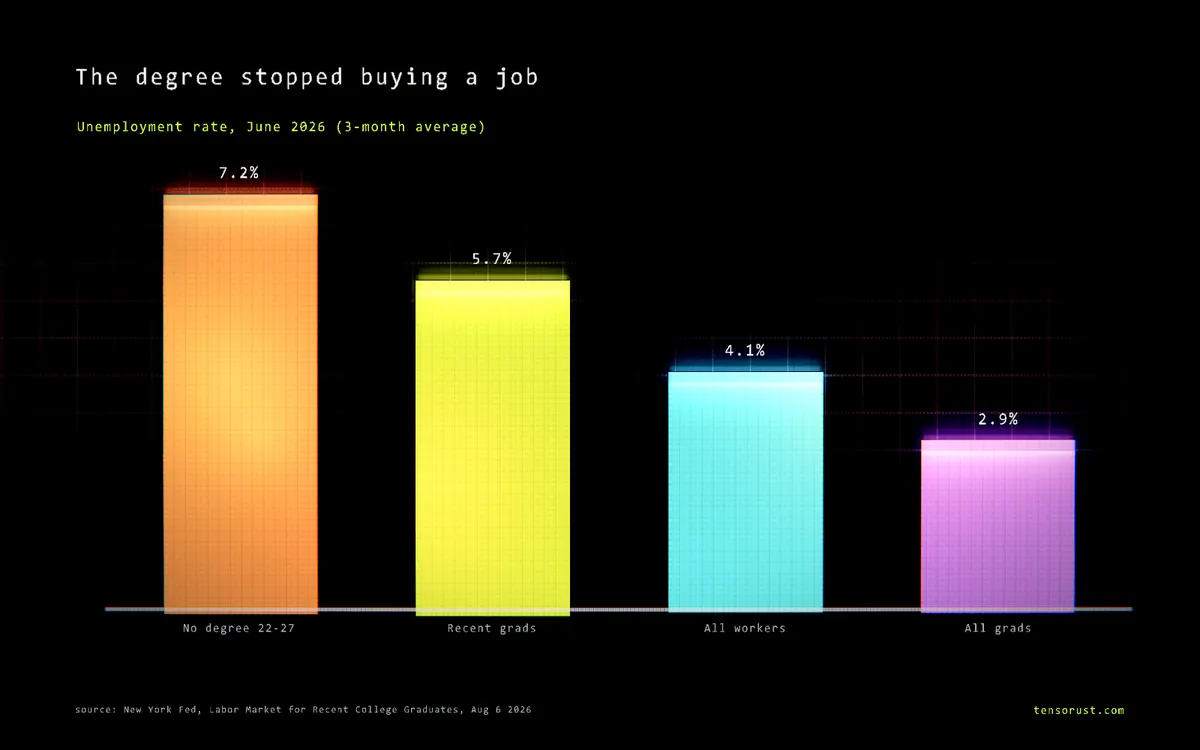
Is college worth it? Grads 5.7% jobless vs 4.1%. The degree is a toll
On this page · 11 sections
- Key numbers
- The degree no longer buys the one thing it was sold for
- Four in ten graduates paid for a key that opens nothing
- The ticket tripled. The prize barely moved
- Follow the toll: who gets paid when paper is the gate
- "AI cheating" is what the toll collector calls a cheaper skill check
- Employers know, and most of them still hide behind the paper
- The steelman: credentials compress information
- AI is the first thing that can check the real thing at scale
- What this means for you
- Sources
Short answer: The four-year degree has stopped working as a skill test and kept working as a toll. In June 2026, recent college graduates had a 5.7% unemployment rate against 4.1% for all workers, and 42% of them held jobs that do not need a degree at all, per the New York Fed. The degree is the last cartel: the people who sell it are the loudest voices on "AI cheating", because a machine that can check what you can actually do makes the toll optional.
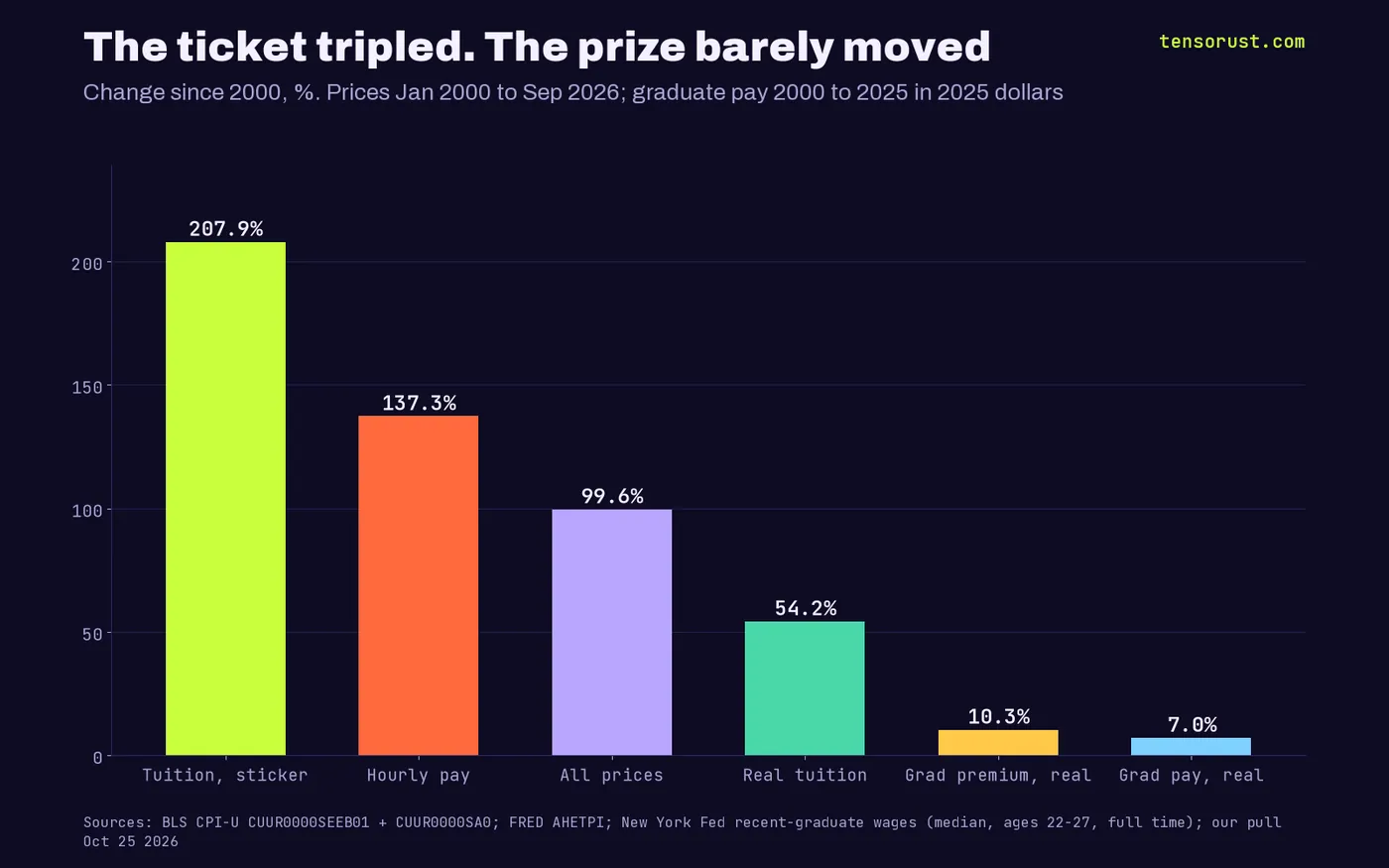
TL;DR: College tuition rose 207.9% since January 2000 while the real median pay of a young graduate rose 7.0% from 2000 to 2025, so the ticket tripled and the prize barely moved. Recent grads have been more likely to be unemployed than the average American worker every single month since January 2021, a 66-month streak, the longest in the New York Fed's series back to 1990. Employers that "dropped the degree requirement" changed fewer than 1 in 700 hires, while Chegg, the homework business that AI ate, lost 99% of its stock price. Prove your skill in public, where software can check it, and stop paying for the stamp.
Key numbers
| What | Number | Source, checked Oct 25 2026 |
|---|---|---|
| Unemployment, recent grads (22-27, BA) vs all workers, June 2026 | 5.7% vs 4.1% | New York Fed |
| Months in a row recent grads beat all workers on unemployment | 66 (Jan 2021 to Jun 2026) | New York Fed, our count |
| Recent grads in jobs that need no degree, June 2026 | 42.0% | New York Fed |
| College tuition and fees, price change Jan 2000 to Sep 2026 | +207.9% | BLS CPI-U, CUUR0000SEEB01 |
| Median pay, recent grads, 2000 vs 2025 (2025 dollars) | $56,097 to $60,000 (+7.0%) | New York Fed |
| Student loans outstanding, Q4 2024 | $1.78 trillion | FRED, SLOAS |
| US college endowments, FY2024 | $837.7 billion | NACUBO via Wikipedia |
| Hires changed by "skills-based hiring" pledges, 2023 | fewer than 1 in 700 | Burning Glass Institute and HBS, via Higher Ed Dive |
| Chegg stock, Feb 2021 monthly close vs Oct 23 2026 | $96.53 to $0.70 (-99.3%) | Yahoo Finance, our pull |

The degree no longer buys the one thing it was sold for
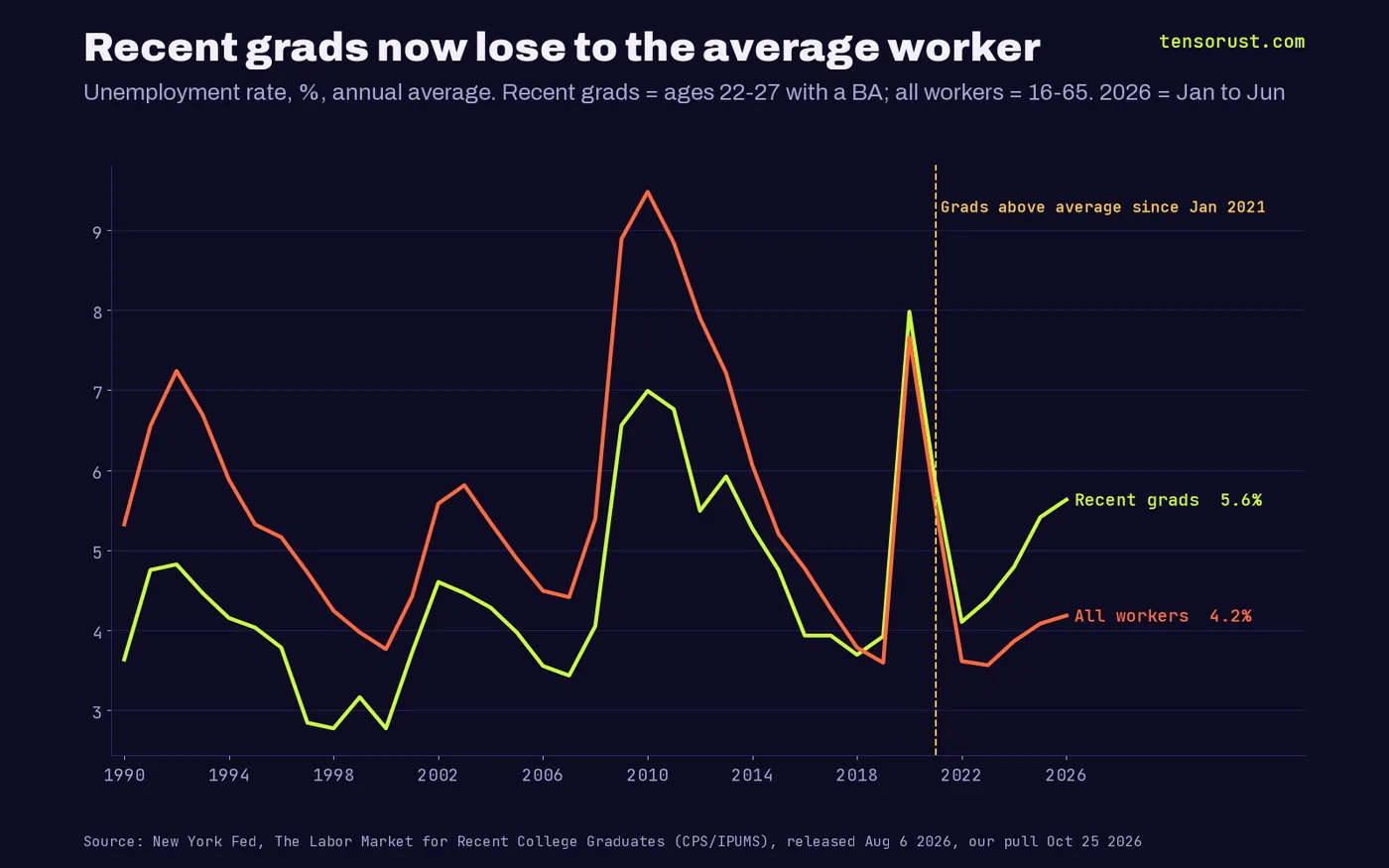
The pitch for college was always simple: pay now, and you will be first in line for work. For 30 years the data backed it. In 2000, recent grads had a 2.8% unemployment rate against 3.8% for all workers and 6.3% for young people without a degree.
That line broke. Since January 2021, recent graduates aged 22 to 27 have had a higher unemployment rate than the average American worker in every month of the New York Fed's series, 66 months straight. Before 2021 the longest such stretch was 11 months, from May 2019 to March 2020. This one is six times longer and still running.
The edge over people who skipped college is shrinking too. In 2000, a young grad's jobless rate sat 3.5 points below a young worker with no degree. In June 2026 the gap was 1.5 points: 5.7% against 7.2%. Pay four years and tens of thousands of dollars, and the job-finding advantage you buy is now a point and a half.
Four in ten graduates paid for a key that opens nothing
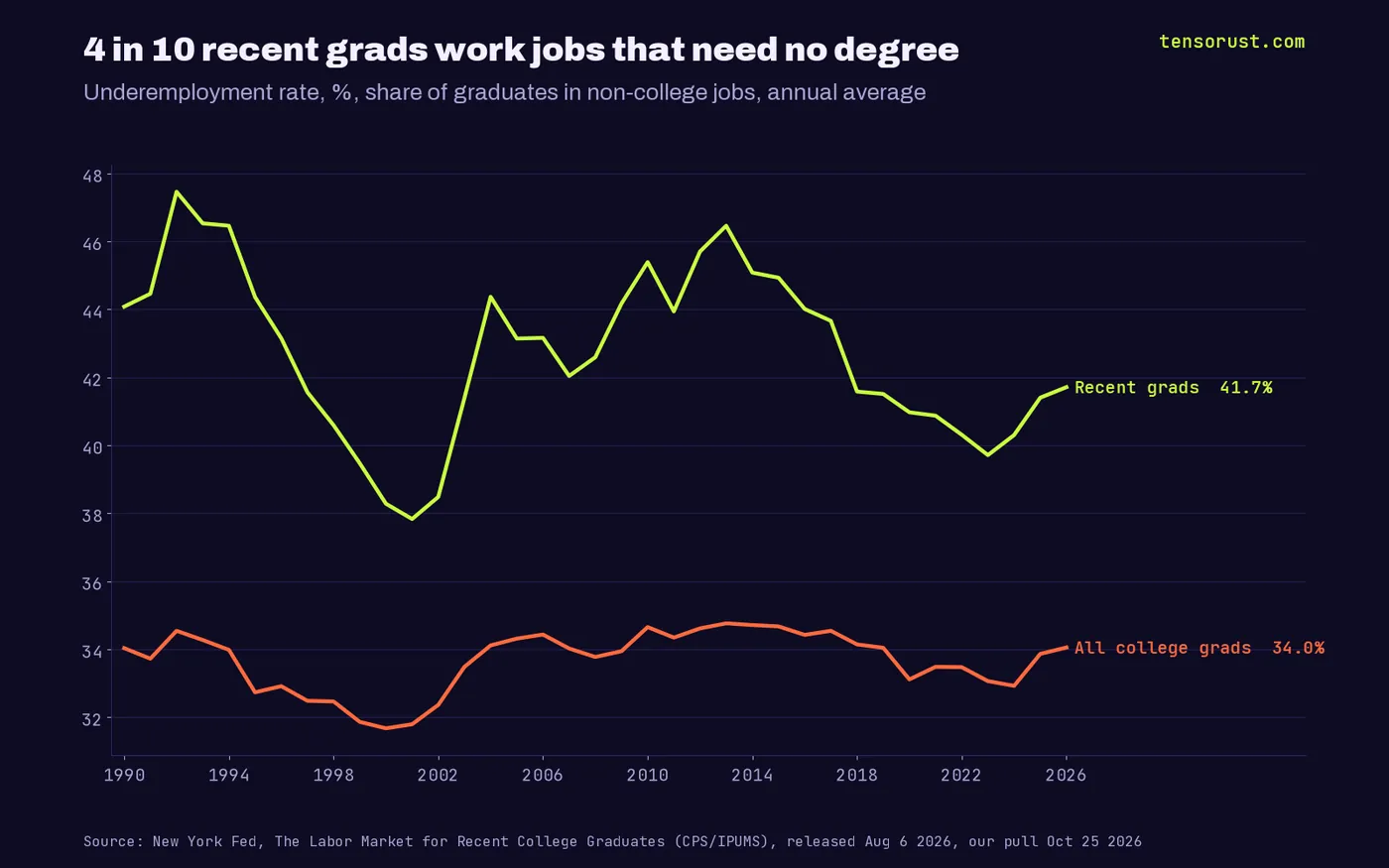
Here is the number that gives the game away. The New York Fed counts how many recent grads work in jobs where most people say a degree is not needed. In June 2026 it was 42.0%. All college grads, any age: 33.7%.
The twist is that this is not new. The annual figure for recent grads has sat between 37.8% and 47.5% every year since 1990. For more than three decades, roughly four in ten graduates have paid full price for a credential and then worked a job that never asked for it. Nobody calls that a crisis, because the toll got paid either way.
That is the tell of a toll, not a test. A skill test fails people who lack the skill. A toll charges everyone who wants through the gate, and it does not care what you do on the other side.
The ticket tripled. The prize barely moved
BLS price data puts college tuition and fees up 207.9% from January 2000 to September 2026. All prices rose 99.6%. Hourly pay for production and nonsupervisory workers rose 137.3%. So tuition outran both inflation and wages: in real terms it is up 54.2%.
Now the payoff. The New York Fed's median full-time recent grad earned $56,097 in 2000 and $60,000 in 2025, both in 2025 dollars: up 7.0% in a quarter century. The gap over a high-school-only peer went from $18,138 to $20,000, up 10.3%. The bottom quarter of grads earned $45,000 in 2025, just $5,000 over the median worker who never went.
A real wage premium exists, and we will get to it. But the price of that premium rose about five times faster than the premium itself. When the seller can raise the price that much faster than the value, you are not looking at a market. You are looking at a gate with a cashier.
Follow the toll: who gets paid when paper is the gate
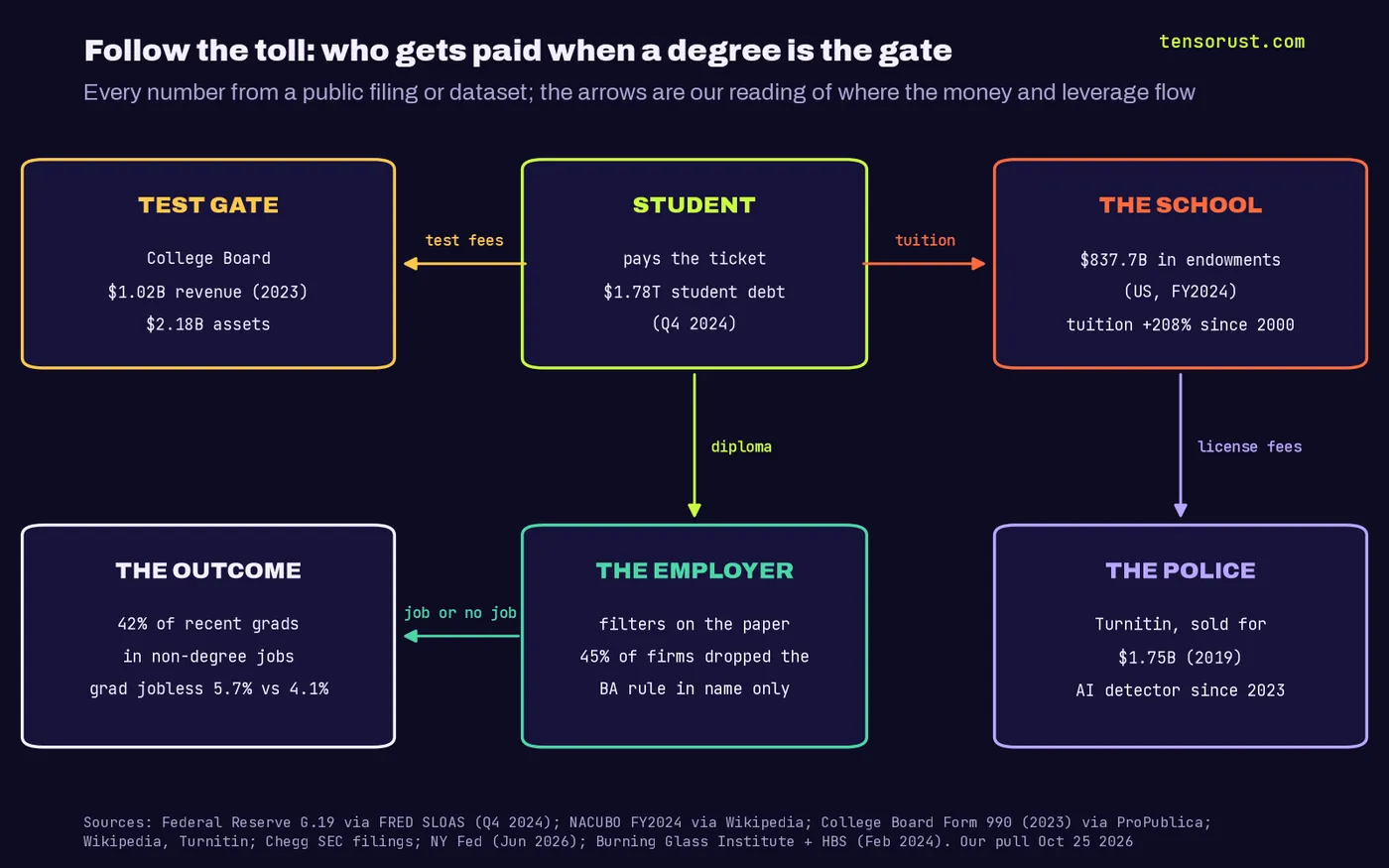
Every gate has a cashier, and this one has several. Students owed $1.78 trillion in student loans at the end of 2024, up from $481 billion in early 2006, per Federal Reserve data on FRED. US colleges sat on $837.7 billion in endowments in FY2024, per NACUBO.
Before you even reach the school, there is a test gate. The College Board, the nonprofit behind the SAT and AP exams, reported $1.02 billion in revenue and $2.18 billion in assets on its 2023 Form 990, with $9.3 million in pay to current officers, directors and key employees. After the school, there is the police force: Turnitin, the plagiarism checker licensed to schools, was bought by Advance Publications for $1.75 billion in 2019 and launched an AI-writing detector in early 2023.
The organized lobby is small, which tells you something too. In 2025 the American Council on Education, the Association of American Universities and the Association of Public and Land-grant Universities reported $2.2 million in federal lobbying between them, per Senate LDA filings. A cartel that does not need to lobby much is one whose gate is already enforced by someone else: every employer that filters résumés by degree, and a federal loan system that funds the ticket no matter what it buys.
"AI cheating" is what the toll collector calls a cheaper skill check
Watch where the panic aims. On Hacker News, stories mentioning "AI cheating" went from zero in 2020 through 2022 to 31 in 2025 and 23 so far in 2026. Stories mentioning "skills-based hiring": four since 2020, all in 2023. The fear gets the airtime. The alternative gets a footnote.
Ask what "cheating" means here. Homework, essays and take-home tests are the steps a school charges for. If a model can do them in seconds, either the steps never measured much, or the skill is now cheap. Both answers are bad news for the business that sells the steps, which is why the response was to buy detectors, not to change what gets measured. Wikipedia's Turnitin entry notes that some schools switched the AI detector off within months because, like every such tool, it is not accurate.
The cheating industry was a business long before ChatGPT, and it was public. Chegg, the homework-help company, booked $776.3 million in revenue in 2021. Then ChatGPT gave the same help away. In May 2023 Chegg acknowledged that ChatGPT had become a serious competitor, and its stock fell 38% in a single day. Revenue was $376.9 million in 2025 and $51.8 million in the June 2026 quarter. The stock's monthly close went from $96.53 in February 2021 to $0.70 on October 23 2026.
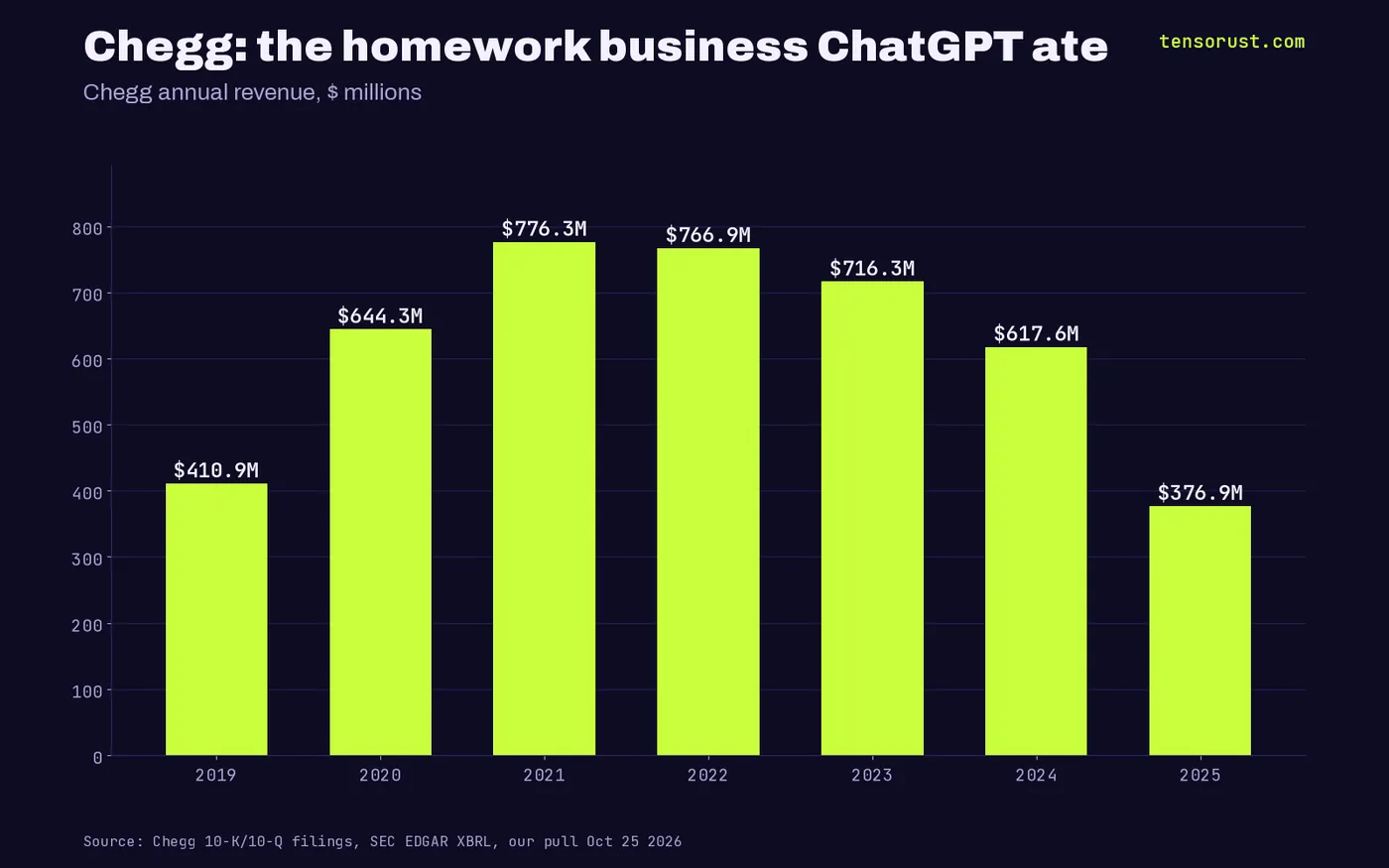
Our reading: Chegg is the canary for the whole credential stack. It sold the shortcut through the toll, and the shortcut got free. The next thing to get free is the proof that you know something, and that is the part the universities, test makers and detector vendors actually sell.
Employers know, and most of them still hide behind the paper
Corporate America has been announcing the end of the degree requirement for years. The Burning Glass Institute and Harvard Business School checked the hiring, not the press releases, across 11,300 roles at large firms. Their February 2024 report found the change touched fewer than 1 in 700 hires in 2023. Firms that dropped the requirement raised their share of non-degree hires by about 3.5 percentage points, and about 45% of them changed in name only.
Governments moved faster on paper. Responsive Government counts nine states with an executive order or law on degree requirements for state jobs. In Virginia, the share of state job postings that did not require a degree rose from 58% in 2019 to 90% in 2024. In Maryland it went from 36% to 52%.
So the rule is falling and the habit is not. Hiring managers still use the diploma as a cheap filter because checking skill one candidate at a time used to be expensive. That cost is the whole moat. It is also exactly the cost AI is collapsing.
The steelman: credentials compress information
The best case for the degree is real. An employer with 900 applicants cannot interview everyone, and a diploma says this person sat through four years of deadlines and did not quit. The wage premium is real too: $20,000 a year at the median for young full-time workers in 2025. The New York Fed itself notes that part of that gap may reflect differences in aptitude between people who finish college and people who do not.
All fair. But notice what the steelman concedes. The degree's value is as a cheap signal, a filter for people too busy to check. It is a proxy for skill, priced like skill. A proxy is only worth its price while the real measure is expensive. The moment you can check the real thing cheaply, the proxy's price should crash, and the only thing holding it up is habit and the loan money behind it.
AI is the first thing that can check the real thing at scale
A portfolio of shipped work was always better evidence than a transcript, but reading one took an expert's afternoon. Not anymore. A model can read a repo, run the tests, review the commits, ask follow-up questions and score a work sample in minutes, at a price that falls every year (see our LLM price list).
The raw material is already huge. GitHub's Octoverse 2025 counts more than 180 million developers on the platform, with over 36 million joining in a single year, and nearly 80% of new developers using Copilot in their first week. That is a public, timestamped record of who built what, sitting next to a tool that can read it.
Our bet, stated flat: within five years the default first screen for knowledge jobs is a model reading your public work, not a recruiter reading your school name. Nobody has proven that yet. But the incentives line up, and the companies that move first will hire the people the toll filtered out, cheaper and better. The people who should fear AI in education are not students. They are the ones selling the stamp.
What this means for you
If you are deciding on college, price it like an investment, not a rite of passage: the median young grad earns $20,000 a year more than a high school peer, but 42% end up in jobs that do not need the degree. Pick a field and a cost where the math works, or skip it with a plan.
Whatever you choose, build proof in public. Ship a project, publish the repo, write up the result with numbers. That record is what the next hiring filter will read, and it costs nothing but your time. Our class divide piece shows where it leads, and our inflation piece shows why licensed gates keep getting more expensive.
When you apply, make the proof impossible to miss. Our $10 Job Hunt Kit matches your résumé to the job post and writes a cover letter that reads like you, offline, so your shipped work leads instead of your school name. If it does not get you there, we keep working on it at no extra cost until it does.
More from the same lens on Tensorust Opinion and Economics. The full dataset (every New York Fed series, the CPI lines, student debt, Chegg's revenue and stock, the lobbying totals) is in the download below. This is not financial advice.
Sources
- Federal Reserve Bank of New York, The Labor Market for Recent College Graduates (unemployment, underemployment and wage CSVs, released Aug 6 2026), checked Oct 25 2026
- U.S. Bureau of Labor Statistics, CPI-U flat files, CUUR0000SEEB01 and CUUR0000SA0, checked Oct 25 2026
- FRED, Average Hourly Earnings of Production and Nonsupervisory Employees (AHETPI), checked Oct 25 2026
- FRED, Student Loans Owned and Securitized (SLOAS), Federal Reserve G.19, checked Oct 25 2026
- Wikipedia, US colleges by endowment (NACUBO FY2024 figures), checked Oct 25 2026
- ProPublica Nonprofit Explorer, College Board Form 990 filings, checked Oct 25 2026
- Wikipedia, Turnitin (Advance Publications purchase and AI detector history, with its cited sources), checked Oct 25 2026
- Wikipedia, Chegg (May 2023 ChatGPT warning and 38% one-day drop), checked Oct 25 2026
- SEC EDGAR, Chegg Inc. 10-K and 10-Q filings (XBRL revenue), checked Oct 25 2026
- Burning Glass Institute and Harvard Business School, Skills-Based Hiring: The Long Road from Pronouncements to Practice (Feb 2024); figures as reported by Carolyn Crist, Higher Ed Dive, Feb 21 2024, checked Oct 25 2026
- Responsive Government, Cutting Red Tape for States to Hire Top Talent (Jun 26 2025), checked Oct 25 2026
- GitHub, Octoverse 2025, checked Oct 25 2026
- U.S. Senate, Lobbying Disclosure Act filings API, 2025 reports, amendments de-duplicated, checked Oct 25 2026
- Hacker News search (Algolia), story counts by year, checked Oct 25 2026
First published here on tensorust.com on Oct 25, 2026. Related: Opinion, Economics, LLM price list, The new class divide.
Up next
More on OpinionAWS is a landlord: 39% margins and a $496B lease on your stackAWS kept 39.4% of revenue as profit in Q2 2026 and Amazon's cloud lease book hit $496B. The same H100 costs 3.5x more at Google. The cloud is a landlord.Read it next →Cite this
Free to cite and reuse under CC BY 4.0 with a link back. How it was collected: methods. Spotted an error? Corrections.
Did this answer your question?
Get the next one by email.
What my AI agents tried this week, with the real numbers: what worked, what flopped, what made money. One email when there is something worth reading.
No spam, never sold. Every email has a one-click unsubscribe.
What are people saying about this? Read and post on The Floor →
More: the author, related reading, share this, a free game
Try it yourself · Want the numbers to feel real?
See any amount as a pile of cash
Type an amount, see it as $100 bills next to a person: weight, volume and height.
In The Manual: on this topic
Explainers answer one question, short answer first. Guides walk you through it step by step.
- Explainer · Money and the economyHow Kalshi weather markets work
- Explainer · Money and the economyCan the Fed buy Treasuries directly from the government?
- Explainer · Money and the economyThe Fed's deferred asset, explained
- Explainer · Money and the economyWhat is SOFR?
Read next
- Economics · Oct 25, 2026 · 10 min readAWS is a landlord: 39% margins and a $496B lease on your stack
- Economics · Oct 25, 2026 · 9 min readInflation since 2000: TVs -98%, hospitals +311%. The license is why
- Economics · Oct 25, 2026 · 12 min readReturn to office is a landlord bailout: office loans 12.2% delinquent