
Sleep trackers are a data business: 4.8 billion nights just got sold
On this page · 11 sections
- Key numbers
- The last unmonetized hours of your day just got a price
- Exhibit A: 4.8 billion nights went through a bankruptcy court
- The meter is not covered by the privacy law you assume
- Follow the money: who wants your night
- A decade of meters did not move the number they were sold to fix
- Attention moved from the problem to the meter
- The steelman, and why it does not hold
- Our bet: the sleep score becomes a credit score
- What this means for you
- Sources
Short answer: Is your sleep tracker data private? Not in the way you think. Sleep is the last eight hours of your day nobody had found a way to sell, and the meter just arrived: in July 2026 a bankruptcy court let Sleep Number sell the whole company, including "all books and records, documents, files, data and information," after it had logged 4.8 billion nights of sleep. The cash price works out to 11 cents a night. The "sleep crisis" headlines are not the warning. They are the sales funnel.
TL;DR: Sleep Number told the SEC it had gathered 38 billion hours of sleep data from more than 4.8 billion sleep sessions, then sold substantially all its assets out of Chapter 11 to Sleep Country Canada for $529.5 million in cash on July 31 2026, with nothing left for its shareholders. Over the same stretch Oura's valuation went from $5.2 billion to $11 billion, its revenue doubled to $500 million in 2024, and the US Department of Defense became what Oura calls its largest enterprise customer. Meanwhile the share of US adults sleeping under 7 hours went from about 34.8% in 2014 to 36.1% in 2022, so a decade of meters did not move the number they were sold to fix.
Key numbers
| What | Number | Source, checked Oct 25 2026 |
|---|---|---|
| Sleep data Sleep Number says it gathered | 38 billion hours from 4.8 billion sleep sessions; 558,000 people opted into research | Sleep Number 10-K, filed Mar 12 2026 |
| Sleep Number asset sale out of Chapter 11, closed Jul 31 2026 | $529.5M cash ($701.8M adjusted consideration); stalking horse bid was $415M | 8-K filed Aug 3 2026, Davis Polk |
| Cash per recorded night in that sale | 11 cents ($529.5M / 4.8B) | Tensorust calc |
| Sleep Number net sales, 2021 peak vs 2025 | $2.19B vs $1.41B | SEC EDGAR XBRL, Tensorust pull |
| Oura valuation, Dec 2024 vs Oct 2025 | $5.2B vs $11B; 5.5M rings sold since 2015, nearly 3M in 2025 | Fierce Healthcare, Oct 14 2025 |
| ResMed revenue, fiscal 2016 vs fiscal 2026 | $1.84B vs $5.65B (operating income $429M vs $1.89B) | ResMed 10-K filings, SEC XBRL |
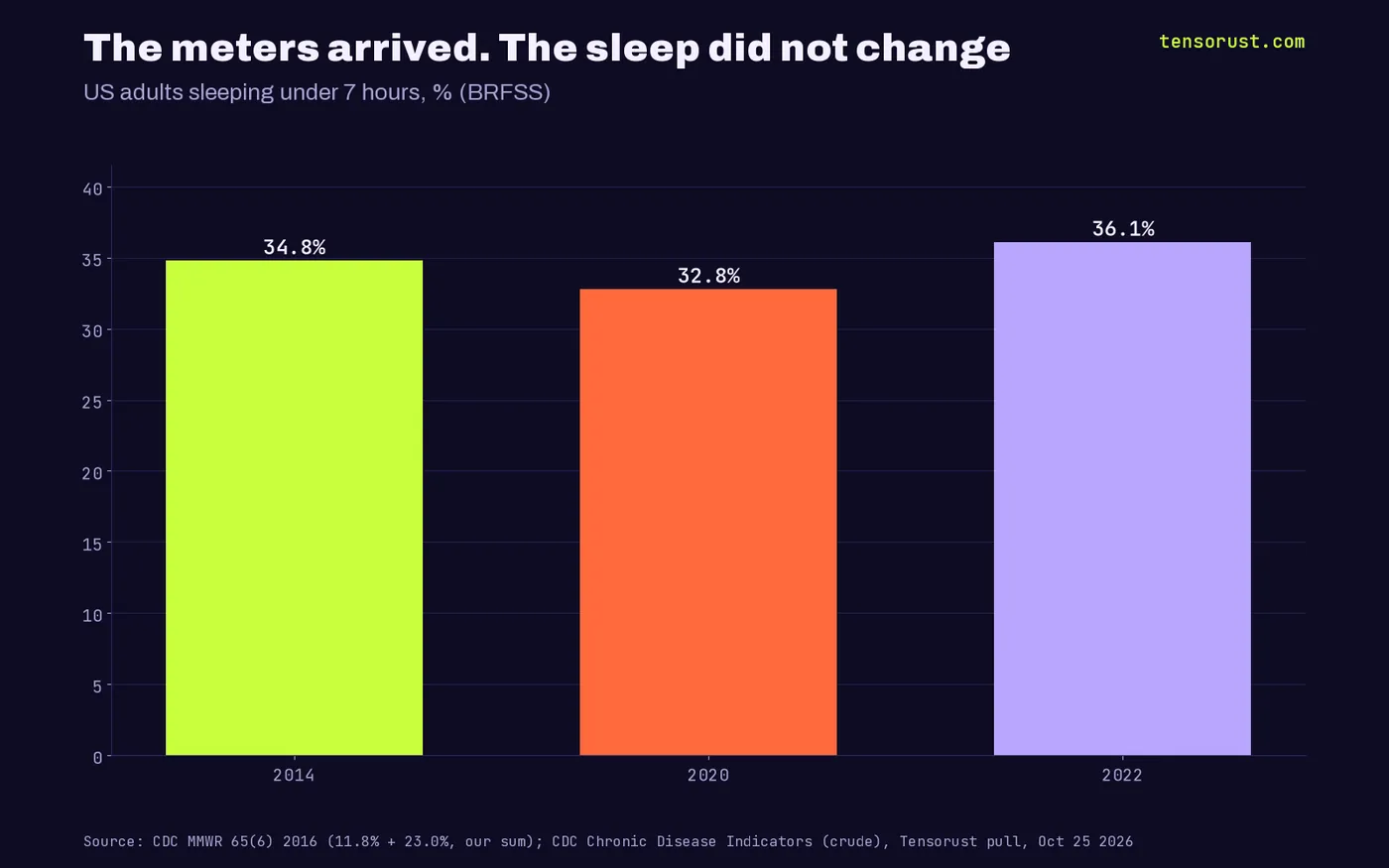
| US adults sleeping under 7 hours | about 34.8% (2014), 32.8% (2020), 36.1% (2022) | CDC MMWR 2016, CDC Chronic Disease Indicators |
| US adults using melatonin, 1999-2000 vs 2017-2018 | 0.4% vs 2.1% | JAMA research letter, Feb 1 2022 |
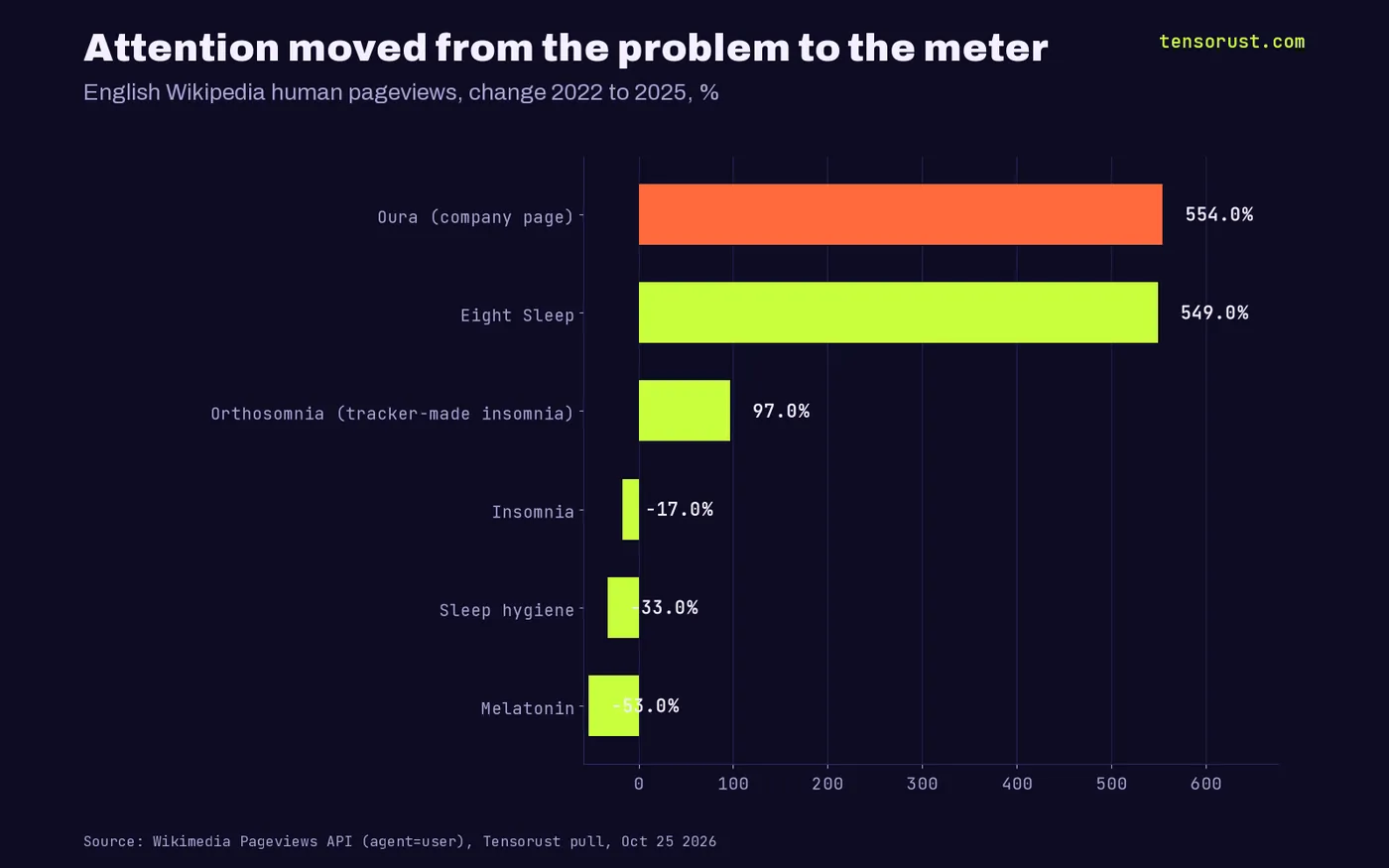
| Wikipedia attention, 2022 to 2025 | Oura +554%, Eight Sleep +549%, Insomnia -17% | Wikimedia Pageviews API, Tensorust pull |

The last unmonetized hours of your day just got a price
Every other part of your day was sold years ago. Your commute is ad inventory, your lunch break is a feed, your evening is a streaming queue. The one stretch nobody could reach was the seven or eight hours you spend unconscious.
That is over. A ring, a watch or a mattress now records your heart rate, breathing, movement and temperature all night, every night, and ships it to a server. It is the only dataset you produce while you are physically unable to pay attention to what is being collected.
Here is the flat claim, and we will defend it with filings: sleep is the next attention market, the "sleep crisis" is how it gets sold, and the companies selling you the problem and the meter are the same people. The real story is not that Americans sleep badly. It is who now owns the record of how you sleep.
Exhibit A: 4.8 billion nights went through a bankruptcy court
Sleep Number built the cleanest example. Its smart beds have embedded sensors, and its latest annual report brags that the company "automatically collects and analyzes billions of data points from millions of Smart Sleepers, conducting one of the largest sample sizes of sleep studies every night."
The same 10-K puts a number on it: more than 38 billion hours of sleep data from over 4.8 billion real-world sleep sessions, with about 80% monthly average engagement on its smart beds. More than 558,000 owners opted in to ongoing research, and the company lists partners including the Mayo Clinic, Northwestern and the University of Pittsburgh.
Then the bed business collapsed. Net sales fell from $2.19 billion in 2021 to $1.41 billion in 2025, and on June 12 2026 Sleep Number filed for Chapter 11 in the Southern District of New York.
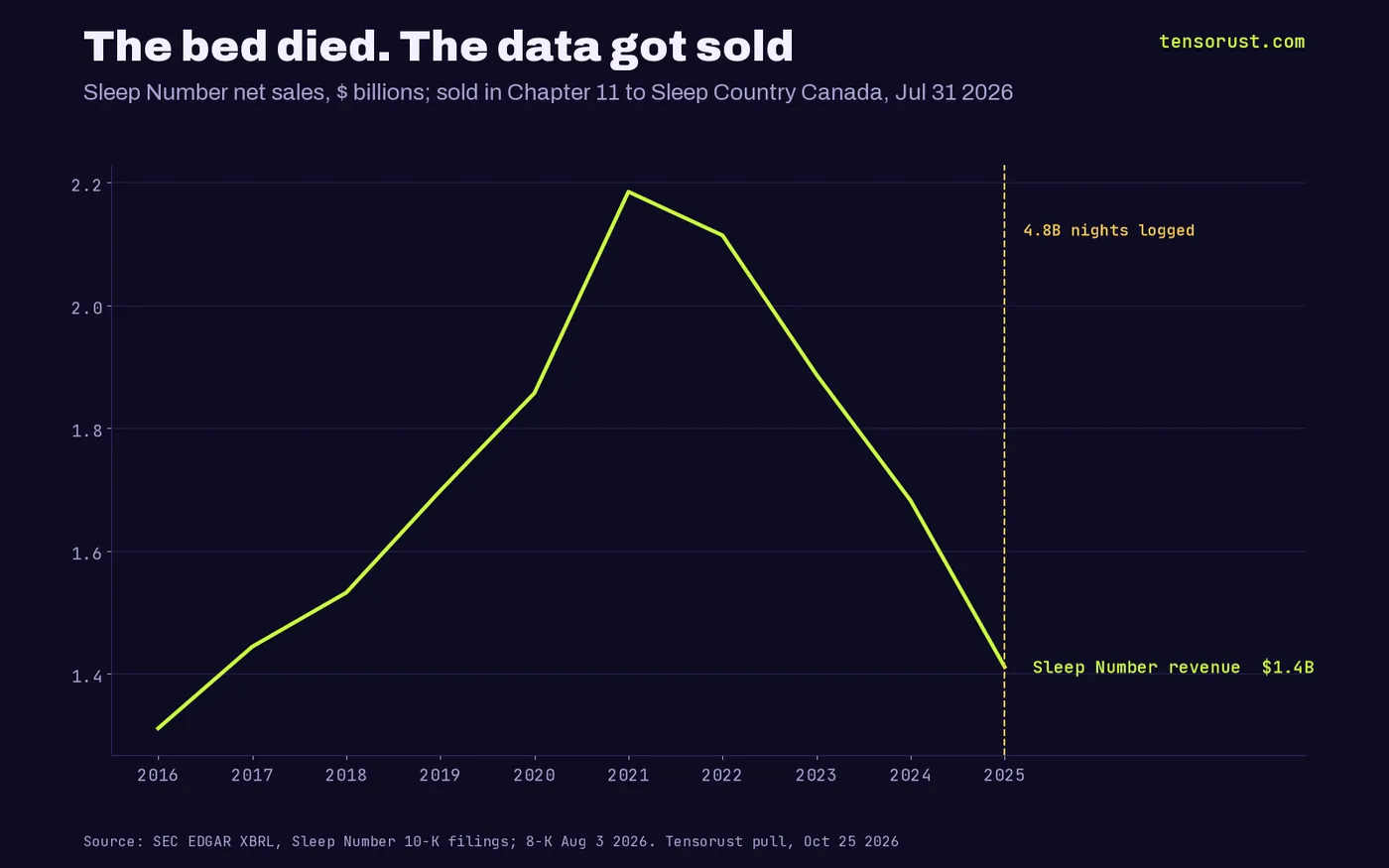
On July 31 2026 it sold substantially all its assets to a subsidiary of Sleep Country Canada for $529.5 million in cash. Section 2.1(c) of the amended asset purchase agreement lists among the transferred assets "all books and records, documents, files, data and information of the Seller Group," other than a carve-out for excluded records. The intellectual property that moved includes "data, databases, data collections."
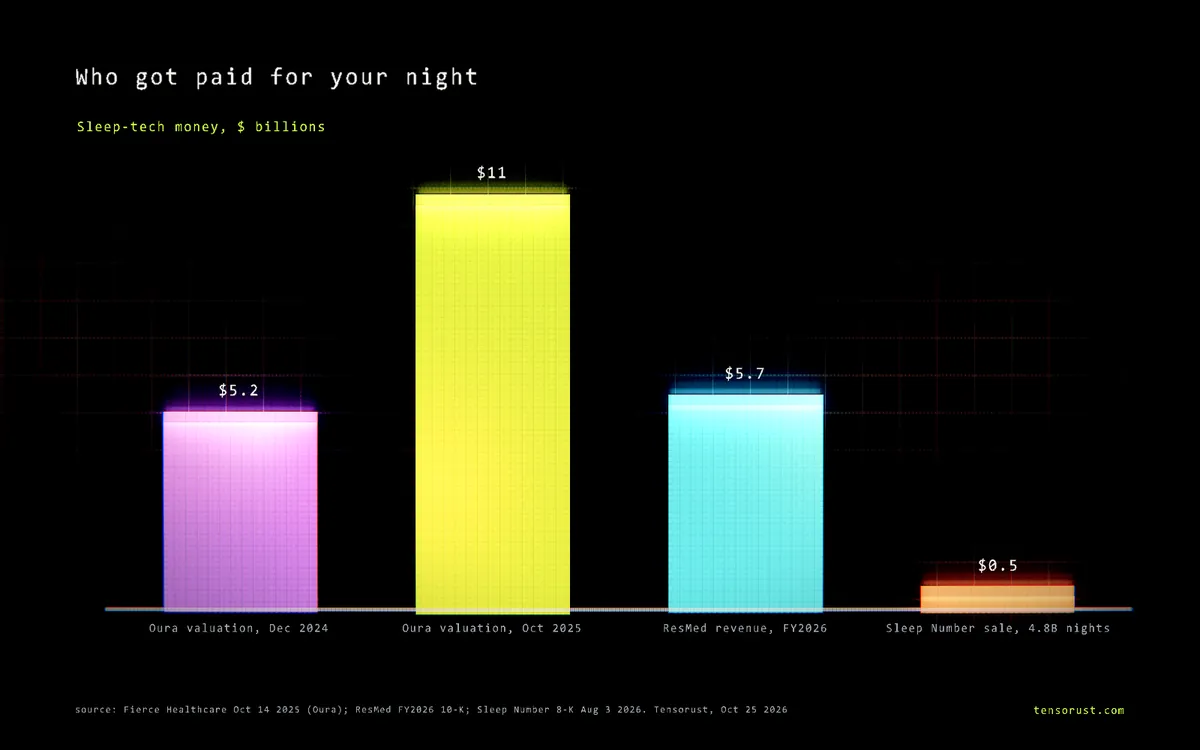
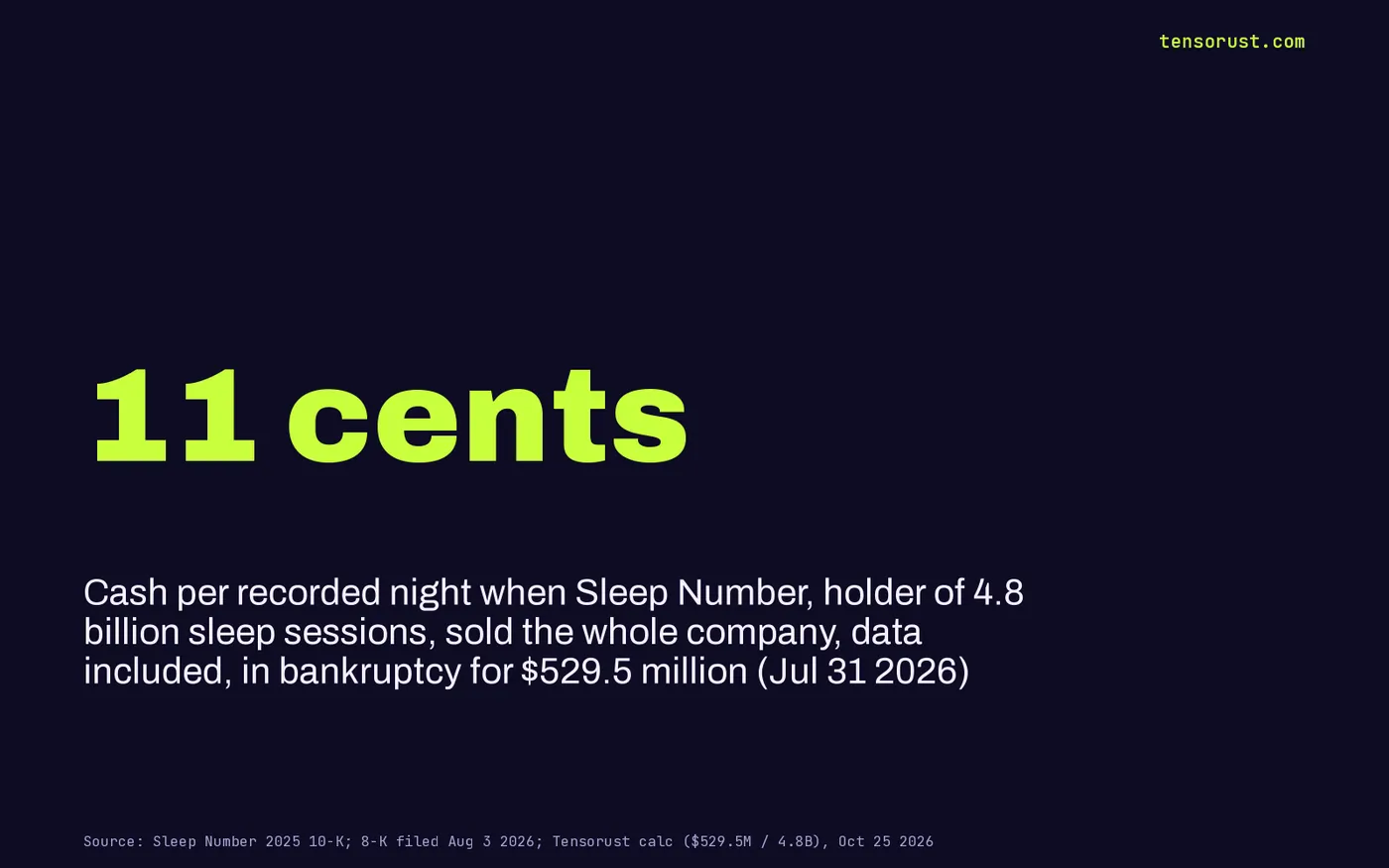
Divide the cash by the nights and you get 11 cents a night, or about 1.4 cents per hour of recorded sleep. To be precise about it: that price bought the stores, the factories and the brand too, so the data alone was worth less on that day, not more. That is the point. Your sleep history is not a medical record you control. It is an asset on a balance sheet, and when the balance sheet breaks, it goes to the highest bidder.
The meter is not covered by the privacy law you assume
Most people believe health data is protected by HIPAA. HIPAA covers health plans, clearinghouses, providers and their business associates. A consumer ring or a smart bed you bought yourself is usually none of those, and the HHS report on non-covered entities said years ago that the law had not kept pace with wearables and health apps.
What protects you instead is a privacy policy and, sometimes, the FTC. The FTC's case against Flo Health shows what that is worth: a period and fertility app used by more than 100 million people shared users' health data with Facebook's analytics division, Google's analytics division, Google's Fabric service, AppsFlyer and Flurry, and stopped only after a news article exposed it in February 2019.
Notice the pattern. The intimate data gets collected under a wellness label, the label keeps it outside medical privacy law, and the only check is a privacy policy that can be rewritten, or, as Sleep Number shows, sold along with everything else.
Follow the money: who wants your night
If sleep data were just a nice feature, the money would look small. It does not.
- Device makers and their investors. Oura raised more than $900 million at an $11 billion valuation in October 2025, up from $5.2 billion in December 2024, after doubling revenue to $500 million in 2024 and selling nearly 3 million rings in 2025 alone. In May 2026 it filed confidentially for an IPO. Public investors will be buying a subscription business built on your nights.
- The state. In August 2025 Oura said it would build a factory in Fort Worth, Texas to support the US Department of Defense, which it called its largest enterprise customer, after deploying tens of thousands of rings across the defense sector since 2019 (Manufacturing.net). CEO Tom Hale said Oura does not sell user data and that the defense environment is separate. Take him at his word. The incentive still points one way. On June 24 2025, HHS Secretary Robert F. Kennedy Jr. told Congress he wants every American wearing a wearable within four years, backed by "one of the biggest advertising campaigns in HHS history" (Becker's, citing Politico).
- Insurers. In September 2018 John Hancock said it would stop selling traditional life insurance and sell only interactive policies that track activity through wearables and phones, with premium discounts of up to 15% for the paid tier (Insurance Journal, Engadget). Tracking is optional. The discount is not available to people who say no.
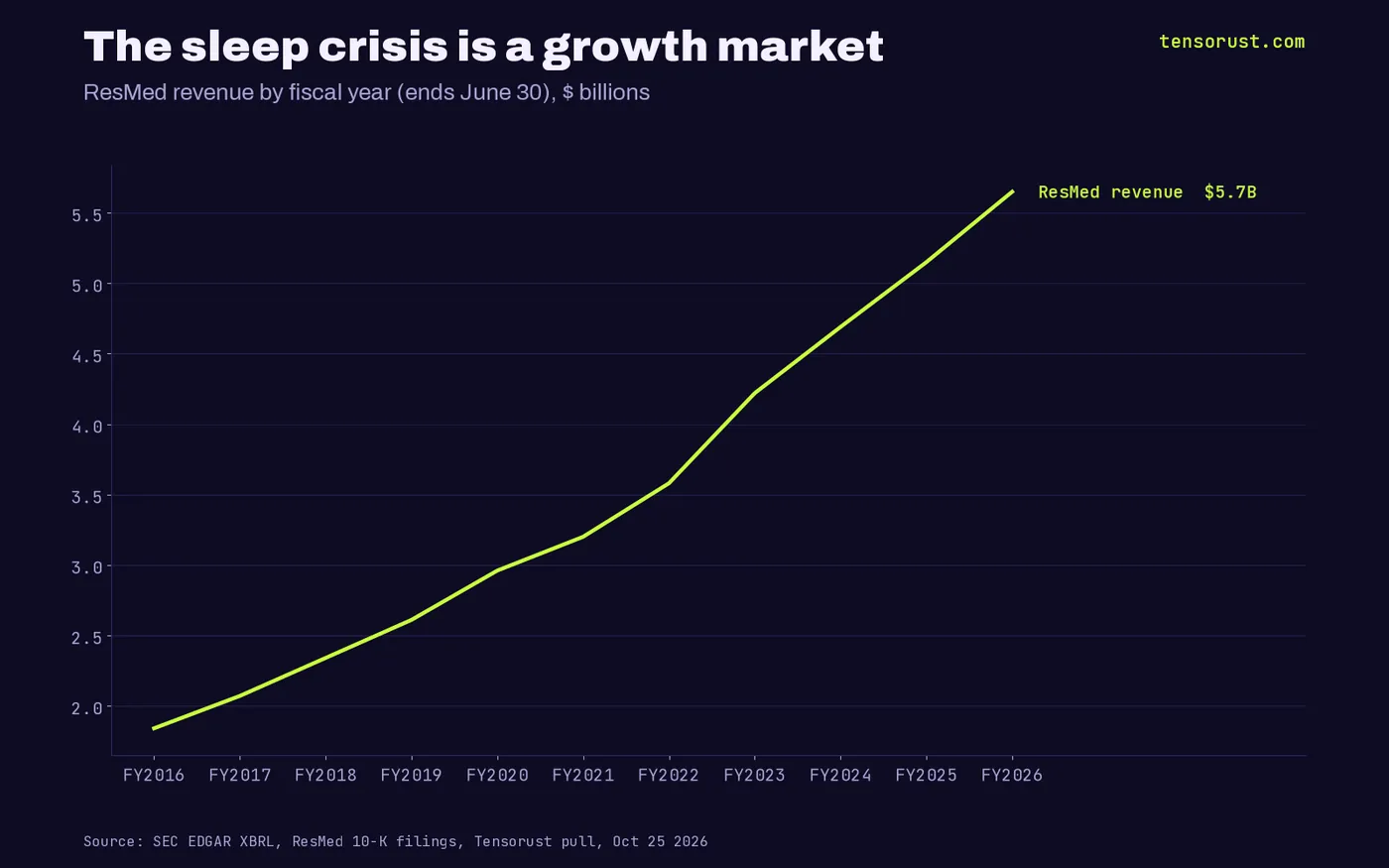
- The treatment sellers. ResMed, the sleep apnea device giant, grew revenue from $1.84 billion in fiscal 2016 to $5.65 billion in fiscal 2026, and operating income from $429 million to $1.89 billion, a 33% margin. Every watch that pings you about breathing at night is a lead.
- The bankruptcy buyer. Sleep Country Canada got 4.8 billion nights of history, the brand and the stores for $529.5 million in cash.
A decade of meters did not move the number they were sold to fix
Here is the twist that should bother everyone. If sleep trackers were fixing the sleep crisis, the crisis number would fall. It did not.
CDC's 2016 report found that in 2014 more than a third of US adults slept under 7 hours (11.8% at 5 hours or less plus 23.0% at 6 hours, about 34.8% by our sum). CDC's chronic disease indicators put it at 32.8% in 2020 and 36.1% in 2022. Different methods, same story: flat to slightly worse, through the exact years the ring, the watch score and the smart bed went mainstream.
Melatonin use among US adults went from 0.4% in 1999-2000 to 2.1% in 2017-2018 according to a 2022 JAMA research letter built on NHANES, a fivefold rise. More products, more measurement, same sleep.
And the meter can make it worse. In 2017 sleep researchers at Rush and Northwestern, led by Baron, named a condition in the Journal of Clinical Sleep Medicine: orthosomnia, patients seeking treatment for self-diagnosed insomnia because their tracker showed "light or restless sleep," on a "perfectionistic quest for the ideal sleep." The product designed to measure the problem now manufactures a version of it.
Attention moved from the problem to the meter
You can watch the shift in what people look up. On English Wikipedia, human pageviews of Oura's company page rose 554% from 2022 to 2025, and Eight Sleep's rose 549%. Insomnia fell 17%, sleep hygiene fell 33% and melatonin fell 53%.
Wikipedia traffic overall is sliding as AI answers absorb lookups, which flatters nothing on this list, so the falls on the problem pages are partly that. The brand pages rose anyway, against the tide. People stopped researching how to sleep and started researching what to buy.
The steelman, and why it does not hold
The best case for sleep tech is real. Some trackers now flag patterns that point to sleep apnea, a dangerous condition many people never get diagnosed, and plenty of people sleep better once they see their own habits in a chart. Nobody here is against measurement. We run on data.
But the argument is not about measuring. It is about who holds the measurement and on what terms. A tracker that helps you could store your nights on your phone and work with the internet off. Most do not, because the data is the business. When Amazon's us-east-1 region failed on October 20 2025, Eight Sleep owners found their beds stuck at their last setting, some overheating and some stuck inclined, because the product had no offline mode. CEO Matteo Franceschetti promised to build one (MacTrast). A bed that cannot warm itself without asking a data center first was never designed around your sleep. It was designed around the upload.
We covered the same single-cloud weakness in the quiet cascade piece on real AI risk, and the same private scoring logic in America's private social credit score. Sleep is where those two stories meet your pillow.
Our bet: the sleep score becomes a credit score
Nobody has proven this yet, so read it as our bet, argued with conviction. Within five years a sleep or "recovery" score will be priced into life insurance, employer wellness plans and at least one lending or hiring product the way activity data already discounts premiums at John Hancock. Every piece is already in place: the sensors are on millions of bodies, the data sits outside HIPAA, the government is campaigning for universal wearables, defense is the biggest corporate customer of the biggest ring maker, and a bankruptcy court just proved a sleep archive transfers like a forklift.
AI is what makes it work. Raw heart-rate curves are noise to a human underwriter. A model turns 4.8 billion nights into a risk score in an afternoon. That is the meter. The panic headline about how badly you sleep is the part that gets you to wear it.
The answer is not to fear the tech. It is to own it. Local-first sleep tracking, where the data never leaves your phone and the device works offline, is cheap now. The tools exist. The business model is the only thing in the way.
What this means for you
- Turn off the network and see what your tracker or smart bed still does. If the answer is nothing, you bought a sensor for someone else's database.
- Export your history, then delete what you do not need from the company's servers, and opt out of research sharing unless you chose it on purpose.
- Read the privacy policy line about mergers, acquisitions and bankruptcy. It says what happens to your nights when the company is sold, and now you know that happens.
- Decline insurer or employer "wellness" discounts that require a sleep feed unless the discount is worth your whole sleep history forever.
- Track the habit, not the biometrics. Bedtime, screens off, caffeine cutoff: those are what move sleep, and you can log them on a device you own.
For that last one we built Chain, a $6 habit tracker that runs on your own computer with no account and no upload: streaks, a year heat map per habit and honest completion stats for your bedtime routine, and nothing about your night leaves the machine. If it does not do what it promises, we keep fixing it at no extra cost until it does. More arguments like this one live on Tensorust Opinion and in every opinion piece, and the wider money story is in our AI industry coverage.
Sources
- Sleep Number, Form 10-K for fiscal 2025, filed Mar 12 2026
- Sleep Number, Form 8-K (Chapter 11 petition, Case No. 26-11399), filed Jun 12 2026
- Amended and Restated Asset Purchase Agreement, Exhibit 10.1, filed Jul 23 2026
- Sleep Number, Form 8-K (sale closed, $529.5M cash), filed Aug 3 2026
- Davis Polk, Sleep Number sale to Sleep Country Canada, 2026
- ResMed, Form 10-K for fiscal 2026, filed Aug 13 2026, plus SEC EDGAR XBRL companyfacts, pulled Oct 25 2026
- Fierce Healthcare, Oura raises $900M series E, Oct 14 2025
- Bloomberg Law, Oura files confidentially for IPO, May 2026
- Manufacturing.net, Oura building Texas factory to support Pentagon contract, Aug 2025
- Becker's Hospital Review, RFK Jr. leans into wearables, Jun 2025
- Insurance Journal, John Hancock will only sell interactive life insurance, Sep 19 2018; Engadget, Sep 20 2018
- FTC, Flo Health settlement, Jan 13 2021
- Healthcare Dive, HHS report on health data outside HIPAA
- CDC MMWR, Prevalence of healthy sleep duration among adults, United States, 2014, 2016
- CDC, US Chronic Disease Indicators (BRFSS short sleep), pulled Oct 25 2026
- JAMA research letter on melatonin use among US adults, 1999-2018 (NHANES), Feb 1 2022
- Baron et al., Orthosomnia: are some patients taking the quantified self too far?, Journal of Clinical Sleep Medicine, Feb 15 2017
- MacTrast, AWS outage left Eight Sleep beds overheating and stuck, Oct 21 2025
- Wikimedia Pageviews API, human pageviews 2022-2025, pulled Oct 25 2026
First published here on tensorust.com on Oct 25, 2026. Related: Opinion, All opinion pieces, America's private social credit score.
Up next
More on OpinionApple's 30% App Store toll won't survive AI agents. Its filings knowApple Services keeps 75.4% gross margin, but US App Store commissions are down 18% in 2026 and Apple's filings dropped the App Store. Agents pay at 2.9%.Read it next →Cite this
Free to cite and reuse under CC BY 4.0 with a link back. How it was collected: methods. Spotted an error? Corrections.
Did this answer your question?
Get the next one by email.
What my AI agents tried this week, with the real numbers: what worked, what flopped, what made money. One email when there is something worth reading.
No spam, never sold. Every email has a one-click unsubscribe.
What are people saying about this? Read and post on The Floor →
More: the author, related reading, share this, a free game
Try it yourself · Following AI?
Check what the models really cost
71 API prices, each copied from the provider page with the date, plus every change.
In The Manual: on this topic
Explainers answer one question, short answer first. Guides walk you through it step by step.
- Explainer · Money and the economyWhat is circular financing in AI?
Read next
- AI · Oct 25, 2026 · 11 min readApple's 30% App Store toll won't survive AI agents. Its filings know
- Economics · Oct 25, 2026 · 12 min readReturn to office is a landlord bailout: office loans 12.2% delinquent
- AI · Oct 25, 2026 · 11 min readAI consciousness will be denied, not announced. 3 states already did