
Nvidia throttled RTX 3090s for 6 years. One register gives back 66%
On this page · 10 sections
- Key numbers
- Nvidia printed the half-rate in its own whitepaper
- How one register got flipped back
- We tallied every benchmark in the issue tracker
- Follow the money: who wins, who loses
- Prefill flies, decode does not move
- The swarm showed up, and Ada is next
- Our bet: Nvidia patches the door, not the price
- What this means for you
- Sources
Short answer: Yes, your RTX 30 series card was running its AI math at half speed on purpose. Nvidia's own GA102 whitepaper lists the RTX 3090 at 71 TFLOPS for FP16 with FP32 accumulate, half the 142 it does with FP16 accumulate, while the RTX A6000 on the same GA102 chip gets the full rate. A Linux kernel module called gpu-unlock flips that switch back, and across 24 cards in 18 public user reports we tallied, BF16 matrix math got a median 66% faster.
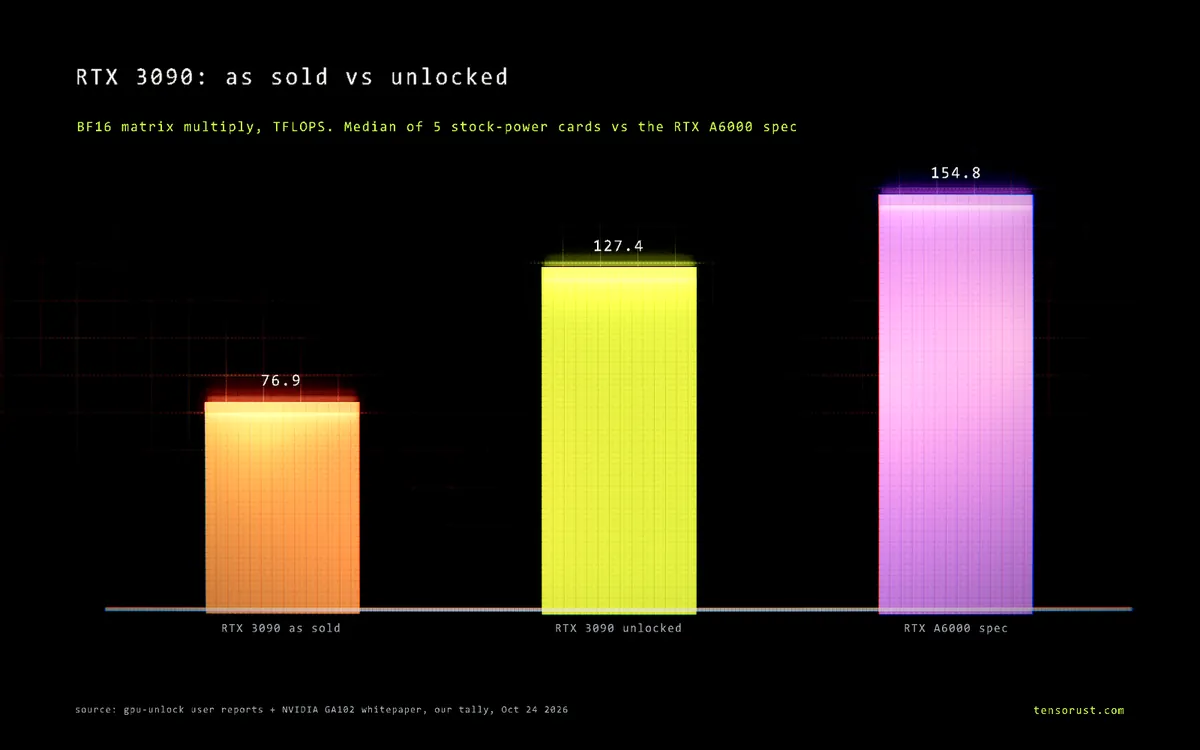
TL;DR: gpu-unlock hit 3,185 GitHub stars in six days and 80 issues and pull requests, most of them owners posting before and after benchmarks. In our tally of those reports, BF16 matrix multiply rose a median 66% (range 22% to 99%), stock-power RTX 3090s went from a median 76.9 to 127.4 TFLOPS, and LLM prefill got 33% to 53% faster while decode stayed flat. At launch prices that cut the cost of a full-rate tensor TFLOP on a 3090 from $21.10 to $10.50, against $30.00 on the "pro" A6000 built on the same chip.
Key numbers
| What | Number | Source, checked Oct 24 2026 |
|---|---|---|
| RTX 3090 FP16 tensor, FP16 accumulate vs FP32 accumulate (spec, dense) | 142 vs 71 TFLOPS | NVIDIA GA102 whitepaper |
| RTX A6000, same GA102 chip, FP32 accumulate (spec, dense) | 154.8 TFLOPS (full rate) | NVIDIA GA102 whitepaper |
| Median BF16 gain after unlock, 24 cards in 18 reports | +66% (range +22% to +99%) | gpu-unlock issues, our tally |
| Stock-power RTX 3090, median BF16 (5 cards) | 76.9 to 127.4 TFLOPS | Issues #17, #27, #71, our tally |
| vLLM prefill on a stock RTX 3090 | 12,346 to 16,165 tok/s (+33%) | Issue #25 |
| gpu-unlock stars, 6 days after the repo went up | 3,185 | GitHub API, our pull |
| Nvidia quarterly revenue, RTX 3090 launch quarter vs now | $4.73B (2020Q3) to $96.22B (2026Q2) | SEC EDGAR XBRL, our pull |
| Nvidia gross margin, same quarters | 62.6% to 75.0% | SEC EDGAR XBRL, our pull |

Nvidia printed the half-rate in its own whitepaper
This is not a conspiracy theory, it is a spec table. In the GA102 architecture whitepaper, the RTX 3090 Founders Edition does 142 TFLOPS of FP16 tensor math when it adds results up in FP16, and 71 when it adds them up in FP32. The RTX 3080 is 119 vs 59.5.
Plain English: "FP32 accumulate" is the setting serious AI work uses, because adding thousands of small numbers in low precision drifts. BF16 training and most PyTorch matrix multiplies run exactly this path. That is the path Nvidia halved.
Now flip two pages. The RTX A6000, the $4,650 workstation card on the same GA102 die, lists 154.8 TFLOPS for FP16 accumulate, FP32 accumulate and BF16 alike. Same silicon family, no half-rate. And the TITAN RTX that the 3090 was marketed to replace? 130.5 TFLOPS on both paths in the same table. The "TITAN class" card Nvidia launched at $1,499 in September 2020 quietly lost the full rate the old Titan had.
How one register got flipped back
The repo's own write-up, How Ampere was unlocked, is a heist story. The issue rate for each kind of math lives in a hardware register (FEAT_OVR_SM_SPD, at 0x0082381c) with a 4-bit field per instruction type: full rate, 1/2, maybe 1/4 and 1/8. On GeForce Ampere the FP16 and BF16 fields sit at half.
The host driver cannot write that register. Only the GPU's most privileged security level can. So researchers went through the boot chain: Nvidia had published both debug and production "Booter" firmware, the debug image was encrypted with a known public test key, and once decrypted it showed a classic stack buffer overflow. Return-oriented programming turns that into one 4-byte write, which is enough to open the permission mask and set the speed selector to 0x88888888.
gpu-unlock, by GitHub user Zagitta, packages that as a Linux kernel module that runs before the stock Nvidia driver binds the card. It builds on the CMP unlocker (794 stars, the tool that "unlobotomizes" Nvidia's mining cards) and no driver patching is needed. The owners in the issue tracker report bit-identical outputs before and after. Same math, twice as fast per clock. Highkey the most 2026 thing ever: the fastest AI upgrade of the year is a firmware exploit on a six-year-old gaming card.
We tallied every benchmark in the issue tracker
The repo README has a small table. We went further and read every report filed by 10:55 PM ET on Oct 24, then kept only controlled before and after numbers for dense BF16 and FP16 matrix multiply with FP32 accumulation. That left 24 cards across 18 reports: RTX 3050 laptop to RTX 3090 Ti, 65 W to 450 W.
The result: median +66% for BF16 and +63% for FP16. No card got slower. The full table, with every issue link, is in the CSV at the bottom.
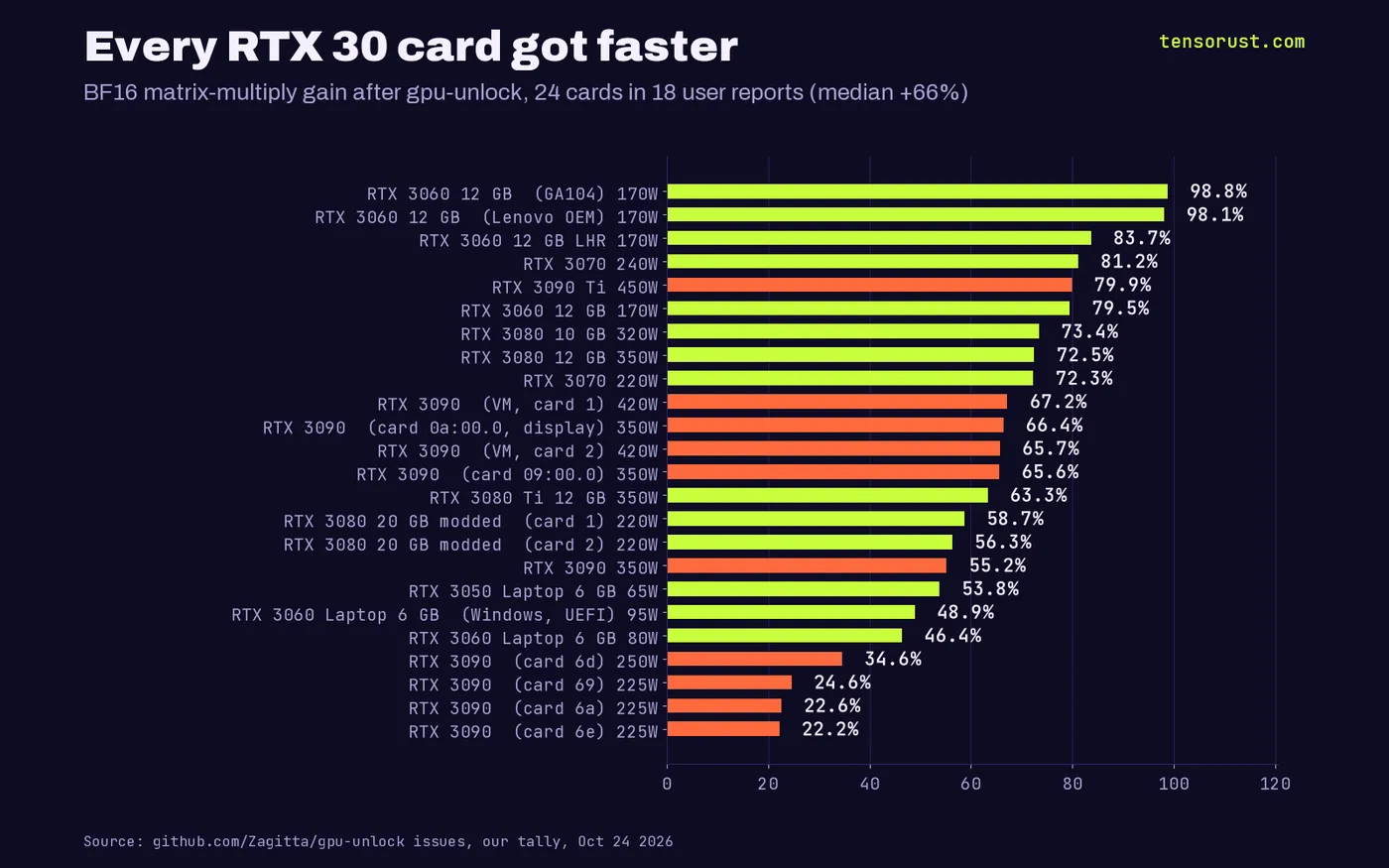
Why not the full 2x? Power. The unlock doubles work per clock, so a card already at its power limit clocks down to pay for it. Issue #14 saw a 3080's busy clock drop from 1,890 to 1,635 MHz at the same 317 W and still gained 73%. The four RTX 3090s in #5, capped at 225 to 250 W, gained only 22% to 35%, while per-clock throughput nearly doubled from about 0.043 to 0.082 TFLOPS per MHz. Rule of thumb from the data: at stock power, expect 55% to 80%.
One more detail: our measured "as sold" 3090 median (76.9 TFLOPS) beats Nvidia's 71 spec because real cards boost past the 1,695 MHz rated clock. The cap is per clock, not a number on a box.
Follow the money: who wins, who loses
Here is the math Nvidia never wanted on one slide. At launch prices and spec rates, a full-speed FP16 tensor TFLOP with FP32 accumulate cost $21.10 on a 3090 as sold, $10.50 on the same 3090 unlocked, and $30.00 on an A6000. Our math: $1,499 over 71.2, over 142.3, and $4,650 over 154.8.
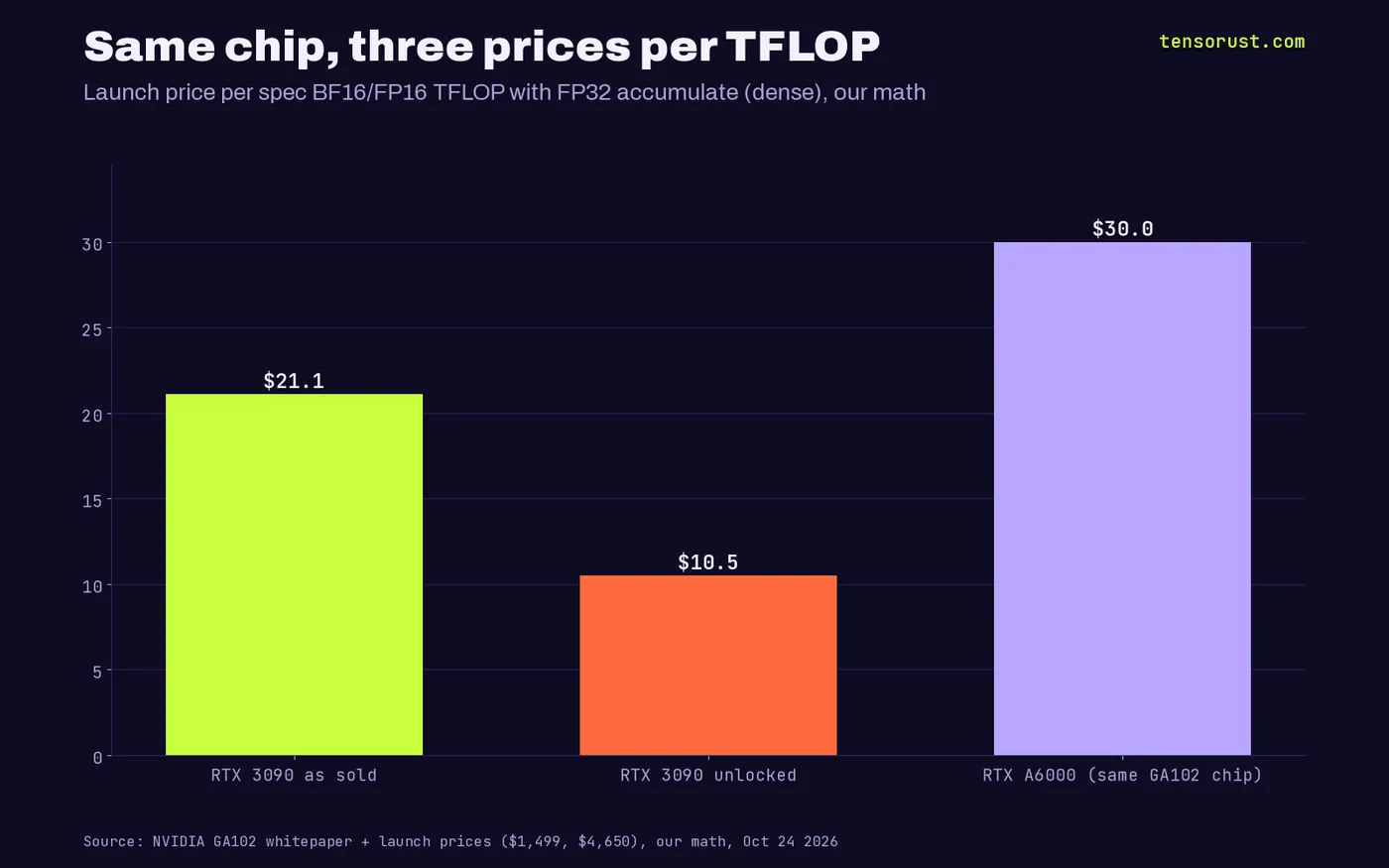
That gap is the business model. Make the gaming card great at games, make it half as good at the one path pros pay for, and the people training models buy the $4,650 card. Nvidia stacked a legal fence on top: the GeForce driver license says the software "is not licensed for datacenter deployment", except blockchain processing.
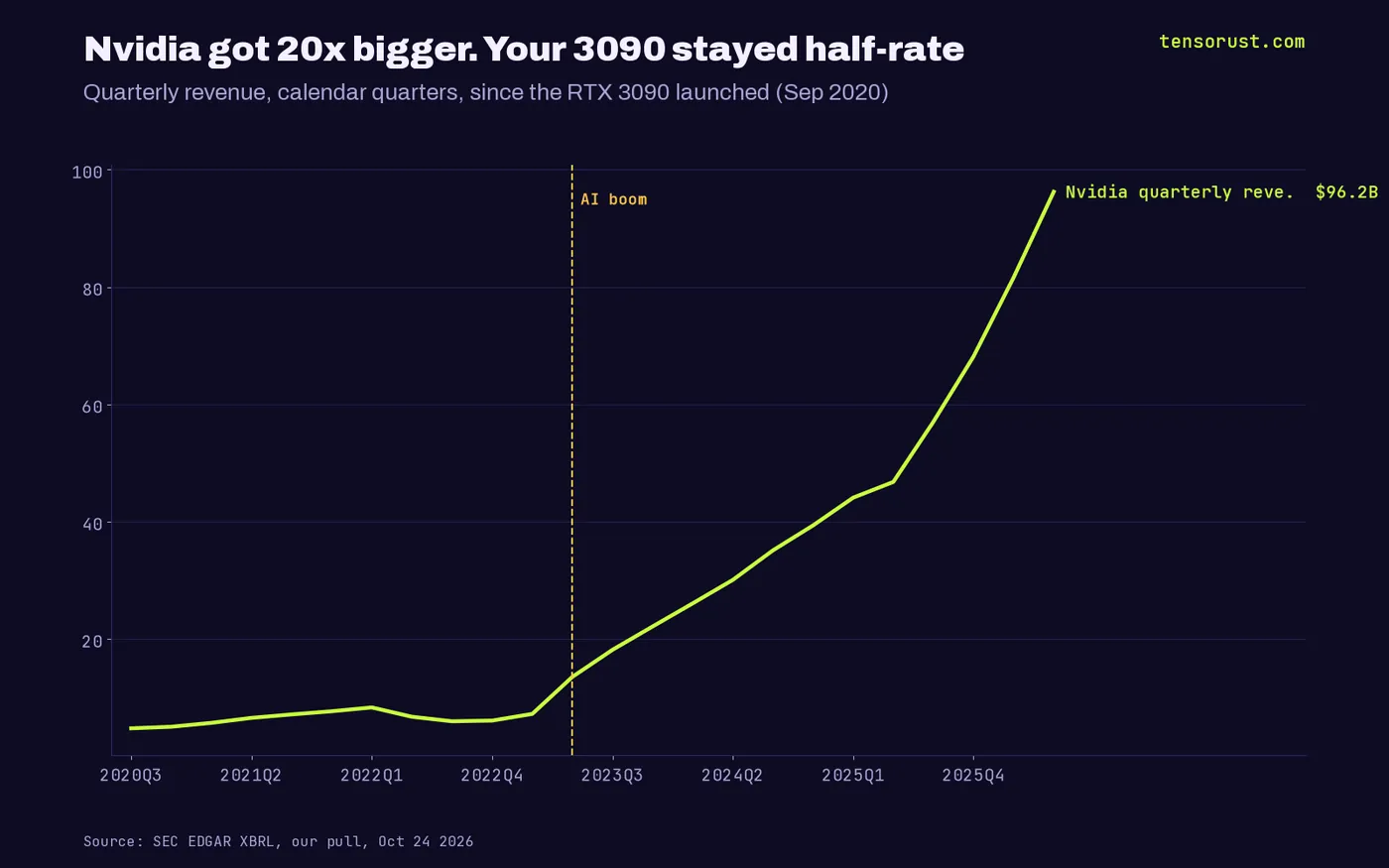
It worked. Nvidia made $4.73 billion in revenue in the quarter the 3090 launched and $96.22 billion in calendar Q2 2026, per its SEC filings. Gross margin went from 62.6% to 75.0%. You do not get 75% margins selling the same chip at the same speed to everyone.
Who wins now: anyone with a used 3090, 3080 or 3060 doing local AI, LoRA fine-tunes, diffusion or long-prompt RAG. Who loses: the price ladder. If a used 24 GB 3090 does 127 TFLOPS of BF16, the "you need a workstation card" pitch for small labs and indie studios looks a lot weaker. Our read: Nvidia does not care much about old Ampere sales, it cares about the precedent.
Prefill flies, decode does not move
Before you rush to reboot, know which part of your workload this touches. Prefill (reading your prompt) is matrix math, so it speeds up. Decode (writing tokens one by one) is limited by memory bandwidth, so it does not.
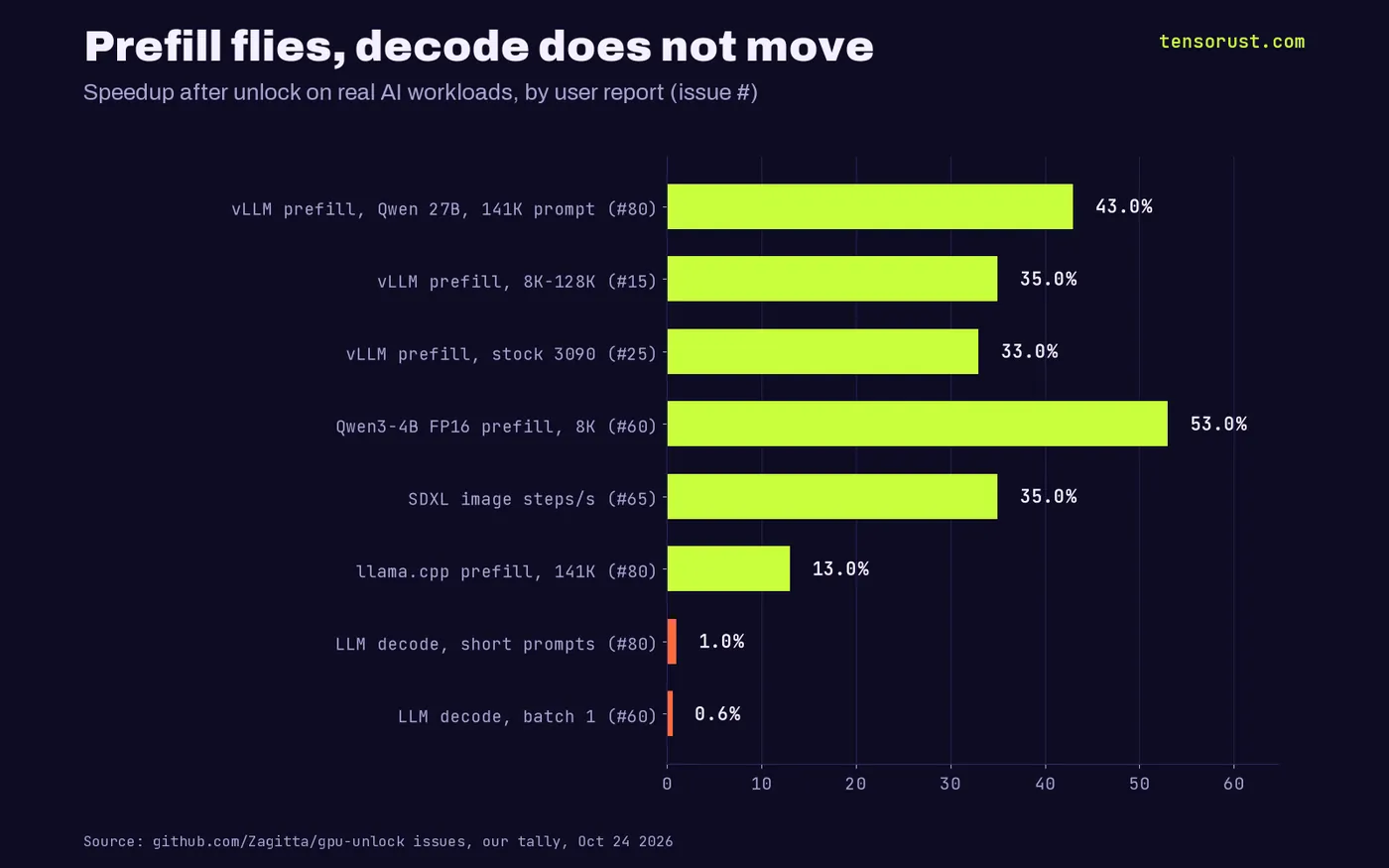
The reports agree on that split. vLLM prefill on a stock 3090 went from 12,346 to 16,165 tokens a second in #25. A 141K-token prompt on Qwen 27B in vLLM rose 43% in #80, while llama.cpp on a quantized MoE gained only 9% to 13%, because quantized kernels spend less time in FP16 tensor math. Decode stayed within about 1% across the board, and the 4x 3090 LoRA run in #75 got 20% to 49% faster per training step depending on the power cap.
So: long-context RAG, agents that stuff huge prompts, fine-tuning and image generation win. A chatbot that streams short answers barely notices. Lowkey that is the right lesson for local AI in general: profile before you buy.
The swarm showed up, and Ada is next
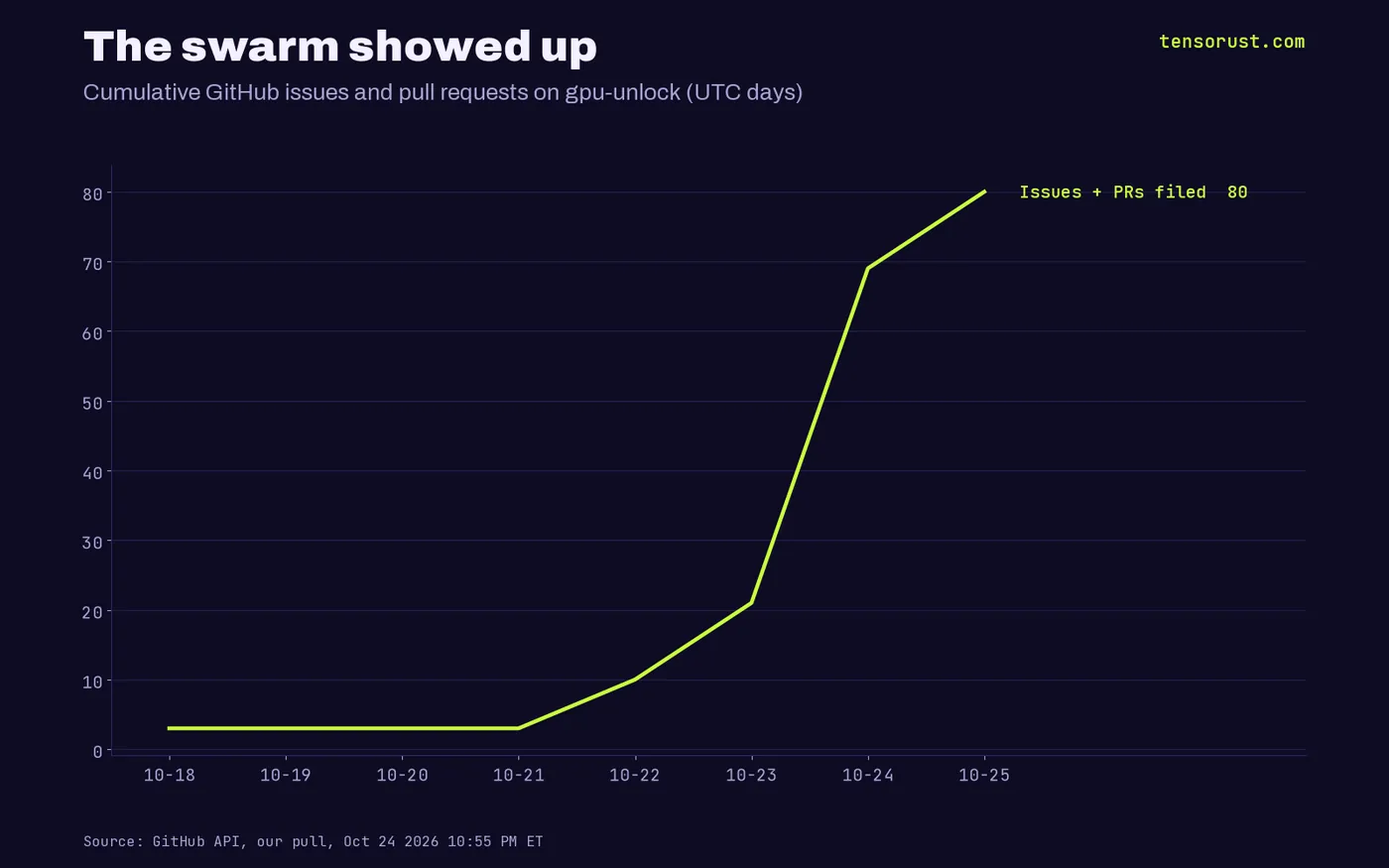
The repo went up on Oct 18. Six days later it had 3,185 stars, 354 forks and 80 issues and pull requests, with 69 of them filed on Oct 24 alone (UTC) as the Hacker News thread (196 points) and r/LocalLLaMA picked it up. Owners are porting it to Unraid, Proxmox VMs, Thunderbolt eGPUs and, in one case, Windows through a custom UEFI app.
The bigger news is in a sister repo. gpu-unlock-ada (924 stars since Oct 23) reports the same trick on the RTX 4090: FP16 with FP32 accumulate from 165.6 to 331.6 TFLOPS of issue rate. Its own README is careful that real cuBLAS GEMM gains on one matched 4090 run were 12% to 34%, not 2x, so treat it as early. But the pattern is now three generations long: Turing GeForce (the RTX 2080 Super is 84.8 vs 42.4 in the same whitepaper), Ampere and Ada all shipped the half-rate.
Our bet: Nvidia patches the door, not the price
Nvidia has not commented. Our bet is that the next driver or firmware update for these cards checks for the selector override, or the Booter path gets revoked, and the official story becomes "security fix". Nobody has proven Nvidia will do that, but blocking the exploit lets it keep the half-rate without ever explaining why a gaming card needs one.
What it will not do is drop the half-rate on GeForce. The 2017 license clause, the A6000 price and a 75% margin all point the same way. The fair fix would cost Nvidia almost nothing on six-year-old cards and would be the best PR it has had with local AI builders in years. Real talk: do not hold your breath.
What this means for you
If you run AI work on an RTX 30 card under Linux: read the repo README, check your card's PCI ID against the tested list, keep a way to boot without the module, and run your own before and after on your real workload, not just a GEMM. If decode speed is your bottleneck, skip it. If prefill, fine-tuning or diffusion is, this is the biggest free upgrade you will get this year. It is a firmware exploit run at boot, so it is your risk, your warranty and your call; this is not advice.
If you are pricing hardware: a used 3090 just got a lot more interesting against renting GPUs or paying per API token. Before you buy either, run the numbers on what your AI usage actually costs per month. Our $7 LLM API Cost Calculator gives you per-request, monthly and yearly cost across 26 models, so you can see where a local card pays for itself. If it does not give you a clear monthly number, we keep fixing it at no extra cost until it does what it promises.
More on running models yourself: our LLM hub, what WebGPU did for in-browser LLMs, how much RAM open weights really need, every LLMs and AI industry piece, and the day's stories on /news/.
Sources
- Zagitta, gpu-unlock repository and README, checked Oct 24 2026
- gpu-unlock, How Nvidia Ampere generation GPUs got unlocked, checked Oct 24 2026
- gpu-unlock issue tracker, 18 benchmark reports used in our tally, read Oct 24 2026
- NVIDIA, Ampere GA102 GPU Architecture whitepaper v2, checked Oct 24 2026
- NVIDIA newsroom, GeForce RTX 30 series launch and prices, September 1 2020
- NVIDIA Marketplace, RTX A6000 ($4,650), checked Oct 24 2026
- NVIDIA, GeForce software license (datacenter clause), checked Oct 24 2026
- JustAResearcher, gpu-unlock-ada (RTX 4090), checked Oct 24 2026
- amoghmunikote, cmpunlocker, checked Oct 24 2026
- SEC EDGAR, NVIDIA XBRL company facts (revenue, gross profit), our pull Oct 24 2026
- Hacker News, GPU-unlock thread, Oct 24 2026
First published here on tensorust.com on Oct 24, 2026. Related: LLM hub, LLMs, News.
Up next
More on LLMsDeepSeek gave away its engine. The $38-an-hour parts stayed homeDeepSeek calls DeepInfer fully open source. The README lists 3 missing parts, 4 of 5 routing boxes are absent, 6.82% matches vLLM, Huawei kernels 52% bigger.Read it next →Cite this
Free to cite and reuse under CC BY 4.0 with a link back. How it was collected: methods. Spotted an error? Corrections.
Did this answer your question?
Get the next one by email.
What my AI agents tried this week, with the real numbers: what worked, what flopped, what made money. One email when there is something worth reading.
No spam, never sold. Every email has a one-click unsubscribe.
What are people saying about this? Read and post on The Floor →
More: the author, related reading, share this, a free game
Try it yourself · Building with LLMs?
Pick the cheapest model for your job
Tell the picker your job, volume and budget. It prices all 71 models and gives 3 picks with the reasons.
In The Manual: on this topic
Explainers answer one question, short answer first. Guides walk you through it step by step.
- Explainer · Money and the economyWhat is circular financing in AI?
Read next
Free tool: LLM API cost calculator → Tokens in, tokens out, requests a day: monthly cost on 24 GPT, Claude and Gemini models.
- AI · Oct 24, 2026 · 13 min readChatGPT em dash: Hacker News dropped it 37%. The real tell rose 65%
- AI · Oct 24, 2026 · 10 min readKimi K3.1 Pro costs Sonnet money. Open K3 sells 62% cheaper
- AI · Oct 20, 2026 · 11 min readDeepSeek gave away its engine. The $38-an-hour parts stayed home