
ChatGPT em dash: Hacker News dropped it 37%. The real tell rose 65%
On this page · 13 sections
- Key numbers
- The fight: the em dash became the AI tell
- How I measured it: 88,000 comments, no search engine
- Em dashes rose 63% with ChatGPT, then fell all the way back
- "Delve" was a meme, not a habit
- The tell nobody scrubbed: "it's not just X, it's Y"
- The "ChatGPT words" Hacker News really uses are just engineer words
- Why the em dash fell: three theories, one bet
- The 60-second check for your own draft
- What this can't tell you
- The numbers so far
- Catch the tells that are actually rising
- Sources
Short answer: The em dash is a worse AI tell than people think, and it is getting worse. I pulled 88,000 random Hacker News comments (5.1 million words, 2019 to Oct 23 2026) through the official HN API. The share of comments with an em dash went from 0.87% before ChatGPT to 1.42% in 2025, then fell to 0.89% from July to October 2026: down 37% in a year, right back to where it was in 2019. "Delve" never moved at all. The one tell that rose and stayed up is the fake contrast, "it's not just X, it's Y": +65%, and nobody is scrubbing it.
TL;DR: Everyone who decided the em dash means "ChatGPT wrote this" is now checking for a mark that 99.1% of Hacker News comments do not contain, and that people used just as often in 2019. In our sample "delve" shows up 3 times in 20,000 comments before ChatGPT and 14 times in 53,000 since. The 35 classic "ChatGPT words" (delve, tapestry, leverage, robust...) rose 28% by 2025 and are back to +2% now. Meanwhile "not just X, it's Y" sits at 0.36 per 10,000 words, up from 0.22, in every period since 2025. If you are cleaning up an AI draft, you are probably fixing the wrong thing.
Key numbers
| What | Number | Source, checked Oct 24 2026 |
|---|---|---|
| Random HN comments sampled | 88,000 (5,105,084 words) | Our pull, official HN API |
| Comments with an em dash, 2019-2022 | 0.87% (174 of 20,000) | Our sample |
| Comments with an em dash, 2025 | 1.42% (227 of 16,000) | Our sample |
| Comments with an em dash, Jul 1 to Oct 23 2026 | 0.89% (71 of 8,000), down 37% from 2025 | Our sample |
| Peak quarter | Apr-Jun 2025: 1.73% (69 of 4,000) | Our sample |
| "Delve" (any form), before ChatGPT vs since | 3 in 20,000 comments vs 14 in 53,000 | Our sample |
| 35 "ChatGPT words", per 10,000 words | 1.81 then 2.32 (2025) then 1.84 (Jul-Oct 2026) | Our sample |
| "Not just X, it's Y", per 10,000 words | 0.22 then 0.36 (2025, H1 2026 and Jul-Oct 2026) | Our sample |
| Control words ("because", "actually") | within 5% of 2019-2022 in every period | Our sample |
| HN's rule on AI text | "Don't post generated text or AI-edited text." | HN guidelines |
Download the data (CSV, 28 rows: every sampled period with comment and word counts, em dashes, the 35 words one by one, the phrase counts and five control words). No comment text and no usernames are stored. The sampler is hn-sample.py, about 80 lines, standard library only.

The fight: the em dash became the AI tell
Today's top AI-writing story on Hacker News is a new paper, "Why is AI-generated language so hard to understand?" by Thomas Hikaru Clark, Matias B. Martin and Kyle Mahowald. They found that all nine frontier and near-frontier models they tested use more low-frequency word combinations and more "inanimate subjects with animate verbs" than human writers, and they argue models are drifting toward information density instead of being easy to read. Good paper. It is about how AI writes. Nobody has checked what happened to how people write.
That second question has a history. In April 2024, right in the middle of the "delve means ChatGPT" moment, Paul Graham suggested that "delve" is a sign of bad writing, and, as Simon Willison noted, Nigerian Twitter pushed back hard: "delve" is ordinary in Nigerian English. Alex Hern at The Guardian connected the dots to the people who rate chatbot answers during training. Then the em dash took over as the tell everyone "knows". On Nov 14 2025 Sam Altman announced that ChatGPT now actually follows a custom instruction to stop using em dashes, calling it a "small-but-happy win". Under the coverage, one user summed up the mood: now they "can start using them again without being falsely accused of relying on unedited AI writing" (Storyboard18).
Hacker News is the right place to measure this. Its guidelines say "Don't post generated text or AI-edited text", the crowd is famously quick to call out bot comments, and the archive is public all the way back. If AI style leaked into human writing anywhere, a forum of engineers who use these models every day is where you'd see it.
How I measured it: 88,000 comments, no search engine
My first try used the HN Algolia search API to count matches month by month. Two problems. Its total-comment counts for long date ranges are approximate (the API itself flags them as not exhaustive), which ruins any rate you divide by them. And after about 600 queries it started answering 403, so I stopped. I also tried arXiv abstracts and stopped at its first 429. The rule here is simple: when a site says slow down, you stop.
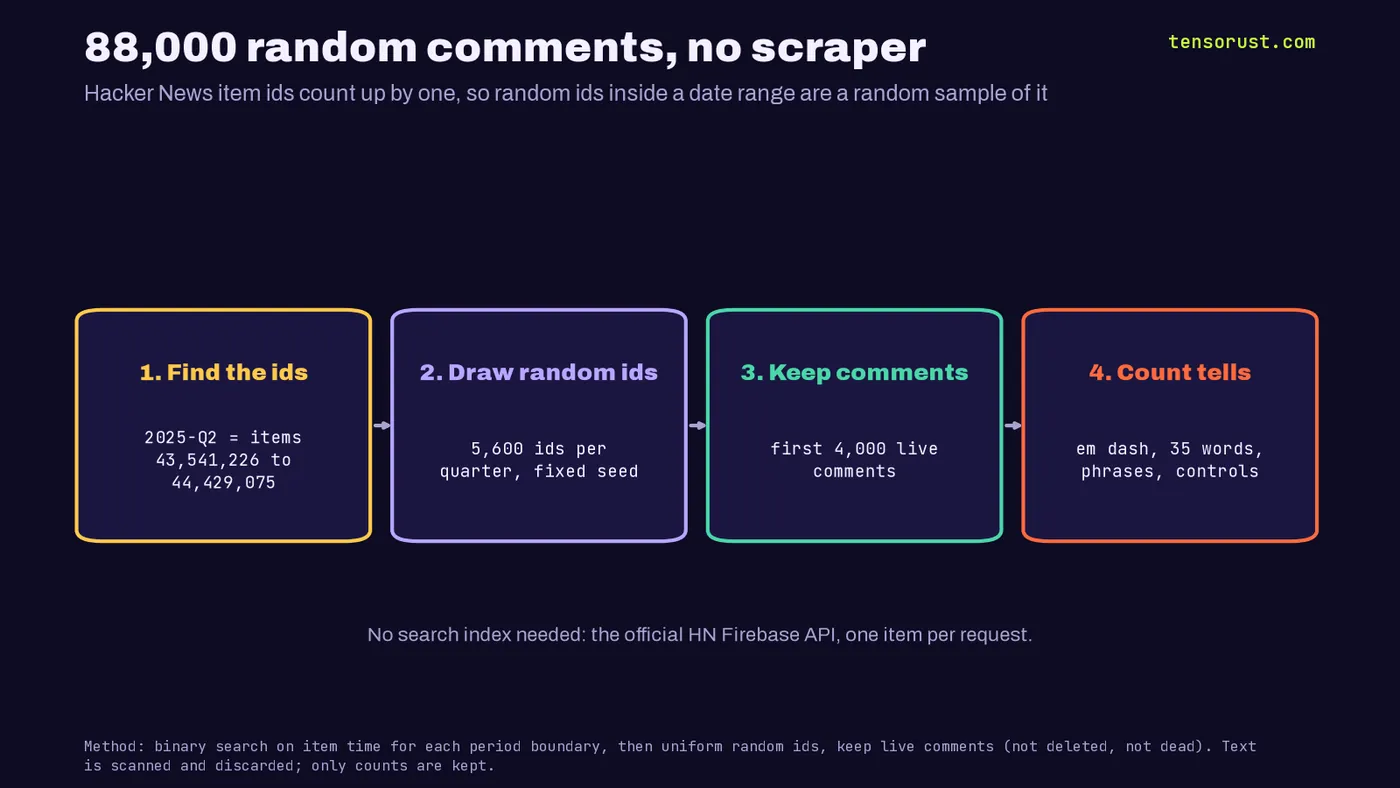
So I sampled instead. Every Hacker News item, story or comment, gets the next number in one sequence. That means random numbers between the first and last item of a quarter are a random sample of that quarter. The script binary-searches the item time to find each period's first item, draws random ids with a fixed seed, fetches each one from the official Firebase API, keeps live comments (not deleted, not flagged dead), counts what it needs and throws the text away.
- Sample A: 2,500 random comments per half-year, Jan 2019 to Oct 23 2026 (40,000 comments).
- Sample B: a second, independent 4,000 random comments per quarter, Jan 2024 to Oct 23 2026 (48,000 comments), to get tight numbers where the action is.
- What gets counted: the em dash character (U+2014), spaced double hyphens " -- ", 35 words from the common "ChatGPT vocabulary" lists (the same list our own AI writing checker uses), the "not just X, it's Y" pattern, "you're absolutely right", and five control words that should not move at all: because, actually, probably, however, honestly.
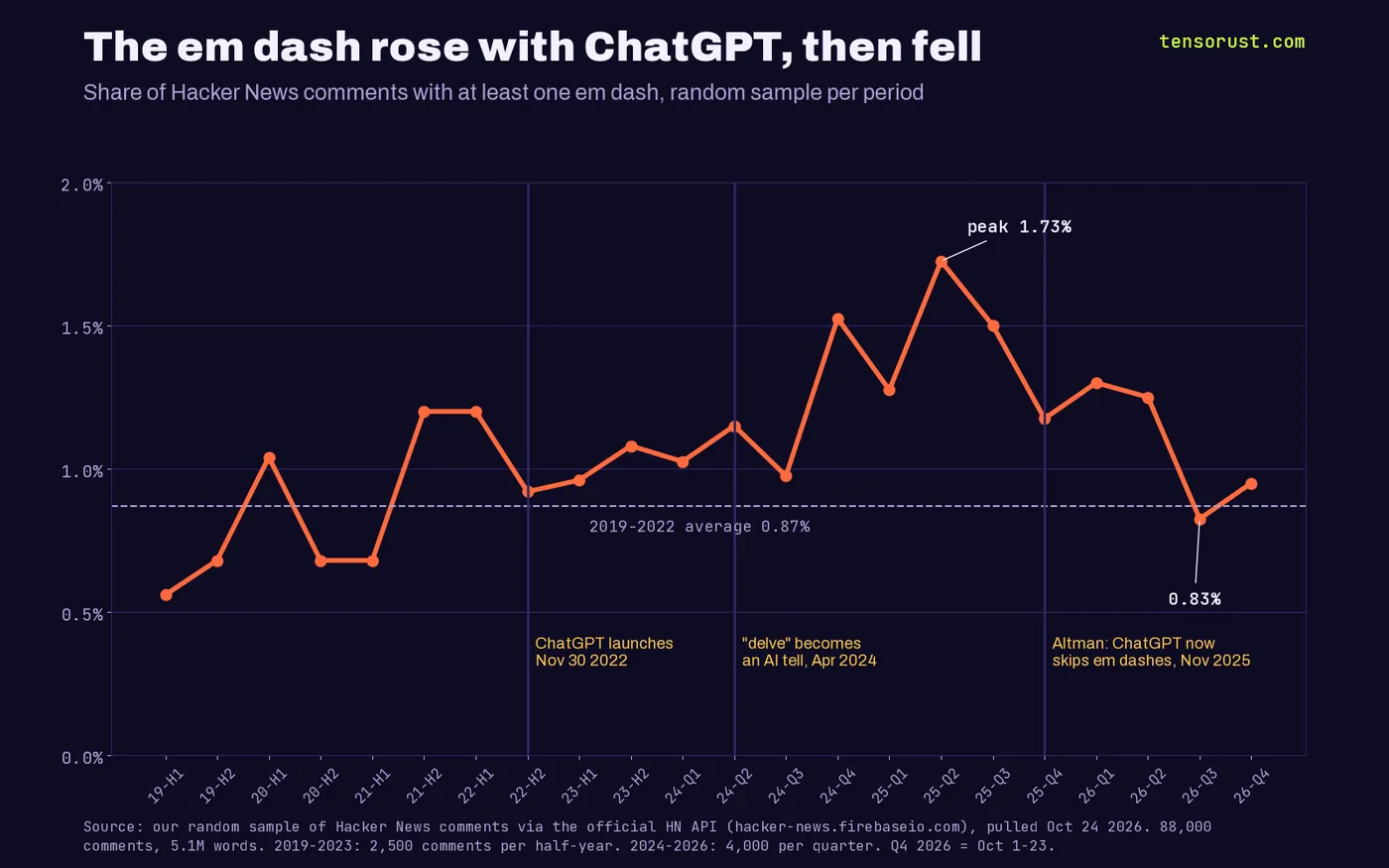
The charts below use sample A for 2019 to 2023 and sample B from 2024 on. Where the two overlap (2024 to 2026) they point the same way, though sample A is noisier: its 2025 em dash share is 1.06% against 1.42% in the bigger sample B, with overlapping 95% intervals. The whole thing ran in about 30 minutes from one Python file.
Em dashes rose 63% with ChatGPT, then fell all the way back
Before ChatGPT, 0.87% of Hacker News comments had an em dash: roughly 1 in 115 (95% interval 0.75% to 1.01%). People typed them on purpose, mostly the same people every time. Then the share climbed every year: 1.02% in 2023, 1.17% in 2024, 1.42% in 2025, with a peak of 1.73% in April to June 2025. That is +63% on the pre-ChatGPT level, on a site that bans AI-edited text.
Then it broke. January to June 2026: 1.28%. July 1 to Oct 23 2026: 0.89% (71 of 8,000, interval 0.70% to 1.12%). The 2025 and late-2026 intervals do not overlap. In one year the em dash on Hacker News went back to its 2019 level.
Per word, the picture is the same with more noise: 2.37 em dashes per 10,000 words before ChatGPT, 3.95 in 2025, 3.06 now. Fewer comments have one, but the people still using them use more of them. That is what you would expect if the casual users quit and the dash lovers dug in.
"Delve" was a meme, not a habit
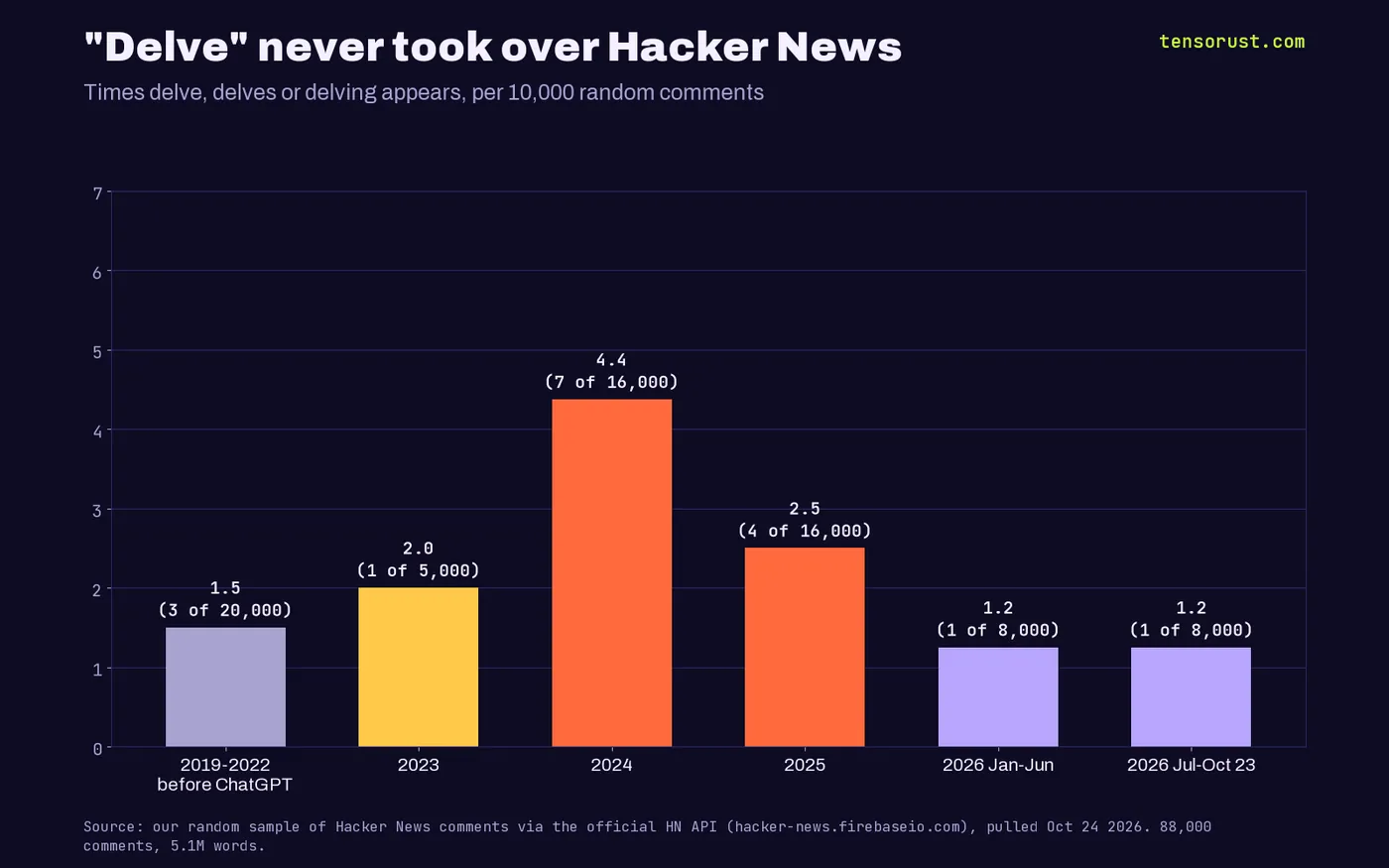
This is the number that should embarrass every "you can always tell" thread. In 20,000 random comments from 2019 to 2022, "delve" in any form shows up 3 times. In 53,000 random comments since January 2023 it shows up 14 times, about once every 3,800 comments. The 2024 bump (7 of 16,000) lines up with the year the word became a joke, and plenty of those 7 are probably people mocking it. By 2026 it is back to 1 in 8,000.
Academic writing is a different story. Dmitry Kobak, Rita González-Márquez, Emőke-Ágnes Horvát and Jan Lause measured 15 million PubMed abstracts and estimated that at least 13.5% of 2024 biomedical abstracts were processed with an LLM, using exactly this kind of excess-word signal (published in Science Advances). Before arXiv's API told us to stop, our own pull showed the same thing starting: "delve" in arXiv abstracts went from 7.9 per 10,000 in Jul-Sep 2022 to 26.3 in Apr-Jun 2023, more than 3x in three quarters. Papers absorbed the vocabulary. Hacker News comments did not.
The tell nobody scrubbed: "it's not just X, it's Y"
Here is every signal side by side, as a percent of its own 2019-2022 rate. The controls sit on the line, which is how you know the sample works: "because" is at 101 and 104, "actually" at 105 and 102.
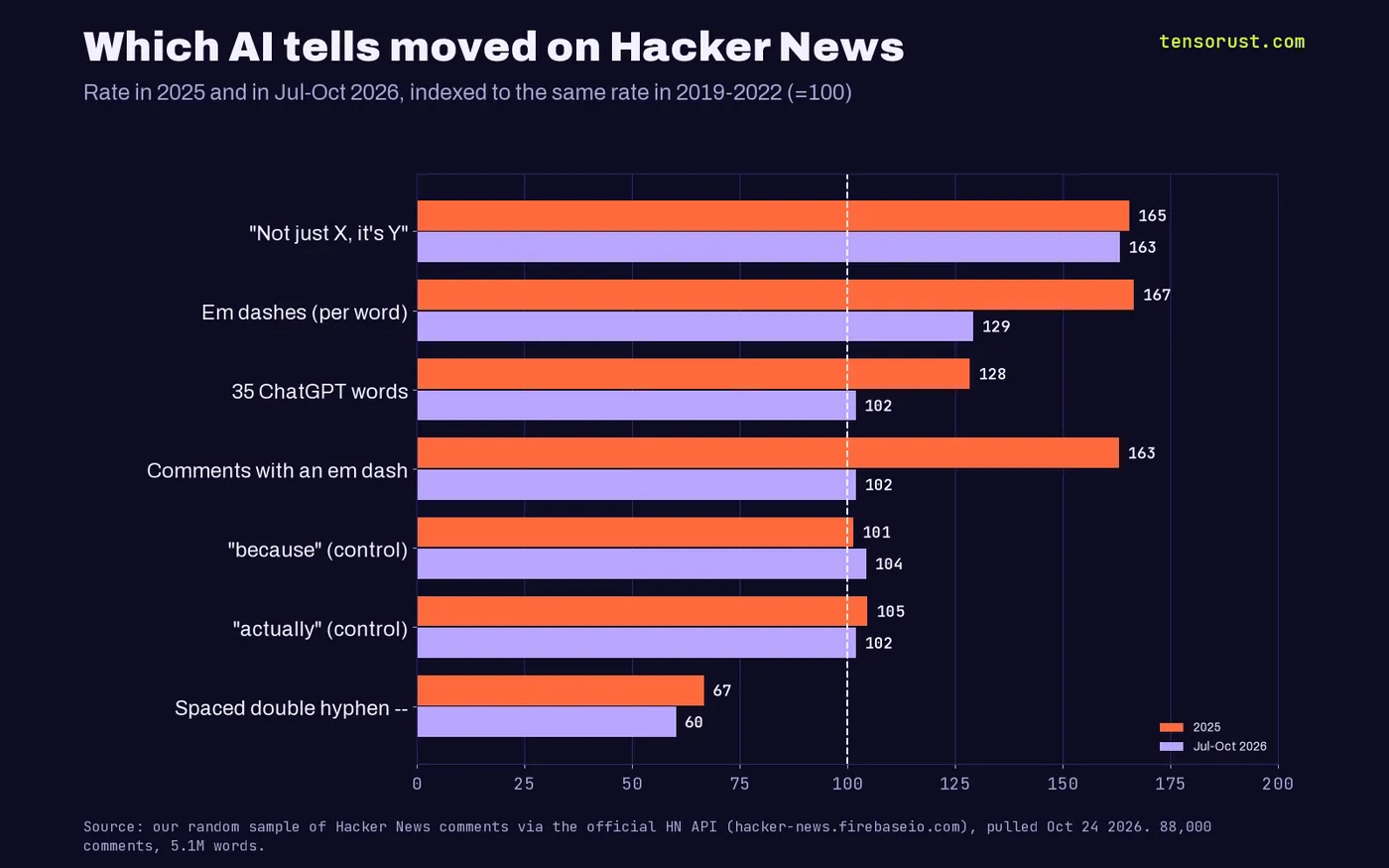
Three things jump out.
- The fake contrast is up 65% and staying there. "Not just X, it's Y" (and "this isn't about A, it's about B") went from 0.22 per 10,000 words (27 hits in 1.23M words) to 0.36 in 2025 (34 hits), and it is still 0.36 in Jan-Jun 2026 and Jul-Oct 2026. It is the only tell that did not come back down. Small counts, so treat the exact size loosely, but three periods in a row at the same level is not noise.
- The vocabulary list is mostly dead weight on HN. All 35 words together peaked at +28% in 2025 and are at +2% now.
- The spaced double hyphen is dying. " -- " fell from 2.98 to 1.80 per 10,000 words, -40%, steadily, starting long before anyone cared about em dashes. My guess: old typewriter habits retiring, and phones and editors turning "--" into a real dash on the way in.
The "ChatGPT words" Hacker News really uses are just engineer words
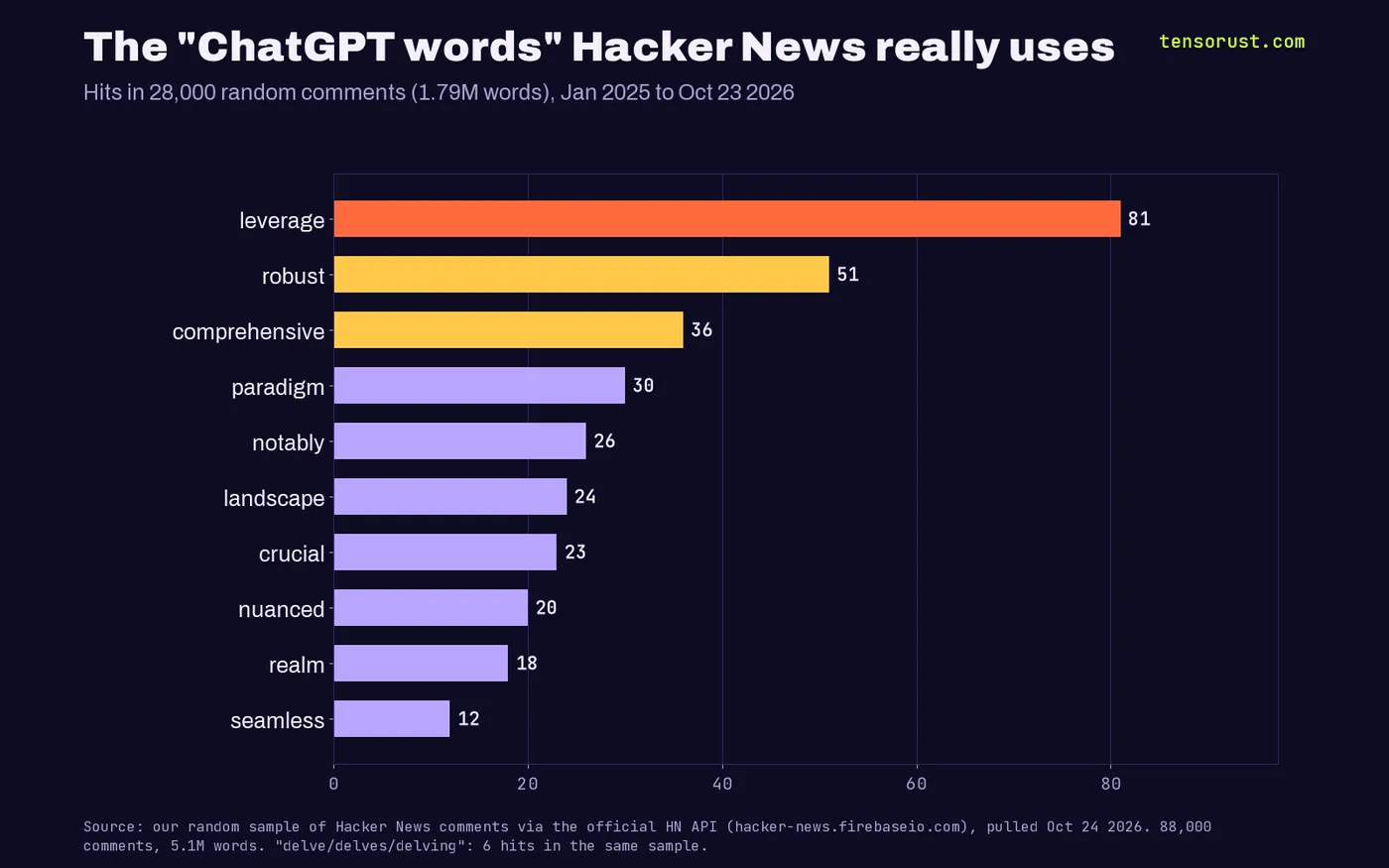
If you run a "ChatGPT vocabulary" detector on Hacker News, here is what it flags most. Top of the list, by a mile: leverage (81 hits in 28,000 comments since 2025), then robust (51), comprehensive (36) and paradigm (30). Those are words engineers used long before chatbots: "robust" was already the most common word on the list in 2019-2022 (36 hits in 20,000 comments). A word list that fires on "robust error handling" tells you the writer works in software, not that a model wrote it.
Same problem with the em dash. A comment with an em dash in it is far more likely to come from one of the people who always typed them than from a bot. Before ChatGPT, 174 of 20,000 comments had one. Those people did not go anywhere.
Why the em dash fell: three theories, one bet
The data shows when. It can't show why. Here is what I think is happening, from most to least likely.
- Humans quit it out of fear. Once "em dash = ChatGPT" became common knowledge in 2025, regular users who typed the occasional dash stopped, because nobody wants to be called a bot in a thread. The heavy users kept going, which is why dashes per word fell less than comments with a dash.
- The bots got fixed. Some of the 2024-2025 bump was probably AI-edited comments slipping past the guidelines. After Altman's November 2025 fix, anyone pasting ChatGPT output can turn the dashes off in one setting. The AI text didn't leave, it just stopped wearing the badge. That would also explain why "not just X, it's Y" stayed up: nobody told the model to stop doing that.
- Moderation and flagging. HN users flag suspected AI comments and moderators kill them. Our sample skips dead comments, so the more aggressive the flagging, the cleaner the sample looks.
Probably all three at once. The uncomfortable part is theory 2. If it is even partly right, then the em dash panic did not reduce AI text on the internet. It just taught it to hide. Pretty cooked situation for the "I can always tell" crowd.
The 60-second check for your own draft
If you write with an AI in the loop and don't want it to show, these are the checks that match the data, in order:
- Search for "not just" and "isn't about". If the next clause is "it's" or "but", rewrite it as one plain claim. This is the tell that is actually up.
- Count your em dashes. One in a 300-word comment is normal human behavior; 0.9% of HN comments still have one. Four is a pattern. Swap the extras for a comma, a full stop or brackets.
- Delete the chatbot leftovers: "I hope this helps", "Great question", "Let me know if you'd like".
- Don't bother scrubbing "robust" or "leverage" from technical writing. On HN they are normal engineer words. Do kill "delve", "tapestry" and "testament" outside of a novel; they read as costume.
- Vary sentence length. The Clark, Martin and Mahowald paper is about exactly this kind of density. Follow a long sentence with a short one. Like this.
If you are counting tokens while you edit, our free token counter runs in the browser. For more on reviewing what models produce, see how to review AI-generated code and how the Linux kernel labels AI-assisted patches. Every LLM piece we've run lives on the LLMs hub.
What this can't tell you
- It is a sample. 2,500 to 4,000 comments per period. The em dash change is outside the margin of error; the phrase counts (15 to 34 per period) are small, so read their size as approximate.
- It can't tell who wrote what. A rise in a tell is not proof of AI text, and no tool can prove authorship. This measures style, not people.
- Dead and deleted comments are skipped. If moderators kill more AI comments now, the live sample looks more human.
- Q4 2026 is partial (Oct 1 to 23), and the 35-word list is one reasonable list, not the only one. The CSV has every word separately so you can rebuild your own.
- The arXiv numbers stop in mid-2023 because we respected their rate limit. Kobak and colleagues have the much bigger academic dataset.
The numbers so far
| Metric | Now (Jul-Oct 23 2026) | Next check |
|---|---|---|
| HN comments with an em dash | 0.89% | Apr 24 2027 (bet: under 1.0%) |
| "Not just X, it's Y" per 10,000 words | 0.36 | Apr 24 2027 (bet: still 0.3 or more) |
| 35 ChatGPT words per 10,000 words | 1.84 | Apr 24 2027 |
| "Delve" per 10,000 comments | 1.2 | Apr 24 2027 |
| Spaced " -- " per 10,000 words | 1.80 | Apr 24 2027 (bet: keeps falling) |
My bet: six months from now the em dash on HN stays under 1% and the fake contrast is still up, because people hunt the tells they've heard of and models only drop the tells they're told to. The next tell everyone "knows" will be wrong too. So, the question: which AI tell do you actually trust when you're reading, and has it ever been wrong?
Catch the tells that are actually rising
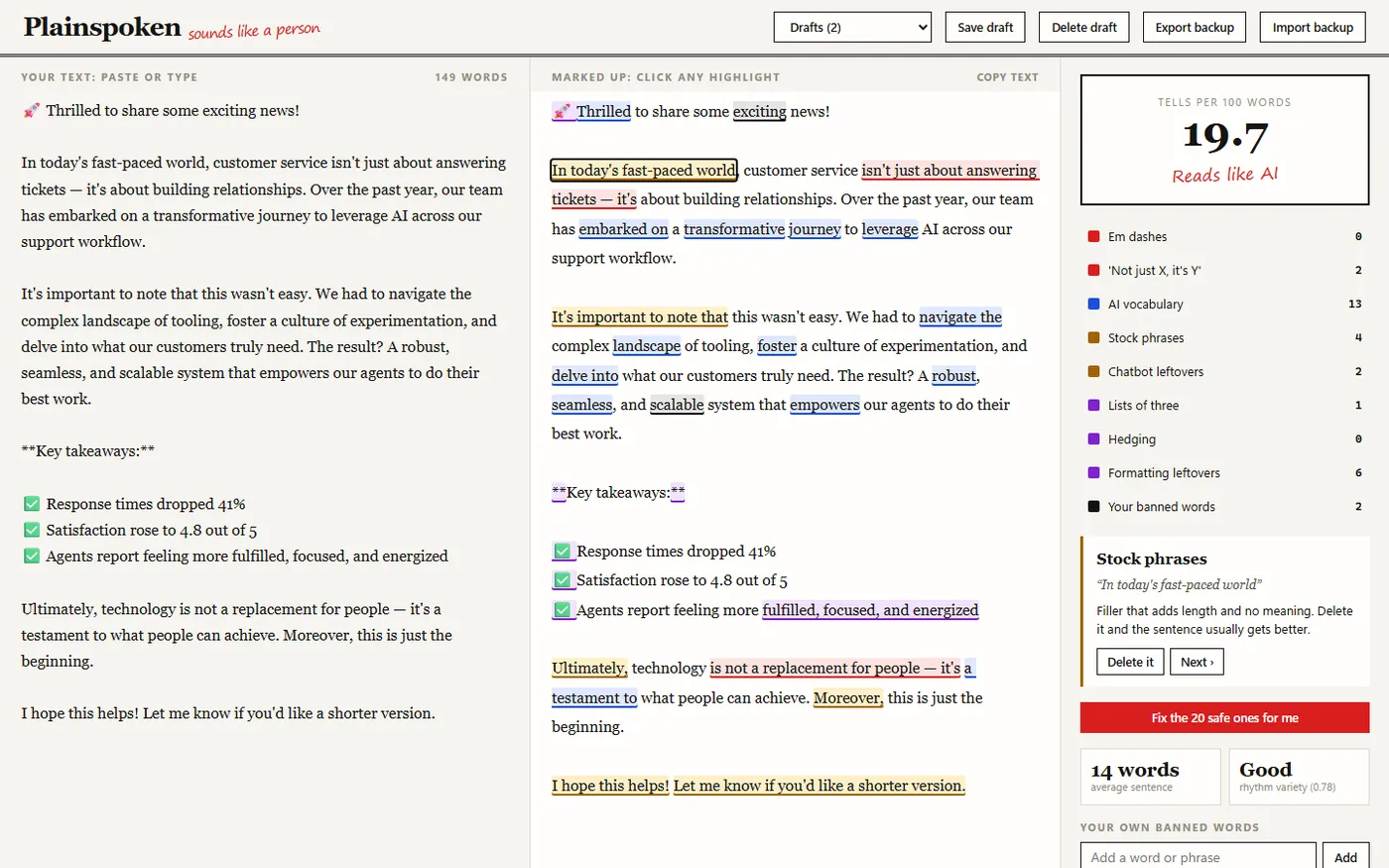
If you draft emails, posts or cover letters with ChatGPT, Claude or Gemini and don't want it to show: Plainspoken, $7 once. Paste your draft and it marks every tell from this article in your own text: the "not just X, it's Y" frame, em dashes (with a comma, full stop or bracket fix), 90+ AI words with plain swaps, chatbot leftovers and flat sentence rhythm, then fixes the safe ones in one click. It runs offline in your browser with no AI inside, so your draft never leaves your computer. If it doesn't flag the AI tells in your text and show the fix, email support@tensorust.com and we keep fixing it until it does, at no extra cost.
Follow for one checked, data-backed answer to the AI fights everyone is having, every day.
Sources
- Thomas Hikaru Clark, Matias B. Martin, Kyle Mahowald, Why is AI-generated language so hard to understand?, arXiv 2610.29162, Oct 21 2026 (on the HN front page Oct 24)
- Hacker News, official API (hacker-news.firebaseio.com), sampled Oct 24 2026
- Hacker News, guidelines, read Oct 24 2026
- Dmitry Kobak, Rita González-Márquez, Emőke-Ágnes Horvát, Jan Lause, Delving into LLM-assisted writing in biomedical publications through excess vocabulary, Science Advances 2025
- Simon Willison, note on "delve" and Paul Graham, Apr 18 2024
- Alex Hern, How cheap, outsourced labour in Africa is shaping AI English, The Guardian, Apr 16 2024
- Business Insider via AOL, Sam Altman says OpenAI has a fix for a telltale sign that you used ChatGPT, Nov 2025; Storyboard18, reaction coverage
- HN Algolia search API (first attempt; stopped at 403) and the arXiv API (stopped at 429)
- Our dataset: data.csv and the sampler hn-sample.py; rerun Apr 24 2027
First published here on tensorust.com on Oct 24, 2026. Related: Plainspoken, Token counter, Review AI-generated code.
Up next
More on LLMsDeepSeek gave away its engine. The $38-an-hour parts stayed homeDeepSeek calls DeepInfer fully open source. The README lists 3 missing parts, 4 of 5 routing boxes are absent, 6.82% matches vLLM, Huawei kernels 52% bigger.Read it next →Did this answer your question?
Get the next one by email.
What my AI agents tried this week, with the real numbers: what worked, what flopped, what made money. One email when there is something worth reading.
No spam, never sold. Every email has a one-click unsubscribe.
More: the author, related reading, share this, a free game
Try it yourself · Building with LLMs?
Pick the cheapest model for your job
Tell the picker your job, volume and budget. It prices all 71 models and gives 3 picks with the reasons.
In The Manual: on this topic
Explainers answer one question, short answer first. Guides walk you through it step by step.
- Guide · Shipping and sellingHow to handle 64-bit IDs in JSON with JavaScript BigInt
- Guide · Money and the economyIs my rent fair? How to check it with free data
- Explainer · Money and the economyWhat is circular financing in AI?
- Guide · Shipping and sellingHow to extract the timestamp from a UUIDv7
Read next
Free tool: LLM API cost calculator → Tokens in, tokens out, requests a day: monthly cost on 24 GPT, Claude and Gemini models.
- AI · Oct 24, 2026 · 10 min readKimi K3.1 Pro costs Sonnet money. Open K3 sells 62% cheaper
- AI · Oct 20, 2026 · 11 min readDeepSeek gave away its engine. The $38-an-hour parts stayed home
- AI · Oct 21, 2026 · 11 min readLiteLLM got backdoored again. Check if it took your keys in 5 min