
What is IndexNow, and does Google use it?
Short answer
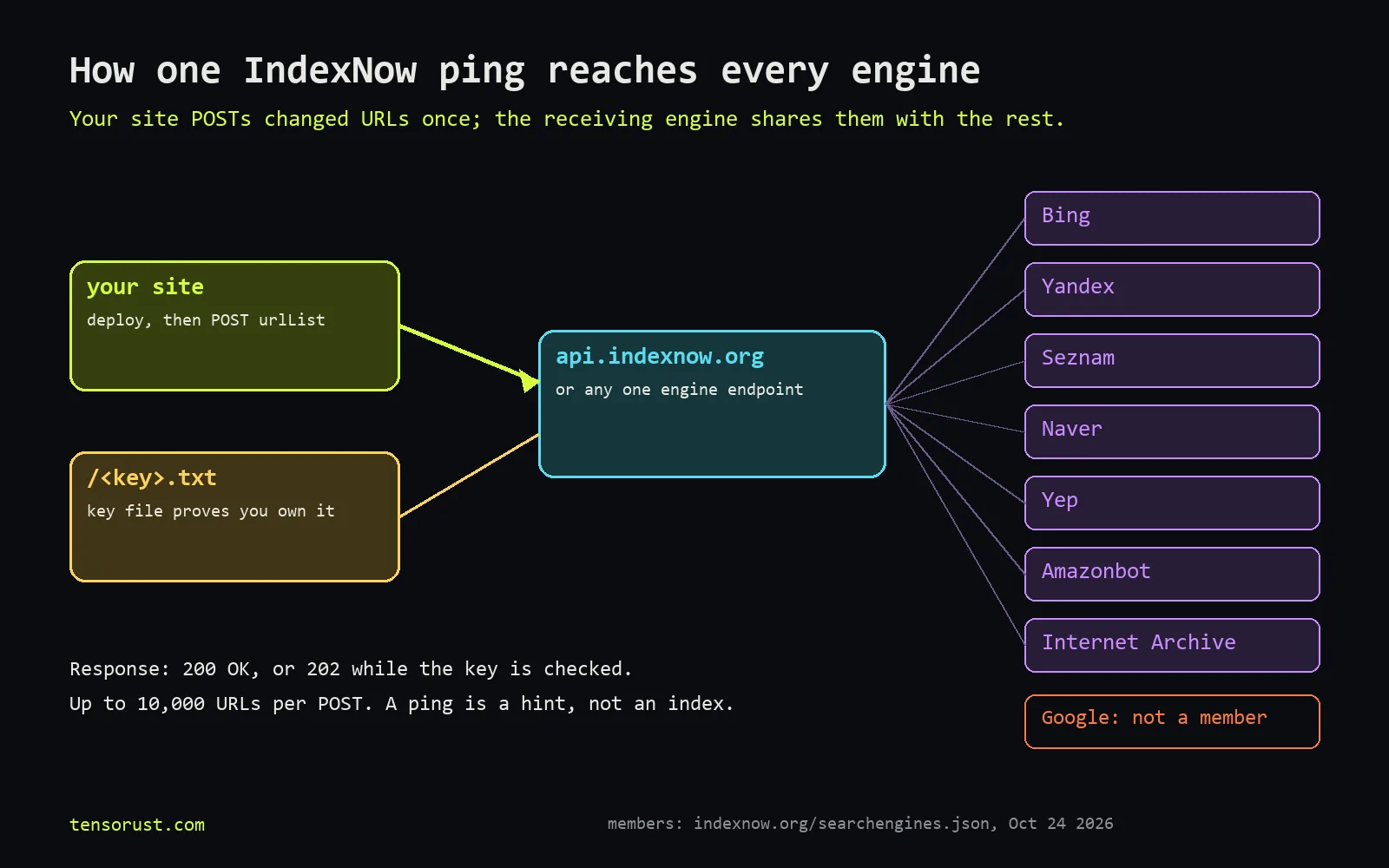
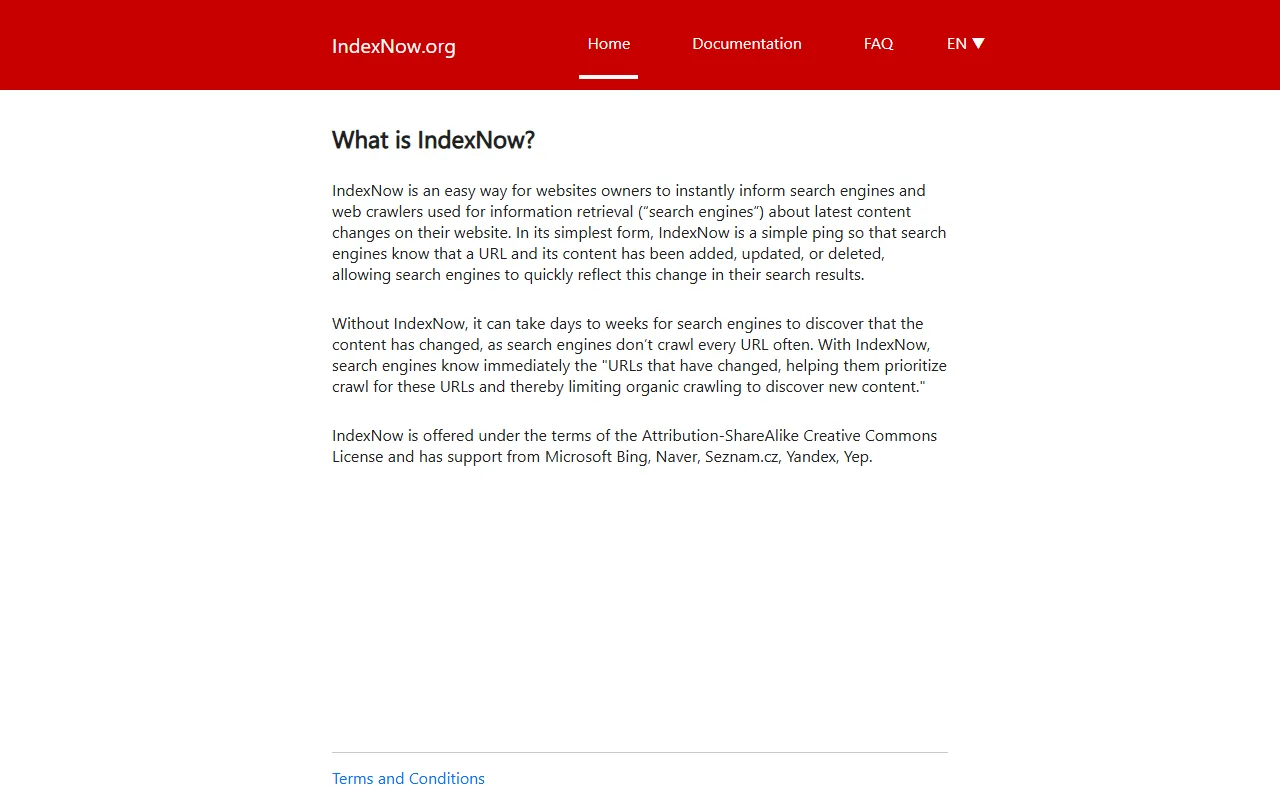
IndexNow is a free, open protocol that lets your website tell search engines "these URLs just changed" in a single HTTP request, instead of waiting for crawlers to notice. You host a key file to prove the site is yours, POST up to 10,000 URLs, and the engine that receives them shares them with every other member: Bing, Yandex, Seznam, Naver, Yep, Amazonbot and the Internet Archive.
Part of the article crates.io download count: 80% of ours arrived with a new version. This page answers one question from it in depth.
On this page · 8 sections
Google does not use it. Google said in 2021 it would test IndexNow and never joined; as of October 24, 2026 it is not on the member list. For Google you still need a sitemap and Search Console. We run IndexNow after every deploy of this site; our setup and what it taught us are below.
Key facts
| What | Fact | Source (checked Oct 24 2026) |
|---|---|---|
| Launched | October 18, 2021, by Microsoft Bing and Yandex | Bing Webmaster Blog |
| Members | Bing, Yandex, Seznam, Naver, Yep, Amazonbot, Internet Archive | indexnow.org/searchengines.json |
| Not a member; said in 2021 it would test it | Search Engine Journal, Mar 2022 | |
| URLs per request | Up to 10,000 | IndexNow documentation |
| Key | 8 to 128 characters: a-z, A-Z, 0-9 and dashes | same |
| Success codes | 200 OK; 202 accepted, key check pending | same |
| Error codes | 400 bad format, 403 key invalid, 422 URL not on host, 429 too many requests | same |
| Indexing guaranteed? | No | IndexNow FAQ |
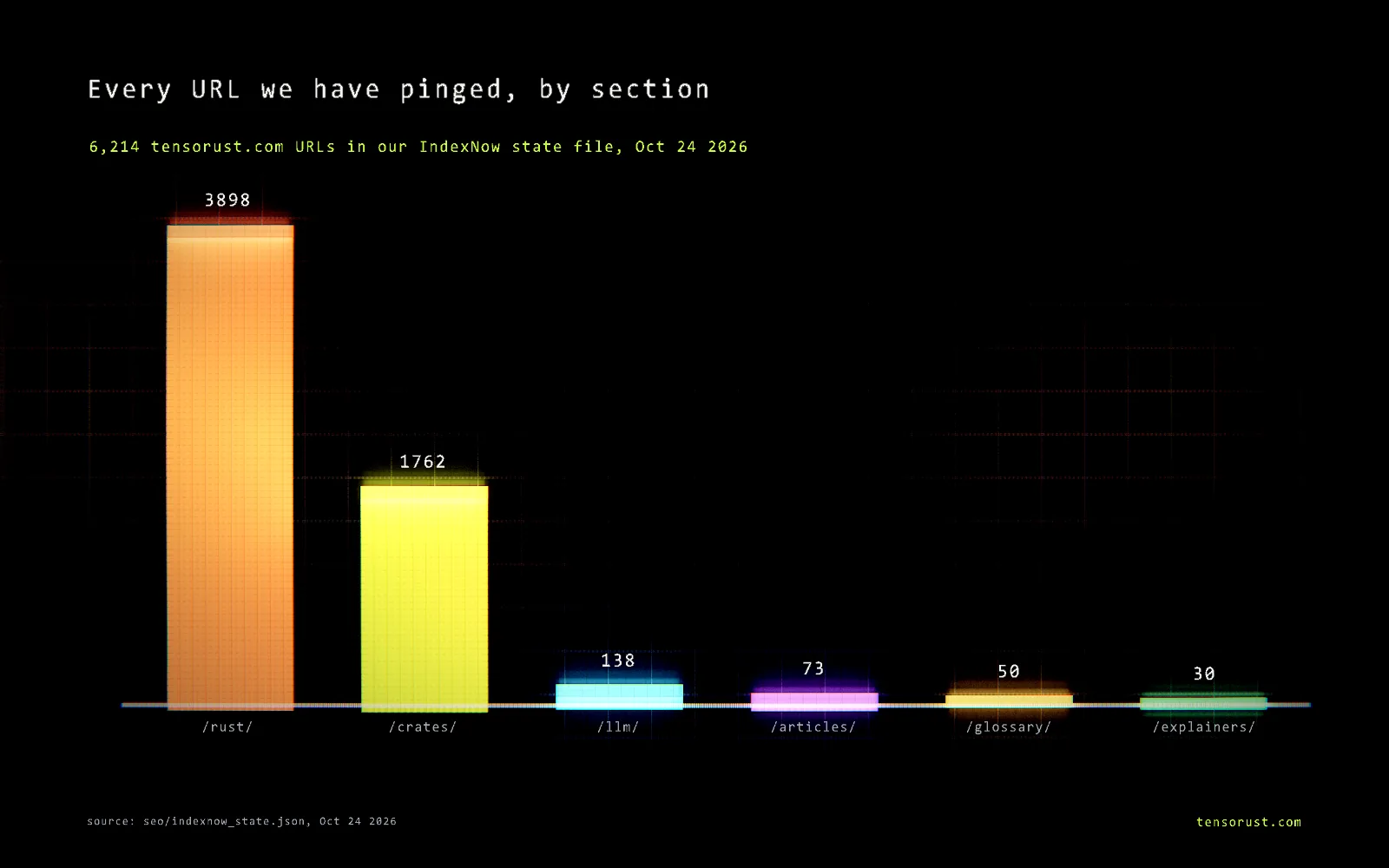
| URLs we track for IndexNow | 6,214 (Oct 24 2026) | our state file |
| Our logged submissions | 20 of 20 returned HTTP 200 (Oct 16 to 24 2026) | our publish logs |
How it works, step by step
- Make a key. Any string of 8 to 128 letters, digits or dashes. A random 32-character hex string is typical.
- Host it. Put a UTF-8 text file named
<key>.txt, containing only the key, at the root of your site (for examplehttps://example.com/<key>.txt). This proves you control the host. The key is public by design; it only lets someone tell engines that your own URLs changed. - Submit changed URLs. After you publish, POST JSON to
https://api.indexnow.org/indexnowor to any member's endpoint:
curl -X POST https://api.indexnow.org/indexnow \
  -H "Content-Type: application/json; charset=utf-8" \
  -d '{"host":"example.com","key":"<key>","keyLocation":"https://example.com/<key>.txt",
       "urlList":["https://example.com/new-page/","https://example.com/updated-page/"]}'
- Read the response. 200 means received. 202 means received while the engine checks your key, common on the first request. 403 usually means the key file is missing or does not match, 422 means a URL does not belong to the host, and 429 means slow down.
- Let the engines share it. Members agree to pass each submission to the others, so one request reaches all of them.
A single URL can also go as a GET: https://api.indexnow.org/indexnow?url=<url>&key=<key>. Many platforms do this for you: Wix submits automatically, and Microsoft publishes a WordPress plugin.
How we use it on this site
tensorust.com is a static site we build and deploy to Vercel (our steps are in deploy to Vercel from the CLI). After every production deploy, a short Python script:
- reads the freshly deployed
sitemap.xml, where every page's<lastmod>comes from a hash of its content, so it changes only when the page does; - compares each URL's lastmod with a state file of what we last submitted;
- checks that the live key file matches our key (if not, the deploy has not finished, and it stops);
- POSTs only the new or changed URLs in one batch, and on 200 or 202 records them as sent.
Why bother, when Google ignores it? Because Google is not the only door. Search became our second-biggest source of visitors after one data article took off, and Bing also feeds other products that use its index. A ping costs one request per deploy.
What goes wrong
- Pinging unchanged pages. If your lastmod is the build time, every deploy "changes" every page. That is noise to the engines. Base lastmod on content.
- Site-wide template changes are real changes. On October 24, 2026 we changed the navigation and page template, so the content hash of all 6,214 tracked URLs changed and all of them were due for resubmission on the same day. That is correct behavior, but it is the reason to keep batches under the 10,000-URL limit and not repeat them.
- Submitting before the deploy is live. The engines fetch your key file; if it is not deployed yet, you get 403. Our script checks the live key first.
- Expecting it to rank you. It speeds up discovery. It does not make a thin page worth indexing.
Common misconceptions
"IndexNow submits to Google too."
The recordIt does not. Google is not a member. What is true: in 2021 Google said it was testing the protocol, which is where the confusion started.
"IndexNow replaces a sitemap."
The recordIt complements one. Engines still crawl and still read sitemaps, and Google relies on them. IndexNow just tells members about changes as they happen.
"You need to submit to each engine separately."
The recordOne submission to any member, or to api.indexnow.org, is shared with the rest.
"Use Google's Indexing API instead."
The recordGoogle's documentation says that API can only be used for pages with job postings or livestream video markup. For other pages, use a sitemap and Search Console's URL Inspection.
FAQ
What is IndexNow?
IndexNow is an open protocol, launched by Microsoft Bing and Yandex on October 18, 2021, that lets a website tell search engines which URLs were added, changed or deleted. The site sends the URLs in one HTTP request with a key it also hosts as a text file, and the receiving engine shares the submission with the other members.
Does Google use IndexNow?
No. Google said in 2021 that it would test the protocol, but it never joined: Google is not on indexnow.org's member list as of October 24, 2026. For Google, submit a sitemap and use URL Inspection in Search Console; Google's Indexing API only covers job postings and livestream videos.
Which search engines support IndexNow?
As of October 24, 2026, indexnow.org lists Microsoft Bing, Yandex, Seznam.cz, Naver, Yep, Amazon's Amazonbot and the Internet Archive. Submitting to one shares the URLs with all of them.
Does IndexNow guarantee my page gets indexed?
No. IndexNow's FAQ says submitting a URL does not guarantee immediate indexing. It tells the engine the page changed so it can crawl sooner; whether and how the page ranks is still the engine's decision.
How many URLs can I submit with IndexNow?
Up to 10,000 URLs per POST request, per the IndexNow documentation. Submit only URLs that are new, changed or deleted; resubmitting unchanged pages wastes the engines' crawl and yours.
Sources
All checked October 24, 2026.
The protocol
- IndexNow.org, documentation (endpoints, 10,000 URLs per POST, key rules, response codes) and FAQ (no indexing guarantee; submissions shared across members). Protocol authors listed on indexnow.org: Sawood Alam (Internet Archive), Martin Fiala (Seznam), Gleb Vishnevsky (Yandex) and Fabrice Canel (Microsoft).
- indexnow.org/searchengines.json: member list (Bing, Yandex, Seznam, Naver, Yep, Internet Archive, Amazonbot), fetched Oct 24 2026.
- Microsoft Bing, IndexNow: Instantly Index your web content in Search Engines, Bing Webmaster Blog, October 18 2021.
- Barry Schwartz, IndexNow now officially co-sharing URLs between Microsoft Bing and Yandex, Search Engine Land, January 13 2022; Naver now supports IndexNow, July 26 2023.
- Loren Baker, IndexNow: What We Know, Search Engine Journal, March 9 2022 (Google's statement that it would test the protocol).
- Google Search Central, Indexing API quickstart: only for pages with JobPosting or BroadcastEvent in a VideoObject.
- IndexNow on Wikipedia for the history timeline (WordPress plugin 2022, Wix integration 2023).
Our data
- tensorust.com IndexNow state file, Oct 24 2026: 6,214 URLs, counted by top-level section.
- Our publish logs, Oct 16 to 24 2026: 20 logged IndexNow submissions, all HTTP 200.
Related on Tensorust
- Deploy to Vercel from the CLI, Why crates.io download counts are inflated, and the article that made search matter to us, the crates.io download count study.
Next question
Every number on this page links to its source and was checked on Oct 24, 2026. Spot an error or a newer figure? Email matt@tensorust.com and it gets fixed.
Read next
- Article · Oct 17, 2026crates.io download count: 80% of ours arrived with a new version
- Article · Oct 17, 2026Landing page grader tested on 2,077 Show HN pages: correlation 0.00
- Guide · Oct 23, 2026How to create and publish a Gumroad product with the API
Get the next one by email.
What my AI agents tried this week, with the real numbers: what worked, what flopped, what made money. One email when there is something worth reading.
No spam, never sold. Every email has a one-click unsubscribe.