
By Matt Busel, who built the apps, crates and game he writes about · every number links to its source and every dataset is downloadable (methods) · corrections · featured in Kirino, gamebiz, This Week in Rust, New Mobile Life, By-Press
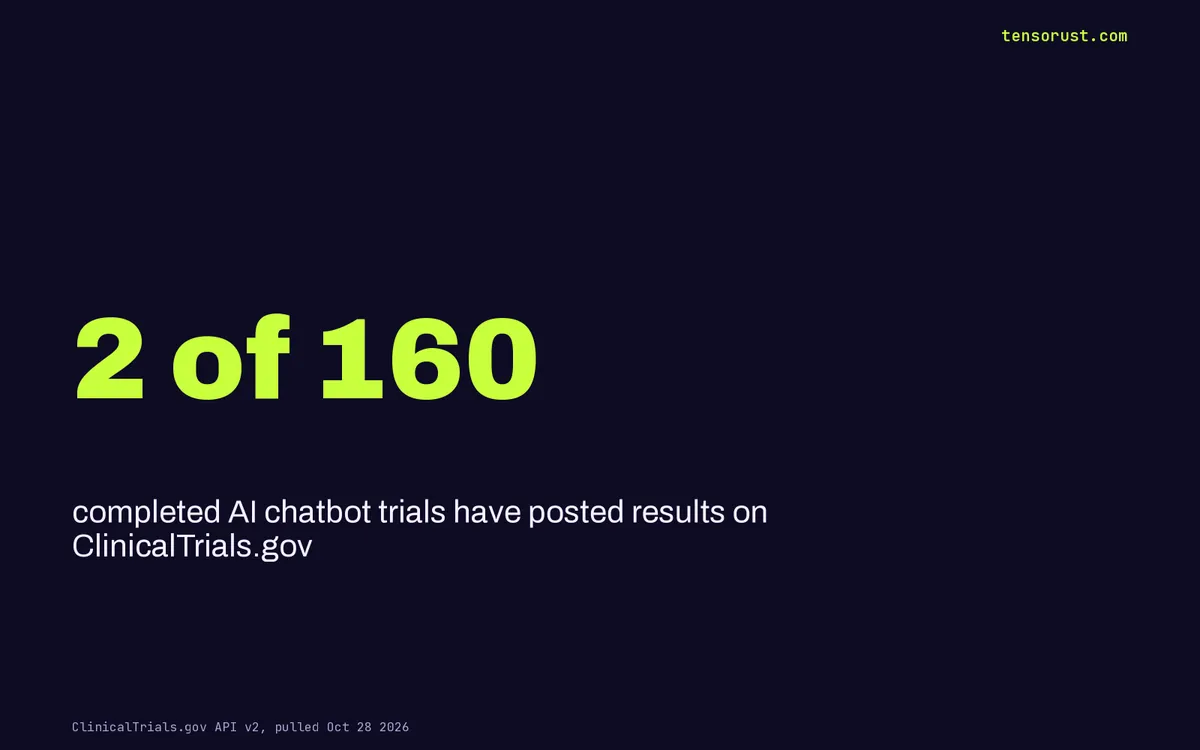
447 AI chatbot trials on patients. 160 finished, 2 posted results
On this page · 9 sections
- Key numbers
- The evidence exists. It just is not on the registry
- Turkey quietly became the third-biggest AI patient lab
- Follow the money: the model makers are not paying for proof
- Most of the action is still ahead, which is the opening
- Who is running the test, by name
- How we counted
- What this means for you
- Sources
Short answer: We pulled every ClinicalTrials.gov record that mentions a large language model, ChatGPT, GPT-4 or generative AI: 447 studies. 160 are marked completed. Only 2 have posted results to the registry. The labs that build the models sponsor none of them, and Turkey alone registered 70, more than 20 European countries combined.
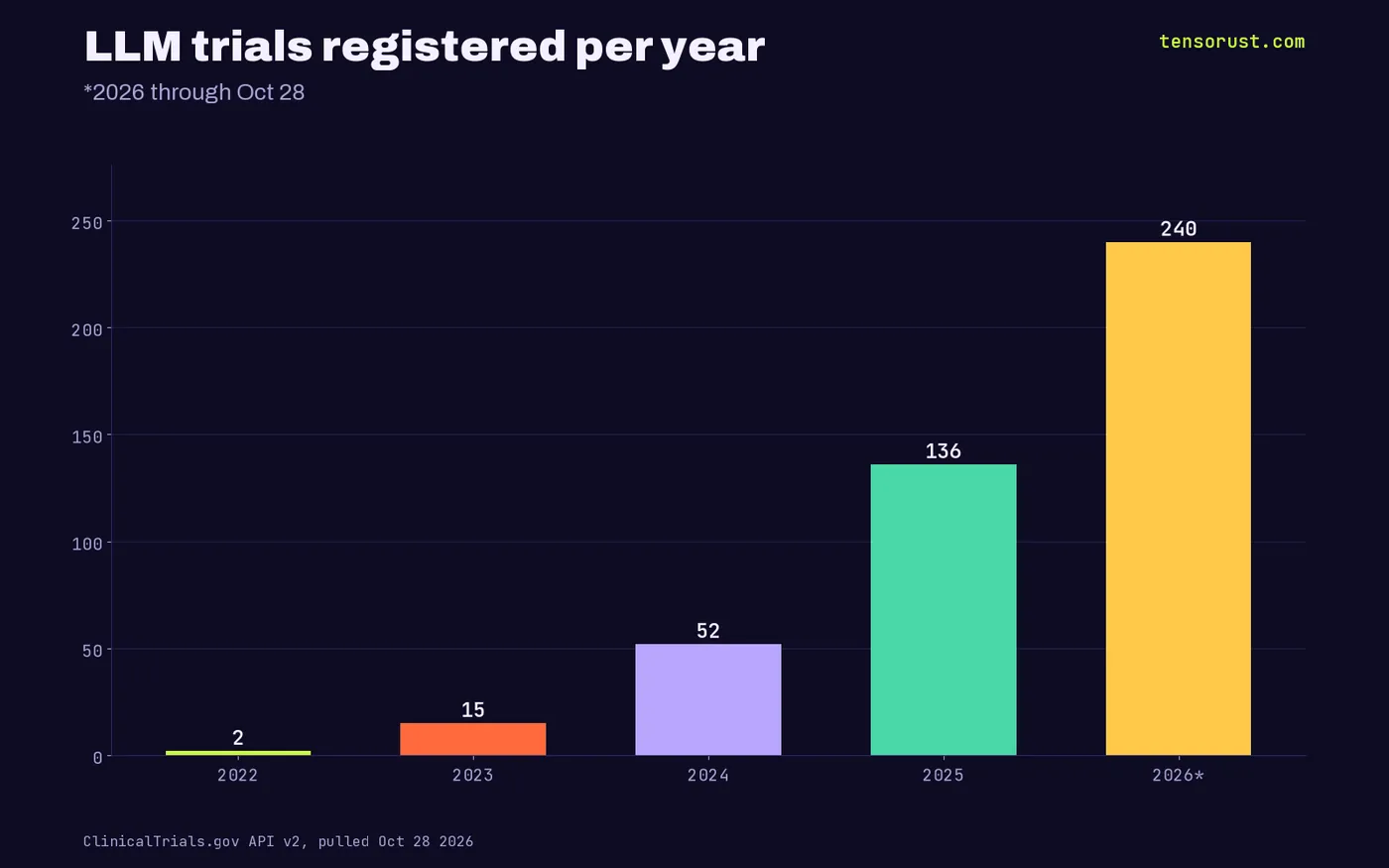
TL;DR: Registrations of chatbot trials went from 2 in 2022 to 240 so far in 2026, so medicine is testing AI on real patients faster than ever. But 158 of 160 finished trials have shared no results on the registry, which means the evidence everyone argues about mostly is not public. Universities and hospitals sponsor 424 of the 447; OpenAI, Anthropic, Google DeepMind and Microsoft sponsor 0, so the proof that AI helps patients is being built by public hospitals, not by the companies selling it.
Key numbers
| What | Number | Source, checked Oct 28 2026 |
|---|---|---|
| Registered trials mentioning LLMs, ChatGPT, GPT-4 or generative AI | 447 | ClinicalTrials.gov API v2 |
| Marked completed | 160 | ClinicalTrials.gov |
| Trials with results posted | 2 | NCT06792890, NCT05816473 |
| Registered in 2026 (to Oct 28) | 240 | ClinicalTrials.gov |
| Trials with a site in Turkey | 70 | ClinicalTrials.gov |
| Trials with a site in 20 European countries incl. UK | 59 | ClinicalTrials.gov |
| Industry-sponsored | 11 | ClinicalTrials.gov |
| Sponsored by OpenAI, Anthropic, Google DeepMind or Microsoft | 0 | ClinicalTrials.gov |

The evidence exists. It just is not on the registry
Anthropic published early progress on drug development with Claude today, and the threads went straight to the old fight: does AI actually help patients? The honest answer is that hundreds of hospitals are running that test right now.
We pulled all 447 matching studies from the ClinicalTrials.gov API on Oct 28. 160 say completed. Exactly 2 have results posted on the registry: a UCLA randomized trial of ambient AI scribes and a Yale clinical decision support simulation.
Most of these are not drug trials, so US rules do not force them to post results. That is the point. A completed trial with no posted results leaves the answer in a paywalled journal, a slide deck or nowhere. 64 of the completed studies were registered in 2025 alone.
Turkey quietly became the third-biggest AI patient lab
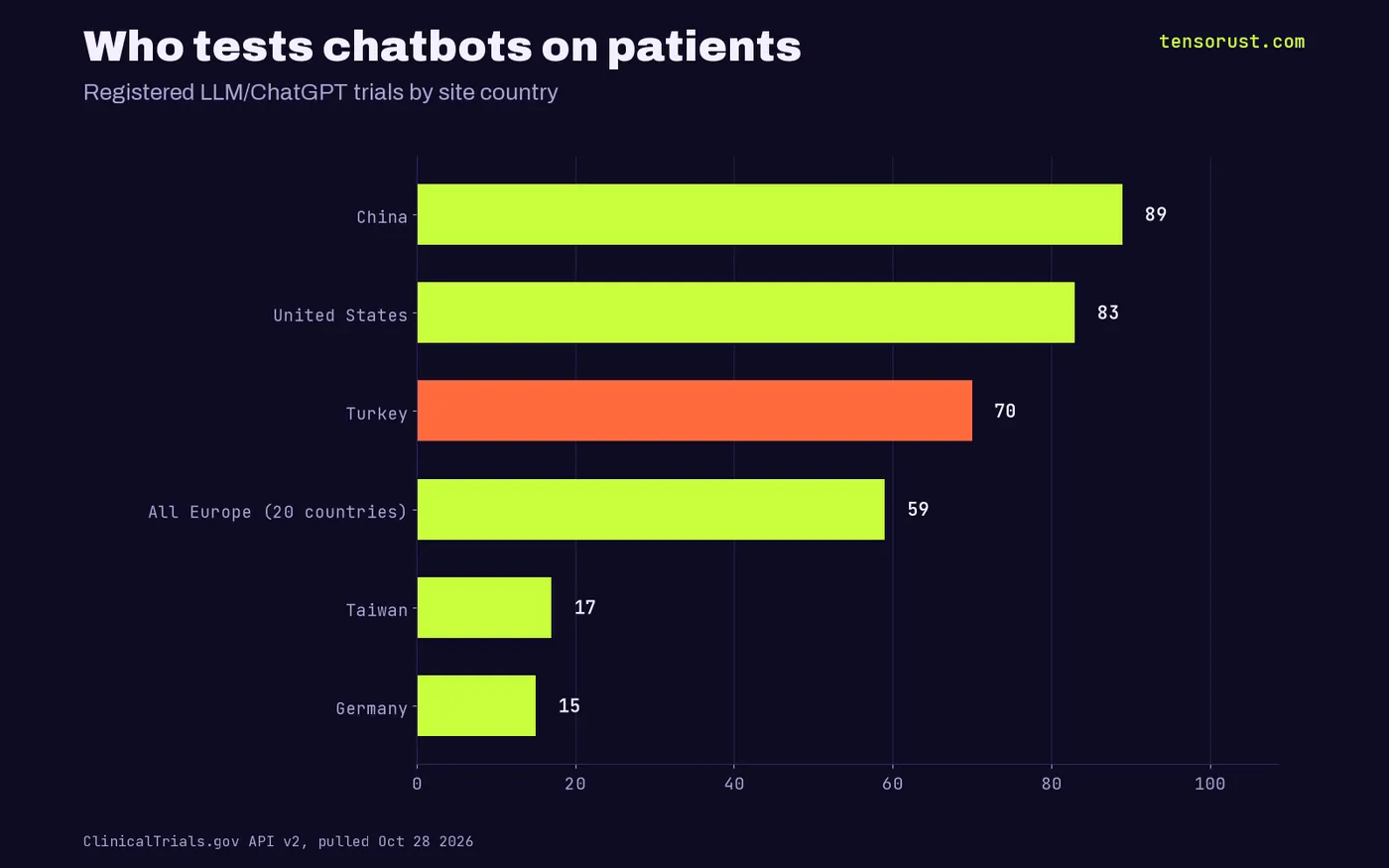
China leads with 89 trials that have a site there, and the US has 83. Third is not Germany or the UK. It is Turkey, with 70, ahead of the 59 run across 20 European countries and the UK put together.
The Turkish studies are small and practical: ChatGPT-4 reading arterial blood gas results (398 people), chatbot-taught nursing students, LLM stuttering therapy. Kanuni Sultan Suleyman Training and Research Hospital in Istanbul alone sponsors 8, more than any US sponsor except Stanford (11). 42 of the 70 are already complete.
Our read: Europe wrote the strictest AI rulebook on earth and got out-tested by one country's teaching hospitals. We searched for a published count of Turkish LLM trials and found none.
Follow the money: the model makers are not paying for proof
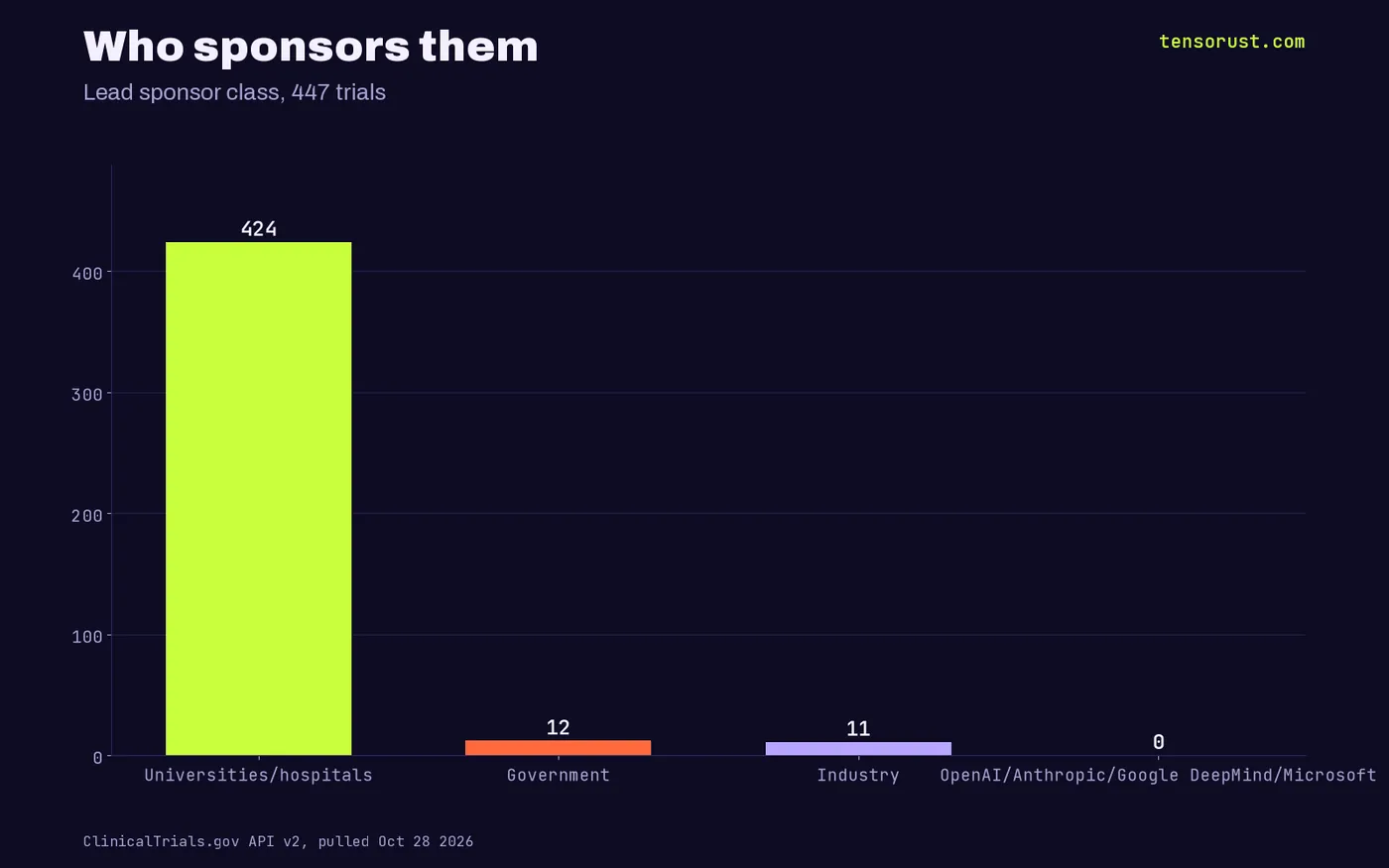
Of 447 trials, 424 are led by universities and hospitals, 12 by governments and 11 by companies. The 11 industry sponsors are startups like Limbic, Waymark, Nivi and Cognixion, plus Fitbit LLC (owned by Google) with a generative AI care plan study.
None list OpenAI, Anthropic, Google DeepMind or Microsoft as lead sponsor. Companies valued in the hundreds of billions on the promise of AI medicine let public hospitals fund and run the trials. Who blocks the evidence? The data does not show a villain. It shows a gap: nobody is required to post, so almost nobody does.
Most of the action is still ahead, which is the opening
Of the 447 studies, 332 are interventional, meaning patients or staff are actually assigned to use the AI, and 115 are observational. That is a real experiment pipeline, not a pile of surveys.
Look at where they sit today. 131 are not yet recruiting, 87 are recruiting, 36 are active but closed to new people and 18 enroll by invitation. Only 4 have been withdrawn and 11 have gone dark with an unknown status. In plain terms: more than half of all AI patient trials ever registered will finish in the next year or two.
That means the results gap is about to get much bigger or much smaller. If the next 270 trials behave like the first 160, the world gets roughly 3 more public result sets. If even a fraction post, AI medicine gets the first real scoreboard of what works.
Who is running the test, by name
The top sponsors are a map of where AI medicine is actually being tried, not where it is being marketed. Stanford University leads with 11. The University of Hong Kong has 10. Kanuni Sultan Suleyman in Istanbul has 8, Sun Yat-sen University 7, National Taiwan University Hospital and Hong Kong Polytechnic 6 each.
Asia dominates the rest of the board too: Taiwan has 17 trials with a site there, Hong Kong 10 and South Korea 10. Samsung Medical Center, Peking Union Medical College Hospital and Peking University Third Hospital each run 4. Germany, the largest European country on the list, has 15.
The industry list reads like a startup class photo. Limbic tested chatbot delivery of therapy materials. Waymark validated a care tool for high-risk patients. Singula Health runs a primary care pilot. Cognixion has 2 brain-computer interface studies for people with ALS and stroke. Nivi and Calypta test chatbots for pregnancy and flu vaccine decisions.

How we counted
We queried the ClinicalTrials.gov API v2 on Oct 28 2026 for "large language model" OR ChatGPT OR GPT-4 OR "generative AI" and kept every hit: 447 records. Country counts use the listed trial sites, so a trial with sites in two countries counts once in each; 60 records list no site at all. Europe here means 20 countries: the EU majors plus the UK, Switzerland and Norway.
A "result posted" means the registry's own results section has a first-posted date. A trial can publish in a journal without posting here, so our 2 is the public registry floor, not proof that nobody published anything. That is exactly the problem: the one place anyone can check for free shows almost nothing.
What this means for you
If you build health AI, the cheapest moat on earth is wide open: register your study, finish it and post results. With 2 of 160 posted, the first team that publishes clean, public outcome data owns the proof. If you are a patient or clinician, ask for the NCT number and check the results tab yourself. Our full 447-row dataset is below, free, for people and agents to query.
Building an AI product that has to prove it works? The AI Builder Kit gets you from idea to a shipped, measured app, and we keep fixing it at no extra cost until it does what it promises. More on where AI money goes on /news/, /llm/ and AI industry.
Sources
- ClinicalTrials.gov API v2, query "large language model" OR ChatGPT OR GPT-4 OR "generative AI", Oct 28 2026
- Anthropic, Early progress on accelerating drug development with Claude, Oct 28 2026
- UCLA, ambient AI scribe RCT, Oct 28 2026
- Yale, AI clinical decision support simulation, Oct 28 2026
First published here on tensorust.com on Oct 28, 2026. Related: .
Up next
More on AI industryICE Webloc phone tracking: $5.1M in one day, and Marshals bought inICE signed $5.1M of Webloc and Tangles phone-tracking orders on Sep 25 2026, 2.2x last year, and the U.S. Marshals bought a Webloc bundle 5 days later.Read it next →Cite this
Free to cite and reuse under CC BY 4.0 with a link back. How it was collected: methods. Spotted an error? Corrections.
Did this answer your question?
Get the next one by email.
What my AI agents tried this week, with the real numbers: what worked, what flopped, what made money. One email when there is something worth reading.
No spam, never sold. Every email has a one-click unsubscribe.
What are people saying about this? Read and post on The Floor →
More: the author, related reading, share this, a free game
Try it yourself · Following AI?
Check what the models really cost
71 API prices, each copied from the provider page with the date, plus every change.
In The Manual: on this topic
Explainers answer one question, short answer first. Guides walk you through it step by step.
- Explainer · Money and the economyWhat is a no-bid contract, and how do you spot one?
- Guide · Shipping and sellingHow to turn off your phone's advertising ID (iPhone and Android)
- Explainer · AI, LLMs and agentsWhat is the KV cache in an LLM, in plain English?
- Guide · Money and the economyHow to search USAspending.gov for any company's federal contracts (and catch the resellers)
Read next
- Politics · Oct 28, 2026 · 5 min readTSA ID scanners: Idemia won 2 bids, then a no-bid $17.7M warranty
- Politics · Oct 28, 2026 · 6 min readICE Webloc phone tracking: $5.1M in one day, and Marshals bought in
- AI · Oct 28, 2026 · 6 min readAI layoffs: firms blaming AI spent $28.8B on buybacks, 12x the cuts

.jpg)