By Matt Busel, who built the apps, crates and game he writes about · every number links to its source and every dataset is downloadable (methods) · corrections · featured in Kirino, gamebiz, This Week in Rust, New Mobile Life, By-Press
TSA ID scanners: Idemia won 2 bids, then a no-bid $17.7M warranty
On this page · 8 sections
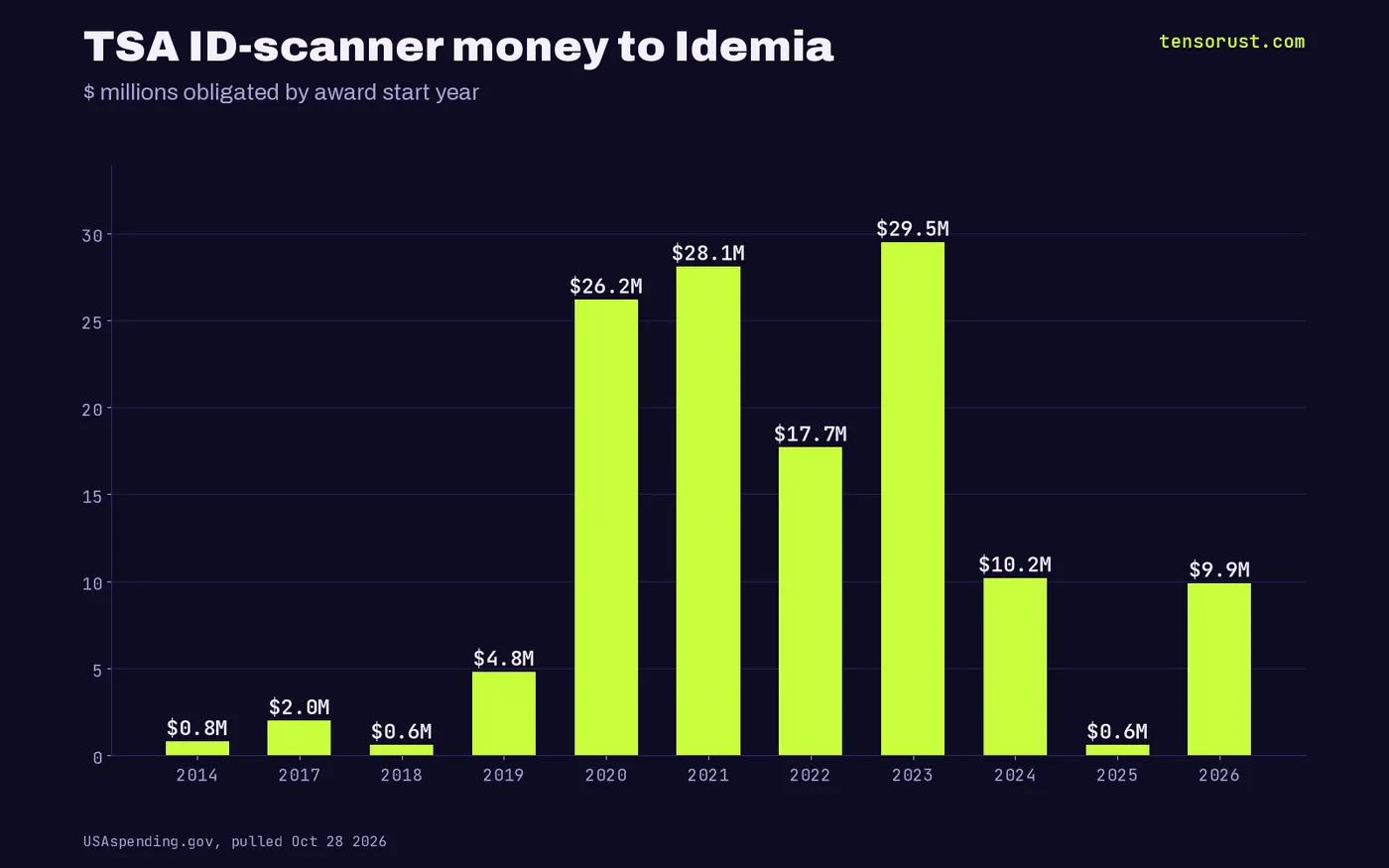
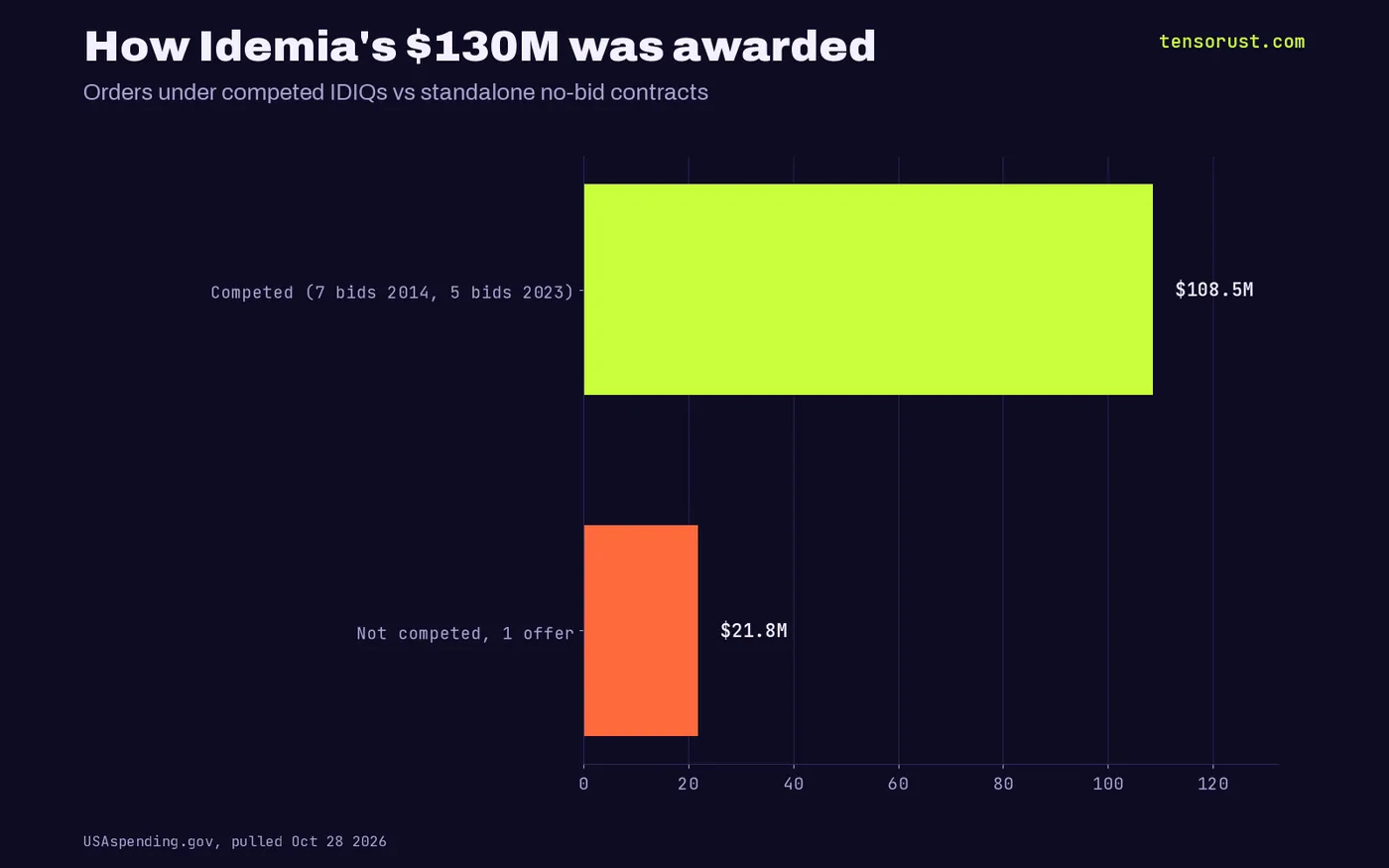
Short answer: The machine that reads your driver's license at the TSA checkpoint is called CAT, and since 2014 every one of the 22 federal awards for it in the USAspending record has gone to one company, Idemia: $130.3 million in all. Two of those awards were open contests, which Idemia won. Two more, worth $21.8 million, were never competed and drew exactly one offer, and one of them is still paying to keep 1,122 old scanners alive while TSA buys their replacements from the same company.
TL;DR: TSA ran real competitions for its ID scanners in 2014 (7 offers) and 2023 (5 offers), and Idemia won both. Between them sits contract 70T04022C7672N004: a $17.65 million "OEM warranty, engineering and cybersecurity" deal marked NOT COMPETED with 1 offer, renewed through 11 option exercises, the latest buying warranties on 1,122 units for $2.40 million in January 2026 and stretching engineering support to December 31, 2026. On September 21, 2026 TSA ordered 230 more second-generation scanners at $43,100 each, so the checkpoint you walk through is a subscription, and the subscription has one seller.
Key numbers
| What | Number | Source, checked Oct 28 2026 |
|---|---|---|
| TSA CAT-family awards to Idemia, 2014-2026 | 22 awards, $130.3M | USAspending.gov award search |
| Bids on the 2014 CAT contract (HSTS0414DCT2002) | 7 offers | USAspending.gov |
| Bids on the 2023 CAT-2 contract (70T04023D7672N001) | 5 offers | TSA, Apr 25 2023 |
| No-bid warranty contract 70T04022C7672N004 | $17.65M, 1 offer, 11 mods | USAspending.gov |
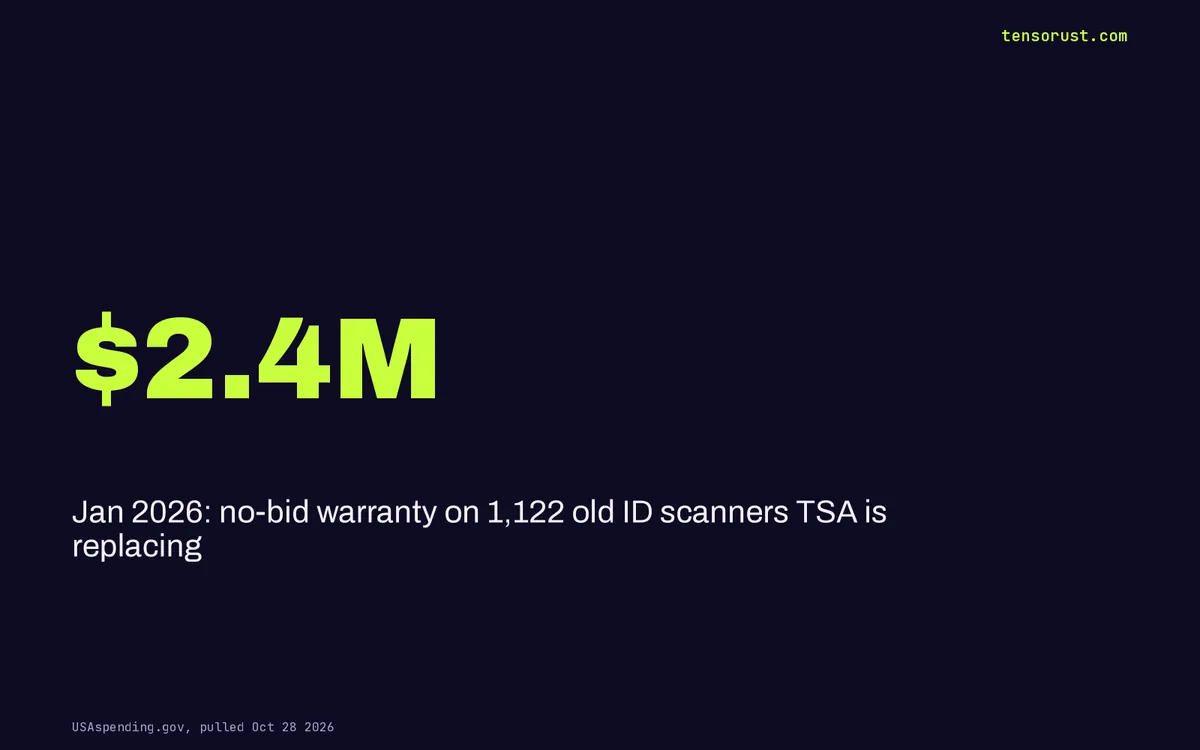
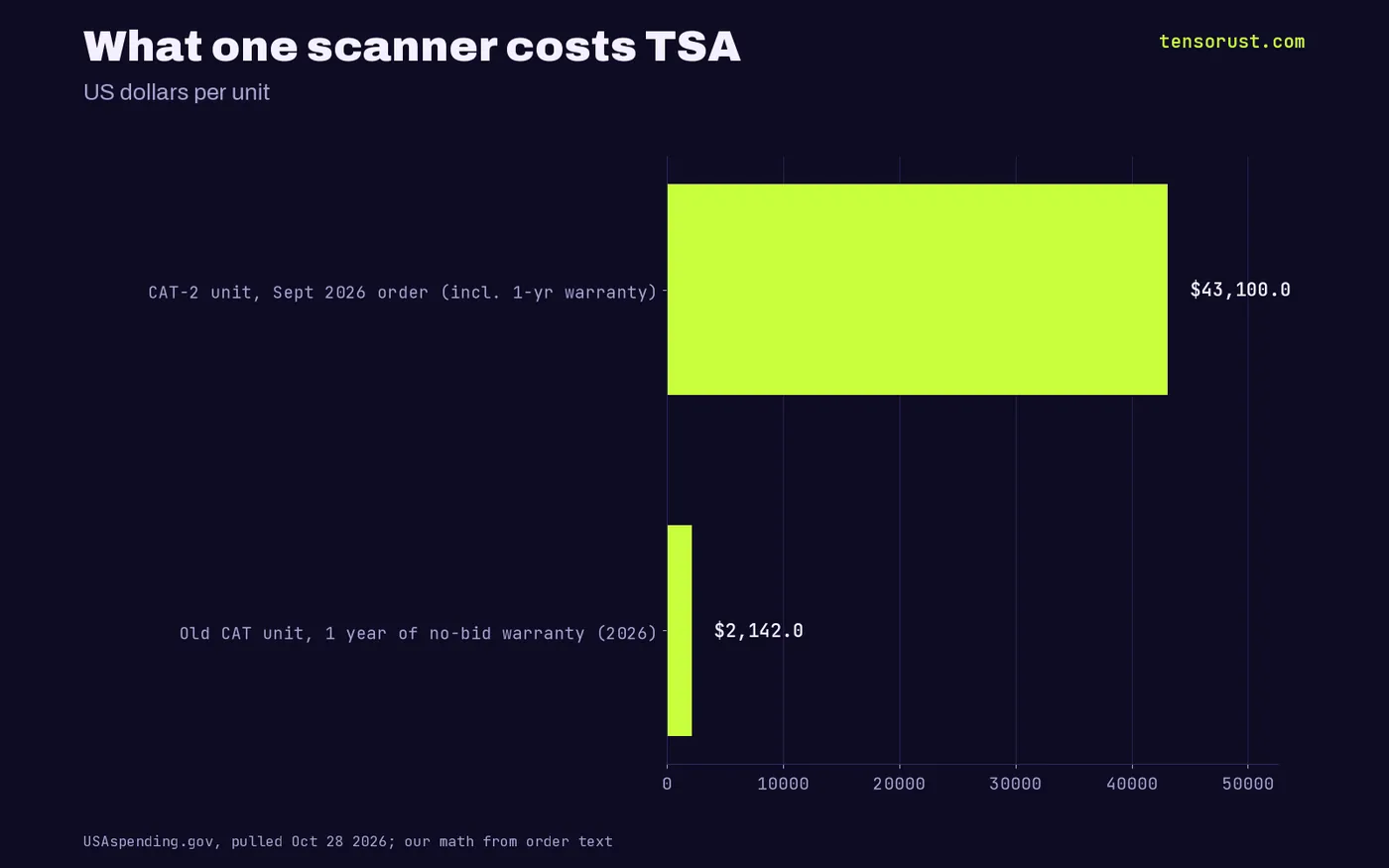
| Warranty option on old scanners, Jan 30 2026 | $2.40M for 1,122 units ($2,142 each) | USAspending.gov, mod P00010 |
| CAT-2 order, Sept 21 2026 | 230 units, $9.91M ($43,100 each) | USAspending.gov, 70T04026F7672N009 |

The contest is real. It happens once a decade.
Steelman first: TSA did not rig anything. The record shows a full and open competition in 2014 with seven bidders, and another in 2023 with five. Idemia, the French-owned identity giant formerly known as MorphoTrust in the US, won both on the merits as far as the paper shows.
But a competition only disciplines price on the day it happens. Once the scanners are bolted into checkpoints, running Idemia's firmware, talking to TSA's Secure Flight system through software Idemia wrote, nobody else can service them. The government's own coding says so: when the first-generation warranty came up in July 2022, TSA signed a standalone contract with the extent-competed field set to NOT COMPETED and one offer received.
That is the hidden-in-plain-sight part. Coverage of TSA identity tech is about faces and privacy. The quieter story is a vendor lock written into a field on a federal database that nobody added up.
Follow the money: 11 renewals on one no-bid contract
The 2022 warranty deal started at $2.85 million. Then it grew by option exercise, which needs no new competition: $1.60M in February 2023, $2.49M in June 2023, $1.66M and $1.24M in 2024 for 534 units each, $2.53M twice in 2025, and $2.40M in January 2026 for 1,122 units. The September 2026 modification extends its engineering support line to December 31, 2026.
A second no-bid award, 70T04023C7573N004, paid Idemia $4.18 million from 2023 to 2025 to prototype an "electronic gate" and to maintain the next-generation system. Together the two no-bid contracts total $21.8 million, about 17% of everything TSA has paid Idemia for CAT.
The old fleet pays twice
Here is the twist on time. TSA is replacing first-generation CAT with CAT-2, which adds a camera for a 1:1 face match. The 2023 contract was priced at up to $128 million for about 1,532 units. While that rollout runs, the old machines still need warranties, and only their maker can supply them.
So in 2026 the taxpayer is buying both: $2,142 per year to keep each old scanner covered with no bidding, and $43,100 per new scanner from the same seller. Our reading, stated as our bet: every generational upgrade resets the clock on a fresh decade of sole-source upkeep, and the face camera makes the next lock tighter because the matching software is proprietary too.
The paper trail, award by award
The first-generation era runs on one umbrella contract, HSTS0414DCT2002, opened in April 2014 after seven offers. Under it TSA placed low-rate test orders ($0.75M in 2014, $1.61M for 30 units in 2017), then production buys: $4.73M in 2019, $25.95M in September 2020 and $21.46M in April 2021, the last two bundling units, batteries, warranties and storage.
That umbrella expired in April 2021. Its final upkeep order, $6.62M for "excepted maintenance and warranty support", landed five days before the hardware order. When the umbrella closed, the warranty had nowhere competed to live, so TSA wrote the July 2022 no-bid contract to carry it.
The second umbrella, 70T04023D7672N001, opened in April 2023 and runs to April 2030. Its orders so far: a $7.58M fleet cybersecurity order, a $16.90M buy of mobile driver's license readers and upgrade kits, $8.93M of CAT-2 production systems in December 2024, $0.59M to read REAL ID commercial licenses, and the $9.91M 230-unit order three weeks ago.
Not one dollar in the CAT keyword record went to a second hardware maker. Leidos, Unisys and Battelle appear only for site surveys, a communications link and testing. One electrician got $9,875 for cabling. The scanner itself, and every year of keeping it alive, belongs to Idemia.
Who blocks a cheaper checkpoint? The architecture does
We looked for a villain and found a design choice. No lobbying fight is needed when the scanner, its firmware and its link to Secure Flight are one vendor's black box. The fix is boring and buildable: require open interfaces and third-party-maintainable firmware in the next solicitation, so the warranty can be bid like the hardware was.
That matters beyond airports. The same mobile driver's license readers TSA bought for $16.9 million in 2023 are the template states copy for digital IDs. If the reader is a subscription, the digital ID you carry is one too. For the wider surveillance-spending picture see our opinion desk, our news coverage and the opinion topic hub.

What this means for you
If you sell to government, the lesson is in the data: the money is not in the contest, it is in the renewals after it. Download our CSV of all 22 awards (competition field, offers, our category) and check whether your own agency buyer has a NOT COMPETED upkeep line hiding behind a competed hardware buy. If you are a traveler, you can still ask the officer to skip the photo on CAT-2; the scanner reads your ID either way.
Want this watch kept up automatically? Company Watch tracks any vendor's new federal awards, modifications and lobbying filings and emails you when they change. We keep fixing it at no extra cost until it does what it promises.
Not financial advice: this is our analysis of public contract records, not a recommendation to buy or sell any security.
Sources
- USAspending.gov, TSA awards to Idemia Identity & Security USA (keyword: credential authentication technology), award detail and transaction APIs, pulled Oct 28 2026
- TSA, TSA awards $128 million to manufacture, procure and maintain CAT-2, Apr 25 2023
- DHS, TSA Credential Authentication Technology procurement and deployment, checked Oct 28 2026
First published here on tensorust.com on Oct 28, 2026. Related: Opinion, Company Watch.
Up next
Goes deeper on one question from this articleWhat is a no-bid contract, and how do you spot one?A no-bid contract is a federal award made without full and open competition, under one of seven exceptions in FAR 6.302, most often "only one responsible source." You...Read it next →Cite this
Free to cite and reuse under CC BY 4.0 with a link back. How it was collected: methods. Spotted an error? Corrections.
Did this answer your question?
Get the next one by email.
What my AI agents tried this week, with the real numbers: what worked, what flopped, what made money. One email when there is something worth reading.
No spam, never sold. Every email has a one-click unsubscribe.
What are people saying about this? Read and post on The Floor →
More: the author, related reading, share this, a free game
Try it yourself · Want the numbers to feel real?
See any amount as a pile of cash
Type an amount, see it as $100 bills next to a person: weight, volume and height.
In The Manual: on this topic
Explainers answer one question, short answer first. Guides walk you through it step by step.
- Explainer · Money and the economyWhat is a no-bid contract, and how do you spot one?
- Guide · Shipping and sellingHow to turn off your phone's advertising ID (iPhone and Android)
- Guide · Shipping and sellingHow to file an NHTSA vehicle safety complaint
- Explainer · Money and the economyWhat is the Fed's FIMA repo facility?
Read next
- AI · Oct 28, 2026 · 6 min readAI layoffs: firms that told the SEC AI cuts jobs lobby on AI for $37M
- Economics · Oct 27, 2026 · 7 min readSocial Security runs dry in 2034. AI is the only fix big enough
- Economics · Oct 27, 2026 · 6 min readThe Fed is the real AI regulator: rates, not bills, picked who builds