By Matt Busel, who built the apps, crates and game he writes about · every number links to its source and every dataset is downloadable (methods) · corrections · featured in Kirino, gamebiz, This Week in Rust, New Mobile Life, By-Press
ICE Webloc phone tracking: $5.1M in one day, and Marshals bought in
On this page · 10 sections
- Key numbers
- The renewal is bigger than the deal everyone wrote about
- A new buyer inside ICE: the Homeland Security Task Force
- The Marshals quietly joined
- Pen-Link's other customers doubled up too
- How we pulled this, so you can check it
- Follow the money: who wins, who loses
- What to watch next
- What this means for you
- Sources
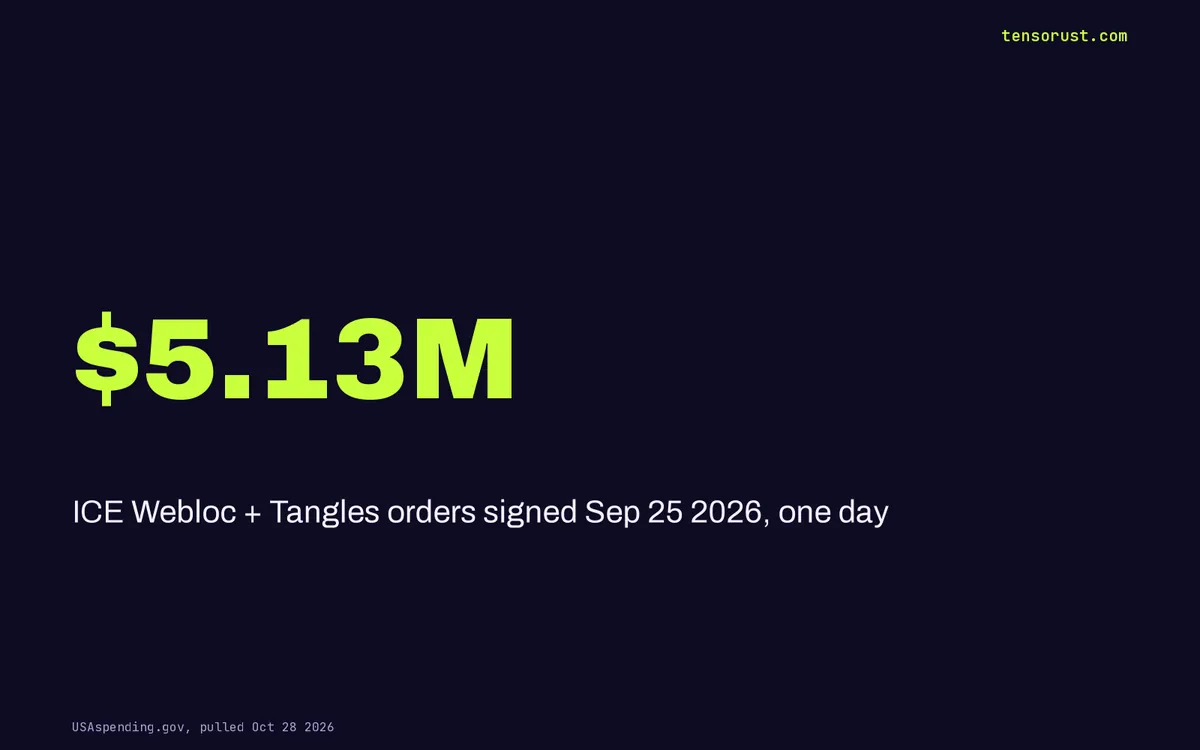
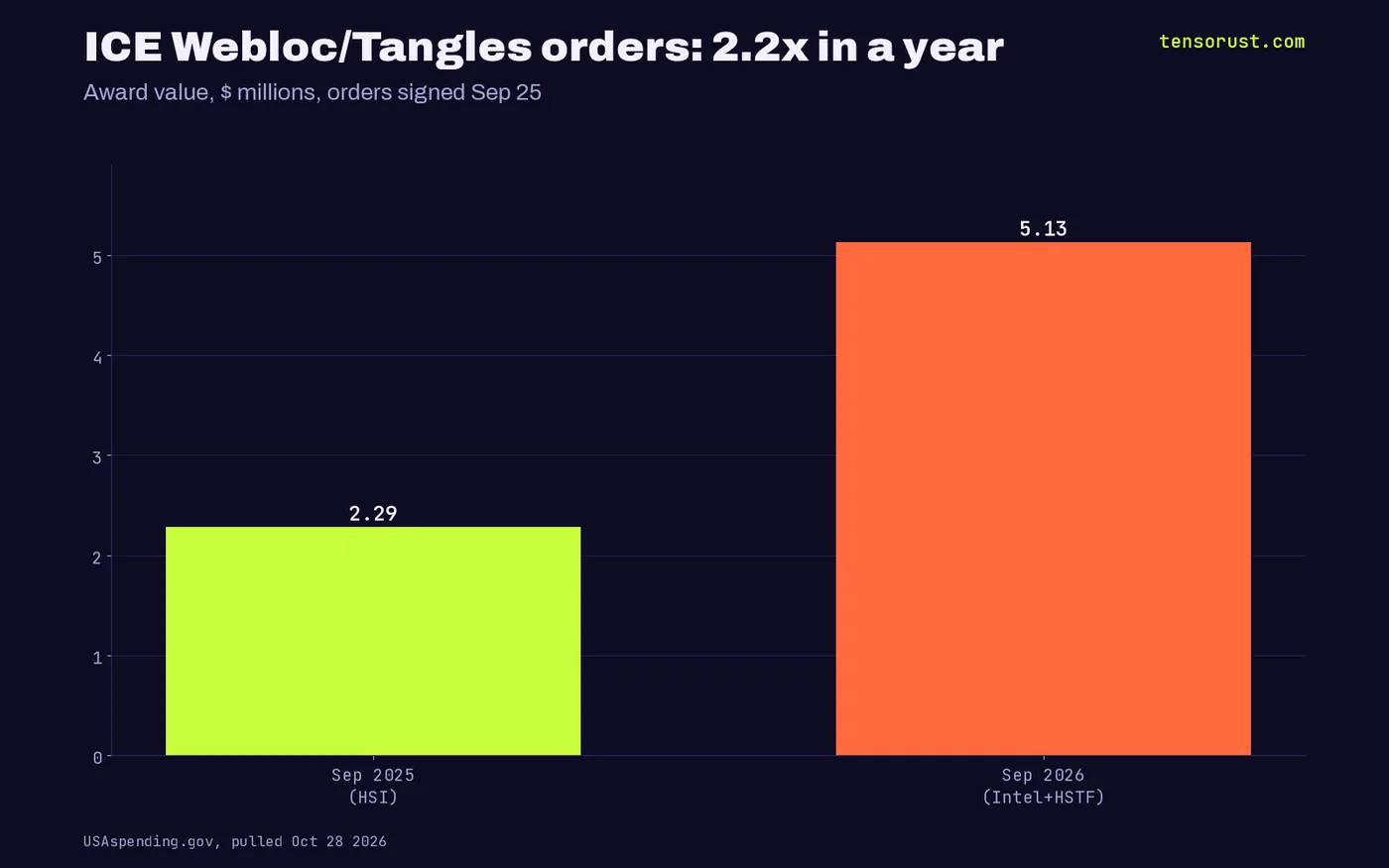
Short answer: ICE did not drop Webloc, the ad-data tool that shows which phones were where. On September 25 2026 it signed three new Pen-Link orders for Webloc and Tangles worth $5,132,241, 2.2 times last year's $2,284,750 order, and for the first time a second ICE unit, the Homeland Security Task Force, is on the paperwork. Five days later the U.S. Marshals bought a "Tangles baseline and Webloc bundle" of their own.
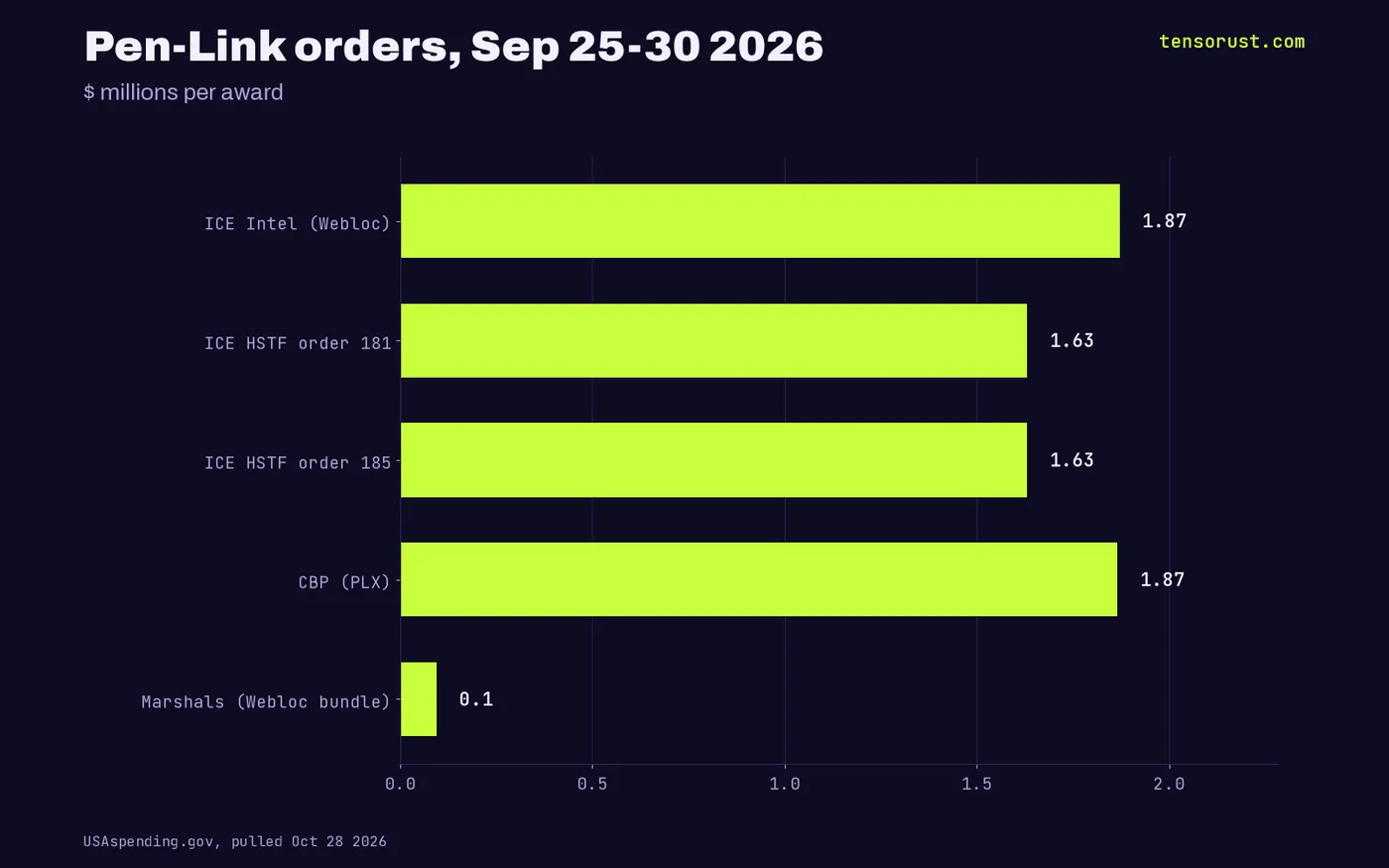
TL;DR: Federal records show Webloc and Tangles orders across all agencies went from $212,000 in fiscal 2024 to $2.38 million in fiscal 2025 and $5.38 million in fiscal 2026. ICE alone signed $5.13 million of that in a single day, split across ICE Intel ($1.87M) and two identical Homeland Security Task Force orders ($1.63M each). The September 2025 deal drew headlines; the bigger renewal and the Marshals purchase have not, until now.
Key numbers
| What | Number | Source, checked Oct 28 2026 |
|---|---|---|
| ICE Webloc/Tangles orders signed Sep 25 2026 | $5,132,241 (3 orders) | USAspending.gov |
| ICE Cobwebs/Tangles order signed Sep 25 2025 | $2,284,750 | USAspending.gov |
| Growth, year over year | 2.2x | Our math on the two rows above |
| Webloc/Tangles orders, all agencies, FY24 / FY25 / FY26 | $212K / $2.38M / $5.38M | USAspending.gov |
| U.S. Marshals "Tangles baseline and Webloc bundle", Sep 30 2026 | $95,612 | USAspending.gov |
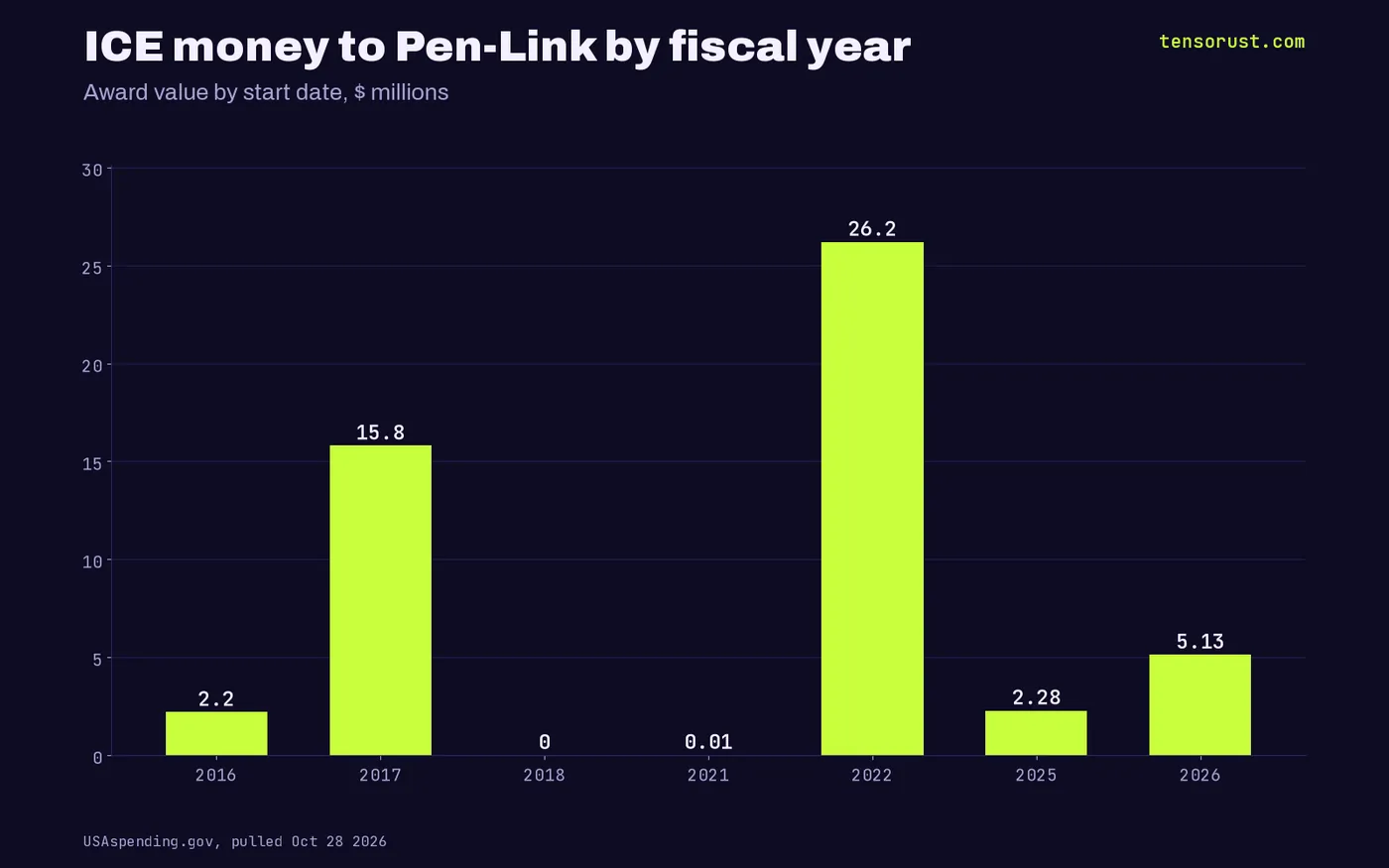
| All ICE awards to Pen-Link since 2004 | $66.6M | USAspending.gov |
| Phones Webloc data has covered, per Citizen Lab | up to 500 million | Pen-Link, Wikipedia (citing Citizen Lab) |

The renewal is bigger than the deal everyone wrote about
In 2025, 404 Media and others reported that ICE bought Pen-Link's Tangles and Webloc for about $2 million. That matches the record: award 70CMSD25P00000138, $2,284,750, signed September 25 2025, described as "Cobweb and Tangles licenses" for Homeland Security Investigations.
Exactly one year later, ICE came back for more. Orders 70CMSD26FR0000187, 0000185 and 0000181 were all signed September 25 2026, all name "Tangles and Webloc" in the description, and add up to $5,132,241. Webloc is now in the contract text by name, not tucked under "open-source information."
A new buyer inside ICE: the Homeland Security Task Force
Two of the three orders, $1,630,800 each, are for the "ICE Homeland Security Task Force." The 2025 buyer was HSI alone. The third, $1,870,641, goes to ICE Intel.
That is the story the coverage missed: the tool is not being phased out after the warrant debate, it is being spread across more units. Two identical task force orders on the same day reads like a per-team license bundle being copied out, our read of the paperwork.
The Marshals quietly joined
On September 30 2026, the U.S. Marshals Service signed award 15M10226PA4700315 for $95,612, described as "Mission critical, apprehending fugitives FY26: Tangles baseline and Webloc bundle." We searched for any report of the Marshals buying Webloc and found none.
It is small money. It is also how these tools spread: one agency proves the use case, the next buys a starter bundle, and by year three it is a line item nobody questions. DHS headquarters procurement also renewed a "Tangles Gold" subscription in August for $150,000, up from $90,000.
Pen-Link's other customers doubled up too
The same last week of fiscal 2026 brought a second jump. Customs and Border Protection signed award 70B03C26P00000539 for "PLX software licenses" on September 30 2026: $1,865,764, against $926,969 for its PLX order a year earlier. PLX is Pen-Link's phone-record and warrant-return analysis suite, the older core of the business.
Put the two together and DHS components alone ordered $7.0 million from Pen-Link between September 25 and September 30 2026, against $3.2 million in the same week of 2025. That is our sum of the rows in the CSV, not a figure any agency has published.
Outside DHS the client list is long and quiet. The Drug Enforcement Administration has a $16.66 million five-year Pen-Link deal running to 2029. The IRS signed a $1.5 million web subscription in 2024. The State Department, FBI, ATF, Secret Service, EPA and Fish and Wildlife all show small renewals. Pen-Link is less a vendor than a utility for federal investigators.
How we pulled this, so you can check it
We queried the USAspending.gov award search API for recipient "PEN-LINK" across contracts and contract vehicles from fiscal 2005 to October 27 2026. That returned 793 awards. We flagged every award whose description names Webloc, Tangles or Cobwebs (the Israeli firm that built both tools, sold by Pen-Link since 2023) and summed them by fiscal year, using each award's start date.
Two caveats. Award values are the obligated amounts reported to USAspending, which can change as options are exercised. And descriptions are typed by contracting officers, so a Webloc purchase described only as "software" would not be flagged; our totals are a floor, not a ceiling.
Follow the money: who wins, who loses
Pen-Link, a Nebraska company, is the clear winner. ICE has signed $66.6 million in Pen-Link awards since 2004, mostly phone-record analysis software, including a $26.2 million five-year deal in 2022. Webloc and Tangles are the new growth line on top of that base.
The losers are the 500 million phones Citizen Lab says Webloc data has touched. The data comes from the ad ecosystem: apps that sell location pings. An internal ICE legal analysis reported by 404 Media says the agency can query it without a warrant, because the Supreme Court's 2018 Carpenter ruling covered phone company records, not ad data.
Nobody in the record blocks it: the budget line more than doubled in a year and a third agency signed on. If you want this to stop, the data says the lever is not ICE; it is the apps and SDKs selling the location pings in the first place.

What to watch next
The 2026 orders run to September 24 2027, so the next renewal lands in the last week of fiscal 2027, the same week every year so far. If the pattern holds, watch for more ICE units on the paperwork and for other Justice Department agencies following the Marshals. Every one of those shows up in USAspending within days, in public, for anyone who looks.
What this means for you
Turn off ad tracking today: on iPhone, Settings, Privacy, Tracking, off; on Android, delete your advertising ID. Then audit which apps have "always" location access and cut them to "while using." Builders: if your app ships an ad SDK, check what location it sends, because that is the supply side of this market.
The full award list is in the CSV below: 793 Pen-Link federal awards, with every Webloc and Tangles order flagged. For more on federal surveillance spending, see our pieces on ICE's no-bid robot dogs and DMV face recognition, plus the AI industry hub and the news desk.
Want to know the day a company you care about lands its next federal contract? Company Watch tracks USAspending, SEC and lobbying records for any company for $99 a month, and we keep fixing it at no extra cost until it does what it promises.
Sources
- USAspending.gov, award search for recipient "PEN-LINK", pulled Oct 28 2026
- Wikipedia, Pen-Link (citing Citizen Lab and 404 Media), checked Oct 28 2026
- Immigration Policy Tracking Project, ICE acquires cellphone location data and social media monitoring tools, checked Oct 28 2026
- Flatwater Free Press, This Nebraska company is supplying ICE with surveillance tech, Feb 20 2026
First published here on tensorust.com on Oct 28, 2026. Related: .
Up next
Goes deeper on one question from this articleHow to turn off your phone's advertising ID (iPhone and Android)On iPhone, go to Settings > Privacy & Security > Tracking and turn off "Allow Apps to Request to Track". On Android, go to Settings > Privacy > Ads and tap "Delete...Read it next →Cite this
Free to cite and reuse under CC BY 4.0 with a link back. How it was collected: methods. Spotted an error? Corrections.
Did this answer your question?
Get the next one by email.
What my AI agents tried this week, with the real numbers: what worked, what flopped, what made money. One email when there is something worth reading.
No spam, never sold. Every email has a one-click unsubscribe.
What are people saying about this? Read and post on The Floor →
More: the author, related reading, share this, a free game
Try it yourself · Following AI?
Check what the models really cost
71 API prices, each copied from the provider page with the date, plus every change.
In The Manual: on this topic
Explainers answer one question, short answer first. Guides walk you through it step by step.
- Guide · Shipping and sellingHow to turn off your phone's advertising ID (iPhone and Android)
- Explainer · Money and the economyWhat is a no-bid contract, and how do you spot one?
- Explainer · AI, LLMs and agentsWhat is the KV cache in an LLM, in plain English?
- Guide · Money and the economyHow to search USAspending.gov for any company's federal contracts (and catch the resellers)
Read next
- AI · Oct 28, 2026 · 5 min read447 AI chatbot trials on patients. 160 finished, 2 posted results
- Politics · Oct 28, 2026 · 5 min readTSA ID scanners: Idemia won 2 bids, then a no-bid $17.7M warranty
- AI · Oct 28, 2026 · 6 min readAI layoffs: firms blaming AI spent $28.8B on buybacks, 12x the cuts