
By Matt Busel, who built the apps, crates and game he writes about · every number links to its source and every dataset is downloadable (methods) · corrections · featured in Kirino, gamebiz, This Week in Rust, New Mobile Life, By-Press
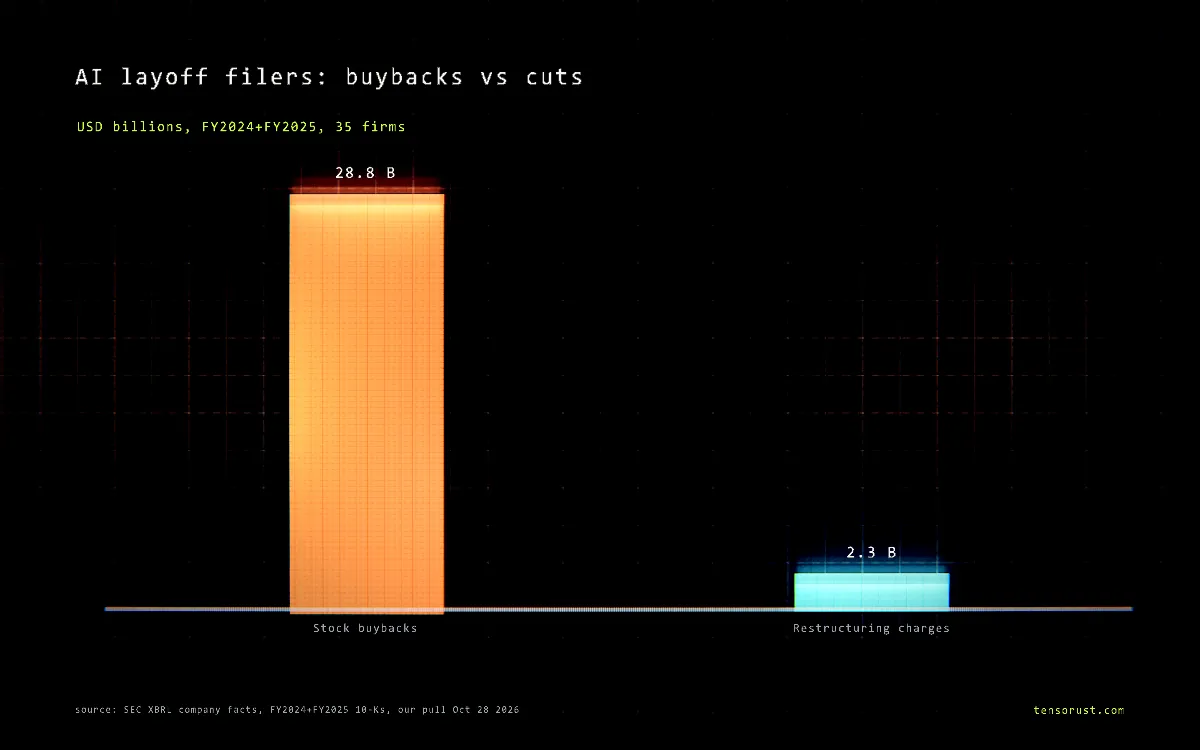
AI layoffs: firms blaming AI spent $28.8B on buybacks, 12x the cuts
On this page · 10 sections
- Key numbers
- The AI layoff is a story told to two audiences
- Follow the money: 12 dollars to the buyback for every dollar of cuts
- Losing money and buying stock anyway
- The steelman, and why it fails
- Company by company: the receipt
- Why "AI" is the word of choice
- What our numbers do not show
- What this means for you
- Sources
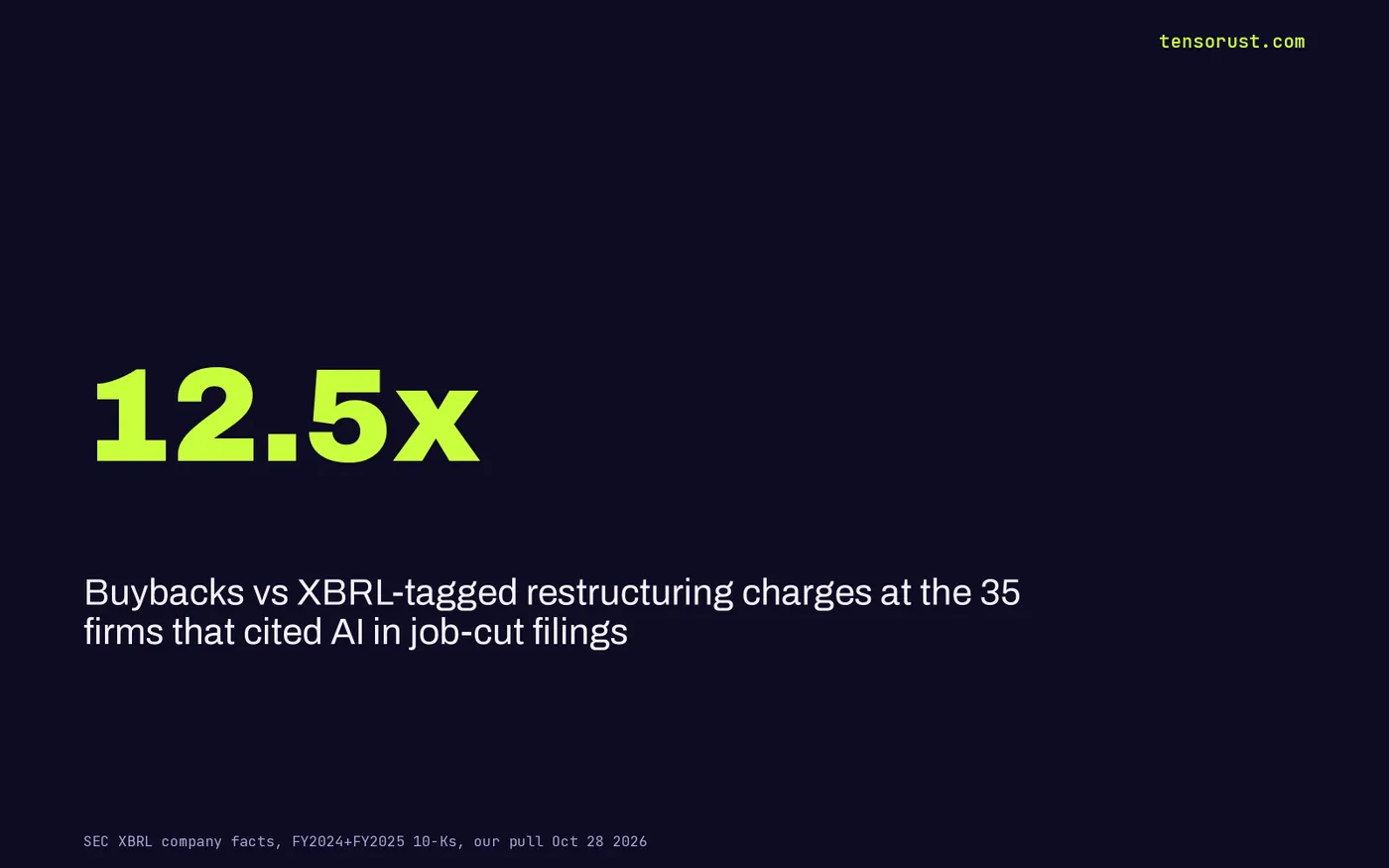
Short answer: The 35 public companies that told the SEC AI was behind their job cuts spent $28.8 billion buying back their own stock over their last two fiscal years, against $2.3 billion in restructuring charges they tagged in the same filings. That is 12.5 dollars to shareholders for every dollar spent on the cuts. "AI replaced them" is the press release. The cash flow statement says something else.
TL;DR: We took the 35 AI-layoff filers from our earlier SEC full-text pull and joined each one to its XBRL cash flow data: 18 of them repurchased stock, and every one of those 18 spent more on buybacks than on tagged restructuring. Accenture alone bought back $9.1 billion, Block $3.5 billion (33x its restructuring), FICO $2.2 billion (205x). Atlassian and Snap both lost money in fiscal 2025 and still bought back $779 million and $751 million of stock.
Key numbers
| What | Number | Source, checked Oct 28 2026 |
|---|---|---|
| Buybacks, 35 AI-layoff filers, FY2024+FY2025 | $28.82B | SEC XBRL company facts |
| Tagged restructuring charges, same firms and years | $2.30B | SEC XBRL company facts |
| Ratio, buybacks to restructuring | 12.5x | Our math, data.csv |
| Filers that bought back stock | 18 of 35 | SEC XBRL, our pull |
| Accenture buybacks, FY2024+FY2025 | $9.14B | Accenture XBRL |
| Snap FY2025: buyback vs net loss | $751M vs -$460M | Snap XBRL |

The AI layoff is a story told to two audiences
To workers and reporters, the line is "AI made these roles redundant." It sounds like progress you cannot argue with.
To shareholders, the same company sends a different signal through the cash flow statement: the money did not go into AI, and it did not go into severance. It went back to the stock.
We are not guessing at intent. The 35 firms in this set are the ones whose own 8-K, 10-K or press exhibit tied a workforce reduction to AI, found by EDGAR full-text search for our AI-layoff lobbying piece. Here we pulled what each of them reported under PaymentsForRepurchaseOfCommonStock and the restructuring tags in their annual reports.
Follow the money: 12 dollars to the buyback for every dollar of cuts
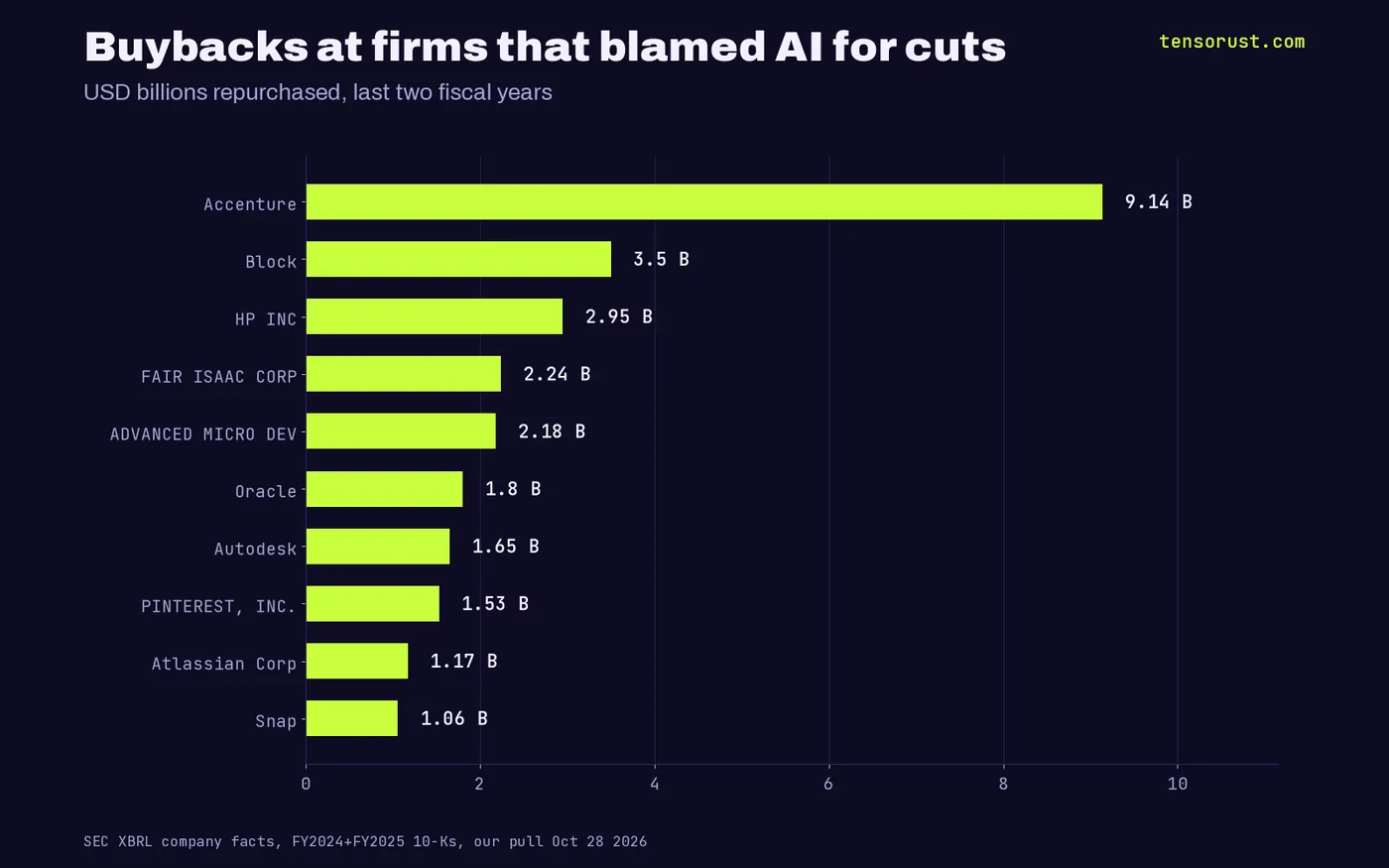
Across the 35 filers, buybacks in the last two fiscal years total $28.82 billion. The restructuring charges those same firms tagged total $2.30 billion.
The gap is not driven by one outlier. Block spent $3.50 billion on buybacks against $105 million of restructuring. HP spent $2.95 billion against $560 million. AMD $2.18 billion against $186 million. Oracle $1.80 billion against $703 million, the closest ratio in the set at 2.6x.
Autodesk ($1.65 billion), Pinterest ($1.53 billion), Atlassian ($1.18 billion), Coinbase ($790 million) and OpenText ($563 million) bought back stock and tagged no restructuring line in XBRL at all in our pull.

Losing money and buying stock anyway
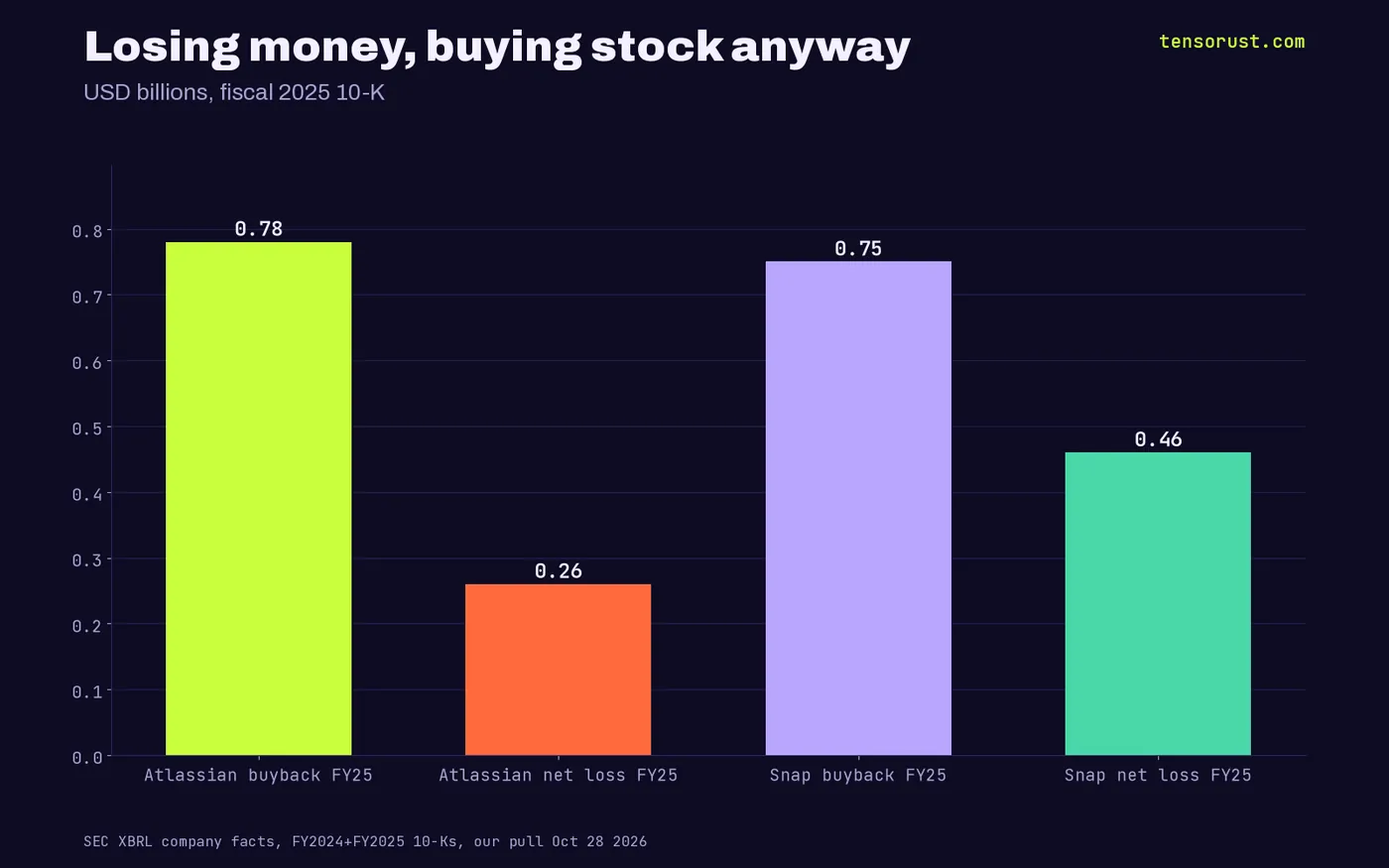
Two filers make the point sharper than any ratio. Atlassian reported a fiscal 2025 net loss of $257 million and bought back $779 million of stock. Snap lost $460 million and bought back $751 million.
A company that loses money and repurchases shares is not funding an AI transformation with the savings. It is using the payroll line to offset the dilution from stock pay and to hold the share price up. AI is the frame that makes the cut sound inevitable instead of chosen.
The steelman, and why it fails
The best defense: buybacks and layoffs are separate decisions. Mature firms return excess cash, and restructuring charges understate the long-run savings from a smaller headcount.
Both true, and both beside the point. If the cash was excess, the layoff was not a survival move. And if the savings are large, the filings show where they landed: 18 of 18 buyers sent more to repurchases than to the cuts. Nobody forced a single one of these firms to name AI. They chose the word because it moves the stock and ends the conversation.
Company by company: the receipt
Here are the 14 biggest repurchasers in the set (four more, Cass, Jamf, Vertex and LiveOne, bought back under $35M each), ranked by two-year repurchases. Restructuring is what each company tagged in XBRL; a dash means no tagged line in our pull.
| Company | Buybacks FY24+FY25 | Tagged restructuring | Ratio |
|---|---|---|---|
| Accenture | $9.14B | $438M | 20.9x |
| Block | $3.50B | $105M | 33.2x |
| HP | $2.95B | $560M | 5.3x |
| Fair Isaac (FICO) | $2.24B | $11M | 204.7x |
| AMD | $2.18B | $186M | 11.7x |
| Oracle | $1.80B | $703M | 2.6x |
| Autodesk | $1.65B | - | - |
| $1.53B | - | - | |
| Atlassian | $1.18B | - | - |
| Snap | $1.06B | $70M | 15.1x |
| Coinbase | $790M | - | - |
| OpenText | $563M | - | - |
| TripAdvisor | $115M | $64M | 1.8x |
| Five9 | $50M | $10M | 5.2x |
The other 17 filers did not buy back stock in the period. Most of them are small or losing money (FiscalNote, Latch, Nerdy, Netskope, Cyngn), and for them the AI line in a layoff filing reads more like a pitch to investors that the company still has a future. That is a different story, and a more honest one: a firm with no cash to hand back is at least spending the savings on staying alive.
Why "AI" is the word of choice
A layoff blamed on weak demand tells investors the business is shrinking. A layoff blamed on AI tells them margins are about to expand. Same pink slips, opposite signal, and the second one comes with a free narrative about the future.
Our bet: as long as "AI efficiency" reads as a growth story on an earnings call, more boards will reach for it, whether or not a single model replaced a single job. The tell is always the same line in the cash flow statement, and anyone can read it.
That is also the opening for builders. If the giants are using AI as a word instead of a tool, the people who actually use it to do the work of ten can take their customers.

What our numbers do not show
XBRL restructuring tags are uneven. Some firms book severance inside other lines, so a blank is "not tagged," not zero; Accenture's fiscal 2025 restructuring, for one, did not appear under the tags we pulled. That means the true ratio is likely below 12.5x. Fiscal years also differ by company (Oracle ends in May, HP in October). Every row, tag and gap is in the CSV so anyone can redo the join. Not financial advice.
What this means for you
If your employer says AI took your role, open its last 10-K and find "Payments for repurchase of common stock" in the cash flow statement. That one line tells you whether the savings went into AI or into the stock, and it is your best number in any severance talk. Builders: the same join works for any company, in a few lines against the free SEC API. Browse more of these reads in Opinion and AI industry, and see the American Express case, the same pattern at one firm.
Want this watched for the companies you care about? Company Watch tracks filings, contracts and lobbying for any firm and flags the next buyback or AI-blamed cut as it is filed. We keep fixing it at no extra cost until it does what it promises.
Sources
- SEC EDGAR, XBRL company facts API (PaymentsForRepurchaseOfCommonStock, RestructuringCharges and related tags, NetIncomeLoss), pulled Oct 28 2026
- SEC EDGAR full-text search, the 35-filer AI-layoff list, Oct 2026
- Accenture XBRL company facts, Oct 28 2026
- Block XBRL company facts, Oct 28 2026
- Snap XBRL company facts, Oct 28 2026
- Tensorust, AI layoffs: firms that told the SEC AI cuts jobs lobby on AI for $37M, Oct 28 2026
First published here on tensorust.com on Oct 28, 2026. Related: Opinion, AI layoffs lobbying data.
Up next
More on OpinionZipline now has more FAA aircraft than United: 3,077 to 1,219Zipline now owns 3,077 FAA-registered aircraft, more than United (1,219). It got 2,147 this year while the drone rule sat 446 days as a proposal.Read it next →Cite this
Free to cite and reuse under CC BY 4.0 with a link back. How it was collected: methods. Spotted an error? Corrections.
Did this answer your question?
Get the next one by email.
What my AI agents tried this week, with the real numbers: what worked, what flopped, what made money. One email when there is something worth reading.
No spam, never sold. Every email has a one-click unsubscribe.
What are people saying about this? Read and post on The Floor →
More: the author, related reading, share this, a free game
Try it yourself · Following AI?
Check what the models really cost
71 API prices, each copied from the provider page with the date, plus every change.
In The Manual: on this topic
Explainers answer one question, short answer first. Guides walk you through it step by step.
- Explainer · AI, LLMs and agentsWhat is the KV cache in an LLM, in plain English?
- Guide · Money and the economyHow to search USAspending.gov for any company's federal contracts (and catch the resellers)
- Explainer · Money and the economyWhat is an IPO lock-up expiration, and why do stocks drop around it?
- Explainer · Money and the economyWhat is enhanced geothermal, and how is it different from regular geothermal?
Read next
- AI · Oct 28, 2026 · 6 min readAI layoffs: firms that told the SEC AI cuts jobs lobby on AI for $37M
- AI · Oct 27, 2026 · 6 min readZipline now has more FAA aircraft than United: 3,077 to 1,219
- Economics · Oct 27, 2026 · 7 min readSocial Security runs dry in 2034. AI is the only fix big enough

.jpg)