
The anti-AI movement is a psyop. Follow the $549M money trail
On this page · 12 sections
- Key numbers
- What we mean by psyop
- One checkbook, every chair at the table
- Where $549 million went
- The pause letter, and the lab founded 13 days earlier
- Baptists, bootleggers and the license nobody small can buy
- The bill where the referee owned the test kit
- Sue in public, sign in private
- The strongest case against us, and why it fails
- Who gains when you're scared
- What this means for you
- Sources
Short answer: The organized anti-AI movement, the pause letters, the extinction statements, the safety institutes and the push for licenses, works like an influence operation, and the receipts show who pays for it. A handful of checkbooks fund the researchers, the Senate fellows, the open letters and the lobbyists at the same time. One crypto gift turned a $482,479-a-year nonprofit into a $549.5 million war chest in twelve months. The labs that warned you about extinction are now the biggest AI lobbyists in Washington. And the cure they all sell is the same one: licenses, compute caps and gatekeepers, which happen to be the one thing a small builder can't afford.
TL;DR: We pulled every federal lobbying filing that mentions artificial intelligence: 881 in 2022, 4,501 in 2025, up 5.1x in three years. Anthropic, the lab built on AI-risk warnings, went from $280,000 of federal lobbying in 2023 to $8.11 million in the first nine months of 2026, 29x, more than OpenAI ($4.62 million) and more than every "AI safety" advocacy group we checked combined. The Future of Life Institute, which wrote the 2023 "pause" letter, booked $549.5 million of revenue in 2021 from Vitalik Buterin's Shiba Inu tokens, gave away $372.7 million in 2022 to recipients its statement doesn't name, and in 2025 spent $46.2 million while taking in about $37,000 in donations. One billionaire's foundation put $97 million into the Georgetown think tank that staffs AI policy, $15.5 million into RAND, $11.1 million into the Center for AI Safety, paid for fellows in Senate offices, and gave OpenAI $30 million. Same money, every side of the table.
Key numbers
| What | Number | Source, checked Oct 24 2026 |
|---|---|---|
| Federal lobbying filings mentioning "artificial intelligence" | 881 (2022) to 4,501 (2025), 5.1x | Our pull, LDA database API |
| Anthropic federal lobbying | $0.28M (2023) to $8.11M (2026, Q1 to Q3) | Our pull, LDA filings |
| OpenAI federal lobbying | $0.38M (2023) to $4.62M (2026, Q1 to Q3) | Our pull, LDA filings |
| Future of Life Institute revenue | $0.48M (2020) to $549.5M (2021) | FLI Form 990s via ProPublica |
| FLI grants out in 2022 / market loss in 2022 | $372.7M / $150.8M | FLI financial statement, Bundestag lobby register |
| FLI 2025 spending vs donations received | $46.2M vs about $37,000 | FLI finances page |
| Open Philanthropy to Georgetown CSET | $55M (pre-2019) + $42M (2021) | Politico, Oct 13 2023 |
| Open Philanthropy to the Center for AI Safety | $11.05M in three grants, 2022 to 2023 | Open Phil grant pages |
| Americans "more concerned than excited" about AI | 37% (2021) to 50% (2025) | Pew Research Center |
Download the data (CSV, 60 rows: every lobbying count and spend figure we pulled, every grant, gift, stake and license deal in this piece, each with its source link), so you can check our map or extend it.

What we mean by psyop
Not a secret room. Nobody has produced a memo where five billionaires agree to scare you, and we're not claiming one exists. A psyop in the plain sense is an operation built to shape what a population feels and therefore what it accepts. You don't need a war room for that. You need the same few funders paying for the research that defines the threat, the staffers who write the bill, the open letter that makes the news, the poll that measures the fear and the lobbyists who turn it into law.
That's what the records show. Fear of AI is up: Pew found 50% of Americans more concerned than excited in June 2025, up from 37% in 2021. Lobbying on AI is up faster. And the people warning loudest keep ending up as the people who own the fix.
Our bet: the anti-AI wave isn't a grassroots revolt that lobbyists then joined. It was financed from the top, early, by people with a stake in which AI wins, and it's aimed at one outcome. A world where building powerful models needs permission, and permission costs millions.
One checkbook, every chair at the table
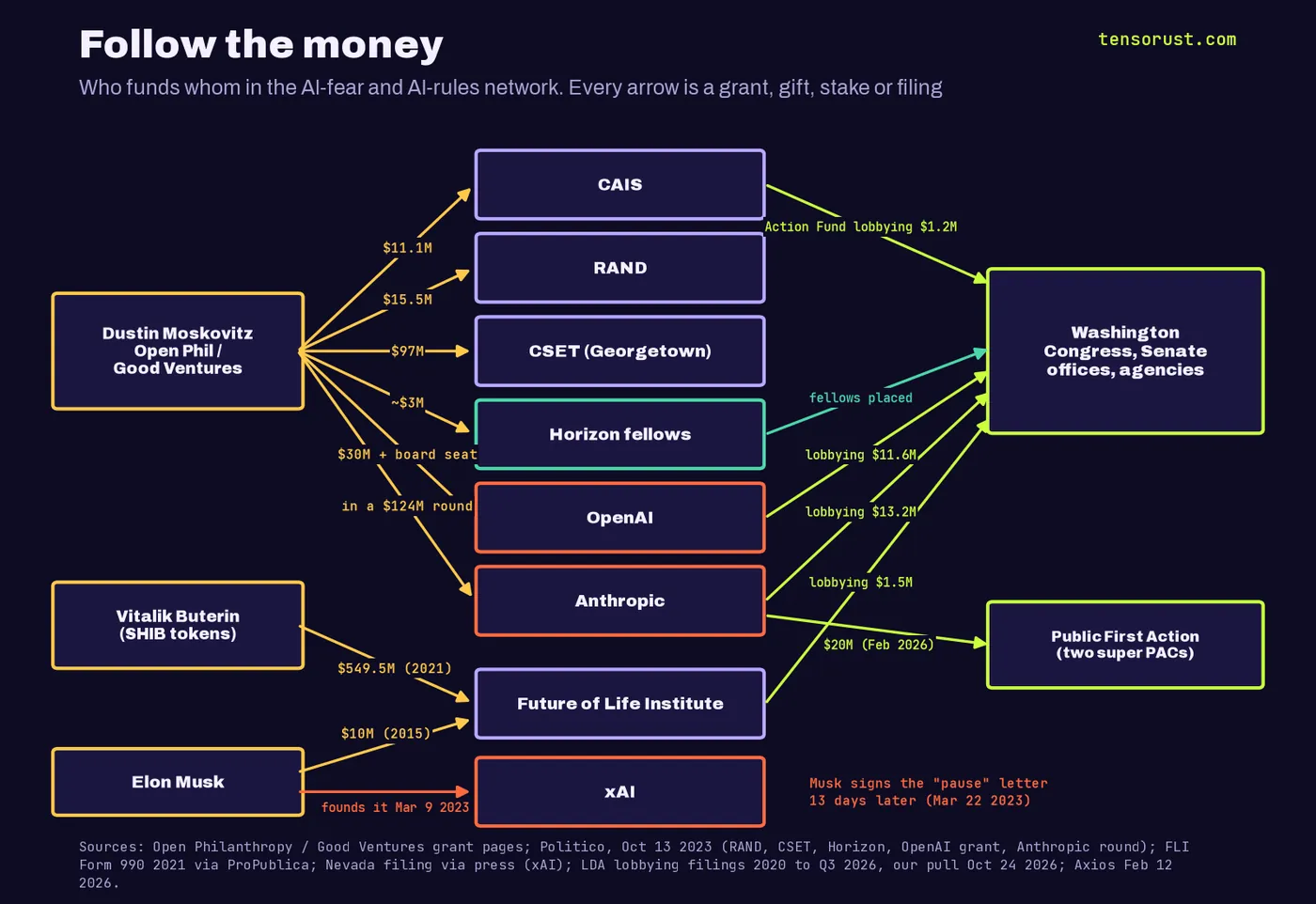
Start with Dustin Moskovitz, the Facebook co-founder, and the foundation he funds, Open Philanthropy (renamed Coefficient Giving in November 2025). Politico's Brendan Bordelon mapped it in October 2023 in "How a billionaire-backed network of AI advisers took over Washington". The numbers are worth reading slowly:
- $97 million to Georgetown's Center for Security and Emerging Technology: $55 million before it launched in 2019 and $42 million in 2021. Politico says CSET is funded almost entirely by Open Philanthropy.
- $15.5 million to RAND in 2023 ($5.5 million for research on risks from advanced AI, $10 million for biosecurity), to be spent at the discretion of CEO Jason Matheny.
- Nearly $3 million in 2022 for the first Horizon Institute fellows, who were placed in the Senate offices of Martin Heinrich, Mike Rounds, Todd Young and Richard Blumenthal, on the House Science and Senate Commerce committees, and at the Pentagon, Homeland Security and State.
- $11.05 million to the Center for AI Safety in three grants from November 2022 to October 2023. CAIS wrote the May 2023 one-line statement that "mitigating the risk of extinction from AI should be a global priority alongside other societal-scale risks such as pandemics and nuclear war."
- $30 million to OpenAI in 2017, after which Open Phil's Holden Karnofsky took an OpenAI board seat.
Now the other side of the ledger. Moskovitz took part in a $124 million Anthropic round in 2021. Open Phil's Luke Muehlhauser sat on Anthropic's board when Politico reported it. Karnofsky is married to Anthropic president Daniela Amodei, and in January 2025 he joined Anthropic to work on its Responsible Scaling Policy. Matheny, who runs RAND and once ran CSET, joined Anthropic's Long-Term Benefit Trust in September 2023. RAND told Politico he is a "financially disinterested trustee."
Take him at his word. It doesn't matter. Look at the shape: the same network funds the think tank that briefs Congress, the fellows who sit in Congress, the group that writes the extinction statement, and a lab that sells "the safe one" as its product. Every one of those people can be sincere and the system still produces one message from five directions, each sounding independent.
Where $549 million went
The Future of Life Institute is the group behind the March 2023 "Pause Giant AI Experiments" letter, which asked every lab to stop training anything stronger than GPT-4 for six months. Its own filings tell a strange story.
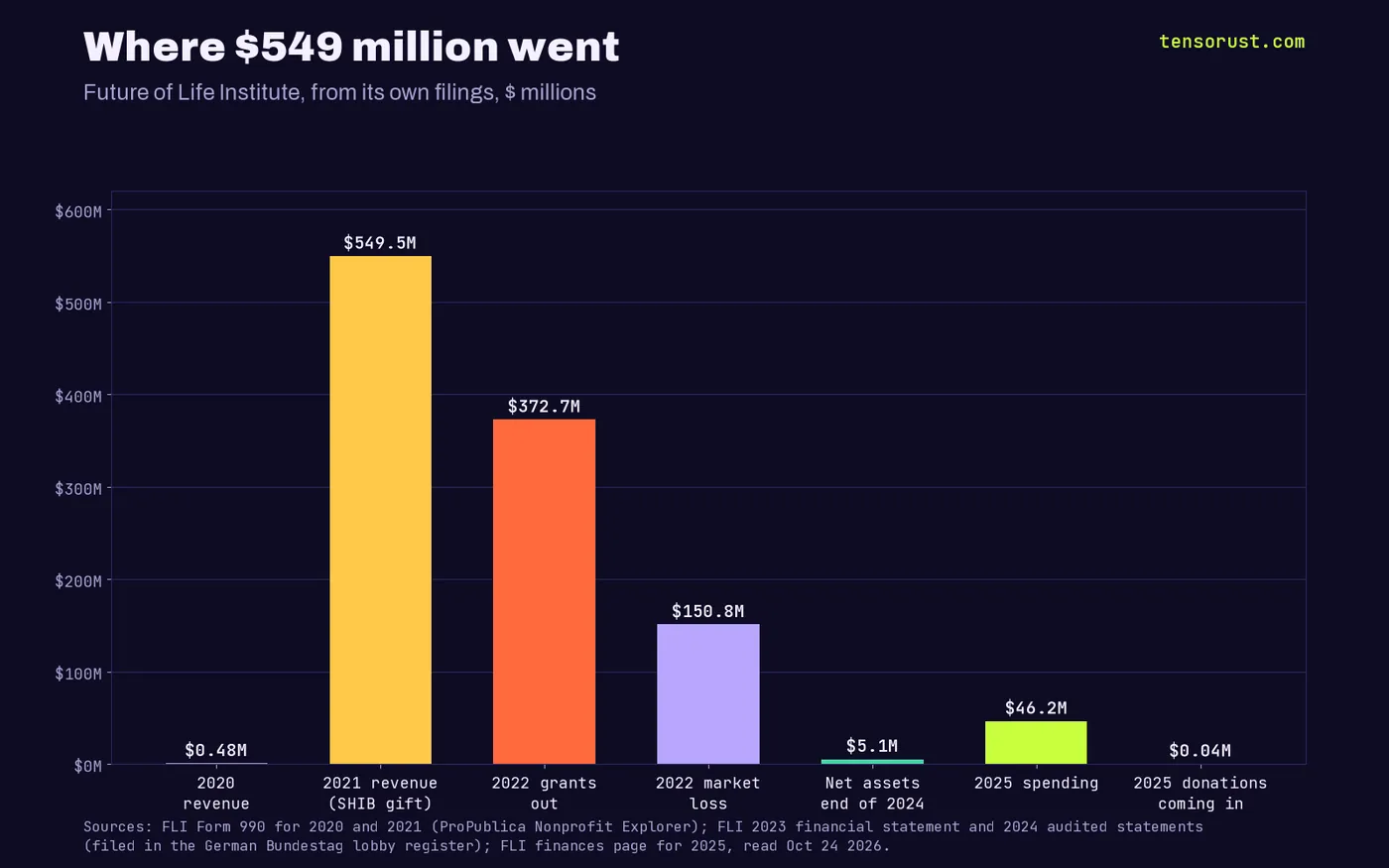
In 2020, FLI's Form 990 shows revenue of $482,479. In 2021, $549,531,672. That's the Shiba Inu tokens Vitalik Buterin handed it in 2021. Buterin later said he expected FLI "would cash out at most $10-25M" because the SHIB market wasn't deep enough. It got roughly $500 million out, by his account in The Block.
Then the money moves. FLI's 2023 financial statement, which it filed in the German parliament's lobby register, shows $372.7 million of "grants to charitable organizations" in 2022 and a $150.8 million investment loss. The statement doesn't name who got the $372.7 million. By the end of 2024 FLI's audited net assets were $5.09 million. Yet in 2025, per its own finances page, it spent $46.2 million, including $5.8 million on media and outreach, against about $37,000 of donations. The gap, it says, "was covered by our funds functioning as an endowment."
So where is the endowment, if not on FLI's balance sheet? Its statements carry "due from related parties" and "due to related parties" lines, and a sister group, the Future of Life Foundation, exists as a separate charity. Nobody has published a map of where the $372.7 million landed. Our reading: the money left the entity you can audit and sits in vehicles you can't see as easily, still funding the same agenda. That's our inference from the filings, not a document, and FLI could end it tomorrow by publishing the recipient list.
What FLI does with it is no secret either. Buterin, the donor, said in March 2026 that FLI went through "an internal pivot" toward "cultural and political action as a primary method", and warned that big-money political campaigns can be "both authoritarian and fragile." He says FLI told him the goal was to "counteract the lobbying war chests of large AI companies." FLI has a $250,000 grant whose stated purpose is to "engage storytellers to cover AI safety in mass media." It ran the October 2025 superintelligence statement that put Steve Bannon, Glenn Beck, Prince Harry and Meghan on one page.
When the guy who funded you calls your playbook authoritarian, the word psyop stops sounding extreme.
The pause letter, and the lab founded 13 days earlier
Elon Musk gave FLI $10 million in 2015 to start its research program. In March 2023 he was the most famous name on its pause letter. Nevada records reported at the time show he had incorporated X.AI Corp on March 9, 2023, thirteen days before the letter went public on March 22. A six-month pause on the leaders would have been six months for a new lab to catch up.
We can't read his mind. We can read the calendar. The pattern says the loudest call to stop came from someone who had just started.
Baptists, bootleggers and the license nobody small can buy
Marc Andreessen named this pattern in June 2023 in "Why AI Will Save the World". In alcohol prohibition, the "Baptists" were true believers who wanted liquor banned. The "Bootleggers" were the smugglers who got rich when it was. Both pushed the same law. Andreessen runs a fund with its own stake in a light-touch world, so read him as a player too. The model still fits the receipts.
Six months after ChatGPT launched, the bootleggers walked into the hearing room. On May 16 2023, OpenAI's Sam Altman told the Senate the government should consider "a combination of licensing and testing requirements for development and release of AI models above a threshold of capabilities." Nine days later Microsoft's Brad Smith, whose company had about $13 billion in OpenAI, said "we would benefit from a new agency" and called for licensing the most powerful models. Licensing is the oldest moat there is. The incumbent can pay the compliance team. The startup in a garage and the open-weights project can't.
Meanwhile, behind the hearings, TIME found through freedom-of-information requests that OpenAI lobbied for parts of the EU AI Act to be "watered down in ways that would reduce the regulatory burden on the company", arguing its general-purpose systems should not count as "high risk." Rules for thee, carve-outs for me.
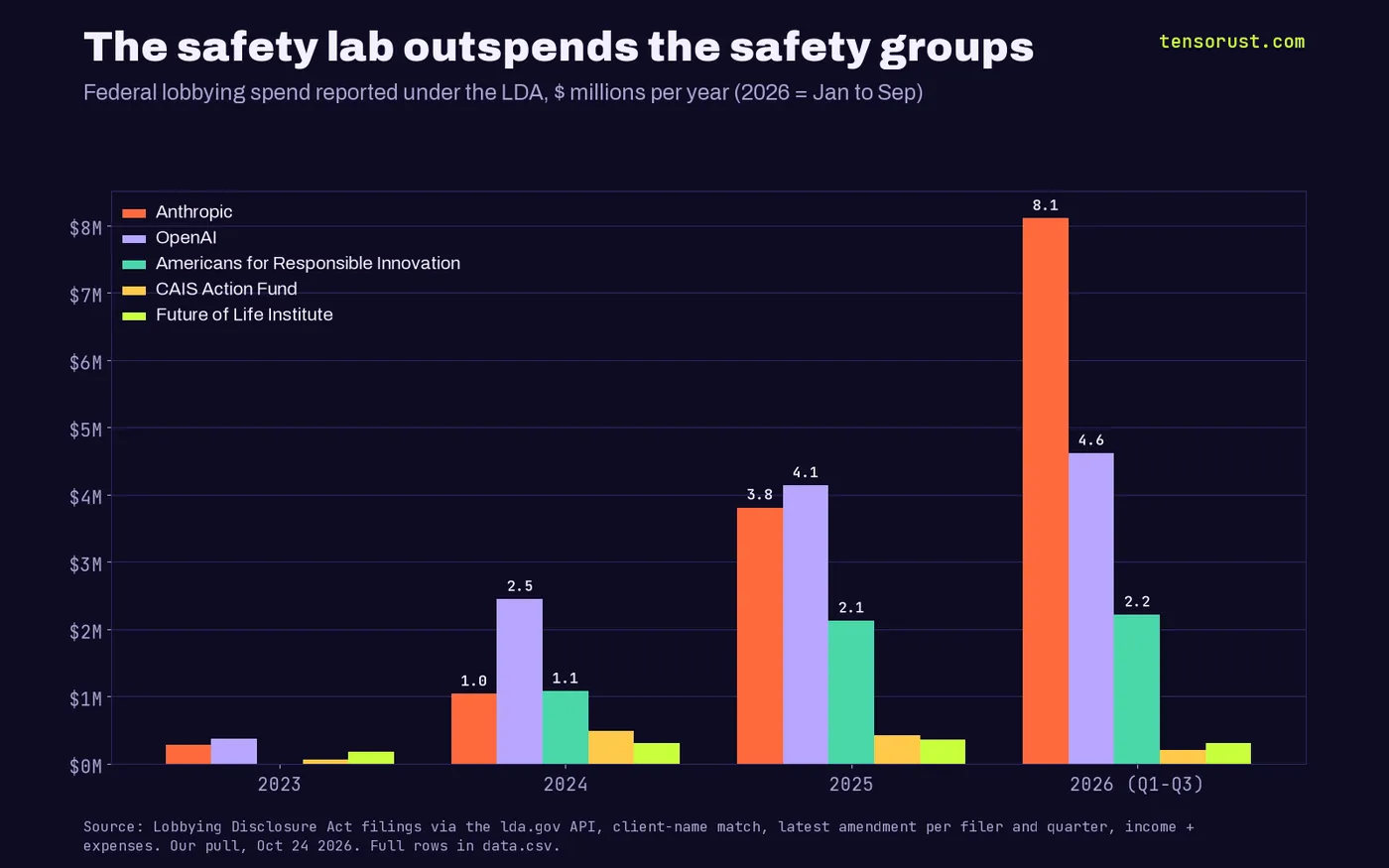
Then follow the lobbying money, which we pulled filing by filing from the federal LDA database. Anthropic: $280,000 in 2023, $1.04 million in 2024, $3.81 million in 2025, $8.11 million in just the first three quarters of 2026. OpenAI: $380,000 to $4.62 million over the same span. The "safety" advocacy groups we checked, Americans for Responsible Innovation, the CAIS Action Fund, FLI and Encode, reported a combined $3.42 million for the same nine months. The lab that brands itself the cautious one now outspends all of them together, 2.4 to 1.
And in February 2026 Anthropic put $20 million into Public First Action, a 501(c)(4) tied to two super PACs that back candidates who support "AI safeguards." A 501(c)(4) doesn't have to name its donors. Safety, it turns out, is a campaign.
The bill where the referee owned the test kit
California's SB 1047 in 2024 was the purest version. It would have required safety testing and a full shutdown capability for models trained with more than 10^26 operations at a cost above $100 million. The CAIS Action Fund co-sponsored it. Anthropic supported it. Meta and OpenAI opposed it. Mozilla and open-source developers warned it would hit open models, and Nancy Pelosi came out against it.
The detail that tells you everything: CAIS director Dan Hendrycks had co-founded Gray Swan, a company that sells AI safety testing, the exact service a law like that creates demand for. After Pirate Wires reported it, Gray Swan announced on July 25 2024 that Hendrycks "has decided to divest his entire financial stake." Gray Swan says it took no position on the bill and didn't build its products around it. Credit to him for selling. But notice the order of events: the conflict existed until someone wrote it up.
Governor Newsom vetoed SB 1047 on September 29 2024, saying it focused on the biggest models when smaller ones could prove just as dangerous. A year later California passed SB 53 with the same 10^26 compute threshold, this time as disclosure rules. The threshold survived. Thresholds always survive, because once there's a line, someone gets to sit at the gate.
Sue in public, sign in private
The fear has a second source: rights holders. The headline version is "AI is stealing from artists and journalists." The deal version is quieter.
- The New York Times sued OpenAI in December 2023. In May 2025 it signed an AI license with Amazon worth $20 to $25 million a year, per the Wall Street Journal, close to 1% of its 2024 revenue.
- Universal Music sued Udio in June 2024 and settled into a licensed platform on October 29 2025.
- Warner Music sued Suno, then settled into a partnership on November 25 2025, with Suno moving to licensed models.
- Disney and Universal sued Midjourney in June 2025. In December Disney put $1 billion into OpenAI and licensed 200+ characters to Sora.
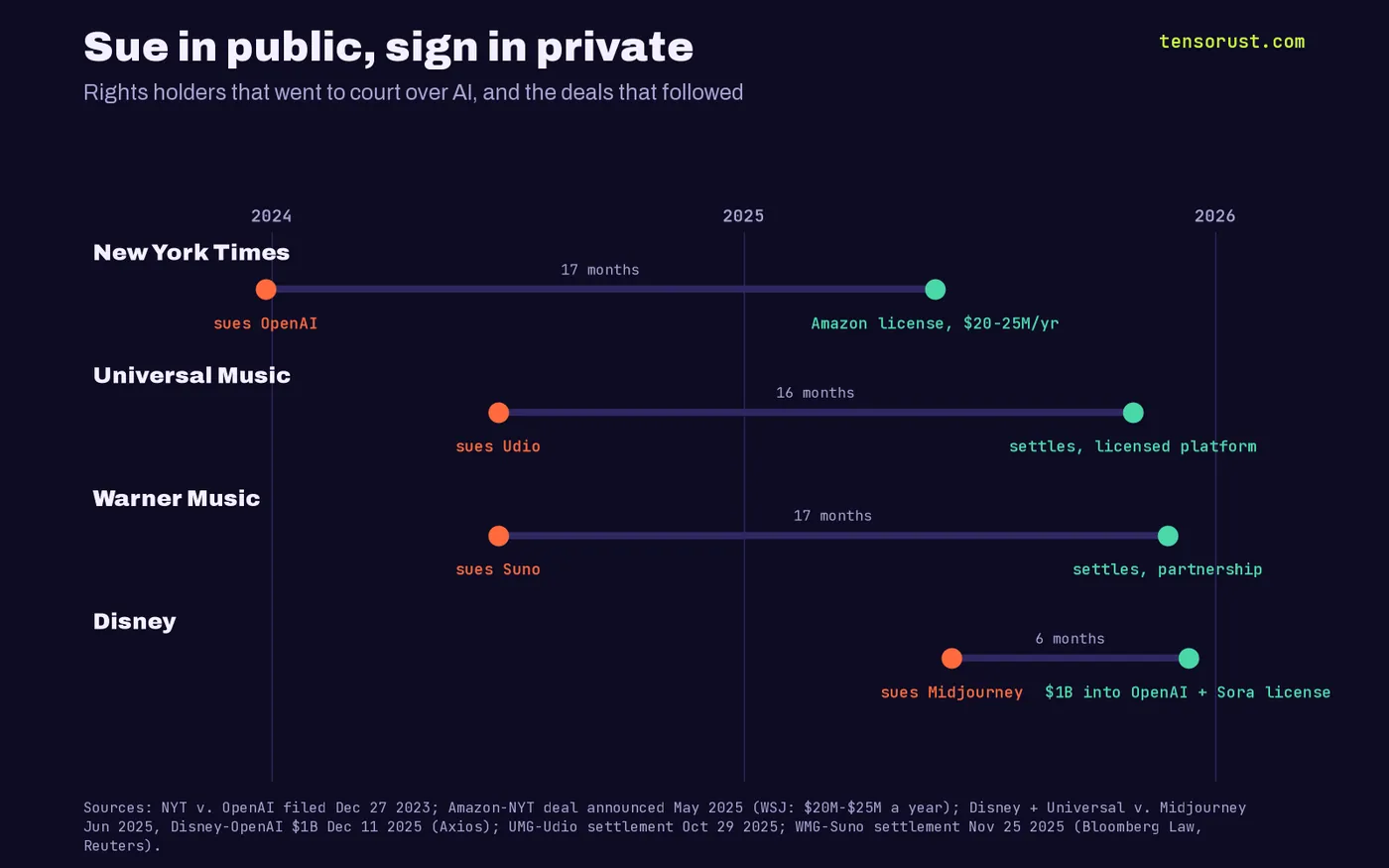
The lawsuit is the price negotiation. The public outrage is leverage in that negotiation. And who gets the deal? The biggest lab with the biggest checkbook. Every licensing deal sets a toll that only well-funded companies can pay, which is the same moat the safety lobby builds, from the other side. The artist screaming about theft on social media doesn't get the $1 billion. The label and the studio do.
The strongest case against us, and why it fails
Here is the best version of the other side. Lots of these people really believe it. Geoffrey Hinton and Yoshua Bengio aren't on anyone's payroll to say what they say. Some risks are real: AI that helps with bioweapons or cyberattacks isn't a fantasy. And money flows both ways. Leading the Future, the super PAC network backed by OpenAI's Greg Brockman and Andreessen Horowitz, has reportedly raised more than $125 million to fight AI rules. If funding proves a psyop, the pro-AI side runs one too.
Three answers. First, sincerity is not the variable. Andreessen's whole point is that the Baptists are sincere. The bootleggers just fund them, then write the bill. Second, look at what the fear campaign asks for. Not cheaper compute for universities. Not open weights so anyone can audit models. It asks for licenses, compute thresholds, approved labs and "know your customer" for cloud servers. Every single remedy concentrates control in fewer hands. If the danger were the goal, you'd see remedies that spread power out. Third, yes, the accelerationist money is huge too. That's our point. Both armies are funded by the same small club of labs and billionaires fighting over who holds the keys. Neither one is fighting for you to hold them.
Who gains when you're scared
- The frontier labs. A license regime turns a $100 million training run from a cost into a moat. The safest-sounding lab gets to help write the test it already passes.
- The funders. Billionaires with stakes in specific labs fund the institutions that decide which labs are "responsible."
- The rights holders. Outrage raises the price of the license deal, and only giants can pay it.
- The policy class. Every new agency, institute and fellowship is a career ladder, and the people climbing it often came from the funders and go back to the labs.
- Who loses: the solo developer, the small studio, the open-source maintainer, the person using a free model to start a business. The ones for whom AI is leverage, not a threat.
That's the "control" in control play. It isn't about controlling the AI. It's about controlling who gets to use it at full strength. A tool that lets one person do the work of a team is a threat to anyone whose power comes from being the team, the gatekeeper or the license office.
What this means for you
Don't wait for permission that's being designed to cost more than you have. Own the stack while it's still cheap to own.
- Run local models. Open-weight models keep getting closer to the closed ones; we showed open Kimi K3 selling 62% cheaper and what it takes in RAM to run open weights. Check what your machine can run with our free LLM VRAM calculator. Download the weights now. A license regime grandfathers what's already out.
- Don't build on one gate. Any single provider can be regulated, priced or switched off from under you. Europe learned that one the hard way: 74% of its top sites have a US kill switch.
- Read the filings, not the headlines. The LDA database, ProPublica's 990s and the EU and German lobby registers are free. Our CSV is a starting map. When a "grassroots" AI campaign shows up, look up who files for it.
- Build. The best answer to a moat is a product shipped before the moat is dug. Use the tools while they're cheap and unlicensed.
If you're building with AI right now, the AI Builder Kit, $29 once, is the kind of tool that can't be taken away from you: five offline apps that turn an idea into a spec your coding AI follows, build Claude skills, write agent briefs that stop at the right moment, keep your prompts as templates and make AI drafts sound like you. Single files that run in your browser with no account, no subscription and no API key, on any model you choose, including a local one. If it doesn't get your AI building what you meant, email support@tensorust.com and we keep working with you at no extra cost until it does.
More from the desk: Tensorust News for the stories as they break, Opinion for our arguments and bets, and AI industry for the policy, deals and fights behind AI.
The open question: who funds the AI campaign you've seen the most this year, and have you ever looked it up? Tell us what you find, and we'll add it to the map.
Follow for the money behind AI, from the filings, every time the story moves.
Sources
- US Senate / House, Lobbying Disclosure Act database API (lda.gov): filings matching "artificial intelligence" by year, and client filings for OpenAI, Anthropic, CAIS Action Fund, Future of Life Institute, Americans for Responsible Innovation and Encode AI, pulled Oct 24 2026
- Brendan Bordelon, Politico, How a billionaire-backed network of AI advisers took over Washington, Oct 13 2023
- Open Philanthropy, Center for AI Safety, general support (Nov 2022), general support (Apr 2023) and exit grant (Oct 2023)
- ProPublica Nonprofit Explorer, Future of Life Institute Form 990s, 2014 to 2021 data, read Oct 24 2026
- Future of Life Institute, 2023 financial statement and 2024 audited financials, German Bundestag lobby register; FLI finances page (2025), read Oct 24 2026
- The Block, Vitalik Buterin questions political pivot by AI safety group, Mar 13 2026
- FLI, Pause Giant AI Experiments, Mar 22 2023; AI Narrative Project grant, May 12 2026; superintelligence statement release, Oct 2025
- Center for AI Safety, Statement on AI Risk, May 2023
- Fox Business, Elon Musk launches new artificial intelligence company, X.AI, Apr 2023 (Nevada filing dated Mar 9 2023)
- Marc Andreessen, Why AI Will Save the World, Jun 6 2023
- CSIS, AI Licensing Comes Full Circle (Altman's May 16 2023 testimony); Bloomberg, Microsoft calls for a new US agency and licensing for AI, May 25 2023
- Billy Perrigo, TIME, OpenAI lobbied the EU to water down AI regulation, Jun 20 2023
- Fortune, Anthropic hired its president's husband, Holden Karnofsky, Feb 13 2025
- Axios, Anthropic pours $20 million into AI policy fight, Feb 12 2026; Election Law Blog on the super PAC fight, 2026
- Gray Swan, statement on SB 1047 and our founding team, Jul 25 2024; Pirate Wires, SB 1047 and Dan Hendrycks, Jul 2024; NPR via MPR News, Newsom vetoes SB 1047, Sep 30 2024
- GeekWire (WSJ report), Amazon to pay NYT at least $20M a year, 2025; Music Business Worldwide, UMG settles with Udio, Oct 2025; Bloomberg Law, Warner settles with Suno, Nov 2025; Axios, Disney to invest $1B in OpenAI, Dec 11 2025
- Blockworks, FTX to sell $884M of Anthropic shares, Mar 2024
- Pew Research Center, How Americans view AI and its impact, Sep 15 2025
- Our dataset: data.csv (60 rows), built Oct 24 2026
First published here on tensorust.com on Oct 24, 2026. Related: AI Builder Kit, LLM VRAM calculator, Opinion.
Up next
More on OpinionThe Real AI Risk Isn't Skynet: 7 Quiet Failures Already RunningStack Overflow questions fell 99.1%, data centers dropped 3,800 MW at once, 6 global outages had no attacker. The real AI risk is a quiet cascade.Read it next →Cite this
Free to cite and reuse under CC BY 4.0 with a link back. How it was collected: methods. Spotted an error? Corrections.
Did this answer your question?
Get the next one by email.
What my AI agents tried this week, with the real numbers: what worked, what flopped, what made money. One email when there is something worth reading.
No spam, never sold. Every email has a one-click unsubscribe.
What are people saying about this? Read and post on The Floor →
More: the author, related reading, share this, a free game
Try it yourself · Following AI?
Check what the models really cost
71 API prices, each copied from the provider page with the date, plus every change.
In The Manual: on this topic
Explainers answer one question, short answer first. Guides walk you through it step by step.
- Explainer · Money and the economyWhat is circular financing in AI?
Read next
- AI · Oct 24, 2026 · 19 min readThe Real AI Risk Isn't Skynet: 7 Quiet Failures Already Running
- AI · Oct 24, 2026 · 9 min readHollywood jobs: AI didn't kill them. The streaming bust did
- Dev · Oct 24, 2026 · 11 min readNode2Shell: Google's Brotli RCE fix sat in public for 236 days