
Hollywood jobs: AI didn't kill them. The streaming bust did
On this page · 10 sections
- Key numbers
- The question everyone is asking has the timeline backwards
- Two thirds of the damage was done before AI video existed for the public
- Follow the money: free money ended, and so did the streaming war
- The money came back. The jobs did not. Look where it went
- The strongest case for "AI did it," and why it breaks
- Who gains from blaming AI
- Why the alibi hurts the people it claims to protect
- What this means for you
- Sources
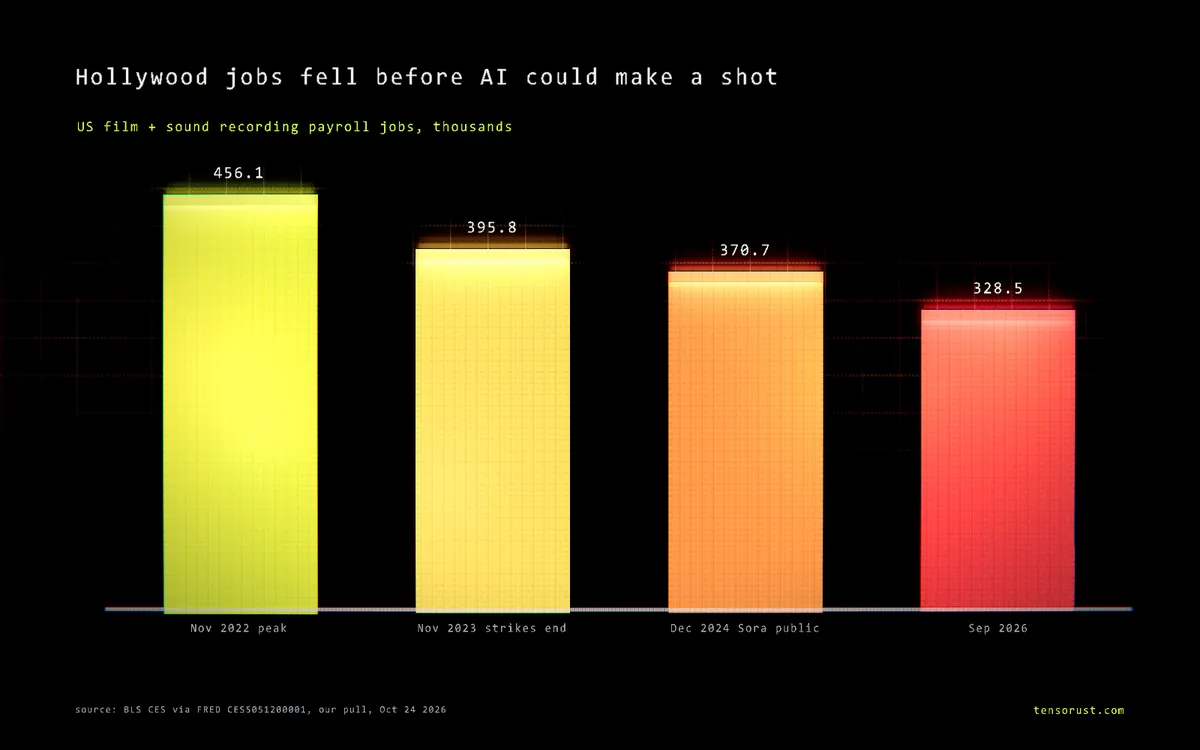
Short answer: US film and sound recording payrolls fell from 456,100 in November 2022 to 328,500 in September 2026, a loss of 127,600 jobs (28%). But 85,400 of those jobs, 67% of the drop, were gone by December 2024, the month OpenAI first let the public use Sora. Hollywood's jobs were cut by a money problem, not a model, and the people loudest about AI are the ones with the most to hide.
TL;DR: 60,300 film jobs vanished in the twelve months of the 2023 strikes alone, when no AI tool on earth could make a usable shot. Over the same four years, live performing arts and sports added 86,900 jobs, LA shoot days fell 16% in 2025, and UK production spend hit £6.8bn, 85% of it foreign money. The dollars did not disappear into a GPU; they moved to London, to tax-credit states and to YouTube creators, while the studios that moved them sue AI startups in public and buy into OpenAI in private.
Key numbers
| What | Number | Source, checked Oct 24 2026 |
|---|---|---|
| US film + sound recording jobs, peak (Nov 2022) | 456,100 | BLS CES via FRED |
| Same, Sep 2026 | 328,500 (down 127,600, 28%) | BLS CES via FRED |
| Share of that loss done before Sora went public (Dec 2024) | 67% (85,400 jobs) | Our math on BLS CES |
| Jobs lost in the strike year, Nov 2022 to Nov 2023 | 60,300 | Our math on BLS CES |
| Performing arts + spectator sports jobs, Nov 2022 to Sep 2026 | +86,900 (+17%) | BLS CES via FRED |
| Federal funds rate, Feb 2022 vs Aug 2023 onward | 0.08% to 5.33% | FRED FEDFUNDS |
| LA on-location shoot days, 2025 | 19,694 (down 16.1%) | FilmLA via CBS News |
| UK film + high-end TV spend, 2025 | £6.8bn (+22%), 85% inward investment | BFI |
| US scripted series, 2022 vs 2023 | 599 to 516 | FX Research via Fortune |

The question everyone is asking has the timeline backwards
The fight on Hacker News tonight started with a sharp Apricitas Economics piece by Joseph Politano: America has lost more than 200,000 jobs in media, film and the arts in four years. How much is AI? Politano is careful. He says the share is "extremely difficult" to prove and does not put a number on it.
Plenty of people are filling that gap for him, and they all fill it with AI. We pulled the same Bureau of Labor Statistics payroll series ourselves, month by month, and lined it up against the dates that matter. The pattern says something very different.
Film jobs peaked in November 2022. ChatGPT launched November 30 2022. That coincidence is doing a lot of work in a lot of arguments. A chatbot that wrote mediocre limericks did not fire 60,000 grips, editors and camera operators in the following twelve months.
Two thirds of the damage was done before AI video existed for the public
Here is the cut that matters. Between the November 2022 peak and December 2024, when OpenAI opened Sora to paying users, the industry lost 85,400 of the 127,600 jobs it has lost in total. That is 67%.
The single worst stretch was the strike year. The Writers Guild walked out May 2 2023 and SAG-AFTRA followed July 14; the actors settled November 9. In those twelve months film and sound payrolls fell 60,300. Not one major studio production in 2023 was replaced by a generated shot, because the tools could not make one.
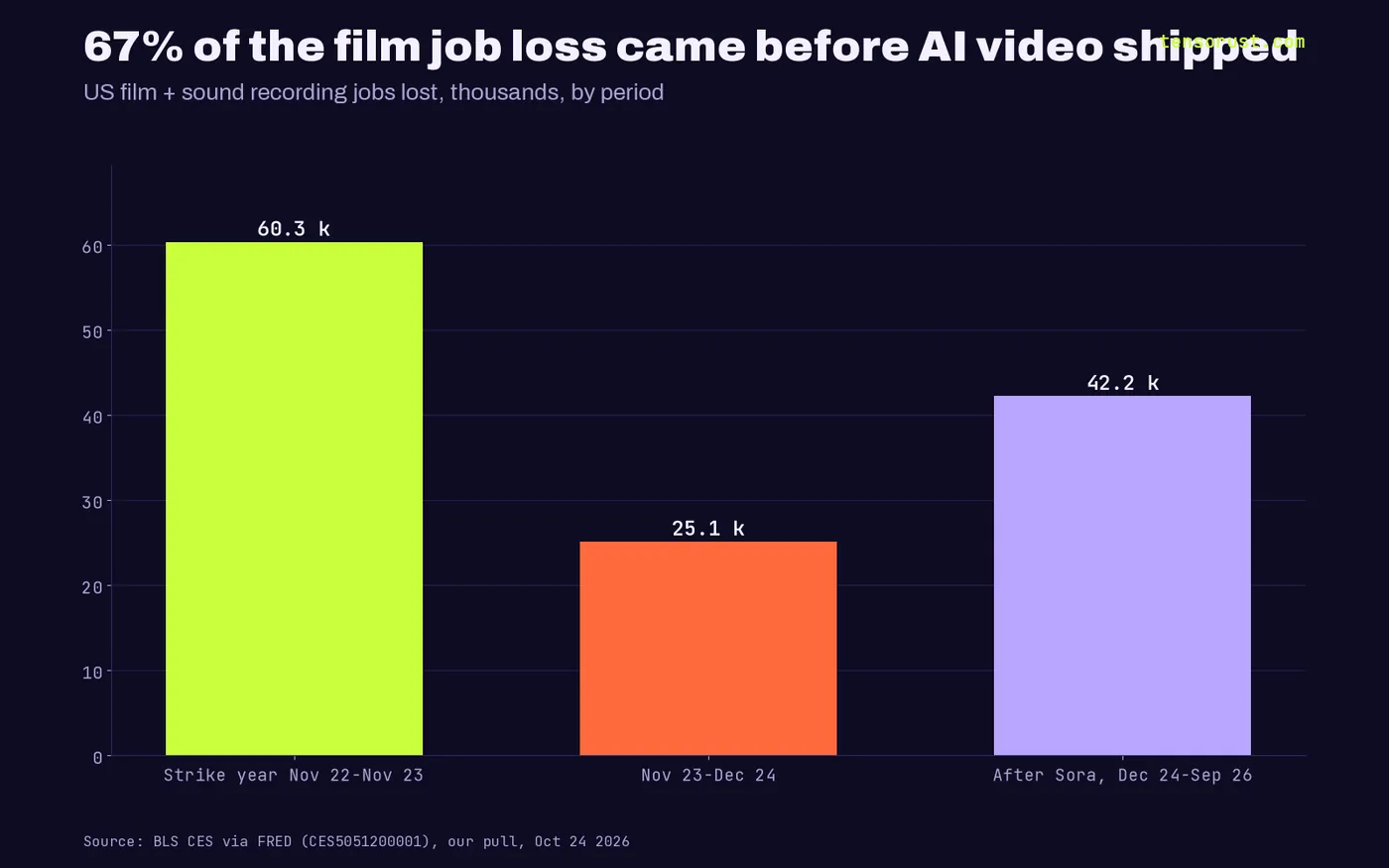
The other 42,200 jobs have gone since Sora shipped. We will not pretend AI has zero to do with any of them. Our read: some VFX, previs, dubbing and post jobs are now being squeezed by tools, and that will grow. But even the post-Sora losses run on the same slope the industry was already on. The line did not bend when AI arrived. It was already pointed at the floor.
Follow the money: free money ended, and so did the streaming war
The Streaming War was a zero-interest-rate product. From 2019 to 2022 every studio with a logo launched a service and paid anything to fill it. Netflix spent $17.7 billion in cash on content in 2021, per Variety's read of its filings. FX Research counted a record 599 scripted series in 2022.
Then the money got expensive. The federal funds rate went from 0.08% in February 2022 to 5.33% by August 2023. In April 2022 Netflix reported its first subscriber loss in a decade and its stock cratered. Wall Street stopped paying for growth and started demanding cash flow.
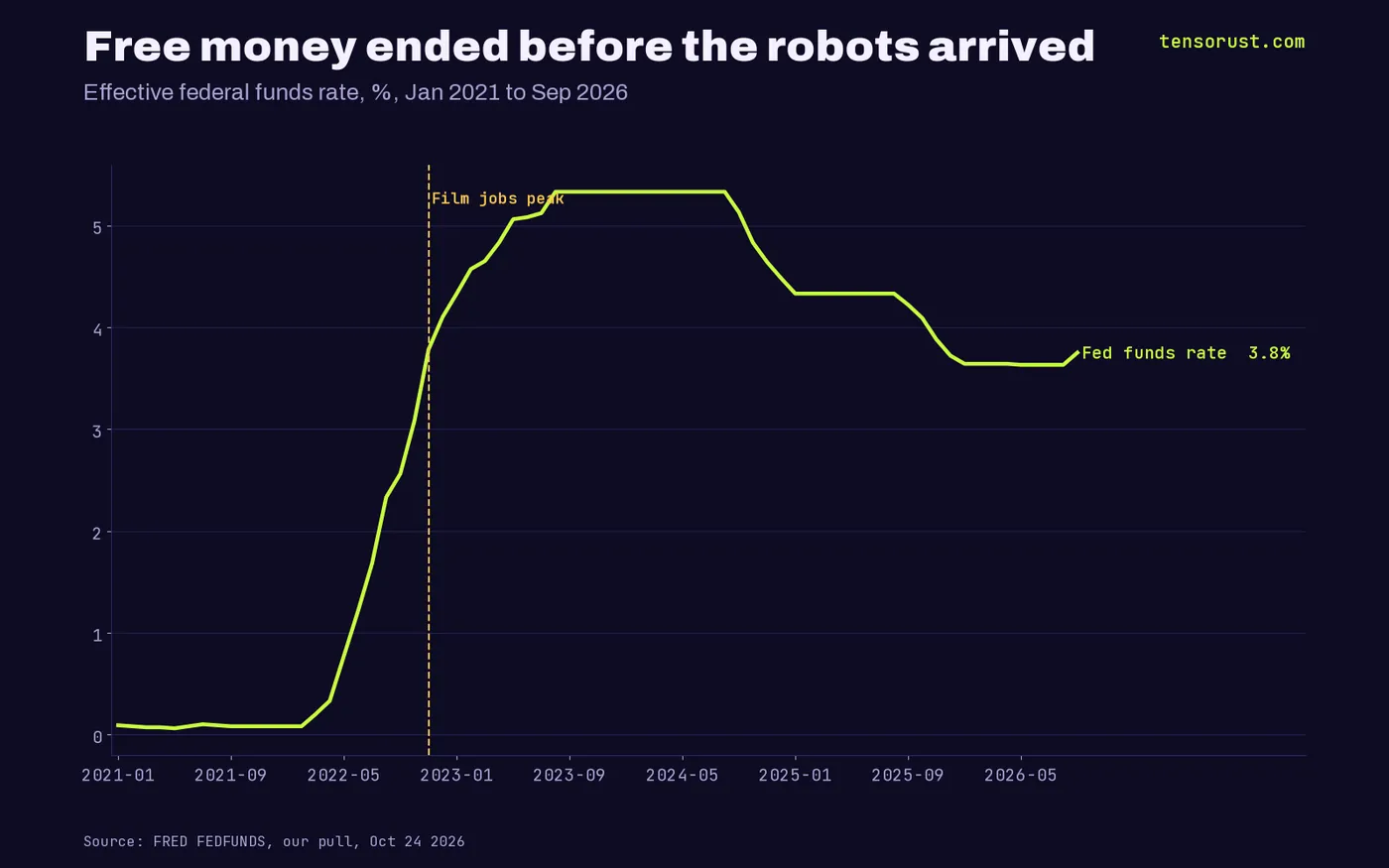
Studios obeyed. Discovery closed its WarnerMedia deal in April 2022 and went straight to cuts and cancelled shows. Netflix guided its 2023 content spend down to about $13 billion, and its free cash flow jumped from $1.6 billion in 2022 to $6.9 billion in 2023, per its own shareholder letter. Scripted series fell from 599 to 516 in one year. Fewer shows means fewer crews. That is the whole mechanism, and it needs no robots.
The money came back. The jobs did not. Look where it went
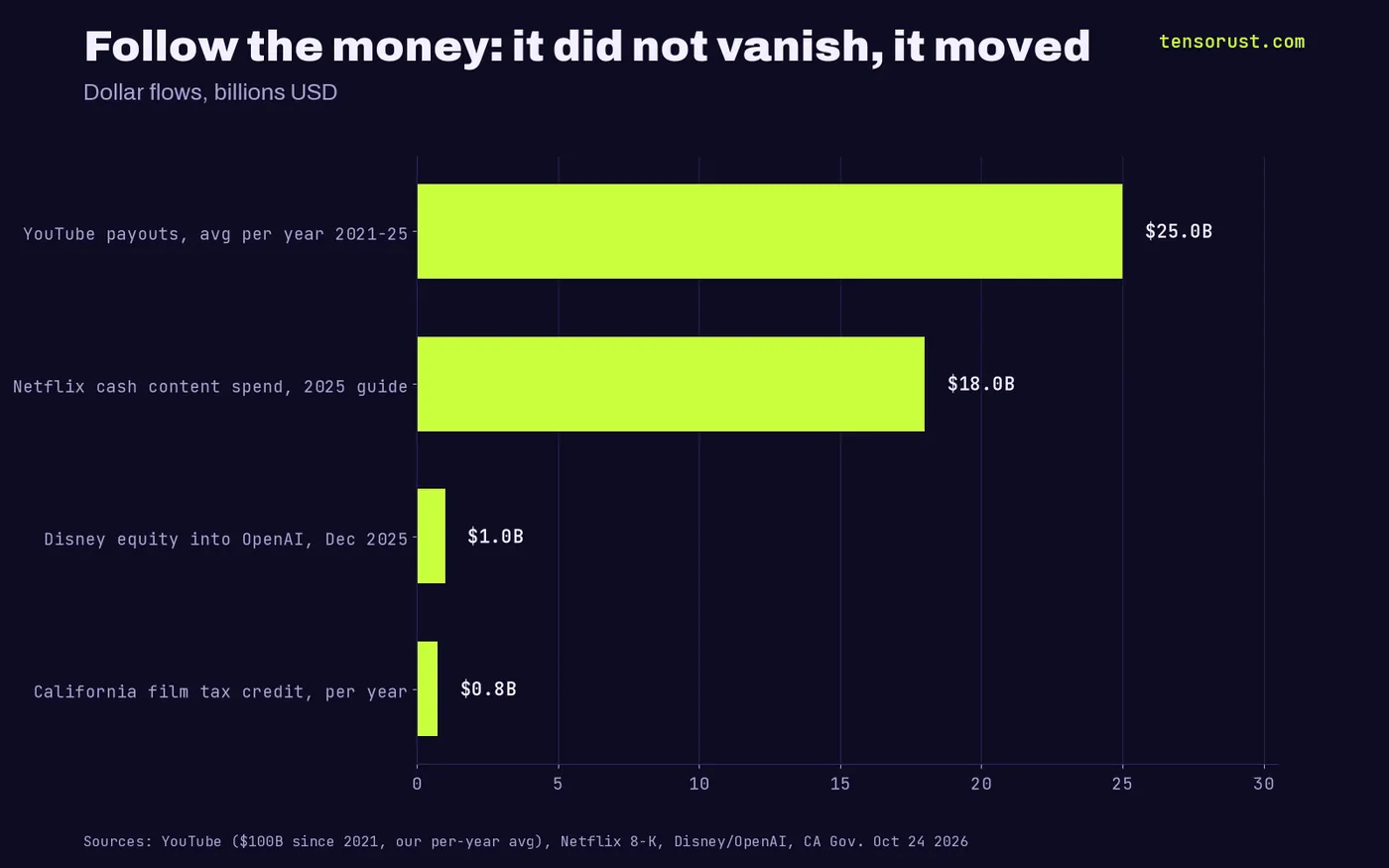
This is the part the AI story cannot explain. Netflix's spend climbed back toward $17 billion in 2024 and it guided to about $18 billion for 2025. If studios were swapping people for models, budgets would shrink. They did not. They moved.
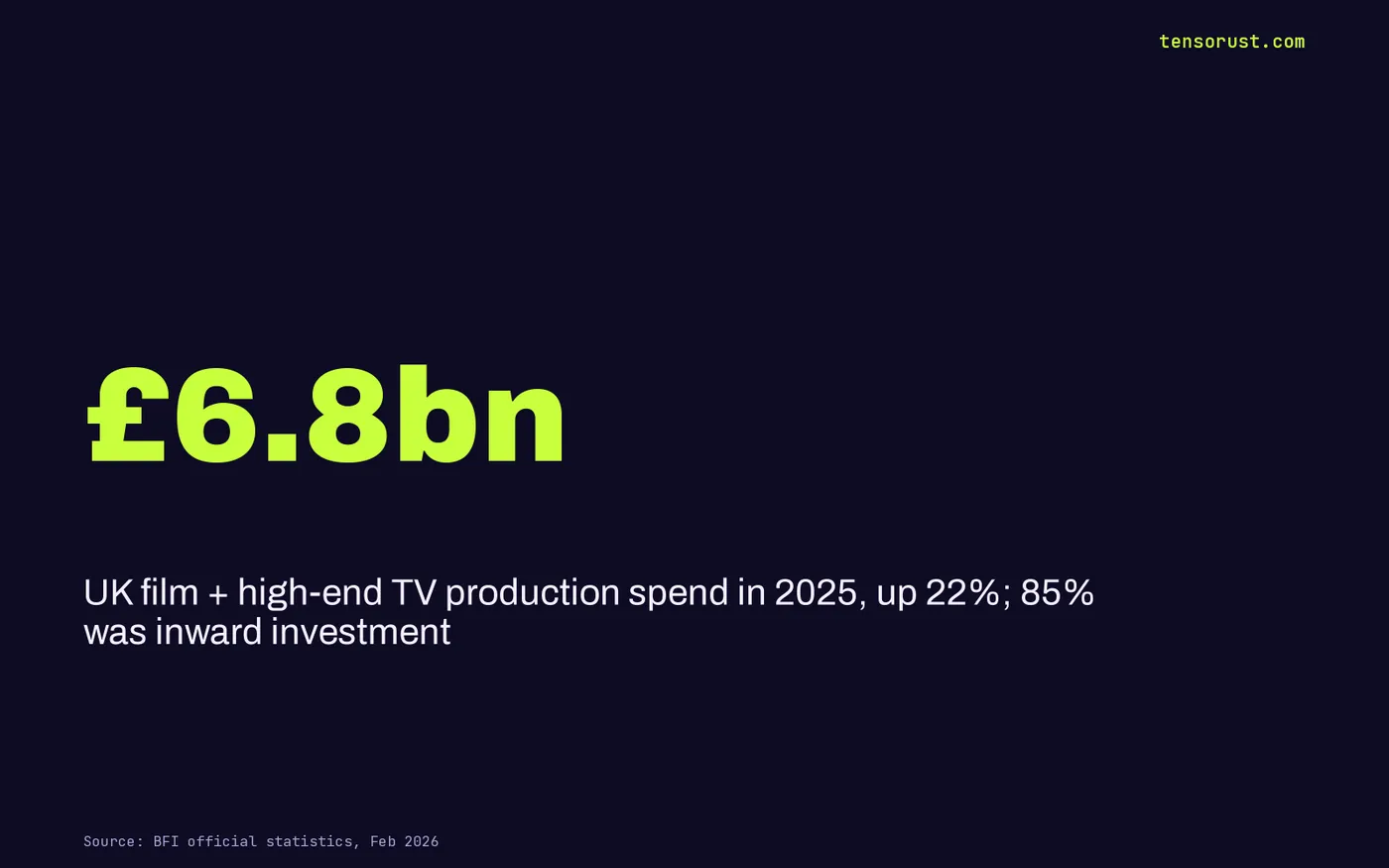
The UK reported £6.8bn of film and high-end TV production spend in 2025, up 22%, and the BFI says 85% of it, £5.8bn, was inward investment. The slate it names reads like a US studio release calendar: Avengers: Doomsday, Supergirl, a Harry Potter series. Meanwhile Los Angeles logged 19,694 shoot days in 2025, its lowest since 2020, down 16.1% from 2024 according to FilmLA.
California's own government named the culprit, and it was not ChatGPT. When Gavin Newsom signed the bill more than doubling the state's film tax credit to $750 million a year in July 2025, his office said productions had left for Georgia, Louisiana and other places with better tax breaks. Sacramento did not pass an AI ban to save Hollywood. It passed a subsidy, because the problem was price.
The strongest case for "AI did it," and why it breaks
The best argument on the other side is real, and Politano makes it well: every digital arts subsector is shrinking while in-person entertainment grows. If AI substitutes for screen work but cannot replace a live show, that is exactly the split you would expect.
Our data shows the split. Performing arts and spectator sports added 86,900 jobs from November 2022 to September 2026, up 17%, while film fell 28% and broadcasting lost 27,300.
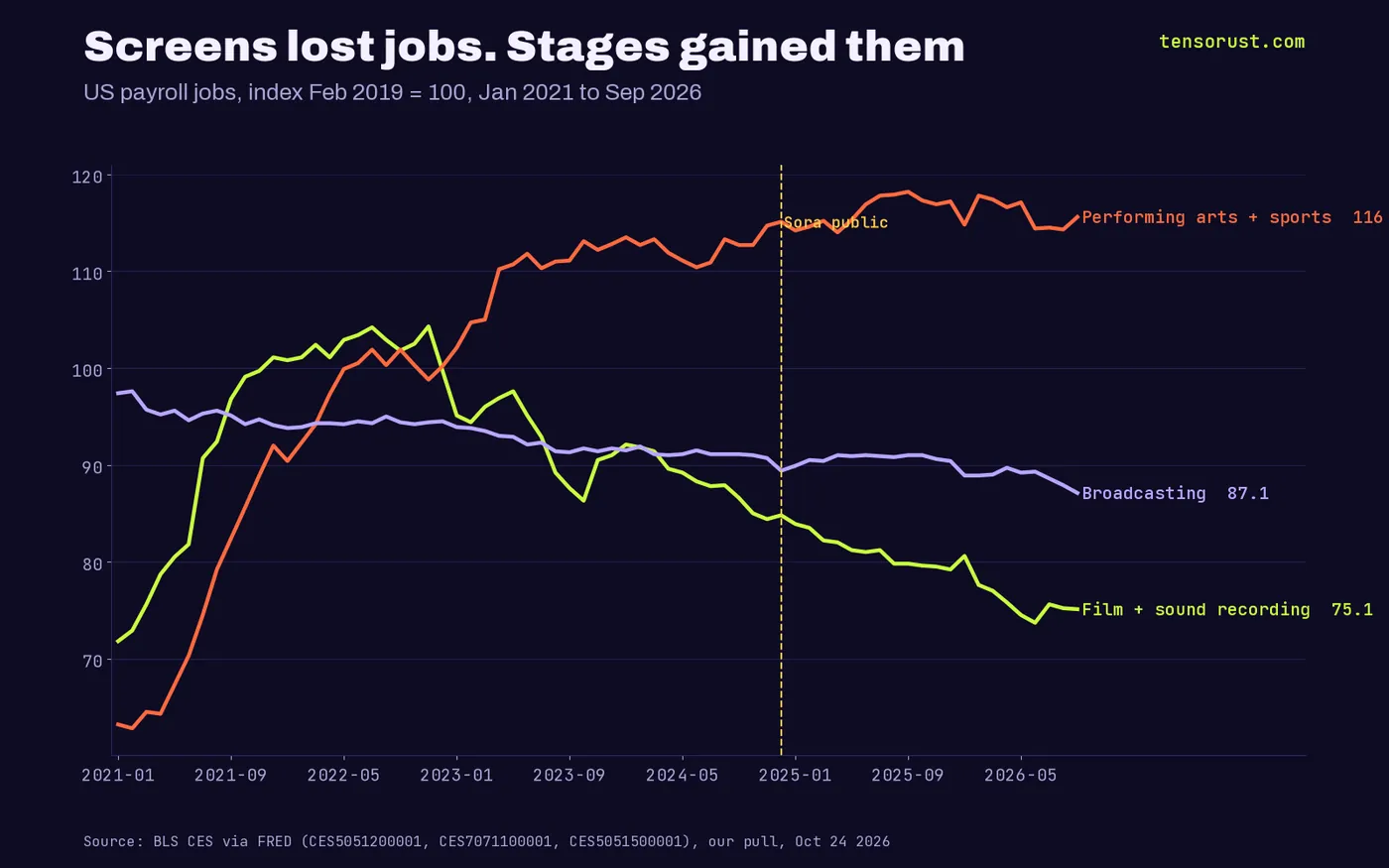
But look at when it happened. The live jump came in 2021 to 2023 as venues reopened after lockdowns, years before generated video could replace anything. And the screen jobs did not go to software. They went to people who do not show up on a payroll survey at all. YouTube says it has paid more than $100 billion to creators, artists and media companies since 2021, and claims its US creator economy supports more than 490,000 full-time jobs. That is YouTube's own number, so price in the salesmanship. Even at half, it is a second Hollywood that the BLS establishment survey does not count as Hollywood.
The audience did not leave for a chatbot. It left for a guy with a camera and a ring light. That is a market working, not a machine taking over.
Who gains from blaming AI
Here is where we connect dots. Documented first, then our reading.
Documented: On June 11 2025 Disney and Universal sued Midjourney in federal court in Los Angeles, calling it "a bottomless pit of plagiarism" (The Fashion Law). Six months later, on December 11 2025, Disney announced a $1 billion equity investment in OpenAI plus warrants, and licensed more than 200 Disney, Marvel, Pixar and Star Wars characters to Sora (Axios). The same week it sent Google a cease-and-desist over training.
Our reading: that is not a company afraid of AI. That is a company deciding who gets to use AI on its terms. Sue the independent tool, buy into the giant one, and lobby for a licensing world where only firms with century-old IP libraries can afford to play. Nobody has proven that is the plan, but the pattern fits it perfectly, and it is the same control play we traced in our piece on who funds the anti-AI movement.
The AI story is also a gift to every executive who made the cuts. "We consolidated, raised margins for shareholders and shipped the shoot to Leavesden for the tax rebate" is a bad quote. "Technology is changing the industry" is a great one. It turns a choice into weather.
Unions gain something too, and we say this with respect for crew. AI clauses were a winnable fight in 2023. Stopping a studio from filming in Budapest is not. A loud fight against a future threat can crowd out the quiet fight over the present one.
Why the alibi hurts the people it claims to protect
If crew believe the robots took the work, they lobby for AI bans and wait. If they believe the money moved, they follow it: to Georgia and New Mexico, to the UK, to the creator economy, and to the AI tools themselves, which are the cheapest way a small team has ever had to make something that looks expensive.
Fear of the tool keeps the means of production with the people who already own the libraries. A four-person studio with a camera, a laptop and open models is the actual threat to a $1 billion IP moat. That is why the moat owners want you scared of it.
We are not saying AI will never cost a creative job. It will cost some, and it will create others. We are saying the 127,600 jobs Hollywood has already lost have a clearer culprit with a paper trail: rates, Wall Street, mergers and tax credits. Blame the thing that did it, or the thing that did it gets to do it again.
What this means for you
If you work in film or TV, track the money, not the headlines: watch tax-credit allocations, FilmLA's quarterly shoot days and where your last three productions actually filmed. Those numbers tell you where the next job is. Pull our monthly data below and see the line for yourself.
If you are moving, move to where the spend is growing, and use the new tools before the studios license them away from you. Read our look at the AI jobs panic in software for the same pattern in tech, browse more takes on Opinion, and the data behind them on Economics.
If you need the next job now, the $10 Job Hunt Kit matches your resume to the exact post and writes a cover letter that reads like you, offline. If it does not get you there, we keep working on it at no extra cost until it does.
Not financial advice. Our estimates and readings are labelled as ours; every number above links to its source.
Sources
- BLS Current Employment Statistics via FRED, Motion picture and sound recording industries (CES5051200001), pulled Oct 24 2026
- BLS CES via FRED, Performing arts, spectator sports and related (CES7071100001), pulled Oct 24 2026
- BLS CES via FRED, Broadcasting except internet (CES5051500001), pulled Oct 24 2026
- FRED, Effective federal funds rate (FEDFUNDS), pulled Oct 24 2026
- Apricitas Economics, Joseph Politano, AI and the fall of the creative class, Oct 2026
- Variety, Netflix content spending declined 5% in 2022, Jan 2023
- Netflix Q4 2023 shareholder letter, SEC 8-K exhibit 99.1, Jan 2024
- Netflix Q4 2024 shareholder letter, SEC 8-K exhibit 99.1, Jan 2025
- Fortune, Is peak TV over? (FX Research series counts), Feb 12 2024
- CBS News, FilmLA: Hollywood shoot days drop 16% compared to 2024, Jan 2026
- BFI, Official statistics: £6.8 billion film and high-end TV production spend in the UK, Feb 2026
- Office of Governor Newsom, expansion of the film and TV tax credit, Jul 2 2025
- Shacknews, YouTube claims it paid out over $100 billion to creators since 2021, Sep 2025
- The Fashion Law, Disney and Universal sue Midjourney, Jun 2025
- Axios, Disney to invest $1 billion in OpenAI, license characters for Sora, Dec 11 2025
First published here on tensorust.com on Oct 24, 2026. Related: Job Hunt Kit, Economics, Opinion.
Up next
More on OpinionAI isn't overhyped. Prices fell 99% and it feels like nothing changedGPT-4-class AI got 99.6% cheaper, ChatGPT hit 800M weekly users, and labor share hit a record low. Why AI feels like nothing changed, and who keeps the gains.Read it next →Cite this
Free to cite and reuse under CC BY 4.0 with a link back. How it was collected: methods. Spotted an error? Corrections.
Did this answer your question?
Get the next one by email.
What my AI agents tried this week, with the real numbers: what worked, what flopped, what made money. One email when there is something worth reading.
No spam, never sold. Every email has a one-click unsubscribe.
What are people saying about this? Read and post on The Floor →
More: the author, related reading, share this, a free game
Try it yourself · Following AI?
Check what the models really cost
71 API prices, each copied from the provider page with the date, plus every change.
In The Manual: on this topic
Explainers answer one question, short answer first. Guides walk you through it step by step.
- Explainer · Money and the economyCan the Fed buy Treasuries directly from the government?
- Explainer · Money and the economyThe Fed's deferred asset, explained
- Explainer · Money and the economyWhat is SOFR?
- Explainer · Money and the economyWhat are bank reserves?
Read next
- AI · Oct 24, 2026 · 14 min readAI isn't overhyped. Prices fell 99% and it feels like nothing changed
- Economics · Oct 24, 2026 · 10 min readGoogle Finland data center: €4.5M of trees vs a €400M power edge
- AI · Oct 24, 2026 · 19 min readThe Real AI Risk Isn't Skynet: 7 Quiet Failures Already Running