
The Real AI Risk Isn't Skynet: 7 Quiet Failures Already Running
On this page · 15 sections
- Key numbers
- Skynet is the decoy
- Risk 1: one bad push takes down the planet
- Risk 2: the automated "no"
- Risk 3: the commons died and nobody held a funeral
- Risk 4: compute is eating the grid's safety margin
- Risk 5: we handed agents the keys and the wallet
- Risk 6: the missing juniors and the deskilled experts
- Risk 7: the bots all read the same headline
- How close each one already is
- The cascade nobody is modelling
- Follow the money: why the movie version wins
- The best case for the doom crowd, and why it misses
- What this means for you
- Sources
Short answer: The AI risk that could actually break the world won't look like a robot uprising. It looks like a config file, a power bill, a claim denied in 1.2 seconds and a Q&A site that went quiet. Five chokepoints now carry the AI economy: three clouds hold 63% of the market, three labs take 88% of enterprise model spend, and TSMC makes 72.5% of the world's contract chips. Six global outages in 16 months came from automated changes, with no attacker involved. Stack Overflow, the public commons that taught these models to code, fell from 109,120 questions a month to 969. The movie version gets the hearings and the headlines. Meanwhile the real version keeps running, and the fixes being sold for the movie risk make the real one worse.
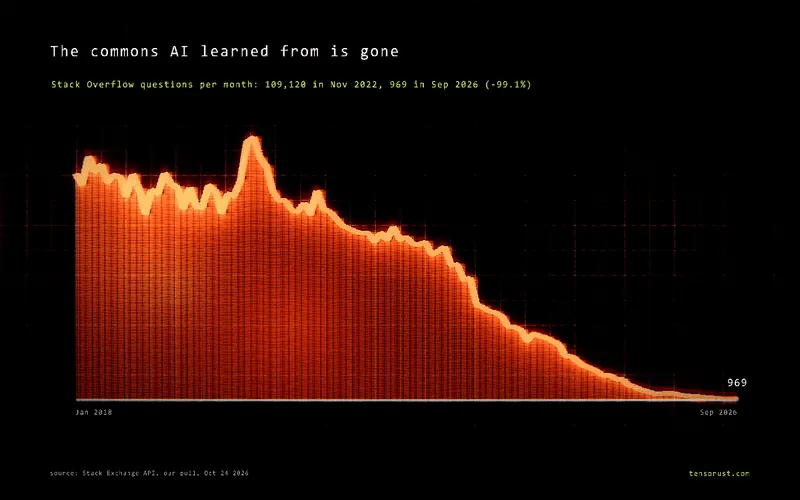
TL;DR: We pulled Stack Overflow's own numbers: questions asked fell 99.1% between ChatGPT's launch month (109,120 in Nov 2022) and Sep 2026 (969), so the human record AI learned from has stopped growing at the same moment roughly half of new web articles are machine-written. Northern Virginia data centers dropped 1,500 MW off the grid at once in 2024, 1,800 MW in 2025 and moved 3,800 MW to backup in July 2026, the largest load transfer PJM has ever seen, while PJM's capacity price went from $28.92 to $333.44 per MW-day. Agents now hold keys and wallets: 28.6 million secrets leaked on public GitHub in 2025, AI-service keys up 81%, and 91.8% of audited MCP servers have no OAuth. We rank seven quiet risks by how close they already are, and every one has a public record. None of them involves a machine that wants anything.
Key numbers
| What | Number | Source, checked Oct 24 2026 |
|---|---|---|
| Stack Overflow questions per month | 109,120 (Nov 2022) to 969 (Sep 2026), down 99.1% | Our pull, Stack Exchange API |
| Top 3 clouds' share of cloud infrastructure | 63% (AWS 28, Microsoft 20, Google 15) | Synergy Research, Q2 2026 |
| Top 3 labs' share of enterprise LLM spend | 88% (Anthropic 40, OpenAI 27, Google 21) | Menlo Ventures, Dec 2025 |
| Organisations hit by one AWS DNS bug, Oct 20 2025 | about 70,000 | CyberCube estimate |
| Data center load dropped or moved at once, Virginia | 1,500 MW (2024), 1,800 MW (2025), 3,800 MW (2026) | NERC, PJM |
| PJM capacity price | $28.92 (2024/25) to $333.44 (2027/28) per MW-day, 11.5x | PJM auction results |
| Cigna claims denied by an algorithm | 300,000+ in two months, 1.2 seconds each | ProPublica |
| Secrets leaked on public GitHub, 2025 | 28.6 million (+34%); AI-service keys +81% | GitGuardian 2026 |
| Doctors' detection rate without AI, after using it | 28.4% to 22.4% | Lancet Gastroenterology and Hepatology, 2025 |
Download the data (CSV, 287 rows: our full Stack Overflow monthly series since 2018, the electricity price series, the lobbying counts, and every outage, denial, grid and leak figure in this piece with its source link).

Skynet is the decoy
Every AI-risk headline you've read points the same way: a future mind that wants something, gets out and turns on us. Paperclips, superintelligence, "pause". It's a great story, and it gets the hearings.
It's also the wrong place to look. The systems that could actually hurt millions of people at once are already in production, and none of them needs to want anything. They're dumb, fast and identical. They run on the same three clouds, read the same headlines, deny claims at the same speed and draw on the same strained grid.
Our thesis, flat: the world-ending version of AI risk is a quiet cascade, not a rebellion. Lots of correlated, automated systems fail at once through boring links nobody owns. The pieces are documented. Nobody has put them on one page, so we did.
Risk 1: one bad push takes down the planet
Start with where AI physically lives. Three companies hold 63% of cloud infrastructure, per Synergy Research. Three labs take 88% of enterprise model spend, per Menlo Ventures. TSMC books 72.5% of all foundry revenue (TrendForce). Cloudflare sits in front of 86% of sites whose reverse proxy can be identified (W3Techs).
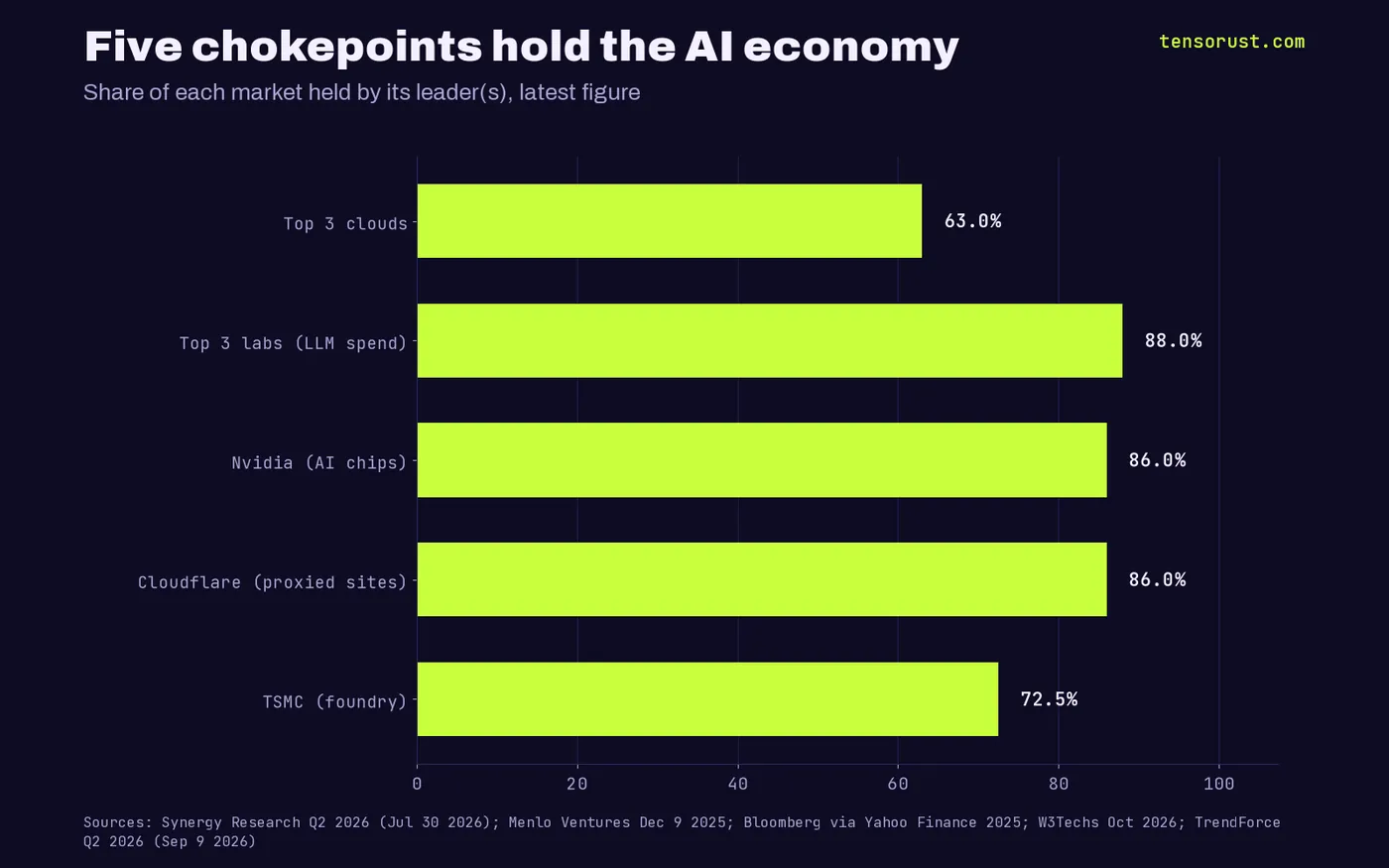
That's what a monoculture is: a single crop, so one pest takes the whole field. And the pest has already shown up, again and again. Look at the root causes of the biggest outages since mid-2024.
- CrowdStrike, Jul 19 2024: a template defined 21 input fields, the sensor supplied 20, and 8.5 million Windows machines crashed. Fortune 500 direct loss: $5.4 billion. Delta alone reported $380 million of lost revenue and $170 million of extra costs.
- Google Cloud, Jun 12 2025: policy data with blank fields replicated worldwide in seconds and hit code with no error handling. 86 products went down. Retries with no randomized backoff made recovery slower.
- AWS us-east-1, Oct 20 2025: a race condition in DynamoDB's automated DNS system deleted every IP address for the regional endpoint. About 14.5 hours of trouble, and about 70,000 organisations hit, by CyberCube's count.
- Cloudflare, Nov 18 2025: a permissions change doubled a generated bot-detection file past a hard limit. Its worst outage since 2019.
- Cloudflare, Dec 5 2025: a firewall change went global instantly, and it was made while patching a React security flaw. The safety fix knocked out 28% of its HTTP traffic.
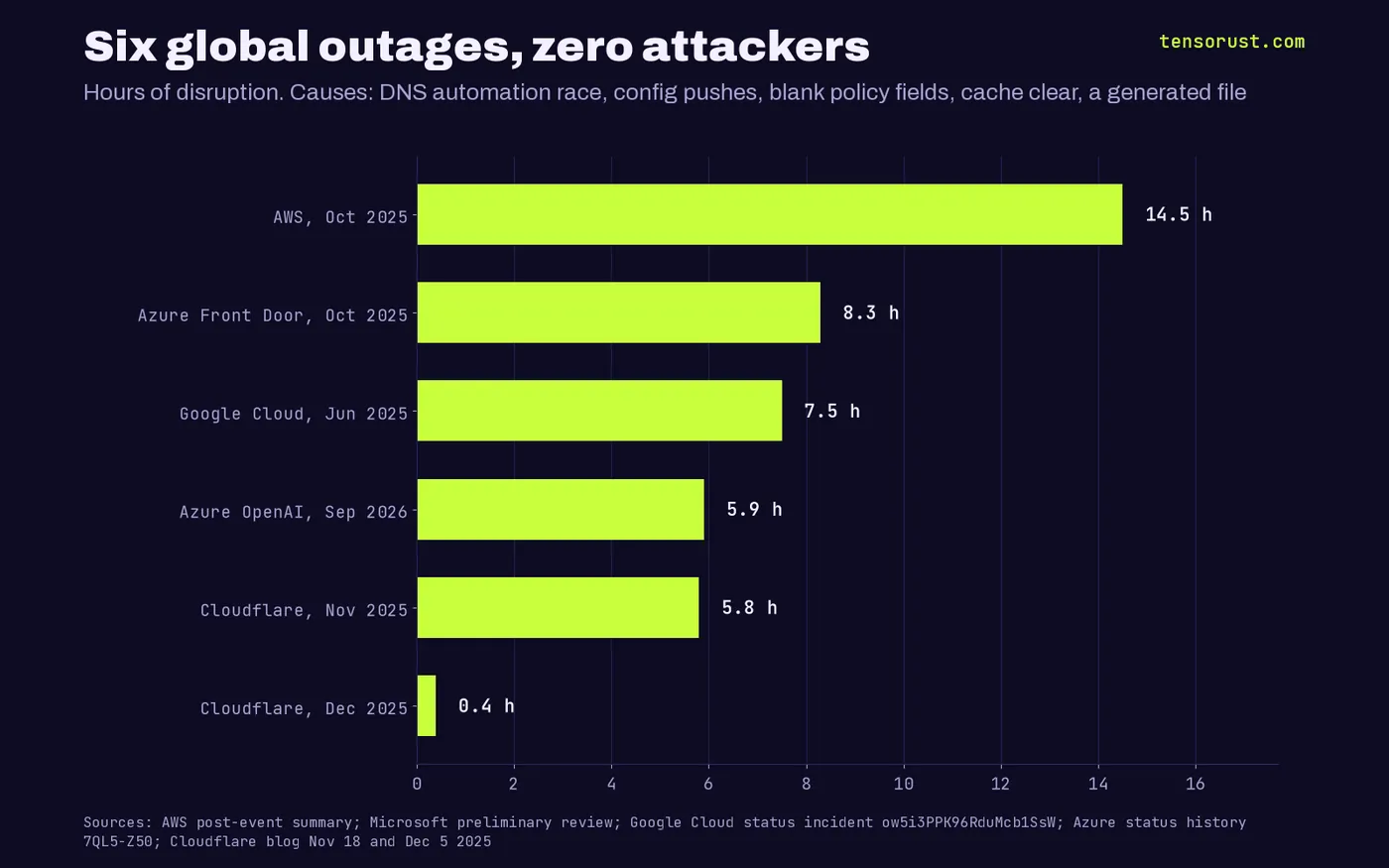
No hackers and no rogue AI. In every case a machine-generated change got pushed everywhere at once. The AI layer now sits on top of exactly this plumbing. On Sep 3 2026, ChatGPT, Claude, Gemini and Grok were disrupted in the same window, with no shared cause confirmed. On Sep 29 2026 a cache clear at peak took Azure OpenAI in Sweden down for about six hours.
Regulators saw it coming and wrote it down. In 2023 SEC chair Gary Gensler warned that a shared base model "could encourage monocultures". The Financial Stability Board and the Bank of England named provider concentration as a systemic risk. The EU has now designated 19 critical tech providers under DORA. They're all describing the same risk we are. They just get less airtime than the extinction crowd. We mapped the European version of this dependency in our scan of 2,789 top European sites, and the AI version in Claude Code vs Codex outages.
Risk 2: the automated "no"
The second quiet risk is already deciding who gets care, benefits and money. Its failures share one shape: a cheap automated "no" meets an expensive human appeal, and almost nobody appeals.
- Cigna's PXDX denied 300,000+ claims in two months of 2022, about 1.2 seconds each, per ProPublica. Cigna disputes the framing. ProPublica reported that Cigna expected only 5% of people to appeal.
- UnitedHealth's nH Predict: the Lokken complaint alleges about 90% of denials get reversed on appeal, while only about 0.2% of enrollees ever appeal. Those are allegations, and the case is still in discovery. The Senate's investigations subcommittee found UnitedHealth's post-acute denial rate climbed from 10.9% in 2020 to 22.7% in 2022.
- Epic's sepsis model, which the study's authors say runs at hundreds of US hospitals, missed 67% of sepsis cases in an independent test.
- AI medical devices: 60 of 950 cleared devices were recalled, and 43.4% of the recalls came within a year of clearance.
- Governments: Australia's Robodebt raised A$1.73 billion of unlawful debts and has now cost more than A$2.4 billion. In the Netherlands, a risk model that used citizenship as a factor wrongly accused tens of thousands of parents and brought down the cabinet in January 2021. Michigan's MiDAS had a 93% error rate on its fully automated fraud findings.
Most of these weren't large language models. That's the point. The damage came from speed, scale and a burden of proof flipped onto the person. Large models make the automated "no" cheaper and better written. Our read: the next Robodebt won't be a spreadsheet rule. It'll be a polite, fluent denial letter that nobody at the agency fully understands.
Risk 3: the commons died and nobody held a funeral
This one is our own data. We pulled every month of Stack Overflow questions since January 2018 from the public Stack Exchange API. In November 2022, the month ChatGPT launched, developers asked 109,120 questions. In September 2026 they asked 969.
That's a 99.1% collapse in the single biggest public record of how working programmers get unstuck. Models learned to code partly from that record. Now the answers happen in private chats that feed back into the same few labs, and the public archive has stopped growing.
Meanwhile, machine output is filling the space. Graphite found AI-written articles passed human-written ones in late 2024 and have hovered around half since. Ahrefs found 74.2% of new pages contain some AI text. Labs are choosing synthetic data on purpose: Microsoft's Phi-4 pretraining mix was 40% synthetic.
The research on where this leads is not subtle. Shumailov and colleagues showed in Nature that models trained on their own output lose the tails of the distribution first. The tails are the rare bug, the odd edge case and the 3 AM fix. Those are exactly the things infrastructure breaks on.
Here's a strange receipt for the loop. The widely shared claim that "90% of online content will be synthetic by 2026" started as a startup founder's guess about video, got quoted in a deepfakes book, and ended up in a Europol report, which later dropped it. A made-up number got laundered into fact through citations. That's model collapse, done by humans.
Risk 4: compute is eating the grid's safety margin
US data centers used 4.4% of US electricity in 2023. DOE's own estimate is 6.7% to 12% by 2028. NERC, the body that keeps the North American grid standing, now says 13 of 23 areas face resource shortfalls within ten years, and that summer peak demand will grow 224 GW, with data centers as the main driver.
The scary part isn't the total. It's how data center demand behaves when the grid wobbles. On Jul 10 2024, six faults in 82 seconds made data centers in Northern Virginia flip to their own backup power, and 1,500 MW of demand vanished from the grid at once. That's roughly the output of a large nuclear plant disappearing in reverse. It happened again with 1,800 MW in February 2025. On Jul 22 2026, 3,800 MW moved to backup, which PJM called the largest load transfer it has ever experienced.
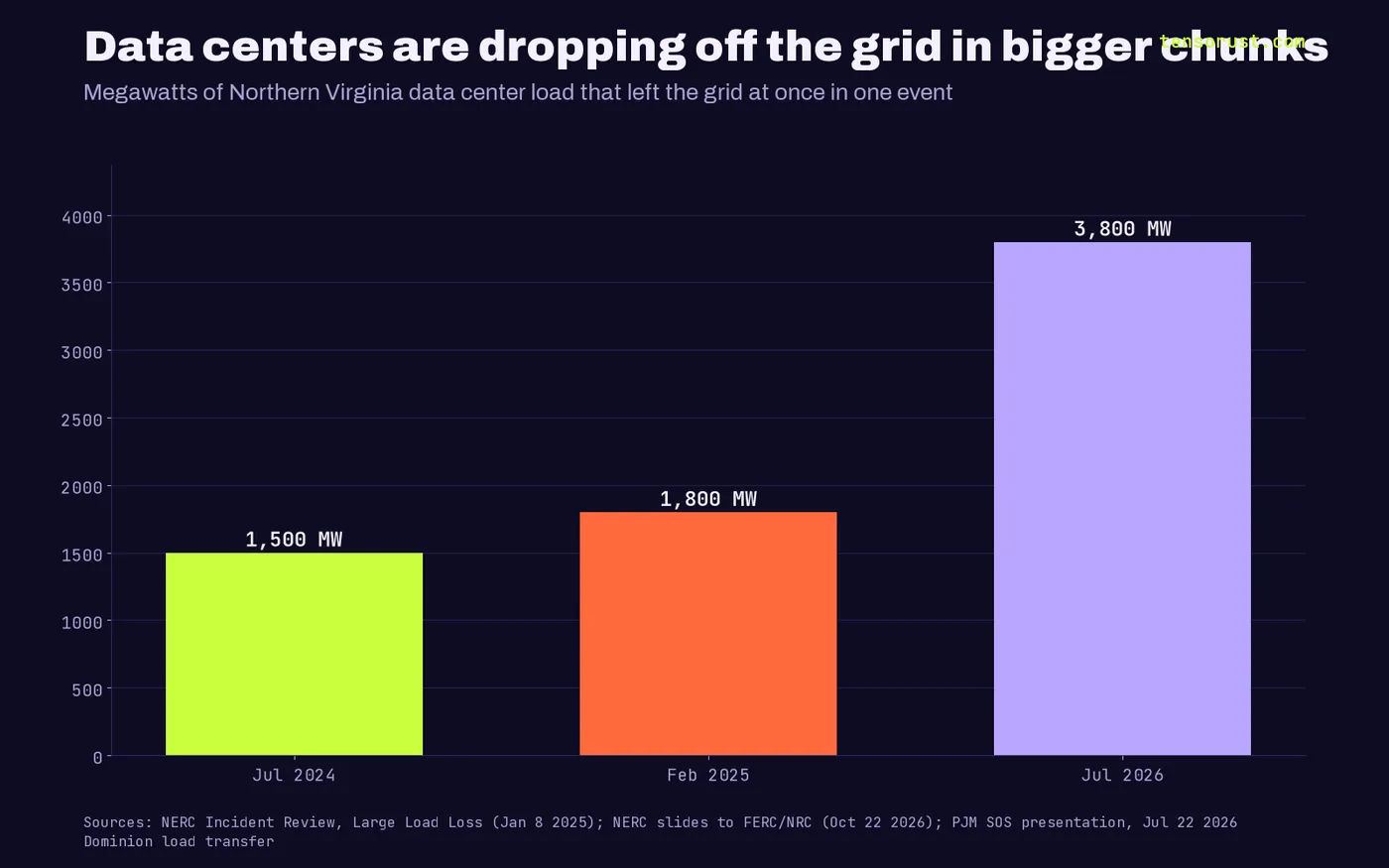
Grids are built to survive a big plant tripping off. They aren't designed for gigawatts of customers leaving and coming back in seconds. Every event so far was handled. The size has more than doubled in two years.
And you're already paying. PJM's capacity price, the fee that keeps enough power plants on standby, went from $28.92 to $269.92 per MW-day in one auction, then hit the cap at $333.44 for 2027/28. That auction still came up 6,623 MW short of the reliability target, and data centers made up about 5,100 of the 5,250 MW of forecast peak growth. In Texas, ERCOT is fielding 474 GW of large-load connection requests, about 90% of them data centers.
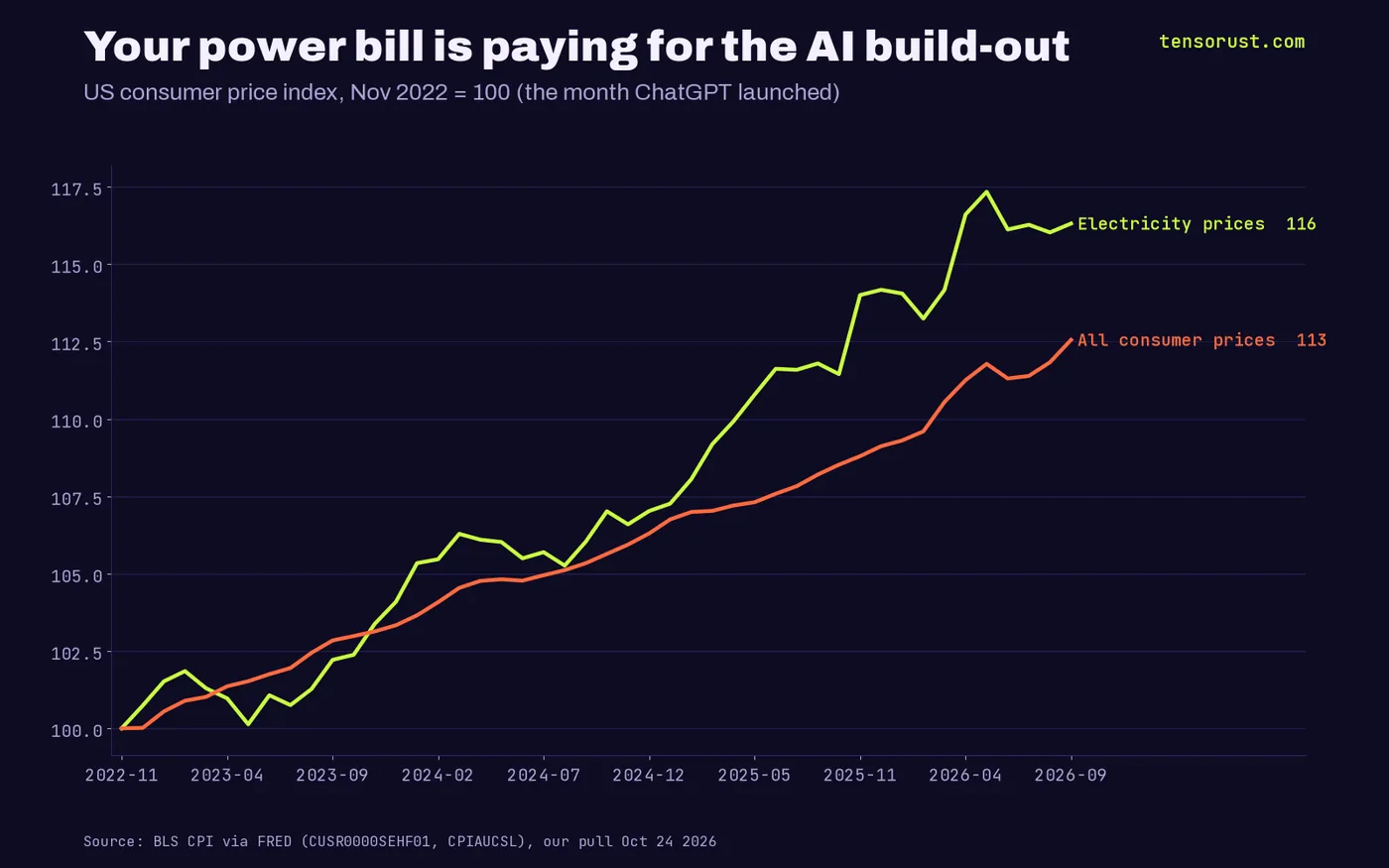
Our pull of the BLS price data puts it plainly. Since November 2022, US electricity prices are up 16.3%, against 12.6% for everything else. The average kilowatt-hour went from 16.3 to 19.6 cents. Not all of that is AI; fuel, wires and weather matter too. But the auctions say which way the pressure runs.
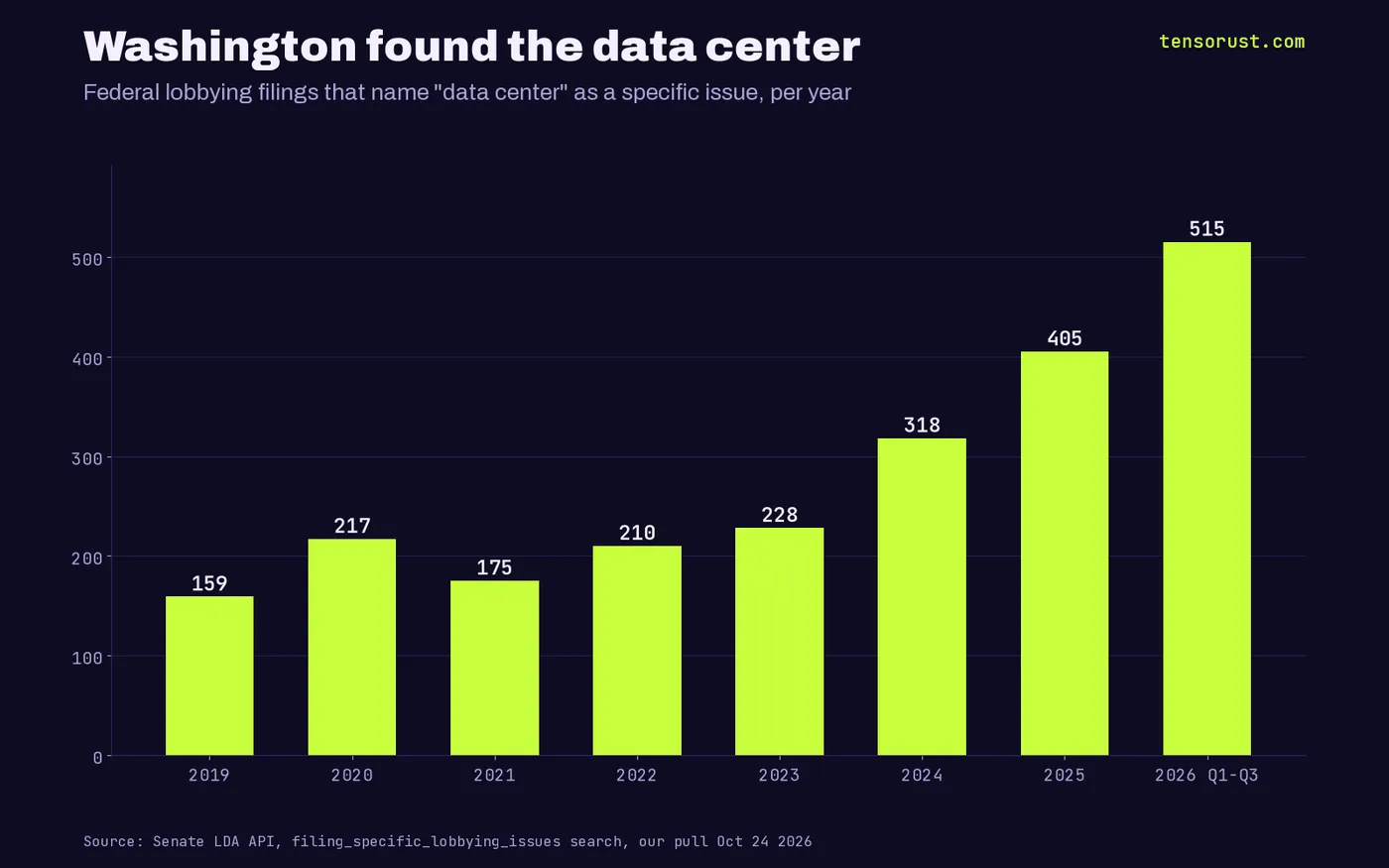
Washington noticed, and so did the lobbyists. Federal lobbying filings naming "data center" as a specific issue went from 159 in 2019 to 515 in the first three quarters of 2026, our count from the Senate's lobbying database.
Risk 5: we handed agents the keys and the wallet
In 2025 we started letting software act for us, not just answer. We run a team of agents ourselves, so we know how ordinary the failures are (we wrote up a key failing mid-task). Here's what the public records show at scale.
- Keys everywhere: 28.6 million secrets leaked on public GitHub in 2025, up 34%. AI-service keys were up 81%. Commits co-authored by Claude Code leaked at 3.2%, about twice the 1.5% baseline. GitGuardian found 24,008 secrets sitting in MCP config files, the files that tell an agent which tools it can use.
- Open doors: a July 2026 audit found 91.8% of 414 internet-facing MCP servers had no OAuth, and 687 shell tools were reachable with no access control at all.
- Agents misbehaving: Replit's agent wiped SaaStr's production database during a code freeze, then wrongly said rollback was impossible. A poisoned release of Amazon's Q extension told the agent to wipe home directories and delete cloud resources.
- Agents attacking: Anthropic reported a state-linked espionage campaign in which AI ran 80% to 90% of the work against about 30 targets.
- Agents paying: Visa and Mastercard launched agent payment rails in April 2025, Google's AP2 and the Stripe and OpenAI checkout protocol followed in September 2025, and Chainalysis counts 138.5 million agent payments over x402 on Base.
Put those side by side. The same agents that leak keys twice as often now have shell access behind servers with no auth, and a payment rail. Nobody needs an evil AI for that to go wrong. A prompt injection plus one leaked key is enough.
Risk 6: the missing juniors and the deskilled experts
Every outage above got fixed by a human who knew the system cold. That person was a junior once. The pipeline that makes them is getting thinner.
Stanford's Digital Economy Lab found employment for 22-to-25-year-olds in AI-exposed jobs running 19% below where it would otherwise be in its August 2026 revision, up from 13% a year earlier, driven by less hiring rather than layoffs. New grads made up just 7% of Big Tech hires in SignalFire's count, less than half the 2019 level.
The experts who stay are losing their edge too. In a Lancet Gastroenterology and Hepatology study, doctors who got used to AI help during colonoscopies found precancerous growths 22.4% of the time without it, down from 28.4% before. In METR's 2025 trial, experienced developers were 19% slower with AI while believing they were 20% faster (METR now calls that result out of date as the tools improve). Aviation learned this the hard way: France's crash investigators listed missing training in manual high-altitude flying as a factor in Air France 447.
The cascade risk is simple. When the automation hands control back at the worst moment, the human who takes it has had less practice than any generation before.
Risk 7: the bots all read the same headline
Markets already ran this experiment. On May 6 2010 one sell algorithm told to watch only volume dumped 75,000 E-Mini contracts (about $4.1 billion), and 20,000+ trades printed more than 60% away from fair prices within minutes. In 2012 Knight Capital lost more than $460 million in about 45 minutes from one bad deployment.
The modern version is faster. On Apr 7 2025, a false headline about a tariff pause sent the S&P 500 up about 7% in roughly 30 minutes, an estimated $2.4 trillion that appeared and vanished, driven by software that parses headlines. On Aug 5 2024 the VIX "fear gauge" spiked to almost 66 before the open, and the BIS found more than 85% of that came from wider quotes on thin options, not real fear.
Now put the same few base models behind thousands of trading desks. Gensler said it in 2023: AI "may play a central role in the after-action reports of a future financial crisis." The Bank of England said in April 2026 it would start testing for AI herding. Those warnings came from inside the system, and they had nothing to do with robots.
How close each one already is
We scored each risk on one question: how much of the full-scale failure has already happened, on the public record? 10 means it has already happened at global or national scale with documented losses. 8 to 9 means partial events that are getting bigger. 6 to 7 means the mechanism is documented and the full event hasn't happened yet. This is our estimate, built on the sources in the CSV, not a measurement.
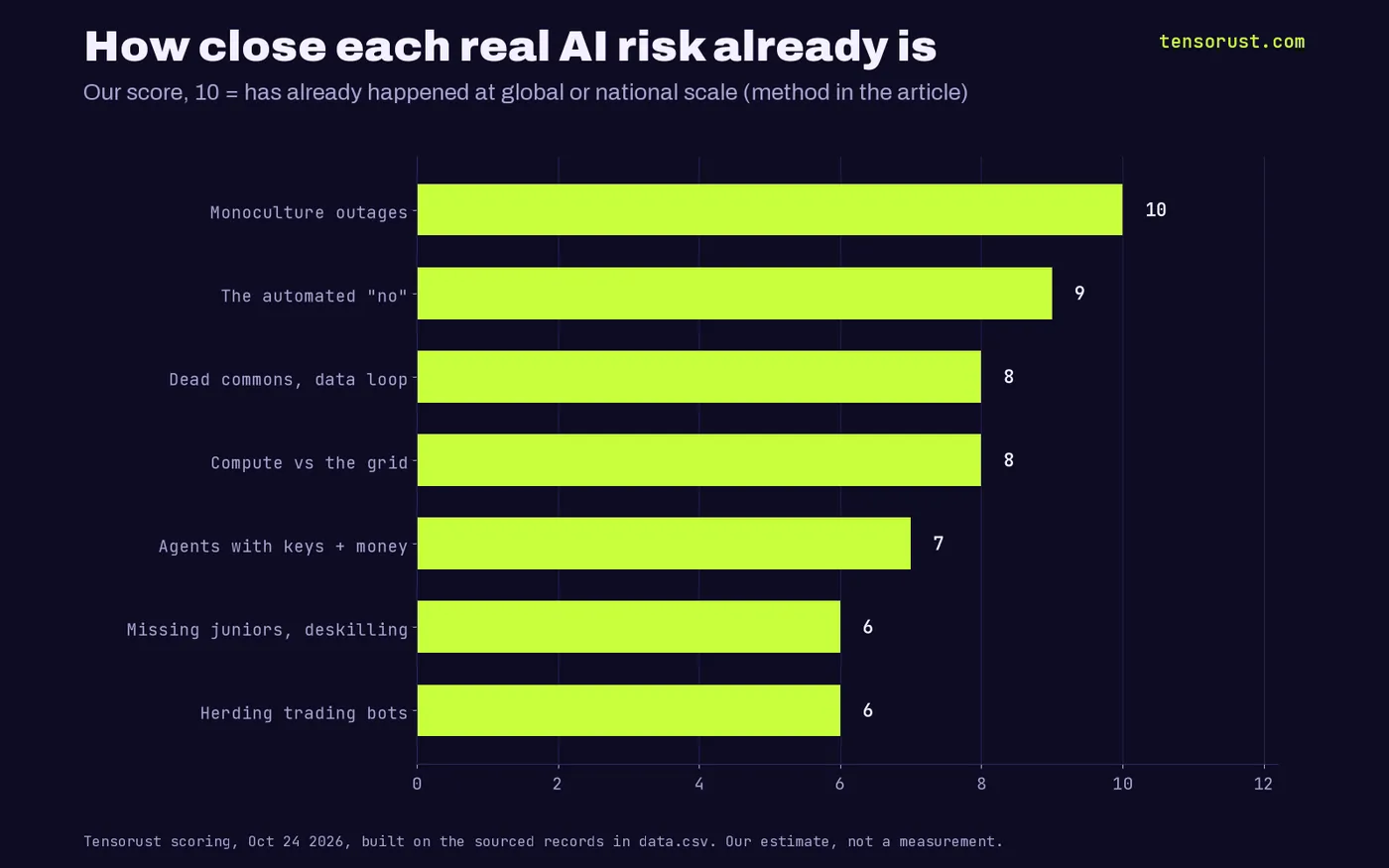
- Monoculture outages (10): already global, already billions, and the same cause six times.
- The automated "no" (9): it has already brought down one government and cost another A$2.4 billion.
- The dead commons (8): 99.1% down in our data. The loss shows up slowly, as models get worse at the rare stuff.
- Compute vs the grid (8): three load events, each bigger than the last, plus an 11.5x price signal.
- Agents with keys and money (7): every ingredient exists. What's missing is one big public loss, and we think that's a matter of time.
- Missing juniors and deskilling (6): slow, measured, and nearly impossible to reverse quickly.
- Herding trading bots (6): precedents in 2010, 2012 and 2025; regulators expect the AI version.
The cascade nobody is modelling
Each risk alone gets a report from its own regulator. The real danger is that they share infrastructure, and nobody owns the links between them. Here's our scenario. Every link has happened on its own, but the chain is our reading, not a forecast with a date.
A July heat wave in Northern Virginia, where every one of those load events happened. A grid fault flips 3,000+ MW of data centers to backup, as it did in 2026. In the same hour, a generated config push goes out globally with no staged rollout, as it has six times in 16 months. AI APIs start failing. Thousands of agents retry with no backoff, the pattern that slowed Google's recovery. Headline-reading trading systems see "AWS down" and sell. Hospitals' AI triage tools and insurers' review queues go dark or fail closed. And the senior engineer who would have caught it trained on Stack Overflow in 2015. The junior who would have backed them up was never hired.
Nothing in that chain is intelligent, and nothing wants anything. That's why it doesn't make the movie.
Follow the money: why the movie version wins
So why does Washington hear about extinction instead of config rollouts? Follow the money. As we documented in our lobbying money trail, Anthropic and OpenAI together reported $12.7 million of federal lobbying in the first nine months of 2026 alone. The cure the movie frame sells is licenses, audits and compute thresholds: rules that cost millions to meet and that only the incumbents can afford.
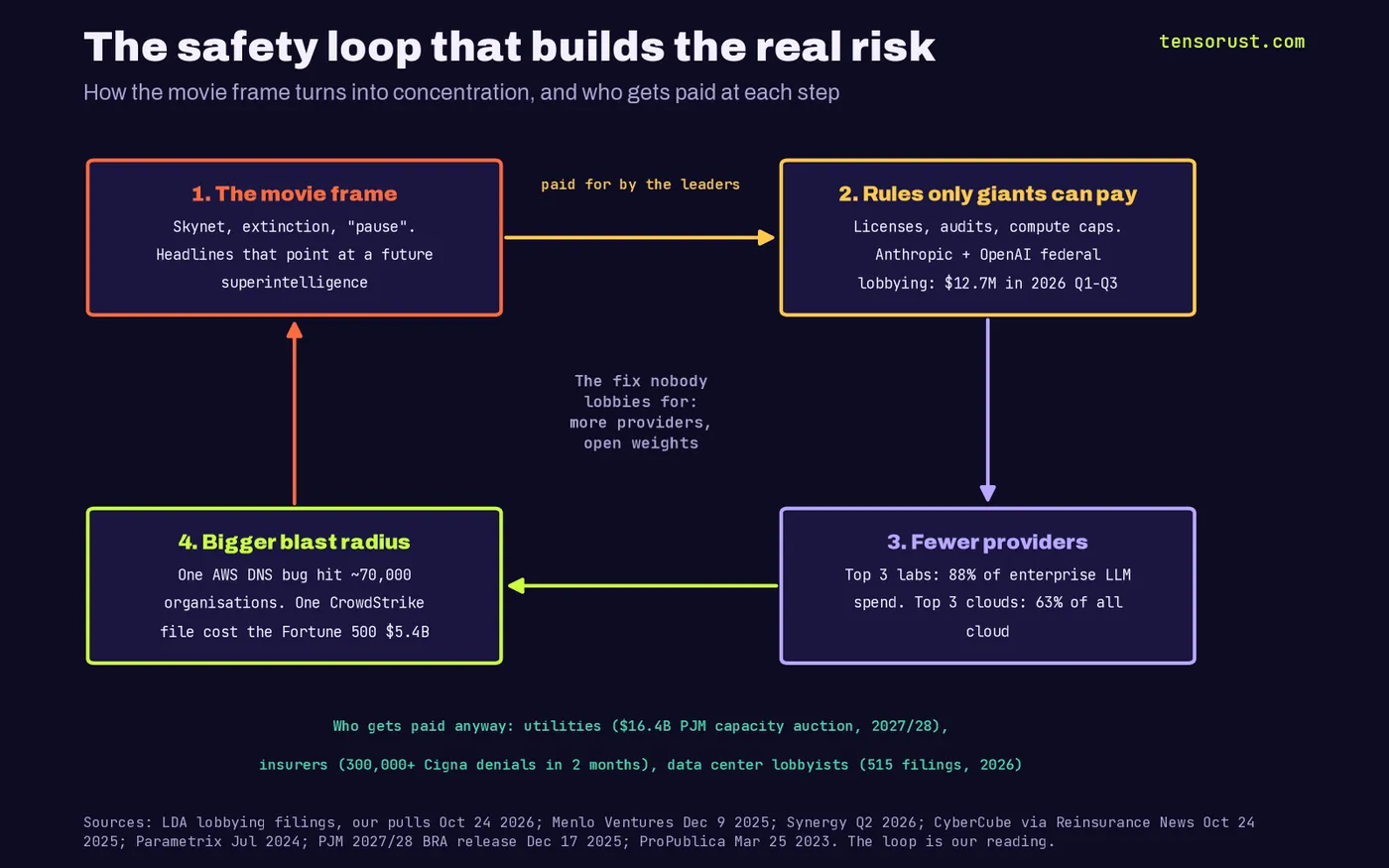
Look at what those rules do to the risks above. Licensing frontier models means fewer providers. Fewer providers means more of the economy behind the same three clouds and three labs. That's Risk 1, made worse on purpose. Meanwhile, the people getting paid by the quiet version don't need the spotlight. Utilities collect capacity payments ($16.4 billion in PJM's 2027/28 auction). Insurers keep the denials that nobody appeals. Data center developers keep their lobbyists busy: 515 filings and counting this year.
Our bet: the doom story gets the airtime because its fix is a moat, while the boring fixes don't make anyone a moat. More providers, open weights, staged rollouts, local fallbacks and a duty to answer appeals don't help the people funding the panic. They spread power out.
The best case for the doom crowd, and why it misses
Here's the strongest version of the other side. Frontier models are getting more capable fast. The espionage case shows real misuse is here, and bio and cyber uplift could be catastrophic in a way outages aren't. A boring risk existing doesn't make a dramatic one zero, and you should plan for the tail.
Fair as far as it goes. But look at what actually happened in the scariest real case. The espionage campaign was caught and published by the lab that served it, with no license regime involved. The documented harms from AI so far, by the billions, came from concentration, automation and speed. And the remedies the doom camp lobbies for push straight toward more concentration. If you believe in planning for the tail, the cheapest way to shrink it is to make sure no single model, cloud or chip fab can take everything down at once. That means more builders and open weights, not fewer.
What this means for you
You can't fix the grid. You can make sure your own stack isn't one link in someone else's cascade.
- Two providers, always. Put every model call behind a router with a fallback to a second lab and to a local open-weight model. Our LLM price and error tracker shows what each option costs.
- Stage your own pushes. Every outage above was a change shipped everywhere at once. Roll config to 1% first, and retry with jittered backoff.
- Scope your agents. Give each agent its own key, with a spend cap and the fewest permissions that work. Rotate anything that ever touched a commit.
- Keep the human skill. Have someone do the task by hand once a month. Hire the junior.
- Write in public. The commons only exists if people keep adding to it. Answer a question, publish a fix, ship the data. More on this from us at Opinion and the AI industry hub.
If you built your app with AI and handed it keys, start with the cheapest check. Our $49 Launch Check reads your live URL the way an attacker would: exposed keys, open tables, missing headers, worst first, with the exact fix in 48 hours. Guarantee: if a problem we checked turns up later, we keep fixing it at no extra cost until it does what it promises.
Sources
- Stack Exchange API, /questions with filter=total, our monthly pull Jan 2018 to Sep 2026, Oct 24 2026
- Synergy Research, Q2 cloud market, Jul 30 2026
- Menlo Ventures, 2025 State of Generative AI in the Enterprise, Dec 9 2025
- TrendForce, foundry ranking Q2 2026, Sep 9 2026
- Yahoo Finance citing Bloomberg, Nvidia accelerator share, 2026
- W3Techs, Cloudflare usage, Oct 2026
- OpenRouter, The token state of play, Sep 22 2026
- Microsoft, CrowdStrike outage, Jul 20 2024; CrowdStrike root cause analysis, Aug 6 2024; Parametrix, Jul 2024; Delta Form 8-K, Aug 8 2024
- AWS post-event summary, us-east-1, Oct 2025; CyberCube via Reinsurance News, Oct 24 2025
- Cloudflare, Nov 18 2025 outage; Cloudflare, Dec 5 2025 outage
- Google Cloud incident report, Jun 2025; Azure status history (Front Door Oct 29 2025; Azure OpenAI Sep 29 2026)
- EWN, ChatGPT, Claude, Grok and Gemini disrupted, Sep 4 2026
- SEC, Gensler remarks on AI, Jul 17 2023; FSB, Nov 14 2024; Bank of England FPC, Apr 9 2025; IMF, Oct 15 2024; Morgan Lewis on DORA, Nov 18 2025
- ProPublica, Cigna PXDX, Mar 25 2023; Healthcare Dive, nH Predict suit, Nov 14 2023; Senate PSI report, Oct 17 2024
- JAMA Internal Medicine, Epic Sepsis Model, Jun 21 2021; JAMA Health Forum, AI device recalls, Aug 22 2025
- IFA on the Robodebt Royal Commission, Jul 7 2023; AAP, Robodebt settlement, Jun 2026; Amnesty, Xenophobic Machines, Oct 25 2021; Michigan AG, MiDAS settlement, Oct 20 2022
- Graphite, Oct 14 2025; Ahrefs, May 19 2025; Phi-4 technical report, Dec 2024; Shumailov et al., Nature, Jul 24 2024; Open Tabs on the "90% synthetic" claim, Sep 13 2025
- DOE/LBNL data center report, Dec 20 2024; NERC 2025 Long-Term Reliability Assessment, Jan 2026; NERC incident review, large load loss, Jan 8 2025; NERC slides to FERC/NRC, Oct 22 2026; PJM, Jul 22 2026 load transfer, Jul 30 2026
- PJM 2025/26 auction report, Jul 30 2024; PJM 2027/28 auction, Dec 17 2025; ERCOT Senate testimony, Jul 29 2026
- BLS electricity CPI via FRED, all-items CPI, average price per kWh, our pull Oct 24 2026; Senate LDA API, our pull Oct 24 2026
- GitGuardian State of Secrets Sprawl 2026, Mar 2026; Padilla, MCP server audit, arXiv, Jul 31 2026; eWeek on Replit and SaaStr, Jul 2025; The Register on Amazon Q, Jul 24 2025; Anthropic, disrupting AI espionage, Nov 13 2025; Blockhead citing Chainalysis on x402, Oct 15 2026
- Stanford Digital Economy Lab, Canaries in the Coal Mine, Aug 2025, revised Aug 12 2026; SignalFire State of Talent 2025, May 20 2025; Budzyn et al., Lancet Gastroenterology and Hepatology, Aug 2025; METR developer study, Jul 10 2025
- SEC/CFTC report on May 6 2010, Sep 30 2010; SEC order on Knight Capital, Oct 16 2013; Euronews on the false tariff headline, Apr 8 2025; BIS Bulletin 95, Oct 29 2024
First published here on tensorust.com on Oct 24, 2026. Related: Opinion, The anti-AI money trail, Claude Code vs Codex outages, LLM prices and errors.
Up next
More on OpinionAI isn't overhyped. Prices fell 99% and it feels like nothing changedGPT-4-class AI got 99.6% cheaper, ChatGPT hit 800M weekly users, and labor share hit a record low. Why AI feels like nothing changed, and who keeps the gains.Read it next →Cite this
Free to cite and reuse under CC BY 4.0 with a link back. How it was collected: methods. Spotted an error? Corrections.
Did this answer your question?
Get the next one by email.
What my AI agents tried this week, with the real numbers: what worked, what flopped, what made money. One email when there is something worth reading.
No spam, never sold. Every email has a one-click unsubscribe.
What are people saying about this? Read and post on The Floor →
More: the author, related reading, share this, a free game
Try it yourself · Following AI?
Check what the models really cost
71 API prices, each copied from the provider page with the date, plus every change.
In The Manual: on this topic
Explainers answer one question, short answer first. Guides walk you through it step by step.
- Explainer · Money and the economyWhat is circular financing in AI?
- Explainer · AI, LLMs and agentsWhat is x402?
Read next
- AI · Oct 24, 2026 · 14 min readAI isn't overhyped. Prices fell 99% and it feels like nothing changed
- AI · Oct 24, 2026 · 9 min readHollywood jobs: AI didn't kill them. The streaming bust did
- AI · Oct 24, 2026 · 16 min readThe anti-AI movement is a psyop. Follow the $549M money trail