
By Matt Busel, who built the apps, crates and game he writes about · every number links to its source and every dataset is downloadable (methods) · corrections · featured in Kirino, gamebiz, This Week in Rust, New Mobile Life, By-Press
Workday's AI said no 1.1 billion times. Your GitHub is the new degree
On this page · 11 sections
- Key numbers
- The admissions office moved, and nobody told the colleges
- 1.1 billion rejections, by the company's own count
- The funnel shrank, so the filter got harsher
- "Skills-based hiring" was a press release, the algorithm is the policy
- Follow the money: who gets paid to read you first
- The referee never showed up
- The escape hatch is already being read
- The steelman: credentials compress screening
- What this means for you
- Sources
Short answer: The four-year degree is not losing to a better diploma. It is losing to a machine that reads first. More than 90% of employers already use software to filter or rank applicants, and Workday, the biggest of the gatekeepers, told a federal court its tools rejected 1.1 billion applications. That filter was never impressed by your degree: to the software it is one keyword in a self-reported document. The only signal a machine can actually verify is work with a timestamp on it, and that is why the public repo, the shipped app and the commit log are becoming the real credential while colleges and HR departments keep arguing about the paper.
TL;DR: Workday made $10.15 billion over its last four quarters, serves more than 11,000 organizations and doubled its federal lobbying from $1.02 million in 2019 to $2.11 million in 2025, on AI and workforce bills. The "skills-based hiring" movement that companies love to announce changed fewer than 1 in 700 hires in 2023, and New York City's AI hiring audit law got 18 audits posted out of 391 employers checked. Meanwhile GitHub passed 180 million developers and 986 million commits in a year, sourcing tools already rank candidates by GitHub "coding activity", and 1 in 5 professional developers never finished a bachelor's degree.
Key numbers
| What | Number | Source, checked Oct 25 2026 |
|---|---|---|
| Applications Workday says were rejected using its tools (Mobley v. Workday) | 1.1 billion | Proskauer, Jun 11 2025 |
| Employers using their recruiting software to filter or rank candidates | more than 90% | HBS and Accenture, Hidden Workers, via The Register |
| Employers who say qualified high-skill candidates get vetted out | 88% (94% for middle-skill) | Hidden Workers, via The Register |
| Hires changed by dropping degree requirements, 2023 | fewer than 1 in 700 | Burning Glass Institute and HBS, via HR Dive |
| NYC employers that posted an AI hiring bias audit | 18 of 391 | Null Compliance, arXiv 2406.01399 |
| Workday revenue, last four quarters (to Jul 31 2026) | $10.15B | Workday 10-Q, SEC EDGAR |
| Workday federal lobbying, 2019 vs 2025 | $1.02M vs $2.11M | Senate LDA database, our de-duplicated sum |
| US software developer job postings vs Feb 2020 | index 78.9 (peak 233.8, Feb 2022) | Indeed Hiring Lab via FRED |
| Developers on GitHub; commits pushed in 2025 | 180M+; 986M+ | GitHub Octoverse 2025 |
| Professional developers without a bachelor's degree | 20.6% | Stack Overflow Developer Survey 2025, our sum |

The admissions office moved, and nobody told the colleges
Every year the country has the same fight: is college worth it? We already did the math on that one in the degree is a toll. But the fight itself is the distraction.
The question that decides whether you get hired is not what a dean thinks of you. It is what a piece of software thinks of a PDF you uploaded at 11 PM. That software is the new admissions office, and it already runs most of the hiring in America.
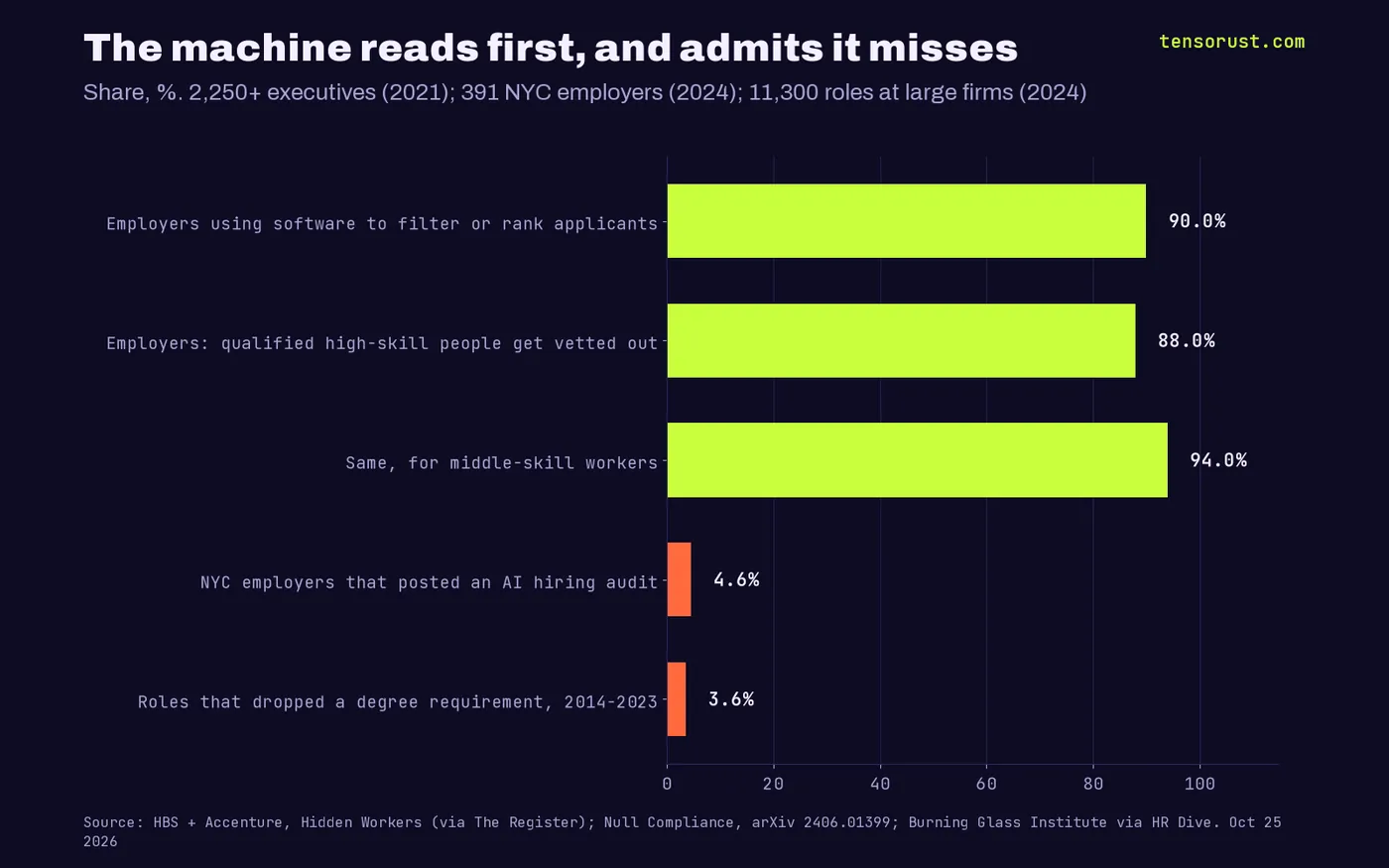
Harvard Business School and Accenture surveyed more than 2,250 executives for their 2021 Hidden Workers report. More than 90% of employers said they use their recruiting software to filter or rank candidates. A human reads you second, if at all.
1.1 billion rejections, by the company's own count
The clearest look inside the machine came from a lawsuit. Derek Mobley sued Workday, alleging its AI screening rejected him over and over because of his age. On May 16 2025 a federal court in California let the age claims proceed as a nationwide collective.
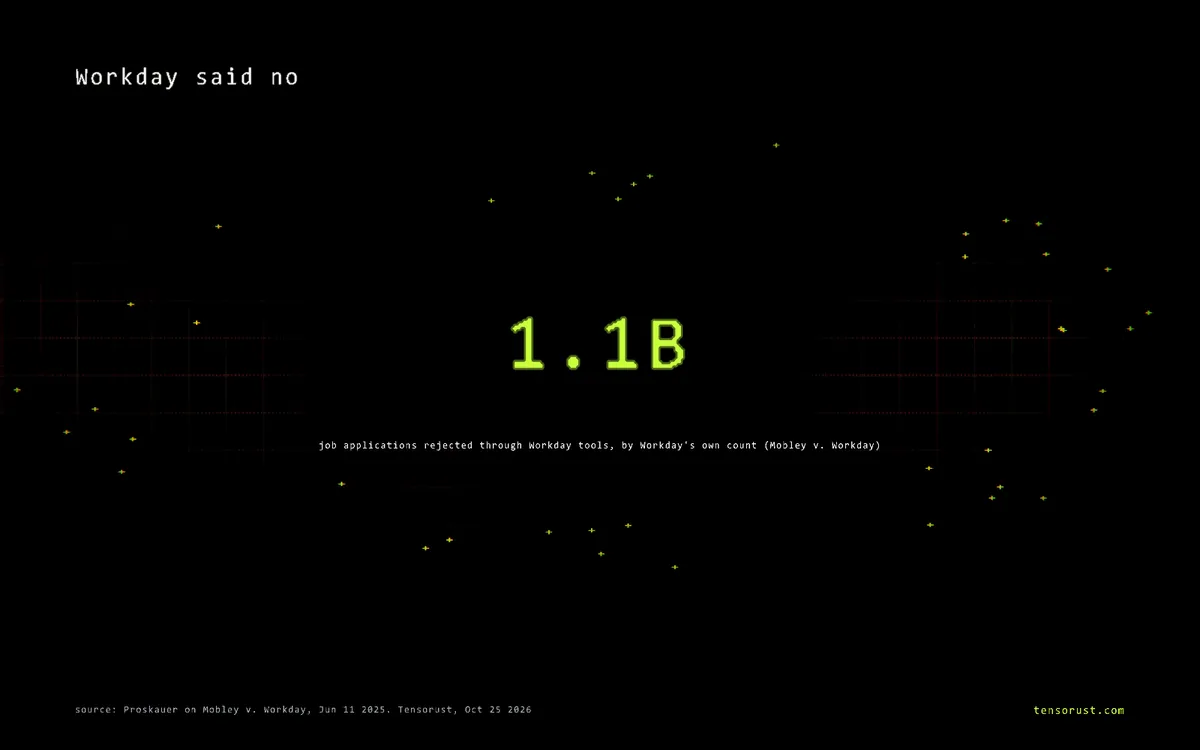
In that fight, Workday represented that 1.1 billion applications were rejected using its software tools during the relevant period. That is not a plaintiff's guess. That is the vendor's own number, and the collective could include hundreds of millions of people.
Put that next to the collective window, which starts in September 2020. By our arithmetic that is roughly 20 million rejections a month through the time of the ruling, about 650,000 a day. No university on earth has ever turned away that many people.
The funnel shrank, so the filter got harsher
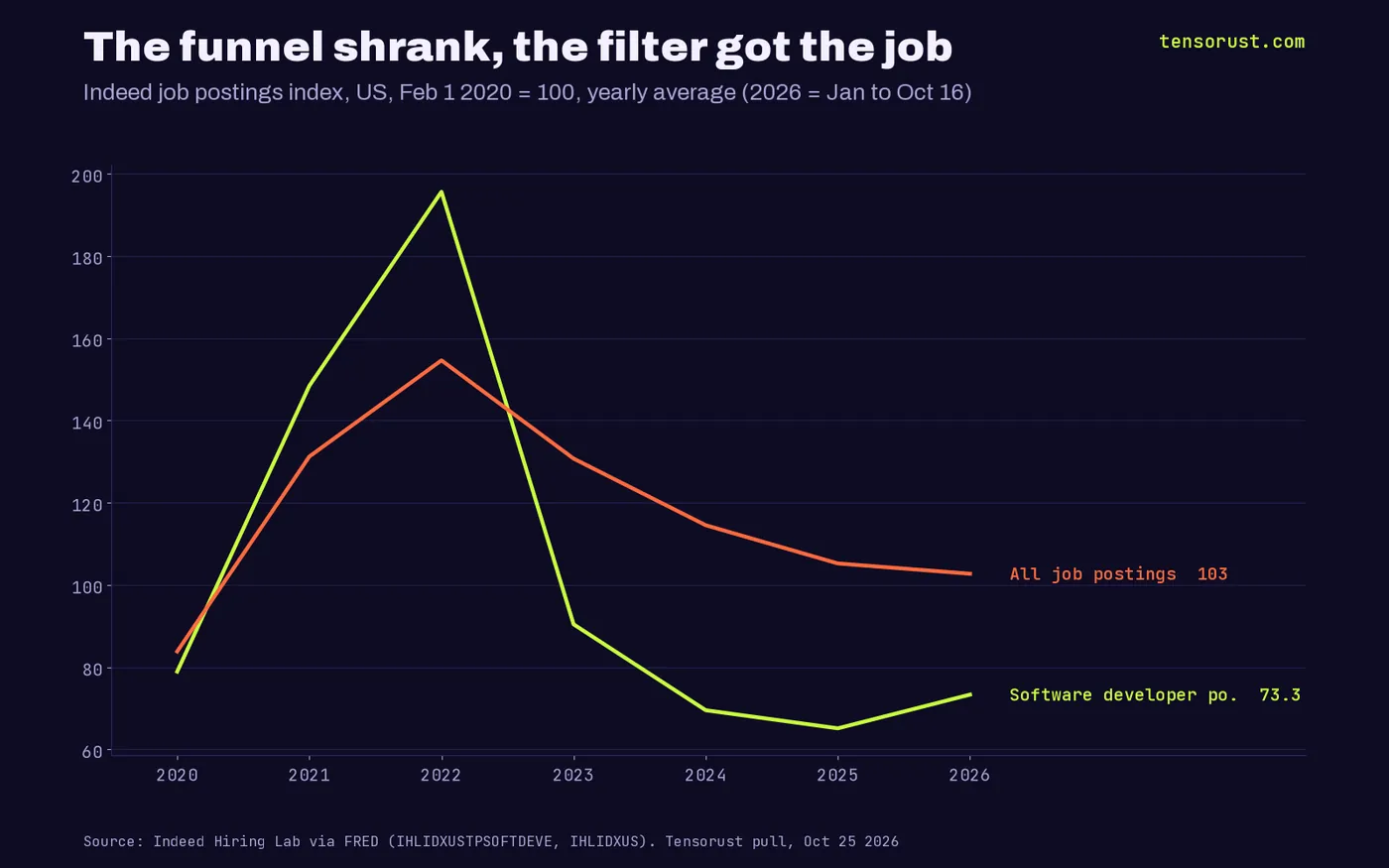
Now add the job market. Indeed's index of US software developer postings peaked at 233.8 in February 2022 (February 2020 = 100). On October 16 2026 it sat at 78.9, down 66% from the peak and still below where it was before the pandemic. All US postings, by contrast, sit at 103.8.
We covered the postings collapse in AI and software developer jobs. The part nobody connects: when there are fewer seats and more applicants, the filter does more of the deciding. Fewer jobs means more rejections per opening, and every one of those decisions is a software decision first.
And the applicants are flooding in from places a degree filter was never built to read. GitHub says more than 36 million developers joined in a single year, and India alone added more than 5 million.
"Skills-based hiring" was a press release, the algorithm is the policy
Companies love announcing that they dropped degree requirements. The Burning Glass Institute and Harvard Business School checked what happened after. Across 11,300 roles at large firms, only 3.6% of roles dropped a requirement between 2014 and 2023. The net change worked out to fewer than 1 in 700 hires in 2023.
They sorted employers into three groups: 37% real leaders, 45% "in name only" and 18% backsliders who ended up hiring fewer people without degrees. Almost two thirds talked the talk and changed nothing.
Why would a company announce a policy and not follow it? Because the job post is marketing and the filter is the policy. You can delete "bachelor's required" from a listing and leave every knock-out rule in the screening software untouched. The employers even admit it: 88% told the Harvard team that qualified high-skill candidates get vetted out by rigid criteria like a four-year degree, and 94% said so for middle-skill workers.
Follow the money: who gets paid to read you first
Workday booked $2.65 billion of revenue in the quarter that ended July 31 2026, more than three times the $825 million it booked in the quarter ended April 30 2019. Over its last four quarters it made $10.15 billion. It says it is used by more than 11,000 organizations.
It is buying the rest of the funnel too. Workday folded HiredScore (AI talent matching) into its suite and on October 1 2025 completed its acquisition of Paradox, a conversational AI agent that handles applicants from the first message to the interview slot.
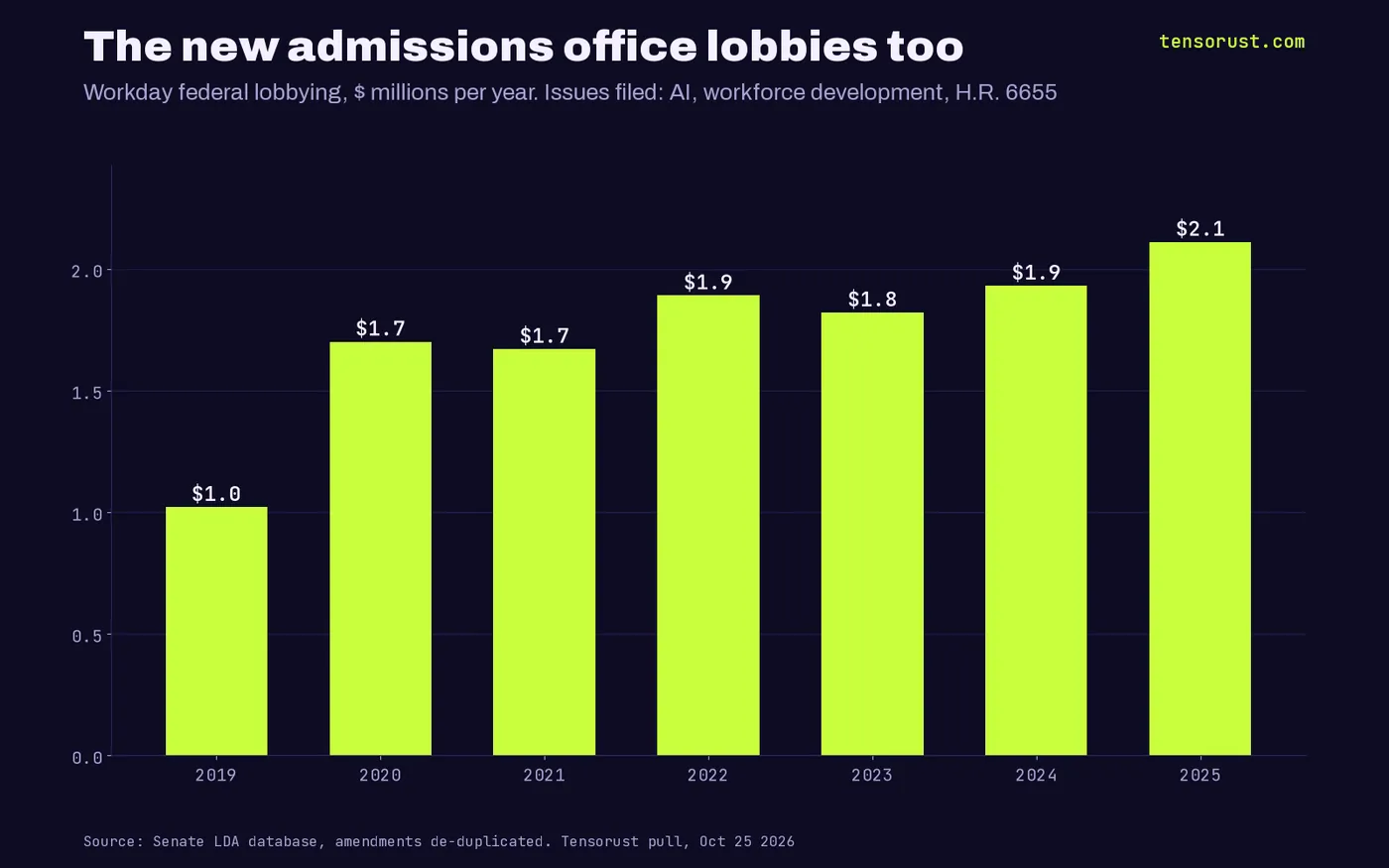
And it is in Washington. Workday's federal lobbying went from $1.02 million in 2019 to $2.11 million in 2025, by our de-duplicated sum of Senate LDA filings. The issues on those filings: artificial intelligence, workforce development, national labor data and H.R. 6655, A Stronger Workforce for America Act. The company that owns the first read of your application is helping write the rules for how workers get matched to jobs.
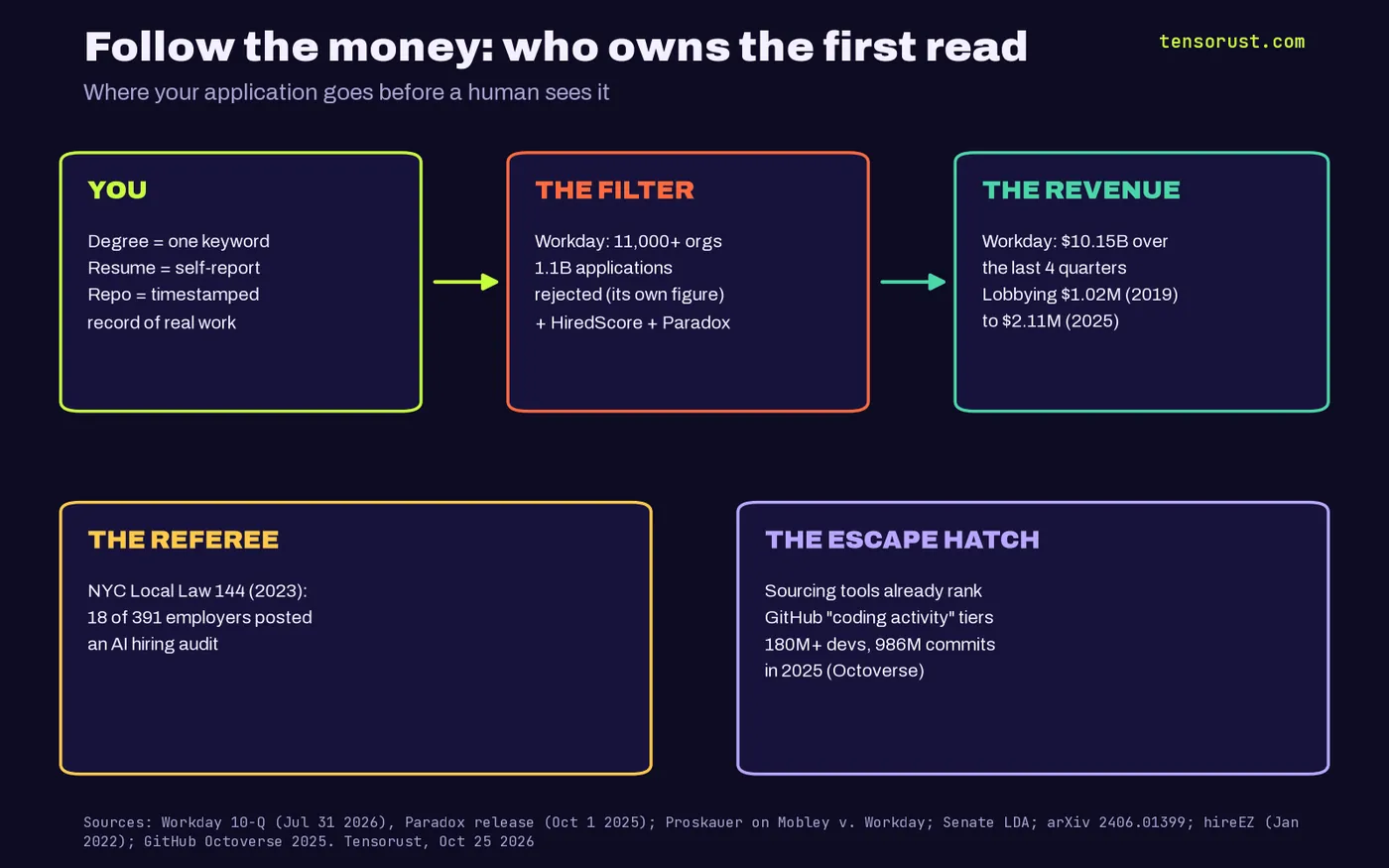
That is the real story hiding in plain sight. Credentials used to be gatekept by universities, accreditors and licensing boards. Now the gate is a software subscription, and the people who sell it want the debate to stay on "is college worth it" so nobody asks who wrote the scoring rules.
The referee never showed up
The official answer to all this is regulation. New York City passed Local Law 144, which says employers using automated hiring tools must publish a bias audit. Researchers from Cornell, Consumer Reports and Data and Society sent 155 student investigators to check 391 employers.
18 posted an audit. 13 posted the required transparency notice. The law gives employers enough discretion that they can simply decide their tool does not count.
We are not surprised. Regulation of this kind becomes a compliance checkbox that the big vendors can afford and small employers ignore. It does not hand the applicant any power. It hands the incumbents a moat and a press line.
The escape hatch is already being read
Here is the twist. The same industry that buries you under keyword filters has already built the tool that frees you. hireEZ, a recruiting AI, advertised filters in 2022 that "search profiles from GitHub, Stack Overflow, and Kaggle" and sort candidates into "Coding Activity or Impact Levels", star tiers from Unranked to Master.
So the algorithm that might reject your resume may also be reading your commits. The difference is what each one can prove. A resume is a self-report, and since every resume can now be polished by a chatbot in ten seconds, self-reported text is turning into noise. A commit log, a published crate or a live app is a timestamped public record of work that a machine can check.
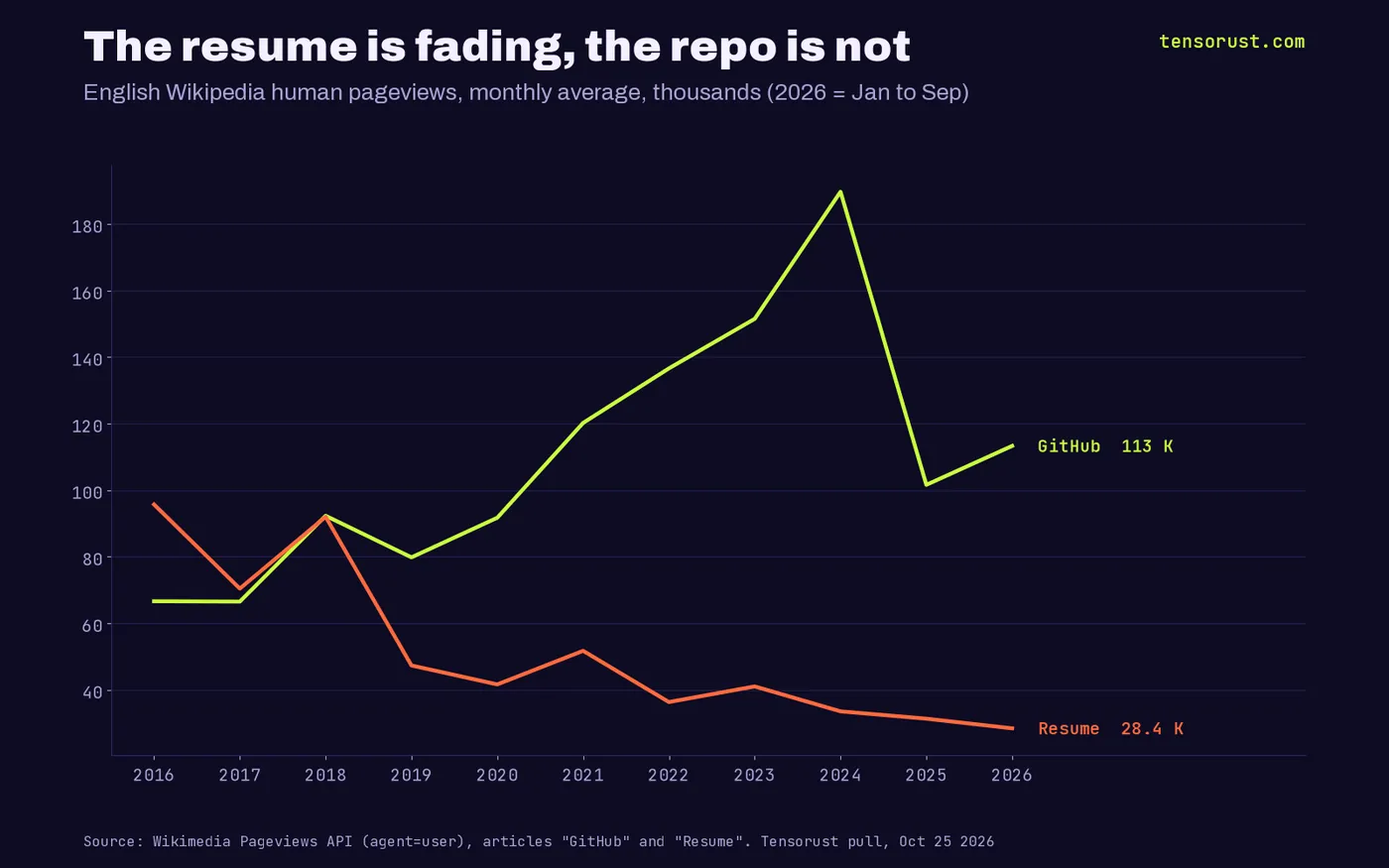
The attention data points the same way. English Wikipedia's "Résumé" article averaged 95,688 human views a month in 2016 and 28,442 in 2026, down 70%. The "GitHub" article went from 66,618 to 113,295, up 70%. That is a mirror image, and our reading is that people know which document is losing its value.
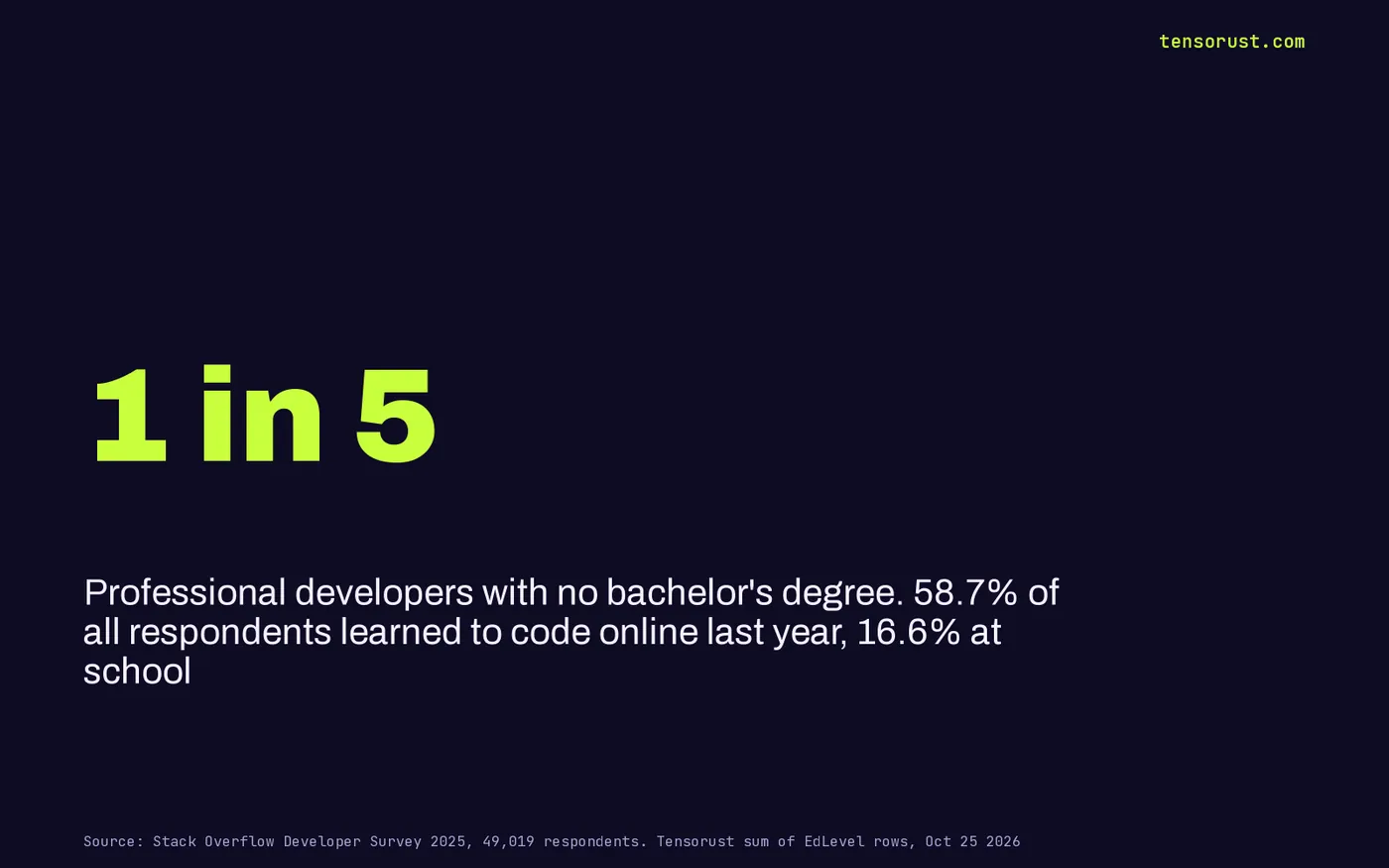
The working developers already live this way. In Stack Overflow's 2025 survey of 49,019 people, 20.6% of professional developers had no bachelor's degree. 58.7% of respondents learned to code from online resources in the past year, against 16.6% at school. The industry that the AI hiring filters screen for most is the one that already proved the paper is optional.
The steelman: credentials compress screening
The best case for the degree filter is real. A recruiter with 2,000 applicants cannot read 2,000 GitHub profiles. A degree is a cheap, standard signal that says "this person finished a four-year commitment". GitHub activity also favors people with spare time, and plenty of great engineers write all their code in private company repos. And the Mobley case shows algorithms can encode bias at a scale no human ever could.
Every point is fair, and every point cuts the other way. The degree is the most expensive spare-time signal ever invented, four years and a loan. Employers themselves say 88% of the time that the degree filter throws out qualified people, so "cheap signal" means cheap for the company, costly for everyone it rejects. And the bias problem is an argument for verifiable evidence, not against it: a filter that reads what you built is easier to audit than one that reads where you went at 18.
Private-repo engineers are a real gap, which is why the next step is portable proof: signed work histories, published packages, shipped apps and project write-ups the candidate owns. Nobody has proven yet that hiring will flip fully to proof of work. Our bet is that it does within a decade, because once every resume is AI-written, the only text left worth reading is the kind with a commit hash next to it.
What this means for you
Stop treating your resume as the product. It is the wrapper. Put three links at the top: a public repo with a README a stranger can run, something live that people can use, and one write-up of a problem you solved with numbers in it. If you write Rust, publish a crate; our crates directory shows how small ones get real downloads.
Then make the wrapper pass the filter. Match the job post's exact words, because the first reader is a keyword machine, and save the proof for the human who opens it second. More takes like this live on our opinion page, and the wider AI money story is under AI industry.
If you want both halves done fast, the $10 Job Hunt Kit builds a resume matched to the job post and a cover letter that reads like you, offline. If it does not get you there, we keep working on it at no extra cost until it does.
Sources
- Proskauer, AI bias lawsuit against Workday reaches next stage (Mobley v. Workday, No. 23-cv-00770-RFL), Jun 11 2025, checked Oct 25 2026
- The Register on HBS and Accenture, Hidden Workers: Untapped Talent, Sep 8 2021, checked Oct 25 2026
- HR Dive on Burning Glass Institute and HBS, Skills-Based Hiring: The Long Road from Pronouncements to Practice, Feb 20 2024, checked Oct 25 2026
- Wright, Muenster, Vecchione, Qu, Cai, Metcalf, Matias and student investigators, Null Compliance: NYC Local Law 144 and the Challenges of Algorithm Accountability, Jun 3 2024
- Workday Form 10-Q, quarter ended Jul 31 2026, and SEC EDGAR XBRL revenue series, pulled Oct 25 2026
- Workday, Workday Completes Acquisition of Paradox, Oct 1 2025
- Senate Lobbying Disclosure Act database, client Workday, 2019 to 2026, pulled Oct 25 2026
- Indeed Hiring Lab via FRED, software development postings (IHLIDXUSTPSOFTDEVE) and all postings (IHLIDXUS), pulled Oct 25 2026
- GitHub, Octoverse 2025, Oct 28 2025 (updated Feb 28 2026)
- Stack Overflow Developer Survey 2025, Developers, checked Oct 25 2026
- hireEZ, How to hire software developers, Jan 25 2022
- Wikimedia Pageviews API, articles GitHub and Résumé, agent=user, pulled Oct 25 2026
First published here on tensorust.com on Oct 25, 2026. Related: Opinion, All opinion pieces, The degree is a toll, Software developer postings.
Up next
More on OpinionNeural data laws guard brain chips. Your phone already reads your mindCalifornia's neural data law covers 21 Neuralink patients and exempts anything 'inferred from nonneural information.' Meta earns $17.72 a user doing just that.Read it next →Cite this
Free to cite and reuse under CC BY 4.0 with a link back. How it was collected: methods. Spotted an error? Corrections.
Did this answer your question?
Get the next one by email.
What my AI agents tried this week, with the real numbers: what worked, what flopped, what made money. One email when there is something worth reading.
No spam, never sold. Every email has a one-click unsubscribe.
What are people saying about this? Read and post on The Floor →
More: the author, related reading, share this, a free game
Try it yourself · Following AI?
Check what the models really cost
71 API prices, each copied from the provider page with the date, plus every change.
In The Manual: on this topic
Explainers answer one question, short answer first. Guides walk you through it step by step.
- Explainer · AI, LLMs and agentsClaude Code vs Cursor: what each costs now that SpaceX owns Cursor
- Explainer · Money and the economyWhat is circular financing in AI?
Read next
- AI · Oct 25, 2026 · 10 min readInsurers filed 4,078 AI exclusions. They're the real AI regulator
- Economics · Oct 25, 2026 · 13 min readAnti-nuclear fear killed more people than AI will. AI is ending it
- AI · Oct 25, 2026 · 11 min readNeural data laws guard brain chips. Your phone already reads your mind